Last Updated: March 27, 2026 | Read Time: 10 minutes
The 2026 Mustang GTD laps the Nürburgring in 6 minutes and 52 seconds. The 2003 SVT Cobra was so underrated from the factory that Ford’s own engineers wouldn’t commit to the real number. The Shelby GT500 Terror took a street Mustang to 200 mph. Here is every significant fast Ford — completely honest, completely accurate, and fully updated for 2026.
Fastest Ford Muscle Cars Ranked
1. Mustang GTD (2024–2026): 815 hp / 0–60 under 3.0 sec / 202 mph top speed
2. Shelby GT500 (2020–2022): 760 hp / 0–60 in 3.3 sec / 180 mph top speed
3. Shelby GT500 (2013–2014): 662 hp / 0–60 in 3.5 sec / 202 mph claimed
4. Mustang Dark Horse SC (2026): 500 hp supercharged / 0–60 sub-3.5 sec expected
5. Mustang Dark Horse (2024–2026): 500 hp / 0–60 in 3.7 sec (auto) / 166 mph
6. Mustang GT (2026): 480–486 hp / 0–60 in 4.2 sec / 155 mph
7. Shelby GT350 / GT350R (2016–2020): 526 hp / 0–60 in 4.0 sec / 174 mph
8. SVT Cobra “Terminator” (2003–2004): 390 hp rated / 500 hp actual / 0–60 in 4.5 sec
9. Boss 302 (2012–2013): 444 hp / 0–60 in 4.0 sec
10. Mustang GT (2026 EcoBoost PP): 315 hp / 0–60 in 4.5 sec
Current Production King: Mustang GTD — first American production car to break 7 minutes at the Nürburgring
Nürburgring Time: 6:52.072 — fourth-fastest production car overall
Platform: All 2024–2026 Mustangs use the S650 platform
Mustang Status as of 2026: Only remaining true muscle car in production
Sources: Ford Motor Company, Car and Driver, MotorTrend, Road and Track, CarBuzz, Chuck Anderson Ford
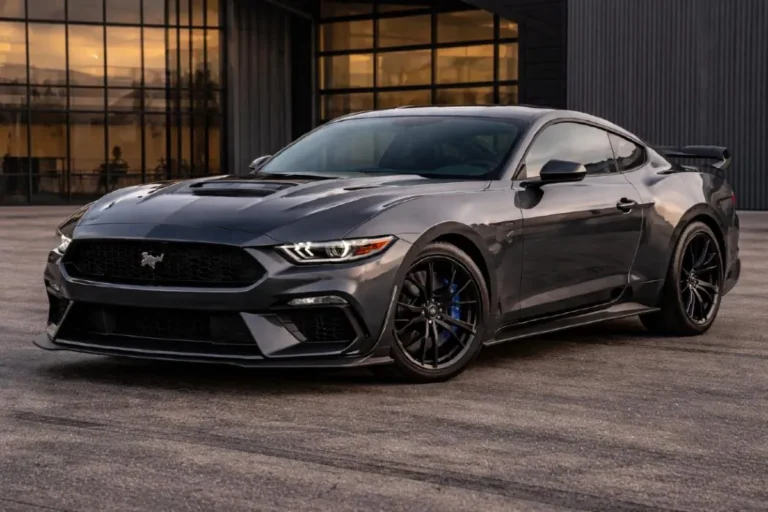
Ford’s Muscle Car Obsession — And Why It’s Stronger In 2026 Than Ever
The American muscle car category has been shrinking for years. Chevrolet killed the Camaro. Dodge killed the Challenger and Charger in their original V8 form. What remains — what still shows up at your local dealership with a V8 engine, rear-wheel drive, and a manual transmission option — is almost exclusively a Ford product.
The 2026 Ford Mustang is the last true American muscle car standing. Ford knows it. Chevrolet knows it. Dodge knows it. And Ford is using that position with a degree of ambition that hasn’t been seen since the original pony car wars of the 1960s.
In 2026, the Mustang lineup runs from a 315-horsepower turbocharged four-cylinder EcoBoost to an 815-horsepower supercharged V8 GTD that laps the Nürburgring faster than every production car in history except three. In between, there are more performance configurations — the Dark Horse, the Dark Horse SC, the RTR Package — than the Mustang has offered in any single model year since the car was introduced in 1964. Ford is not slowing down. If anything, it is accelerating.
Ford’s performance ambition in 2026 is not limited to the Mustang — the F-150 Shelby Super Snake Sport demonstrates that the same engineering philosophy that produces 815-horsepower Mustangs is being applied to America’s most popular full-size truck, producing 785 horsepower and a 3.45-second 0-to-60 run in a vehicle you can take to a job site.
But the fastest Ford muscle cars are not all from the present. The history of fast Fords is a story of specific moments when engineers were given permission to do something extraordinary — and took that permission further than anyone expected. The 2003 Terminator Cobra that Ford officially rated at 390 horsepower when everyone who drove it knew that number was wrong. The 2013 GT500 that claimed 200 mph from the factory at a time when that figure was essentially the domain of European supercars. The Shelby GT350R that produced the most driver-engaging naturally aspirated V8 in a generation of Mustangs.
This guide covers all of them — the fastest Fords from every era, the specifications that matter, the context that makes the numbers meaningful, and the complete 2026 picture of where Ford’s performance car lineup stands right now.
The 1964–1968 Mustang: Laying The Foundation
The original Mustang was not a fast car. This is important to say plainly because the mythology around it sometimes obscures the engineering reality. The 1964½ Mustang that launched on April 17, 1964, was built on the Falcon platform, offered with a 170-cubic-inch six-cylinder as its base engine, and was designed to appeal to young buyers who wanted style and personality more than outright performance.
But the foundation was there for something more. The pony car wars that followed the Mustang’s launch — Chevrolet with the Camaro, Pontiac with the Firebird, Plymouth with the Barracuda — forced Ford to develop performance versions faster than anyone had originally planned.
The 289 High Performance V8 in the original K-code Mustang produced 271 horsepower. The 1965 Shelby GT350 — developed by Carroll Shelby under contract from Ford to transform the Mustang into a SCCA B-Production racer — produced 306 horsepower from a modified 289. These were genuinely fast cars for 1965, capable of 0-to-60 runs in the mid-six-second range and quarter-mile times around 14 seconds — numbers that put them ahead of most performance cars available to American buyers at the time.
The 1968 model year brought the 428 Cobra Jet — a 335-horsepower (officially; the real figure was considerably higher, a theme that would repeat throughout Mustang history) big-block that launched the Mustang into genuine muscle car territory. Quarter-mile times in the 13-second range made the 428 CJ one of the fastest production cars in America in 1968. The muscle car era had arrived at Ford.
Boss 302, Boss 429, And The Mach 1: The Peak Of The First Muscle Car Era
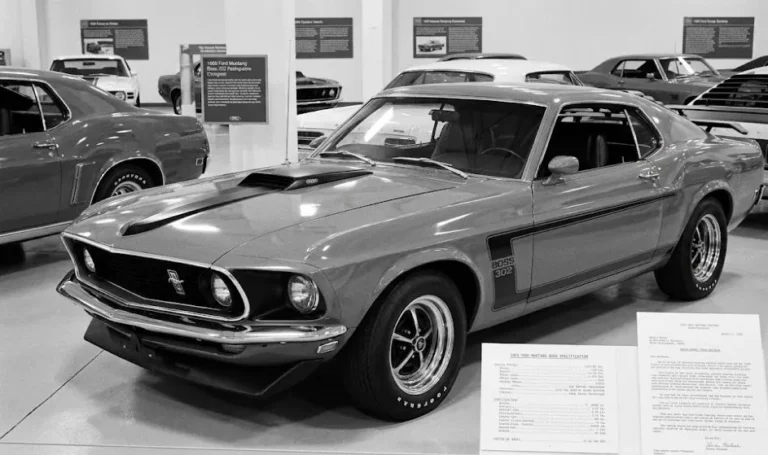
The Boss 302 (1969–1970): Built For Trans-Am Racing
Engine: 302 cubic inch V8 — 290 hp (officially) / approximately 360 hp (actual)
0–60 mph: Approximately 6.0 seconds
Quarter Mile: 14.0 seconds at 100 mph
Top Speed: 118 mph (limited by tires of the era)
The Boss 302 is one of the most important performance Mustangs in history — not because of its power output, which was significant for its time but modest by modern standards, but because of why it was built and what it represented.
The Boss 302 was developed specifically to homologate the engine for Trans-Am road racing — Ford needed to sell at least 1,000 street versions of a car with the racing engine to qualify for the series. The result was a high-revving, cross-bolted 302 that was, by contemporary accounts, genuinely underrated from the factory. The suspension package that came with the Boss 302 was, at the time of its introduction, the most sophisticated handling setup ever offered on a production Mustang — front spoiler, rear spoiler, staggered rear shocks to prevent axle hop under hard acceleration, and large Goodyear E70-15 bias-ply tires.
The Boss 302 is a driver’s car in the way that the biggest, most powerful muscle cars of the era were not. It rewards skill rather than simply deploying power. It is, in that sense, the direct ancestor of the modern Mustang Dark Horse — a machine built for drivers who want engagement as much as acceleration.
The Boss 302’s place in American performance culture runs deeper than its factory specifications suggest — the original Mustang fastback design that the Boss wore became the visual template for Eleanor in Gone in 60 Seconds, a film whose sequel question we answer completely in our dedicated guide.
The Boss 429 (1969–1970): The Most Exotic First-Generation Mustang
Engine: 429 cubic inch “semi-hemispherical” V8 — 375 hp (officially) / 500+ hp (actual, per contemporary testing)
0–60 mph: 6.8 seconds (officially — actual figures were faster with better tires)
Quarter Mile: 14.09 seconds at 102.85 mph
The Boss 429 is the most mechanically exotic Mustang of the first generation. The 429 engine — developed for NASCAR racing — was too wide to fit in the standard Mustang engine bay. Ford contracted Kar Kraft, a specialty vehicle modifier in Michigan, to cut and relocate the front shock towers and battery to accommodate the massive motor. The result was a car that looked like a standard Mustang but contained some of the most sophisticated American V8 engineering of the decade.
The Boss 429 is not the most user-friendly performance car. The massive engine compromised the steering geometry, the suspension modifications introduced their own quirks, and the enormous power was delivered in a way that required driver experience to manage. But it remains one of the most collectible and most mechanically significant Mustangs ever produced.
The Mach 1 With The 428 Cobra Jet: Real Numbers From A Real Test
Engine: 428 cubic inch V8 — 335 hp (officially) / widely believed to be 400+ hp actual
0–60 mph: 5.5 seconds
Quarter Mile: 13.56 seconds at 106.1 mph (Motor Trend tested)
Motor Trend’s December 1969 test of the Mach 1 with the 428 Super Cobra Jet produced a 13.56-second quarter-mile run — a figure that shocked readers and confirmed what people who drove these cars already knew: the official horsepower ratings were conservative to the point of being actively misleading. Ford, like its competitors, was underrating power output in the late 1960s to stay below insurance company thresholds that penalized high-horsepower vehicles.
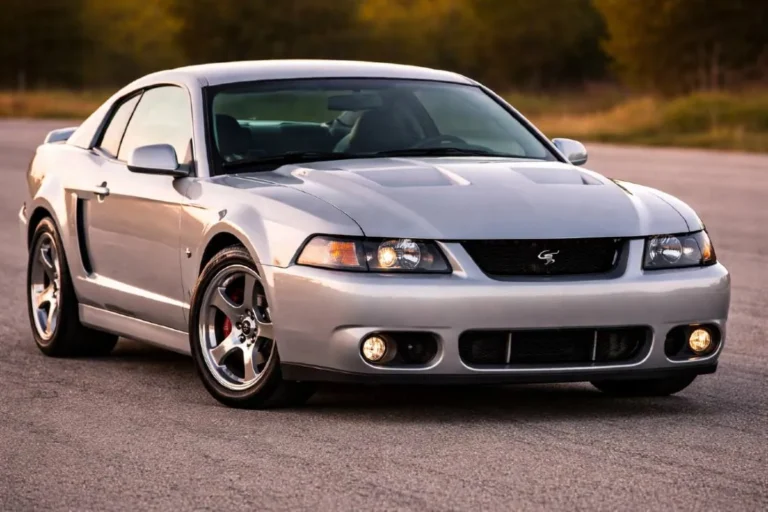
The 2003 Terminator Cobra: The Most Underrated Ford Muscle Car In History
Engine: 4.6-liter DOHC V8 with Eaton M112 Roots-type supercharger — 390 hp (official) / approximately 500 hp (actual)
0–60 mph: 4.5 seconds (with factory tires) / faster on better rubber
Quarter Mile: 12.9 seconds at 109 mph (Road and Track, 2003)
Top Speed: Approximately 160 mph
The 2003–2004 SVT Cobra — universally known among enthusiasts as the “Terminator” — is one of the most legendary American performance cars of the modern era, and its legend is built entirely on a number that Ford refused to say out loud.
Ford officially rated the Terminator at 390 horsepower. The number was a formality. Road and Track’s testing in 2003 produced quarter-mile times of 12.9 seconds. Car and Driver ran 12.8. Independent chassis dyno testing, which measures power at the wheels and extrapolates back to the crank, consistently showed numbers in the 500-horsepower range. When journalists pressed Ford engineers about the discrepancy, they received polite non-answers. The consensus among everyone who drove the car, tested the car, or modified the car was that Ford had built an engine making genuinely close to 500 horsepower and released it into a market that would have raised significant insurance and perception concerns at that honest figure.
The Terminator’s chassis was modified to handle the power in ways that the contemporaneous GT simply was not — independent rear suspension replaced the Mustang’s traditional solid rear axle on the SVT Cobra, making it the first independent-rear-suspension Mustang in production history. This was not a small change. The handling difference between the live-axle GT and the IRS Cobra was substantial and immediately apparent to anyone who drove both cars back to back.
The Terminator Cobra is the car that established the modern template for what a high-performance Mustang should be: supercharged, independently suspended, capable of genuine sports car behavior alongside its muscle car power delivery. Everything that has come after it — the GT500, the Dark Horse, the GTD — is in some sense a more refined version of what the Terminator established.
Shelby GT500: Three Generations Of Getting Faster
The 2007–2009 Shelby GT500: 500 HP Returns To The Mustang
Engine: 5.4-liter DOHC V8 with Roots-type supercharger — 500 hp / 480 lb-ft
0–60 mph: 4.5 seconds
Quarter Mile:12.9 seconds at 113 mph
Top Speed: 155 mph (electronically limited)
The 2007 GT500 was the car that brought the Shelby name back to the production Mustang lineup after a long absence. At 500 horsepower, it was the most powerful production Mustang since the original muscle car era — a figure that felt genuinely extraordinary at its launch year, when 500 horsepower in a street car still commanded attention.
The 2007 GT500 was not without its limitations. The supercharged 5.4-liter sat in a Mustang that was still running the S197 platform — a chassis that was good but not great at managing 500 horsepower in committed driving situations. The live rear axle that GT500 shared with the standard Mustang could be provoked into behavior that required correction. These were not reasons to dismiss the car. They were reasons to drive it with awareness and respect — the same philosophy that applied to every performance Mustang since the Boss 429.
The 2013–2014 Shelby GT500: 662 HP And 202 MPH From The Factory
Engine: 5.8-liter “Trinity” DOHC V8 with Roots-type supercharger — 662 hp / 631 lb-ft
0–60 mph: 3.5 seconds
Quarter Mile: 11.6 seconds at 125 mph
Top Speed: 202 mph (factory claimed)
The 2013 Shelby GT500 is, by most measures, the greatest muscle car ever produced up to its moment in time. 662 horsepower. A factory-claimed top speed of 202 mph at a point in automotive history when that figure was reserved for cars costing three to five times as much. A quarter-mile time of 11.6 seconds that put it in genuinely exotic car territory.
The engine at its heart — the 5.8-liter “Trinity” V8, displacing more than any Mustang engine since the original big-block era — was developed with a singular purpose: maximum power output from a production supercharged V8. The result was an engine that produced more power than anything in the American muscle car segment and that delivered it in a way that was, in the right hands, genuinely manageable on public roads.
Car and Driver tested the 2013 GT500 at 3.5 seconds to 60 mph. The quarter-mile in 11.6. These were supercar numbers in a car that started at $54,000 — an extraordinary value proposition that made every European performance manufacturer paying attention somewhat nervous. The 2013 GT500 remains one of the best performance buys in American automotive history when its original price is considered against its capabilities.
The 2013 GT500’s 662 horsepower and factory-claimed 202 mph placed it in a very short list of American performance cars capable of genuine European supercar performance — the same short list that included the Dodge Viper’s naturally aspirated V10, which our Dodge Viper complete guide covers across all five generations of the car that defined American supercar ambition from 1992 to 2017.
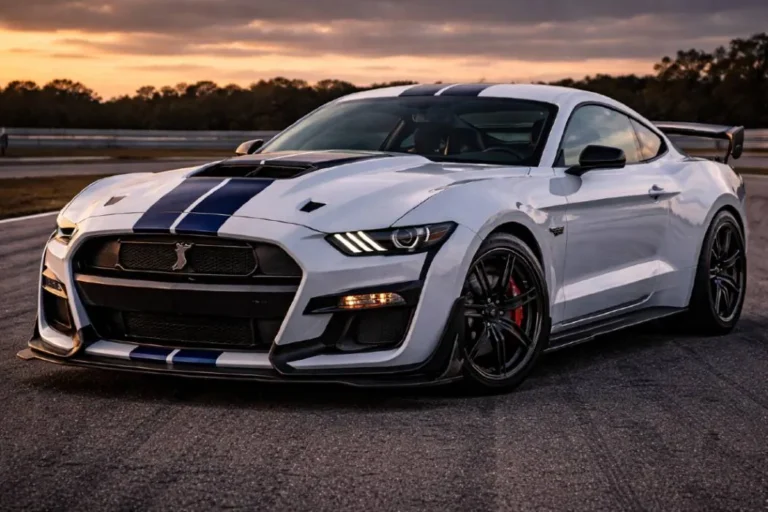
The 2020–2022 Shelby GT500: 760 HP And The End Of The Manual Option
Engine: 5.2-liter “Predator” DOHC V8 with Roots-type supercharger — 760 hp / 625 lb-ft
Transmission: 7-speed dual-clutch automatic (Tremec TR-9007) — no manual option
0–60 mph: 3.3 seconds
Quarter Mile: 11.1 seconds at 131 mph
Top Speed: 180 mph (electronically limited)
MSRP: Starting at $73,995 (2020)
The 2020 Shelby GT500 is the most technically sophisticated and most genuinely fast muscle car that Ford has ever produced within the mainstream Mustang lineup. 760 horsepower from a 5.2-liter supercharged V8 — the Predator engine — delivered through a Tremec 7-speed dual-clutch automatic that was so committed to its performance mandate that Ford did not offer a manual transmission option. This was a controversial decision in the enthusiast community. It was the correct engineering decision for maximum acceleration performance: the dual-clutch’s shift times simply cannot be matched by any human operating a clutch pedal and a gear lever.
Quarter-mile in 11.1 seconds at 131 mph. The 0-to-60 run in 3.3 seconds. These were numbers that, a decade earlier, would have seemed impossible from a production pony car. The 2020 GT500 beat its own 2013 predecessor’s quarter-mile by 0.5 seconds — a significant gap that represents a genuine step function in capability rather than incremental improvement.
The 2020 GT500 also represented a new maturity in the GT500’s chassis. The S550 Mustang platform, with its independently suspended rear end and significantly more sophisticated chassis dynamics than any previous Mustang, gave the GT500 the foundation to deploy 760 horsepower in a way that felt controlled and communicative rather than merely terrifying.
The Shelby GT350 and GT350R: Ford’s Best Driver’s Car
Engine: 5.2-liter Voodoo flat-plane-crank V8 — 526 hp / 429 lb-ft
0–60 mph: 4.0 seconds
Quarter Mile: 12.3 seconds at 118 mph
Top Speed: 174 mph
MSRP: Starting at $45,495 (2016)
The Shelby GT350 occupies a different place in the fast Ford story than any other car on this list. It is not the most powerful Mustang. It is not the fastest in a straight line. It is, by the consensus of almost everyone who has driven it seriously, the most rewarding Mustang ever built for a driver who values engagement over raw velocity.
The reason is the engine. The 5.2-liter Voodoo V8 uses a flat-plane crankshaft — a design inherited from racing engines and used extensively by Ferrari and other exotic car manufacturers, but almost unheard of in an American production V8. The flat-plane crank allows the engine to rev more freely than a traditional cross-plane V8, because the firing order creates more balanced pressure pulses that don’t fight each other at high rpm. The Voodoo revs to 8,250 rpm — the highest rev limit of any naturally aspirated V8 in a production American car.
At full throttle, it makes a sound unlike any other American engine — a high-pitched, mechanical scream that is completely unlike the traditional V8 burble of a Coyote or a Predator. The GT350R, the track-focused variant, added carbon fiber wheels — reducing unsprung weight significantly — and an aero package that produced genuine downforce. A GT350R at a track day is one of the purest driving experiences available in a production American car from this era.
The GT350 and GT350R were discontinued after the 2020 model year when the S550 platform’s life cycle ended. Their absence from the current S650 lineup represents a genuine gap — a naturally aspirated, high-revving, driver’s car that nothing in the 2026 Mustang lineup quite replaces. The Dark Horse comes closest, but the Voodoo engine’s specific character is gone. This is one of the few genuine losses in the transition from S550 to S650.
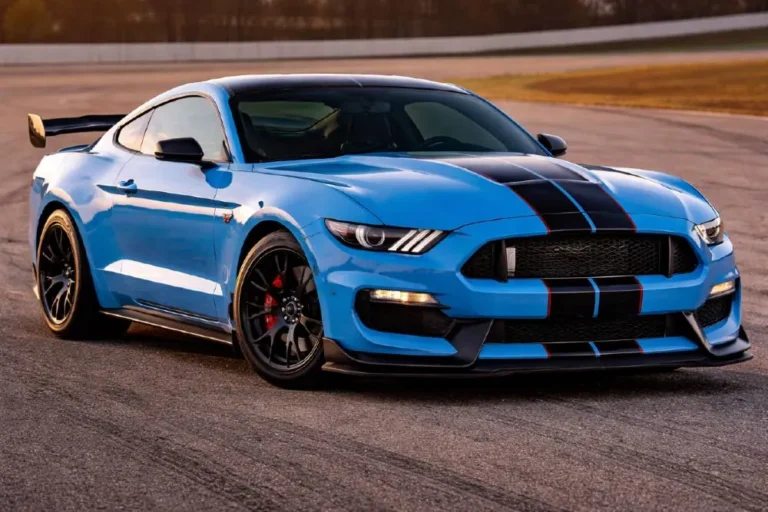
The Current 2026 Mustang Performance Lineup: What’s Available Right Now
The 2026 Mustang GT: 480 HP And The Right Answer For Most Buyers
Engine: 5.0-liter Coyote V8 — 480 hp standard / 486 hp with active valve performance exhaust / 415–418 lb-ft torque
Transmission: 6-speed manual or 10-speed automatic
0–60 mph: 4.2 seconds (Car and Driver tested, performance exhaust)
Top Speed: 155 mph
MSRP: Approximately $42,000 (fastback)
The 2026 Mustang GT is the correct Mustang for the majority of buyers who want genuine V8 muscle car performance in a car they can live with every day. 480 horsepower from a naturally aspirated 5.0-liter — a figure that would have seemed extraordinary in any Mustang before 2010 — delivered through either a six-speed manual or a ten-speed automatic in a well-sorted, daily-driveable package.
The Coyote V8 is one of the great modern naturally aspirated V8 engines. It responds cleanly to throttle inputs, produces a genuine V8 exhaust note, and has accumulated a reliability record across years of production that gives buyers real confidence in long-term ownership. The 2026 GT continues to develop the platform that began with the S550 — stiffer body structure, better steering feel, improved brake pedal consistency.
For most buyers, the GT is the honest answer. Not because the Dark Horse or the GTD aren’t magnificent — they are — but because the GT’s combination of performance, daily usability, and price represents genuine value in a way that the more extreme options do not always deliver proportionally.
The 2026 Mustang GT is magnificent, but it belongs in experienced hands — if you are shopping for a first car for a new driver, our guide to the best first cars for teenagers in 2026 explains specifically why even the base Mustang is one of the vehicles we recommend against for drivers without established skills behind the wheel.
The 2026 Mustang Dark Horse: The Performance Sweet Spot
Engine: 5.0-liter Coyote V8 (Gen 4 modified) — 500 hp / 418 lb-ft torque
Transmission: Tremec 6-speed manual (standard) or 10-speed SelectShift automatic
0–60 mph: 4.1 seconds (manual) / 3.7 seconds (automatic)
Quarter Mile: 12.5 seconds at 115 mph (Car and Driver)
Top Speed: 166 mph
MSRP: Starting at approximately $59,000
The 2026 Mustang Dark Horse is the performance sweet spot of the standard Mustang lineup — the car that delivers the most track capability in a package that still functions as a genuine street car without demanding supercar-level commitment from its driver.
The 500-horsepower modified Coyote V8 in the Dark Horse uses specific internal components — higher-flow cylinder heads, revised cam profiles, a modified intake — that distinguish it from the standard GT’s 5.0-liter. The result is 20 additional horsepower and a top-end character that rewards high-rpm use in a way the standard Coyote doesn’t quite replicate.
The chassis upgrades that separate the Dark Horse from the GT are equally significant. A strut-tower brace adds rigidity to the front end. The MagneRide adaptive damper system — available on the GT but standard on the Dark Horse — continuously adjusts damping rates to match road conditions and driving intensity. Standard Brembo brakes with larger rotors provide braking performance that matches the car’s acceleration capability rather than creating a mismatch at the track.
The Dark Horse hits a top speed of 166 mph thanks to advanced cooling preventing overheating. The Dark Horse’s 0-to-150-to-0 mph speed test time of 29.7 seconds beat Toyota’s Supra 3.0. That 0-to-150-to-0 number is genuinely impressive — it measures not just acceleration but also braking from high speed, and beating the Supra on that combined test confirms that the Dark Horse’s capability is real and balanced rather than skewed toward one end of the performance envelope.
The 2026 Mustang Dark Horse SC: The Most Important New Ford Of 2026
Engine: 5.0-liter Coyote V8 with supercharger
Power: Not officially confirmed at time of publication — expected to exceed 600 hp
Transmission: Tremec-based 6-speed manual with revised calibration
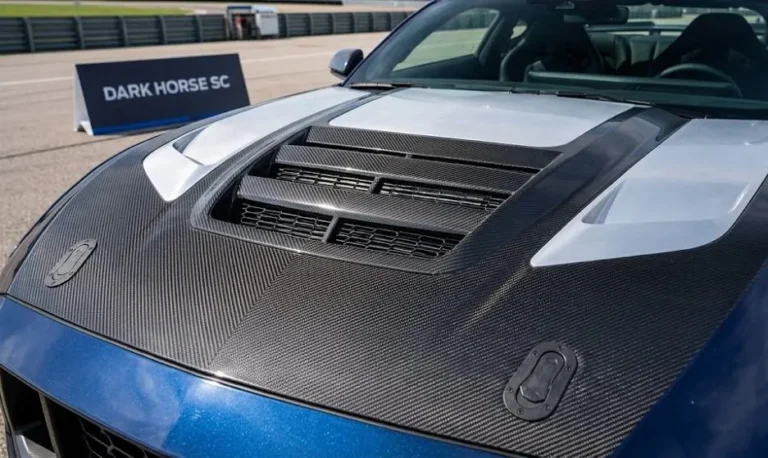
New for 2026: Carbon fiber hood with cooling vent (2.5x more downforce than standard Dark Horse hood), revised front fascia for improved brake and engine cooling, upgraded MagneRide with revised springs and stabilizer bars, available carbon-ceramic Brembo brakes, available carbon exterior package, optional RECARO seats with Track Pack
The 2026 Mustang Dark Horse SC is the result of a total-package approach to development between the Ford Racing motorsports and road-car teams. Engine, gearbox, aerodynamics, cooling, braking, suspension tuning, steering feel, even tire compounds — engineers and designers looked at it all.
The new aluminum hood includes standard hood pins and a massive carbon-fiber vent. This improves cooling and creates 2.5 times more downforce than the standard hood vent on the Mustang Dark Horse.
The Mustang Dark Horse SC fascia is crafted from motorsports experience to maximize brake and engine cooling while maintaining aerodynamic performance. Directly developed from racing experience, the aerodynamic features of the Mustang Dark Horse SC with Track Pack produce an additional 620 pounds of downforce compared to the 5.0L Mustang Dark Horse fastback.
The Dark Horse SC is positioned directly between the standard Dark Horse and the GTD — a car that brings genuine motorsports-derived aerodynamics and cooling into a package that doesn’t demand GTD’s price commitment. It is the most significant new addition to the 2026 Mustang performance lineup and the car that enthusiasts who want more than the Dark Horse but less than the GTD’s six-figure price have been waiting for.
MSRP: Expected in the $75,000–$85,000 range — not officially confirmed at time of publication.
The 2024–2026 Mustang GTD: America’s First Sub-Seven-Minute Production Car
Engine: 5.2-liter Predator V8 with Roots-type supercharger — 815 hp / 664 lb-ft torque
Transmission: Tremec 8-speed dual-clutch automatic — no manual option
0–60 mph: Under 3.0 seconds (Car and Driver)
Top Speed: 202 mph
Nürburgring Nordschleife: 6 minutes 52.072 seconds — fourth fastest production car overall
MSRP: $325,000
Production: Extremely limited — numbers not officially disclosed
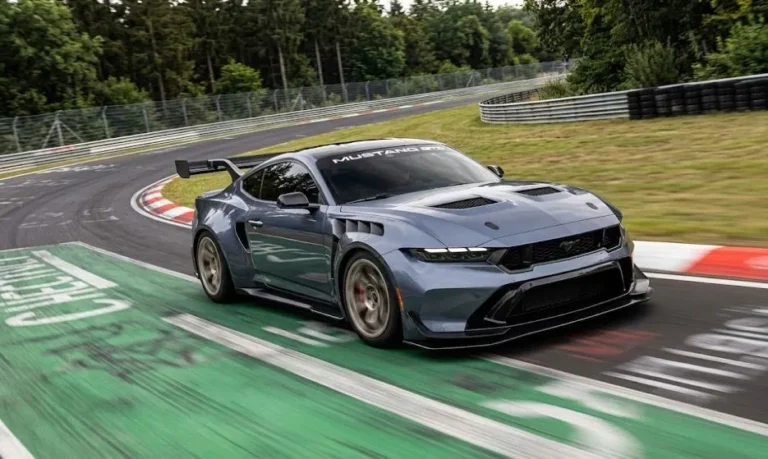
The Ford Mustang GTD did the Nürburgring in 6 minutes and 52.072 seconds. The Mustang GTD was the first American production car to break the seven-minute barrier at the Nürburgring and is currently the fourth-fastest production sports car to do so.
These are sentences that require a moment to process. A Mustang — a car whose original purpose was to sell to young Americans who wanted a stylish, affordable, sporty vehicle — just became the fastest American production car ever to lap the most demanding road course in the world. In 26 years of Mustang history since the SVT Cobra Terminator established the modern performance template, Ford has gone from a car making approximately 500 real-world horsepower with a 12.9-second quarter-mile to a car making 815 horsepower that laps the Nürburgring in under seven minutes.
The Mustang GTD coupe achieves a 202 MPH top speed. This top speed is achieved with its supercharged 5.2-liter V8 engine, which produces 815 horsepower at 7,400 rpm and 664 ft.-lb. of torque at 4,800 rpm.
The GTD is not a muscle car in the traditional sense — it is closer to a GT3 racing car built for street use. The carbon fiber aerodynamic package — front splitter, side sills, massive rear wing — generates serious downforce that enables cornering loads that would destabilize most production cars. The hydraulic active suspension system, developed in partnership with the Ford Mustang GT3 racing program, provides adjustment range that spans genuine track use to highway cruising. The Brembo carbon-ceramic brake rotors are standard — a first for any production Mustang.
What the GTD means for the fast Ford story is this: for the first time in the nameplate’s history, Ford has built a Mustang that can legitimately compete with the fastest production cars in the world on a road course. Not in a straight line. Not with an asterisk. On a 12.9-mile circuit that rewards chassis balance, aerodynamic stability, braking performance, and driver confidence in equal measure — the GTD ran 6:52. Four production cars in history have done it faster. All four of them cost considerably more.
The Anti-Lag Turbo Mustang That Almost Nobody Talks About
Engine: 2.3-liter EcoBoost four-cylinder with Ford-patented anti-lag turbocharger technology
Features: Dark Horse suspension components, standard Brembo brakes, 19×9.5-inch wheels, electronic drift brake (class-first)
MSRP: Available as a package on EcoBoost fastback
The Mustang RTR fastback draws on Ford-patented anti-lag turbocharger technology to keep the power flowing. Mustang Dark Horse suspension components, standard Brembo brakes, and wide 19-inch by 9.5-inch wheels round out its aggressive stance. A standard, class-first electronic drift brake completes a thrilling, fun-to-drive experience.
The RTR Package is the most interesting entry in the 2026 Mustang lineup that most people overlook. It takes the EcoBoost four-cylinder — already capable of 0-to-60 in 4.5 seconds with the Performance Package — and applies anti-lag technology borrowed from rally and racing applications to virtually eliminate turbo lag during hard driving. Pair that with Dark Horse suspension components and a first-in-class electronic drift brake, and you have a light, responsive, technically interesting performance package at a price point significantly below any V8 option.
The RTR won’t appear at the top of any straight-line performance ranking. But it represents a different kind of fast — precise, adjustable, and genuinely engaging for a driver who wants to learn vehicle dynamics without the intimidation factor of 500 or 815 horsepower.
The 2012–2013 Boss 302: The Nameplate That Deserved Its Comeback
Engine: 5.0-liter V8 with unique “RoadRunner” valve train from GT350 development program — 444 hp / 380 lb-ft
Transmission: 6-speed manual only — no automatic option
0–60 mph: 4.0 seconds
Quarter Mile: 12.4 seconds at 113 mph
Top Speed: 155 mph (electronically limited)
The 2012 Boss 302 was the right car at the right moment — Ford had just introduced the 5.0-liter Coyote V8, and the Boss program gave engineers an opportunity to develop what the engine could do with specific modifications aimed at high-rpm output and track use.
The Boss 302 Laguna Seca edition — named for the iconic California road course — is the definitive version. Additional aerodynamic components, a stiffer suspension, and the deletion of rear seats reduced weight and sharpened every dynamic characteristic. It remains one of the most usable and most rewarding track-day Mustangs ever produced in a mainstream body style.
FAQ
Q: What is the fastest Ford muscle car in 2026?
A: The fastest Ford muscle car in 2026 is the Mustang GTD, which produces 815 horsepower from a supercharged 5.2-liter V8, achieves 0 to 60 mph in under 3.0 seconds as tested by Car and Driver, and reaches a top speed of 202 mph. The GTD set a Nürburgring Nordschleife lap time of 6 minutes and 52.072 seconds — making it the first American production car to break the seven-minute barrier at the circuit and currently the fourth-fastest production sports car to lap it.
Q: What is the fastest Mustang 0 to 60 time?
A: The fastest 0 to 60 time in the current Mustang lineup belongs to the Mustang GTD, which achieves the run in under 3.0 seconds. In the standard Mustang lineup available at conventional dealerships, the 2026 Dark Horse with the 10-speed automatic transmission achieves 0 to 60 in 3.7 seconds. The Dark Horse with the standard Tremec 6-speed manual runs 0 to 60 in 4.1 seconds, and the 2026 Mustang GT achieves 4.2 seconds with the performance exhaust option.
Q: What was the most underrated Ford muscle car ever?
A: The 2003–2004 SVT Cobra “Terminator” is widely regarded as the most underrated Ford muscle car in history. Ford officially rated it at 390 horsepower, but independent dyno testing and quarter-mile times consistent with approximately 500 real-world horsepower at the crank confirmed that the factory figure was deliberately conservative. Road and Track clocked quarter-mile times of 12.9 seconds in 2003 — numbers that aligned with a car making far more than 390 horsepower. Ford engineers never officially confirmed the discrepancy.
Q: How much horsepower does the 2026 Mustang Dark Horse have?
A: The 2026 Mustang Dark Horse produces 500 horsepower and 418 lb-ft of torque from its modified 5.0-liter Gen 4 Coyote V8. The 2026 Mustang Dark Horse SC — the new supercharged variant introduced for 2026 — is expected to produce significantly more power, though Ford had not officially confirmed the specific output figure at the time of this publication. The Dark Horse SC also adds 620 pounds of additional downforce with the Track Pack over the standard Dark Horse.
Q: What is the Mustang GTD Nürburgring time?
A: The Mustang GTD lapped the Nürburgring Nordschleife in 6 minutes and 52.072 seconds — making it the first American production car to break the seven-minute barrier at the circuit and the fourth-fastest production sports car to do so at the time of the record. The supercharged 5.2-liter V8 produces 815 horsepower and 664 lb-ft of torque, and the GTD’s active aerodynamic and suspension systems are derived directly from the Ford Mustang GT3 racing program.
Q: Is the Mustang the only muscle car left in 2026?
A: As of 2026, the Ford Mustang is the only true American muscle car remaining in production with a V8 engine, rear-wheel drive, and a manual transmission option. Chevrolet discontinued the Camaro’s V8 production model, and Dodge ended production of the Challenger and Charger with their traditional V8 powertrains. This gives Ford a unique market position and the freedom to develop the Mustang’s performance identity without direct muscle car competition — a position the company is using aggressively with the GTD, Dark Horse SC, and RTR Package.
Q: What is the 2026 Mustang Dark Horse SC?
A: The 2026 Mustang Dark Horse SC is the newest high-performance addition to the Mustang lineup, developed through collaboration between Ford’s motorsports and road-car engineering teams. Key features include a supercharged version of the 5.0-liter Coyote V8, a carbon-fiber aluminum hood with standard hood pins and a massive cooling vent that produces 2.5 times more downforce than the standard Dark Horse hood, a redesigned front fascia for improved cooling, upgraded MagneRide suspension with revised springs and stabilizer bars, optional Brembo carbon-ceramic brakes, and available Track Pack adding 620 pounds of downforce over the standard Dark Horse. It positions between the standard Dark Horse and the $325,000 GTD in the lineup.
Conclusion
The story of the fastest Ford muscle cars is the story of American performance refusing to accept its assigned ceiling. Every generation of fast Ford has been faster than the generation before it in ways that, if you’d predicted them at the start, would have seemed implausible. In 1964, a 271-horsepower Mustang was a fast car. In 1969, 500 honest horsepower in a Boss 429 was the outer limit. In 2003, a 500-horsepower Cobra was officially rated at 390. In 2020, 760 horsepower was a production Mustang. In 2026, 815 horsepower laps the Nürburgring in 6 minutes and 52 seconds.
And the Mustang is the last muscle car standing.
There is something remarkable about a nameplate that has been in continuous production since 1964, that has survived every market cycle and regulatory challenge and competitor offensive thrown at it, and that in 2026 finds itself in the position of being the sole remaining American V8, rear-wheel-drive, manual-transmission-available muscle car in showrooms. Ford did not engineer that position. But it has earned it — one faster generation at a time.
Editorial Note
This article was written and reviewed in March 2026. All current model specifications are sourced from Ford Motor Company official product pages, Car and Driver road tests, MotorTrend testing, and Road and Track. The Mustang GTD Nürburgring time of 6:52.072 is sourced directly from Ford’s official GTD product page. The Dark Horse SC specifications are based on Ford’s official 2026 Mustang lineup announcement — final power output for the Dark Horse SC was not officially confirmed by Ford at time of publication.
The rumored 2026 Shelby GT500 is noted in industry reporting but was not confirmed by Ford as a production vehicle at time of publication and is therefore not included in this article’s main rankings. Historical specifications are sourced from contemporary road tests published by Car and Driver, MotorTrend, and Road and Track.

0 Comments