Last Updated: September 29, 2026 | Read Time: 10 minutes
The last Dodge Challenger rolled off the Brampton Assembly Plant line in Ontario, Canada in December 2023. It was the end of a 54-year story told in three distinct chapters — the 1970 original that defined the pony car era, the forgotten Japanese-built second generation that almost nobody talks about, and the sixteen-year third generation that gave the world the supercharged Hellcat, the drag strip-focused Demon, and the 1,025-horsepower Demon 170 — the most powerful Challenger ever produced. Whether the Challenger was your dream car or just the car your neighbor kept in the garage with a cover on it, it mattered. It mattered in a way that spreadsheets and sales charts cannot fully capture. This is the complete honest story.
At A Glance – Dodge Challenger Key Facts
** Production Years: 1970–1974 (first gen) / 1978–1983 (second gen) / 2008–2023 (third gen)
** Status: Discontinued after the 2023 model year
** Assembly: Brampton Assembly Plant — Brampton, Ontario, Canada (third generation)
** Platform: Chrysler LX/LC platform — shared with Charger and Chrysler 300
** Body Styles: 2-door coupe (all generations) / convertible (first gen only)
** Most Powerful Challenger Ever: 2023 SRT Demon 170 — 1,025 HP / 945 lb-ft on E85
** Signature Modern Engines: 392 HEMI and 6.2L Supercharged HEMI (Hellcat)
** Quarter-Mile Record: 8.91 seconds @ 151.17 mph — Demon 170 (2023)
Third Generation Engine Lineup:
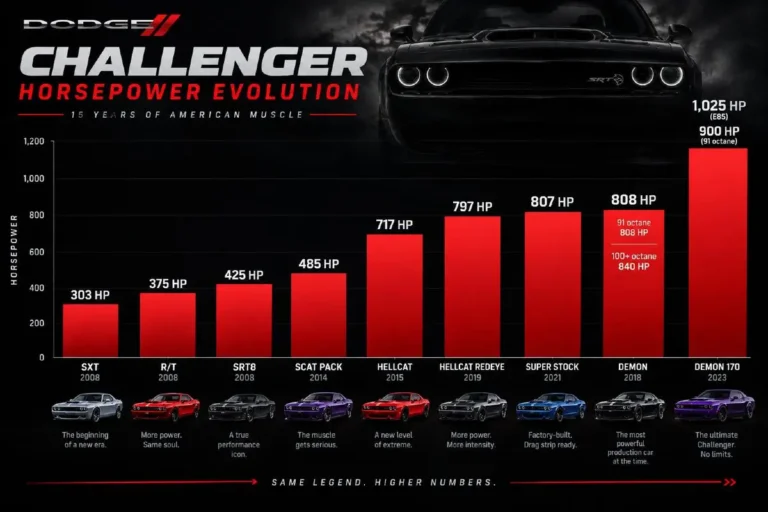
— 3.6L Pentastar V6: 303 HP (SXT)
— 5.7L HEMI V8: 375 HP (GT / R/T)
— 392 6.4L HEMI V8: 485 HP (Scat Pack / 392)
— 6.2L Supercharged HEMI: 717 HP (SRT Hellcat)
— 6.2L Supercharged HEMI: 797 HP (Hellcat Redeye)
— 6.2L Supercharged HEMI: 807 HP (Super Stock)
— 6.2L Supercharged HEMI: 808 HP on 91-octane / 840 HP with 100-octane fuel and Direct Connection Controller (SRT Demon, 2018)
— 6.2L Supercharged HEMI: 1,025 HP on E85 (SRT Demon 170, 2023)
**Current Dodge Performance Successor: Dodge Charger — available in gasoline-powered SIXPACK and all-electric Daytona configurations in 2026
**Collector Status: Original 1970 HEMI Challengers can command substantial collector premiums depending on configuration, provenance, condition, and market; values vary significantly by example.
**Third-Generation Performance Values: Used-market values vary significantly by trim, mileage, condition, provenance, modifications, and market conditions.
**Sources: Dodge official press releases and specifications, Stellantis technical specifications, MotorTrend historical coverage, Car and Driver Demon 170 review, Hagerty valuation resources, and NHRA performance records where applicable.
Overview
Why The Challenger Mattered More Than The Numbers Suggest
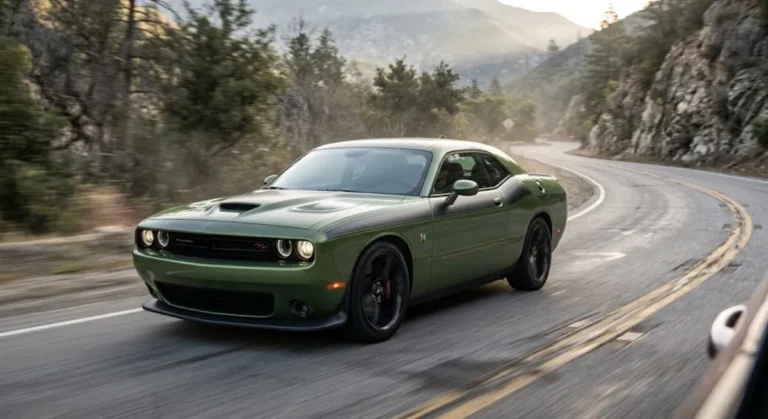
There is a specific kind of American automotive nostalgia that the Dodge Challenger occupied for much of its existence — a nostalgia that was never really about the past, even when it looked like it was. The third-generation Challenger’s retro styling, introduced in 2008, borrowed aggressively from the 1970 original’s visual vocabulary. The long hood, the wide stance, the aggressive fastback roofline, the dual side scoops that echoed the original’s design — all of it was a deliberate conversation between the present and the past.
But what made the Challenger relevant was not the styling alone. Plenty of cars have tried retro styling and faded from significance. What made the Challenger relevant was the engine underneath the hood — and Dodge’s willingness to keep adding more power to it until the number reached four digits. The Hellcat’s 717 horsepower in 2015 was extraordinary. The Demon’s 840 horsepower in its high-octane configuration in 2018 seemed unreasonable. The Demon 170’s 1,025 horsepower in 2023, in a two-door muscle car available through Dodge dealers, represented a remarkable final escalation of the supercharged HEMI formula.
The Challenger’s cultural presence extended well beyond automotive enthusiasm — its distinctive silhouette has appeared in dozens of films and television productions across its production run, a tradition explored in our complete guide to American sci-fi cars, which covers how American manufacturers’ vehicles became the visual language of American popular fiction.
The Challenger’s final production specification reached 1,025 horsepower, and the progression from the 390-horsepower 440 Six Pack of 1970 through the supercharged HEMI of 2023 reflects the changing relationship between American performance cars, technology, and enthusiast demand.
Section 1 – The First Challenger (1970–1974)
The Original That Started Everything – And What Made The 1970 The One That Matters
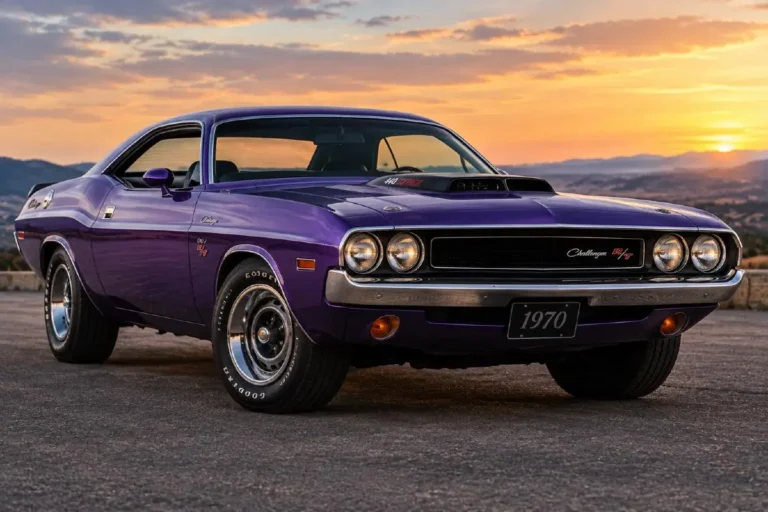
What was the first Challenger? It was a 1970 Dodge Challenger in E-body platform form — Chrysler’s response to the Ford Mustang and Chevrolet Camaro that had been dominating the pony car market since 1964 and 1966 respectively. Dodge arrived late but arrived decisively.
The 1970 Challenger launched with an engine lineup that communicated Chrysler’s specific intentions for the car. The base engine was a 225 cubic inch slant-six producing 145 horsepower — adequate for buyers who wanted the styling without the operating cost of a performance engine. Above it sat a series of V8 options that escalated from the 318 cubic inch two-barrel through the 383 Magnum, the 440 Magnum, and the 440 Six Pack with three two-barrel carburetors producing 390 horsepower. At the absolute top of the lineup sat the 426 HEMI — a 425-horsepower racing-derived engine in street-car form that came with a steep price premium, a requirement for premium fuel, and the specific knowledge that you were driving something genuinely extraordinary.
The 426 HEMI’s origins were in Chrysler’s NASCAR racing program, where its hemispherical combustion chamber design — which gave it the HEMI name — allowed for a spark plug positioned directly at the top of the combustion chamber, contributing to efficient combustion and high power output. When Chrysler offered it in the Challenger, buyers received a race-derived engine in a street car, which was central to the muscle car era.
The 1970 Challenger was available as both a coupe and a convertible — the convertible was discontinued after 1971 and is among the rarer first-generation configurations. The T/A (Trans Am) package offered a unique 340 cubic inch six-pack engine with three two-barrel carburetors and a short production run of 2,399 units, making it among the more desirable first-generation Challengers for collectors who want driving performance alongside rarity.
Production continued through 1974, though each successive year brought emissions and insurance regulations that steadily reduced power output and engine availability. The 426 HEMI was discontinued after 1971. The 440 Six Pack ended after 1971. By 1974, the Challenger had moved significantly away from its original high-performance specification, and Dodge discontinued the model at the end of that model year. Total first-generation production was approximately 165,000 units across all five model years.
The current collector market for original first-generation Challengers reflects the importance of configuration, originality, provenance, and condition. Values can vary dramatically between ordinary examples and highly documented HEMI or Six Pack cars. A 1970 Challenger with a documented 426 HEMI, for example, occupies a very different collector category from a standard six-cylinder or small-block car. Auction results and specialist valuation guides should be consulted for a specific vehicle rather than applying a single broad value range to every example.
The 1970 Challenger arrived at the peak of an era that had already produced the Shelby Cobra’s landmark 1965 FIA championship and the specific proof that American power could beat European machinery at its own game — our complete history of the first Shelby Cobra documents that earlier chapter, showing the performance tradition the Challenger was inheriting when it arrived in 1970.
For authentication, buyers and collectors should rely on VIN decoding, fender-tag and build-sheet documentation where available, factory records, provenance, and expert inspection appropriate to the vehicle. No single document should be treated as sufficient proof of originality on a high-value collector car.
Section 2 – The Second Generation (1978–1983)
The Forgotten Chapter That Almost Nobody Talks About
How many generations did the Challenger have? Three — and the second one is the generation that most enthusiasts conveniently skip over when telling the Challenger story, for understandable reasons.
The second-generation Challenger, sold in the United States from 1978 through 1983, was actually a rebadged Mitsubishi Galant Lambda — a compact Japanese sports coupe that had no mechanical or philosophical relationship with the American muscle car it borrowed its name from. Chrysler was struggling financially in the late 1970s and had entered a partnership with Mitsubishi that involved badge-engineering Japanese vehicles for the American market. The Challenger was one of the results.
The second-generation Challenger was a rear-wheel-drive compact sports coupe powered primarily by Mitsubishi four-cylinder engines producing roughly 77 to 105 horsepower depending on engine and model year. The 2.6-liter four-cylinder became the larger and more powerful engine option during the run. The car was mechanically related to the Mitsubishi Galant Lambda and Plymouth Sapporo rather than to the original E-body Challenger.
This is mentioned not to dismiss the second-generation Challenger’s qualities as a compact car — by the standards of its era and category, it was a viable rear-wheel-drive sports coupe — but to be honest about the Challenger lineage. The second generation was a very different product from the original muscle car, and Dodge let the name disappear from the lineup after 1983 without the kind of farewell associated with the original car. The name then sat dormant for roughly 25 years until Dodge revived it for the 2008 model year.
Section 3 – The Third Generation (2008–2023)
Sixteen Years, 1,025 Horsepower, And The End Of An Era
The third-generation Dodge Challenger debuted for the 2008 model year with a design that was both immediately recognizable and genuinely ambitious. The Challenger’s styling drew directly from the 1970 original — not as a literal reproduction but as a careful translation, adapting the original’s proportions and graphic elements to modern safety, ergonomic, and manufacturing requirements. The result was a car that looked strongly connected to the past while also being something that had not existed before: a large, rear-wheel-drive, retro-styled American muscle car built on a modern platform.
The early third-generation Challengers used the Chrysler LX platform — the same basic architecture shared with the Dodge Charger and Chrysler 300 — which provided a solid engineering foundation but also gave the Challenger its distinctive characteristic of being large for a muscle car. At 197.9 inches long, the third-generation Challenger was significantly longer than a Chevrolet Camaro or Ford Mustang, which gave it a different character: more boulevard presence, more interior space for a four-seat muscle car, and less agility than its smaller competitors. This was a defining characteristic for buyers who wanted to use their muscle car as a genuine daily driver.
The first four years of production (2008–2011) offered the 5.7-liter HEMI V8 producing 375 horsepower and the 6.1-liter HEMI SRT8 producing 425 horsepower. These were powerful cars by the standards of their period, and they re-established the Challenger name with the buying public. But the number that changed everything came in 2015.
Section 4 – The Hellcat
717 Supercharged Horsepower And The Car That Changed The Performance Benchmark
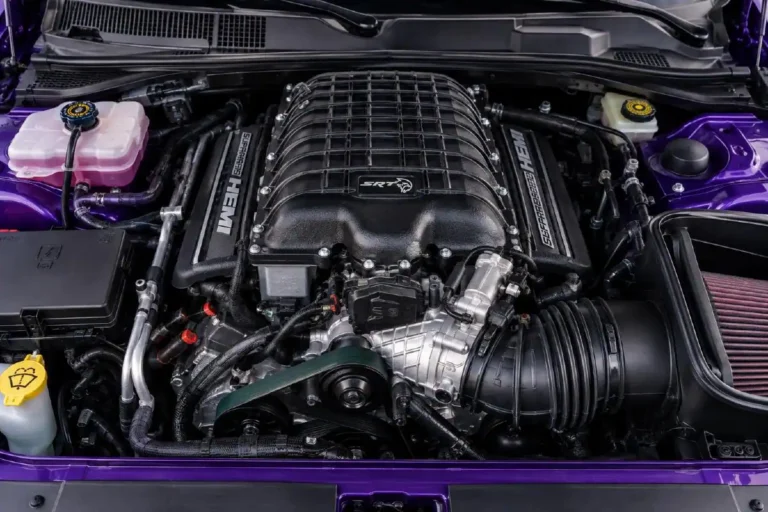
The 2015 Dodge Challenger SRT Hellcat was a defining moment in the modern muscle-car era. The Hellcat’s 6.2-liter supercharged HEMI V8 produced 717 horsepower and 650 lb-ft of torque — more than any Chevrolet Camaro or Ford Mustang available at the time, and delivered in the same large, comfortable, retro-styled body that had been selling to daily-driver buyers since 2008.
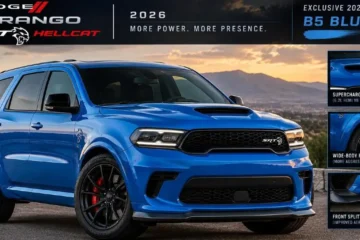
The supercharged 6.2-liter HEMI that made the Hellcat Challenger what it was did not stay exclusive to the Challenger — the same engine family produced the Jeep Grand Cherokee Trackhawk’s 707 horsepower and the Dodge Durango SRT Hellcat’s 710 horsepower, both of which appear in our complete guide to the fastest SUVs in the world.
The supercharger is a 2.4-liter twin-screw unit mounted directly to the top of the HEMI, forcing additional air into the engine and enabling power output far beyond what the naturally aspirated engine could achieve. The specific sound the Hellcat makes under full throttle — the supercharger whine building through the power band over the V8’s exhaust note — became one of the most recognizable automotive sounds of the decade.
The Hellcat could reach 60 mph in approximately 3.4 seconds and cover the quarter mile in approximately 11.2 seconds under appropriate test conditions. For context, contemporary performance-car testing showed that the Hellcat could deliver acceleration comparable to far more expensive sports cars while retaining the larger Challenger’s everyday practicality.
Subsequent years brought the Hellcat Redeye with 797 horsepower (2019), the Hellcat Super Stock with 807 horsepower (2021), and the Jailbreak edition that allowed buyers to unlock additional factory ordering combinations that had previously been restricted. Each iteration demonstrated the same fundamental argument: that the supercharged HEMI platform still had significant performance headroom and that Dodge intended to explore it.
The word Mopar — used throughout the Challenger’s history in reference to official parts, accessories, and the enthusiast community — deserves explanation here. Mopar is a portmanteau of MOtor and PARts, originating in 1937 as a Chrysler antifreeze brand. Over the decades it became the official parts and service division for Chrysler-family vehicles.
Today Mopar is Stellantis’s official parts and accessories brand, but in the enthusiast community it carries a deeper meaning — it is the shared identity of Dodge, Chrysler, Jeep, and Ram fans who consider the specific character of these vehicles something worth belonging to. When someone says “Mopar or no car,” they are not talking about parts catalogs. They are talking about loyalty to a specific automotive culture and driving experience.
Section 5 – The Scat Pack
The 485-Horsepower Value Argument
Between the Hellcat and the R/T sat one of the American muscle car market’s strongest performance-per-dollar propositions: the Dodge Challenger Scat Pack, powered by the naturally aspirated 392 cubic inch (6.4-liter) HEMI V8 producing 485 horsepower and 475 lb-ft of torque.
The Scat Pack name came from a late-1960s Dodge performance package, and its revival for the third-generation Challenger was appropriately nostalgic. The 392 HEMI is an engine with genuine character — it revs freely to its 6,200 RPM redline, produces a sound that is distinctly different from the supercharged Hellcat’s compressed fury, and provides performance that is more than sufficient for most road use without requiring the Hellcat’s higher-performance operating requirements.
A Scat Pack Challenger can cover the quarter mile in approximately the high-11- to low-12-second range depending on configuration, tires, conditions, and testing method. It was also available with a six-speed manual transmission — a choice that mattered to buyers who wanted direct involvement in shifting rather than relying exclusively on an automatic transmission.
The Scat Pack’s pricing — which started below the Hellcat by a substantial margin and varied by model year and configuration — made it one of the highest power-per-dollar production cars available from an American manufacturer during the third generation’s production run.
Section 6 – The Demon And The Demon 170
From 840 HP To 1,025 HP – The Cars That Ended On Their Own Terms
The 2018 Dodge Challenger SRT Demon was engineered specifically around drag-strip performance. Its 6.2-liter supercharged HEMI produced 808 horsepower and 717 lb-ft of torque on 91-octane fuel. With the Direct Connection Controller and minimum 100-octane fuel, output increased to 840 horsepower and 770 lb-ft of torque.
The Demon covered the quarter mile in 9.65 seconds under Dodge’s published test conditions, making it one of the quickest factory production cars of its era. Its drag-focused specifications included a TransBrake function, Torque Reserve, specialized launch calibration, and factory drag-oriented tires. The car’s NHRA-related restrictions were associated with its exceptionally quick elapsed time and the safety requirements applicable to vehicles entering the relevant competition classes.
The Demon 170’s 8.91-second quarter-mile achievement was conducted under conditions subject to NHRA documentation protocols — the NHRA quarter-mile certification records provide the sanctioning body framework under which production car drag racing performance is independently verified in the United States.
The Demon was built around the specific physics of drag racing — it had a TransBrake function that allowed the driver to build launch boost while the transmission was held in place, the Torque Reserve system that pre-loaded the driveline for maximum launch force, and drag-focused tires from the factory. The rear seat was deleted as standard equipment and could be added back for a nominal charge. The passenger seat was also available as an option. These features reflected the specific weight-reduction and launch priorities of a car built primarily around straight-line acceleration.
Then came the Demon 170 in 2023, and it pushed the same formula considerably further.
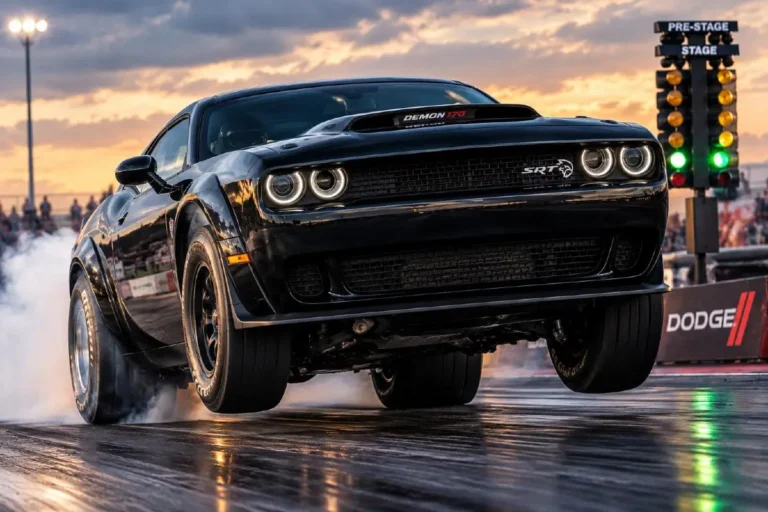
What was the Demon 170? It was the final expression of the supercharged HEMI platform — producing 1,025 horsepower and 945 lb-ft of torque on E85, while producing 900 horsepower and 810 lb-ft of torque on E10 fuel. Dodge’s official material identifies the 1.66-second 0–60 mph acceleration and the car’s drag-racing-focused engineering as central parts of its specification.
All third-generation Challenger engine output figures — from the 303-horsepower Pentastar V6 through the 1,025-horsepower Demon 170 on E85 — are confirmed in the Dodge official Challenger specifications archive, which preserves the complete documentation of every configuration produced during the 2008 through 2023 production run.
The Demon 170’s quarter-mile time of 8.91 seconds at 151.17 mph was achieved under Dodge’s specified testing conditions. The result placed the car among the quickest factory-produced cars ever recorded over the quarter mile, and Dodge itself positioned the Demon 170 as the final and most powerful Challenger in the model’s history.
The independent real-world assessment of the Demon 170’s 8.91-second quarter mile, the 1.70-second 60-foot launch time that gives the car its name, and the specific driving experience of 1,025 horsepower in a muscle car body is from the Car and Driver 2023 Demon 170 review — the publication whose editorial standard this article emulates and the primary road test documentation for the car’s benchmark performance.
Only up to 3,300 Demon 170s were planned, with 3,000 allocated for the United States and 300 for Canada. Each one was accompanied by additional drag-racing equipment and documentation. Like the original Demon, the Demon 170 was developed primarily for straight-line performance at a drag strip rather than for track days, autocross, or canyon-road driving.
Section 7 – The Last Call
Seven Farewell Editions And The End Of The Internal Combustion Challenger
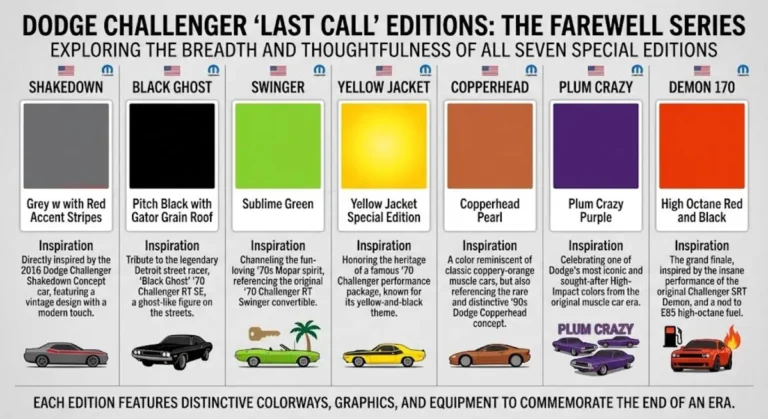
When did Challenger production end? Officially, Dodge Challenger production ended on December 31, 2023. Dodge’s final Last Call program included seven special-edition models across the Challenger and Charger lineups.
The seven Last Call special-edition models were:
** Dodge Challenger Shakedown
** Dodge Charger Super Bee
** Dodge Challenger and Charger Scat Pack Swinger
** Dodge Charger King Daytona
** Dodge Challenger Black Ghost
** Dodge Challenger SRT Demon 170
The Dodge Challenger SRT Demon 170 was the seventh and final Last Call model. Dodge’s official announcement identifies the six previously introduced Last Call models as the Challenger Shakedown, Charger Super Bee, Challenger and Charger Scat Pack Swinger, Charger King Daytona, and Challenger Black Ghost.
The Last Call program also brought back several heritage exterior colors, including Plum Crazy, B5 Blue, and Sublime. These colors were part of the broader 2023 heritage program and should not be confused with the seven official Last Call special-edition models.
The special editions were designed to commemorate different parts of Dodge’s performance history. The Swinger referenced the historic Swinger package, Shakedown drew on Dodge’s performance heritage, Black Ghost referenced a famous 1970 Challenger HEMI, King Daytona celebrated the Charger nameplate’s drag-racing history, and the Demon 170 served as the final high-performance statement of the Challenger era.
Not every 2023 Challenger with a heritage color was a separate Last Call special edition. This distinction matters when researching production numbers, documentation, and collector status.
Section 8 – What Replaced The Challenger
The Dodge Charger And The Transition To A Multi-Energy Performance Lineup
What replaced the Challenger? The closest current Dodge successor is the Dodge Charger, but the Charger lineup is not exclusively electric.
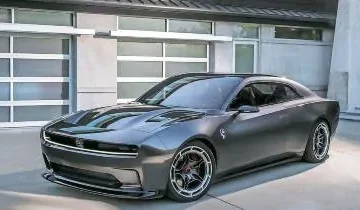
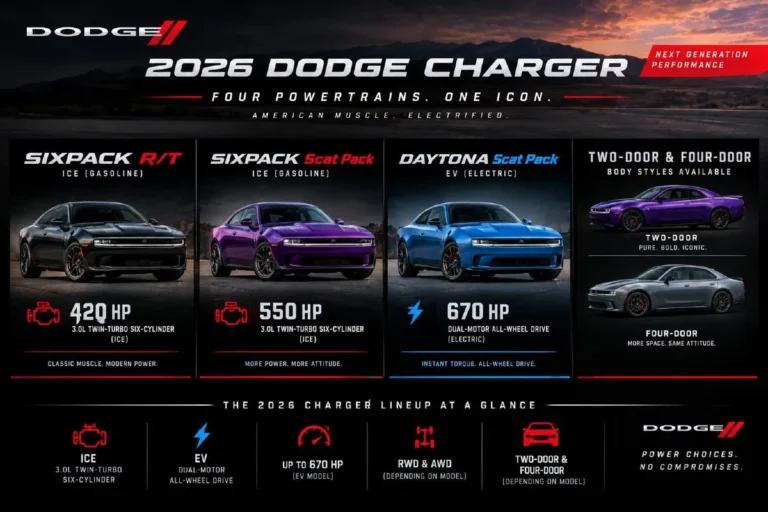
Dodge now offers the Charger as a multi-energy performance car. The lineup includes the gasoline-powered 420-horsepower Charger R/T, the 550-horsepower Charger Scat Pack with the 3.0-liter twin-turbo SIXPACK engine, and the 670-horsepower all-electric Charger Daytona Scat Pack. The lineup is available in both two-door and four-door configurations.
The current Charger therefore represents a broader continuation of Dodge’s performance strategy rather than a simple electric replacement for the Challenger. The two-door Charger is particularly relevant when discussing the Challenger’s body-style legacy, while the four-door version continues the role historically associated with the Charger.
The Charger Daytona uses an all-electric powertrain and was developed around the challenge of making an EV feel connected to Dodge’s muscle-car identity. Dodge also developed the Fratzonic Chambered Exhaust system, an electronically generated sound system intended to provide a more familiar performance-car sensory experience.
At the same time, gasoline-powered Charger models demonstrate that Dodge has not abandoned internal-combustion performance. The 420-horsepower R/T uses the standard-output 3.0-liter twin-turbo SIXPACK engine, while the Scat Pack uses the high-output version producing 550 horsepower. The Daytona Scat Pack provides the all-electric 670-horsepower alternative.
The complete 2026 Dodge Charger lineup — including the SIXPACK R/T at 420 horsepower, the SIXPACK Scat Pack at 550 horsepower, the Daytona Scat Pack EV at 670 horsepower, and the full two-door and four-door configuration availability — is confirmed at the Dodge 2026 Charger official lineup page, the manufacturer’s primary current product reference.
The complicated answer to what replaced the Challenger is that the current Charger does not reproduce every characteristic of the final Challenger. The Challenger’s combination of retro styling, large two-door body, rear-wheel-drive architecture, manual-transmission availability on selected versions, and supercharged HEMI power belongs to a specific period in Dodge history. The current Charger represents a different technical and product strategy.
The current Dodge lineup therefore provides both combustion and electric performance alternatives under the Charger name. The specific future of the Challenger name should be treated separately from the currently confirmed Charger lineup and should not be presented as a confirmed production program without an official Dodge announcement.
Section 9 – Buying A Challenger
The Used Market Reality And What To Look For
The used market for third-generation Challengers is one of the more interesting segments of the American performance-car market. The discontinuation of the model at the end of 2023 means no new Challenger production is continuing, while used-market supply is now determined by the existing vehicle population. Performance variants such as Hellcats, Redeyes, Demons, Super Stocks, and Last Call editions can command substantial premiums depending on mileage, condition, originality, documentation, and market demand.
Before purchasing any Challenger — particularly high-mileage supercharged Hellcat or Redeye examples whose owners may have driven them hard — understanding Dodge’s current reliability standing is essential preparation. Our complete guide to the most reliable American cars 2026 documents Dodge’s reliability position and the specific powertrain considerations that any used Challenger buyer should evaluate alongside the Demon 170’s Customer Service Notice.
Standard V6 and 5.7-liter R/T Challengers from 2015 through 2022 can be found across a wide range of prices depending on mileage and condition. These cars provide a combination of performance, distinctive styling, and the ownership appeal of a discontinued model.
The Scat Pack market likewise varies substantially according to model year, mileage, body style, transmission, condition, modifications, and regional demand. The 485-horsepower naturally aspirated HEMI remains one of the defining engines of the third-generation Challenger.
Hellcat examples from 2015 through 2018 also vary significantly in value depending on mileage, condition, accident history, originality, and documentation. Hellcat Redeye and Super Stock examples occupy a more specialized portion of the market because of their higher output and lower production volumes.
The 2023 Demon 170, produced in limited numbers, occupies an even more specialized collector segment. Its value relative to its original MSRP should be evaluated using actual recent sales, verified vehicle condition, mileage, originality, documentation, and market data rather than assuming that every example trades at the same premium. The original MSRP was $96,666 before destination and fees.
The Demon 170’s $96,666 MSRP — a number chosen to reference the year 1966 — placed it at the apex of American muscle car pricing, a tier explored in full in our complete guide to the most expensive cars, which covers the Cadillac Celestiq, the Hennessey Venom F5, and every other landmark American vehicle priced in six and seven figures.
For original first-generation 1970 Challengers, HEMI-equipped examples with strong documentation can occupy a very different market category from ordinary production cars. Non-HEMI performance variants such as 440-powered cars can also command significant values depending on configuration and condition.
For any Challenger purchase, buyers should pay particular attention to:
** VIN and fender-tag consistency
** Build sheets and factory documentation where available
** Matching engine and transmission numbers where applicable
** Accident and restoration history
** Rust and structural condition on first-generation cars
** Modifications and tuning history on third-generation performance models
** Supercharger, cooling, drivetrain, and transmission condition on Hellcat-family cars
** Originality and documentation on Demon, Demon 170, Super Stock, and Last Call models
** Independent inspection before purchasing a high-value example
Collector-car valuation should always be treated as vehicle-specific. Auction results, Hagerty valuation data, specialist-market listings, and recent comparable sales can provide useful context, but no single range applies equally to every Challenger.
For buyers who want to verify actual transaction prices for Challengers across recent auctions — including Demon 170, Hellcat Redeye, and Last Call editions — the Bring a Trailer Dodge Challenger completed auction results provide documented transaction data with buyer-verified condition reports and full photographic documentation for every completed sale.
FAQ
Is the Dodge Challenger discontinued?
Yes. The Dodge Challenger was discontinued after the 2023 model year, and Dodge states that production ended on December 31, 2023. The final Challenger chapter included the Last Call program, culminating in the Demon 170. The current Dodge Charger is the brand’s closest successor in its performance-car lineup.
How many generations of Challenger are there?
The Dodge Challenger was produced across three distinct generations: the first generation from 1970 through 1974, the second generation from 1978 through 1983 — a Japan-built, Mitsubishi-based rear-wheel-drive coupe — and the third generation from 2008 through 2023. The third generation is the one most people associate with the modern Challenger and the supercharged HEMI variants from the Hellcat through the Demon 170.
What was the most powerful Challenger ever made?
The 2023 Dodge Challenger SRT Demon 170, producing 1,025 horsepower and 945 lb-ft of torque on E85 fuel. On E10 fuel, Dodge lists 900 horsepower and 810 lb-ft of torque. The car achieved a published quarter-mile time of 8.91 seconds at 151.17 mph under Dodge’s specified conditions. Up to 3,300 units were planned, with 3,000 for the United States and 300 for Canada.
What does Mopar mean?
Mopar is a portmanteau of MOtor and PARts — a brand that originated in 1937 as a Chrysler antifreeze product line and evolved into the official parts, service, and accessories division for Chrysler-family vehicles. In enthusiast culture, Mopar has also become a shared identity term for owners and enthusiasts associated with Dodge and other Chrysler-family performance vehicles.
What was the Demon 170?
The 2023 Dodge Challenger SRT Demon 170 was a limited-production, drag-racing-focused muscle car and the seventh and final Last Call special-edition model. It produced 1,025 horsepower and 945 lb-ft of torque on E85 fuel, while Dodge lists 900 horsepower and 810 lb-ft on E10. It recorded a published 8.91-second quarter mile at 151.17 mph and was planned for production of up to 3,300 units.
What replaced the Dodge Challenger?
The current Dodge Charger is the closest successor to the Challenger in Dodge’s performance lineup. However, Charger is not exclusively electric. Dodge offers the 420-horsepower gasoline-powered Charger R/T, the 550-horsepower gasoline-powered Charger Scat Pack, and the 670-horsepower all-electric Charger Daytona Scat Pack. The lineup is available in both two-door and four-door configurations.
The Bottom Line
The Dodge Challenger’s story is, at its core, a story about American performance-car persistence — the refusal to accept that the traditional muscle-car formula had to disappear completely. Dodge revived the Challenger in 2008 with a design philosophy rooted in the 1970 original and then spent sixteen years developing increasingly powerful versions of the platform.
The result was a car that went from the 375-horsepower 5.7-liter HEMI R/T at the beginning of the third generation to 1,025 horsepower in the final Demon 170. That progression — through the R/T, Scat Pack, Hellcat, Redeye, Super Stock, Demon, and Demon 170 — represents one of the most dramatic power escalations associated with a single modern production nameplate.
The Demon 170 covered the quarter mile in 8.91 seconds under Dodge’s published conditions. It did so as a factory-produced street-legal vehicle with a supercharged HEMI V8 and a level of drag-racing capability that would have been difficult to imagine when the third-generation Challenger first arrived in 2008.
The specific era that produced that car is over. The Challenger is no longer in production, and Dodge has moved to a new Charger lineup combining gasoline and electric powertrains. What comes next will therefore be technically and commercially different from the final Challenger.
But the Challenger, across all three of its generations and especially in the supercharged final chapter of the third, occupies a distinctive place in American automotive history. Its final chapter ended not with a reduction in performance, but with the 1,025-horsepower Demon 170 — an unusually powerful closing statement for a production muscle-car nameplate.
Editorial Note
This article was written and reviewed in September 2026. Technical specifications, production information, historical details, and current-model information were checked against primary manufacturer material and established automotive references.
For the 2018 Challenger SRT Demon, official Stellantis specifications identify 808 bhp and 717 lb-ft with 91-octane fuel, and 840 bhp and 770 lb-ft with the Direct Connection Controller and minimum 100-octane fuel.
For the 2023 Challenger SRT Demon 170, Dodge identifies 1,025 horsepower and 945 lb-ft on high-ethanol fuel blends, with 900 horsepower and 810 lb-ft on E10, a published 1.66-second 0–60 mph time, an 8.91-second quarter-mile result at 151.17 mph, and production of up to 3,300 units, allocated as 3,000 for the United States and 300 for Canada.
For the Last Call program, Dodge’s official announcement identifies the seven special-edition models as the Challenger Shakedown, Charger Super Bee, Challenger and Charger Scat Pack Swinger, Charger King Daytona, Challenger Black Ghost, and Challenger SRT Demon 170. Heritage colors such as Plum Crazy were part of the broader 2023 heritage-color program and are not counted as separate Last Call models.
For the current 2026 Dodge Charger, official Dodge information identifies the multi-energy lineup as including the 420-horsepower Charger R/T, 550-horsepower Charger Scat Pack, and 670-horsepower Charger Daytona Scat Pack, with both two-door and four-door configurations available.
The second-generation Challenger’s history is documented in automotive historical coverage as a rebadged Mitsubishi Galant Lambda-based, rear-wheel-drive coupe sold in the United States from 1978 through 1983.
Collector-market values are inherently vehicle-specific. Any valuation should take into account model year, engine, transmission, production configuration, mileage, originality, condition, documentation, restoration quality, provenance, geographic market, and recent comparable sales. Auction results and specialist valuation resources should therefore be treated as market indicators rather than guarantees of future appreciation.
** Primary and Reference Sources:
* Dodge official Challenger and Demon 170 materials
* Stellantis official 2018 Dodge Challenger SRT Demon technical specifications
* Dodge official 2023 Last Call announcements
* Dodge official 2026 Charger specifications and model information
* MotorTrend historical Dodge Challenger coverage
* Car and Driver performance and historical coverage
* Hagerty valuation resources
* NHRA performance and safety information where applicable
**Editorial Methodology: Manufacturer specifications are prioritized for factory power, production, fuel, and model-line information. Established automotive publications are used for historical context and independent performance reporting. Collector-market statements are treated as indicative and should be verified against current comparable sales and valuation data.
**Last Reviewed: September 2026