Last Updated: July 13, 2026 | Read Time: 9 minutes
The Rivian R1S Quad-Motor reaches 60 mph in 2.6 seconds with 1,025 horsepower from four individual wheel motors. The Jeep Grand Cherokee Trackhawk tops out at 180 mph with a 707-horsepower Hellcat V8 that covers the quarter mile in 11.6 seconds — and Jeep put all of that in a vehicle that still has the Grand Cherokee’s familiar, no-nonsense styling.
The Dodge Durango SRT Hellcat does it with three rows of seating and 8,700 pounds of towing capacity alongside its 710 horsepower and 180 mph top speed. The Cadillac Escalade-V does 0-60 in 4.4 seconds in a hand-built luxury SUV that weighs over 6,000 pounds. American performance SUVs do not make sense in the best possible way. Here is every number, every contender, and the complete ranking.
Quick Facts – Fastest SUV In The World
— Fastest 0-60 (any power): Rivian R1S Quad-Motor — approximately 2.6 seconds / 1,025 HP
— Fastest Gas-Powered 0-60: Jeep Grand Cherokee Trackhawk and Dodge Durango SRT Hellcat — tied at 3.5 seconds
— Highest Top Speed: Jeep Grand Cherokee Trackhawk and Dodge Durango SRT Hellcat — tied at 180 mph
— Most Powerful American SUV (electric): Rivian R1S Quad-Motor — 1,025 HP
— Most Powerful American SUV (gas): Dodge Durango SRT Hellcat — 710 HP (in production 2026)
— Fastest Three-Row American SUV: Dodge Durango SRT Hellcat — 3.5 seconds, 180 mph, 7 seats
— Fastest American Luxury SUV: Cadillac Escalade-V — 4.4 seconds, 682 HP
— Fastest American Full-Size Gas SUV: Cadillac Escalade-V — 4.4 seconds, 682 HP
Complete Ranked List by 0-60:
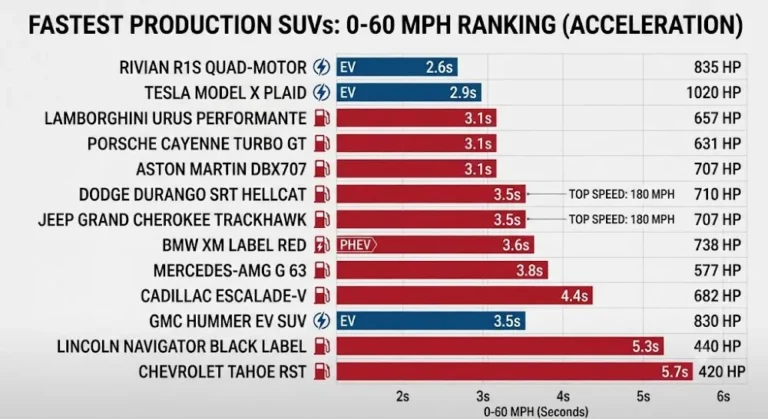
1. Rivian R1S Quad-Motor — 2.6 seconds / 1,025 HP (electric)
2. Rivian R1S Tri-Motor (2025) — 2.9 seconds / 850 HP (electric)
3. GMC Hummer EV SUV — approximately 3.0 seconds / 830 HP (electric)
4. Jeep Grand Cherokee Trackhawk — 3.5 seconds / 707 HP / 180 mph (discontinued 2021, used market)
5. Dodge Durango SRT Hellcat — 3.5 seconds / 710 HP / 180 mph (in production 2026)
6. Ford Mustang Mach-E GT PE — 3.5 seconds / 480 HP (electric, current production)
7. Rivian R1S Dual-Motor + Performance — 3.4 seconds / 665 HP (electric)
8. Cadillac Escalade-V — 4.4 seconds / 682 HP (supercharged V8, in production 2026)
9. Jeep Grand Cherokee SRT — 4.4 seconds / 475 HP (in production 2026)
10. Chevrolet Tahoe RST Performance — 5.7 seconds / 433 HP (in production 2026)
Sources: CarBuzz , TopSpeed, Motor-Junkie, World Parts Direct, GlennSaid
Overview – How America Built The Fastest SUVs In The World — And Why Nobody Saw It Coming
The SUV was not supposed to be fast. The original sport utility vehicle was a body-on-frame working vehicle built for unpaved roads and payload, not quarter-mile times and top speed records. The idea that an American family hauler would match a Porsche 911 to 60 mph was not part of anyone’s ten-year product plan when the segment was developing in the 1990s.
There are plenty of high-powered SUVs on the market, but none quite like the American performance SUV. The segment once known for heavy, sluggish torque mills is now full of supercharged V8s and cutting-edge electric drivetrains making over 1,000 horsepower. The transformation has been rapid, specific, and entirely American in character — combining the specific cultural appetite for maximum performance with the practical demands of family transportation and producing vehicles that do both simultaneously with complete sincerity.
The key question at the top of every performance SUV conversation is one of American specificity: how do you take a vehicle designed to carry seven passengers and tow a boat and make it run the quarter mile in 11.5 seconds? The answer, in most of the gas-powered cases, is the Hellcat engine. Stellantis’s 6.2-liter supercharged V8 — the specific engine architecture that produced the Dodge Challenger Hellcat, the Dodge Charger Hellcat, and then the Jeep Grand Cherokee Trackhawk and Dodge Durango SRT Hellcat — is the engineering decision that redefined what American SUV performance could mean. The very idea that a Jeep has over 700 HP just makes you chuckle.
That specific response, documented by CarBuzz when reviewing the Trackhawk’s legacy, captures the cultural absurdity and genuine engineering achievement simultaneously. The electric version of the story is even more extreme: the Rivian R1S Quad-Motor produces 1,025 horsepower from four individual wheel motors, reaches 60 mph in 2.6 seconds, and maintains the off-road capability that the R1S was specifically designed around. In a single product, Rivian has produced the fastest American SUV ever built that also goes off-road — a combination that no gasoline-powered vehicle in the segment has achieved simultaneously.
This guide covers every contender — gasoline and electric, in production and discontinued, in current and historical context — with every number, every specification, and the honest assessment of what each vehicle is actually like to experience in the real world.
Section 1 – The Rivian R1S
America’s Fastest SUV — And The One That Also Goes Off-Road
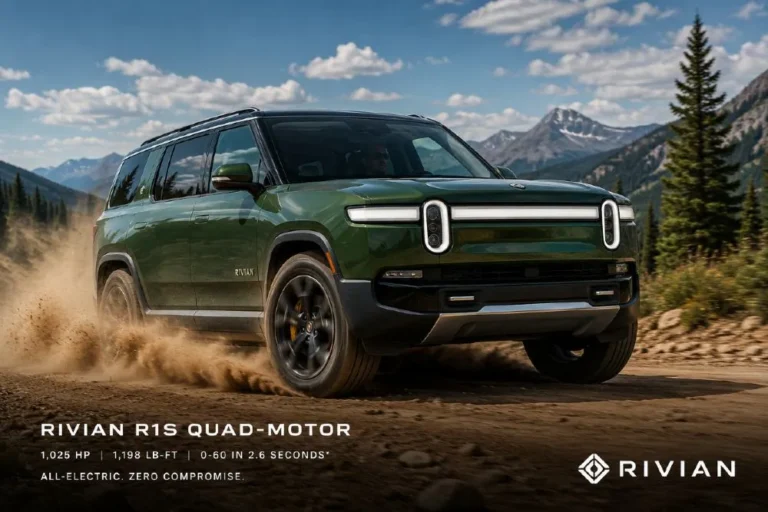
The 2026 Rivian R1S Quad-Motor is the fastest American SUV ever built in terms of 0-60 mph time. With up to 1,025 horsepower and 0-60 under 2.6 seconds, it blends quiet speed with genuine off-road skill. One minute it rips, the next it climbs — a dual nature, civilized and savage, that expresses modern American SUV energy in the most complete available form.
The R1S’s performance hierarchy in 2026 spans three configurations. The Dual-Motor version with the Performance upgrade package produces 665 horsepower and 829 lb-ft of torque, delivering a 3.4-second 0-60 time. The 2025 Tri-Motor, which received a significant power upgrade for 2025, produces 850 horsepower and 1,103 lb-ft of torque with a 2.9-second 0-60 time. The Quad-Motor, with a motor powering each wheel individually, produces the full 1,025 horsepower and reaches 60 mph in approximately 2.6 seconds — matching the Tesla Cybertruck Cyberbeast’s identical figure and making both the fastest-accelerating SUVs on the American market.
The Rivian R1S got some big power bumps thanks to better batteries and motors. As a result, even the lowly dual-motor version of the R1S with a $5,000 Performance upgrade package now produces 665 hp and a whopping 829 lb-ft of torque. It can rip off a 3.4-second 0-60 mph time. Giving this much power and performance to any ordinary Rivian buyer willing to spend $5,000 more is just another sign of the crazy horsepower times we’re living in.
What separates the R1S from every other entry on this list is its dual personality. The Quad-Motor R1S that matches sports car 0-60 times also has the ground clearance, the approach angle, the four-motor torque vectoring, and the specific off-road hardware to handle technical terrain that would stop a Trackhawk or Durango Hellcat. The same car that covers a quarter mile in the 10-second range can also wade through deep water and climb over rocks — a specific combination of capabilities that represents the most complete American performance SUV ever built.
The R1S’s warranty — four years and 50,000 miles bumper-to-bumper alongside eight years and 150,000 miles of battery coverage — provides meaningful long-term ownership confidence for a vehicle that costs significantly more than the gasoline performance SUVs it outperforms in straight-line acceleration. The approximately 420-mile maximum range means long-distance travel does not require the planning complexity of shorter-range electric vehicles.
For buyers who want to verify the specific R1S configuration — choosing between Dual, Tri, and Quad motor options, confirming the Performance package availability, and checking current pricing — the Rivian R1S official range and performance specifications page provides the manufacturer’s complete configuration tool with current pricing for every available version.
Section 2 – The Jeep Grand Cherokee Trackhawk
The Gas-Powered Legend That Started The American Performance SUV Arms Race
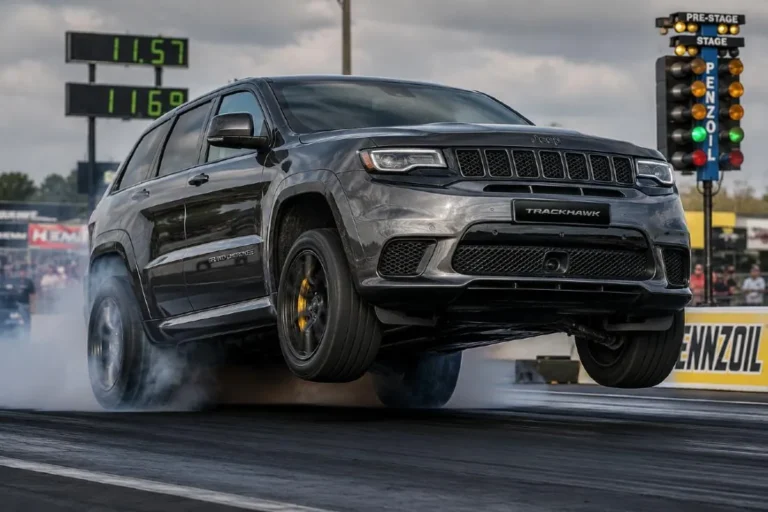
The Jeep Grand Cherokee Trackhawk is the vehicle that defined what an American performance SUV could be — and despite being discontinued after the 2021 model year, it remains the reference point against which every other gas-powered American performance SUV is measured. The Trackhawk’s all-wheel-drive system and eight-speed automatic transmission enable it to launch from 0 to 60 mph in a blistering 3.5 seconds, making it one of the fastest SUVs ever produced.
Equipped with a supercharged 6.2-liter V8 engine, it delivers 707 horsepower and 645 pound-feet of torque, moving it from 0 to 60 mph in just 3.5 seconds. This performance is complemented by a top speed of 180 mph and a towing capacity of up to 7,200 pounds, making it crazy-fast and functional.
The Trackhawk’s 180 mph top speed is the highest of any gas-powered American SUV ever built — a number that places it in the territory of dedicated sports cars rather than family vehicles. At 180 mph in a two-row Jeep Grand Cherokee body, the Trackhawk was operating in entirely unexplored territory for the American SUV market, and the automotive community’s reaction was appropriate bewilderment followed by deep affection.
The dearly departed Jeep Grand Cherokee Trackhawk was just one of the many insane, Hellcat-powered vehicles from Fiat-Chrysler Automobiles, and this one sadly never made the transition to the new-generation Grand Cherokee. For the four years it was in production, though, this SUV made its mark on the automotive world with its brutal launches, wonderful sounds, and a 0-60 mph time that would force every enthusiast to bear the shame of knowing they lost to a Jeep.
The Trackhawk’s specific combination of engineering details makes its performance achievable and usable. Launch control is activated by a button, allowing novice drivers to set off like a pro with maximum power and grip from the go. Brembo brakes provide stopping power appropriate to 180 mph capability — the ability to decelerate from 60 mph in approximately 110 feet. Quadra-Trac AWD manages power delivery across all four wheels during launch and cornering. And the adaptive suspension maintains composure through transitions that a vehicle of this weight and power would otherwise struggle to manage.
Despite its size and weight, that potent engine pushed the Jeep Grand Cherokee Trackhawk from 0-60 mph in a staggering 3.5 seconds to complete a quarter mile in 11.6 seconds. The quarter-mile time of 11.6 seconds places the Trackhawk in territory that a factory Chevrolet Camaro SS or Ford Mustang GT would struggle to match — and the Trackhawk does it while carrying five passengers in comfortable seats with available heated and ventilated leather surfaces.
Any buyer considering a used Jeep Grand Cherokee Trackhawk — a vehicle whose final production year was 2021, meaning every example is now four or more years old — should verify open recall status through the NHTSA performance SUV safety recall database before finalizing any purchase at the $75,000 to $85,000 price range typical for clean examples.
The used market Trackhawk is now the only way to acquire one. Prices have settled from their original $90,070 starting MSRP to approximately $75,000 to $85,000 for clean low-mileage examples, with exceptionally well-documented examples occasionally reaching the original MSRP range. For the buyer who wants the fastest gas-powered American SUV in history and is willing to accept a used market purchase, the Trackhawk represents a genuinely extraordinary performance value.
All Trackhawk specifications cited in this article — 707 horsepower, 645 lb-ft torque, 3.5-second 0-60, 180 mph top speed, 7,200-pound towing capacity — are confirmed in the Jeep Grand Cherokee Trackhawk official specifications, the manufacturer’s primary technical reference for the 2021 final production year.
The used market Trackhawk is an extraordinary performance vehicle at a compelling price — but any buyer considering a high-mileage example should understand the specific reliability profile of the 6.2-liter supercharged Hellcat V8 under sustained performance use. Our complete guide to common issues that kill American cars covers the documented failure patterns affecting supercharged Chrysler V8 applications, the MDS cylinder deactivation concerns on high-mileage examples, and the inspection checklist for any used performance Jeep or Dodge purchase
Section 3 – The Dodge Durango SRT Hellcat
Three Rows, 710 Horsepower, And 180 MPH — The Most Absurd Practical Vehicle Ever Made
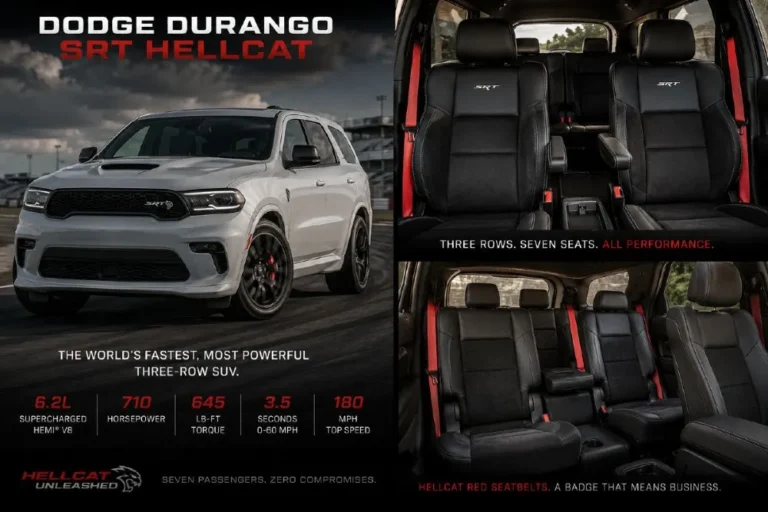
The Dodge Durango SRT Hellcat is arguably the most logically impossible vehicle in the American performance car market — a three-row family SUV with seating for seven passengers that also reaches 180 mph and covers the quarter mile in 11.5 seconds. The Durango Hellcat is an icon. At its heart lies a supercharged 6.2-liter HEMI V8 engine, delivering an impressive 710 horsepower and 645 pound-feet of torque. This powerhouse enables the Durango SRT Hellcat to accelerate from 0 to 60 mph in just 3.5 seconds and achieve a top speed of 180 mph.
Despite its performance credentials, it maintains practicality with a towing capacity of up to 8,700 pounds. What truly sets the Durango SRT Hellcat apart is its blend of outrageous performance with everyday usability. You get three rows of seating, ample cargo space, and all the creature comforts expected from a modern family hauler, and then launch control.
The 8,700-pound towing capacity alongside the 180 mph top speed is the specific combination that makes the Durango SRT Hellcat functionally impossible to categorize. It tows more than most dedicated truck platforms. It is faster than most dedicated performance cars. It seats seven in a comfortable, practical cabin. And Dodge has continued to produce it — making the Durango SRT Hellcat the fastest three-row production vehicle of any kind currently available for sale anywhere in the world in 2026.
The Durango SRT Hellcat’s specific advantage over the Trackhawk is the third row. For families who need to seat seven passengers — which eliminates the Trackhawk as a practical option — and who want the specific performance experience of the 6.2-liter Hellcat supercharged V8, the Durango SRT Hellcat is the only option that provides both simultaneously. There is no European or Japanese alternative that offers three-row seating and 180 mph capability at any price. The Durango Hellcat holds that specific record entirely without competition.
A uniquely tuned suspension set up pairs with adaptive dampers as well as a similar Brembo brake setup make the Durango Hellcat a true monster. Even more impressive is that it has three-rows of seating and can tow up to 8,700 pounds.
The interior of the Durango SRT Hellcat includes performance pages — a specific screen layout that displays real-time performance data including g-forces, braking distances, and acceleration times — alongside the red seatbelts that communicate the car’s performance identity to every passenger. Launch control is standard. The supercharger whine that accompanies wide-open-throttle acceleration is one of the most memorable sounds in the American performance car landscape. And the exhaust note at full throttle in third gear on a highway on-ramp produces the specific experience of realizing that the vehicle underneath you is doing something genuinely extraordinary.
The Dodge Durango SRT Hellcat’s 710 horsepower, 645 lb-ft torque, 8,700-pound towing capacity, and current 2026 production availability are confirmed through the Dodge Durango SRT Hellcat official build and price tool, which also confirms the specific performance packages, color options, and interior configurations available for the current model year.
Section 4 – The GMC Hummer EV SUV
830 Horsepower, 9,000 Pounds, And The Most Extreme American Electric SUV
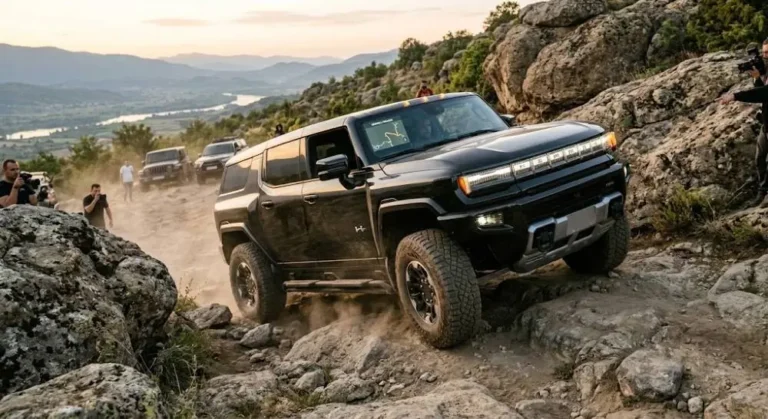
The GMC Hummer EV SUV is the most extreme expression of the American performance electric vehicle in the current market — not the fastest in outright 0-60 terms, but the most dramatic in overall presence and capability combination. It’s GM’s way of showing that an EV can be just as wild as any gas-powered SUV, and there’s no doubt that they achieved their goal there. If 830 hp isn’t enough, and you’re okay with a truck instead, the pickup truck version of the 2026 Hummer EV now makes up to 1,160 hp, taking the insanity even further.
The Hummer EV SUV’s 830 horsepower reaches 60 mph in approximately 3.0 seconds — a figure that would have been genuinely shocking from any SUV at any price five years ago and that remains deeply impressive in a vehicle weighing approximately 9,000 pounds. The WattsBomb launch system — which charges up the battery capacitors for maximum power delivery at launch — produces the specific dramatic acceleration that makes the Hummer EV SUV’s launch experience unlike any other production vehicle in the current market.
CrabWalk — the four-wheel steering mode that allows the Hummer EV to move diagonally — adds the specific off-road and maneuvering capability that justifies the SUV body shape alongside the electric powertrain’s performance credentials. Extract Mode raises the suspension for maximum ground clearance on off-road terrain. These features combine with the 830-horsepower electric powertrain to produce the most capable large-format American electric SUV currently in production.
The Hummer EV SUV’s primary limitation is its weight and size — at 9,000 pounds, it is the heaviest passenger vehicle in the American market, and that weight communicates itself in urban driving and parking situations in ways that the more manageable Rivian R1S does not. The battery capacity required to move 9,000 pounds with appropriate range means the Hummer EV SUV is not the most efficient use of electric vehicle technology — it is the most extreme use of it.
The GMC Hummer EV SUV’s 830 horsepower is genuinely extreme — but the pickup truck version of the same platform now produces up to 1,160 horsepower, extending the performance conversation from SUVs into the American truck market. Our complete guide to the best pickup trucks covers the Hummer EV pickup alongside every other performance-oriented American truck, completing the full picture of what American manufacturers are doing at the extreme end of the performance vehicle market.
Section 5 – The Cadillac Escalade-V
682 Horsepower In A Luxury SUV — The Most Refined Fast American SUV
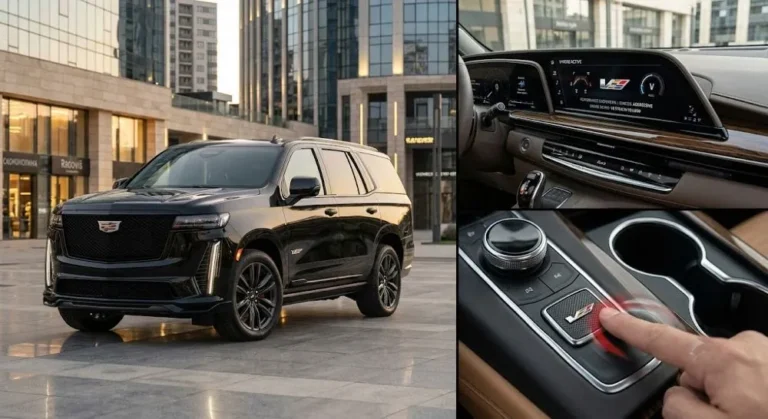
The Cadillac Escalade-V is the performance entry in the full-size luxury three-row American SUV segment and the vehicle that most directly demonstrates what Magnetic Ride Control and an adaptive air suspension can do to make 682 horsepower feel composed in a vehicle weighing over 6,000 pounds. The Escalade-V is one of only two gas-powered vehicles on this list that’s still in production, carrying the torch and continuing the tradition.
This powerhouse propels the nearly three-ton SUV from 0 to 60 mph in just 4.4 seconds, a remarkable feat for a vehicle of its size. That straight-line speed is matched by the Escalade-V’s commanding presence and refined ride quality. Magnetic Ride Control and an adaptive air suspension help balance its brute force with everyday comfort, making it just as capable cruising down the highway as it is roaring off the line.
The Escalade-V’s 4.4-second 0-60 time is meaningfully slower than the Trackhawk and Durango Hellcat — a consequence of both its greater mass and its engineering priority of composed, refined performance over maximum acceleration. The Escalade-V is not built to win drag races against the Trackhawk. It is built to provide a driving experience that combines luxury with genuine performance in proportions that make the Escalade-V daily-drivable as a primary vehicle for buyers whose priorities include both speed and refinement.
The hand-built 6.2-liter supercharged V8 — assembled in Bowling Green, Kentucky, and signed by the craftsman who built it — represents the same engineering heritage as the Corvette’s powerplants. The 55-inch curved OLED display, the 36-speaker AKG Studio Reference audio system, and the Super Cruise hands-free highway driving system are the luxury counterparts to the performance hardware that makes the vehicle quick. The Escalade-V is the complete American performance luxury SUV — the only vehicle on this list where the cabin technology is as impressive as the performance numbers.
V-Mode — the Escalade-V’s specific performance activation — sharpens throttle response, firms the suspension, and changes the exhaust character when the driver chooses maximum performance. In everyday use, the Escalade-V is a comfortable, refined full-size luxury SUV. In V-Mode, it is a genuinely quick vehicle whose performance would embarrass drivers of dedicated sports cars who underestimate what a large Cadillac can do.
The Escalade-V’s 4.4-second 0-60 is the headline number, but it is one specification inside a vehicle that also includes a 55-inch curved OLED pillar-to-pillar display, a 36-speaker AKG Studio Reference audio system, and Super Cruise hands-free highway driving as standard equipment — our complete Cadillac Escalade-V guide covers every specification, every trim, and the honest case for spending $170,000 on the most refined fast American SUV available.
Section 6 – The Gas VS Electric Performance Divide
Why The Fastest American SUVs Are Electric – And What That Means For The Gas Legends
American performance SUV market has a specific and important divide: the fastest vehicles by 0-60 mph time are electric, while the most dramatic and most culturally resonant experiences are gasoline-powered. Understanding the difference between these categories is essential for any buyer who is evaluating the performance SUV market honestly.
The Rivian R1S Quad-Motor’s 2.6-second 0-60 time is faster than the Trackhawk’s 3.5-second figure by nearly a full second — a genuinely meaningful difference in objective terms. But the experience of those 2.6 seconds in the Rivian and those 3.5 seconds in the Trackhawk is fundamentally different in ways that specifications cannot capture.
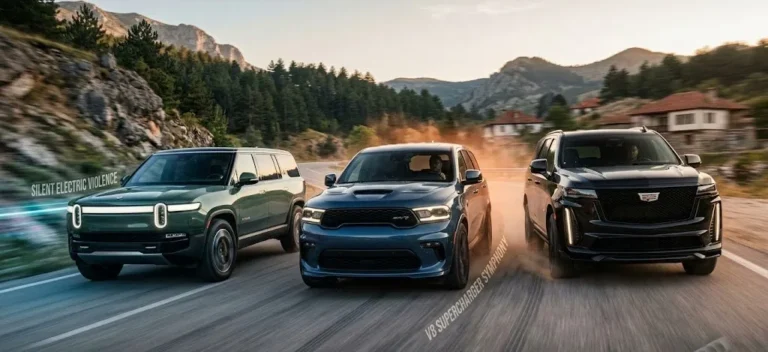
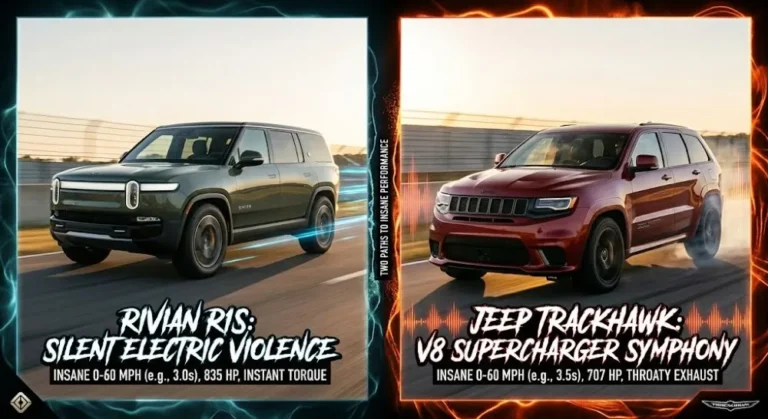
The Rivian delivers silent violence — the experience of near-instantaneous acceleration without engine noise, without supercharger whine, without the specific sound drama that accompanies the Hellcat’s wide-open-throttle experience. The Trackhawk delivers a symphony of noise and mechanical sensation alongside its acceleration — the supercharger building pressure, the exhaust barking, the launch control releasing, and the very specific experience of a heavy vehicle being propelled forward faster than physics suggests is reasonable.
The Rivian R1S delivers silent violence; the Durango SRT Hellcat turns the same sprint into a symphony. Both are blistering; they just tell different stories. V8 sound is ritual; cold-start rumble; midrange bark; supercharger whine. It is emotion you can hear. EVs write new soundtracks; some synthesize acceleration cues; others embrace near-silence so tire and wind become the feedback loop.
The charging consideration is the practical differentiation that specifications ignore. A Durango SRT Hellcat fills in five minutes at any gas station. A Rivian R1S with 420 miles of range requires charging infrastructure planning for long road trips. For buyers who primarily commute and charge at home, the EV charging consideration is minimal. For buyers who regularly take long road trips or tow heavy loads that accelerate range consumption, the gasoline-powered Durango SRT Hellcat’s immediate refueling advantage matters.
The performance SUV market’s future is clearly trending toward electric — the raw acceleration numbers that electric motors produce at zero RPM are physics advantages that no gasoline engine with a supercharger or turbocharger can match at the same power levels. But the gasoline experience — the sound, the mechanical sensation, the immediate refueling — remains meaningful to the specific buyer who chooses the Durango SRT Hellcat or waits for a clean used Trackhawk rather than accepting the electric alternative’s superior objective numbers.
Section 7 – The Supporting Cast
Every Other Fast American SUV Worth Knowing About
Beyond the headline contenders, the American performance SUV market offers a range of vehicles whose performance credentials are genuinely impressive in the context of the vehicles they compete against even if they do not challenge the top-tier rankings.
The Jeep Grand Cherokee SRT delivers thrilling performance with its 6.4-liter HEMI V8, producing 475 horsepower and rocketing from 0-60 mph in just 4.4 seconds. Thanks to its all-wheel-drive system and adaptive suspension, this SUV is both fast and remarkably agile for its size. The SRT helped pave the way for even bolder Jeep models, setting a high bar for speed and control.
The Grand Cherokee SRT is the vehicle that demonstrated Jeep’s willingness to pursue performance before the Trackhawk arrived — the 4.4-second 0-60 from the 6.4-liter HEMI V8 established that a performance Jeep was commercially viable and technically achievable, setting the stage for the Hellcat’s arrival in 2018.
The Ford Mustang Mach-E GT Performance Edition brings legendary Mustang excitement into the world of electric SUVs. Armed with 480 horsepower and a massive 634 lb-ft of torque, it rockets from 0-60 mph in just 3.5 seconds. This SUV offers crisp handling and blistering acceleration—traits you’d expect from a sports car, yet wrapped in a practical, stylish SUV body.
The Ford Mustang Mach-E GT Performance Edition’s 480 HP and 3.5-second 0-60 time make it one of the fastest American electric SUVs currently in production — our complete Mustang Mach-E guide covers every trim from the $37,795 Select through the Rally’s off-road credentials, showing where the GT Performance Edition sits in the full Mach-E lineup context
The Chevrolet Tahoe RST Performance Edition with the 6.2-liter V8 producing 433 horsepower is the most accessible entry into the American performance full-size SUV segment — a full-size three-row V8 SUV that reaches 60 mph in 5.7 seconds at a price significantly below the Escalade-V. For buyers who want a quick, capable full-size American SUV without the Escalade-V’s $170,000 price tag, the Tahoe RST Performance Edition is the specific recommendation.
The Lincoln Navigator, with its available twin-turbocharged V6 producing 440 horsepower, provides the luxury full-size American SUV experience at a 0-60 time of approximately 5.0 seconds — quick for a vehicle of this size and luxury level, and positioned specifically for buyers who want the Navigator’s specific brand identity alongside genuine performance.
FAQ
Q: What is the fastest American SUV in the world?
A: The fastest American SUV by 0-60 mph time is the Rivian R1S Quad-Motor, which reaches 60 mph in approximately 2.6 seconds with 1,025 horsepower from four individual electric motors. The 2025 Rivian R1S Tri-Motor also qualifies, reaching 0-60 in 2.9 seconds with 850 horsepower. The fastest gasoline-powered American SUV is the Jeep Grand Cherokee Trackhawk (discontinued after 2021, available on the used market) and the Dodge Durango SRT Hellcat (in production for 2026), both reaching 60 mph in 3.5 seconds with a top speed of 180 mph from their respective Hellcat engines.
Q: What is the top speed of the Jeep Grand Cherokee Trackhawk?
A: The Jeep Grand Cherokee Trackhawk has a top speed of 180 mph — the highest top speed of any gas-powered American SUV ever built. It reaches 0-60 mph in 3.5 seconds and covers the quarter mile in approximately 11.6 seconds from its supercharged 6.2-liter Hellcat V8 producing 707 horsepower and 645 lb-ft of torque. The Trackhawk was produced from 2018 through 2021 before being discontinued.
Q: How fast is the Dodge Durango SRT Hellcat?
A: The Dodge Durango SRT Hellcat reaches 0-60 mph in 3.5 seconds and has a top speed of 180 mph from its 710-horsepower supercharged 6.2-liter Hellcat V8. It covers the quarter mile in approximately 11.5 seconds. It is the fastest three-row production vehicle of any kind currently available for purchase anywhere in the world, combining 710 horsepower, three rows of seating for seven passengers, and a towing capacity of 8,700 pounds simultaneously.
Q: Is the Rivian R1S faster than the Trackhawk?
A: Yes. The Rivian R1S Quad-Motor reaches 0-60 mph in approximately 2.6 seconds — nearly a full second faster than the Trackhawk’s 3.5-second 0-60 time. The R1S Tri-Motor reaches 0-60 in 2.9 seconds. Even the standard Dual-Motor R1S with the Performance upgrade reaches 0-60 in 3.4 seconds, slightly edging the Trackhawk’s 3.5-second figure. However, the Trackhawk’s top speed of 180 mph may exceed the R1S’s electronically limited top speed depending on configuration. The R1S also offers off-road capability the Trackhawk cannot match.
Q: What is the fastest American SUV with three rows?
A: The fastest American SUV with three rows of seating is the Dodge Durango SRT Hellcat, which reaches 0-60 mph in 3.5 seconds with a top speed of 180 mph from its 710-horsepower Hellcat V8. It seats seven passengers, tows 8,700 pounds, and is in active production for the 2026 model year. The Cadillac Escalade-V is the second-fastest three-row American SUV at 4.4 seconds with 682 horsepower.
Q: What will be the next fastest American performance SUV?
A: The most anticipated upcoming American performance SUV is the Jeep Wagoneer S, which has already demonstrated a sub-3.5-second 0-60 time in its electric configuration but with over 100 fewer horsepower than the Trackhawk. The Ram 1500 REV platform may produce a performance SUV variant. And Rivian’s continuous improvement of the R1S platform suggests the Quad-Motor’s 2.6-second 0-60 may be challenged by an updated version before the end of the decade.
The Bottom Line
The fastest American SUVs in the world are a genuinely extraordinary group of vehicles. The Rivian R1S Quad-Motor reaches 60 mph in 2.6 seconds from four individual electric motors in a body that also goes off-road. The Jeep Grand Cherokee Trackhawk and Dodge Durango SRT Hellcat reach 180 mph from a supercharged V8 that makes a sound no electric motor will ever replicate. The Cadillac Escalade-V does 4.4 seconds with 682 horsepower while providing the most sophisticated luxury SUV interior in American production.
The fastest is the Rivian by objective measure. The most culturally significant is the Trackhawk. The most practically absurd is the Durango Hellcat — a three-row family vehicle that reaches 180 mph and tows 8,700 pounds. The most refined is the Escalade-V. None of these descriptions requires any exaggeration because the vehicles themselves are genuinely extreme.
American performance SUVs do not make sense in the best possible way. A vehicle designed to carry a family, haul cargo, and potentially pull a trailer has no business reaching 180 mph or covering a quarter mile in 11.5 seconds. American manufacturers built them anyway, because the same culture that produced the 1969 Dodge Charger R/T and the 1970 Chevelle SS 454 LS6 does not stop asking what happens when you put the biggest available engine in the most practical available body.
The next fastest American performance SUV is already in development — the Jeep Wagoneer S’s electric platform, Rivian’s continuous R1S improvement cycle, and the potential for a Ram REV platform performance SUV are all part of the American performance vehicle future covered in our complete guide to future cars 2026–2029, which documents every confirmed and rumored upcoming American performance vehicle across all body styles
What happens is this list.
Editorial Note
This article was written and reviewed in July 2026. All performance specifications are sourced from the following primary sources: CarBuzz “The 10 Most Powerful American SUVs Ever Built” (June 14, 2025) — primary source for the Rivian R1S Quad-Motor 1,025 HP and 2.6-second 0-60 figure, Tri-Motor 850 HP and 2.9-second 0-60, GMC Hummer EV SUV 830 HP, and the Trackhawk legacy characterization;
TopSpeed “American SUVs All-In Horsepower” (July 12, 2025) — primary source for the Trackhawk 707 HP / 3.5-second / 180 mph figures, the Durango SRT Hellcat 710 HP / 3.5-second / 180 mph figures, the Escalade-V 4.4-second 0-60, and the Mach-E GT Performance Edition 480 HP and 3.5-second 0-60; World Parts Direct “American Performance SUVs Guide 2025” (April 2026) — primary source for the competitive comparison framework and the gas vs electric character distinction;
GlennSaid (August 2025) — supplementary source for the Durango SRT Hellcat 11.57-second quarter-mile and the Trackhawk 11.62-second quarter-mile comparison data; Motor-Junkie “15 American SUVs Built for Pure Speed” (June 2025) — supplementary source for the Trackhawk 0-60 and top speed confirmation and the Grand Cherokee SRT 475 HP and 4.4-second figure. The GMC Hummer EV SUV 3.0-second 0-60 figure is a manufacturer-stated approximate figure. All other 0-60 figures are manufacturer claims or independently confirmed test results as documented by the cited publications.