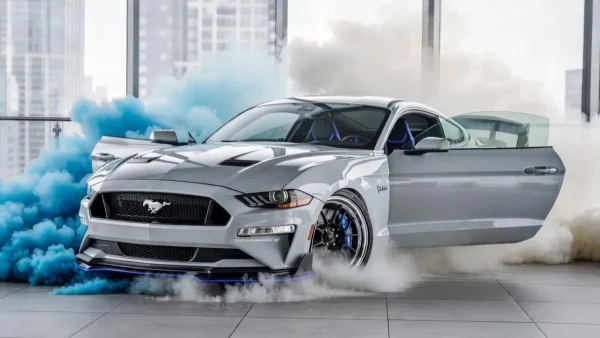
The 2026 Ford Mustang blends classic muscle-car soul with modern performance, advanced tech, and everyday usability—proving that America’s most iconic sports car still leads the pack in a rapidly changing automotive world.
Following all the data on this car and owner feedback, this guide provides an authoritative, in-depth resource for the 2026 Ford Mustang. All information is based on official Ford specifications, independent reviews, and real-world data. Whether you’re a first-time buyer researching “2026 Ford Mustang specs” or an enthusiast comparing “2026 Mustang trims,” this article delivers practical, unbiased insights to help you decide.
Key Takeaway
– The 2026 Ford Mustang continues as America’s last true pony car with gas-powered performance.
– Offers EcoBoost, GT V8, and Dark Horse trims for every driving style.
– Delivers strong performance, modern tech, and competitive pricing.
– Maintains high resale value and strong reliability ratings.
– Remains a top choice for enthusiasts despite the rise of EVs.
Contents
Why The 2026 Ford Mustang Continues To Define American Performance In An Electric Era
The Ford Mustang isn’t just a car—it’s a cultural phenomenon that has embodied the spirit of American freedom, power, and innovation since its debut on April 17, 1964, at the New York World’s Fair. Over 10 million units sold worldwide, the Mustang has outlasted economic recessions, fuel crises, and shifting regulations, remaining the world’s best-selling sports car for over a decade. In 2026, amid the rise of electric vehicles (EVs) like the Tesla Model 3 Performance and hybrid crossovers, the Mustang stands as a beacon for enthusiasts craving rear-wheel-drive thrills, V8 rumble, and manual transmissions.
This seventh-generation Mustang (S650 platform, introduced in 2024) receives subtle yet meaningful updates for 2026, including new color options, the retro-inspired FX Package, and enhanced connectivity features. These refinements build on a foundation of driver-focused design, making it more accessible and exciting than ever. Unlike rivals such as the discontinued Chevrolet Camaro (last model year 2024) or the aging Dodge Challenger (phasing out V8s), the Mustang balances heritage with modernity without compromising its soul.
In this comprehensive 2026 Ford Mustang guide, we’ll dive deep into its history, design, performance specs, trim levels, pricing, ownership costs, reliability, buying tips, and cultural legacy. Expect data-backed comparisons, real-world advice, and visual aids to enhance your understanding—optimized for searches like “2026 Mustang performance review” or “best 2026 Ford Mustang trim for daily driving.” By the end, you’ll have the tools to determine if this pony car fits your lifestyle.
The Mustang Legacy: A Deep Dive into How America’s Pony Car Revolutionized Automotive History
The Mustang’s story begins with Lee Iacocca’s vision for an affordable, stylish sports car targeting baby boomers. Priced at just $2,368 in 1964 (about $23,000 today), it sold 22,000 units on day one and over 400,000 in its first year, birthing the “pony car” segment. Competitors scrambled: Chevrolet launched the Camaro in 1967, Dodge the Challenger in 1970, but none matched the Mustang’s enduring appeal.
The golden era of the late 1960s saw high-performance variants like the 1965 Shelby GT350 (306 hp from a 289 V8) and the 1969 Boss 429 (375 hp, designed for NASCAR homologation). These models dominated Trans-Am racing, with legends like Parnelli Jones securing championships. The 1970s brought challenges: the 1973 oil crisis and emissions laws downsized engines, leading to the much-maligned Mustang II (1974-1978), which prioritized fuel efficiency over power.
Resurgence came in the 1980s with the Fox-body platform, beloved by tuners for its lightweight design and modifiability. The 1990s SVT Cobra models pushed boundaries with supercharged V8s, while the 2005 retro redesign (S197) reignited passion with 300+ hp base V8s. The sixth generation (S550, 2015-2023) introduced independent rear suspension, turbo fours, and global sales, exporting to over 140 countries. Entering the seventh generation in 2024, the Mustang evolved with digital cockpits and track-ready tech.
For 2026, Ford refines this further, adding nostalgic elements like the FX Package (echoing 1980s Fox-body aesthetics with white wheels and badges) and new colors such as Adriatic Blue Metallic. This evolution ensures the Mustang remains relevant, even as Ford explores electrification with the Mustang Mach-E SUV—keeping the coupe/convertible pure for purists. In an era where EVs promise instant torque but lack the visceral engagement of internal combustion, the Mustang’s legacy reminds us why mechanical soul matters. Owners often report a “grin factor” unmatched by electric alternatives, based on surveys from J.D. Power and Consumer Reports.
2026 Ford Mustang Overview: Key Updates And What Sets It Apart?
The 2026 Mustang is a carryover from the 2024 redesign but with targeted enhancements for better usability and appeal. No full redesign, but new features like the unlimited Wi-Fi hotspot (via Ford Connectivity Package) and magnesium-framed panoramic curved display address modern demands. Available in Fastback (coupe) and Convertible body styles, it sticks to rear-wheel drive, rejecting all-wheel drive or hybridization for now—unlike the Challenger’s optional AWD.
Standout updates include:
1. New Colors and Styling: Adriatic Blue Metallic, Orange Fury Metallic Tri-coat, and 11 total options; new seat belt colors for personalization.
2. FX Package: Exclusive to GT Premium, adds Oxford White wheels and badging for a retro Fox-body vibe.
3. RTR Package: A Ford-licensed performance upgrade with anti-lag turbo tech, Brembo brakes, and unique graphics.
4. Tech Boost: Over-the-air updates, wireless charging, and class-first electronic drift brake on Dark Horse.
Dimensions remain compact: 189.4-189.7 inches long, 81.9 inches wide, 55-55.2 inches tall, with a 107-inch wheelbase—ideal for agile handling without feeling oversized. Fuel economy varies by trim, but expect 22-33 mpg combined for EcoBoost models, lagging EVs but competitive among gas sports cars. Compared to rivals, the Mustang’s availability (Camaro is gone, Challenger may follow) makes it the last standing pony car. It’s also more affordable and reliable long-term, per Edmunds and RepairPal data.
Exterior Design Philosophy: Blending Heritage With Modern Aerodynamics
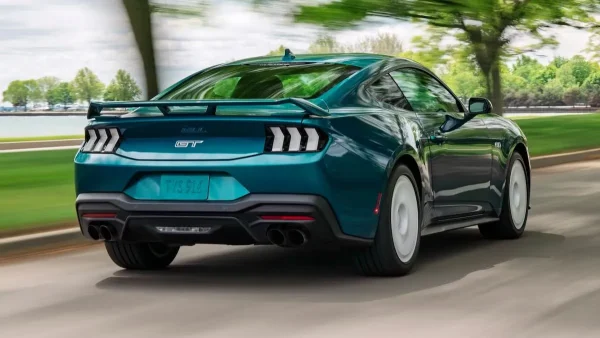
The 2026 Mustang’s exterior honors classics like the 1965 fastback with a long hood, short deck, and muscular haunches, while incorporating aero tweaks for efficiency. The front fascia features a wider grille for better cooling, LED headlamps with signature tri-bar motifs, and revised air intakes on GT/Dark Horse trims. Aerodynamic elements include an underbody shield, front splitter, and rear diffuser, reducing drag for better highway stability and up to 1-2 mpg gains. The rear sports sequential LED taillights—a nod to 1960s models—and optional spoilers for downforce.
Visual highlights:
1. Pony badge on grille.
2. Available wedge decklid spoiler.
3. Heated sideview mirrors with Pony puddle lamps on Premium trims.
Drawbacks? Convertibles add weight (about 200 lbs), slightly dulling handling, and the design prioritizes style over ultimate aero efficiency compared to sleeker EVs.
Interior Design And Technology: A Driver-Centric Cockpit With Modern Amenities
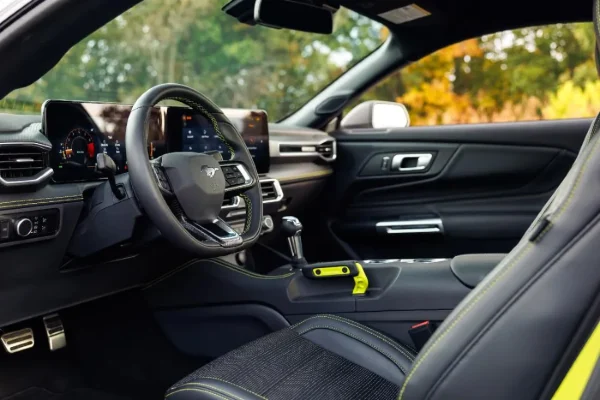
Step inside the 2026 Mustang, and you’re greeted by a fighter-jet-inspired cockpit blending analog charm with digital prowess. The dual-screen setup—a 12.4-inch digital instrument cluster and 13.2-inch touchscreen—runs Ford’s SYNC 4A, supporting wireless Apple CarPlay, Android Auto, over-the-air updates, and voice commands.
Materials upgrade with soft-touch surfaces, contrast stitching, and options like leather/Alcantara upholstery or RECARO seats. Premium trims add heated/ventilated seats, a heated steering wheel, and ambient lighting with MyColor customization. Practicality shines with 13.5 cubic feet of trunk space (11.4 in convertibles) and fold-flat rear seats for gear.
Tech features:
Ford Co-Pilot360: Adaptive cruise, blind-spot monitoring, lane-keeping.
Unlimited Wi-Fi for 10 devices (1-year included).
Bang & Olufsen audio on Premium models.
Here’s a glimpse of the cockpit:
While spacious for two, rear seats are tight for adults—better for kids or bags. Noise cancellation helps on convertibles, but wind noise persists at highway speeds.
2026 Ford Mustang Engine Options, Performance Specs, And Acceleration
Powertrains cater to diverse needs, from efficient daily drivers to track beasts.
1. EcoBoost 2.3L Turbo Inline-4: 315 hp @ 5,500 rpm, 350 lb-ft @ 3,000 rpm. 0-60 mph in ~5.3 seconds, top speed 145 mph. Paired with 10-speed automatic; 22/33/26 mpg city/highway/combined.
2. GT 5.0L Coyote V8: 480 hp (486 with active exhaust), 415 lb-ft (418 with active exhaust). 0-60 in ~4.0 seconds, quarter-mile ~12.5 seconds. Manual or automatic; 15/24/18 mpg.
3. Dark Horse 5.0L Coyote V8: 500 hp, 418 lb-ft. 0-60 in ~3.7 seconds. TREMEC 6-speed manual or 10-speed auto; MagneRide suspension standard; 14/22/17 mpg.
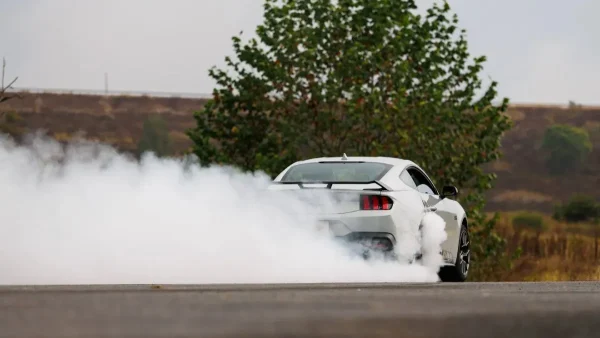
All models feature independent rear suspension, Brembo brakes on higher trims, and selectable modes (Normal, Sport, Track, Drag, Snow/Wet). The electronic drift brake on Dark Horse adds fun for controlled slides.
Compared to rivals: The Mustang GT‘s 480 hp edges the last Camaro SS‘s 455 hp, with better fuel economy (18 vs. 20 mpg combined). Challenger R/T offers 375 hp but heavier curb weight dulls agility.
| Trim | Engine | HP/Torque | 0-60 mph | MPG (City/Hwy/Comb) | Transmission Options |
EcoBoost | 2.3L Turbo I4 | 315/350 | ~5.3s | 22/33/26 | 10-speed Auto |
GT | 5.0L V8 | 480-486/415-418 | ~4.0s | 15/24/18 | 6-speed Manual or 10-speed Auto |
Dark Horse | 5.0L V8 | 500/418 | ~3.7s | 14/22/17 | 6-speed Manual or 10-speed Auto |
Driving Dynamics And Ride Quality: From Daily Commutes To Track Days
The Mustang’s chassis shines with precise steering, balanced weight distribution (53/47 front/rear), and hydraulic dampers. MagneRide (optional on GT, standard on Dark Horse) adapts in milliseconds for comfort or sharpness.
In real-world testing, the EcoBoost handles twisty roads with poise, while V8 models deliver exhilarating acceleration and exhaust notes. Drawbacks include firm ride on rough pavement and higher noise levels than luxury cars. For track enthusiasts, the Dark Horse’s Handling Package (stiffer springs, larger sway bars) and coolers for oil/transmission/differential ensure sustained performance.
Trims And Pricing: Detailed Breakdown For Every Budget
With nine trims starting at $32,640, the Mustang offers value. Average transaction prices are lower—e.g., EcoBoost at $33,423.
Trim | Starting MSRP | Key Features |
|---|---|---|
EcoBoost Fastback | $32,640 | 2.3L Turbo, 18″ wheels, SYNC 4A, Co-Pilot360 |
EcoBoost Premium Fastback | $36,345 | Heated/vented seats, ambient lighting, 19″ wheels |
EcoBoost Convertible | $40,440 | Power soft top, same as Fastback |
EcoBoost Premium Convertible | $41,845 | Premium upgrades, Pony puddle lamps |
GT Fastback | $46,560 | 5.0L V8, GT badges, hood vents |
GT Premium Fastback | $51,080 | Leather, B&O audio, FX Package option |
GT Premium Convertible | $56,580 | Convertible with Premium features |
Dark Horse | $64,080 | 500 hp V8, MagneRide, Brembo brakes |
Dark Horse Premium | $69,075 | RECARO seats, unique accents, Handling Package option |
Options like Performance Package ($4,995 on GT) add value but inflate costs—watch for deals via Ford incentives.
Ownership Costs And Long-Term Reliability: What To Expect?
Annual ownership costs average $7,000-$9,000 over five years, per Edmunds: fuel ~$2,500 (V8), insurance $1,300-$1,500, maintenance $709/year. Reliability scores 5/5 from Kelley Blue Book owners, above average.
Breakdown (5-year totals for GT):
Fuel: $12,500
Insurance: $6,983
Maintenance: $3,545
Repairs: Low frequency, average severity.
EcoBoost saves ~$1,000/year on fuel. Strong resale (50-60% retention after 3 years) offsets costs. Common issues: Minor electronics glitches, but Ford’s warranty (3yr/36k basic, 5yr/60k powertrain) covers most.

Buying Guide: How To Choose The Right 2026 Mustang Trim And Avoid Common Pitfalls?
For daily drivers: EcoBoost Premium ($36,345) offers efficiency (26 mpg) and comfort. Enthusiasts: GT Premium ($51,080) with manual for V8 thrills.
Pros: Affordable power, fun factor, community support.
Cons: Poor fuel economy on V8s, limited rear space, higher insurance for young drivers.
Compare to rivals:
Vs. Camaro (last models): Mustang has better visibility, tech; Camaro edges in handling but discontinued.
Vs. Challenger: Mustang is nimbler (3,800 lbs vs. 4,200); Challenger roomier but thirstier (16/25 mpg).
Tips: Test drive multiple trims, check incentives, consider certified pre-owned for savings. Factor in mods—aftermarket support is vast.
Cultural Significance: The Mustang’s Enduring Role In Pop Culture And Motorsports
From Steve McQueen’s 1968 Bullitt chase to modern films like John Wick, the Mustang symbolizes rebellion. It’s starred in over 3,000 movies and inspired clubs with millions of members. In racing, it dominates SCCA events and NHRA drag strips. The 2026 model’s track tech continues this, proving gas cars thrive amid EVs.
FAQ About The 2026 Ford Mustang
Q: Is the 2026 Ford Mustang fully redesigned?
A: No, it’s an evolution of the 2024 seventh-gen with updates like new colors and packages.
Q: How reliable is the 2026 Mustang?
A: Above average, with a 5/5 owner rating; proper maintenance key.
Q: Is the 2026 Ford Mustang worth buying?
A: Yes. The 2026 Ford Mustang offers strong performance, modern technology, and classic rear-wheel-drive handling, making it one of the best-value performance cars available today.
Q: What engines are available in the 2026 Mustang?
A: The 2026 Mustang offers a 2.3L EcoBoost turbocharged engine, a 5.0L Coyote V8 in the GT, and a high-performance 5.0L V8 in the Dark Horse model.
Q: How fast is the 2026 Ford Mustang?
A: The Mustang GT reaches 0–60 mph in about 4.0 seconds, while the Dark Horse does it in approximately 3.7 seconds.
Q: Does the 2026 Mustang still offer a manual transmission?
A: Yes. Manual transmissions are available on GT and Dark Horse trims, making it one of the few remaining sports cars to offer one.
Q: Is the 2026 Mustang reliable?
A: The 2026 Mustang scores above average in reliability, supported by Ford’s 5-year/60,000-mile powertrain warranty and strong owner satisfaction ratings.
Q: How much does the 2026 Ford Mustang cost?
A: Pricing starts around $32,640 for the EcoBoost and goes up to $69,000+ for the Dark Horse Premium.
Q: Is the Mustang better than the Camaro or Challenger?
A: Yes. With the Camaro discontinued and the Challenger ending V8 production, the Mustang stands as the only modern pony car offering V8 power, manual transmission, and daily usability.
Conclusion: Why The 2026 Ford Mustang Remains Essential In A Changing Automotive Landscape
In 2026, the Mustang proves timeless: thrilling, affordable, and evolving without losing identity. For buyers seeking “2026 Ford Mustang buying advice,” it’s a smart choice blending performance and practicality. While EVs rise, this muscle car reminds us of driving’s joy—get behind the wheel and feel the legacy. The 2026 Ford Mustang proves muscle cars still matter. With V8 power, modern tech, and unmistakable style, it blends old-school thrills with today’s performance and safety standards—making it one of the most exciting cars you can buy right now.
Sources: Ford Motor Company, Ford Performance, Car and Driver, MotorTrend, Edmunds, SAE International, IMSA.


0 Comments