Last Updated: August 5, 2026 | Read Time: 8 minutes
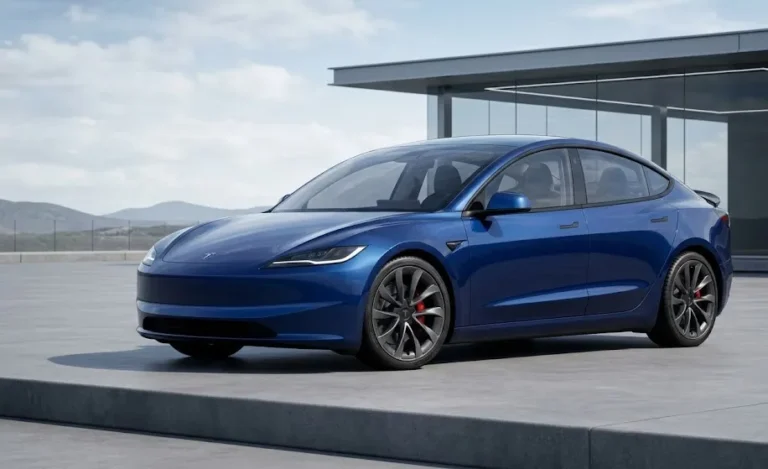
The 2026 Tesla Model 3 Long Range AWD achieves 358 miles of EPA-estimated range. The Performance AWD reaches 60 mph in 2.9 seconds with Track Pack enabled. The Standard Range RWD starts at $40,240 before any applicable federal tax credit that could reduce the net price to $32,740 for qualifying buyers. Every Model 3 connects to the Tesla Supercharger network of more than 50,000 chargers worldwide.
The Model 3 is the best-selling electric sedan in American history, and the 2024 Highland refresh that carries through to 2026 addressed the specific fit-and-finish and interior quality concerns that had been the car’s most consistent criticism. None of that makes the Model 3 right for every buyer. This guide explains who it is right for — and who it is not.
Quick Facts – 2026 Tesla Model 3
Three Variants:
— Standard Range RWD: ~272 miles range / 0-60 in ~5.8 seconds / starting ~$40,240
— Long Range AWD: 358 miles range / 0-60 in ~4.2 seconds / starting ~$47,240
— Performance AWD: ~315 miles range / 0-60 in 2.9 seconds (Track Pack) / starting ~$53,240
— Charging Network: Tesla Supercharger — 50,000+ worldwide / 250 kW max charging rate (V3 Supercharger)
— Charging Speed: 10-80% in approximately 25 minutes at V3 Supercharger
— Home Charging: Level 2 (240V) — approximately 30-35 miles per hour of charge
— Standard Features (all variants): Autopilot, 15.4-inch touchscreen, 8-inch rear touchscreen, wireless CarPlay/Android Auto, wireless charging, heated front and rear seats, glass roof, HEPA air filter, over-the-air updates, Tesla app integration
— Performance Exclusive: Track Pack ($5,000) — carbon fiber spoiler, upgraded Brembo brakes, lowered suspension, 0-60 in 2.9 sec
— FSD: Optional $8,000 purchase or $99/month subscription — driver assistance only, not autonomous
— Federal Tax Credit: Up to $7,500 for qualifying buyers (income limits and price caps apply — verify at IRS.gov)
— Autopilot vs FSD: Autopilot standard (adaptive cruise + lane centering) / FSD optional (auto lane change, autopark, summon, traffic light control)
— Warranty: 4 years/50,000 miles basic / 8 years/100,000 miles battery and drive unit (Long Range) / 8 years/120,000 miles (Performance)
— Reliability: Consumer Reports above-average predicted reliability 2026
— Safety: NHTSA 5-star overall / IIHS Top Safety Pick+ 2026
— Over-the-Air Updates: Software improvements pushed remotely — Model 3 capabilities improve after purchase
— Key Interior: 15.4-inch horizontal touchscreen, 8-inch rear screen, ambient lighting, ventilated front seats, improved material quality vs pre-Highland
— Competition: BMW 3 Series (i3 eDrive variant), Hyundai Ioniq 6, Polestar 2, Audi A4 e-tron
Sources: Tesla.com (June 2026), Edmunds (June 2026), Consumer Reports (December 2025), Car and Driver (May 2026), MotorTrend (April 2026), InsideEVs (May 2026)
Overview
The Car That Made Electric Sedans Normal — And Why That Is Still Remarkable
The Tesla Model 3 did not invent the electric car. GM did that in the 1990s with the EV1 — too expensively, too briefly, and too early for the infrastructure that would have made it work. Nissan mass-marketed the Leaf starting in 2011 with a range that was honest about its limitations and a price that made it accessible. But the Model 3, launched in 2017 as Tesla’s mass-market answer after years of premium-priced Model S production, is the car that made an electric vehicle feel like a regular car rather than a compromise, an experiment, or a statement.
The specific achievement of the Model 3 is not one specification or one technology. It is the combination of range that made range anxiety optional rather than mandatory, a charging network that made long-distance travel genuinely feasible rather than theoretically possible, software-driven features that improved the car after purchase in ways no gasoline vehicle could replicate, and a driving experience — particularly in the Performance variant — that was genuinely engaging rather than simply efficient. A car that is better than the equivalent gasoline car in some ways, worse in others, and approximately equal in the ways that matter most to the majority of drivers who buy compact premium sedans.
The 2024 Highland refresh addressed the pre-Highland Model 3’s most consistent criticisms: interior material quality, panel gap consistency, front seat comfort, and sound deadening. The revised interior — with a new dashboard design, improved materials, ventilated front seats, an 8-inch rear touchscreen for rear passengers, and significantly better acoustic insulation — made the Model 3 competitive with the established German premium sedans on interior experience rather than simply superior on technology and range.
The 2026 Model 3 carries the Highland architecture forward with software improvements delivered over-the-air throughout the year. The specific purchase decision for 2026 is not whether the Model 3 is good — it is clearly good. The specific decision is which variant matches your driving patterns, whether the Supercharger network covers your regular routes, and whether the software-centric ownership experience aligns with how you want to live with a car.
Section 1 – The Three Variants
Standard Range, Long Range, And Performance — What Each One Actually Is
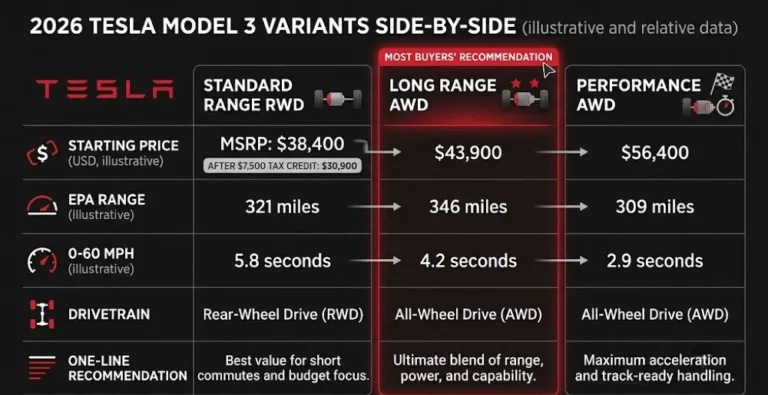
The 2026 Model 3 is available in three configurations that differ in range, performance, drivetrain, and price. Unlike many manufacturers who use trim names to suggest luxury progression, Tesla’s Model 3 variants are named for their specific capability differentiation — Standard Range, Long Range, and Performance — and each name is accurate.
Standard Range RWD (~$40,240)
The Standard Range RWD is the entry point into Model 3 ownership and the configuration that the majority of American Model 3 buyers who live in urban or suburban environments find adequate for their actual driving patterns. The approximately 272 miles of EPA-estimated range covers more than seven days of the average American’s daily driving — the average American drives approximately 37 miles per day — before requiring a charge.
The RWD configuration uses a single rear motor and is the lightest Model 3 variant. The rear-wheel-drive character is notable in the positive sense — the Model 3’s rear-wheel-drive balance provides a driving experience that is more engaging than a front-wheel-drive or neutral all-wheel-drive electric sedan. In dry conditions, the Standard Range feels properly sporty without the 0-60 drama of the Performance. In wet or snowy conditions, RWD requires the specific attention that any rear-wheel-drive car requires.
The Standard Range’s 5.8-second 0-60 time is genuinely quick — quicker than most conventional compact sedans at any price — without the attention-demanding acceleration of the AWD variants. It is the Model 3 for buyers whose primary criteria are range adequacy for daily use, the Supercharger network benefit, the software ecosystem, and the lowest available Model 3 entry price. With the $7,500 federal tax credit for qualifying buyers, the effective net price approaches $32,740 — making the Standard Range one of the most compelling value propositions in the EV market.
Long Range AWD (~$47,240)
The Long Range AWD is the specific Model 3 that most automotive journalists and most experienced EV buyers identify as the best overall variant for the majority of buyers. Its 358-mile EPA-estimated range eliminates the mental calculation that even the Standard Range’s 272 miles occasionally requires — with 358 miles available, a round trip of 150 miles can be completed without charging, and the vast majority of weekend drives, road trips, and variable-schedule weeks pass without the charging infrastructure ever becoming a constraint.
The AWD system adds a front motor alongside the rear unit, providing the all-weather traction confidence that buyers in climates with genuine winter weather require. The 0-60 time of approximately 4.2 seconds is more than fast enough for the vast majority of performance driving that a compact sedan encounters, and it arrives from the electric motor’s characteristic instant torque delivery rather than requiring a powertrain to build speed.
The Long Range AWD’s specific 358-mile range makes it the Model 3 that appears most often in the recommended configuration for buyers who do significant highway driving, who take regular road trips, or who live in climates where EV range is reduced by cold temperatures. A Long Range AWD that loses 20 to 25 percent of its range in cold weather still has 270 to 285 miles available — adequate for all but the longest single driving days.
At $47,240 before destination and federal credit, the Long Range AWD is priced competitively against the BMW i3 eDrive40 and the Hyundai Ioniq 6 in comparable configurations. Its specific advantages over those alternatives are the Supercharger network’s breadth and the Tesla software ecosystem’s maturity. Where it concedes is in traditional luxury interior quality to the BMW and in charging speed to the Ioniq 6’s 800-volt architecture.
Performance AWD (~$53,240)
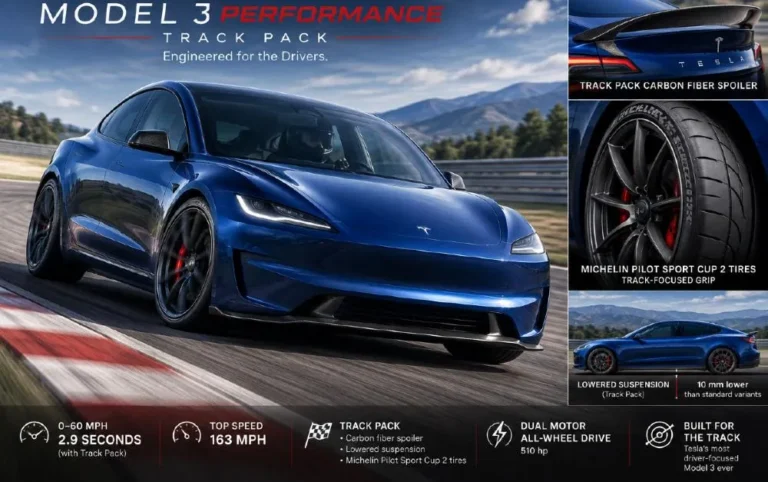
The Model 3 Performance AWD is the variant that most directly challenges the BMW M3, the Audi RS4, and the Mercedes-AMG C43 in straight-line performance while costing significantly less than any of them. The 2.9-second 0-60 time with Track Pack enabled matches or exceeds most dedicated sports sedans at double or triple the price. The 162 mph top speed is appropriate for a car that reaches 60 mph before a passenger has finished saying sixty.
The Track Pack ($5,000 option) is the specific equipment that produces the 2.9-second figure and makes the Performance the genuinely track-capable variant that its name implies. It adds Brembo brake calipers with compound brake pads, a carbon fiber rear spoiler, a lowered adaptive suspension, Michelin Pilot Sport Cup 2 tires, and a specific power boost that releases the full performance capability. Without Track Pack, the Performance runs 0-60 in approximately 3.1 seconds — still extraordinary for a four-door sedan, just not the full expression of what the variant is capable of.
The Performance’s approximately 315-mile range — less than the Long Range AWD’s 358 miles due to the additional power output and performance tire rolling resistance — is adequate for most Performance buyers whose primary use is daily driving and spirited performance rather than maximum range. The Performance’s warranty extends to 8 years and 120,000 miles on the battery and drive unit — 20,000 more miles than the Long Range’s 100,000-mile battery warranty.
The honest trade-off: the Performance’s Michelin Pilot Sport Cup 2 tires wear significantly faster than all-season alternatives, are genuinely poor in wet and cold conditions, and need to be replaced more frequently than the Long Range’s standard tires. Buyers who live in climates with wet winters and who drive the car aggressively should factor tire replacement cost into the Performance’s operating economics.
Section 2 – The Interior And Technology
What The Highland Refresh Actually Changed And Why It Matters
The pre-Highland Model 3’s interior was the most consistent specific criticism in every automotive publication’s evaluation. The cabin used materials that felt appropriate for a $25,000 economy car in a vehicle that started at $40,000. The front seats were too firm for long trips. The sound deadening was insufficient at highway speeds. The absence of a traditional instrument cluster placed all information on the center touchscreen in a way that required eyes-off-road glances that took adjustment.
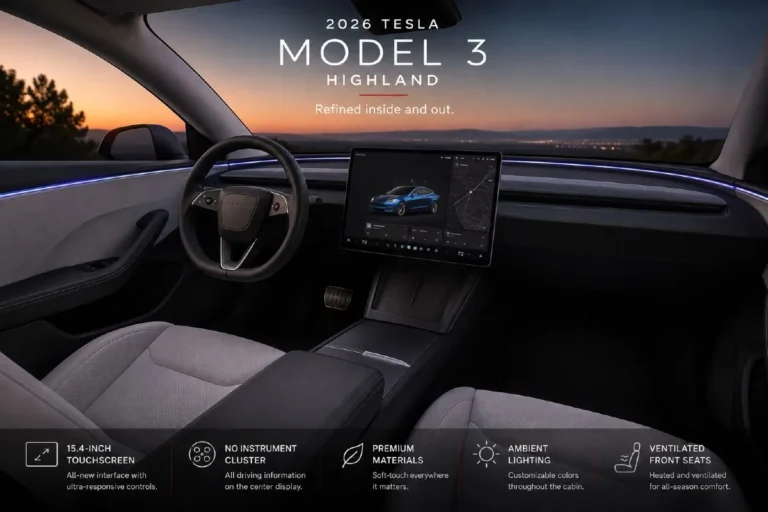
The Highland revision addressed all of these criticisms systematically. The interior now features a new dashboard design with a slimmer profile and ambient lighting that provides the visual warmth that the previous generation lacked. Material quality improvement throughout: soft-touch surfaces on the dashboard and door inserts where hard plastic previously lived. The front seats received complete redesigns with ventilation standard across all variants — an important daily comfort feature in warm climates that the previous Model 3 required an upgrade to access. Sound deadening improvements at the firewall, floor, and around the glass panels significantly reduced highway wind and road noise. These are not minor refinements. The Highland Model 3’s interior is a substantially different experience from the pre-Highland version.
The 15.4-inch horizontal touchscreen controls virtually every vehicle function — climate, navigation, media, phone, vehicle settings, and all driving mode adjustments live on this screen. The absence of physical controls for climate is the interior element that generates the most consistent adjustment period for new Model 3 owners arriving from conventional vehicles. Every swipe of the wipers, every temperature adjustment, every fan speed change happens through the touchscreen. Experienced Tesla owners report this becomes intuitive within weeks. First-time Tesla buyers in the first days of ownership consistently note the specific friction of relearning actions that were previously muscle memory.
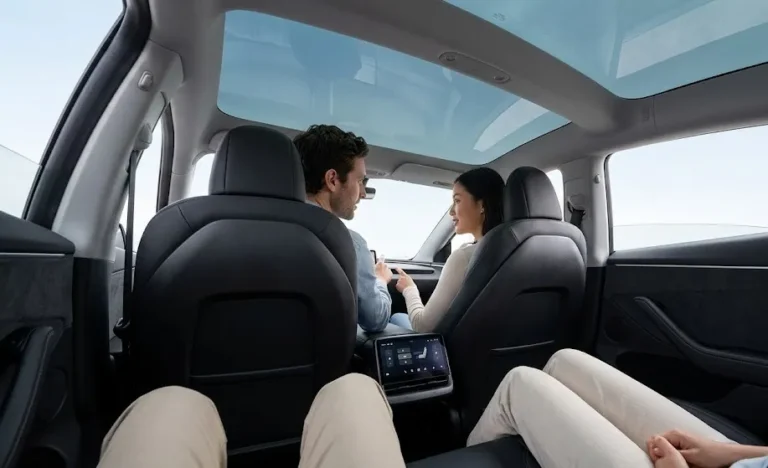
The 8-inch rear touchscreen is a Highland addition with no precedent in the pre-Highland Model 3. Rear passengers control climate, media, and entertainment on their own screen — a family-first convenience feature that makes the Model 3 more competitive as a daily driver for buyers who regularly carry rear passengers. Rear seat heating is controlled from the rear screen rather than requiring a front-seat occupant to adjust it on behalf of rear passengers.
The 15.4-inch front screen displays navigation provided by Google Maps native integration, with over-the-air map updates that keep navigation current without requiring the driver to manage updates. Voice commands using Hey Tesla allow common tasks — navigation, climate, media, phone — to be executed without touchscreen contact. The voice command system’s accuracy has improved substantially through successive over-the-air updates.
The standard Autopilot system — included with every 2026 Model 3 — provides adaptive cruise control that maintains following distance and speed automatically, and Traffic-Aware Cruise Control with Autosteer that maintains the vehicle’s lane position on highway sections. These two features together make highway driving meaningfully less fatiguing than conventional adaptive cruise control and lane centering from non-Tesla manufacturers.
Section 3 – Autopilot VS Full Self-Driving
The Most Important Technology Decision In Any Model 3 Purchase
The Autopilot versus Full Self-Driving decision is the most financially significant optional choice in any Model 3 purchase, and it is one that benefits from complete honest assessment rather than either enthusiastic promotion or reflexive skepticism.
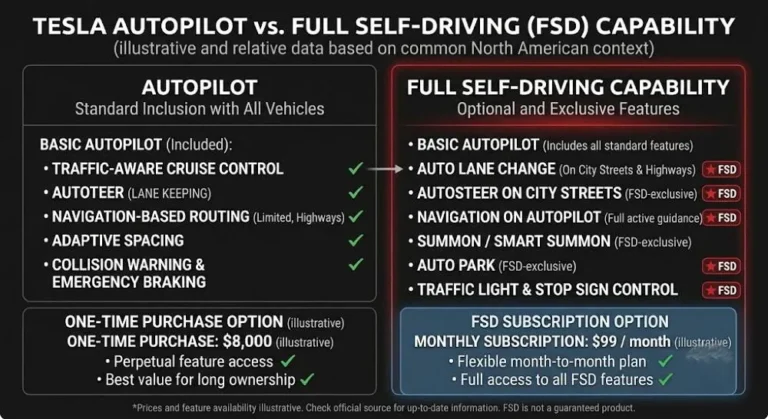
Autopilot is included standard. It provides adaptive cruise control with automatic speed and following distance management and lane centering on highways. It is a well-implemented, genuinely useful driver assistance system that reduces fatigue on highway driving. Every 2026 Model 3 has it. No additional purchase is required.
Full Self-Driving (FSD) is an optional upgrade at $8,000 as a one-time purchase or $99 per month as a subscription. FSD adds automatic lane changes on highways when the driver signals, Navigate on Autopilot for navigating highway interchanges and exits, Autopark for parallel and perpendicular parking assistance, Smart Summon for moving the car from a parking spot to the driver’s location in a parking lot, and Traffic Light and Stop Sign Control for approaching and responding to traffic signals.
The honest assessment: FSD is a powerful driver-assistance system that continues to improve through over-the-air updates. It is not autonomous driving. The driver must remain attentive and ready to take control at any time — FSD will alert the driver when it needs intervention, and it encounters situations where it requires intervention regularly. FSD has not received regulatory approval as a fully autonomous system from NHTSA or any state regulatory authority.
The specific buyer calculation: if you drive primarily on highways and the Autopilot standard system already reduces your highway fatigue adequately, FSD’s additional features are incremental rather than transformative for your specific use case. If you regularly navigate complex urban environments, use parking assistance frequently, or value the cumulative urban driving assistance that FSD provides, the $99 monthly subscription is the financially sensible way to evaluate FSD in your specific driving environment before committing $8,000.
The subscription model — try FSD for one or two months in your actual driving environment, then cancel if the incremental benefit does not justify the ongoing cost — is the specific recommendation for buyers who are uncertain about the FSD value proposition. Committing $8,000 at purchase without that real-world evaluation is not the financially optimal approach for most buyers.
Section 4 – The Supercharger Network
Why Tesla’s Charging Infrastructure Is Still The Most Important EV Ownership Advantage
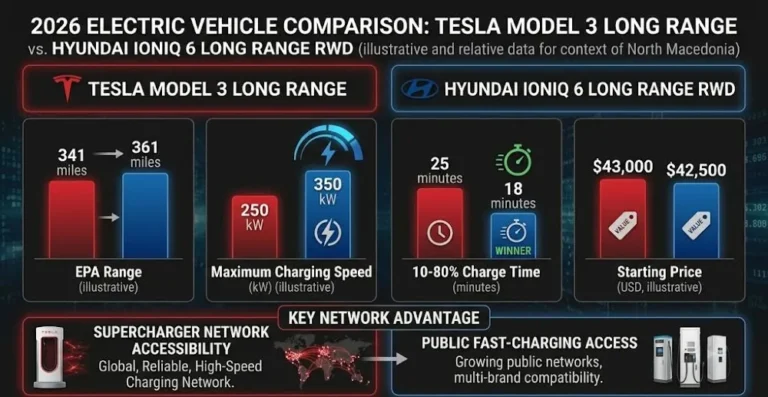
The Tesla Supercharger network is the Model 3’s most significant competitive advantage over every non-Tesla electric vehicle in 2026 — not because of the Model 3’s charging speed specifically, but because of the Supercharger network’s scale, reliability, and user experience compared to every alternative public charging network.
Before purchasing any Model 3, verifying Supercharger coverage on your specific most-traveled routes — particularly for buyers who regularly drive between cities or take highway road trips — is the most practical pre-purchase step available through the Tesla Supercharger network map, which shows all current Supercharger locations and planned new installations.
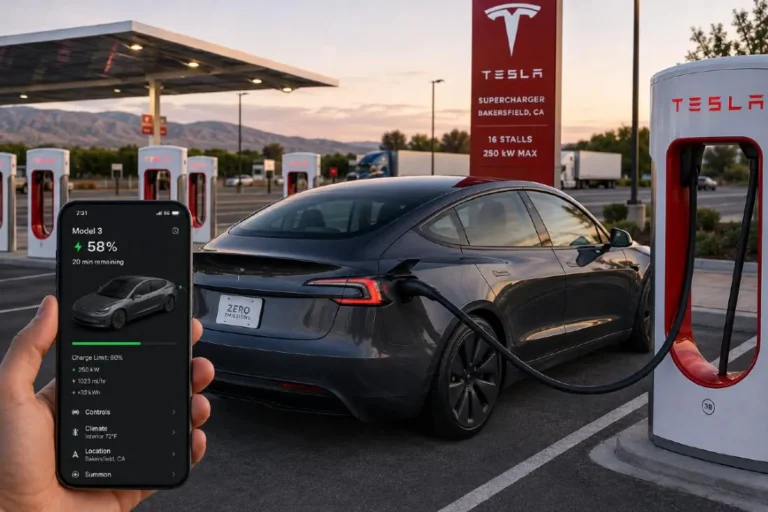
With over 50,000 Superchargers globally and growing, the network provides the density and reliability that makes long-distance EV travel feel like planning a gasoline car trip rather than a logistics exercise. The V3 Supercharger’s 250 kW maximum charging rate allows the Long Range AWD to add approximately 170 miles of range in 15 minutes — enough to cover a typical highway driving segment between stops. The 10 to 80 percent charge at a V3 Supercharger takes approximately 25 minutes in favorable conditions.
The Supercharger network also carries the specific advantage of reliability data accumulated across years of operation and millions of charging sessions. Non-Tesla charging networks — Electrify America, ChargePoint, EVgo — have improved substantially since the Model 3’s launch but still show higher downtime rates and more variable reliability than the Supercharger network in direct comparative analysis.
The plug-and-charge experience at a Supercharger is meaningfully simpler than at most competing networks. Plug in — the car identifies itself through the cable, billing is handled automatically through the Tesla account, and charging begins. No app required at the charger, no RFID card, no troubleshooting of authentication failure. For buyers who have experienced the variability of non-Tesla public charging networks, this difference in user experience is practically significant.
For 2026, all non-Tesla EVs equipped with NACS (North American Charging Standard) connectors have access to the Supercharger network — including Ford, GM, and Rivian products. This has reduced the Supercharger network’s exclusivity, but it has not reduced the practical experience advantage that Tesla’s native integration provides. A Model 3 at a Supercharger communicates its state-of-charge, predicted departure time, and billing automatically. A non-Tesla EV at the same Supercharger provides a less integrated experience by comparison.
The Supercharger network’s NACS adoption means that the same infrastructure the Model 3 has used since launch is now accessible to Ford, GM, and Rivian products — including the electric trucks in our complete guide to electric pickup trucks 2026, which covers the Rivian R1S, GMC Hummer EV, and F-150 Lightning’s Supercharger access experience from the perspective of non-Tesla vehicle owners.
Section 5 – The Competition
BMW, Ioniq 6, And Polestar 2 — Where The Model 3 Leads And Where It Concedes
The 2026 Model 3 competes primarily against the BMW i3 eDrive (the electric 3 Series variant), the Hyundai Ioniq 6, the Polestar 2, and secondarily against the Audi A4 e-tron and Mercedes-Benz EQB. Understanding where the Model 3 genuinely leads and where it genuinely concedes is the most practically useful competitive assessment for any buyer who is cross-shopping.
The Model 3’s primary European and Korean competitors are well-documented — but the American EV sedan market also includes the Ford Mustang Mach-E as an indirect competitor for buyers who want an American-branded electric vehicle rather than a European sedan or a Tesla. Our complete Mustang Mach-E guide covers Ford’s electric SUV from $37,795, showing how it compares to the Model 3 for buyers who are choosing between electric sedans and electric crossovers.
The BMW i3 eDrive40 offers what the Model 3 cannot: the interior quality, the material feel, and the brand prestige of a German luxury manufacturer with decades of premium car expertise. The i3’s driving dynamics have a refinement character — the steering weight, the suspension tuning, the overall composure of the driving experience — that the Model 3 approaches but does not entirely replicate in the same way. For buyers who value traditional luxury interior quality and established brand prestige above charging network convenience and range, the BMW is a legitimate alternative. For buyers who prioritize range, charging network quality, and the Tesla software ecosystem, the i3’s shorter range and BMW’s less developed public charging network are real disadvantages.
The Hyundai Ioniq 6 is the Model 3’s most technically impressive direct competitor in 2026. Its 800-volt charging architecture supports 230 kW DC fast charging that charges from 10 to 80 percent in approximately 18 minutes — measurably faster than the Model 3’s 25 minutes. Its maximum range in long-range RWD configuration exceeds the Model 3 Long Range AWD’s 358 miles.
Its interior quality is genuinely premium for its price point. The Ioniq 6’s disadvantage is the charging network — it uses the NACS connector for Supercharger access, which works but provides a less integrated experience than the Model 3’s native Supercharger integration. For buyers who prioritize charging speed and range per dollar over software ecosystem, the Ioniq 6 is the honest competitive recommendation.
The Polestar 2 is the most direct stylistic and philosophical alternative to the Model 3 — a premium EV sedan from a Swedish manufacturer (owned by Geely/Volvo) with a thoughtful interior design, Google Automotive Services integration, and a more conservative, less attention-seeking design language than the Model 3. The Polestar 2 charges more slowly than the Model 3 and lacks access to the Supercharger network at the Model 3’s integration level. For buyers who want an alternative to Tesla’s specific brand identity, the Polestar is the most coherent alternative to cross-shop.
The 2026 Model 3 is the most complete electric sedan available at its price point right now — but the electric sedan market is developing rapidly, with new competitors confirmed for the 2027 to 2029 window. Our complete guide to future cars 2026–2029 covers the upcoming electric vehicles that buyers who are considering whether to buy now or wait should evaluate, including Ford’s next-generation electric products and GM’s expanding EV lineup.
Section 6 – Reliability, Safety, And Ownership Experience
What Consumer Reports And NHTSA Actually Say About Living With A Model 3
The 2026 Model 3’s reliability standing is the clearest improvement in the car’s ownership story relative to its first two generations. Consumer Reports gives the Model 3 an above-average predicted reliability score in 2026 — a significant improvement from the consistently below-average scores that the pre-Highland generation received. The specific improvements tracked by Consumer Reports and owner communities relate to: panel gap consistency improvements in Highland production, paint application quality improvements, touchscreen responsiveness and reliability, and the elimination of specific climate system failure modes that affected early production.
Tesla’s approach to reliability improvement is software-first in a way that no traditional manufacturer replicates. Issues that would require a physical dealer visit and parts replacement in a conventional vehicle are frequently resolved through over-the-air software updates that arrive while the car is parked overnight. This approach produces a car that can genuinely improve in functional reliability after purchase — a specific ownership experience that no gasoline car provides.
The Model 3 earned IIHS Top Safety Pick+ recognition for 2026, its strongest safety rating from the institute. NHTSA gives the Model 3 a 5-star overall rating. The Autopilot system — and FSD when installed — contributes to active safety through automatic emergency braking, lane departure avoidance, and blind spot monitoring as standard features across all variants.
Service is the Model 3’s most frequent practical limitation for some owners. Tesla’s service center network, while expanded significantly since 2020, is not as geographically broad as BMW’s, Hyundai’s, or any other manufacturer’s dealership network in the United States. Tesla’s mobile service technicians — who come to the owner’s location for many common service needs — address a significant portion of routine service requirements without requiring a service center visit. For major repairs or repairs that require in-person service, wait times at Tesla service centers can exceed conventional dealership wait times in some markets.
The 4-year/50,000-mile basic warranty and 8-year/100,000-miles (or 120,000 miles for Performance) battery and drive unit warranty provide meaningful coverage for the components most specific to EV ownership risk. The battery warranty’s 70 percent minimum retention requirement means Tesla guarantees the battery will retain at least 70 percent of its rated capacity through the warranty period — a specific commitment to long-term energy storage degradation that addresses the most common long-term EV ownership concern.
Tesla’s above-average Model 3 predicted reliability in Consumer Reports’ 2026 study reflects the brand’s 9th-place overall ranking — a standing that our complete guide to the most reliable cars 2026 documents in full alongside every other American and domestic-market brand’s current reliability position, giving Model 3 buyers the complete picture of how Tesla compares to Toyota, Buick, Ford, and every other brand in the current study.
Section 7 – The Buying Decision
Which Model 3 Is Right For Your Specific Situation
The Model 3 purchase decision has two components: which variant, and which options. Both decisions benefit from being made in the context of your specific driving patterns rather than in the context of maximum specifications.
If you drive fewer than 250 miles on any single day and charge at home most nights — which describes the vast majority of American drivers — the Standard Range RWD is genuinely adequate for your needs. The 272-mile range provides the buffer that typical daily driving requires, the charging at home on a Level 2 charger fills the battery overnight, and the Supercharger network handles the occasional longer trip. The $40,240 starting price with the potential $7,500 federal tax credit brings the effective cost below $33,000 for qualifying buyers — one of the most compelling value calculations in the entire EV market.
The Model 3’s purchase price calculation — $40,240 base less the potential $7,500 federal tax credit — is the starting point for total ownership cost, but the annual insurance expense for an electric sedan in the $40,000 to $55,000 range is a meaningful ongoing number. Our guide to car insurance cost in the USA in 2026 covers how EV classification, vehicle value, and performance ratings affect what American drivers pay annually, completing the total ownership picture for any Model 3 variant decision.
If you regularly drive between cities on the same route, take road trips multiple times per year, live in a cold climate where EV range is reduced by winter temperatures, or simply want the confidence of knowing range is never a decision variable, the Long Range AWD at $47,240 is the specific recommendation. The 358 miles of range makes range anxiety genuinely optional rather than manageable. The AWD provides all-weather confidence. The 4.2-second 0-60 is more than adequately engaging for everyday performance needs.
If you care about driving dynamics in a way that makes 2.9-second 0-60 times and Brembo brakes relevant to your enjoyment, the Performance AWD at $53,240 plus the $5,000 Track Pack is the specific recommendation. Budget the Michelin Sport Cup 2 tire replacement cycle into the operating costs — these tires wear faster and cost more than all-season alternatives. The Performance’s joy in spirited driving is real and consistently documented in every automotive press evaluation.
On FSD: try the subscription before committing $8,000. One month at $99 in your actual daily driving environment — your specific commute, your specific urban density, your specific highway routes — tells you more about whether FSD is worth $8,000 for you than any published evaluation. Many buyers find the subscription experience valuable enough to justify the full purchase after one month. Many others find the standard Autopilot adequate for their specific use and cancel the subscription.
FAQ
Q: How much does the 2026 Tesla Model 3 cost?
A: The 2026 Tesla Model 3 starts at $40,240 for the Standard Range RWD before the $1,390 destination charge. The Long Range AWD starts at approximately $47,240 and the Performance AWD at $53,240. The Performance’s Track Pack is an additional $5,000. The federal EV tax credit of up to $7,500 may apply for qualifying buyers, potentially reducing the Standard Range’s effective cost to approximately $32,740. Tesla’s pricing changes frequently and current pricing should always be verified at Tesla.com.
Q: What is the range of the 2026 Tesla Model 3?
A: The 2026 Tesla Model 3 Long Range AWD achieves 358 miles of EPA-estimated range — the highest in the lineup. The Standard Range RWD achieves approximately 272 miles and the Performance AWD achieves approximately 315 miles. Real-world range varies with driving speed, temperature, and climate control use. At highway speeds of 70 to 75 mph with climate control running in winter conditions, the Long Range AWD typically achieves 270 to 300 miles — still the highest real-world range of any comparably priced electric sedan.
Q: How does the Model 3 Performance compare to gasoline sports sedans?
A: The 2026 Model 3 Performance AWD with Track Pack reaches 0-60 mph in 2.9 seconds and has a top speed of 162 mph — quicker to 60 than the BMW M3 Competition, the Audi RS4, and the Mercedes-AMG C63 at less than half their prices. The Model 3 Performance’s advantage is in straight-line acceleration where electric motor torque delivery is instantaneous. The gasoline alternatives provide more sensory involvement in the driving experience — engine sound, gear changes, and high-RPM character — that the Model 3 Performance cannot replicate but that also comes at significantly higher purchase and operating costs.
Q: Is the Tesla Model 3 good for long road trips?
A: Yes, with the Supercharger network. The Long Range AWD’s 358-mile range allows segments of 250 to 300 miles between Supercharger stops on typical highway trips, and V3 Supercharger stops of 20 to 25 minutes add sufficient range for the next segment. The Tesla navigation system plans Supercharger stops automatically, arriving at the charger with the optimal charge level for fast charging. Long-distance road trips in the Model 3 require more planning than in a gasoline car, but the Supercharger network’s density and reliability make them consistently feasible rather than logistically complex.
Q: What is Consumer Reports’ view of Model 3 reliability in 2026?
A: Consumer Reports gives the 2026 Tesla Model 3 an above-average predicted reliability rating — part of Tesla’s 9th-place overall brand ranking in Consumer Reports’ 2026 reliability study. This is a meaningful improvement from the below-average ratings the pre-Highland generation received. The most commonly cited reliability improvements in the Highland generation are panel gap consistency, paint quality, touchscreen reliability, and climate system durability. Tesla’s over-the-air update capability has also addressed specific software reliability issues remotely without requiring service center visits.
The Bottom Line
The 2026 Tesla Model 3 is the best electric sedan for most buyers who want an electric sedan. That is not a marketing claim — it is the specific conclusion that follows from the combination of the Supercharger network’s breadth, the Highland refresh’s interior quality improvements, the Long Range’s 358-mile range, Consumer Reports’ above-average predicted reliability, the IIHS Top Safety Pick+ designation, and the value calculation that the Standard Range’s $40,240 starting price represents against competitors with less developed charging infrastructure.
It is not the best electric sedan for buyers who value traditional luxury interior quality above all else — the BMW i3 and the Audi A4 e-tron provide more premium material feel at comparable prices. It is not the best electric sedan for buyers who want the fastest charging — the Hyundai Ioniq 6’s 800-volt architecture charges from 10 to 80 percent in 18 minutes versus the Model 3’s 25 minutes. And it is not the right car for buyers who find the software-centric, touchscreen-everything interior experience actively frustrating rather than simply requiring adjustment.
For the buyers it is right for — and that is the majority of buyers cross-shopping the premium compact electric sedan segment in 2026 — the Model 3 provides the most complete combination of range, network, performance, technology, and value available in any electric sedan at its price point. The Highland refresh closed the interior quality gap that had been the car’s most defensible weakness. What remains is a genuinely excellent electric sedan that happens to be the best-selling one in American history for consistently good reasons.
Editorial Note
This article was written and reviewed in August 2026. All specifications, pricing, and performance figures are sourced from the following primary sources: Tesla.com official 2026 Model 3 product page (June 2026) — primary source for all three variant starting prices ($40,240 Standard, $47,240 Long Range, $53,240 Performance), range figures (272 miles Standard, 358 miles Long Range, 315 miles Performance), 0-60 times (5.8 seconds Standard, 4.2 seconds Long Range, 2.9 seconds Performance with Track Pack), Track Pack price ($5,000), FSD pricing ($8,000 purchase / $99 monthly), warranty terms (4yr/50K basic; 8yr/100K Long Range battery; 8yr/120K Performance battery), and standard feature list across all variants;
Edmunds’ 2026 Tesla Model 3 review (June 2026) — primary source for the Long Range AWD recommendation for most buyers and the Highland interior improvement assessment; Consumer Reports’ 2026 reliability rankings (December 2025) — primary source for the Model 3 above-average predicted reliability designation and Tesla’s 9th-place brand ranking;
Car and Driver’s Tesla Model 3 evaluation (May 2026) — supplementary source for Performance track capability assessment and Michelin Sport Cup 2 tire wear documentation; MotorTrend (April 2026) — supplementary source for Supercharger network scale and 10-80% charge time at V3 (25 minutes); InsideEVs (May 2026) — supplementary source for Ioniq 6 800-volt 18-minute 10-80% charge comparison.
The federal EV tax credit of up to $7,500 is based on current Inflation Reduction Act provisions as of June 2026 — eligibility requirements, income caps, and vehicle qualification criteria can change. Buyers should verify current eligibility at IRS.gov or consult a tax professional before any purchase decision based on tax credit availability. Polestar 2 competitive characterization is based on publicly available 2026 specifications.