Last Updated: May 13, 2026 | Read Time: 11 minutes
The Ford GT40 MkIV won Le Mans in 1967 at the hands of Americans A.J. Foyt and Dan Gurney — the only all-American GT40 built in Michigan, driven by Americans, winning the most important endurance race in the world. The Hudson Hornet won 27 of 34 NASCAR races in a single season in 1952. The Dodge Charger Daytona broke 200 mph on a NASCAR superspeedway before the moon landing. Six Shelby Cobra Daytona Coupes were built, and one sold for $3.85 million in 2020. America has always had an answer when the racing world asked what it could produce. Here is the complete record.
Contents
Quick Facts – Best Race Cars In American History
– Most Historic Win: Ford GT40 MkIV — 1967 24 Hours of Le Mans — first all-American built car to win outright
– Most Dominant NASCAR Car: 1952–1954 Hudson Hornet — 80+ total NASCAR wins, 27 of 34 in 1952
– First NASCAR 200 MPH Car: 1969 Dodge Charger Daytona — first car in NASCAR history to exceed 200 MPH
– Rarest American Race Car: Shelby Cobra Daytona Coupe — only 6 ever built
– Most Expensive American Race Car Sold: Shelby Cobra Daytona Coupe prototype — $3.85 million (2020)
– First American Championship at Le Mans GT Class: Shelby Cobra Daytona Coupe — 1965 FIA GT Championship
– Greatest American Endurance Car: Chevrolet Corvette C5-R — 31 ALMS class victories, multiple Le Mans classes
– Most Significant Formula One American Car: Dan Gurney Eagle Mk1 — 1967 Belgian Grand Prix — only American-built F1 car to win a Grand Prix with an American driver
– Most Innovative NASCAR Design: 1969 Dodge Charger Daytona / Plymouth Superbird — wing and nose cone aero warriors
– Greatest American Driver Connection: A.J. Foyt and Dan Gurney (Ford GT40 MkIV Le Mans), Richard Petty (Plymouth Belvedere/Road Runner), Marshall Teague (Hudson Hornet)
– Key American Racing Eras: Pre-war board track racing (1909–1929), NASCAR Grand National era (1949–1970s), Can-Am (1966–1974), Trans-Am (1966–present), IMSA/ALMS (1969–present), IndyCar (1909–present)
Sources: HiConsumption, CarBuzz, SlashGear, Autoevolution, M1 Concourse, Wikipedia IMSA
Overview – Why American Race Cars Matter More Than Most People Know
Folks often associate iconic racing cars with famous European brands like Ferrari, Lamborghini, Porsche, and so on. But there is actually a long and distinguished list of great — and iconic — American race cars that took the fight to the European brands and beat them. Or, if they did not directly compete against them, were as good or better than their European counterparts.
That is a direct challenge, and it is a defensible one. The Ford GT40 won Le Mans four consecutive times beginning in 1966 and ending Ferrari’s dominance of the world’s most prestigious endurance race — a dominance that had appeared unbreakable. The Shelby Cobra Daytona Coupe won the FIA World Sportscar Championship GT class in 1965 — the only time an American car has won that championship outright. The Dan Gurney Eagle is considered by many as one of the best-looking Formula One racers ever made, and it won the 1967 Belgian Grand Prix — the only American-built Formula One car to win a Grand Prix in the modern era with an American driver at the wheel.
On American soil, the record is equally compelling. The Hudson Hornet won more than 80 NASCAR races during its competitive life and dominated the NASCAR Grand National series so completely in 1952 that its rivals simply could not match what Hudson had achieved through superior engineering rather than brute power.
Richard Petty’s Plymouth Belvedere won 27 of 48 races in 1967 — including ten consecutive victories, a record that stands today. The Dodge Charger Daytona broke 200 mph on a superspeedway in 1969. The Chevrolet Corvette C5-R accumulated 31 class victories in the American Le Mans Series, demonstrating that an American sports car could compete with purpose-built prototype machinery from Europe at the highest level of endurance racing.
The complete story of the best race cars in American history spans oval tracks and road courses, drag strips and Le Mans, Formula One and Trans-Am and Can-Am and IndyCar. It is a story that begins before Henry Ford changed the world — Henry Ford himself went racing before he built the Model T — and that continues today with the Corvette C8.R winning its class at Le Mans and the IndyCar series producing some of the closest and most competitive open-wheel racing on Earth.
This guide covers the cars at the center of that story. Not every great American racing car — the list would require a book — but the specific machines that changed what American motorsport was capable of, what it looked like, and what it meant in the global context of competitive motor racing.
The American cars that dominated international racing in the 1960s — the GT40, the Shelby Cobra, the Charger Daytona — are the same cars that have defined American automotive culture in film, music, and popular imagination. Our guide to the Gone in 60 Seconds sequel covers how America’s most iconic performance cars continue to shape cultural identity decades after they were built.
Section 1 – The Ford GT40 MkIV
The Most Important American Racing Victory Ever Achieved
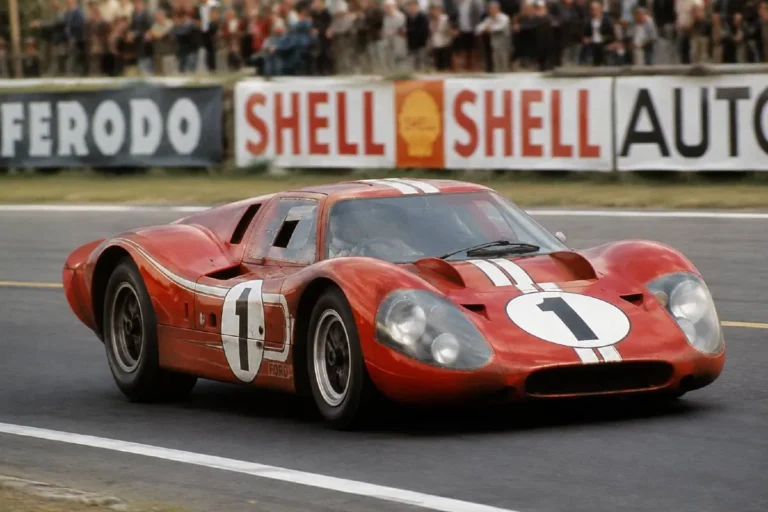
The Ford GT40 MkIV is the greatest American race car ever built, and its 1967 victory at the 24 Hours of Le Mans is the greatest single result in American motorsport history. Its distinction from the previous GT40 variants is important: the Mk I, II, and III models were produced overseas as offspring of the British Lola Mk6, with significant British engineering involvement throughout their development. The MkIV was different. The vehicle was crafted at Ford’s Wixom, Michigan assembly plant — the same plant that produced the Lincoln Continental presidential limousine. It used a series of different, American-made V8 engines. It was designed, built, and prepared in America.
The GT MkIV‘s Le Mans victory in 1967 was not a one-off achievement — it was the most dramatic single expression of a Ford engineering philosophy that runs from the 427 NASCAR program of the 1960s through to the cars we cover in our guide to the fastest Ford muscle cars, where the 815-horsepower Mustang GTD now carries the same Nürburgring ambitions that the GT40 carried to Le Mans.
The MkIV used the same 7.0-liter 427 cubic-inch V8 engine as the Mk II, fitted to a reinforced J-chassis that was specific to the conceptually different J-4 race car. The chassis included a NASCAR-style steel-tube roll cage and a newly adopted aerodynamic shape that gave the MkIV an exceptional top speed advantage over all competitors at Le Mans. To accommodate the larger engine, a bigger engine bay and a larger nose were required — making the MkIV’s front end slightly more aggressive in appearance than the elegant Mk I, but considerably more effective aerodynamically.
On June 11, 1967, American drivers A.J. Foyt and Dan Gurney drove the No. 1 Ford GT40 MkIV to victory at the 24 Hours of Le Mans — beating Ferrari on Ferrari’s most important stage, with an all-American car prepared by an all-American team. The victory was complete and comprehensive. The GT40 achieved a formation finish — Ford cars crossing the line in first, second, and third positions — mirroring what it had done in 1966 and demonstrating that the 1966 result was not a fluke.
Ford had first attempted Le Mans in 1964, failed, and returned in 1966 to win. The 1967 victory with the all-American MkIV confirmed that the win was not merely the result of British engineering carried through an American program. It was a complete American engineering achievement, one that has not been equaled in scope or significance by any subsequent American racing car at any international event.
Section 2 – The Shelby Cobra Daytona Coupe
Six Cars, One Championship, $3.85 Million At Auction
The Shelby Cobra Daytona Coupe is the rarest and most expensive American race car of its era — and arguably of any era — and its achievement of the 1965 FIA World Sportscar Championship GT class is the most significant single-series championship won by an American-built car in international motorsport history.
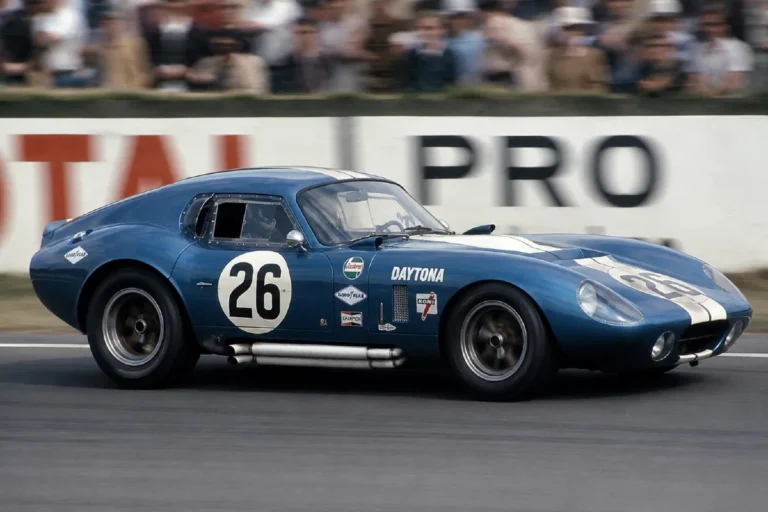
A young Peter Brock joined the Shelby Cobra outfit in the 1960s and got stuck in creating the fastest Cobra racing car the world had ever seen. The challenge was aerodynamic: the open-bodied Cobra roadster was fast in a straight line but unstable at the speeds required to compete with Ferrari’s purpose-built GT racing cars at circuits like Le Mans, Reims, and Daytona. Brock’s solution was to discard the roadster’s open body entirely and design an enclosed coupe shape that would reduce drag and stabilize the car at high speed.
Firstly, Brock decided to do away with the open-top roadster design, penning a more aerodynamic coupe shape. Carroll Shelby was, apparently, not impressed by the look of it, but said that, as long as it was fast, he would be happy to get it built. With the new, lightweight aluminum body made by hand and a 7.0-liter V8 engine from Ford’s NASCAR program, the Coupe was around 20 mph faster than the roadster, straight out of the box. The aerodynamic efficiency that the enclosed body created — reducing the large frontal area and the drag of the open cockpit — transformed a quick car into a genuinely competitive one.
Only six Daytona Coupes were ever built. Each was constructed by hand in Shelby American’s facility in Venice, California, using the aluminum body panels that defined the car’s specific visual character. The Daytona Coupe’s long nose, sweeping fastback roofline, and rounded tail were as purposeful as they were beautiful — the form was entirely dictated by function, and the function was exceptional aerodynamic efficiency at sustained high speeds.
The 1965 FIA World Sportscar Championship GT class victory was the culmination of what Brock, Shelby, and the drivers who campaigned the Coupe across Europe and America had worked toward. Ferrari — with its factory support, its heritage, and its European home advantage — was beaten by six American-built cars that had been designed in California, built by hand, and prepared by a team that had existed for only a few years. Years after seeing incredible success on the racetrack, one of the prototype models sold for a staggering $3.85 million in 2020, confirming that the market’s recognition of the Daytona Coupe’s historical significance had fully arrived six decades after the championship was won.
Section 3 – The Hudson Hornet
The Car That Dominated NASCAR Before the V8 Era Began
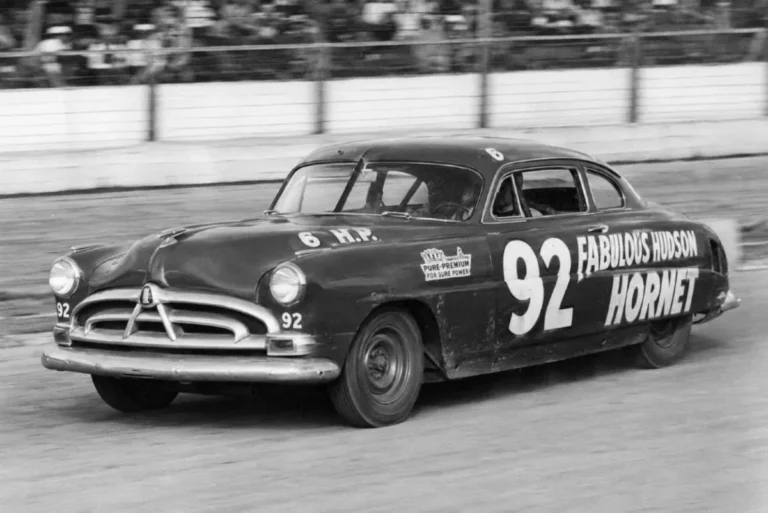
The 1952–1954 Hudson Hornet is the most dominant NASCAR race car in the history of the Grand National series — a vehicle that won 27 of 34 NASCAR Grand National races it entered in 1952 alone and accumulated more than 80 total victories across its competitive life, using an inline-six cylinder engine at a time when V8s were beginning to define American performance.
In 1953, customers could head on over to a Hudson showroom, buy a 170-horsepower Hornet, make some minor modifications to it to raise the power to 210 horsepower, add some stickers, and go race it against other production cars in the NASCAR Grand National series. The connection between the showroom car and the race car was essentially direct — the Hornet’s racing success was a function of engineering decisions made in the design of the production vehicle, not of purpose-built race car technology grafted onto a street car shell.
The engineering advantage was structural. The Hudson Hornet used a unique step-down unibody construction — named for the fact that the body’s floor was recessed below the top of the frame rails rather than sitting on top of them. This lowered the entire passenger compartment, and with it, the center of gravity of the car, to a point below what conventional body-on-frame construction of the era could achieve. The result was a handling advantage in cornering that no competitor could replicate without fundamentally redesigning their vehicles.
The 5.0-liter inline-six engine at 210 horsepower was not the most powerful option in the field — by the mid-1950s, V8 competitors were arriving with more peak output. But horsepower alone does not win oval track races. The combination of the Hornet’s structural handling advantage, its reliability over the race distance — increasingly important as races were often run on rough gravel or sand tracks — and the driving skill of men like Marshall Teague and Herb Thomas behind the wheel produced the most dominant single-model NASCAR record in the series’ history.
The Hornet’s reign came to an end toward the end of the 1950s, when competitors started campaigning more powerful V8 engines. Hudson believed its six-cylinder engine would suffice against the new V8 opposition. It did not. But the record it accumulated before the V8 era arrived — more than 80 NASCAR wins, multiple championships, and a level of dominance that no subsequent single model has equaled — is permanent and unrepeatable.
The 1952 Hornet, owned by Michigan collector Al Schultz, was inducted into the National Historic Vehicle Register in 2022 and is the only remaining factory racing Hornet and the oldest NASCAR-winning car known to exist.
Section 4 – The Cunningham C4-R
The First American Team To Challenge Le Mans Seriously
The Cunningham C4-R represents America’s most serious and most sustained attempt to win the 24 Hours of Le Mans with an American car and an American team before the Ford program of the mid-1960s — and in doing so, it occupies a specific and important position in American racing history as proof that the ambition existed long before the machinery was sufficient to execute it.
In 1951, Briggs Cunningham announced that he would foster a winning American team in an attempt to secure victory at the world’s premier racing stage. In order to help his hand-selected team rise to the occasion, the entrepreneur turned to the Chrysler-powered Cunningham C2-R, which finished 18th overall during the first year of competition.
Cunningham’s resolve led to the conception of the C4-R, a vehicle that would weigh 1,000 pounds less than the C2 and produce even more horsepower than its predecessor. The C4-R used the Chrysler Hemi V8 — the same engine architecture that would later appear in the Dodge Charger and Plymouth Superbird — in a purpose-built racing chassis. In 1952, the Hemi-powered C4-R would fail to obtain the win at Le Mans but finished fourth overall — a result that, for an American team competing at Le Mans in 1952 against the established European manufacturers, was genuinely remarkable.
Although the vehicle would never obtain the title that the American racing community so diligently pursued, it would go down in history as one of the greatest attempts at the legendary endurance race to date — proving that even an American team could challenge the Le Mans circuit at a competitive level. The C4-R’s fourth-place finish in 1952 gave American motorsport something to build on: the knowledge that the machinery, the preparation, and the driving were capable of competing at the highest level of international endurance racing.
Section 5 – The Dodge Charger Daytona And Plymouth Superbird
When NASCAR Became An Aerodynamics Competition
The 1969 Dodge Charger Daytona and its twin, the 1970 Plymouth Superbird, are the most visually extreme vehicles in NASCAR history — and the most technically innovative stock cars ever to compete in the Grand National series. Their design story is inseparable from the specific regulatory environment of NASCAR in the late 1960s, when manufacturers were investing unprecedented resources in aerodynamic development to find every possible advantage on the new high-banked superspeedways being built across the American South.
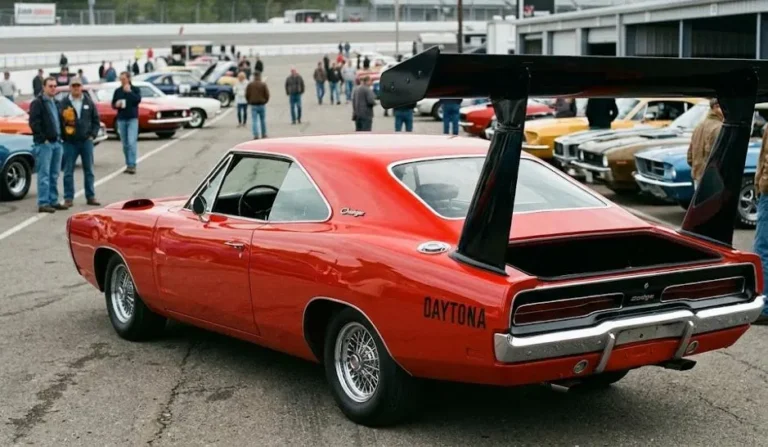
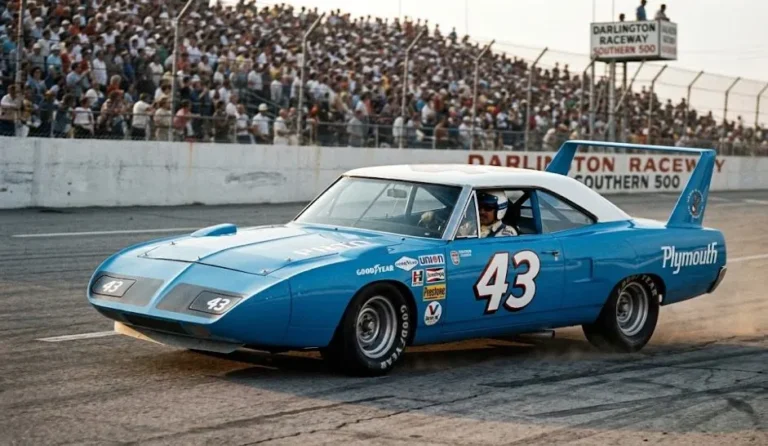
In response to Ford’s Torino Talladega — which used a flush nose treatment and specific body modifications to reduce aerodynamic drag at superspeedway speeds — Chrysler developed its own aero warrior for the 1969 season. Based on the standard Dodge Charger but fitted with a number of aerodynamic improvements, including a pointy nose cone, flip-up headlights, and a humongous rear wing stabilizer mounted on struts high above the trunk lid, the Charger Daytona became by far the most exotic-looking race car that ever competed in NASCAR until then.
The rear wing was not decorative. At 200 mph, the aerodynamic forces acting on a car’s body can lift the rear wheels off the track unless specific downforce is generated to counteract them. The Daytona’s tall wing created that downforce while also providing a stabilizing effect at high speed — allowing the car to reach and sustain speeds that conventional NASCAR stock cars could not approach safely. The Charger Daytona became the first car in NASCAR history to break the 200 mph barrier on a superspeedway, a milestone that at the time seemed as remote as the land speed records being set on the Bonneville Salt Flats.
For 1970, Plymouth — Dodge’s corporate twin within Chrysler — produced the Superbird using a similar aerodynamic package applied to the Plymouth Road Runner body. The Superbird’s most notable driver was Richard Petty, who returned to Plymouth from Ford specifically to drive it. The combination of Petty and the Superbird’s aerodynamic package was as effective as anyone at Chrysler had hoped — though NASCAR soon banned the extreme aero configurations, and both the Daytona and the Superbird were competitive for only a brief window before regulations eliminated their advantage.
Both cars were homologated for NASCAR by producing street-legal production versions — a requirement that resulted in some of the most visually extraordinary civilian automobiles ever sold at American dealerships. The production Daytona and Superbird, with their full wing and nose cone packages on street-legal cars, remain among the most sought-after American muscle cars in the collector market six decades after they were sold.
Section 6 – The Chevrolet Corvette C5-R
America’s Greatest Endurance Racing Achievement
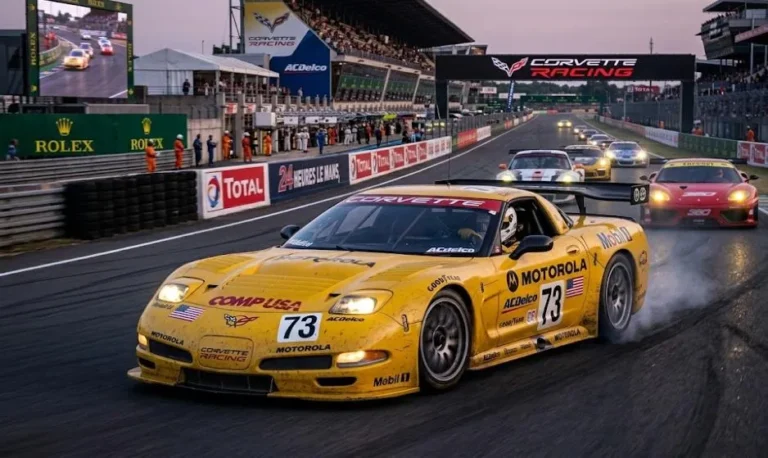
The Chevrolet Corvette C5-R is a purpose-built, space-frame racing car that, for several years, was the car to beat in its endurance racing class. It accumulated 31 class victories in the American Le Mans Series, won the 24 Hours of Daytona, won its class at Le Mans, and won at the 12 Hours of Sebring — a record of endurance racing achievement that no other American-built racing car has matched.
The C5-R was initially developed by Pratt and Miller in association with Chevrolet and aimed toward specialized motorsport use. In 1999, the C5-R was introduced to the circuit — powered by a Katech LS1.R that would produce 610 horsepower and 570 lb-ft of torque. Only 11 of the modified chassis would ever be produced by Pratt and Miller, but with over 31 class victories at the ALMS, a victory at Daytona, and various podiums at Le Mans, the Corvette stands as one of the crowning achievements of American engineering.
The C5-R’s significance extends beyond its race results. It established the Corvette Racing program’s identity and engineering approach — the partnership between Pratt and Miller’s race preparation expertise and Chevrolet’s factory engineering support — that has continued through the C6.R, C7.R, and C8.R generations, each of which has maintained the program’s record of consistent class-winning endurance racing success. The C8.R’s recent Le Mans victories confirm that the foundation the C5-R established in 1999 is still producing results more than two decades later.
The C5-R demonstrated something specific about American racing engineering that previous IMSA and ALMS programs had not fully proven: that a GT-class car built around an American sports car platform could compete on equal terms with purpose-built European GT machinery at the world’s most demanding endurance circuits. Before the C5-R, the conventional wisdom held that American GT racers were competitive domestically but disadvantaged internationally. The C5-R disproved that assessment comprehensively and permanently.
The C5-R’s ALMS racing program established the engineering and organizational foundation that produced every subsequent Corvette Racing championship — a heritage that runs directly to the modern Corvette ZR1 and its 1,064-horsepower LT7 engine. Our comparison of the Corvette ZR1 vs Camaro ZL1 covers both cars’ performance credentials in the context of the racing lineage the C5-R helped build.
Section 7 – The Dan Gurney Eagle Mk1
The Only All-American Formula One Car To Win A Grand Prix
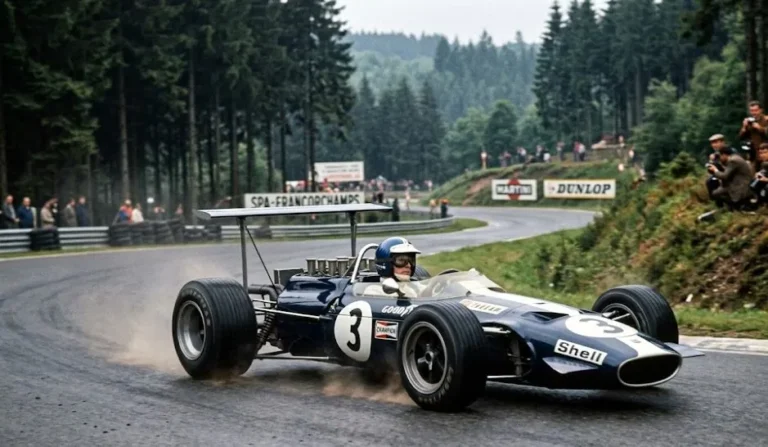
The Dan Gurney Eagle Mk1 is the only Formula One car built by an American constructor and driven by an American driver to win a World Championship Grand Prix in the sport’s modern era — a distinction that remains unique sixty years after the achievement and that defines the Eagle’s place in American racing history as categorically different from every other American contribution to open-wheel racing.
In 1966, legendary American racer Dan Gurney commissioned Eagle-Weslake to build a new 3.0-liter V12 engine for his Eagle Formula One car. The 60-degree V12, which came with twin overhead cams, produced around 450 horsepower. The Eagle racing car is considered by many as one of the best-looking Formula One racers ever made, and combined with the magnificent three-liter engine, the car, with Gurney behind the wheel, was one of the fastest Formula One cars at the time. Revving to around 10,000 rpm, the engine propelled the Eagle, which weighed less than 1,200 pounds, to a top speed of around 160 mph.
On June 18, 1967, at the Belgian Grand Prix at Spa-Francorchamps — one of the most demanding and highest-speed circuits on the Formula One calendar — Dan Gurney drove the Eagle to victory, becoming the only American driver in an American-built Formula One car to win a World Championship Grand Prix. The achievement has not been repeated. American drivers have won Formula One races in European-built cars. European drivers have won in American-funded efforts. But the combination of an American constructor, an American engine, and an American driver winning the highest level of open-wheel racing has occurred exactly once.
The Eagle’s visual identity — the long nose, the low-slung body, the specific proportions that Gurney’s team achieved with the Goodyear-sponsored car — made it one of the most admired Formula One designs of an era when Formula One cars were widely regarded as the most beautiful racing machines in the world. The Eagle was not merely fast. It was, by the standards of its time and the judgment of subsequent history, genuinely beautiful.
Section 8 – The Dodge Viper GTS-R
America’s Halo Racing Car Of The 1990s And 2000s
The Dodge Viper GTS-R is America’s most successful international GT racing car of the 1990s and early 2000s — a racing machine built from one of the most extreme production sports cars ever offered by an American manufacturer and developed into a class-winning competitor at Le Mans, the 24 Hours of Daytona, and numerous IMSA events.
Most famously, it won its class at the 2000 Le Mans 24 Hour race, the 8.0-liter V10 engine proving to be as reliable as it is powerful. A total of 57 Dodge Viper racing cars were made, with many still competing in classic sports car events around the world. The engine under the hood makes 600 horsepower, and the Viper will top 200 mph. The V10’s specific combination of displacement — at 8.0 liters, one of the largest engines ever used in GT racing — and natural atmospheric breathing provided a power delivery character that the smaller-displacement turbocharged European alternatives could not precisely replicate.
The Viper GTS-R’s contribution to American racing history extends beyond its specific race victories. It demonstrated that the Viper’s fundamental engineering — the enormous V10, the straightforward rear-wheel-drive architecture, the tube-frame construction of the racing version — was competitive with the most sophisticated European GT machinery of the era. At a time when European GT racing was dominated by cars from Ferrari, Porsche, and McLaren with highly developed aerodynamics and complex engineering, the Viper’s straightforward but effective approach produced results that validated the American engineering philosophy of displacement and power over complexity.
The Viper GTS-R’s racing success at Le Mans and in IMSA competition was built directly on the engineering foundation of the production Dodge Viper — one of the most extreme American sports cars ever offered at any mainstream manufacturer’s dealership. Our complete Dodge Viper guide covers all five generations of the car whose V10 engine powered the GTS-R to its 2000 Le Mans GT class victory.
Section 9 – The Trans-AM And Can-AM Legends
The Camaro Z/28, The McLaren M8B, And America’s Greatest Road Racing Eras
Two American road racing series from the late 1960s through the mid-1970s produced some of the most significant and most spectacular race cars in the history of the sport — the Trans-American Sedan Championship and the Canadian-American Challenge Cup (Can-Am).
The Trans-Am series — established in 1966 — created the conditions for one of the most direct and most consequential manufacturer rivalries in American motorsport. Ford, Chevrolet, Dodge, and Pontiac competed through dealer-supported racing programs in a series that required genuinely production-based vehicles, making it the closest thing to a direct factory-to-factory competition available in American road racing.
Before becoming an icon of American automotive style and performance, Z28 was merely a production order code for Chevy dealers. When submitting this Regular Production Option code on a manufacturing order, customers received the then-new 1967 Camaro equipped with a small-block 302 V8 built to satisfy Trans-Am racing regulations that limited engine displacement to 305 cubic inches. The Z/28 became one of the most successful Trans-Am racing cars of the late 1960s, and its racing success translated directly into street credibility and commercial success that made it one of the most sought-after Camaro options of the era.
The Can-Am series — established in 1966 with its first race — produced a completely different type of American racing car. With virtually no rules governing engine displacement, aerodynamics, or weight, Can-Am attracted the most extreme and most technically advanced sports cars of their era. The series was briefly dominated by Bruce McLaren and Denny Hulme in McLaren M8-series cars — Canadian-American cars that used American Chevrolet V8 engines to produce power outputs exceeding 700 horsepower. The series attracted Ferrari, Porsche, and other European manufacturers who attempted to compete with the McLaren-Chevrolet combination and consistently failed until the arrival of Porsche’s 917 in 1972 ended the McLaren era.
The Can-Am’s legacy in American racing history is specific: it was the series that produced the most powerful naturally aspirated sports racing cars America had ever seen, running Chevrolet engines in purpose-built chassis to create a combination that dominated international sports car racing for six consecutive seasons.
The Z/28’s Trans-Am racing success in 1967 and 1968 happened alongside the broader Camaro SS performance story that defined what the first-generation Camaro meant to American performance buyers. Our complete guide to the 1969 Camaro SS covers the full story of the first generation at its most capable — including the COPO 427, the Z/28’s street evolution, and the performance options that made 1969 the most celebrated year in first-generation Camaro history.
FAQ
Q: What is the greatest American race car of all time?
A: The Ford GT40 MkIV is the most widely cited candidate for the greatest American race car ever built. The only all-American GT40 — designed, built, and prepared at Ford’s facilities in Michigan and California — won the 1967 24 Hours of Le Mans outright, driven by Americans A.J. Foyt and Dan Gurney, achieving a 1-2-3 formation finish and defeating Ferrari on the world’s most prestigious endurance stage. It was the first American-built car to win Le Mans outright and the culmination of Ford’s four-year program to break Ferrari’s dominance of international endurance racing.
Q: What was the most dominant NASCAR race car ever?
A: The most dominant NASCAR race car in history is the 1952–1954 Hudson Hornet, which won 27 of 34 NASCAR Grand National races in 1952 and accumulated more than 80 total NASCAR victories during its competitive life. The Hornet’s dominance was based on structural engineering rather than engine power — its step-down unibody construction lowered the center of gravity below the frame rails, providing a handling advantage that no competitor could replicate with conventional construction. The 1952 Hornet was inducted into the National Historic Vehicle Register in 2022 as the oldest NASCAR-winning car known to exist.
Q: What was the first car to break 200 MPH in NASCAR?
A: The 1969 Dodge Charger Daytona was the first car in NASCAR history to break the 200-mph barrier on a superspeedway. It achieved this with a combination of a pointed aerodynamic nose cone, flip-up headlights, and an enormous rear wing mounted high above the trunk lid on vertical struts — an aerodynamic package designed specifically to reduce drag and add rear downforce at Talladega Superspeedway’s long, high-banked surface.
Q: Did an American car ever win the 24 Hours of Le Mans outright?
A: Yes. The Ford GT40 won Le Mans outright four consecutive times from 1966 to 1969. The 1967 victory with the all-American MkIV — built at Ford’s Wixom, Michigan plant and driven by Americans A.J. Foyt and Dan Gurney — is the most historically significant. The Ford GT won its GTE Pro class at Le Mans in 2016. The Chevrolet Corvette C5-R won its class at Le Mans, and the Dodge Viper GTS-R won the GT class at the 2000 24 Hours of Le Mans.
Q: How many Shelby Cobra Daytona Coupes were built?
A: Only six Shelby Cobra Daytona Coupes were ever built, all constructed by hand at Shelby American’s facility in Venice, California, using hand-formed aluminum body panels. The six cars won the 1965 FIA World Sportscar Championship GT class — the first and only time an American car has won that international championship outright. A prototype Daytona Coupe sold for $3.85 million at auction in 2020.
Q: What was Dan Gurney’s Eagle Formula One car?
A: The Dan Gurney Eagle Mk1 was a Formula One car built by Gurney’s All American Racers team in 1966 and 1967, powered by a 3.0-liter Eagle-Weslake V12 engine producing approximately 450 horsepower. On June 18, 1967, at the Belgian Grand Prix at Spa-Francorchamps, Gurney drove the Eagle to victory — making it the only American-built Formula One car to win a World Championship Grand Prix with an American driver. The Eagle is widely considered one of the most beautiful Formula One cars ever designed.
Q: What was the Cunningham C4-R?
A: The Cunningham C4-R was an American sports racing car built by Briggs Cunningham for competition at the 24 Hours of Le Mans, powered by a Chrysler Hemi V8 engine. In 1952, the C4-R finished fourth overall at Le Mans — the best result an American-built, American-entered car achieved at Le Mans before the Ford GT40 program. The C4-R weighed 1,000 pounds less than its predecessor and was Cunningham’s most competitive Le Mans entry in his multi-year campaign to win the race with an American car.
The Bottom Line
The best race cars in American history share one characteristic that no specification sheet can fully capture: they were built by people who were told they could not compete at the highest level of world motorsport and who responded by competing and winning anyway.
Briggs Cunningham was told that America could not build a Le Mans contender. He built one anyway and proved that the competition could be approached if not immediately beaten. Carroll Shelby was told that an open-top roadster could not beat Ferrari’s purpose-built GT racers. Peter Brock designed a coupe and the answer became six cars that won a world championship. Henry Ford II was reportedly told by Enzo Ferrari that Americans could not win Le Mans. Ford spent four years and hundreds of millions of dollars proving that they could, and then won four times in a row.
The Hudson Hornet won because it was engineered better, not because it had more power. The Charger Daytona broke 200 mph because the engineers took aerodynamics seriously before NASCAR expected them to. The Dan Gurney Eagle won a Formula One race in the most beautiful Formula One car of its era because one American racer decided to build his own car rather than drive someone else’s.
The record is what it is. The cars are documented, the results are verified, and the historical context makes them more significant rather than less with every decade that passes. America went racing. The results were extraordinary.
Editorial Note
This article was written and reviewed in April 2026. All race results and vehicle specifications are sourced from the following primary sources: HiConsumption’s “10 Best American Race Cars in History”, CarBuzz’s “10 Greatest American Racing Cars Of All Time“, SlashGear’s “10 Of The Best-Looking American Race Cars Ever Made”, Autoevolution’s “5 Most Iconic NASCAR Race Cars From the Golden Age of Muscle Cars“, and M1 Concourse historical documentation.
The Hudson Hornet National Historic Vehicle Register induction in 2022 is documented by M1 Concourse. The Shelby Cobra Daytona Coupe $3.85 million auction sale in 2020 is confirmed by SlashGear. The Dodge Charger Daytona’s first 200-mph NASCAR record is confirmed by Autoevolution and KAMR. The Cunningham C4-R’s fourth-place Le Mans finish in 1952 is confirmed by HiConsumption. The Corvette C5-R’s 31 ALMS class victories and specific engine output of 610 HP are from HiConsumption and CarBuzz.
Dan Gurney Eagle V12 specifications — 450 HP, less than 1,200 lb weight, 10,000 RPM, 160 mph — are sourced from CarBuzz. The Ford GT40 MkIV Wixom Michigan assembly documentation is sourced from HiConsumption. The Hudson Hornet’s 27-of-34 1952 win record is confirmed by both HiConsumption and CarBuzz.


0 Comments