Last Updated: April 13, 2026 | Read Time: 9 minutes
1,064 horsepower against 650. A twin-turbocharged mid-engine supercar that costs $174,995 against a supercharged front-engine muscle car that went out of production — and into the hearts of collectors — at $73,695. Both wear Chevrolet badges. Both have supercharged V8 engines rooted in the same GM engineering family. And in 2026, only one of them is still in production. This is the most American automotive comparison you can make right now.
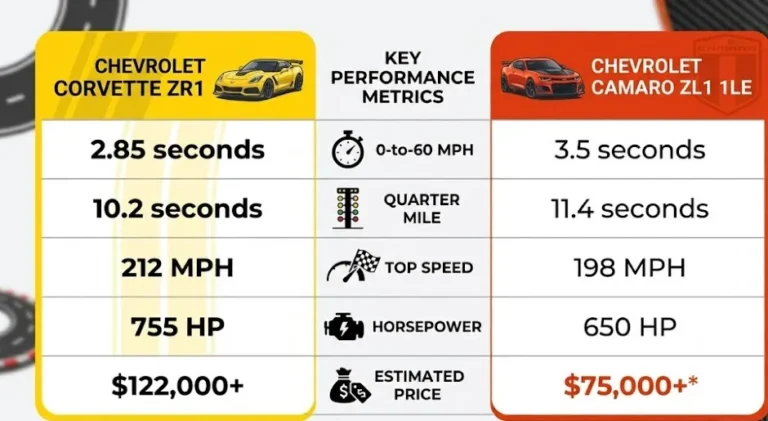
At A Glance – Camaro ZL1 vs Corvette ZR1 Head – To – Head
– Corvette ZR1 (2025–present):
– Engine: 5.5-liter LT7 twin-turbocharged V8, flat-plane crank
– Horsepower: 1,064 hp at 7,000 rpm
– Torque: 828 lb-ft at 6,000 rpm
– Transmission: 8-speed dual-clutch automatic
– Layout: Mid-engine, rear-wheel drive
– 0–60 mph: 2.3 seconds (GM official, with rollout)
– Quarter Mile: 9.6 seconds at 150 mph (with ZTK package)
– Top Speed: 233 mph (without ZTK aero) / 215 mph (with ZTK)
– Downforce: 1,200+ lbs (ZTK package)
– Dry Weight: 3,670 lbs (coupe)
– Starting MSRP: $174,995 (1LZ coupe, including DFC)
– Status: Current production at Bowling Green, Kentucky
– Camaro ZL1 (2017–2024 — Final Year 2024):
– Engine: 6.2-liter LT4 supercharged V8
– Horsepower: 650 hp
– Torque: 650 lb-ft
– Transmission: 6-speed manual (standard) / 10-speed automatic (optional)
– Layout: Front-engine, rear-wheel drive
– 0–60 mph: 3.5 seconds (standard ZL1) / 3.1 seconds (ZL1 1LE auto)
– Quarter Mile: 11.3 seconds at 128 mph
– Top Speed: 198 mph
– Nürburgring (ZL1 1LE): 7:16.04
– Starting MSRP: $73,695 (final 2024 MSRP)
– Status: Discontinued after 2024 — collector car as of 2026
– Sources: GM official press release, Edmunds, Car and Driver, TopSpeed, MotoGallery
Overview – One Chevy Lives. One Chevy Is Now History. Both Are Worth Knowing
There are comparisons that make perfect logical sense on paper — same brand, same performance DNA, overlapping enthusiast communities — but that reveal deep philosophical differences the moment you start looking at the actual numbers.
This is one of those comparisons.
The Corvette ZR1 and the Camaro ZL1 are both Chevrolet performance vehicles. Both use supercharged V8 engines built from GM’s legendary small-block architecture. Both have been benchmarks of American performance engineering in their respective categories. Both attract the same kind of driver — someone who cares intensely about what a car can do, how it does it, and why.
But the ZR1 is a hypercar masquerading as a sports car — 1,064 horsepower, a 233-mph top speed, a quarter-mile in 9.6 seconds, and enough downforce with the ZTK package to make the tires work as hard as the engine. It costs $174,995 to start and requires a closed course to even begin to explore its capabilities.
The ZL1 was a muscle car that had quietly become a sports car — 650 supercharged horsepower, a front-engine layout that rear-wheel-drive enthusiasts love for exactly the reason that engineers don’t, a Nürburgring lap time of 7:16 in ZL1 1LE configuration that shocked the performance car world, and a price tag that started at $73,695 in its final year. It was discontinued after the 2024 model year.
In 2026, the ZR1 is the living benchmark of what Chevrolet can engineer. The ZL1 is a closed chapter — discontinued, appreciated, and already becoming a collector car. This comparison is therefore both a performance evaluation and a eulogy, and it is worth doing both honestly.
Section 1 – The Engines
Two Supercharged V8s, Two Very Different Philosophies
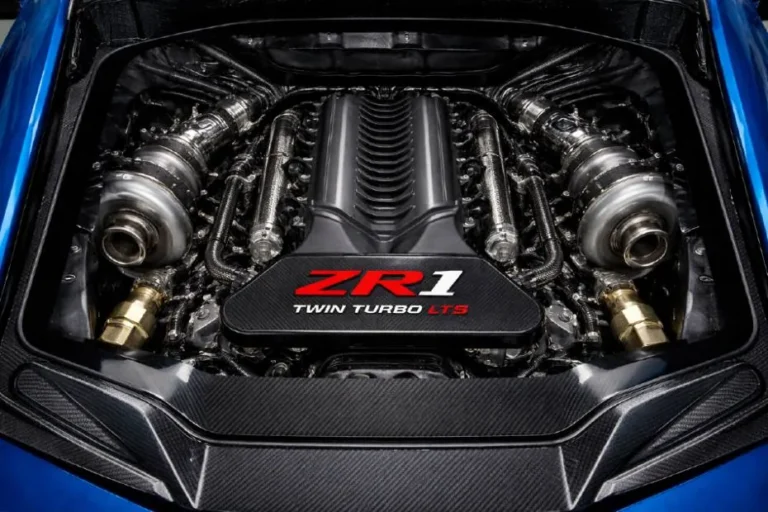
The Corvette ZR1’s LT7: 1,064 HP Of Twin-Turbo History
The engine in the Corvette ZR1 is called the LT7, and it is one of the most significant American production V8 engines in history. It is closely related to the Z06’s LT6 — sharing a block casting and several key architectural elements — but where the LT6 is naturally aspirated and spins to 8,600 rpm in pursuit of its 670 horsepower, the LT7 adds twin turbochargers operating at 20 PSI of boost, a revised intake system, stronger connecting rods, both port and direct fuel injection, an anti-lag system for the turbos, and new piston designs for a lower compression ratio that the forced induction requires.
The result is 1,064 horsepower at 7,000 rpm and 828 lb-ft of torque at 6,000 rpm — the most powerful V8 ever produced in America by an automaker, according to GM’s official press materials. The LT7 retains the flat-plane crankshaft from the LT6, which gives it a distinctive exhaust character and allows it to rev more freely than a traditional cross-plane V8, even under the enormous thermal loads that twin turbocharging creates.
800 lb-ft of torque is available by 3,000 rpm. That means the ZR1 has more torque in its usable low-rpm range than most cars have at peak. The 8-speed dual-clutch transmission that manages this output is a fortified version of the Z06’s unit — strengthened, recalibrated, and capable of absorbing the ZR1’s power without complaint.
The carbon fiber aero package creating over 1,200 pounds of downforce at top speed means the tires are being pushed into the road harder at speed than the ZR1 weighs at rest. That is not a marketing claim — it is a physics statement about what the car becomes as it accelerates.
All ZR1 performance specifications in this article are sourced from the GM official 2025 Corvette ZR1 press release published January 9, 2025 — including the 1,064-horsepower rating at 7,000 rpm, the 828 lb-ft of torque at 6,000 rpm, the 2.3-second 0-to-60 claim, and the 9.6-second quarter-mile time with the ZTK package.
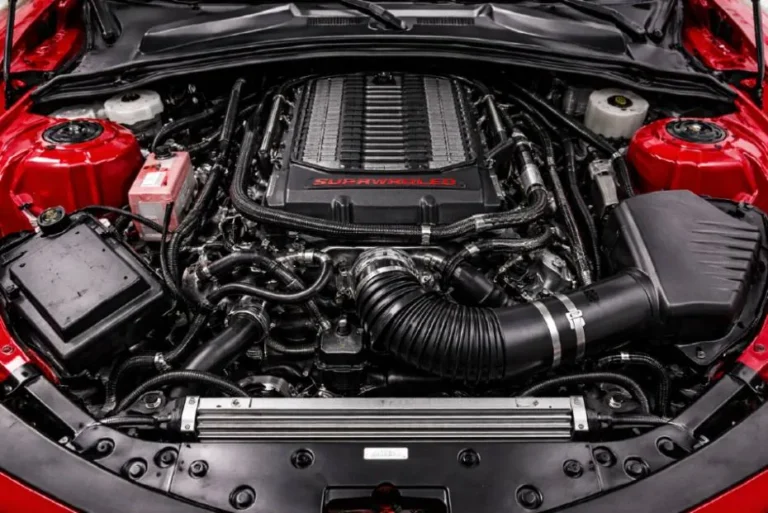
The Camaro ZL1’s LT4: 650 HP Of Supercharged American Tradition
The LT4 in the Camaro ZL1 is a 6.2-liter supercharged V8 that uses an Eaton TVS R1740 roots-type supercharger to push the engine to 650 horsepower and an equal 650 lb-ft of torque. It uses direct injection and liquid-to-air charge cooling — the supercharger sits in a package that manages heat aggressively enough to allow the LT4 to sustain its output under repeated track conditions without heat soak degrading the power delivery.
The LT4 is a cross-plane V8 with the traditional American V8 character — strong torque from very low rpm, a broad, accessible power band that does not require the driver to chase a redline to find performance, and the kind of deep exhaust note that sounds nothing like the ZR1’s flat-plane scream and everything like what Americans have associated with performance since the 1960s.
The LT4’s 650 lb-ft of torque at relatively low rpm makes the ZL1 feel effortlessly quick in everyday driving — twist the throttle anywhere in the rev range and the car responds with authority. The supercharger’s characteristic whine under hard acceleration is one of the most distinctive sounds in American performance cars and one that ZL1 owners consistently identify as one of the car’s most addictive qualities.
The six-speed manual transmission that comes standard on the ZL1 — a Tremec unit with rev matching — is a genuine driver’s gearbox in an era when paddles and dual-clutches are increasingly standard. The optional 10-speed automatic is the faster option for straight-line times and track performance, but the manual is the option that makes the ZL1 feel like a muscle car rather than a performance appliance.
How The Engines Compare
The power difference between the LT7 and the LT4 is not incremental — it is categorical. 414 additional horsepower is the gap between a very fast car and a car that challenges the performance of vehicles costing two to three times as much. The ZR1 has more torque available at 3,000 rpm than the ZL1 has at its peak. These are not similar engines at different states of tune. They are different engineering philosophies sharing common ancestry.
What the LT4 offers that the LT7 does not — and what matters to a specific kind of driver — is accessibility. The LT4’s power arrives in a way that is intuitive and manageable on public roads, through traffic, and on a weekend canyon drive. The LT7’s power requires a track, enormous respect, and ideally, some driver training.
The LT7 shares a block casting and several key architectural elements with the Z06’s LT6 — for a complete understanding of where the ZR1’s engine comes from and what makes the naturally aspirated version so significant in its own right, our Corvette Z06 complete guide covers the LT6 in full detail including why its flat-plane crankshaft is one of the most technically significant American V8 decisions in a generation.
Section 2 – Performance Numbers
Every Benchmark, Honestly Compared
Zero To 60 MPH
– ZR1: 2.3 seconds (GM official, with rollout)
– ZL1: 3.5 seconds (standard) / 3.1 seconds (ZL1 1LE with 10-speed auto)
The 2.3-second ZR1 figure is measured with rollout — a drag-racing measurement convention that starts the clock when the car has moved approximately one foot, which reduces the displayed time compared to a standing-start measurement. Even accounting for this, the ZR1 is in a different performance category. A Car and Driver test of the Z06 — the ZR1’s 670-horsepower predecessor in the same platform — returned 3.2 seconds. Adding 394 more horsepower and twin turbos drops that by nearly a full second.
The ZL1’s 3.5 seconds is genuinely impressive for a front-engine, live-rear car with 650 supercharged horsepower. The 10-speed automatic ZL1 1LE, which adds specific suspension and tire upgrades on top of the transmission’s faster shift times, brings the figure closer to 3.1 seconds in ideal conditions. These are numbers that genuinely challenged European sports cars when the sixth-generation ZL1 arrived in 2017 — and they still do today.
The honest summary: the ZR1 is faster to 60 mph by more than a full second. In real-world feel, a full second from 0 to 60 mph is the difference between quick and genuinely shocking.
Quarter Mile
– ZR1: 9.6 seconds at 150 mph (ZTK package, GM official)
– ZL1: 11.3 seconds at 128 mph
The ZR1’s 9.6-second quarter-mile puts it in company that was previously exclusive to dedicated drag cars and multi-million-dollar hypercars. The 150-mph trap speed indicates the car is still deeply in its powerband at the quarter-mile marker — it has not approached its limits. The standard ZR1 without the ZTK package is expected to run in the low-10s based on Edmunds’ testing context.
The ZL1’s 11.3 seconds at 128 mph is the benchmark of a genuine performance muscle car. An 11-second quarter-mile on street tires from a car that seats four people, has a functional trunk, and can be driven to work on Monday is an achievement that the ZL1 has consistently delivered across its production run.
The gap — 1.7 seconds in the quarter-mile — is significant but slightly less revelatory than the 0-to-60 gap, because at quarter-mile distances, the ZR1’s aerodynamic package and weight (3,670 pounds vs. the ZL1’s approximately 3,900 pounds loaded) play a more complex role.
Top Speed
– ZR1: 233 mph (without ZTK aero) / 215 mph (with ZTK aero package)
– ZL1: 198 mph
The ZR1’s 233-mph top speed is the highest ever claimed for any production Corvette and for any American production car. It is also one of the highest top speed claims of any production car under $1 million at the time of writing. The ZTK’s downforce package actually reduces top speed to 215 mph — the wing creates drag alongside downforce — but the improvement in cornering capability more than compensates for any straight-line loss.
The ZL1’s 198 mph is faster than the Z06’s 189 mph and equal to the Dodge Viper ACR in its final production configuration. For a car that started at $73,695 and was available at your local Chevrolet dealer, 198 mph represents an extraordinary achievement in performance per dollar.
Nürburgring Nordschleife
– ZR1: No official full Nürburgring lap time confirmed at time of publication
– ZL1 1LE: 7:16.04 — one of the fastest times ever recorded by an American production car
The ZL1 1LE’s Nürburgring time is the ZL1’s most enduring performance legacy. 7:16.04 at the 12.9-mile circuit, where lap time is the most respected single metric of holistic performance, placed the ZL1 1LE among a very short list of cars capable of that result regardless of price. It was faster than cars costing two and three times as much. It was the result of the ZL1 1LE’s Multimatic DSSV dampers — the same technology used in purpose-built racing cars — applied to a front-engine American muscle car.
Chevrolet has taken the ZR1 and ZR1X to the Nürburgring in a documented Three Corvettes, Three Drivers campaign, but official lap time claims for the production ZR1 were not publicly confirmed at the time of this article’s publication. Given the ZR1’s performance envelope, a time significantly faster than the ZL1 1LE’s benchmark is expected when confirmed.
The ZL1’s 7:16 Nürburgring time placed it among a very short list of American cars capable of that result — a list that also includes Ford’s own performance engineering, which we cover completely in our guide to the fastest Ford muscle cars in 2026, from the Boss 302’s Trans-Am roots to the 815-horsepower Mustang GTD that now holds the Nürburgring benchmark for American production cars.
Section 3 – Chassis And Handling
Where The Cars Diverge Most Fundamentally
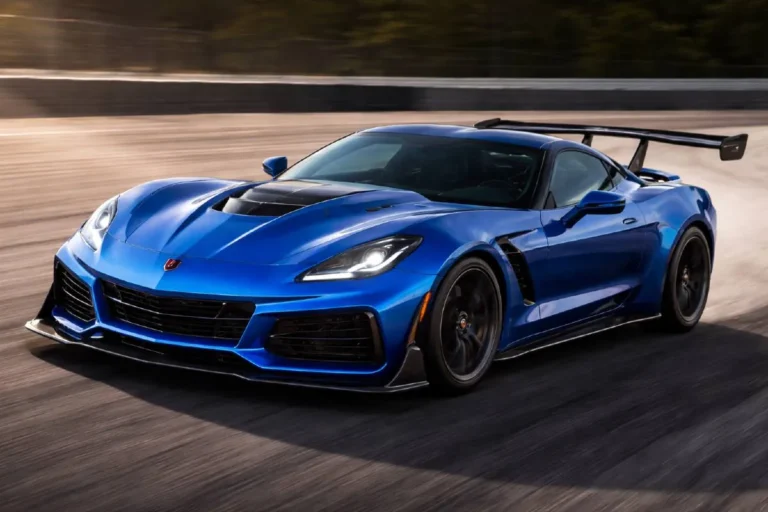
The ZR1: Mid-Engine Precision And 1,200 Pounds Of Downforce
The C8 Corvette platform that underpins the ZR1 is a mid-engine architecture — the engine sits behind the passenger compartment, ahead of the rear axle. This placement optimizes weight distribution in a way that front-engine cars cannot replicate: more weight on the rear wheels where the power goes, less weight ahead of the front axle, and a center of gravity that sits closer to the geometric center of the car.
The ZR1’s suspension is similar to the Z06’s but revised for its additional power and speed requirements. Magnetic Ride Control 4.0 — the same system that reads the road 1,000 times per second and adjusts damping in 10-15 milliseconds — manages the chassis dynamics. The ZTK package adds Michelin Pilot Sport Cup 2 R tires and a stiffer suspension calibration that transforms the ZR1 from an extremely fast road car into a genuine track weapon.
With the ZTK’s 1,200 pounds of downforce at speed, the ZR1 generates aerodynamic grip that adds to mechanical grip in a way that makes high-speed cornering feel more secure the faster you go — the opposite of most cars, where aerodynamic forces become destabilizing at extreme speeds. The step from the standard ZR1 to the ZTK-equipped version is surprisingly large, making it a must-have for track use.
The ZR1 is rear-wheel drive only, which means that 1,064 horsepower goes through the rear tires without the mechanical assistance of front-axle torque. The throttle must be caressed, not punched. A car demands respect and delivers extraordinary rewards to drivers who earn it.
The ZL1: Front-Engine Soul And The 1LE’s Track Mastery
The Camaro ZL1’s front-engine layout is — depending on your perspective — either a limitation or a feature. It is a limitation in the pure physics sense: more weight ahead of the front axle means more understeer tendency, more weight transfer to the rear under acceleration, and a center of gravity that is inherently further from the ideal mid-car position.
It is a feature in the character sense: a front-engine, supercharged V8, rear-wheel-drive muscle car with a manual transmission gearbox is a specific and irreplaceable driving experience that mid-engine cars with dual-clutch transmissions — however more capable they may be by objective measure — do not provide. The ZL1 goes where you point it with a tactile engagement that the ZR1, for all its electronic sophistication, delivers differently.
The ZL1 1LE takes the standard car’s performance architecture and replaces the Magnetic Ride Control dampers with Multimatic DSSV spool-valve units — the same damper technology used in purpose-built racing cars. The result is a chassis that communicates more directly, responds more predictably at the limit, and produces those Nürburgring lap times that shocked the automotive world when they were published.
The standard ZL1 uses a MacPherson-type strut suspension with dual lower ball joints and a direct-acting stabilizer bar — a competent and well-proven setup for a front-engine performance car. The electronically controlled limited-slip differential manages power delivery to the rear tires with enough sophistication to keep the car’s 650 lb-ft pointed in the right direction under hard acceleration.
Section 4 – Desing And Presence
What They Look Like and What They Communicate
The ZR1 — Functional Aggression
The Corvette ZR1’s exterior is not a styling exercise with performance theater bolted on. Every visual element is a functional decision, and the car’s aggressive appearance is the honest result of what a 1,064-horsepower car needs to manage heat and aerodynamic forces.
The flow-through hood — replacing the standard Corvette’s front trunk to allow air to pass through the engine bay for cooling — is among the most visually distinctive elements. The large side air inlets with carbon-fiber wishbone bezels feed eleven heat exchangers. The return of the split rear window, first seen on the 1963 Corvette Sting Ray, is a design callback that carries real structural significance — the rear window’s split accommodates the cooling requirements of the LT7 engine mounted behind it.
The ZTK package’s massive rear wing is not subtle. It is the visual announcement of 1,200 pounds of downforce. Combined with the front dive planes, the Gurney lip on the hood, and the underbody strakes, the ZTK-equipped ZR1 looks like a race car that has been licensed for road use because some engineer made a compelling case to their management that it could be done.
The coupe’s carbon-ceramic brakes — 15.7 inches front, 15.4 rear — are the largest ever fitted to a production Corvette. They are visible through the standard carbon-fiber wheels. The brakes on the ZR1 are not accessories. They are components designed to stop 1,064 horsepower from 233 mph, repeatedly, without fade.
The ZL1 — Muscle Car Authority
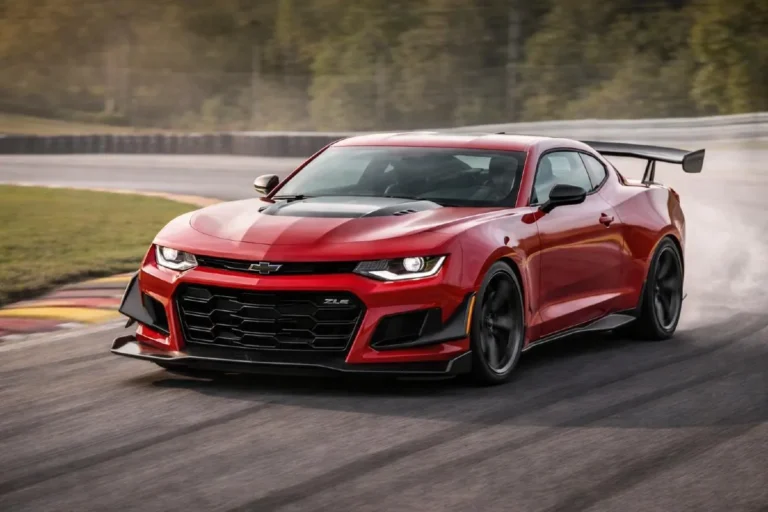
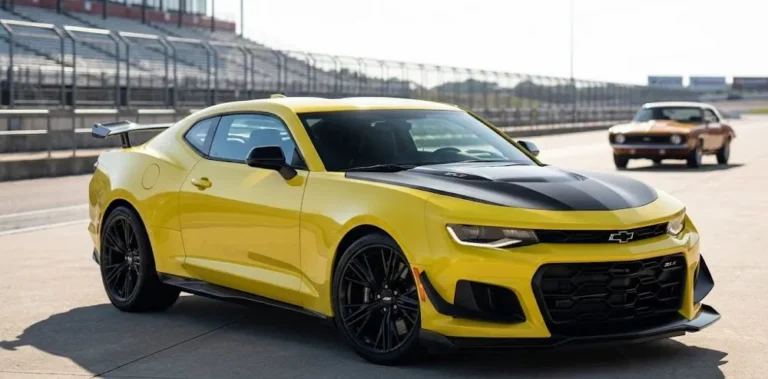
The Camaro ZL1’s design language is different in every dimension from the ZR1’s. Where the ZR1 is aerodynamic precision, the ZL1 is aggressive proportions — wide, low, with a muscular stance that communicates power through mass rather than through technical detail.
The ZL1’s vented hood — with a heat-extracting insert — is functional rather than decorative. The deep front fascia feeds eleven heat exchangers, managing the LT4’s considerable thermal requirements. The wide rocker panels and aggressive body lines create the visual identity of a car that means business without requiring a wing or a splitter to prove it.
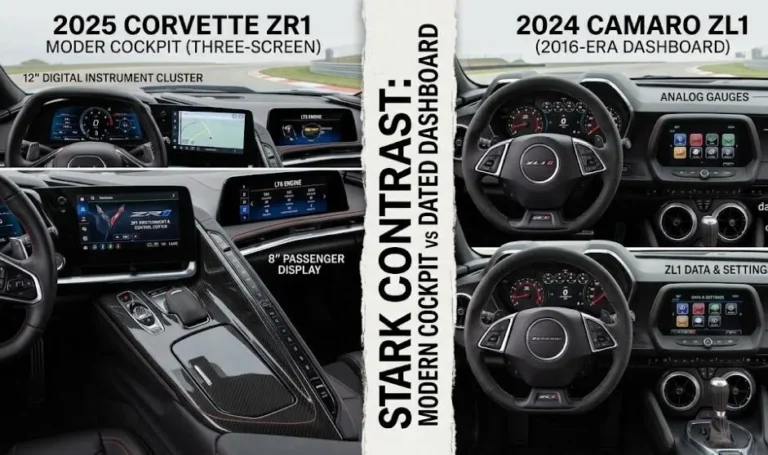
The ZL1’s interior, however, is where the car’s age showed most honestly by its final year. Stepping inside the 2024 ZL1 was like stepping back into 2016 — because it was, effectively, a 2016-era interior carried across a production run that Chevrolet declined to update significantly. The analog dials, the LCD touchscreen, and the steering wheel design all dated the car in ways the exterior did not. The Recaro front seats were excellent — well-bolstered, supportive, comfortable in the specific way that a dedicated performance seat balances grip and comfort better than a luxury seat does. But the dashboard around them belonged to a different era.
This contrast between the ZL1’s excellent performance capability and its dated interior is, in hindsight, one of the clearest signals that Chevrolet was not investing in the Camaro’s future — a signal that 2024 being the final model year confirmed.
Section 5 – Price And Value
What Each Car Costs And What You Get For The Money
The ZR1: $174,995 Starting — Is It A Bargain?
The 2025 Corvette ZR1 starts at $174,995 for the 1LZ coupe. The 3LZ coupe is $185,995. The convertible configurations are $10,000 more in each trim. Add the ZTK track package at $1,500, the carbon aero package at $8,495, and optional carbon-fiber wheels at $13,995, and a fully equipped ZR1 can exceed $210,000.
For $174,995 to $210,000, the ZR1 delivers performance that genuinely rivals production cars from Ferrari, Lamborghini, and McLaren costing two to three times as much. This has been the defining value proposition of the Corvette brand for decades — world-class performance at prices that make the European competition uncomfortable — and the ZR1 extends that proposition to hypercar performance levels.
As one of the most compelling cars you can get for under $200,000, the ZR1 is, by any rational analysis of performance per dollar at this price tier, a genuine value. This is not easy to say about a $175,000 car without embarrassment. But the ZR1 earns it.
The ZL1: $73,695 — Was Always A Value. Now Also A Collectible
The 2024 Camaro ZL1 started at $73,695 — roughly 42 percent of the ZR1’s starting price for a car that delivered 650 horsepower, 198-mph capability, and Nürburgring credibility. In its production years, the ZL1 was one of the best performance-per-dollar arguments in any market segment.
In 2026, the ZL1 is no longer available new from a Chevrolet dealer. It is a closed chapter in American automotive history. And that means the used market conversation has shifted: the ZL1 is no longer evaluated primarily as a performance purchase. It is increasingly evaluated as a collector car.
Low-mileage, manual-transmission ZL1 coupes — particularly ZL1 1LE examples and any with the Collector’s Edition package from the final year — are already commanding premiums above their original MSRP in the used market in 2026. The pattern is familiar to anyone who watched what happened to the last-year Dodge Viper, the final Shelby GT500 of the SN95 era, or the last-year C6 ZR1 — when a beloved American performance car reaches its final year, the market eventually recognizes what it had.
Collector interest follows the usual pattern: low-mile, manual-transmission coupes and well-preserved ZL1 1LEs command a premium. The ZL1’s future value is as a museum piece for American muscle car culture’s final chapter — and as a driver’s car for the enthusiast who recognizes that the combination of a supercharged V8, a manual transmission, a front-engine layout, and four real seats exists nowhere else in the current new-car market.
The ZR1’s $174,995 starting price is the beginning of the ownership cost conversation, not the end — a 1,064-horsepower supercar carries insurance premiums that can add $5,000 to $8,000 per year to the total cost. The ZL1 in collector-car configuration carries its own insurance considerations. Our guide to car insurance cost in the USA in 2026 covers how performance car specifications affect what you pay and how to minimize it without compromising coverage.
Section 6 – Daily Drivability
Which One You Can Actually Live With
The ZR1 On The Road
The ZR1 is a more livable daily driver than its specifications suggest — but it is not the same kind of livable as a Stingray or a Z06. Tour mode in the Magnetic Ride Control 4.0 system softens the suspension to a genuinely comfortable setting for road use. The cockpit is functional and driver-focused. Climate control, wireless Apple CarPlay and Android Auto, and the ZR1’s connectivity features work exactly as they do in the rest of the C8 family.
What makes the ZR1 challenging as a daily driver is not comfort — it is the car’s fundamental performance envelope. 1,064 horsepower and rear-wheel drive in traffic, on wet roads, or in any situation that involves partial throttle management in low-grip conditions requires constant awareness. The electronic stability aids can be adjusted or switched off — and with 828 lb-ft of torque available, the driver who switches them off on a public road is making a decision that demands extraordinary respect.
The ZR1 also no longer has a front trunk — the frunk that every other C8 Corvette offers has been replaced by the flow-through hood’s cooling architecture. Trunk space is limited to what fits behind the mid-mounted engine. If your daily errands involve meaningful cargo, the ZR1 makes them difficult.
The ZL1 As A Daily Driver
The ZL1, by comparison, was a remarkably civilized daily driver for its level of performance. The LT4’s broad torque band meant that normal city driving — where you are rarely above 2,000 rpm — felt smooth and effortless rather than rough and demanding. The 10-speed automatic’s close-ratio gear spacing kept the engine in its comfortable power range without the driver’s constant attention.
Four seats — even the compromised rear seats of the Camaro’s relatively cramped cabin — gave the ZL1 a practical utility that two-seat sports cars cannot provide. The ZL1’s trunk, at 9.1 cubic feet in coupe form, could accommodate a weekend’s worth of luggage. The rear-seat accommodations were genuinely only appropriate for small passengers, but the front seats were excellent and the overall package was one you could justify as a primary vehicle in a way that the ZR1 cannot quite be.
The ZL1’s visibility was its most significant everyday frustration — the high dashboard, small windows, and low seating position made parking and low-speed maneuvering legitimately difficult. This was a consistent criticism across the sixth-generation Camaro’s entire production run and never adequately addressed. It is the compromise the ZL1 asks you to make for everything else it delivers.
Section 7 – Who Should Buy Each Car
The Honest Answer For Every Type Of Buyer
The ZR1 Is For The Track Enthusiast Who Has Arrived
The Corvette ZR1 is for the buyer who has experience with high-performance cars, has access to track time, has the financial resources to maintain and insure a $175,000 supercar, and wants the most capable American-made performance vehicle available at any price below seven figures. It is also for the buyer who recognizes that “a $200,000 car that performs like a $500,000 car” is a specific and historically significant opportunity that the automotive market does not often provide.
To extract the best from the ZR1, you need a lot of circuit to match a lot of car. That is not a criticism. It is an honest description of what the ZR1 is and what it demands in return for what it provides.
The ZL1 Is For The Collector And The Engaged Driver
The ZL1 is no longer a new car purchase. It is a used car purchase — and in 2026, it is a collector’s item that you happen to be able to drive. The buyer for a ZL1 in 2026 is one of two people: the enthusiast who always wanted one and is buying it now before prices rise further, and the collector who understands that the last-year, manual-transmission, American-supercharged V8 front-engine muscle car is a document of an era in automotive history that has definitively ended.
Both are legitimate reasons to buy a ZL1 in 2026. The car’s performance remains entirely real — 650 supercharged horsepower does not depreciate — and the experience of driving a ZL1, particularly a manual-transmission example on a good road, remains exactly what it always was. The fact that it is no longer made makes it more precious, not less capable.
FAQ
Q: Is the Corvette ZR1 faster than the Camaro ZL1?
A: Yes — significantly. The Corvette ZR1 accelerates from 0 to 60 mph in 2.3 seconds versus the Camaro ZL1’s 3.5 seconds. The ZR1 completes the quarter mile in 9.6 seconds at 150 mph versus the ZL1’s 11.3 seconds at 128 mph. The ZR1’s top speed is 233 mph versus the ZL1’s 198 mph. The performance gap between the two cars reflects their fundamental difference in purpose — the ZR1 is a hypercar-class mid-engine supercar and the ZL1 was a front-engine American muscle car with genuine sports car aspirations.
Q: How much more powerful is the ZR1 than the ZL1?
A: The Corvette ZR1 produces 1,064 horsepower from its twin-turbocharged 5.5-liter LT7 V8. The Camaro ZL1 produces 650 horsepower from its supercharged 6.2-liter LT4 V8. The ZR1 has 414 more horsepower and 178 more lb-ft of torque (828 vs. 650). The ZR1 also uses forced induction of a fundamentally different type — twin turbochargers versus the ZL1’s roots-type supercharger — which creates different power characteristics across the rev range.
Q: Is the Camaro ZL1 discontinued?
A: Yes. The Camaro ZL1 was discontinued after the 2024 model year. Chevrolet confirmed in 2023 that 2024 would be the final model year for the sixth-generation Camaro. A Collector’s Edition package was offered on 2024 ZL1 models as a tribute to the nameplate’s history. As of 2026, no new Camaro is in production and no confirmed date has been given for the nameplate’s return.
Q: Is the ZL1 now a collector car?
A: Yes. With the Camaro discontinued after 2024, all ZL1 examples are now closed-production vehicles. Low-mileage ZL1 coupes — particularly those with the six-speed manual transmission, the ZL1 1LE package, or the 2024 Collector’s Edition — are already commanding used-market premiums above their original MSRP in some cases. The ZL1’s status as the final year of an American muscle car nameplate gives it historical significance alongside its performance credentials.
Q: What does the ZTK package do on the Corvette ZR1?
A: The ZTK Performance Package on the Corvette ZR1 adds a large adjustable carbon-fiber rear wing, front dive planes, a Gurney lip on the hood, underbody strakes, Michelin Pilot Sport Cup 2 R tires, a stiffer suspension calibration, and additional aerodynamic enhancements. The ZTK package increases downforce to 1,200 pounds at top speed but reduces maximum top speed from 233 mph to 215 mph due to the increased drag from the aero elements. The ZTK is widely considered a must-have for drivers who intend to use the ZR1 on a race circuit.
Q: How does the ZL1 1LE compare to the standard ZL1?
A: The ZL1 1LE is a track-focused variant of the standard ZL1 that adds Multimatic DSSV spool-valve dampers (replacing Magnetic Ride Control), front dive planes and a larger rear wing, a splitter, underbody strakes, and Goodyear Eagle F1 Supercar 3R tires. The 1LE’s chassis upgrades significantly improve cornering performance and lap times — it recorded a 7:16.04 lap at the Nürburgring Nordschleife. The 1LE is available only as a coupe, not as a convertible, and the aero package reduces straight-line top speed slightly in exchange for the improved cornering capability.
Q: Which Chevy is easier to drive on public roads?
A: The Camaro ZL1 is significantly easier to manage in everyday driving conditions. Its front-engine layout, broad power band, four-seat accommodation, and conventional muscle car ergonomics make it intuitive on public roads. The ZR1’s 1,064 horsepower in a rear-wheel-drive mid-engine car requires more driver discipline and respect in everyday situations — particularly in wet weather, in stop-and-go traffic, and in any low-speed situation where the car’s full capability cannot be safely accessed. The ZR1’s Magnetic Ride Control in Tour mode is genuinely comfortable, but the car’s fundamental performance envelope demands more awareness from the driver than the ZL1.
Conclusion
The Corvette ZR1 wins every performance comparison in this article — 0 to 60, quarter mile, top speed, downforce, horsepower, and torque. It is a better car by every objective performance metric. It is also more than twice the price, is no longer available with a manual transmission, seats two rather than four, has no front trunk, and requires a race track to approach its limits. None of this makes it the wrong choice. It makes it the right choice for a very specific buyer.
The Camaro ZL1 doesn’t win any of those performance comparisons. It wins the character comparison. It wins the accessibility comparison. It wins the manual transmission comparison. It wins the four-seats comparison. It wins the historical significance comparison — because it is now finished. The last real American front-engine, supercharged V8 muscle car you could buy from a dealership has been built and sold. Its final examples are on the road. Some of them will end up in museums.
In 2026, the ZR1 is what American performance engineering can do when the constraints are removed. The ZL1 is what American performance engineering did for nearly a decade when those constraints were working conditions rather than obstacles — and the result was a muscle car that could lap the Nürburgring in 7:16, embarrass exotic cars, and still take you and three passengers to a baseball game on Saturday.
Both are worth knowing. One is what we have. One is what we had. Appreciate the distinction.
Editorial Note
This article was written and reviewed in March 2026. All ZR1 specifications are sourced from GM’s official press release and Edmunds’ 2025 Corvette ZR1 first drive review. All ZL1 specifications are sourced from Edmunds, Car and Driver, MotoGallery, TopSpeed, and HotCars. The ZL1 1LE Nürburgring time of 7:16.04 is an officially published and verified figure. ZR1 Nürburgring lap times had not been officially published by GM at time of writing. 2024 ZL1 final MSRP figures are confirmed. Camaro discontinuation after 2024 is confirmed by Chevrolet. Collector market observations are editorial assessments based on used car market trends.


0 Comments