Last Updated: June 25, 2026 | Read Time: 8 minutes
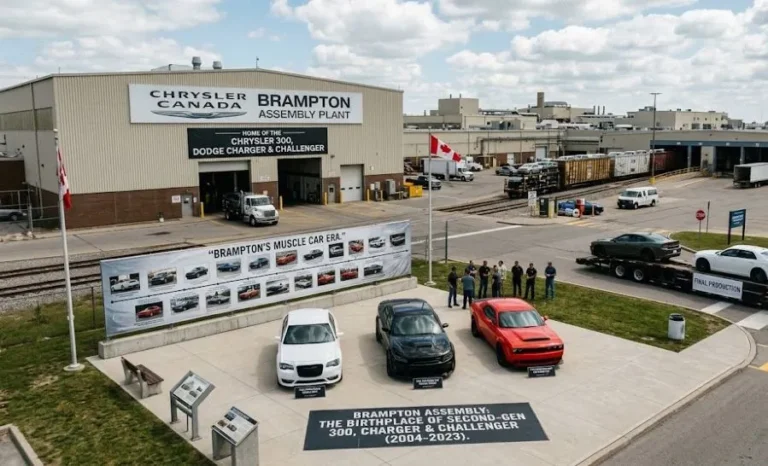
The last Chrysler 300C came off the line at the Brampton, Ontario plant in 2023. Approximately 2,000 went to American buyers and 200 to Canada — a farewell edition with the 6.4-liter HEMI V8 producing 485 horsepower, reaching 60 mph in 4.3 seconds, and covering the quarter mile in 12.4 seconds. Chrysler CEO Christine Feuell has since confirmed that the brand is planning a comprehensive new lineup including a new sedan that industry sources say could revive the 300 nameplate as early as 2027 to 2029.
The new car would ride on the STLA Large platform shared with the Dodge Charger, take design inspiration from the dramatic Halcyon concept, and offer multiple powertrain options after the brand rejected all-electric-only plans. This is the complete guide to what was, what is being planned, and what the next Chrysler 300 could be.
Quick Facts – New Chrysler 300
— Current Status: Discontinued — final production ended 2023 at Brampton Assembly, Ontario
— Final Model: 2023 Chrysler 300C — approximately 2,000 US units, 200 Canadian units
— Final Engine: 6.4-liter SRT HEMI V8 — 485 HP / 475 lb-ft torque
— Final Performance: 0-60 in 4.3 seconds / Quarter mile 12.4 seconds / Top speed 160 mph
— Final Colors: White, Black, and Red only
— Final Price: Approximately $55,000 for the 300C limited edition
— Regular 300 Production End: 2020 (300C special edition produced 2023)
— Revival Confirmed: Chrysler CEO Christine Feuell confirmed new sedan plans — Autoblog November 2025
— Expected New Platform: STLA Large — same as 2025 Dodge Charger
— Expected Powertrain: Multi-energy — electric, PHEV, and possibly conventional gasoline
— Design Inspiration: Chrysler Halcyon concept — fully electric luxury sedan concept
— SRT Performance: Confirmed to return for future Chrysler models
— Potential Launch Year: 2027 to 2029 depending on source (Motor1, MotorTrend, Cars Frenzy)
— Expected Price New: Approximately $65,000 starting for EV version (Motor1 estimate)
— Chrysler Is NOT Being Sold: CEO Christine Feuell confirmed — Autoblog November 2025
— Current Chrysler Lineup: Only Pacifica minivan and Voyager as of April 2026
— Next New Chrysler: C6X crossover — expected 2026 or 2027
Sources: Autoblog, Motor1, Cars Frenzy, Fox News, MotorTrend
Overview – The Car That Defined American Luxury On Its Own Terms — And Why It Matters That It Might Return
The Chrysler 300 was never the most sophisticated luxury sedan in its segment. It was never the best-handling. It never had the most advanced technology or the most refined interior in the class. What it had, more completely than any competing sedan from any nationality, was identity. The long hood, the upright grille, the wide body, the rear-wheel-drive stance, and the available HEMI V8 — together they produced a car that felt genuinely American in a market where American luxury had largely given up competing with German and Japanese alternatives and retreated into pickup trucks and SUVs.
The iconic Chrysler 300 needs no introduction. A staple of the brand that never failed to offer conventionally handsome style and ample luxury at an accessible price point, the 300 has unfortunately been absent from Chrysler showrooms since its discontinuation after the 2023 model year. That assessment — from Autoblog in August 2025 — captures both the car’s appeal and its absence with the specific honesty the situation deserves.
The 300 was never for everyone. It was specifically for the buyer who wanted an affordable rear-wheel-drive sedan with available V8 power, distinctive styling, and the kind of presence that makes people ask what the car is when it parks. For that specific buyer, nothing currently on the American market provides what the 300 offered.
That buyer is now potentially getting the car back. Chrysler CEO Christine Feuell has confirmed that the brand is planning a comprehensive new lineup, including a new sedan that could revive the 300 nameplate. The new sedan would be built on the STLA Large platform that underpins the new Dodge Charger, would take design inspiration from the dramatic Halcyon concept, and would offer multiple powertrain options — Chrysler has rejected the all-electric-only mandate that Stellantis had originally planned for the brand. SRT performance models are also confirmed to return.
The complete story of the new Chrysler 300 has three chapters: what the last 300C was and why it matters as a collector car; what Chrysler’s CEO and the automotive press have confirmed about the brand’s revival plans; and what the next-generation 300 could actually look like, how it could be powered, and when it might arrive. This guide covers all three honestly — separating confirmed facts from credible industry speculation and making clear which is which throughout.
Section 1 – The Final Chrysler 300C
The Last HEMI, The Last V8 Sedan, And Why It Already Has Collector Status
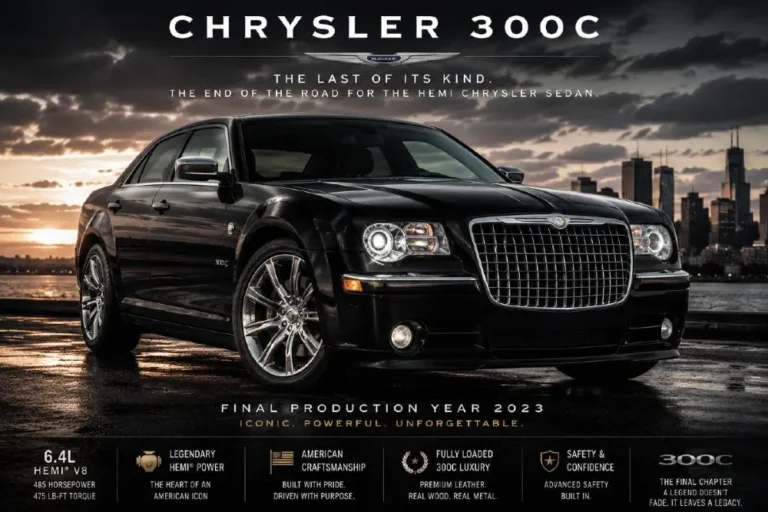
The 2023 Chrysler 300C is already a collector car — not because of its age, which is only three years at the time of writing, but because of what it was and how clearly Chrysler understood the moment it represented. This is the last model year for the 300. We really wanted to give our 300 enthusiasts something to celebrate as we sunset this version. Chrysler CEO Christine Feuell said that when the 300C was unveiled, and the final product reflected that intention with complete sincerity.
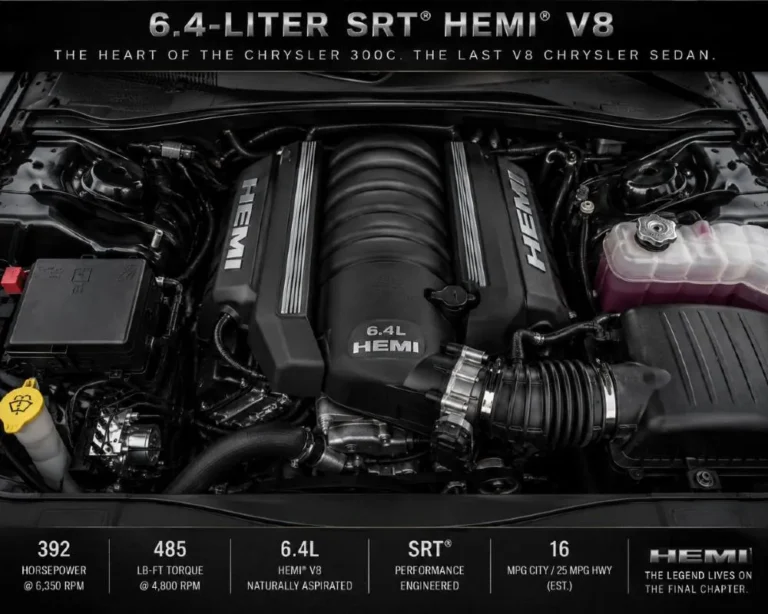
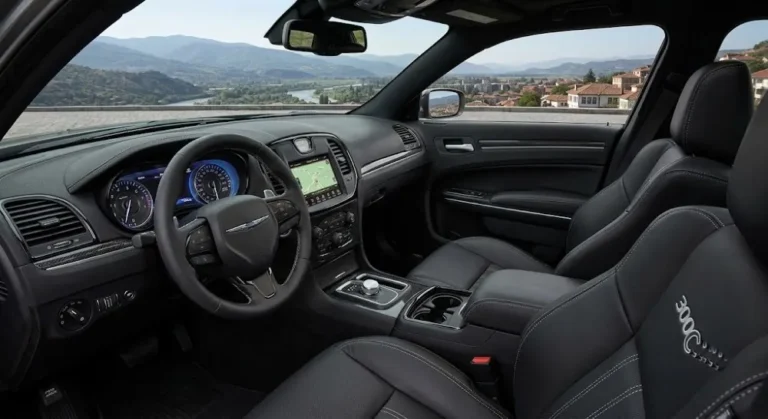
The 2023 Chrysler 300C used the 6.4-liter HEMI V8 — rated at 485 horsepower and 475 lb-ft of torque, an increase from the previous 470 HP rating that gave the farewell edition a specific mechanical distinction from its predecessors. Those numbers produced 0-to-60 mph in 4.3 seconds, a quarter-mile time of 12.4 seconds, and a top speed of 160 mph. In a large, comfortable rear-wheel-drive sedan, those are genuine sports sedan performance numbers — numbers that European luxury brands charge significantly more to deliver.
The 6.4-liter HEMI was equipped with Brembo brake calipers for the appropriate stopping force, a computer-controlled adaptive suspension system for the appropriate chassis control, and 20-inch wheels with high-performance all-season tires for the appropriate road contact. This was not a comfort-oriented powertrain installed in a sport package for marketing reasons — it was a purpose-built performance sedan that happened to carry the Chrysler badge and come at a price that made it accessible to buyers who could not have afforded a BMW M5 or Mercedes-AMG E63.
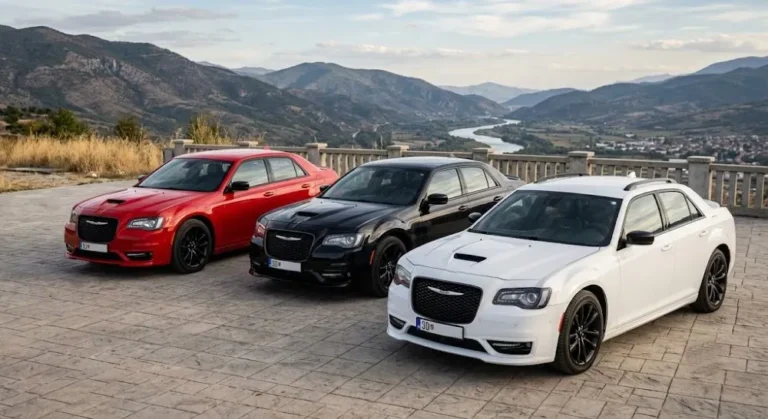
The 300C’s availability was deliberately limited to three colors — white, black, and red — which gave each configuration a specific visual clarity that the broader 300 lineup, with its extensive color palette, did not have. A black 300C on 20-inch wheels communicates its performance identity in a single impression. A red 300C does the same thing in a different register. The limited color selection was not an austerity measure — it was an editorial decision that understood the car’s meaning.
Approximately 2,000 of these cars went to American buyers and 200 to Canada. By comparison, the Ferrari Roma produces approximately 3,000 units per year. By the standard of low-production collectibles, the 2023 Chrysler 300C is genuinely rare — and it is the last V8-powered Chrysler sedan in history, a historical significance that will only appreciate over time.
The regular Chrysler 300 production — the V6 and 5.7L HEMI V8 versions across Touring, Limited, and S trim lines — ended in 2020. The 300C special edition was a post-discontinuation farewell, produced specifically because the Brampton assembly plant had the capacity and Chrysler understood that its enthusiast community deserved a proper goodbye. The 300 saw strong sales for about a decade before demand started to dwindle even before the COVID-19 pandemic, as smaller and more fuel-efficient models became more popular. That is accurate history. The 300 was not cancelled because it was bad. It was cancelled because the market moved away from large rear-wheel-drive sedans in a way that made continuing production economically unsustainable at full volume.
For buyers who love what the Chrysler 300 represented — rear-wheel drive, V8 character, American muscle car DNA — but cannot access the $55,000+ 300C farewell edition, our guide to the best sports cars under $10,000 covers the available alternatives including the Pontiac GTO, Chevrolet Camaro Z28, and Pontiac Firebird that share the 300’s fundamental rear-wheel-drive V8 philosophy at a fraction of the price.
Section 2 – The Chrysler 300 Legacy
Two Decades Of Blue-Collar Luxury — The Story The Numbers Tell
The Chrysler 300 that ended production in 2020 and 2023 was the second-generation model, introduced for 2005 on the LX platform that Chrysler developed in collaboration with Mercedes-Benz during the DaimlerChrysler era. That platform connection gave the 300 its specific engineering foundation — the rear-wheel-drive architecture, the independent rear suspension, and the overall chassis character that made it genuinely different from the front-wheel-drive alternatives that American luxury had largely settled for by the early 2000s.
The original second-generation 300 arrived with a design so distinctive that it remains identifiable without a badge to this day. The upright waterfall grille, the long hood, the wide body with its pronounced fenders, and the greenhouse that sat high and formal above a body that was aggressively wide — these were design choices that communicated a specific kind of American confidence. Not the apologetic, me-too luxury of a badge-engineered European platform. Not the aggressively styled, overly complex visual language of a car trying too hard to look premium. The 300’s design said what it meant clearly, and what it meant was: this is an American luxury car, and it is not trying to be anything else.
The blue-collar luxury approach — the specific marketing philosophy that Chrysler’s current CEO references when describing the brand’s future — was the 300’s fundamental identity from the beginning. More car than you expect at a price that surprises you. Rear-wheel drive when other American sedans had given it up. Available V8 when most competitors had moved to turbocharged fours and sixes. A grille that would look appropriate on a car costing twice as much. The 300 consistently offered these things at prices that started in the mid-$30,000 range and topped out in the mid-$50,000 range — positioning it below the German luxury segment while offering specific equipment and character that the German brands did not.
The SRT8 variants — beginning with the original 6.1-liter HEMI producing 425 horsepower and evolving to the 6.4-liter producing 470 and then 485 horsepower — provided the performance tier that turned the 300 from a comfortable luxury cruiser into a legitimate performance sedan. The 300 SRT8’s quarter-mile capability and top speed numbers consistently surprised European performance sedan owners who underestimated what a Chrysler badge communicated in practice.
The 300 also achieved a specific cultural significance in American music and visual culture — its appearance in music videos, film, and celebrity photography gave it a cultural presence that no amount of advertising could have purchased. The car looked expensive without being a European luxury badge. It looked fast without requiring a track weekend to appreciate. And it looked distinctly American in a way that resonated with a specific cultural identity that the German and Japanese luxury brands, regardless of their engineering excellence, could not replicate.
Section 3 – Chrysler’s Confirmed Revival Plans
What The CEO Has Actually Said And What It Means
The most important development in the Chrysler 300 story is not a new car — it is a confirmed change in strategy at the corporate level that makes a new 300 possible for the first time since the discontinuation.
Chrysler CEO Christine Feuell’s November 2025 Autoblog interview is the primary document for what Chrysler is actually planning. The confirmed facts from that interview and subsequent coverage: Chrysler is not being sold. Stellantis is committed to the brand. A comprehensive new lineup is planned including crossovers, a sedan, and a sub-$30,000 model. SRT performance models will return. Multiple powertrain options will be available — Chrysler has rejected the all-electric-only mandate that Stellantis had originally intended for the brand.
CEO Christine Feuell’s confirmation that Chrysler is planning a comprehensive new lineup including a sedan, SRT performance models, a multi-energy approach, and a sub-$30,000 model — alongside the confirmation that Chrysler is not being sold — is documented in Autoblog’s Chrysler revival plan confirmed new sedan report, published November 26, 2025 and the primary source for the revival plans in this article.
The most significant of these confirmations for 300 enthusiasts is the rejection of all-electric-only plans. When Chrysler first announced the 300’s discontinuation, the brand’s stated future was fully electric — Chrysler plans to become an all-electric brand by 2028 with its first EV set to debut in 2024. That plan did not survive contact with market reality. The CEO confirmed that the brand is not going to mandate electric powertrains and is instead pursuing a multi-energy approach based on customer demand. For buyers who wanted a new HEMI-powered 300 or a hybrid 300 rather than a pure EV, this confirmation is meaningful.
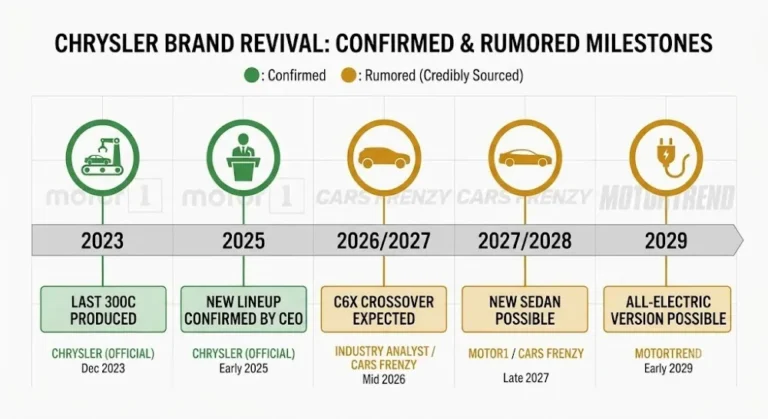
The new sedan that could revive the 300 nameplate is specifically mentioned in industry coverage as potentially arriving in 2027 or 2028 based on unnamed Chrysler sources, with a 2029 launch for an all-electric version referenced in MotorTrend rumor coverage. The discrepancy between dates reflects the fluid nature of automotive planning. Chrysler’s first confirmed new model — the C6X crossover — was originally expected in 2026 and has since been pushed to 2027, which indicates that the brand’s timeline is subject to the same pressures affecting Stellantis broadly.
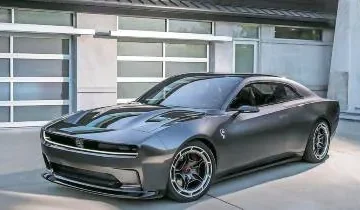
Should the 300 return, it would be built on the modern STLA Large platform, shared with vehicles like the Dodge Charger. This is the specific platform detail that determines what the new 300 can and cannot be. The STLA Large platform is a genuine step forward from the LX platform that underpinned the original second-generation 300. It supports multiple powertrain configurations including fully electric, plug-in hybrid, and extended-range electric options. It provides the wheelbase and structural architecture appropriate for a large rear-wheel-drive sedan. And it is already in production in the Dodge Charger — which means the manufacturing experience and supplier relationships are established.
The most honest assessment of where the new Chrysler 300 is: confirmed as a brand intention, unconfirmed as a specific product. Chrysler has told the automotive press and its CEO has told publications including Autoblog that a new sedan is coming. The specific nameplate, the specific powertrain configuration, the specific design, and the specific launch date are all unconfirmed. The STLA Large platform is the most credible structural assumption. The 2027 to 2029 timeframe is the most credible timing assumption. Everything beyond that is informed speculation rather than confirmed fact.
The new Chrysler 300 sedan is one piece of a much larger American automotive future that includes Ford’s $30,000 electric pickup, the Rivian R2, and the Slate Truck — our complete guide to future cars 2026–2029 covers every confirmed upcoming American vehicle in a single reference, providing the full context for where Chrysler’s revival plans sit alongside the most significant new American cars of the decade.
Section 4 – The Halcyon Concept
The Design Inspiration That Shows Where Chrysler Wants To Go
The Chrysler Halcyon concept is the most direct available evidence of what Chrysler’s design team envisions for the brand’s future — and therefore the most useful reference for understanding what a new Chrysler 300 could look like if and when it arrives.
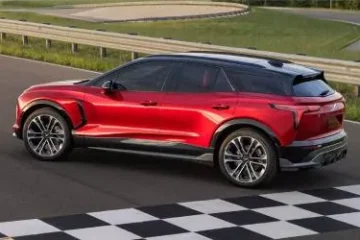
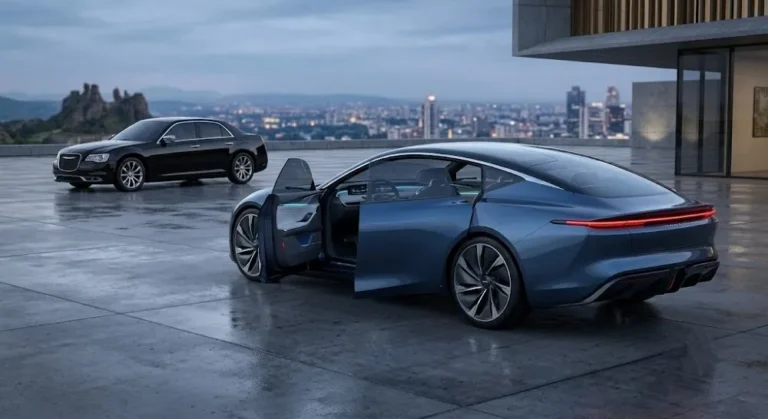
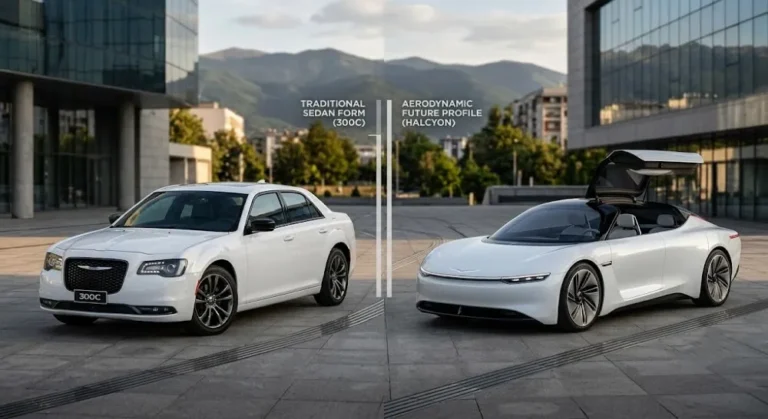
The Halcyon is a fully electric luxury sedan concept with a design that departs entirely from the second-generation 300’s formal three-box proportions. Where the 300 was upright, imposing, and deliberately traditional in its sedan architecture, the Halcyon concept is aerodynamically shaped, dramatically low, and explicitly futuristic. The Halcyon features suicide doors — rear doors hinged at the C-pillar and opening rearward, a configuration reminiscent of the original 1960s Lincoln Continental — that communicate both the design team’s awareness of American luxury heritage and their intention to reframe it in contemporary terms.
The interior of the Halcyon concept uses sustainable materials, advanced ambient lighting, and a technology-forward interface that communicates where the premium automotive market is moving — toward minimalist, material-quality-focused interiors rather than the button-heavy, feature-dense layouts of the previous generation’s luxury sedans. The connection to Chrysler’s blue-collar luxury positioning is maintained through the cabin’s emphasis on genuine material quality over complexity — the Halcyon is not trying to impress through electronic gadgetry but through the quality of what you can touch.
Reviving the 300 as a flagship sedan could restore Chrysler’s identity and desirability. But the critical question is whether the Halcyon’s design language is the right one to carry the 300 nameplate, or whether a new 300 would require a more conservative interpretation of the heritage. The 300’s existing buyer base — attracted specifically by the traditional sedan proportions, the upright grille, and the rear-wheel-drive performance character — may not respond as enthusiastically to a swoopy electric four-door as they did to the formal, imposing original.
The more pragmatic design prediction, from Autoblog’s coverage of potential new Chrysler 300 renders on the Dodge Charger platform, imagines a car that combines modern aerodynamic proportions with enough of the 300’s specific visual DNA — the wide stance, the prominent grille treatment, the long hood — to be immediately identifiable as a spiritual successor. This more conservative interpretation of the Halcyon’s design direction is probably the more commercially viable approach, and it is the approach that the STLA Large platform’s existing Dodge Charger body architecture makes most structurally straightforward.
The most current independent visual exploration of what a new Chrysler 300 could look like on the Dodge Charger’s STLA Large platform — and the specific design language that could bridge the Halcyon concept’s futuristic direction with the 300’s established visual heritage — is covered in Autoblog’s Chrysler 300 revival render on Dodge Charger platform feature, published April 3, 2026.
Section 5 – What The New 300 Could Be
Platform, Powertrains, Price, And The Honest Timeline
Building a specific picture of what the new Chrysler 300 could be requires separating confirmed platform information from estimated specifications — but the combination of confirmed STLA Large platform details and the existing Dodge Charger’s production reality provides more solid ground than most anticipated future car discussions offer.
The STLA Large platform supports wheelbase configurations appropriate for a full-size sedan. Its structural architecture enables multiple powertrain configurations — battery electric, plug-in hybrid, and conventional internal combustion — which aligns directly with CEO Feuell’s multi-energy commitment. The platform’s battery packaging in EV configuration allows for a low floor, which changes the interior proportions and seating position relative to the traditional 300’s architecture. This is both a design opportunity and a departure from what made the original 300 visually distinctive.
Using the STLA Large platform would also allow the revived 300 to optimize a diverse range of powertrains, such as fully electric battery power, hybrid and plug-in hybrid powertrains — providing the multi-energy approach that Chrysler’s CEO has explicitly committed to. The Dodge Charger’s existing turbocharged inline-six configurations — producing 420 and 550 horsepower — and any future Hurricane engine variants could theoretically power a gasoline or hybrid 300 if Chrysler chooses to offer non-electric variants. The STLA Large platform does not preclude conventional powertrains, which is a significant advantage over a purpose-built EV platform.
On pricing, the most credible estimate comes from Motor1’s analysis: the outgoing Chrysler 300 started at just under $40,000 for the 2023 model year, but average vehicle prices have skyrocketed, which means we don’t expect this new version to be that affordable. Motor1 uses the 2025 Dodge Charger EV — which starts at $61,590 for the base R/T on the STLA Large platform — as the primary reference point and estimates a new 300 EV starting at approximately $65,000. As a more premium product, we expect the Chrysler 300 to be a few thousand dollars more expensive than the Charger — a starting price of $65,000 for the EV isn’t out of the realm of possibility.
If a hybrid or gasoline configuration is offered alongside the EV — which the multi-energy strategy explicitly makes possible — pricing could potentially start lower than the EV version, providing a more accessible entry point to the nameplate. The hybrid configuration, in particular, could start in the $50,000 to $55,000 range if Chrysler positions it below the full EV while maintaining the premium sedan positioning above the Charger.
The performance tier — the SRT model that the CEO has confirmed will return to the Chrysler lineup — would presumably represent the 300’s performance flagship. The existing SRT heritage, from the original 300 SRT8 through to the final 300C, suggests a high-output configuration that would need to compete with or exceed the previous 485-horsepower standard. In an electric platform, achieving that would require approximately 400 to 600 horsepower from the battery-electric powertrain — achievable on the STLA Large architecture based on what the Dodge Charger Daytona demonstrates in its own lineup.
The comprehensive analysis of the 2026 Chrysler 300 release date speculation — including the timeline discrepancies between 2026, 2027, 2028, and 2029 estimates from different sources and the reasoning behind each — is documented in Cars Frenzy’s 2026 Chrysler 300 release date analysis, published January 23, 2026 and one of the most detailed independent timeline evaluations available.
The $65,000 estimated starting price for a new Chrysler 300 EV, the 2027 to 2028 timeline estimate with a concept another year out still, and the analysis of the Dodge Charger EV as the primary pricing reference are all from Motor1’s new Chrysler 300 everything we know report, published June 18, 2025.
Section 6 – The Competition The New 300 Would Face
A Market That Has Changed Dramatically Since 2020
The Chrysler 300’s discontinuation in 2020 came at a moment when the full-size American rear-wheel-drive sedan market was already in advanced decline. By 2026, that market has changed further — and understanding the competitive environment the new 300 would enter is essential context for evaluating whether the revival strategy makes sense.
The traditional large American sedan competitors have been eliminated almost entirely. The Dodge Charger has transitioned to a turbocharged gasoline inline-six across its main lineup, with no V8 available and no four-door configuration in the current Charger lineup. The Cadillac CT5 — the closest American luxury sedan — uses a conventional platform with multiple powertrain options and starts in the $45,000 to $85,000 range, occupying the accessible luxury tier that the 300 once commanded. The Lincoln Continental was discontinued in 2020, the same year as regular 300 production ended.
Large sedans from non-German brands are a hard sell, though, so perhaps Chrysler’s D-segment crossover will have a more premium look and feel. That honest assessment from Autoblog’s November 2025 coverage of Chrysler’s revival plans captures the fundamental market challenge that the new 300 would face. The American luxury sedan market that existed in 2005 when the 300 launched — where a large, imposing, V8-powered rear-wheel-drive sedan at an accessible price could find a substantial audience — is not the market that exists.
The electric luxury sedan market, into which the Halcyon-inspired 300 EV would enter, is dominated by Tesla’s Model S and the Lucid Air at the premium end, with the BMW i7 and Mercedes EQS occupying the ultra-luxury tier. A $65,000 Chrysler 300 EV would be entering a segment where Tesla’s Model S delivers 670 miles of range and 1,020 horsepower from its Plaid configuration, and where the Lucid Air has already established a reputation for extraordinary efficiency. These are not competitors that a Chrysler brand — currently selling only minivans — can approach without significant brand rehabilitation investment.
The most realistic competitive position for the new 300, if it arrives in the 2027 to 2029 timeframe, is the accessible luxury large sedan that offers genuine performance capability at a price point below the German premium tier. This is exactly the position the original 300 occupied, and it is a position that genuinely does not have a strong current American occupant.
The Cadillac CT5 is the nearest competitor, but it is smaller and does not carry the same visual presence or rear-wheel-drive performance identity. A new 300 that arrives with 400-plus horsepower, genuine luxury interior quality, and a starting price below $70,000 would have a specific and underserved market position to occupy — if Chrysler can execute on the promise.
The Cadillac CT5 occupies the most directly competitive position to any future Chrysler 300 in the American luxury sedan market — and understanding its reliability standing alongside Cadillac’s current brand position is important context for any buyer evaluating American luxury sedans in 2026. Our complete guide to the most reliable cars covers Cadillac’s 18th-place Consumer Reports ranking and the specific models where the brand scores above average.
Section 7 – What To Do If You Love The 300
Buying The Farewell Model, Waiting For The Return, And The Collector Case
For buyers who have been following the 300 story and wondering what to do — whether to find a used final-generation example, to wait for the rumored new model, or to accept that the 300 they remember is not coming back — the honest guidance depends on which aspect of the 300’s appeal matters most.
If the specific mechanical appeal is the HEMI V8 — the sound, the feel, the rear-wheel-drive performance character of a large American sedan with a naturally aspirated V8 — the new 300 is unlikely to replicate it regardless of when it arrives. The multi-energy approach means gasoline powertrains may be available, but the probability of a new naturally aspirated HEMI V8 in the post-emissions-regulation environment is low. The turbocharged Hurricane inline-six is the more likely gasoline option if an ICE configuration is offered. For buyers who specifically want the HEMI experience, the 2023 300C or a clean final-year conventional 300 with the 5.7L HEMI is the appropriate purchase — not a future model whose powertrain is unconfirmed.
If the 300’s appeal is the visual and cultural identity — the imposing rear-wheel-drive sedan presence, the wide-body three-box proportions, the specific American luxury character that neither the Charger nor any other current American car replicates — the new model is worth waiting for. The brand is committed to a sedan. The platform supports the necessary architecture. The Halcyon concept demonstrates that Chrysler’s design team is thinking about exactly the right design language for a premium American sedan revival.
The 2023 Chrysler 300C as a collector purchase is the most interesting case. Approximately 2,200 North American examples is a genuinely limited production run. It is the last V8 Chrysler sedan in history. It has confirmed performance credentials that are not speculative. And used 300C examples in clean condition with documented history are available at prices that reflect their limited production without yet reflecting their eventual collector recognition fully. Hagerty’s guidance on farewell edition collectibles consistently suggests that the period immediately following discontinuation — before the collector market fully prices the scarcity — is the most opportune purchasing window. That window is currently open for the 2023 300C.
Buyers considering a used Chrysler 300 — whether the final-year 300C or the earlier 5.7L or 3.6L configurations — should understand the Pentastar V6 oil consumption issue and the 5.7L HEMI MDS system concerns documented in our complete guide to common issues that kill American cars, both of which affect the 300’s platform in specific configurations and model years.
FAQ
Q: Is the Chrysler 300 coming back?
A: Chrysler CEO Christine Feuell has confirmed that the brand is planning a comprehensive new lineup including a new sedan that could revive the 300 nameplate, according to Autoblog’s November 2025 reporting. MotorTrend has reported rumors of a possible 2029 launch for an all-electric version. Industry sources and Motor1 suggest a 2027 or 2028 arrival for a production confirmation or concept reveal. No official announcement of a new Chrysler 300 has been made as of April 2026. The brand’s first new product — the C6X crossover — is expected in 2026 or 2027.
Q: What was the last Chrysler 300 ever made?
A: The last Chrysler 300 was the 2023 Chrysler 300C — a limited farewell edition produced in approximately 2,000 units for the US market and 200 for Canada at the Brampton Assembly plant in Ontario. The 300C used a 6.4-liter HEMI V8 producing 485 horsepower and 475 lb-ft of torque, reached 0-60 mph in 4.3 seconds, and covered the quarter mile in 12.4 seconds. It was offered only in white, black, and red. Regular Chrysler 300 production in the V6 and 5.7L HEMI V8 configurations ended in 2020.
Q: What platform would the new Chrysler 300 use?
A: The new Chrysler 300 is expected to be built on Stellantis’ STLA Large platform — the same architecture that underpins the new Dodge Charger. The STLA Large platform supports fully electric, plug-in hybrid, extended-range electric, and conventional gasoline powertrains, which aligns with CEO Feuell’s confirmed multi-energy approach. Using the STLA Large platform would also allow the revived 300 to optimize a diverse range of powertrains including fully electric battery power, hybrid, and plug-in hybrid configurations.
Q: How much will the new Chrysler 300 cost?
A: Motor1’s June 2025 analysis estimates that a new Chrysler 300 EV starting price of $65,000 is not out of the realm of possibility, using the 2025 Dodge Charger EV’s $61,590 base price as the primary reference. The outgoing 2023 Chrysler 300 started at just under $40,000, but average vehicle prices have increased significantly since then. No official pricing has been announced. If a hybrid or gasoline configuration is offered alongside the EV, it could potentially start lower than the EV version.
Q: What was the Chrysler 300C HEMI engine output?
A: The 2023 Chrysler 300C used the 6.4-liter SRT HEMI V8 producing 485 horsepower and 475 lb-ft of torque — an increase from the previous 470 horsepower rating. This engine produced 0-to-60 mph in 4.3 seconds, a quarter-mile time of 12.4 seconds, and a top speed of 160 mph. The car was equipped with Brembo brake calipers and a computer-controlled adaptive suspension system. The broader Chrysler 300 lineup also offered the 5.7-liter HEMI V8 producing 363 horsepower and the 3.6-liter Pentastar V6 producing 292 horsepower.
Q: What is the Chrysler Halcyon concept?
A: The Chrysler Halcyon concept is a fully electric luxury sedan concept unveiled by Chrysler to preview the brand’s future design direction. It features a dramatic exterior design with suicide rear doors, a sustainable material interior, and the brand’s blue-collar luxury positioning in an electrified format. The Halcyon has been cited in industry coverage as a potential design inspiration for a new Chrysler 300 sedan. The concept demonstrates that Chrysler’s design team is thinking about a premium large sedan in the brand’s future, even without confirming the specific nameplate it would wear.
The Bottom Line
The Chrysler 300 story is a story in two parts — the ending of one era and the uncertain beginning of another. The ending is documented and complete: the 2023 300C, 2,200 examples, 485 horsepower, 4.3 seconds to 60 mph, last HEMI sedan in Chrysler’s history. That car exists. It is already in garages and collections. Its historical significance as the last V8 Chrysler sedan is permanent and will only appreciate as time separates it from its production context.
The beginning is less certain — but more hopeful than it has been at any point since the discontinuation. CEO Christine Feuell has confirmed that Chrysler is staying and building a new lineup. She has confirmed that the brand is not going all-electric — customers will have choices. She has confirmed that SRT performance returns. A sedan is specifically mentioned in the planned lineup. The STLA Large platform is there. The Halcyon concept is there. The brand’s blue-collar luxury identity — the specific positioning that the 300 occupied so effectively for eighteen years — is explicitly what Chrysler says it wants to recapture.
Whether the new car wears the 300 nameplate or not, whether it arrives in 2027 or 2029, and whether it carries a turbocharged six or an electric motor or a V8 that nobody currently expects — all of that is unconfirmed. What is confirmed is that Chrysler understands what it lost when the 300 was discontinued, understands what no other American car currently provides, and is working toward providing it again.
The 300 was never a perfect car. It was always a specific car — for a specific buyer with specific priorities in a specific tradition of American automotive identity. That buyer still exists. That tradition still matters. And that specific car is coming back in some form.
Editorial Note
This article was written and reviewed in June 2026. All confirmed specifications of the 2023 Chrysler 300C — 485 HP, 475 lb-ft, 4.3-second 0-60, 12.4-second quarter mile, 160 mph top speed, Brembo brakes, adaptive suspension — are sourced from Fox News’ 2023 Chrysler 300C unveiling coverage and CBC News’ Brampton plant production reporting.
The production figure of approximately 2,000 US and 200 Canadian units is from CBC News. The CEO’s confirmation of Chrysler’s new lineup plans, the sedan development, SRT returns, multi-energy approach, and the statement that Chrysler is not being sold are from Autoblog’s “Inside Chrysler’s Radical Revival Plan” published November 26, 2025. The STLA Large platform identification and the multi-energy powertrain description are from Cars Frenzy (January 23, 2026).
The 2027 to 2029 timeline range is synthesized from Motor1 (June 18, 2025 — confirming “2027 or 2028” with a concept “another year out still”), Cars Frenzy (January 2026 — confirming “2027 or 2028”), and MotorTrend via Autoblog (August 26, 2025 — confirming “2029” rumor for all-electric version). The $65,000 estimated starting price for the EV version is from Motor1 (June 18, 2025), using the 2025 Dodge Charger EV’s $61,590 base price as its reference point. The Halcyon concept description is from Autoblog (April 3, 2026).
The blue-collar luxury description is from Autoblog’s November 2025 revival plan article. This article correctly characterizes the new Chrysler 300 as unconfirmed and not yet announced — all future vehicle details are clearly identified as industry speculation or unconfirmed rumors rather than manufacturer-confirmed specifications.