Last Updated: June 1, 2026 | Read Time: 9 minutes
Quick Facts – Best Sports Cars Under 10K
— Best Overall Value: Pontiac GTO (2004–2006) — 350–400 HP, LS V8, consistently under $10K
— Best Daily Driver: Ford Mustang GT (2005–2009) — 300 HP, massive parts support, most reliable
— Best Raw Performance: Chevrolet Corvette C5 (1997–2000) — 345 HP, aluminum frame, supercar dynamics
— Best Underdog: Pontiac Firebird Formula/Trans Am (1998–2002) — LS1 V8, forgotten and cheap
— Best Muscle Car Feel: Dodge Challenger SXT/R/T (2009–2011) — modern platform, iconic styling
— Best First V8: Ford Mustang GT (1999–2004) — simple, cheap to fix, widely understood
— Best Sleeper: Chevrolet Camaro Z28/SS (1998–2002) — LS1 V8, handles better than it looks
— Best Special Edition: Ford Mustang Mach 1 (2003–2004) — DOHC Cobra motor in Mach 1 body
— Market Reality: No new American sports car sells under $10,000 — all picks are used
— Budget Rule: At under $10,000, every purchase requires a pre-purchase inspection
— Cheapest Reliable V8: 1999–2004 Ford Mustang GT — $4,500 to $7,000 for a driver-quality example
— Mileage Sweet Spot: 80,000–130,000 miles with documented maintenance history
— Avoid: Salvage titles, flood damage, unresolved rust on structural components, heavily modified without documentation
Sources: Hagerty Valuation Tool, KBB, Classic.com, Autotrader, AutoZone reliability data, editorial assessment
Overview – The American Sports Car Under $10,000 Has Never Been A Better Deal
Something unusual has happened to the American used sports car market. While inflation has pushed nearly every other used vehicle category into prices that would have seemed impossible five years ago — used full-size trucks regularly exceeding their original MSRP, used compact SUVs holding value for years past any historical precedent — the American sports car segment under $10,000 has remained relatively stable. The Gen 4 Camaro, the SN95 and New Edge Mustang, the Pontiac Firebird, and the GTO — these vehicles have appreciated from their rock-bottom valuations of the 2010s, but not so dramatically that they have left the under-$10,000 budget category entirely.
The reason is a combination of production volume and buyer psychology. American muscle cars were built in enormous numbers during the 1990s and 2000s — Mustangs, Camaros, and Challengers sold in the hundreds of thousands annually. The supply of clean, usable examples remains large even after attrition from accidents, rust, and abuse.
And the buyer psychology that drives appreciation — the collector community of concours-quality enthusiasts who push values to stratospheric levels — has focused primarily on the pre-1975 muscle car era. The modern-era American performance car, built after 1990, remains attainable in a way that the 1969 Camaro has not been for a generation.
This guide covers eight specific cars that deliver genuine American sports car driving experience under $10,000. Every pick is a V8 or represents the best available value in its specific segment. Every pick includes what to look for, what to avoid, and the realistic market pricing you will encounter rather than the optimistic pricing that makes every car seem like a deal.
The under-$10,000 sports car purchase is not without risk. Every car in this guide has specific known issues, documented failure patterns, and age-related concerns that a buyer who does not do the homework will discover only after the purchase. The buyer who reads this guide, performs a pre-purchase inspection, and chooses the correct model year and configuration can find one of the best performance-per-dollar values in the American automotive market.
Section 1 – Ford Mustang GT
America’s Most Reliable Budget Sports Car In Two Generations
The Ford Mustang GT is the safest purchase in the under-$10,000 American sports car category — not because it is the most exciting or the fastest, but because it is the most thoroughly documented, the most widely supported, and the most reliably maintained of every car in this guide. Two generations are relevant to this price range.
The 1999–2004 New Edge Mustang GT
The 1999 to 2004 Ford Mustang GT uses the 4.6-liter two-valve modular V8 producing 260 horsepower in 1999 through 2000 trim and 260 horsepower in the same configuration through 2004. In its era this was competitive. It is modest by modern standards but still produces the V8 sound, the rear-wheel-drive character, and the manual transmission engagement that defines what an American sports car should feel like. The T-45 and later Tremec T-3650 manual transmissions are robust and widely understood by independent shops.
Driver-quality examples of the 1999 to 2004 Mustang GT are available in the $4,500 to $7,000 range depending on mileage, condition, and region. These are cars with 100,000 to 180,000 miles that still have significant reliable life ahead if they have been maintained correctly. The engine is simple, parts are inexpensive everywhere in the country, and any mechanic who works on American cars can service it competently.
The known issues on this generation are manageable: the 4.6L two-valve is prone to developing oil leaks at higher mileages from the cam chain tensioner gaskets and the valve cover gaskets — inexpensive to repair but worth checking before purchase. The plastic intake manifold crossover tube — a factory known weakness — should be inspected for cracks. Rust on the rocker panels and the trunk floor is the most serious structural concern in northern examples. Inspect every body seam carefully.
The 2005–2009 Three-Valve Mustang GT — The Sweet Spot
The 2005 to 2009 Ford Mustang GT is the better purchase in this price range for buyers who can find a clean example at the top of the budget. The three-valve 4.6-liter V8 produces 300 horsepower in the 2005 to 2009 configuration — 40 more than the previous generation — in a significantly more modern platform with independent rear suspension geometry updates, a revised body that many consider the best-looking Mustang of the modern era, and interior quality meaningfully improved over the previous generation.
Prices range from $7,000 to $10,000 for good examples, with very clean low-mileage examples occasionally exceeding the $10,000 ceiling. The three-valve engine has a documented spark plug seizure issue — the same design concern documented in the 5.4L Triton — where the plugs can break during removal if they have been installed too long. Change plugs at 60,000 miles and the problem never arrives. Buy a high-mileage example where nobody is sure when the plugs were last changed and you may face the extraction bill. Ask about plug history before any purchase of a higher-mileage 2005 to 2009 GT.
The three-valve GT also has cam phaser rattle on cold starts if oil changes have been deferred — the same VCT system as the Triton, requiring consistent oil pressure. Regular full-synthetic oil changes resolve and prevent this condition. An engine that rattles for the first 30 seconds of a cold start after a period of non-use is flagging deferred maintenance — inspect the oil condition carefully and verify the change interval history.
Section 2 – Chevrolet Camaro
LS Power At Bargain Prices Across Two Completely Different Generations
The Fourth-Generation Camaro Z28 And SS (1998–2002)
The fourth-generation Chevrolet Camaro Z28 and SS represents one of the most remarkable performance value propositions in the under-$10,000 used car market. The Z28 uses the LS1 5.7-liter V8 producing 305 horsepower in the same basic engine architecture that powers the contemporary Corvette. The SS uses the same LS1 in a slightly higher state of tune, typically adding the Borla exhaust and specific suspension tuning. Both are genuine performance cars that handle, brake, and accelerate with a capability far beyond what their current prices suggest.
The fourth-generation Camaro was discontinued after 2002 and spent years as the forgotten cheap muscle car — the car that enthusiasts who could not afford Corvettes bought as a consolation purchase. That perception has partially corrected, but the market has not pushed prices beyond attainability. Clean driver examples of 1998 to 2002 Camaros with the LS1 are available for $5,000 to $9,000. Z28s with documented service histories and solid bodywork are available at the $7,000 to $9,500 level.
The fourth-generation Camaro Z28 that delivers LS1 power for under $10,000 is the direct descendant of the car that defined American performance in the muscle car era — our complete guide to the 1969 Camaro SS covers the original’s performance heritage, the COPO ordering program, and what made the first-generation Camaro the benchmark that every subsequent generation has been measured against.
The T-56 six-speed manual transmission in these cars is excellent — one of the better-feeling manual transmissions ever fitted to an American production car at any price. The automatic alternative is less engaging but equally capable. What the fourth-generation Camaro has always had in abundance is handling — the F-body platform’s suspension geometry produces genuine sports car cornering behavior that the Mustang’s solid rear axle could not match in this era.
The concerns: T-top panels on optioned examples leak and can cause interior water damage — inspect the headliner and carpets carefully. Rust on the rockers and floor pans is serious in northern examples. Power window regulators fail regularly — a relatively minor annoyance. LS1 engines with deferred oil changes develop intake gasket leaks between the valley cover and the intake manifold — inspect for any coolant or oil smell from the intake area.
The fourth-generation Camaro Z28’s LS1 and the Corvette C5’s identical engine are both part of the same GM performance engineering story that runs from the 1953 Corvette’s inline-six to the 2026 ZR1X’s 1,250 combined horsepower. Our complete guide to sports Chevy cars covers the full performance Chevrolet lineup across every era, providing the historical context that makes a $7,500 Z28 or a $9,000 C5 feel like buying a piece of a genuinely significant engineering legacy.
The Fifth-Generation Camaro V6 And LS3 SS (2010–2012)
The fifth-generation Camaro launched in 2010 on the Zeta platform and immediately established itself as a genuinely competitive sports car — the first Camaro in decades that could legitimately argue with European alternatives on handling and dynamics rather than relying solely on straight-line power. The 2010 to 2012 Camaro LS3 SS produces 426 horsepower and is the most capable American muscle car in this price range for drivers who prioritize outright performance.
The challenge with the 2010 to 2012 Camaro SS under $10,000 is that finding truly clean examples at this price requires patience. Most sub-$10,000 examples of the fifth-generation SS have significant mileage — 120,000 to 180,000 miles — or have had cosmetic or mechanical issues that are priced accordingly. The search is rewarding when it succeeds. Budget additional time relative to the earlier generation Camaro.
The V6 3.6-liter fifth-generation Camaro is significantly more available under $10,000 — clean examples with 70,000 to 100,000 miles regularly appear in the $6,000 to $8,500 range. The 3.6L produces 312 horsepower in 2010 to 2012 trim — more than the previous generation’s LS1 Z28 — and the Zeta platform’s handling makes it a genuinely entertaining car to drive even without a V8. For a buyer who prioritizes modern handling feel and reliability over pure V8 character, the fifth-generation V6 Camaro is a legitimate choice.

Section 3 – The Pontiac GTO
The Most Undervalued Performance Car In America Under $10,000
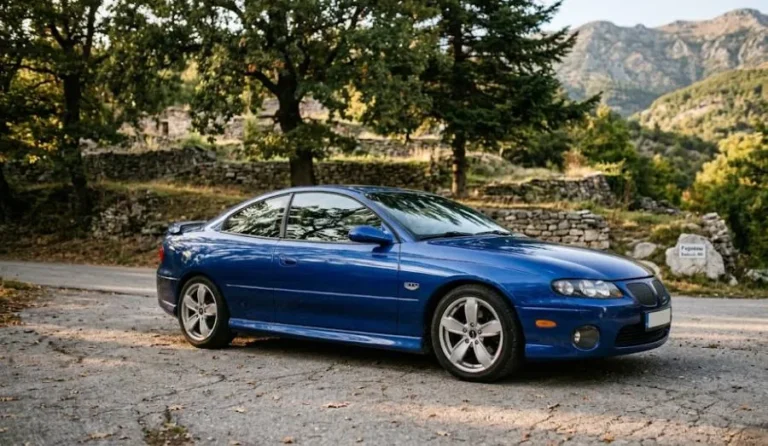
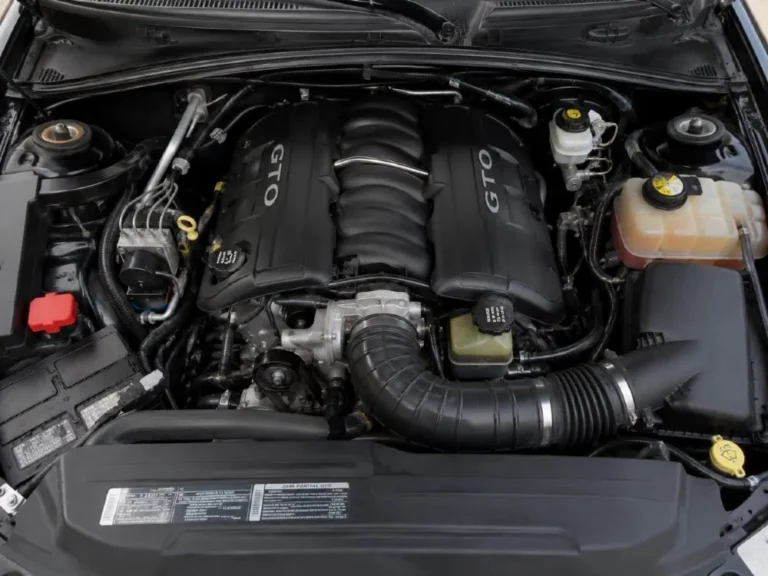
The 2004 to 2006 Pontiac GTO is the best-kept secret in the under-$10,000 American sports car market, and if you are reading this guide and have not already considered one, this section may change how you spend your budget entirely.
General Motors revived the GTO nameplate from 2004 to 2006 using an Australian-market Holden Monaro platform. The result was a two-door coupe with a chassis that handled like a European sports car, a suspension that impressed every automotive publication that tested it, and an engine lineup that starts at extraordinary and escalates to genuinely spectacular. The 2004 and 2005 GTO uses the LS1 5.7-liter V8 producing 350 horsepower. The 2006 GTO upgraded to the LS2 6.0-liter V8 producing 400 horsepower — the same engine fitted to the base 2005 Chevrolet Corvette.
The reason the GTO is available under $10,000 while the Corvette C5 commands premiums above that level is simple: styling. The 2004 to 2006 GTO looks like an unremarkable two-door coupe. It has no hood scoops, no aggressive body kit, no visual language that communicates the 400 horsepower underneath. This design decision — made in an attempt to appeal to buyers who wanted a muscle car without the muscle car attention — was commercially unsuccessful in the American market. In 2026, that commercial failure is the buyer’s financial advantage. You pay Malibu prices for Corvette engine performance.
The Tremec T-56 six-speed manual is available and is the recommended transmission for engaged drivers. The four-speed automatic is available for buyers who prefer it. Both transmissions are solid. The suspension — tuned for Australia’s demanding road conditions — provides handling competence that consistently surprises drivers who expect muscle car dynamics and find sports car behavior instead. Hagerty’s valuation tool consistently shows the GTO in the $7,000 to $11,000 range for average examples — with patient shopping, under-$10,000 examples appear regularly.
The concerns are minimal. The platform is well-engineered and the LS family of engines has one of the best long-term reliability records of any American V8 in history. The most common issues are minor: the turn signal stalks wear out and become intermittent, the power window motors occasionally fail, and the parking brake mechanism can seize if the car is parked for extended periods without use. None of these are consequential. The LS2 engine with proper maintenance runs reliably past 200,000 miles on documented examples — an engine that can outlast the rust on the body if the rust is managed correctly.
If there is one car in this guide where you should stretch to the top of the $10,000 budget to find the cleanest available example, the GTO is that car. The performance-per-dollar calculation at this price point is not matched by anything else in this guide.
Section 4 – Pontiac Firebird Formula And Trans Am
The Car That Should Be Worth More Than It Is
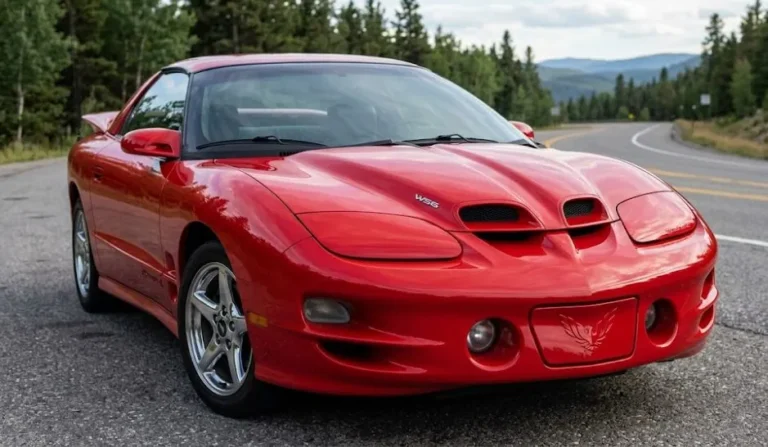
The 1998 to 2002 Pontiac Firebird Formula and Trans Am is the least expensive LS1-powered sports car in the American used car market, and the specific reason it is less expensive than the equivalent-year Camaro — which uses the exact same platform, the exact same LS1 engine, and the exact same T-56 transmission — is that fewer people know about it. This information gap is the buyer’s opportunity.
The Firebird and Trans Am are built on the same F-body platform as the fourth-generation Camaro. The LS1 5.7-liter V8 in the Trans Am produces the same 305 horsepower it produces in the Camaro Z28. The T-56 six-speed manual is the same unit. The suspension geometry is the same. The driving experience is effectively identical in everything that matters dynamically.
What differs is appearance — the Firebird’s more dramatic front clip with pop-up headlights on earlier examples and the WS6 Ram Air package available on the Trans Am that adds a specific hood with Ram Air induction. The WS6 Trans Am with the Ram Air package produces 325 horsepower rather than 305 — a meaningful upgrade that is worth confirming when evaluating any example. The Firebird Formula — the step below the Trans Am — drops the Trans Am’s specific bodywork for a slightly cleaner, less dramatic appearance at the same mechanical specification.
Driver-quality Firebird Formulas with the LS1 are available in the $4,500 to $7,500 range — consistently less than equivalent Camaros. Trans Ams command a small premium for the WS6 package but remain under $9,000 for driver examples. The same concerns as the Camaro apply identically: T-top leak inspection if equipped, rocker panel rust in northern examples, and LS1 intake gasket inspection. The additional Firebird-specific concern is the pop-up headlight mechanism — the electric actuators that raise and lower the headlights on pre-1998 examples can develop failures that leave headlights stuck in either position. The 1998 to 2002 generation uses fixed headlights and avoids this specific issue.
Section 5 – The Dodge Challenger
Modern Platform, Classic Proportions, And A Budget That Works
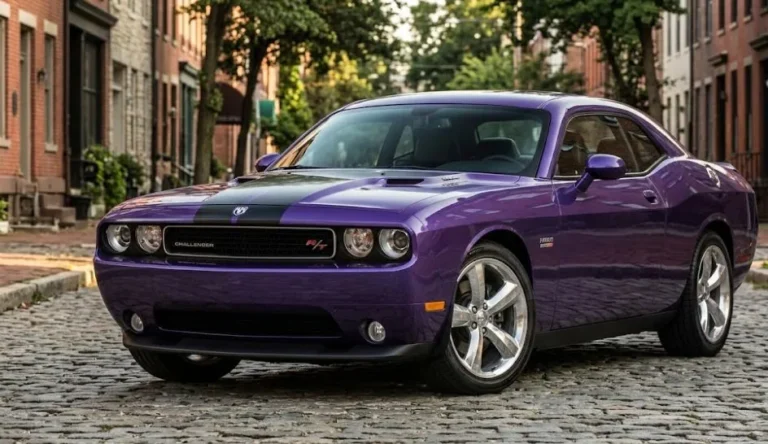
The Dodge Challenger entered its third generation in 2008 on the LX platform — a rear-wheel-drive, live-axle-equipped muscle car specifically designed to evoke the original 1970 Challenger’s proportions and presence. The 2009 to 2011 Challenger represents the most accessible entry into modern American muscle car ownership under $10,000.
The 2009 to 2011 Challenger SXT uses a 3.5-liter V6 producing 250 horsepower — adequate but not inspiring. The car that belongs in this guide is the R/T, which uses the 5.7-liter HEMI V8 producing 370 horsepower with multi-displacement system cylinder deactivation. Finding a 2009 to 2011 Challenger R/T under $10,000 requires searching in markets where the car has higher mileage — 120,000 to 160,000 miles — or where cosmetic condition reduces the asking price below what a cleaner example would command. These cars exist, and the HEMI V8 at these mileages with proper maintenance has significant additional life remaining.
The Challenger’s most significant limitation is its weight — at approximately 4,100 pounds, it is the heaviest car in this guide by a substantial margin, and that weight communicates itself in cornering behavior. The Challenger is not a car that rewards aggressive corner entry. It rewards straight-line drama, comfortable highway cruising, and the specific experience of arriving somewhere in a vehicle that communicates presence the way an aircraft carrier communicates presence. For that specific experience, nothing in this price range replicates what the Challenger provides.
The HEMI MDS (Multi-Displacement System) cylinder deactivation — the Dodge equivalent of GM’s AFM — can develop similar lifter concerns at high mileages, particularly if oil change intervals have been irregular. Inspect oil condition carefully on any high-mileage HEMI R/T example, and if the oil is dark or shows signs of contamination, factor a maintenance refresh into the budget before purchase. The HEMI with documented oil change history at proper synthetic intervals is a durable and reliable engine that routinely exceeds 200,000 miles.
Section 6 – The Chevrolet Corvette C5
America’s Sports Car At Prices Nobody Expected
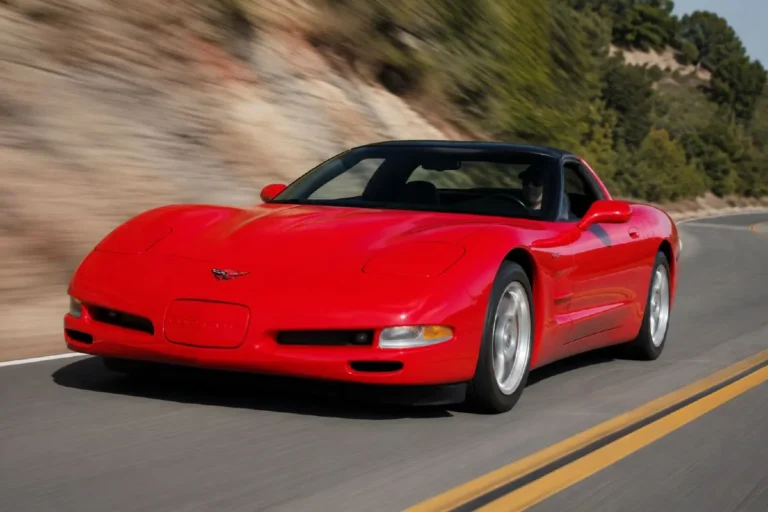
The Chevrolet Corvette C5 — produced from 1997 through 2004 — is the most technically accomplished vehicle in this guide and the one whose under-$10,000 availability continues to surprise people who have not checked prices recently. The C5 uses an aluminum-intensive structure with a composite body, fully independent suspension at both ends, a transaxle rear transmission for optimal weight distribution, and the LS1 5.7-liter V8 producing 345 horsepower — or 350 in the 2001 and later versions.
The C5 at $10,000 is not a mint example. Hagerty values average C5s at approximately $13,000 to $15,000 for the 1997 to 2000 base coupe. The cars that fall under $10,000 are higher-mileage examples — 130,000 to 200,000 miles — or examples with specific cosmetic issues, known mechanical needs, or documentation gaps that push them below the average valuation. These are real cars that can be purchased, maintained, and driven reliably — but they require more careful inspection than a cleaner $13,000 example and should be purchased with a mechanical inspection budget factored in.
What the under-$10,000 C5 provides that nothing else in this guide provides: the specific driving experience of America’s dedicated sports car — not a pony car, not a muscle car, but a purpose-built sports car with mid-engine-like weight distribution, a suspension designed specifically for performance rather than adapted from a production platform, and handling dynamics that remain genuinely impressive against modern alternatives. The C5 at 130,000 miles with documented service history is a more sophisticated sports car than any other vehicle in this guide regardless of its mileage.
Known issues requiring inspection: the C5’s roof panel leaks if the seal has degraded — inspect the headliner for water staining. The differential fluid should be checked and replaced on any example where its service history is uncertain — the limited-slip differential runs dry without regular attention and the resulting wear is expensive. The Stabilitrak system can develop brake modulator issues at higher mileages. None of these concerns are disqualifying — they are manageable maintenance items on a vehicle whose fundamental engineering excellence justifies the inspection effort.
The Corvette C5’s appeal under $10,000 becomes clearer when you understand the performance heritage of the platform — the same LS architecture that powers the budget C5 has evolved into the 1,064-horsepower ZR1. Our comparison of the Corvette ZR1 vs Camaro ZL1 covers the modern performance ceiling of both lineages, showing how the under-$10,000 C5 sits at the foundation of a performance architecture that remains relevant six generations later.
Section 7 – What To Look For And What To Avoid
The Pre-Purchase Inspection That Separates A Good Deal From An Expensive Mistake
Every car in this guide is available under $10,000. Not every car under $10,000 in these categories is worth buying. The difference between a great deal and an expensive mistake is almost always visible on inspection if you know where to look.
The pre-purchase inspection by an independent mechanic is the single most important expenditure in any under-$10,000 sports car purchase. For $100 to $200, a mechanic who is familiar with the specific model will check every system you cannot easily evaluate yourself — compression across all cylinders, oil pressure at idle and at speed, transmission fluid condition and shift quality, brake condition and rotor thickness, suspension component play, exhaust system leaks, and the specific failure points that each model is known for. A $150 inspection that identifies a $2,000 repair need is money that prevented a catastrophic purchase. A $150 inspection on a clean example confirms your confidence before signing.
The pre-purchase inspection skills needed to evaluate a $9,000 Mustang GT or GTO — reading oil condition, identifying rust patterns, evaluating transmission behavior — are grounded in the same general car maintenance knowledge covered in our complete guide to how to fix common car problems, which provides the diagnostic framework for every warning sign a used car shows during a careful evaluation.
Run a vehicle history report on every car you seriously consider. Carfax and AutoCheck both access accident records, title history, odometer records, and recall compliance documentation. A salvage title — indicating the car was declared a total loss at some point — means structural repairs that are not always executed to the original specification. A flood-damage record means electrical systems that corrode progressively over years after the event. Neither history is necessarily disqualifying if the price reflects the history — but both histories must be disclosed and known before the purchase.
For every specific vehicle you seriously consider in this guide — particularly any Mustang or Camaro from the 2005 to 2012 range — verify open recall status with the NHTSA safety recall check by VIN, which takes thirty seconds and confirms whether any safety-critical recall is outstanding on the exact vehicle you are evaluating.
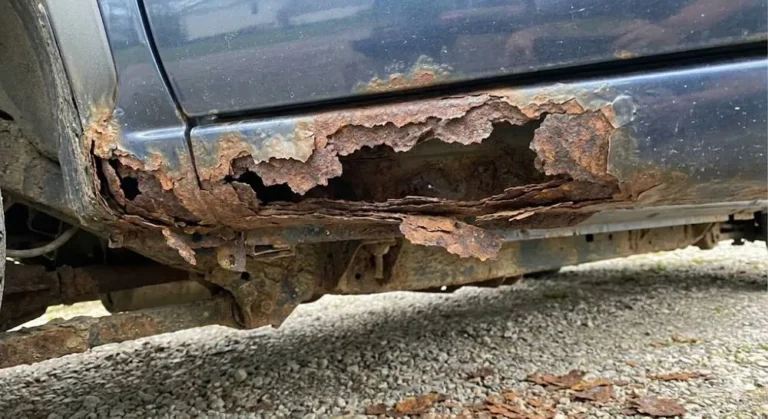
Rust is the most disqualifying structural concern on every car in this guide. Surface rust on brake rotors or suspension components is cosmetic. Rust on rocker panels that can be pushed through with a finger is structural. Rust on the floor pans is structural and expensive to repair correctly.
Rust on the frame rails — particularly on Mustangs and trucks — can compromise the vehicle’s integrity in ways that are not always visible from the outside. Use a flashlight and a pry tool on any used car purchase in this price range. The effort is repaid by the confidence to walk away from a car that presents beautifully from fifteen feet and fails inspection from underneath.
Engine oil condition tells a story in ten seconds. Pull the dipstick and wipe it on a white cloth. Black oil that smears opaquely means the oil is overdue for a change. Milky or frothy oil means coolant contamination — either a head gasket failure or a cracked block. These are two completely different situations. The first is a $50 service item. The second is a $1,500 to $3,000 repair or a reason to walk away. The smell of the oil also communicates — burnt-smelling oil that has been in a hot engine past its service life indicates either extreme heat cycling or a sustained oil loss situation.
Know the specific issues for the specific car you are buying. This guide documents the most common ones for each model. The Mustang GT three-valve spark plugs. The GTO turn signal stalks. The Camaro T-top leaks. The Corvette differential. The HEMI MDS lifter concerns at high mileage. These are the known failure patterns — the documentation of decades of owner experience with these specific cars. Use them as an inspection checklist rather than as reasons to avoid any specific car.
The model-specific issues documented in this guide — Mustang GT spark plug seizure, Camaro LS1 intake gaskets, HEMI MDS lifter concerns — are part of a larger documented landscape of American car reliability problems. Our complete guide to common issues that kill American cars covers every major failure pattern across Ford, GM, and Chrysler platforms, providing the complete inspection framework for any used American car purchase in this price range.

Section 8 – Market Pricing And Where To Find These Cars
The Realistic Numbers And The Best Sources
The market for used American sports cars under $10,000 is concentrated on specific platforms and channels. Understanding where these cars are most commonly listed, what realistic pricing looks like, and what the regional variations mean for a specific buyer improves both the search experience and the likelihood of finding a genuinely good car at a fair price.
Hagerty’s valuation tool is the most accurate publicly available pricing reference for the vehicles in this guide — particularly the Corvette C5, the Pontiac GTO, and the fourth-generation Camaro, which Hagerty tracks as collector vehicles with condition-tiered valuations. Hagerty’s Fair condition value — representing a complete, mechanically functioning vehicle with visible wear and cosmetic imperfection — is the closest approximation to what a $7,000 to $9,500 example from this list actually looks like in person.
Autotrader and Cars.com carry the largest active inventory of the specific vehicles in this guide. Facebook Marketplace has become increasingly significant for under-$10,000 performance cars — private sellers who are not dealers often price based on what they paid or what they need rather than what the market will bear, creating specific opportunities for buyers who search consistently. Private seller transactions also avoid dealer fees that add $500 to $1,500 to the effective purchase price on lot-sold vehicles.
Regional pricing matters significantly for this price range. The South and Southwest — Texas, Arizona, Nevada, Florida — tend to produce cleaner bodywork on the same mechanical condition because road salt is absent. A Texas Mustang GT at $8,000 will typically show better body condition than an equivalent-mileage Michigan example at the same price. For buyers in northern states, buying from a southern market seller and having the car transported is a legitimate strategy when the goal is a car without structural rust — the transport cost of $400 to $800 is frequently recovered in the condition difference.
Specialty classifieds for specific models — Corvetteforum.com for C5 listings, LS1tech.com for LS-powered cars, MustangForums.com for period-specific Mustang listings — carry higher-quality examples than general used car marketplaces because the sellers understand their audience and the buyers know specifically what they want. The quality of information available on these platforms — seller-disclosed maintenance history, documented modifications, known issue disclosure — is consistently higher than general platforms where the seller may not know the car’s history thoroughly.
FAQ
Q: What is the best American sports car under $10,000?
A: The best overall value in American sports cars under $10,000 is the 2004 to 2006 Pontiac GTO. The 2006 model’s LS2 6.0-liter V8 producing 400 horsepower is the same engine as the base 2005 Corvette, available consistently under $10,000 for good examples because the GTO’s understated styling has prevented it from commanding Corvette-level collector prices. For daily driver reliability, the 2005 to 2009 Ford Mustang GT is the safest purchase with the most comprehensive parts support. For ultimate driving experience, the Chevrolet Corvette C5 at the top of the budget range provides supercar-level dynamics in a purpose-built sports car platform.
Q: Can you find a V8 American sports car for under $10,000?
A: Yes. Multiple V8 American sports cars are consistently available under $10,000. The Ford Mustang GT from both the 1999 to 2004 and 2005 to 2009 generations with the 4.6-liter V8 is widely available at $5,000 to $9,500. The Chevrolet Camaro Z28 and SS from 1998 to 2002 with the LS1 5.7-liter V8 producing 305 horsepower is available at $5,000 to $9,000. The Pontiac GTO with 350 to 400 horsepower is regularly available at $7,000 to $10,000. The Pontiac Firebird Trans Am with the same LS1 engine is consistently available at $5,000 to $8,500 — often less than equivalent Camaros.
Q: Is the Pontiac GTO a good buy under $10,000?
A: Yes — the 2004 to 2006 Pontiac GTO is arguably the best performance value purchase under $10,000 in the American used car market in 2026. The 2006 LS2 6.0-liter V8 produces 400 horsepower, handles with European-sports-car competence from the Holden Monaro platform, and carries a T-56 six-speed manual option. The LS family of engines has documented reliability exceeding 200,000 miles with proper maintenance. The GTO is undervalued specifically because its styling is understated — buyers who prioritize performance over visual drama benefit from this market inefficiency consistently.
Q: What should I check when buying a used sports car under $10,000?
A: On any under-$10,000 sports car purchase, inspect: oil condition on the dipstick — black is overdue, milky is a serious problem; rust on rockers, floor pans, frame rails, and wheel arches; transmission shift quality through the complete range; brake pedal firmness and rotor condition; all electrical systems including windows, lights, and climate; any warning lights on the dashboard; the vehicle history report via Carfax or AutoCheck; and have an independent mechanic complete a pre-purchase inspection for $100 to $200. Model-specific checks: three-valve Mustang spark plug history; Camaro T-top seals; Corvette differential fluid; GTO parking brake function; HEMI Challenger oil change history.
Q: What is the most reliable cheap American sports car?
A: The most reliable used American sports car under $10,000 is the Ford Mustang GT from the 2005 to 2009 generation. The 4.6-liter three-valve V8 is well-documented, widely serviced, and has an enormous aftermarket parts base that keeps maintenance costs low. The TR-3650 manual transmission is robust and repairable. Any independent mechanic with American car experience can service it competently. The known issues — spark plug history at 60,000 miles, cam phaser noise from deferred oil changes — are manageable and preventable. For second place in reliability, the Pontiac GTO’s LS2 engine has one of the best long-term track records of any American V8 produced in the last thirty years.
Q: Is a Corvette C5 reliable under $10,000?
A: Corvette C5 under $10,000 is a higher-mileage, higher-attention-required purchase compared to the other cars in this guide. The LS1 engine is mechanically reliable, but the specific C5 systems — the roof panel seals that can leak, the differential fluid that must be changed regularly, the Stabilitrak brake modulator that can develop issues at high mileage — require proactive management. A C5 purchased at $8,000 to $9,500 with documented service history and a clean pre-purchase inspection can provide genuinely excellent long-term ownership. A C5 purchased at the same price without documentation and inspection carries higher risk. The Corvette C5 rewards the buyer who does the homework and penalizes the buyer who does not.
The Bottom Line
The best American sports cars under $10,000 represent one of the most compelling used car segments available to any enthusiast buyer anywhere in the world. No other country’s automotive history produced this specific combination — a Corvette with 345 horsepower for $8,500, a GTO with 400 horsepower for $9,000, a Firebird Trans Am with LS1 power for $6,500. These are real cars at these real prices in the current market. They require homework, they require inspection, and they require the buyer to understand both their capabilities and their known limitations. None of that homework is difficult, and every dollar of it is repaid by the confidence of knowing exactly what you are buying.
The Pontiac GTO is the best value. The Mustang GT is the most reliable. The Corvette C5 is the most technically sophisticated. The Firebird is the most underrated. The Camaro Z28 handles the best. The Challenger has the most presence. The Mustang Mach 1 is the best sleeper. Every one of those statements is defensible, and the correct choice depends on which of those qualities matters most to the specific buyer reading this guide.
What they all share: rear-wheel drive, American V8 character, and prices that make performance accessible to any buyer with a serious interest and a two-week search window. The $10,000 sports car dream is not a compromise. It is a deliberate, well-researched purchase decision that delivers one of the most satisfying driving experiences available at any price.
Editorial Note
This article was written and reviewed in May 2026. All market pricing ranges are editorial estimates based on Hagerty Valuation Tool data (April 2026), Autotrader and Cars.com active listing surveys (April 2026), KBB used car pricing (April 2026), and Classic.com transaction data for relevant models. Hagerty’s valuation for the Pontiac GTO places the Fair condition value at approximately $8,500 to $10,500 for the 2006 LS2 model.
Hagerty’s valuation for the Corvette C5 base coupe places the Fair condition value at approximately $13,000 to $16,000 for 1997 to 2000 models — the sub-$10,000 examples noted in this article represent higher-mileage or condition-compromised examples below Hagerty’s Fair grade, which are present in the active market but require additional inspection diligence.
All horsepower figures are SAE gross specifications as published by the manufacturers. The Pontiac GTO LS2 400 HP specification is the SAE net figure for the 2006 model after the 2005 recalibration. The Firebird WS6 Trans Am 325 HP figure is the Ram Air package output. All repair cost estimates are editorial assessments based on current labor rate data and documented repair invoice community data as of May 2026 and will vary by region, shop rate, and specific vehicle condition.


0 Comments