Last Updated: May 16, 2026 | Read Time: 10 minutes
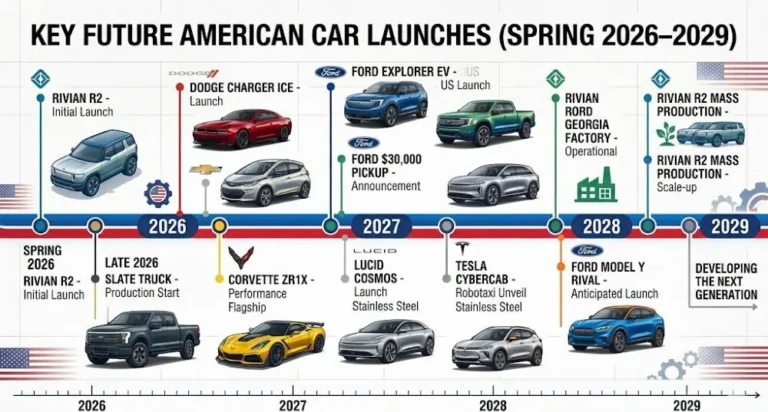
Ford’s CEO stood in Kentucky in August 2025 and promised a $30,000 electric pickup truck that could power your house for six days, charge faster than anything currently on the market, and outrun the Mustang twin turbo. Rivian is launching the R2 in spring 2026 at $45,000 — the make-or-break product that determines whether the company becomes a mainstream automaker or a niche one.
Dodge dropped the electric Charger’s fake engine sounds and brought back a real engine — a turbocharged inline-six with 550 horsepower — in a car that comes as both a coupe and a sedan. The Corvette ZR1X has 1,250 combined horsepower. And a company called Slate is building a bare-bones electric pickup in Warsaw, Indiana, that starts in the mid-$20,000s and lets buyers customize nearly everything. Here is every confirmed future American car coming between 2026 and 2029.
Quick Facts – The Future Cars 2026-2029
– Most Anticipated 2026: Rivian R2 — Spring 2026 — $45,000 starting — 330-mile range
– Most Affordable EV Coming: Slate Truck — Mid-$20,000s — late 2026 production in Warsaw, Indiana
– Most Powerful 2026: Corvette ZR1X — 1,250 combined HP — AWD — 1.68 sec 0-60
– Biggest Industry News: Ford F-150 Lightning discontinued December 2025 — next-gen EV pivot underway
– Most Surprising Return: Dodge Charger 2026 — turbocharged I6 replacing electric powertrain, 420–550 HP
– Ford’s Key Promise: $30,000 electric midsize pickup for 2027 — Jim Farley “Model T Moment” announcement August 11, 2025
– Chevrolet Value Play: 2026 Bolt EV returns at $28,595 — 255-mile range — 26-minute 10–80% fast charge
– Luxury EV to Watch: Lucid Cosmos — under $50,000 — US launch 2027 — competes with Tesla Model Y
– Most Futuristic Vehicle: Tesla Cybercab — two-seat robotaxi — production before 2027
– Ford 2027 Commitment: Ford Explorer EV three-row electric SUV — Oakville Assembly Complex Canada
– Rivian 2028 Milestone: New Georgia factory capable of producing hundreds of thousands of R2s annually
– Ford Long-Term Pledge: By 2030 every Ford vehicle will have an affordable EV platform — hybrid available on every model
– Key Cancellations: Ford F-150 Lightning, Ford Project T3 electric F-150 replacement (cancelled in favor of new next-gen Lightning), Dodge electric Charger halo model 800V reportedly not a priority
Sources: TopElectricSUV (May 2026), TopSpeed (May 2026), New York Sun (Jan 2026),InsideEVs (Mar 2026), Cochran Ford (Apr 2026), Cochran Ford Boardman
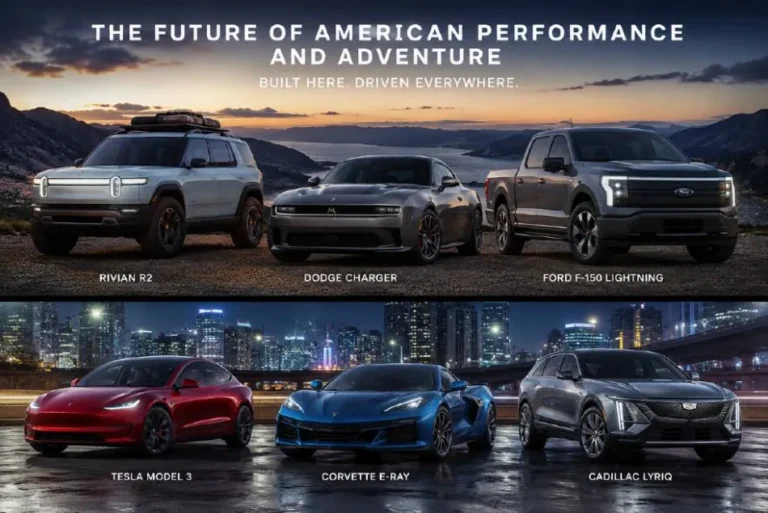
Overview – American Automakers Are Making Decisions In 2026 That Will Define The Decade
The American auto industry in 2026 is making bets in multiple directions simultaneously — and the bets are bigger, and more contradictory, than they have been at any point since the muscle car era. Ford is discontinuing the F-150 Lightning while promising a $30,000 electric pickup for 2027. Dodge dropped the electric Charger’s fake engine sounds and replaced them with a real turbocharged engine.
Chevrolet is bringing back the Bolt at $28,595 after discontinuing it in 2023. Tesla is preparing a two-seat robotaxi. A company called Slate that most people have never heard of is building a bare-bones electric pickup in Indiana that starts below $25,000. And Rivian is staking its existence as a mainstream automaker on a $45,000 midsize SUV that goes into production in spring 2026.
These decisions are not contradictory in the way they appear. They are responses to the same underlying reality: American consumers want electric vehicles, but not at the prices currently available, not with the charging infrastructure currently in place, and not when the vehicles require them to abandon the trucks, muscle cars, and large SUVs that define American automotive culture. The manufacturers who are succeeding in this environment are the ones threading the needle — offering electric options that do not require buyers to compromise their fundamental preferences.
The future car market is not simply an electric car market. It is a market in which electric vehicles are becoming viable alongside hybrid options, extended-range alternatives, and in the Dodge Charger’s case, a frank acknowledgment that some buyers will never accept an electric powertrain and deserve a new internal combustion option built for their preferences. It is also a market in which new American companies — Rivian, Slate, Lucid — are competing with century-old manufacturers for buyers who have no particular loyalty to any badge and will simply buy whichever vehicle best serves their needs.
The most comprehensive single independent reference for all confirmed upcoming vehicles across every manufacturer from 2026 to 2029 — including American models alongside their global competitors — is the US News future cars 2026–2029 comprehensive list, which provides context for where American manufacturers’ upcoming vehicles sit relative to the full competitive landscape.
This guide covers everything confirmed for American production or American sales between 2026 and 2029 — every vehicle, every price, every specification that has been announced, and an honest assessment of which promises are likely to be kept and which are likely to face the delays that have characterized the American EV market for the past five years.
Section 1 – The Dodge Charger
The Most American Story Of 2026: Real Engine, Real Muscle, Two Body Styles
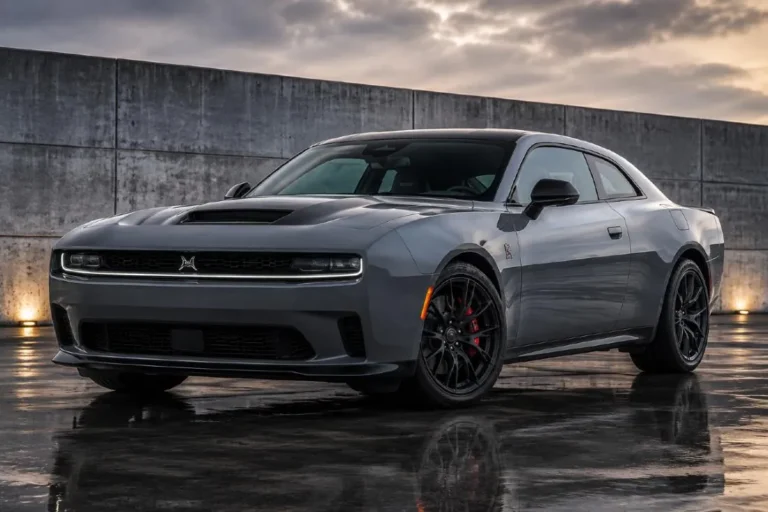
The 2026 Dodge Charger is the most significant American muscle car story of the year — not because it is the most powerful car Dodge has ever built, but because of what it represents about the company’s understanding of what its buyers actually want.
Dodge tried so hard to convince its muscle car customers to buy an electric vehicle that it put a fake V8 engine in one. The electric Charger Daytona was equipped with a feature called Fratzonic Chambered Exhaust that vibrated the car and blasted digital exhaust sounds out of the rear bumper. The buyers were not buying it — literally. The electric Charger’s sales were a fraction of what the old HEMI-powered Charger had achieved, and the message from the market was unambiguous: Dodge’s core customer wants a real engine.
The 2026 Charger drops the Daytona name and electric motors and adds a turbocharged inline-six-cylinder engine under the hood. The all-wheel-drive full-size car is offered in two-door and four-door versions starting at $51,990 with 420 horsepower and $57,990 with 550 horsepower. The decision to offer both a coupe and a sedan at these power levels in a single vehicle family — the four-door with 420 or 550 horsepower — is a recognition that Dodge’s buyers want options that do not exist elsewhere in the American market.
The turbocharged inline-six is a different kind of engine from the 6.4-liter HEMI V8 that defined the previous Charger — it makes power differently, sounds different, and delivers torque in a different part of the rev range. Whether Dodge’s core buyers accept it as a genuine replacement for the HEMI — or whether they continue to view it as a compromise between what they want and what Stellantis was willing to build — is the key commercial question the 2026 Charger must answer.
What is not in question is the Charger’s relevance. A 550-horsepower, all-wheel-drive, full-size car in both two-door and four-door configurations at $57,990 occupies a market position that no other American vehicle currently fills. The Charger’s unique combination of performance, practicality, and price may prove to be exactly the product that Dodge’s buyers were waiting for — even if it does not sound exactly the way they remembered.
Section 2 – The Chevrolet Bolt Returns
America’s Most Affordable EV Is Back — And More Capable Than Before
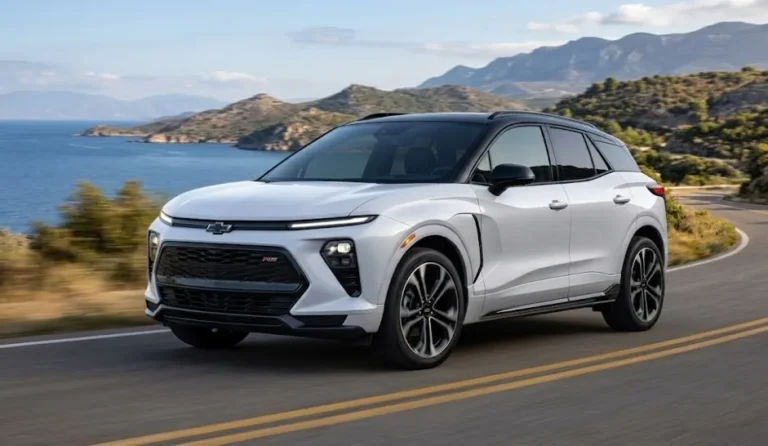
The 2026 Chevrolet Bolt EV is a returning vehicle with a genuinely improved specification — and at $28,595, it is one of the most strategically important American electric vehicles in the current market, whether or not the federal tax credit that would have made it an even more compelling bargain is available.
The reborn Bolt has been updated with refreshed styling, a longer 255-mile range, and lists for $28,995 in base configuration — making it one of the most affordable new electric vehicles available in America from an established manufacturer. Chevrolet calls it a limited-run model without confirming exactly how long that run will be, which introduces a degree of urgency into the purchase calculation that the previous Bolt generation did not create.
The 2027 Chevrolet Bolt crossover — the second-generation vehicle that builds on the returning 2026 model — is even more significant. With a $28,595 starting price, 255 miles of range, and a 10 percent to 80 percent charging time of 26 minutes with 150 kW or higher DC fast charging — 2.5 times faster than its predecessor — this crossover is set to be Chevy’s newest bestseller in the near future. The 26-minute fast charging time addresses one of the most consistent practical objections to EV ownership: the time required to add significant range on a road trip.
The 2027 Bolt crossover also introduces RS trim at $31,600 — an appearance and equipment package that adds heated and ventilated front seats, multicolor ambient lighting, and specific exterior upgrades that give the crossover a more premium visual identity. The RS trim represents Chevrolet’s acknowledgment that EV buyers respond to the same equipment signals as any other automotive buyer — heated seats, ambient lighting, and exterior distinction matter to this customer regardless of powertrain type.
The Bolt’s return to the Chevrolet lineup after its 2023 discontinuation reflects a specific lesson the company learned: discontinuing the most affordable EV in your lineup during a period when EV adoption is price-sensitive was a mistake, and correcting it with an improved specification at a maintained price point is the most direct available response.
Section 3 – The Rivian R2
The $45,000 Bet That Determines Rivian’s Future
The Rivian R2 is the most commercially significant new American vehicle of 2026 — not because of its specifications, which are impressive, but because of what its sales results will determine about Rivian’s future as a company.
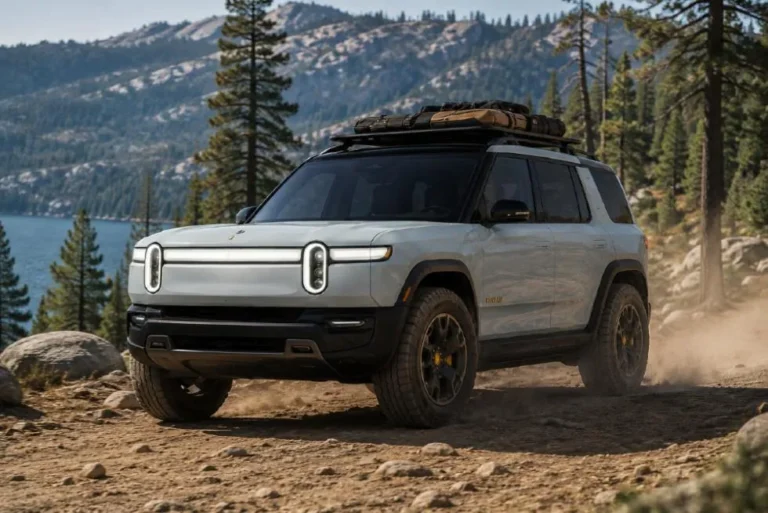
Rivian has been following in Tesla’s footsteps since it launched five years ago. Like its electric rival, it started out selling pricey luxury vehicles, but is moving closer to the mainstream in 2026 with the R2 that competes directly with the Tesla Model Y in the compact SUV segment that dominates the American market. The R2 features rugged off-road styling and looks just like Rivian’s larger $77,000 R1S from a distance — a design decision that allows Rivian’s premium brand identity to translate to a more affordable price point without requiring a separate visual language.
The Rivian R2 is an electric midsize SUV designed with the same authentic SUV character as the larger R1, but with more accessible pricing and urban-friendly dimensions. Production begins in spring 2026. The R2 packs up to 656 horsepower and up to 609 lb-ft of torque, accelerates from 0 to 60 mph in as little as 3.6 seconds, and offers a maximum payload capacity of 1,168 pounds and a maximum towing capacity of 4,400 pounds.
The R2 starts at approximately $45,000 with a 270-mile driving range, with more expensive 300-mile and 330-mile versions also available. The range-price hierarchy — a $45,000 entry with adequate range, a more expensive version with more comfortable range — reflects Rivian’s understanding that different buyers will have different range anxiety thresholds and that offering optionality is more effective than requiring all buyers to pay for the maximum range specification.
The R2 is a make-or-break moment for Rivian, which plans to move its production to a new factory in Georgia in 2028 that will be capable of building hundreds of thousands of R2s each year if the customers show up. That specific phrase — if the customers show up — contains the entire commercial risk of the R2 launch. Rivian’s current production in Normal, Illinois provides the initial R2 supply. The Georgia factory investment is the commitment that turns the R2 from a product launch into a company-defining strategic bet.
Section 4 – The Slate Truck
The Most Affordable American Electric Truck You Have Never Heard Of
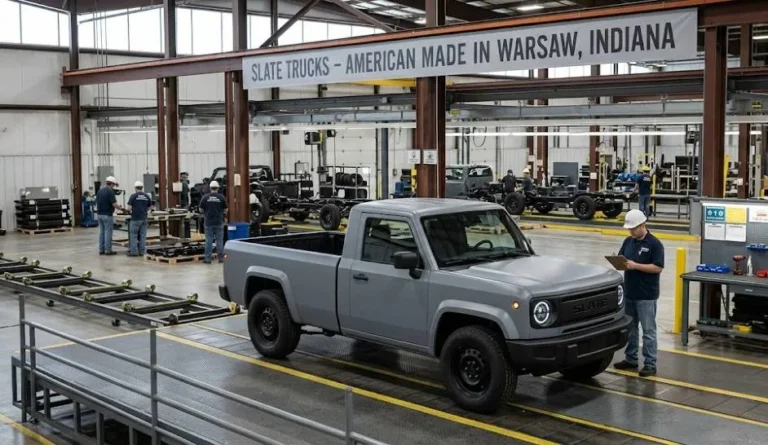
The Slate Truck is a bare-bones, heavily customizable electric pickup truck entering production in late 2026 in Warsaw, Indiana — and its starting price in the mid-$20,000s makes it potentially the most affordable new electric truck in American history if it arrives on schedule and at its announced pricing.
The Blank Slate — as the company’s marketing describes it — begins in the mid-$20,000s, with detailed pricing expected to follow in June 2026. The philosophy is straightforward: build the most stripped-down, most customizable electric pickup truck possible, price it at the level where buyers who want a work truck rather than a status symbol can afford it, and allow the aftermarket to fill in the customization that the base specification intentionally omits.
The Slate is not a luxury vehicle. It is not a technology showcase. It is not competing with the Rivian R1T’s camping-focused feature list or the Ford F-150 Lightning’s Pro Power Onboard generator functionality. It is competing with the buyer who buys a base F-150 or a base Ram 1500 with a regular cab and a long bed because they need a truck to haul things, not a lifestyle accessory. That buyer has never had an affordable electric option. The Slate is designed to give them one.
The production location in Warsaw, Indiana — an American manufacturing city with a strong industrial base — is a deliberate choice that communicates the Slate’s identity clearly. This is not a Silicon Valley startup building trucks in California. It is an attempt to build an American electric truck in an American factory for American buyers who have been priced out of the current electric truck market.
The Slate Truck’s mid-$20,000s starting price makes it the most affordable new truck purchase available — but the total ownership cost calculation requires insurance alongside the purchase price. Our guide to the cheapest truck insurance in 2026 covers how electric truck ownership changes the insurance calculation and which companies offer the most competitive rates for new EV pickup owners.
Whether the Slate can actually deliver a functional, reliable electric truck at mid-$20,000s pricing with the battery costs of 2026 is the central engineering and business challenge of the company’s existence. The announcement price is compelling. The execution is the variable that will determine whether the Slate becomes the affordable EV breakthrough that the American market has been waiting for.
The Slate Truck and Ford’s $30,000 electric pickup are targeting buyers at the entry and working end of the truck market — the buyers who choose a base-trim work truck over the premium configurations that define the segment’s upper tier. Our complete guide to the Ram 1500 Limited covers the opposite end of that spectrum: the most luxurious half-ton pickup available in 2026, at a starting price more than twice the Slate Truck’s anticipated figure.
Section 5 – Ford’s Electric Future
The $30,000 Pickup Promise, The Explorer EV, And What Comes After
Ford’s electric vehicle strategy in 2026 is simultaneously more ambitious and more honest than it was three years ago — a company that overcommitted to specific EV timelines, missed them, cancelled vehicles, and is now rebuilding its approach around products that have more realistic engineering foundations and more defensible price points.
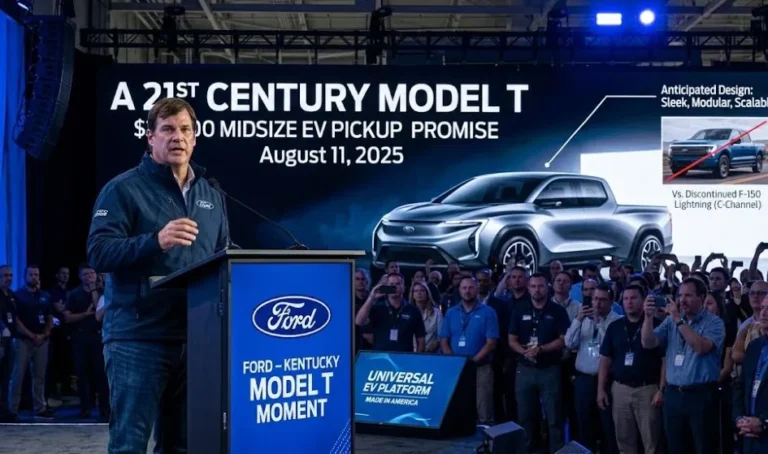
The most significant Ford announcement of the near-term future came from CEO Jim Farley at a Model T Moment event in Kentucky on August 11, 2025. Farley promised a midsize electric pickup targeting approximately $30,000 for 2027, using Ford’s new Universal EV Platform developed in California and Michigan-made LFP prismatic batteries.
His specific words were striking: “It will be faster than our Mustang twin turbo. It will be fully connected with a brand new digital experience no one has seen in our country. It will offer, for the first time, fast charging. It will have amazing range. It can power your house for 6 days — you don’t need a generator, you just buy this truck. And we’re going to start the vehicle at $30,000.”
The boldness of that statement is notable precisely because Ford has made bold EV statements before and missed them. The F-150 Lightning was discontinued in December 2025 after being the best-selling electric truck in America for most of its existence. The Project T3 electric pickup that was meant to replace it was cancelled in favor of a next-generation F-150 Lightning approach. Against this backdrop, Farley’s $30,000 promise is either the most confident statement an American auto CEO has made in the EV space — or the most overdue reckoning with the company’s credibility on electric vehicle commitments.
The 2027 Ford Explorer EV is a separate and equally anticipated vehicle — a fully electric three-row SUV being built at the Oakville Assembly Complex in Ontario, Canada. The new Explorer EV is expected to offer an impressive range and the latest technology while maintaining the rugged capabilities the Explorer nameplate is known for.
Potential buyers can expect more aerodynamic styling, efficiency, and a lower ride height than the current Explorer. This second-generation EV was expected to be released in 2025 before being delayed to 2027 — a delay attributable to supply chain challenges and the company’s decision to ensure the technology was right before committing to production.
Ford has also confirmed that it can develop a small SUV on the Universal EV Architecture — a vehicle expected to compete with the Tesla Model 3 and Model Y at around $35,000. Jim Farley said during a March 2026 podcast appearance: “We’ll have an all-electric affordable vehicle to compete with Model Y and Model 3.” No launch timing has been officially confirmed, but a 2028 arrival is the reasonable expectation based on the Universal EV Platform development timeline.
Ford has promised that by 2030, every Ford vehicle will have an affordable EV platform, and hybrid powertrains will be available on every model — a commitment that frames the company’s entire product planning process for the next four years and provides the context for every individual vehicle decision within it.
Ford’s $30,000 electric pickup promise represents a complete departure from the brand’s recent performance-focused identity — the same company that produced the 815-horsepower Mustang GTD and the Boss 302’s Trans-Am legacy is now promising a $30,000 workhorse EV. Our guide to the fastest Ford muscle cars in 2026 covers the full story of what Ford’s performance engineering has achieved, providing the contrast that makes the affordable EV pivot so significant.
Section 6 – Tesla’s Next Moves
The Cybercab, The Affordable Model, And The Robotaxi Era
Tesla’s future American vehicle plans are the most consequential in the industry — not because the cars themselves are necessarily the most interesting, but because Tesla’s decisions about pricing, technology, and production methods shape the competitive environment within which every other manufacturer is operating.
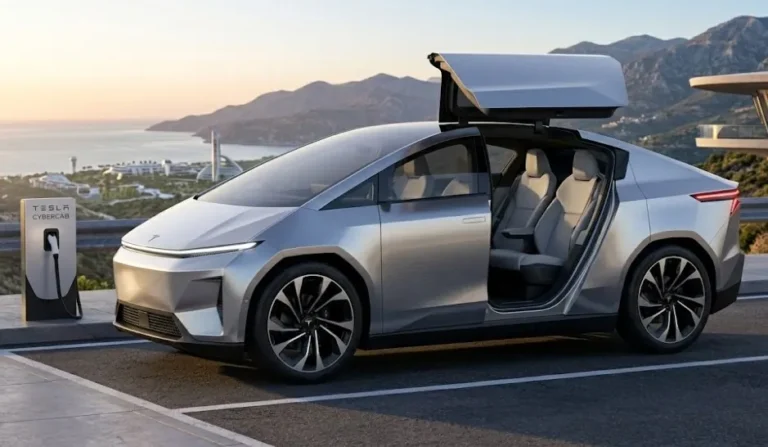
The Tesla Cybercab is the most futuristic American vehicle confirmed for near-term production. The two-seat Cybercab will be used in Tesla’s robotaxi service — a ride-hailing operation that Tesla plans to offer at rates lower than popular competitors like Uber and Lyft. Tesla also plans to sell the Cybercab directly to customers. Production is expected to begin before 2027, with a price target below $30,000.
The Cybercab’s significance extends beyond its own sales potential. A self-driving taxi service that undercuts Uber and Lyft on price — if Tesla can execute on the autonomous driving capability that the business model requires — would represent a transformation of American urban transportation more significant than the introduction of the smartphone. Whether Tesla’s Full Self-Driving technology is capable of supporting that model at the scale and reliability that a commercial transportation service requires is the central question that the Cybercab’s launch will begin to answer.
Tesla is also developing next-generation affordable models using production methods designed to lower costs and bring electric vehicles to a wider audience. Instead of the standard approach where a car’s frame is built as a single unit, Tesla plans to manufacture separate sections in parallel and join them later — a method that reduces production complexity and material costs. The company is also developing a rare-earth-free motor and transitioning to a 48-volt electrical system, which simplifies wiring and reduces material costs.
The specific pricing and timing of Tesla’s next affordable model have not been officially confirmed, but the Model 3 and Model Y, at their current price points, remain the reference vehicles against which every other affordable EV in America is measured. Whatever Tesla builds next will reset that reference point.
Section 7 – Lucid Motors And The Premium EV Challenge
The Cosmos: Competing With Tesla Model Y Under $50,000
Lucid Motors — the American electric vehicle manufacturer best known for the Air luxury sedan, which holds the EPA range record for any production EV — is preparing its most commercially significant vehicle to date: the Cosmos, a midsize electric SUV designed to compete directly with the Tesla Model Y at a price point under $50,000.
The Lucid Cosmos will be a new electric midsize SUV designed to compete with the Tesla Model Y. It is likely to feature a bold and futuristic exterior and a progressive interior, both inspired by the Lucid Gravity. The Cosmos enters production in Saudi Arabia in late 2026, followed by the US in 2027. It will be priced at under $50,000 in the base configuration.
Lucid’s engineering capability — demonstrated most visibly by the Air’s 516-mile EPA-rated range and its 670-horsepower standard configuration — gives the Cosmos a credible technical foundation for competing in one of the most competitive segments in the American automotive market. The midsize electric SUV category is currently dominated by the Tesla Model Y, which has been the best-selling vehicle in America, and challenged by the Rivian R2, the Chevrolet Equinox EV, and numerous European alternatives.
The Cosmos’s specific challenge is Lucid’s brand awareness outside the luxury EV enthusiast community. The Air is known to people who follow EV technology closely. The Cosmos needs to be known to people who are simply shopping for a midsize SUV. Building that broader brand awareness while simultaneously launching a sub-$50,000 product in a price range where Lucid has no current presence is the specific marketing and commercial challenge that the Cosmos must navigate.
If Lucid can deliver on the Cosmos — on-time, at-price, with the range and feature content that make it genuinely competitive with the Model Y — it becomes a mainstream American EV manufacturer overnight. If it cannot, the Air’s record-setting range becomes a footnote in the story of a company that never quite crossed the chasm from enthusiast product to mainstream success.
Section 8 – The Corvette And Performance Future
America’s Sports Car Keeps Getting Faster While The Industry Gets Cheaper
While the American auto industry’s primary strategic focus in 2026 is on affordable electric vehicles and accessible transportation, Chevrolet’s performance division is moving in the opposite direction — building the most powerful, most expensive, and most technically sophisticated Corvette in the nameplate’s 73-year history.
The 2026 Corvette ZR1X produces 1,250 combined horsepower from its LT7 twin-turbocharged V8 and a front electric drive unit — making it the first ZR1-level Corvette with all-wheel drive and the fastest-accelerating production Chevrolet ever built. Chevrolet confirmed that the ZR1X set a 0-to-60 mph time of 1.68 seconds with no non-standard equipment. Its top speed of 233 mph matches the ZR1, and its AWD architecture provides more traction and more consistent performance across different road surfaces than the rear-wheel-drive ZR1’s 2.3-second run.
The ZR1X is not a vehicle that the majority of American car buyers will purchase or even encounter in person. Its significance for the future of American performance cars is as a technology demonstrator — the first application of hybrid electric assistance to a ZR1-level Corvette platform, a preview of the direction that Chevrolet’s performance engineering is heading as hybrid and electric technology becomes more deeply integrated into even the most performance-focused American vehicles.
The ZR1X’s 1,250 combined horsepower and 1.68-second 0-to-60 sit at the apex of a Chevrolet performance lineup that spans from the $68,300 Stingray to the ZR1 and ZR1X — a range covered completely in our sports Chevy cars complete guide, which puts the ZR1X’s performance in the context of every performance Chevrolet currently available.
The specific combination of a twin-turbocharged internal combustion V8 and a front electric motor that defines the ZR1X is the same combination that will appear in increasingly affordable American performance vehicles over the next decade. Today it is a 1,250-horsepower hypercar that most buyers cannot afford. In ten years, it is the standard configuration of a performance sedan. The ZR1X is the proof of concept.
Section 9 – What Got Cancelled And Why It Matters
The Ford Lightning, The Dodge Electric Halo, And The Reality Of American EV Development
Understanding which future American cars will not be built is as important as knowing which ones will — because the cancellations reveal the specific miscalculations that shaped the optimistic EV timelines of 2021 and 2022, and understanding those miscalculations helps calibrate how much confidence to place in the promises being made in 2026.
The most significant American EV cancellation of the period was the Ford F-150 Lightning, discontinued in December 2025 after being the best-selling electric truck in America for most of its existence. After three and a half years on sale, one of the first real electric trucks on the American market was officially discontinued. Ford explained that it would focus on hybrids and extended-range EVs instead — a strategic pivot that reflects the market’s actual purchasing behavior more accurately than the EV-optimistic planning of the early 2020s.
Ford’s Project T3 — the purpose-built electric pickup intended to replace the Lightning on a new platform — was initially scheduled for 2025, then delayed to 2027, then delayed again to 2028, and ultimately cancelled in favor of a next-generation F-150 Lightning that will use Ford’s new Universal EV Platform. The cancellation of a three-times-delayed vehicle in favor of a different vehicle on the same general platform is both a pragmatic decision and a frank acknowledgment that the original Project T3 approach was not viable at the cost structure required to compete with the Tesla Cybertruck and the expected Chevy Silverado EV.
The top-spec electric Charger halo model — which was set to become the performance EV flagship for Dodge with an 800-volt electrical system, a multi-speed transmission, and over 800 horsepower — is reportedly no longer a priority for Stellantis according to supplier sources. The electric Charger’s mainstream failure informed Stellantis’s decision to prioritize the turbocharged ICE Charger over further investment in an electric performance variant that had not attracted the buyers it needed.
These cancellations are not simply commercial failures. They are data points about what American buyers will and will not accept in 2026, and the manufacturers who are reading that data correctly — Ford with its $30,000 ICE-adjacent electric pickup, Dodge with its turbocharged Charger, Chevrolet with its value-priced Bolt — are making different bets than the ones they made in 2021. The bets look more realistic because they are built on real market data rather than optimistic projections.
The Corvette ZR1X’s arrival as the most powerful Chevrolet ever built happens simultaneously with the Camaro’s discontinuation — a juxtaposition that defines Chevrolet’s performance strategy in 2026. Our comparison of the Corvette ZR1 vs Camaro ZL1 covers the performance gap that existed between the two vehicles in their shared final years and explains why Chevrolet’s entire performance future now rests with the Corvette platform.
FAQ
Q: What American cars are coming in 2026?
A: The most significant American cars arriving in 2026 are the new Dodge Charger with a turbocharged inline-six engine in 420-horsepower and 550-horsepower configurations, starting at $51,990 and $57,990 respectively, in two-door and four-door body styles; the 2026 Chevrolet Bolt EV returning at $28,595 with 255 miles of range; the Rivian R2 midsize electric SUV beginning production in spring 2026 and starting at approximately $45,000; the Slate electric pickup entering production in Warsaw, Indiana in late 2026 starting in the mid-$20,000s; and the 2026 Corvette ZR1X with 1,250 combined horsepower and an official 1.68-second 0-to-60 time.
Q: What is the cheapest future American electric car coming?
A: The cheapest confirmed future American electric vehicle is the Slate Truck, starting in the mid-$20,000s with production beginning in late 2026 in Warsaw, Indiana. The next most affordable confirmed option is the 2027 Chevrolet Bolt crossover at $28,595 starting price. Ford’s CEO Jim Farley announced at an August 2025 Kentucky event that Ford’s midsize electric pickup will start at approximately $30,000 in 2027. The 2026 Bolt EV returning at $28,595 is available as a limited-run model.
Q: What is the new 2026 Dodge Charger?
A: The 2026 Dodge Charger replaces the electric Charger Daytona and the previous HEMI V8 Charger with a turbocharged inline-six engine producing 420 horsepower or 550 horsepower with standard all-wheel drive. It is available in both two-door coupe and four-door sedan body styles — starting at $51,990 for the 420-horsepower configuration and $57,990 for the 550-horsepower version. Dodge dropped the Charger Daytona name and the electric powertrain after the electric version’s sales fell short of the previous HEMI-powered Charger’s performance.
Q: When does the Rivian R2 go on sale?
A: Rivian plans to start sales of the R2 in spring 2026. The R2 is a midsize electric SUV starting at approximately $45,000 with a 270-mile range, with 300-mile and 330-mile configurations also available at higher prices. The R2 produces up to 656 horsepower, reaches 0-to-60 mph in as little as 3.6 seconds, and offers a maximum towing capacity of 4,400 pounds. Rivian plans to move R2 production to a new Georgia factory in 2028 capable of producing hundreds of thousands of units annually.
Q: What is Ford’s $30,000 electric truck?
A: Ford CEO Jim Farley announced at a Model T Moment event in Kentucky on August 11, 2025, that Ford would produce a midsize electric pickup starting at approximately $30,000 for the 2027 model year. The truck will use Ford’s Universal EV Platform developed in California, ride on Michigan-made LFP prismatic batteries, target sub-5-second 0-to-60 performance, offer fast charging capable of powering a house for six days, and start at $30,000. Farley said it will be faster than Ford’s Mustang twin turbo.
Q: What happened to the Ford F-150 Lightning?
A: The Ford F-150 Lightning was discontinued in December 2025 after approximately three and a half years on sale. Despite being the best-selling electric truck in America for most of its existence, Ford decided to discontinue it to focus on hybrids and extended-range EVs. The Project T3 that was meant to replace it as a next-generation purpose-built electric pickup was cancelled after multiple delays. Ford is now developing a next-generation F-150 Lightning using its Universal EV Platform, alongside the separate $30,000 midsize electric pickup announced in August 2025.
The Bottom Line
The future car market from 2026 to 2029 looks nothing like what the industry predicted it would look like four years ago. The $30,000 electric truck that Ford’s CEO promised at a Kentucky event in 2025 may be the most important new American vehicle of the decade if it arrives on time and at price. The Slate Truck may be the first electric vehicle that genuinely reaches the working-class American buyer who has never been able to afford EV pricing.
The Rivian R2 will determine whether a new American automaker can cross from niche to mainstream. And the Dodge Charger — back with a real engine after its electric experiment failed — is the most honest acknowledgment that American buyers have specific preferences that will not bend to manufacturer strategy alone.
The cancellations — the Lightning, the Project T3, the electric Charger halo — tell a story about what did not work and why. The announcements — the $30,000 Ford, the Bolt at $28,595, the Slate in the mid-$20,000s — tell a story about what the industry has learned from those failures and what it is prepared to try instead.
The American auto industry has always been most interesting when it is simultaneously building the most powerful vehicles on Earth and the most affordable ones. In 2026, the ZR1X reaches 60 mph in 1.68 seconds. The Slate Truck starts in the mid-$20,000s. The gap between them has never been wider. The industry has never been more alive.
Editorial Note
This article was written and reviewed in May 2026. All pricing, specifications, and launch timing are sourced from the following primary sources: TopElectricSUV’s “2026 Electric Cars List: 40 new models to watch out for in the U.S.” (May 2026 update); TopSpeed’s “Upcoming Vehicles Every Major Car Brand Is Planning For 2026-2029” (May 2026 update); The New York Sun’s “Review: The New American Cars That Will Define 2026” (January 4, 2026); InsideEVs’s “All The EVs That Got Canceled Or Delayed In 2025 And 2026” (March 2026); and Cochran Ford Boardman’s “Future Ford Electric Vehicles: New Electric SUVs Set for 2026 and 2027.”
The Jim Farley $30,000 electric pickup quote is sourced from TopElectricSUV as spoken at the “Model T Moment” event in Kentucky on August 11, 2025. The Farley Model Y/Model 3 rival quote is sourced from his appearance on Spike’s Car Radio (episode 456, published March 25, 2026). The Rivian R2 production figure of spring 2026 and the $45,000 starting price are confirmed by both The New York Sun and TopElectricSUV. The Slate Truck Warsaw, Indiana production location and mid-$20,000s pricing are confirmed by TopElectricSUV.
The Dodge Charger 2026 pricing of $51,990 (420 HP) and $57,990 (550 HP) is confirmed by The New York Sun. Ford F-150 Lightning discontinuation in December 2025 is confirmed by InsideEVs. The Corvette ZR1X 1,250 combined HP and 1.68-second 0-to-60 are confirmed by Chevrolet official documentation. All the future cars announcements carry inherent uncertainty regarding final pricing, specifications, and availability.

0 Comments