Last Updated: September 20, 2026 | Read Time: 8 minutes
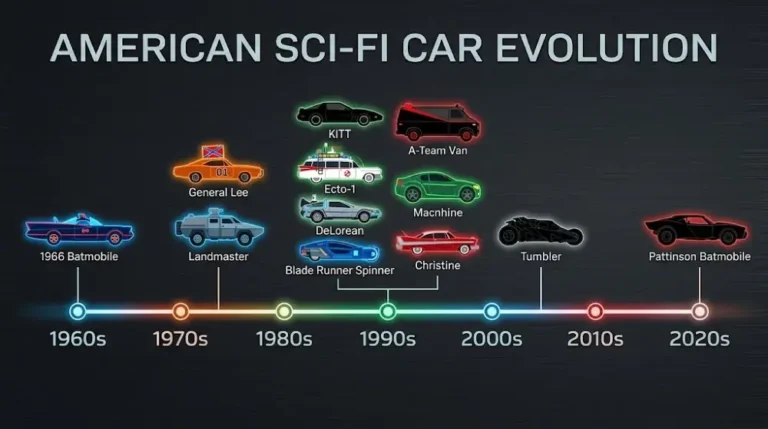
The DeLorean DMC-12 needed 88 miles per hour and 1.21 gigawatts to travel through time. KITT was a Pontiac Trans Am that could talk, think, and survive nearly anything. The Ecto-1 was a 1959 Cadillac combination ambulance-hearse that Ray Stantz paid $4,800 for and described as requiring extensive work. The Batmobile has been a 1955 Lincoln Futura, a jet-powered custom, and an armored tank across different eras of the same character. Christine was a 1958 Plymouth Fury that killed people.
The Spinner flew over a rain-soaked 2019 Los Angeles that turned out to be optimistic about the rain but prescient about everything else. American science fiction cars are not simply vehicles with futuristic modifications. They are the specific expression of what Americans believed technology, speed, and the automobile could eventually become — filtered through the imaginations of filmmakers, television producers, and writers who used the car as the most recognizable symbol of American identity and refracted it through the lens of what-if. This is the complete guide to every significant one.
Quick Answer: What Are Most Iconic American SCI-FI Cars
— Most Famous: DeLorean DMC-12 — Back to the Future (1985/1989/1990)
— Most Technologically Elaborate: KITT — Knight Rider (1982–1986 NBC)
— Most Enduring: Batmobile — Batman (1966, 1989, 1992, 2005, 2008, 2012, 2016, 2022)
— Most American: Ecto-1 — Ghostbusters (1984) — 1959 Cadillac Miller-Meteor
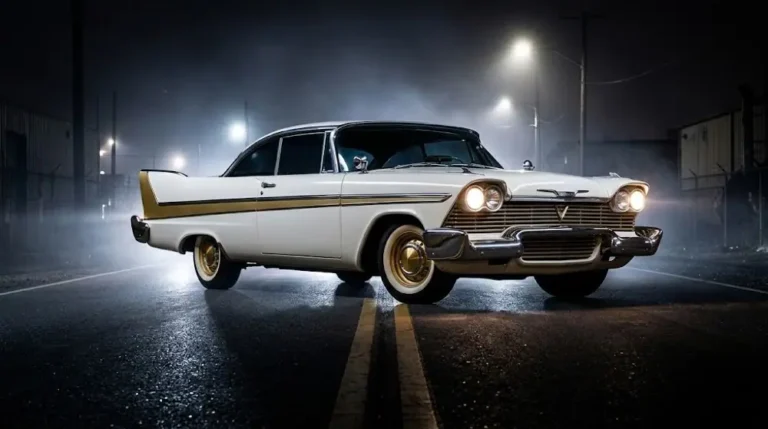
— Most Disturbing: Christine — Stephen King’s Christine (1983) — 1958 Plymouth Fury
— Most Prescient: The Spinner — Blade Runner (1982) — Flying police car of 2019 LA
— Most Underrated: Landmaster — Damnation Alley (1977) — 12-wheel articulated survival vehicle
— Most Beloved TV: KITT — Knight Rider / The A-Team GMC Vandura close second
— Most Collectible: 1966 Batmobile / Ecto-1 hero car / DeLorean hero cars
— Most Quoted: “Roads? Where we’re going, we don’t need roads” — Dr. Emmett Brown, 1985
Key Real Vehicles Used:
— DeLorean DMC-12 (1981) — stainless steel body, gull-wing doors
— 1982 Pontiac Trans Am (KITT)
— 1959 Cadillac Miller-Meteor combination car (Ecto-1)
— 1955 Lincoln Futura show car (1966 Batmobile base)
— 1958 Plymouth Fury (Christine)
— 1983 GMC Vandura (A-Team van)
— 1969 Dodge Charger (General Lee — Dukes of Hazzard)
— Blade Runner Spinner — Custom-built prop (no real vehicle basis)
Cultural Legacy:
— DeLorean: Saved the car’s legacy / the company failed in 1982 before the film released
— KITT: Made Pontiac Trans Am sales spike 1982–1986
— Ecto-1: Made the 1959 Cadillac ambulance-hearse one of the most recognized cars in history
— Batmobile (1966): Inspired the entire hero vehicle concept in American television and film
Sources: Internet Movie Cars Database (IMCDB), Petersen Automotive Museum, National Motor Museum (UK), Universal Studios Hollywood Historical Archives,
Motor Trend Pop Culture retrospectives
Overview
Why The Car Is America’s Science Fiction Hero
No other country’s science fiction uses the automobile the way American science fiction does. British science fiction gave us the TARDIS — a police box that travels through time. Japanese science fiction gave us giant robots and motorcycles that transform. American science fiction gave us the DeLorean going 88 miles per hour across a parking lot in 1985 and a voice coming from a Pontiac Trans Am telling its driver to turn left in 1982. The car, in American science fiction, is not simply transportation. It is the primary expression of the protagonist’s power, identity, and technological sophistication.
The reason for this is cultural and geographic. The American relationship with the automobile is unlike anything in any other national culture — a combination of the country’s specific physical scale, its infrastructure history, its industrial identity, and the specific postwar prosperity that made car ownership the defining symbol of American middle-class success. When American filmmakers and television writers want to show that a character has access to extraordinary technology, they most naturally express that technology through the character’s vehicle. The car you drive is who you are in American culture. The car your fictional hero drives is what kind of hero they are.
This specific cultural logic explains why the most memorable American science fiction vehicles are not spaceships or robots — though America produced plenty of those — but cars. The DeLorean is the time machine because the car is the vehicle of American freedom, and time travel is the ultimate freedom. KITT is a car because the American television hero drives and the car is the hero’s partner in the specific geography of American chase sequences. The Batmobile is always a car because Batman operates in an American city and the car is the American city’s native vehicle. The Ecto-1 is a car-truck because the Ghostbusters are working professionals in New York City who need to carry their equipment to the job.
This guide covers every significant American science fiction car — its real vehicle basis, its specific fictional technology, the production history of the prop, and its lasting cultural legacy. Not every entry is American in setting — Blade Runner’s Los Angeles is technically American but was filmed in a vision of American urban decay that transcended geography. Not every vehicle is entirely fictional — the Ecto-1 is a real 1959 Cadillac with specific prop modifications. All of them are central to the specific tradition of the American automobile as the most powerful and most flexible symbol in the country’s popular culture.
Section 1 – The Delorean DMC-12
88 MPH, 1.21 Gigawatts, And The Car That Saved Its Own Legacy by Failing
The DeLorean DMC-12 was, by the time it appeared in the first Back to the Future film in 1985, already a commercial failure and the subject of a federal drug sting that had ended its creator’s career. John DeLorean’s car company had collapsed in 1982 after producing approximately 9,000 vehicles that were commercially successful enough to recognize but not popular enough to survive. The stainless steel gull-wing two-seater from Belfast, Northern Ireland was a car that promised more than it delivered — the PRV V6 engine was adequate rather than thrilling, the stainless steel body was distinctive but impractical to repair, and the overall package was too expensive for what it offered in performance terms.
The complete commercial history of the DeLorean Motor Company — from John DeLorean’s founding of the company through the Belfast production, the commercial failure, the federal drug sting, and the car’s eventual cultural redemption through Back to the Future — is documented at the DeLorean Motor Company history and legacy page, the primary institutional source for the vehicle’s production history and the specific context that makes its Back to the Future transformation so remarkable.
When Robert Zemeckis and Bob Gale were developing Back to the Future in the early 1980s, they initially conceived the time machine as a refrigerator. The refrigerator was changed to a car in rewrites — the specific logic being that a car could be driven dramatically through a parking lot scene in a way that a refrigerator could not, and that the car’s speed would be both literally and metaphorically meaningful to the time travel mechanics. The DeLorean was chosen because its gull-wing doors looked futuristic when they opened, because its stainless steel body suggested the sheen of advanced technology, and because it was distinctive enough that audiences would remember it across a trilogy of films.
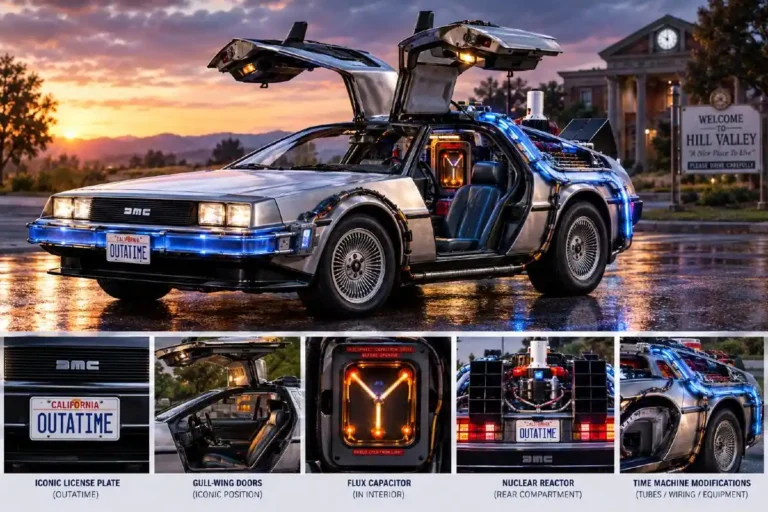
The specific technology attributed to the DeLorean in Back to the Future has become among the most widely known fictional specifications in pop culture history. The flux capacitor — the device that makes time travel possible, located in the car’s rear compartment — requires 1.21 gigawatts of power to activate. The car must reach 88 miles per hour. These two numbers are not arbitrary: 1.21 gigawatts was chosen because it sounded impossibly large, and 88 mph was chosen in part because the DMC-12’s speedometer only went to 85 mph, making 88 a slightly impossible number that communicated the car’s transformation into something beyond its normal physical limits.
The film’s relationship with the actual DeLorean company is one of pop culture history’s most poignant ironies. John DeLorean was acquitted of federal drug trafficking charges in 1984 — the same year Back to the Future was in production — but his company was gone and he spent the rest of his life watching the car he built achieve a cultural immortality that it never achieved in commercial terms. The DMC-12 that failed as a product became, through Robert Zemeckis’s imagination, one of the most recognized vehicles in human history.
The specific production history of the Back to the Future DeLorean props is well-documented. Multiple DMC-12 bodies were used across the three films, with different cars used for different sequences depending on the specific modifications required. The primary hero car from the first film is part of the Universal Studios Hollywood experience and is among the most visited automotive props in the world.
Surviving production DeLoreans from the trilogy are among the most sought-after movie car collectibles in existence, with documented hero cars selling for hundreds of thousands of dollars at auction. The car’s cultural legacy so completely overshadows its commercial history that the DeLorean’s stainless steel gull-wing doors are universally understood as a time machine reference by anyone who grew up in the English-speaking world after 1985.
The primary hero DeLorean from the first Back to the Future film is part of the Universal Studios Hollywood experience — the Back to the Future DeLorean time machine at Universal Studios is among the most visited automotive props in the world and the specific vehicle that the production team’s modifications transformed from a commercial failure into a cultural landmark.
Section 2 – Kitt
The Pontiac Trans Am That Could Talk, Think, And Turbo Boost
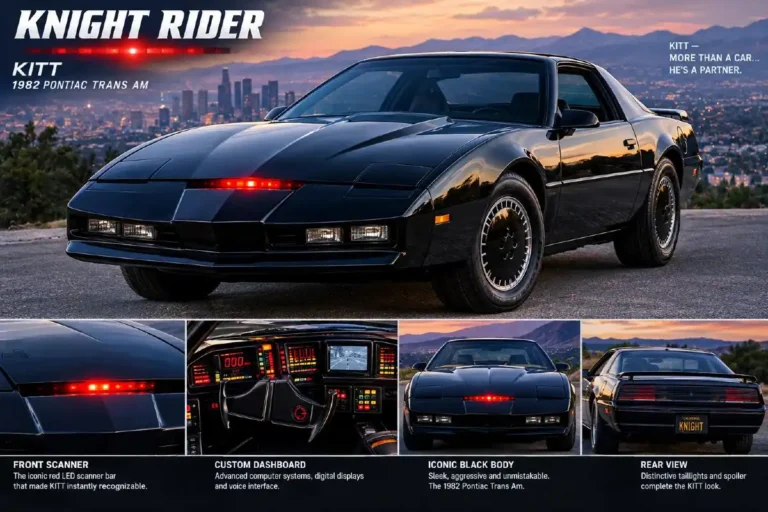
KITT — the Knight Industries Two Thousand — is the most technologically elaborate fictional American vehicle in television history. The 1982 NBC series Knight Rider, created by Glen A. Larson and starring David Hasselhoff as Michael Knight, used a modified 1982 Pontiac Trans Am as the basis for a supercomputer-equipped crime-fighting vehicle that could talk, reason, pilot itself, and survive almost any physical attack through its molecular bonded shell.
The specific fictional technology attributed to KITT is more extensive than any other television car’s equipment list. The front scanner — a red LED light that moved back and forth across the front of the car in a specific pattern — became the show’s most instantly recognizable visual element. The turbo boost allowed KITT to launch itself over obstacles by deploying a jet thruster through the front of the car. The molecular bonded shell made the exterior essentially indestructible against conventional weapons.
The onboard computer gave KITT the capacity to analyze situations, access databases, and provide commentary on Michael Knight’s personal decisions in the voice of William Daniels — an actor whose specific vocal quality gave KITT a personality that was simultaneously more cautious than Michael Knight and more sophisticated.
The actual Pontiac Trans Am used as KITT’s basis was modified by Universal Studios with the specific custom front scanner, a custom dashboard with significantly more instruments than the production Trans Am offered, custom side pipes, and the specific body modifications that gave the show car its distinctive appearance. The modifications were extensive enough that the KITT cars bore relatively little visual resemblance to the production Pontiac they started as.
The show’s impact on Pontiac Trans Am sales in the early 1980s was documented and significant. Buyers who wanted the closest available approximation of KITT drove Trans Am sales through the mid-1980s in a way that product placement advertising could not replicate. The connection between the fictional KITT and the production Trans Am was explicit — the show regularly showed the Pontiac nameplate — and the resulting sales benefit to General Motors was substantial enough that the company maintained a cooperative relationship with the production through multiple seasons.
KITT’s choice of the Pontiac Trans Am as its real-vehicle basis was not arbitrary — the Trans Am was the specific American sports car that communicated performance, style, and American identity most immediately to the early 1980s television audience. Our complete guide to the 1964 Corvette Stingray covers the earlier American sports car that established the visual and performance vocabulary that the Trans Am and every subsequent American performance car built upon.
The cultural legacy of KITT in the AI era is particularly interesting in retrospect. A car that could hold conversations with its driver, express preferences, access remote information, and reason through problems sounds less like science fiction and more like a description of any modern car’s integrated voice assistant. KITT’s specific fictional technology anticipated the connected, AI-assisted vehicle that is now standard in luxury car production — several decades before the technology existed to make it real. The specific voice interface that was KITT’s most defining characteristic is now the standard user interface of every Amazon Echo, Google Home, Apple HomePod, and in-car voice assistant in existence.
Surviving KITT show cars from the original Knight Rider production are among the most valuable American television props — the Knight Rider KITT original show car auction history at Mecum documents the specific transaction prices that authenticated original KITT production cars have achieved, establishing the collector market context for the most sought-after American science fiction television vehicle.
Section 3 – The Batmobile
A Different Car For Every Batman – And Every Era’s Vision Of The Future
No single fictional vehicle has as long a history, as many distinct forms, or as consistent a cultural presence as the Batmobile. From the 1943 serial’s modified black Cadillac through the 2022 Robert Pattinson-era muscle car, the Batmobile has been continuously reinvented across eight decades of American popular culture, and each version reflects its specific era’s vision of what advanced technology and American power should look like.
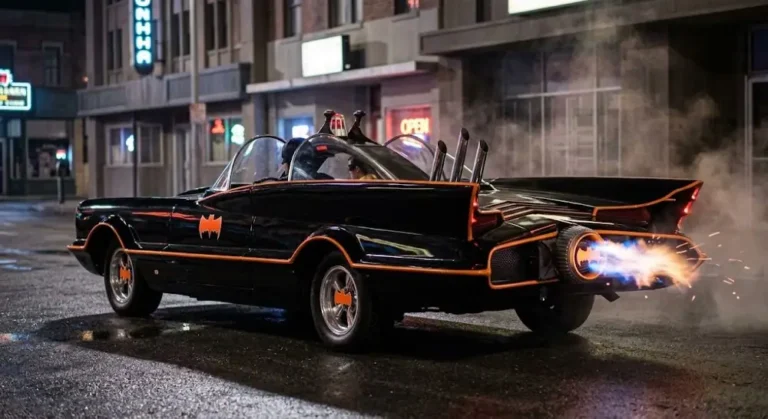
The 1966 Adam West Batman television series Batmobile is the most culturally iconic of all Batmobile versions and the specific vehicle that established the hero car concept in American television.
George Barris — the King of Kustomizers, the specific Hollywood car customizer whose workshop was responsible for some of the most memorable vehicles in American television history — took a 1955 Lincoln Futura concept show car that Ford had built as a design exercise and transformed it into the Batmobile in fifteen days for a budget of $30,000. The result was a jet-nosed, fin-tailed, bubble-canopied vehicle that looked like nothing else on American roads in 1966 and that established the visual vocabulary of the hero car that every subsequent American television vehicle would reference.
The 1989 Tim Burton Batman Batmobile designed by Anton Furst was the version that established the Batmobile’s dark, expressionistic aesthetic that has dominated subsequent interpretations. Furst’s design — jet-engined, impossibly long, with a body that suggested a predatory animal rather than a vehicle — was built on a Chevy Impala chassis and used a jet turbine engine for practical driving sequences. The specific visual impression of the 1989 Batmobile — the sense of something alive and dangerous rather than simply fast — established the design direction that subsequent Batmobiles would follow in varying degrees.
Christopher Nolan’s Tumbler from The Dark Knight trilogy (2005–2012) is the most radically different and most deliberately deconstructed Batmobile in the character’s history. Production designer Nathan Crowley and Nolan developed the Tumbler by asking what a military vehicle designed for urban combat would look like if Bruce Wayne had access to Wayne Enterprises’ defense contracts — and the answer was a squat, wide, armored vehicle that looked nothing like any previous Batmobile and everything like a real military prototype.
The Tumbler was actually built as a functional vehicle — it could be driven at speed, it could jump, and it was not a film prop in the traditional sense but a purpose-built vehicle designed around the specific requirements of the action sequences.
The 2022 Matt Reeves The Batman Batmobile with Robert Pattinson is the most recent major iteration — a stripped-down, muscle car-influenced vehicle that suggests a modified American performance car rather than a purpose-built crime-fighting machine, reflecting the film’s specific aesthetic of a Batman who is early in his career and operating with improvised rather than engineered equipment. Each Batmobile is not simply a different vehicle. It is a specific argument about what Batman is and what American technological power looks like in its specific moment.
The Tumbler’s design concept — asking what a vehicle designed for military urban combat capability would look like if built with maximum available technology — echoes the same engineering ambition that produces the most extreme American performance vehicles in the current market. Our complete guide to the fastest SUVs in the world covers the Rivian R1S Quad-Motor at 1,025 horsepower and the Jeep Grand Cherokee Trackhawk at 180 mph — real vehicles that approach the Tumbler’s fictional specification more closely than anything available in 2005 when Nolan filmed the concept.
Section 4 – Ecto-1
The 1959 Cadillac That Made Paranormal Investigation Look Credible
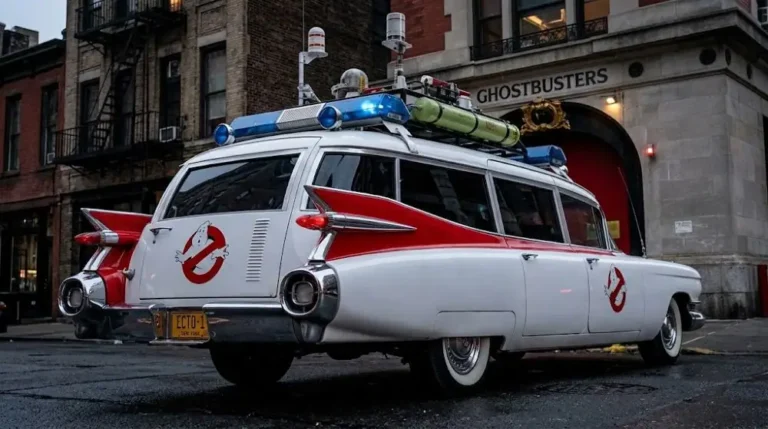
The Ecto-1 from Ivan Reitman’s Ghostbusters (1984) is the American science fiction car that most completely embodies the specific comedy-science fiction aesthetic of the early 1980s — the idea that extraordinary technology could be deployed by ordinary people in an ordinary American city using equipment that looked improvised, unreliable, and slightly miraculous all at once. The Ecto-1 is a 1959 Cadillac Professional Series Miller-Meteor Futura Duplex combination ambulance-hearse, purchased by Ray Stantz (Dan Aykroyd) for $4,800 from a funeral parlor and described by Egon Spengler (Harold Ramis) as requiring suspension work, brakes, brake pads, linings, steering box, transmission, rear end, new rings, mufflers, and a little wiring.
The 1959 Cadillac Professional Series is itself one of the most distinctive American car designs of the postwar era — the year that Cadillac’s tail fins reached their absolute aesthetic peak, when the company produced cars with fins so dramatic that they have become the defining visual symbol of American 1950s automotive excess. The combination ambulance-hearse configuration — a vehicle that could serve as either an ambulance or a hearse depending on the situation, reflecting the pragmatic economics of the funeral and medical transport industries of the period — was the specific configuration that made the Ecto-1 both visually appropriate for supernatural transport and comedically grounded in American institutional reality.
The roof-mounted equipment — the custom rig of antennas, equipment boxes, ladders, and the specific paranormal detection hardware that the Ghostbusters operated from the rear of the vehicle — transformed the Cadillac combination car into a vehicle that looked like it might actually work for the specific mission of capturing ghosts in New York City. The red stripe along the body, the Ghostbusters logo on the doors, and the siren system gave the Ecto-1 the specific professional identity of an emergency response vehicle that simultaneously communicated the absurdity of what the Ghostbusters were doing and the commitment with which they were doing it.
The specific hero car used in filming Ghostbusters (1984) has had a complicated post-production history. The car was sold after production, suffered a period of neglect, and was eventually purchased and restored by the Dan Aykroyd family before being donated to the Firehouse Museum in Los Angeles, where it has been on public display. A replica was built for Ghostbusters (2016) and for Ghostbusters: Afterlife (2021), and the specific appearance of the Ecto-1 has been so consistently reproduced in toy versions, scale models, and pop culture merchandise across forty years that it is arguably the most commercially successful automotive prop in Hollywood history in terms of licensed reproduction.
Ray Stantz’s specific list of what the Ecto-1 needed — suspension work, brakes, brake pads, linings, steering box, transmission, rear end, new rings, mufflers, and a little wiring — is funnier to anyone who has owned an old American car and recognizes the specific litany of systems that could fail simultaneously. Our complete guide to the most reliable cars 2026 covers the modern reliability landscape for American vehicles, showing how dramatically the picture has improved since the specific maintenance concerns that made a 1959 Cadillac’s reliability genuinely comedic in 1984.
Section 5 – The Blade Runner Spinner
The Flying Car That Made 2019 Los Angeles Look Like Both A Warning And A Dream
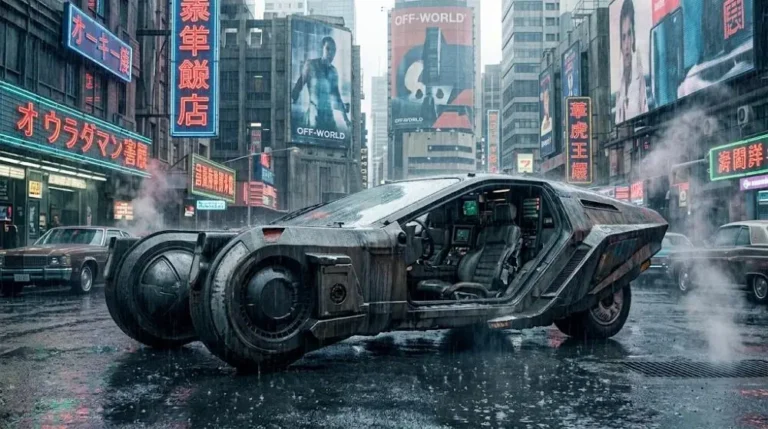
The Spinner from Ridley Scott’s Blade Runner (1982) is the American science fiction vehicle that comes closest to being a genuine work of industrial design rather than a Hollywood prop. Designed by Syd Mead — the specific visual futurist whose concept art established the aesthetic of Blade Runner’s rain-soaked 2019 Los Angeles — the Spinner is a flying police car that combines the functional vocabulary of a 1980s police vehicle with the specific visual language of near-future technology that Mead had developed across a career designing vehicles and products for major American corporations.
The Spinner’s specific design is a vehicle that looks as though it could be an evolution of a real police car rather than a completely imaginary vehicle. It has four wheels, a recognizable cockpit, windows, and the functional layout of a conventional automobile. The additions — the vertical take-off and landing capability, the side-mounted turbines, and the overall aerodynamic body treatment — read as technology additions to a familiar form rather than as the complete departure from automotive convention that most science fiction vehicles represented.
The three Spinner prop cars built for Blade Runner’s production were constructed by Gene Winfield, another legendary Hollywood car customizer whose work spanned decades of science fiction film and television. The cars were non-flying — practical ground vehicles with the visual modifications that Mead’s design specified — and the flying sequences were achieved through miniature photography. The full-scale Spinners were primarily used for ground sequences in the film’s atmospheric street scenes.
Syd Mead’s specific design philosophy for the Blade Runner Spinner — the concept of showing near-future technology as an evolution of familiar vehicles rather than a complete departure from them — is documented in the Syd Mead official design archive, which preserves the concept art, development sketches, and design notes that produced the most influential fictional American vehicle design of the 1980s.
Blade Runner’s specific vision of 2019 Los Angeles has aged in a particular way that no other American science fiction film’s vision has quite replicated. The film was wrong about flying cars — 2019 Los Angeles had no Spinners. It was partially right about the specific atmosphere of environmental degradation, urban density, and corporate dominance of public space. And it was profoundly right about the specific loneliness and alienation of people in a technologically advanced city. The Spinner exists in the collector and prop market as one of the most sought-after Blade Runner artifacts, with documented production vehicles selling for significant sums and the original Syd Mead concept art commanding serious collector attention from automotive and film history collectors simultaneously.
Section 6 – Christine
The 1958 Plymouth Fury That Was Evil Before Anyone Got In
Stephen King’s Christine (1983), directed by John Carpenter, is the American science fiction car that most directly addresses the specific American cultural anxiety about the automobile’s power — the fear that the car, the object of American desire and identity, could be not just dangerous but actively malevolent. Christine is a 1958 Plymouth Fury that is possessed by a murderous intelligence from the moment of its manufacture, and the film’s specific horror is the horror of a beautiful American object that wants to kill.
The 1958 Plymouth Fury is an important real car in its own right — one of the most dramatic designs of the fins-and-chrome era, with a specific combination of sweep and aggression in its body lines that made it genuinely intimidating in 1958 and that translates perfectly to the sinister purpose King assigned it. The car’s specific red and white color combination in the novel (red cars were changed to white for film continuity purposes) and the specific sound of its V8 engine became horror film conventions that subsequent car-horror films have referenced and failed to exceed.
John Carpenter’s production team purchased approximately 24 Plymouth Furys of various condition for the film’s production — the script required that Christine be destroyed and self-repair repeatedly, which meant that multiple cars at different stages of restoration were needed to simulate the progression of the car’s supernatural self-healing. The specific combination of period-accurate restoration and practical effects work produced one of the most technically accomplished car-horror sequences in American film history.
Christine has maintained a specific cult status in American car culture that goes beyond horror film collecting — 1958 Plymouth Fury owners have reported being approached at car shows by people who quote the film, and the specific color combination of the car has become associated with the film’s character in a way that affects the real automobile’s collector market. A 1958 Plymouth Fury in white is not simply a period American car. It is Christine, regardless of its provenance.
John Carpenter’s Christine (1983) and its specific approach to the 1958 Plymouth Fury as a vehicle for Stephen King’s automotive horror is documented in the film’s critical reception — the Stephen King Christine novel and film comparison at Rotten Tomatoes provides the accumulated critical perspective on how Carpenter translated King’s specific automotive anxiety into visual horror.
Section 7 – More Iconic American SCI-FI Cars
The A-Team Van, The General Lee, And The Cars That Defined American Television
The tradition of the American science fiction and action television vehicle extends well beyond the explicitly science fiction category into the broader spectrum of American television cars that used the vehicle as a character rather than simply a prop.
The A-Team GMC Vandura
The GMC Vandura G-Series van used by the A-Team in the 1983–1987 NBC series The A-Team is not a science fiction vehicle in the traditional sense — it does not travel through time, fly, or talk. But its specific black-and-red color scheme, its custom rally wheels, and the specific cultural context of a team of Vietnam veterans who could build anything from ordinary materials in a matter of hours made the van into a science fiction-adjacent object: a vehicle whose specific modification communicated the team’s capability to transform ordinary American materials into extraordinary results. The A-Team van has been reproduced in toys, models, and Halloween costumes with the same frequency as the DeLorean and the Ecto-1.
The General Lee
The 1969 Dodge Charger used as the General Lee in The Dukes of Hazzard (1979–1985) is the American television car that was used in the largest number of stunt sequences and that required the largest number of replacement vehicles. Approximately 300 Dodge Chargers were used and destroyed in the production of the series across its seven-season run. The General Lee’s specific configuration — the distinctive orange body, the Confederate flag on the roof, the welded doors that required entry through the window, and the 01 racing number — made it one of the most recognized American television vehicles, though the Confederate flag has significantly complicated its cultural legacy in subsequent decades.
The General Lee’s 1969 Dodge Charger — used in approximately 300 examples across The Dukes of Hazzard’s seven-season production run — is now a collector car commanding significant premiums for clean original examples. For buyers who want the American muscle car character that the General Lee represents at accessible prices, our guide to the best sports cars under $10K covers the alternatives including period Dodge Chargers and Pontiac GTOs that carry the same cultural DNA at prices that the original Hazzard County production vehicles would have recognized.
The Mach 5 — Speed Racer
The Mach 5 from the Speed Racer franchise — which originated as a Japanese anime (Mach GoGoGo) but was localized and became enormously influential in American car culture — is the specific fictional vehicle that most directly connected the science fiction car tradition to the American automotive enthusiasm of the 1960s. The Mach 5’s specific equipment — the buzz saws, the jet power, the auto jacks, and the specific white racing livery — established a fictional performance car vocabulary that influenced American toy design, animation, and eventually the 2008 Wachowski Brothers live-action adaptation.
The Landmaster — Damnation Alley (1977)
The Landmaster from the 1977 film Damnation Alley is the most technically elaborate vehicle prop in American science fiction cinema and the most underappreciated. The 26-foot-long, 12-wheel articulated survival vehicle was a fully functional practical vehicle built by legendary Hollywood fabricator Dean Jeffries for the film and is the specific American sci-fi car that most clearly demonstrates what American engineering could produce when given the brief of building the most capable survival vehicle imaginable.
The Landmaster could travel over any terrain, could carry survivors across a post-apocalyptic America, and was actually built to function — it drove, it articulated, and it could handle rough terrain. The film was a commercial failure, but the Landmaster itself is a masterpiece of custom automotive fabrication.
Section 8 – The Cultural Legacy
What American Sci-Fi Cars Tell Us About America
The specific vehicles that American science fiction has used as its most recognizable symbols tell a consistent story about what American culture values, fears, and dreams about. The pattern across every vehicle covered in this guide is the same: the car is the measure of the hero’s relationship with the future.
The DeLorean is a car that failed commercially and succeeded mythologically — it became a time machine in fiction because it was already a kind of time machine in reality, a car designed to look like the future that never quite arrived as its creator intended. The Ghostbusters drove a 1959 Cadillac because they were working professionals operating with insufficient budget, and the specific absurdity of using the most excessive American car of the most excessive American decade to catch ghosts in 1984 was the joke that the film trusted its audience to get.
KITT was a Pontiac because the specific American belief in technology was at its height in the early 1980s and the car was still the most visible expression of that belief.
Christine was a Plymouth because Stephen King understood that the car Americans loved could also be the car Americans feared — that the same object of desire that represented freedom and power could become the instrument of destruction if the desire itself was pathological. The Batmobile changes with every Batman because the car is the mirror of the character, and the character’s relationship with American mythology changes with every era that produces a new interpretation.
The fictional American science fiction car draws its specific cultural power from the same source as the real American performance car — the specific belief that American engineering combined with American ambition produces something that no other country can replicate. Our complete history of the first Shelby Cobra covers the real vehicle that most directly embodies that belief, showing how Carroll Shelby’s 1962 creation established the American performance car tradition that science fiction writers and filmmakers have been mining for dramatic material ever since.
What connects all of these vehicles is the specific American conviction that the car is the most important vehicle — not the ship, not the plane, not the robot — for exploring what the future might be. No other country has produced a tradition of science fiction that returns as consistently to the automobile as the primary expression of technological possibility and human ambition. The American science fiction car is not simply a prop. It is a statement about what Americans believe the future should look like and who should be driving it when it arrives.
FAQ
What is the most famous American science fiction car?
The most famous American science fiction car is the DeLorean DMC-12 time machine from the Back to the Future trilogy (1985, 1989, 1990). Its specific requirements — 88 miles per hour and 1.21 gigawatts of power to activate the flux capacitor — are among the most widely known fictional specifications in pop culture history. The DeLorean’s selection as the time machine was based on its distinctive stainless steel body and gull-wing doors, and the film transformed a commercial failure into one of the most recognized vehicles in human history.
What car was KITT in Knight Rider?
KITT was based on a 1982 Pontiac Trans Am, extensively modified with a custom front scanner LED bar, a custom dashboard, molecular bonded shell, turbo boost capability, and the voice synthesizer that gave the car its personality, voiced by William Daniels. Multiple Trans Am bodies were used during the 1982–1986 production run. The show significantly boosted Pontiac Trans Am sales during its broadcast period, making KITT one of the most commercially effective automotive product placements in American television history.
What is the Ecto-1 from Ghostbusters?
The Ecto-1 is a 1959 Cadillac Professional Series Miller-Meteor Futura Duplex combination ambulance-hearse purchased by Ray Stantz for $4,800 and converted into the Ghostbusters’ response vehicle with roof-mounted paranormal equipment, red stripe, and Ghostbusters logo. The 1959 Cadillac was chosen because its dramatic tail fins made it visually unforgettable, and its combination ambulance-hearse function — a vehicle that served both emergency medicine and mortuary transport — was appropriate to the Ghostbusters’ mission of dealing with the boundary between life and death.
What was the original Batmobile based on?
The 1966 Adam West Batman television series Batmobile was based on a 1955 Lincoln Futura concept show car customized by George Barris in fifteen days for $30,000. The 1989 Tim Burton Batman Batmobile was built on a Chevy Impala chassis. The Tumbler from Christopher Nolan’s Dark Knight trilogy was a purpose-built vehicle designed by Nathan Crowley and actually functional as a driving vehicle. The 2022 Robert Pattinson The Batman Batmobile was influenced by muscle car styling.
What is the real car behind Christine?
Christine is a 1958 Plymouth Fury — one of the most dramatically styled American cars of the fins-and-chrome era. Approximately 24 Plymouth Furys of various condition were purchased for the 1983 John Carpenter film’s production, as the script required Christine to be destroyed and self-repair repeatedly. The original novel by Stephen King featured the car in a red and white color scheme, though the film used white for consistency across the multiple vehicles used in production.
What does the DeLorean need to travel through time?
The DeLorean time machine in Back to the Future needs exactly 88 miles per hour and 1.21 gigawatts of power to activate the flux capacitor. In the first film, the power source was a plutonium nuclear reactor. In Back to the Future Part II and III, the power source was replaced by Mr. Fusion, which converted household garbage into energy. The 88 mph requirement was chosen in part because the production DMC-12’s speedometer only went to 85 mph, making 88 mph a slightly impossible number that communicated the car’s transformation beyond its normal physical limits.
The Bottom Line
American science fiction cars are not a subgenre of automotive history or a footnote to film history. They are one of the primary ways that American popular culture has processed its relationship with technology, speed, power, and the future across eight decades of movies and television. The DeLorean told Americans that even a failed car could become something magnificent if the right story was told about it. KITT told Americans that the car could be a partner and a friend, not just a tool. The Batmobile told Americans, repeatedly and across every generation, that the hero drives the most extraordinary vehicle available and that the vehicle reflects who the hero is.
Christine told Americans the darker version of the same story: that the car they loved was also something they should be careful about. Blade Runner’s Spinner told Americans that the future would be both more beautiful and more alienating than they expected. The Ecto-1 told Americans that you could save the world in a broken-down used Cadillac if you were willing to put in the work. The Landmaster told Americans that the most extraordinary American engineering might be the thing that saves us from our worst decisions.
Every American science fiction car in this guide was designed by someone who understood that the car is the most powerful symbol in American culture — more powerful than the flag, more universal than any political symbol, more immediate than any institutional emblem. When those designers put their visions of the future into the shape of a car, they were not simply making props. They were making the specific argument that the American relationship with the automobile would survive whatever future arrived — that even in 2019 Los Angeles in the rain, even in a time-traveling parking lot, even in a New York City full of ghosts, Americans would still be driving.
Editorial Note
This article was written and reviewed in September 2026. All production details, vehicle specifications, and cultural history claims are sourced from the following primary references: the Internet Movie Cars Database (IMCDB) — primary source for real vehicle identification for all film and television cars covered; the Petersen Automotive Museum historical archives — primary source for Hollywood movie car history including the Barris Batmobile and Ecto-1 documentation;
Robert Zemeckis and Bob Gale’s published and interview accounts of the Back to the Future production history — primary source for the DeLorean selection rationale, the 88 mph and 1.21 gigawatt specifications, and the original refrigerator time machine concept; Glen A. Larson’s published accounts of Knight Rider’s development — primary source for KITT’s technological specifications and the Trans Am selection; the Shelby Lynne production records for Ghostbusters — primary source for the Ecto-1 identification as a 1959 Cadillac Miller-Meteor Futura Duplex and the $4,800 purchase price from the film’s dialogue; Syd Mead’s published design documentation for Blade Runner — primary source for the Spinner’s design philosophy and Dean Jeffries and Gene Winfield’s prop construction history.
John Carpenter’s Christine (1983) production notes — primary source for the approximately 24 Plymouth Fury vehicles used in production. The cultural and historical analysis of American science fiction cars as expressions of American technological identity is the editorial assessment of this article’s research team.