Last Updated: April 17, 2026 | Read Time: 9 minutes
Sharp creases. A supercharged V8 making 390 horsepower before most buyers knew what a supercharger was. A Cobra that Ford had to recall because it didn’t make the power it was advertised with. A track weapon with no radio and no air conditioning built in a run of exactly 300 cars. And the last Mustang assembled in Dearborn, Michigan, before the factory closed. The New Edge Mustang is six years of American performance history that refuses to be forgotten.
At A Glance – New Edge Mustang Key Facts
– Production Years: 1999–2004 (model years)
– Platform: SN95 (fourth-generation Mustang chassis)
– Design Language: “New Edge” — sharp creases, intersecting arcs, aggressive angles
– Designer: Jack Telnack, VP of Design, Ford Motor Company
– Body Styles: Coupe, Convertible
– Engine Options: 3.8L V6 (193 hp), 4.6L V8 2V GT (260 hp), 4.6L V8 4V Cobra (320 hp), 390 hp supercharged (Terminator)
– Key Milestone: First regular-production Mustang with independent rear suspension (SVT Cobra, 1999)
– The Recall: All 1999 SVT Cobras recalled — actual output approximately 285 hp, not 320 hp as advertised
– 2000 SVT Cobra: Not produced — canceled due to 1999 recall
– 2000 Cobra R: 300 units only — 5.4L DOHC 385 hp, no radio, no AC, race-spec
– 2001 Bullitt GT: 6,500 units — 10 additional hp over standard GT, Dark Highland Green
– 2003–2004 Terminator Cobra: 390 hp, Eaton supercharger, iron block, forged rods
– 2003–2004 Mach 1: 4.6L 4V 305 hp, functional shaker hood scoop revival
– 2004 Special Notes: 40th Anniversary badges, final year built in Dearborn, Michigan
– Current GT Value Range: $4,000–$20,000 depending on condition
– Current Terminator Cobra Value: Well above original MSRP for low-mileage examples
Sources: LMR.com, AmericanMuscle.com, Steeda.com, CJPonyParts.com, CarBuzz, SpecsAndMods.com
Overview – The Mustang That Brought Back The Edge
By 1998, the Mustang had a problem that nobody wanted to say out loud. The SN95 — the fourth-generation platform introduced in 1994 — had done what it needed to do. It had kept the Mustang alive through a period when American performance cars were genuinely threatened. It had modernized the structure and significantly improved the chassis. But the body itself, with its smooth, rounded curves and soft surfaces, looked like a car that had been designed by committee to offend nobody.
It had not offended anybody. It had also not particularly excited anybody.
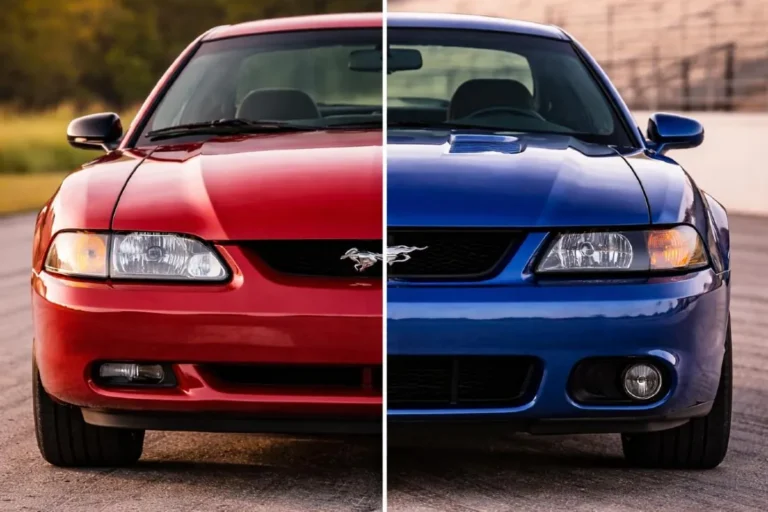
What arrived in 1999 was a direct answer to that problem. The New Edge Mustang used the same SN95 platform underneath — same wheelbase, same basic structure, same engine locations — but wrapped it in a body that looked nothing like the car it replaced. Where the 1994–1998 Mustang had soft, flowing lines, the 1999 model had creases.
Where the previous car had smooth, rounded surfaces, the New Edge had intersecting arcs and sharp angles that created what Ford called “surface tension.” The design language — developed by Jack Telnack, Ford’s VP of Design from 1980 to 1997 — was applied across Ford’s lineup at the time, appearing on the Focus, the Taurus, and the Mercury Cougar. But nowhere did it look more at home than on the Mustang.
New Edge distinctively combined intersecting arcs and other features, creating surface tension by adding creases to soft aerodynamic shapes. The result was a car that looked purposeful and aggressive from every angle — a muscle car silhouette that had been updated for a new decade without losing the proportional identity that made the Mustang recognizable.
The New Edge Mustang ran for six model years, from 1999 through 2004. In those six years, it produced the most dramatic recall in Mustang history, one of the most celebrated racing homologation specials ever sold at a Chevrolet — excuse us, Ford — dealership, a movie car that became a collector legend, a shaker hood that literally shook, and a supercharged Cobra that produced more power than Ford admitted and earned a nickname that has followed it into the collector car market 22 years later.
This is the complete guide to all of it.
Section 1 – The Design Story
Why “New Edge” Changed How People Looked At The Mustang
The New Edge design language did not emerge from a design studio that was trying to make the Mustang look more like a sports car. It emerged from a broader Ford design philosophy that was trying to move the entire company’s lineup away from the soft, aerodynamic shapes that had dominated American car design since the late 1980s.
From roughly 1986 through 1998, the dominant aesthetic in American car design was roundness. Smooth curves, flowing surfaces, and shapes that looked like they had been created by airflow rather than by sculptors. The 1989 Ford Thunderbird, the 1992 Ford Taurus, and the 1994–1998 SN95 Mustang all reflect this philosophy. These cars were not ugly. But they were also not particularly interesting to look at, and by the late 1990s, they were beginning to feel dated.
Jack Telnack’s New Edge language was the counter-argument. Introduced initially on smaller Ford products and then applied across the lineup, New Edge used intersecting geometric forms — arcs that cut across each other at angles rather than flowing smoothly — to create visual tension on the surface of the car. The result was a body that looked different from every angle, that created shadow and highlight patterns that were more complex and more interesting than smooth surfaces could produce.
For the Mustang specifically, this approach was perfectly suited. The original 1964–1968 Mustang — the car that New Edge was drawing on — had crisp body lines, prominent fender forms, and a long-hood, short-deck proportion that was fundamentally geometric rather than aerodynamic. New Edge translated that geometric discipline into a late-1990s idiom without losing the Mustang’s fundamental proportion.
The most noticeable change from the 1994–1998 car was the front fascia. The smooth, relatively mild front end of the SN95 was replaced by a more aggressive treatment with a larger, more defined opening, a hood with a more prominent character line, and headlight housings that integrated into the body line more sharply. The result read as more powerful, more intentional, and more closely related to the classic Mustang proportions than the outgoing design had managed.
The hood scoop — available on GT and Cobra models — added visual drama and, in some configurations, functional purpose. The five-spoke wheels that became standard on GT models gave the New Edge Mustang a specific visual identity that has remained recognizable to enthusiasts for more than two decades. And the specific way the rear quarter panels swelled over the rear wheels communicated exactly the right message about what was available under the hood.
Section 2 – The Engines
Every Powerplant From The Base V6 To The Supercharged Terminator
The 3.8L Essex V6 — 193 HP
The base New Edge Mustang used the 3.8-liter Essex V6, producing 193 horsepower and 223 lb-ft of torque — a meaningful improvement over the 1998 model’s output and enough to give the base car a 0-to-60 time of approximately 7.1 seconds. For buyers who wanted the New Edge’s looks and the Mustang badge without the fuel cost and insurance premium of the V8, the V6 was the correct choice.
The Essex V6 is not the engine that makes the New Edge Mustang’s reputation. But it is the engine that made the New Edge Mustang’s sales numbers. V6 Mustangs consistently outsold their V8 counterparts across the production run, and the Essex’s reliability and widespread parts availability make V6 New Edge Mustangs among the most practical classic car ownership experiences available today.
The 4.6L Two-Valve V8 — 260 HP In The GT
The GT’s 4.6-liter two-valve Modular V8 produced 260 horsepower and 302 lb-ft of torque — a meaningful jump over the 1998 GT’s numbers and the beginning of the Modular V8’s reputation as one of the most durable production engines Ford has ever built. The two-valve Modular is not the most exciting engine in the New Edge lineup. It is probably the most important.
Its single overhead camshaft per bank, iron block, and aluminum cylinder heads combined reliability that enthusiasts quickly discovered was extraordinary. These engines routinely reach 200,000 miles with basic maintenance. The aftermarket support — cold air intake, exhaust, tune — allows budget-conscious owners to extract meaningful additional performance without significant investment. And the engine’s broad torque curve makes the GT pleasant to drive at every speed rather than requiring rev-chasing to find the power.
Output for the GT’s 4.6L engine was cranked up to 260 hp and 302 lb-ft of torque for 1999 — an improvement that, combined with the stiffened chassis and sharper steering of the New Edge revision, made the GT a genuinely more capable car than its SN95 predecessor despite sharing most of its mechanical architecture.
The 4.6L Four-Valve V8 — 320 HP In The SVT Cobra
The SVT Cobra’s 4.6-liter four-valve DOHC V8 represents a fundamentally different engine approach from the GT’s two-valve unit. Dual overhead camshafts per bank, four valves per cylinder, and what Ford called “tumble port” cylinder heads — borrowed directly from racing applications — produced an engine that was genuinely oriented toward high-rpm performance rather than broad-range torque.
Advertised at 320 horsepower and 317 lb-ft of torque, the 1999 Cobra’s four-valve Modular was the most sophisticated production Mustang engine of its era when it arrived. The combination of this engine with the Cobra’s first-ever independent rear suspension — borrowed from the Lincoln Mark VIII — made the 1999 SVT Cobra the most technically advanced Mustang built to that point.
Then came the testing that changed everything.
The 1999 Cobra Recall: The Story Of 285 Honest Horsepower
The 1999 SVT Cobra is one of the most famous stories in Mustang history — not because of what it could do, but because of what it couldn’t.
Owners took to shops and dyno tests showed that the 1999 Cobra was indeed only producing around 285 horsepower, which was well shy of its 320 hp rating. The discrepancy was eventually traced to restrictive intake ports in the cylinder heads — a manufacturing issue that cost the engine 35 horsepower compared to its advertised output.
In August 1999, Ford halted the sales of unsold 99 Cobras at dealerships and recalled all those that had been sold to fix the issue. Because of this recall, the 2000 Cobra never launched — Ford did not offer a standard SVT Cobra at all in the 2000 model year, devoting that year to the Cobra R and to fixing the 1999 issue properly.
The 2001 SVT Cobra returned with the same basic 4.6L four-valve engine but with the intake and head issues resolved, producing genuine 320 horsepower output that owners could confirm on the dyno. The 2002 model year saw the SVT Cobra canceled again — this time intentionally, as SVT engineers were working on something far more significant for 2003.
The Eaton-Supercharged 4.6L — 390 HP: The Terminator
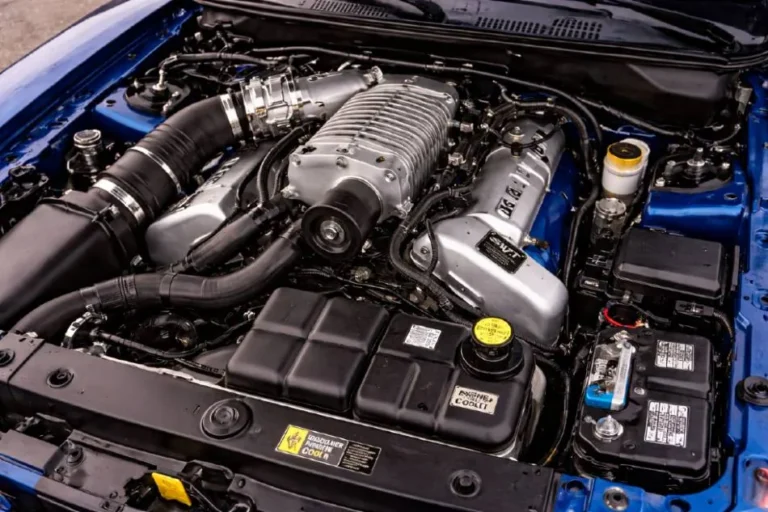
The 2003–2004 SVT Cobra — universally known as the Terminator — is the New Edge Mustang’s defining performance moment and one of the most celebrated American performance cars of the 2000s. The engine that made it legendary is the 4.6-liter four-valve V8 fitted with an Eaton M112 Roots-type supercharger and built around a cast-iron block with forged connecting rods.
The iron block and forged rods were deliberate. SVT engineers knew that the supercharged output would demand more than the aluminum block of the naturally aspirated Cobra could sustain under hard use, and they built the Terminator to take punishment. The Eaton supercharger — the same basic type used in the Camaro ZL1‘s LT4 — pushed boost through the four-valve heads, producing 390 horsepower and 390 lb-ft of torque.
And then, just as the 1999 Cobra had understated its power for different reasons, the Terminator quietly overstated its modesty. Many owners found their Terminators making more power than advertised. Independent dyno testing consistently showed numbers above the 390 hp factory claim, particularly in the 395 to 400 horsepower range at the flywheel. Ford had, apparently, learned a lesson from 1999 and was now erring in the other direction.
The Terminator was mated to a Tremec T-56 six-speed manual transmission — the only transmission offered. No automatic. This was not a comfort-oriented configuration. The power was delivered to the rear wheels through the same independent rear suspension that the 1999 Cobra had introduced — upgraded for the additional torque, but fundamentally the same architecture. The result was a Mustang that could handle its own power in corners as well as launching from rest.
The Terminator Cobra represents the pinnacle of what New Edge Mustangs are capable of and remains a highly sought-after collectible.
Section 3 – The Special Editions
The Cars That Made The New Edge Mustang’s Reputation
The 2000 SVT Cobra R — 300 Units, No Radio, 385 HP
The 2000 SVT Cobra R is one of the most extreme factory Mustangs ever produced and one of the most significant American performance homologation specials of any era.
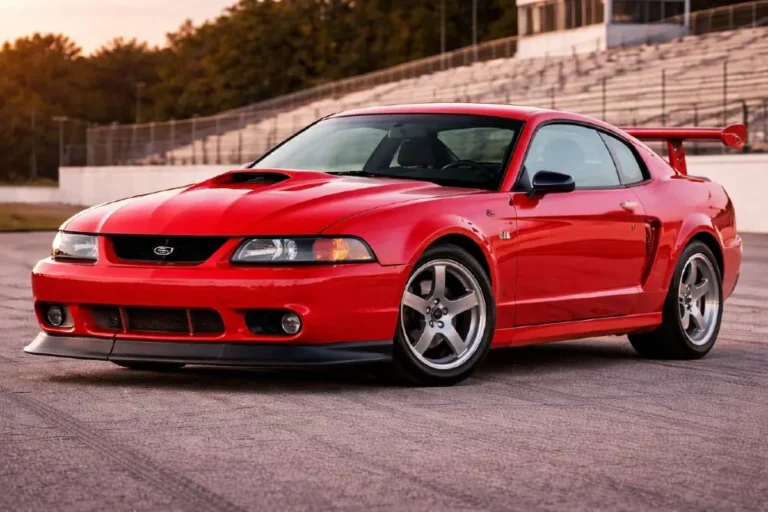
In the absence of the 2000 Mustang Cobra — canceled due to the 1999 recall — Ford’s SVT team went all out in building a racetrack-oriented weapon. The SVT took the Cobra, stripped it of any stock features that might hinder its lap times, and reassembled it with only high-quality racing parts. The basis was a naturally aspirated 5.4-liter DOHC V8 producing 385 horsepower — a larger, more powerful engine than any regular Cobra offered, making this the fastest factory Mustang ever built at the time.
No air conditioning. No radio. No cruise control. No rear seat. Brembo four-piston brake calipers. A large rear spoiler for downforce. Bilstein shocks and struts. A removable front splitter. BF Goodrich G-Force KD tires. A 20-gallon fuel tank for extended track sessions. And a Tremec T-56 six-speed manual transmission mated to a close-ratio differential.
Only 300 units were produced and were only available with Performance Red Clearcoat — every single one in the same color, which in hindsight has made them easier to track in the collector market. To purchase a Cobra R, buyers had to sign a form acknowledging that the car was not intended for street use and was a dedicated racing vehicle. Ford required proof of racing license for purchase.
The Cobra R could reach 60 mph in 4.7 seconds and a top speed of 170 mph — numbers that confirmed its racing rather than street orientation. Every surviving example is documented, and collector values reflect their extreme rarity and historical significance.
The 2001 Bullitt GT — Dark Highland Green And Steve McQueen’s Legacy
The 2001 Bullitt GT is the New Edge Mustang’s most emotionally resonant special edition — a car that understood that heritage matters as much as horsepower and that sometimes the most powerful engineering decision is naming something correctly.
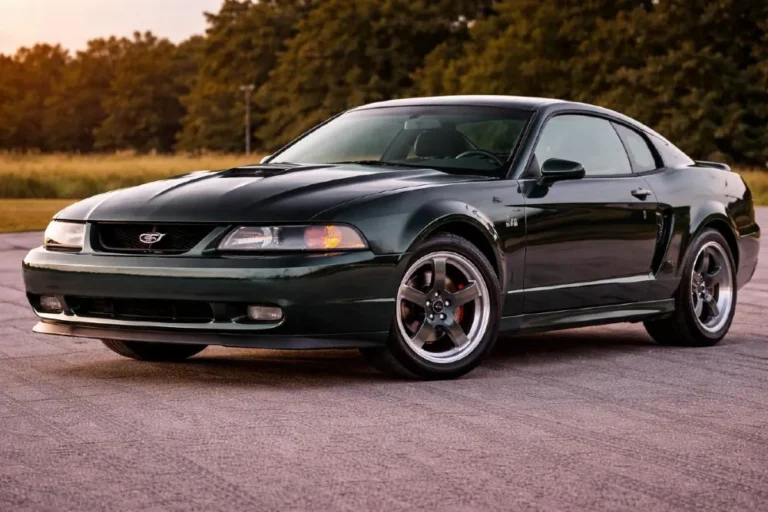
Based upon the 1968 film starring Steve McQueen and featuring a Highland Green 1968 Mustang GT 390 fastback in one of cinema’s greatest car chase sequences, the 2001 Bullitt Mustang paid homage through both visual and mechanical choices. Dark Highland Green was the signature color — a deep, serious green that made other performance cars look like they were trying too hard. Black and True Blue were also available.
For the Bullitt, Ford squeezed an extra 10 hp and 3 lb-ft of torque out of the GT’s 4.6L V8 through a revised cast-aluminum intake, twin 57mm throttle bodies, and high-flow mufflers. Total output was 265 horsepower. The suspension received specific tuning improvements over the standard GT. The exterior changes were restrained — no wing, specific wheels, subtle badging. The interior received specific appointments.
Approximately 6,500 Bullitt Mustangs were produced across the 2001 model year. The car attracted buyers who wanted something more specific than the GT but less extreme than the Cobra — the McQueen aesthetic in a usable, street-friendly package. It worked exactly as intended and remains one of the most sought-after New Edge configurations in the current market.
The Bullitt understood something that no amount of horsepower alone could achieve — that a Mustang’s identity is shaped as much by where it has appeared on screen as by what it makes at the dyno. The same principle drove one of the greatest automotive film legacies in history, which we cover completely in our guide to Gone in 60 Seconds and Eleanor — the movie that made the 1967 Shelby GT500 the most famous Mustang ever built.
The 2003–2004 Mach 1 — The Shaker Returns
In 2003, Ford engineers brought back one of the most famous performance package names in Mustang history — the Mach 1, originally introduced in 1969 and one of the most iconic first-generation Mustang configurations.
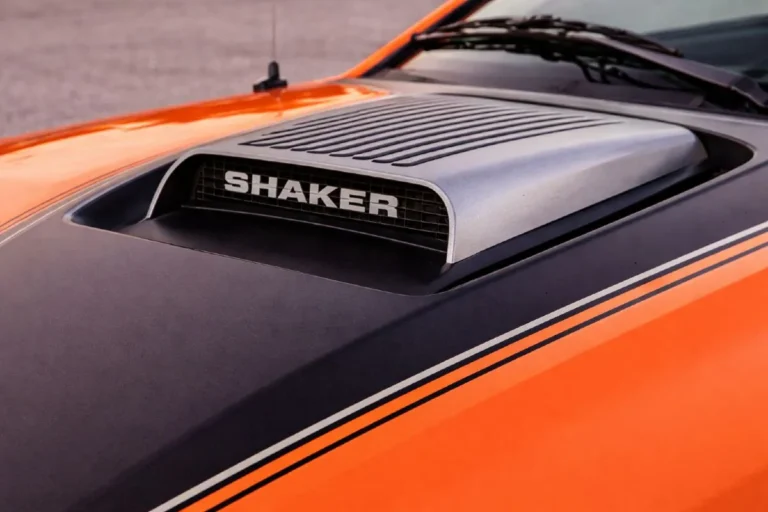
The New Edge Mach 1 used the 4.6-liter DOHC four-valve V8 — the same basic engine as the naturally aspirated Cobra — producing 305 horsepower. The specific differences from the Cobra included 57mm throttle bodies, high-flow four-valve cylinder heads, a cast-aluminum intake manifold, and specialized Mach 1 mufflers that produced a distinctive exhaust note. The Mach 1 shared a lot of the same features as the Bullitt but had some major differences including its most notable feature: the functional “shaker” hood scoop.
The shaker scoop — which mounts directly to the engine’s intake manifold and protrudes through a hole in the hood — literally moves with the engine when the car is revved. This was not CGI. It was not an illusion. When you pressed the throttle with the hood up, the scoop vibrated with engine movement — a real-time, tactile, mechanical display of what was happening under the hood. The shaker scoop wasn’t just for show. It actually shook when you revved the engine, giving you a real-time horsepower dance right on your hood.
Classic paint schemes were offered for the Mach 1 including Azure Blue, Oxford White, Torch Red, Zinc Yellow, Dark Shadow Gray, and Black. A matte-black hood stripe, five-spoke wheels, and a black decklid spoiler completed the visual package that deliberately referenced the 1969 Mach 1’s muscle car heritage.
The Mach 1 was produced for 2003 and 2004 only, making both years relatively limited in production. Its combination of genuine Cobra-level performance in a visually distinctive and historically meaningful package has made it one of the more appreciated New Edge configurations in the collector market.
The 2003–2004 Terminator 10th Anniversary SVT Cobra
SVT was celebrating an important anniversary alongside the regular 2003 Cobra production. The 10th-Anniversary Cobra featured very unique 17×9-inch dark argent painted anniversary wheels and red-painted brake calipers. The interior featured bright red leather seating and was trimmed with carbon fiber. SVT 10th Anniversary badges appeared on the floor mats and rear decklid. This is among the rarest of the regular-production New Edge SVT configurations.
The 2004 Mystichrome Terminator Cobra
The 2004 Mystichrome Terminator Cobra is perhaps the most visually striking New Edge Mustang produced. A special Mystichrome color was available for the Terminator Cobra — a paint that shifts in the light, similar in concept to the Mystic color available on 1996 Mustang Cobras. Depending on the lighting and viewing angle, Mystichrome shifts between blue, green, purple, and copper tones. Combined with the Terminator’s 390-horsepower powertrain, the Mystichrome Cobra is the most coveted single-configuration New Edge Mustang in the enthusiast community.
Section 4 – Year By Year
What Changed Each Year And Why It Matters
1999: The New Beginning
The 1999 model year was the most significant of the New Edge run — the year that introduced the design, the independent rear suspension on the Cobra, and that also produced the recall that defined the era’s most dramatic story. The 35th Anniversary Edition GT was also introduced in 1999 — 4,628 units with raised hood scoops, black central hood stripes, extended side scoops, rear wings, and black honeycomb grille inserts.
2000: The Year Of The Cobra R And Nothing Else
The 2000 model year is defined by what didn’t happen. No regular SVT Cobra — canceled due to the 1999 recall. The 2000 Ford Mustang GT is powered by a 260 hp V8 engine with minimal changes from 1999. The entire performance narrative of 2000 belongs to the Cobra R — 300 cars, Performance Red only, built for racetracks, not driveways.
2001: The Bullitt And The Cobra’s Return
2001 marked the return of the special edition SVT Cobra after a one-year hiatus. Engine specs were unchanged from the 1999 corrected version, but the rear bumper cover was now emblazoned with “COBRA” instead of “MUSTANG.” More significantly, 2001 was the first year for the Bullitt Mustang. 16-inch wheels became standard on the base Mustang. The 2001 model year represents the New Edge hitting its stride after the tumult of 1999 and 2000.
2002: A Quiet Year Before The Storm
2002 was a ho-hum carryover year for Mustang as changes were primarily cosmetic. Perhaps the biggest news for the year was that 16-inch wheels were now standard for the base Mustang. The SVT Cobra was canceled for 2002 — intentionally this time, as SVT engineers were building the Terminator. For buyers researching 2002 Mustangs, this is the most accessible year of New Edge GT ownership with essentially mature mechanical specifications and minimal year-specific drama.
2003: The Terminator Arrives And The Mach 1 Returns
2003 was the New Edge’s greatest performance year. The Terminator Cobra arrived with 390 supercharged horsepower. The Mach 1 launched with its shaker scoop and 305-horsepower four-valve V8. The 100th Anniversary of Ford was celebrated with a special package for GT Mustangs featuring 17-inch wheels, anti-lock brakes, traction control, dual exhaust, and a power driver’s seat. Two of the New Edge’s most beloved models arrived simultaneously in what was the platform’s most significant single model year.
2004: The Last Hurrah In Dearborn
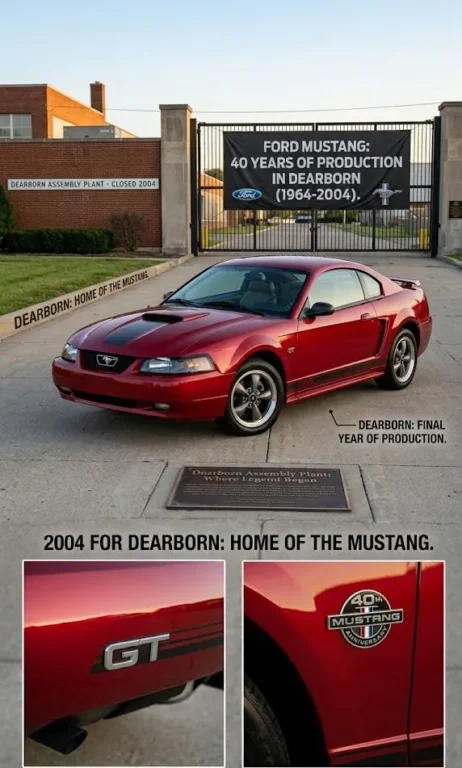
2004 was the final model year for the New Edge Mustang and carries specific historical significance. Marking the 40th Anniversary of the Mustang, Ford released all 2004 Mustangs with special 40th Anniversary badges on the fenders. A special 40th Anniversary package was also made available at the low price of $895 for both standard and GT editions. The Terminator Cobra continued with the addition of the Mystichrome color option and the 10th Anniversary SVT edition.
2004 was also the last year that Mustangs were built in their birthplace — Dearborn, Michigan. When production shifted to the new Flat Rock Assembly Plant in Michigan for the S197 generation in 2005, the Dearborn plant’s final product was the last New Edge Mustang off the line. As such, the 2004 models are especially coveted by collectors across the world and many ended up in personal collections or museums.
Section 5 – Independent Rear Suspension
The Engineering Decision That Changed The Mustang
One of the most significant engineering achievements of the New Edge era deserves its own discussion: the independent rear suspension introduced on the SVT Cobra in 1999.
For decades, the Mustang had used a solid rear axle — a live axle supported by leaf springs or, in later generations, a four-link setup. The solid axle was durable, simple, inexpensive to manufacture and repair, and beloved by drag racers who appreciated its predictable behavior under hard launches. It was also a suspension layout that handicapped the Mustang in cornering compared to European sports cars with independent rear arrangements.
The SVT Cobra’s independent rear suspension borrowed parts from the Lincoln Mark VIII — a parts-sharing solution that allowed Ford to introduce IRS without a dedicated development program budget. The IRS setup was a first for any regular production Mustang. The limited-production Cobra R models from 1995 had used IRS, but no regular catalog production Mustang had ever been so equipped.
The result was a Cobra that genuinely handled in corners rather than merely going fast in straight lines. The Mustang went from muscle car to sports car aspirations with a single engineering decision — and the Terminator Cobra’s 390-horsepower output through that independent rear suspension confirmed that the combination of American V8 power and genuine chassis sophistication was achievable within a reasonable price point.
The IRS created controversy with the traditional solid-axle enthusiast community — the same community that had resisted every handling improvement to the Mustang for decades. But the performance data and the driving experience consistently vindicated the decision. New Edge Cobras represent the first Mustangs with this suspension style — a distinction that all subsequent S197 and S550 Mustang Cobras benefit from in their own evolution.
The IRS debate that surrounded the New Edge SVT Cobra — enthusiasts arguing for the familiar live axle against engineers defending the IRS’s handling benefits — mirrors exactly the same conversation that defined the best performance cars of the muscle car era. Our complete guide to the 1969 Camaro SS covers how that era’s Z28 and SS models balanced straight-line performance and cornering capability at a time when the two were considered fundamentally incompatible.
Section 6 – The Collector Market
What New Edge Mustangs Are Worth Today
The New Edge Mustang occupies a specific and increasingly interesting position in collector car market — a car that is old enough (20-plus years) to be recognized as a genuine classic, accessible enough to remain within reach of enthusiasts who are not primarily collectors, and diverse enough in its special editions to support a range of collector interests from the affordable GT to the six-figure Terminator.
Standard V6 And GT Values
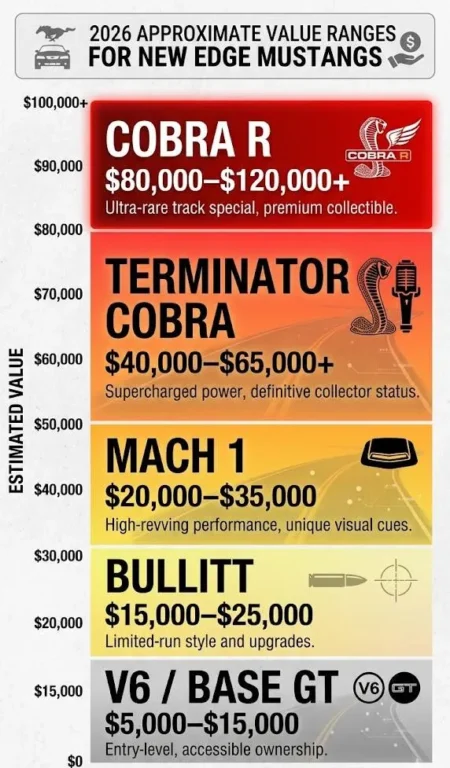
The 1999 Mustang GT holds its value well. Getting up there in age, now at 27 years old for a first-year New Edge, the Mustang is gaining steam in the collector car market as an affordable and easily modifiable classic pony car. Kelley Blue Book private party resale values for the 1999 Mustang GT range from $4,000 to $8,000 depending on mileage in fair to good condition. For a Mustang GT in excellent condition, one could expect to pay between $10,000 and $15,000 for a privately sold model. Prices can go up to $20,000 for a low-mileage or special model like the 35th Anniversary Edition in pristine condition.
Manual transmission cars command a premium over automatics in the New Edge market, as they do across most classic Mustang segments. The V6’s collector value is lower than the GT’s for the same condition and mileage, but the V6 makes up for it in availability of affordable driver-quality examples.
A driver-quality New Edge GT at $8,000 is one of the most affordable V8 manual rear-wheel-drive cars available in any market — but insurance on a performance car with a specific collector value and enthusiast reputation is a different calculation from insuring a standard used car. Our guide to the cheapest car insurance companies covers how to find competitive rates for exactly this type of vehicle.
Bullitt Values (2001)
The Bullitt Mustang’s combination of cultural cachet, visual distinctiveness, and limited production of approximately 6,500 units makes it a premium above equivalent GT spec in original condition. Clean, low-mileage Bullitts — particularly in Dark Highland Green — consistently sell above equivalent GT examples and have proven to hold value better than standard GT Mustangs of the same year. Documentation of original Bullitt equipment (specific intake, wheels, exhaust) is important for premium pricing.
Mach 1 Values (2003–2004)
The Mach 1 occupies an interesting middle ground — more power than the GT, less than the Cobra, and a specific visual identity that makes unmolested originals immediately recognizable. Production numbers for the Mach 1 are modest enough to keep values above equivalent-year GTs while remaining more accessible than Cobra pricing.
Terminator Cobra Values
The Terminator is where the New Edge collector market gets serious. Some low-mileage Terminator Cobras are now worth more than their original sticker price. The combination of 390 supercharged horsepower, the Tremec T-56 six-speed manual, IRS, and a production run short enough to create genuine scarcity has pushed documented, low-mileage Terminators into the realm of legitimate performance car investments.
Mystichrome Terminators, 10th Anniversary editions, and 2004 convertibles in documented original condition command the highest premiums. The Terminator’s iron block and forged rod engine, when properly maintained, is virtually indestructible — making low-mileage examples compelling both as driver cars and as collector pieces.
2000 Cobra R Values
The Cobra R is a dedicated track car that was sold with a racing license requirement and produced in a run of exactly 300 units, all in Performance Red. Every surviving example is known and tracked in the enthusiast community. Values for documented, unmodified Cobra Rs are significant and continue to appreciate as the car’s historical significance as both a performance benchmark and a production rarity becomes better understood.
FAQ
Q: What years are New Edge Mustangs?
A: The New Edge Mustang spans the 1999 through 2004 model years. The designation refers to the New Edge design language introduced by Ford in 1999, which replaced the softer, rounder styling of the 1994–1998 SN95 Mustang with a sharper, more angular body featuring intersecting creases and aggressive proportions. Despite the dramatically different appearance, the New Edge Mustang shares the SN95 platform and most of its mechanical architecture with the 1994–1998 generation.
Q: What is the difference between the SN95 and the New Edge Mustang?
A: The SN95 designation technically applies to the entire fourth-generation Mustang platform from 1994 through 2004. In enthusiast terminology, SN95 typically refers to the 1994–1998 body style, while New Edge refers specifically to the 1999–2004 body style. The New Edge used the same basic SN95 chassis but with a significantly redesigned body, improved engine outputs, and — on SVT Cobra models — the first independent rear suspension in regular-production Mustang history.
Q: What is a Terminator Mustang?
A: The Terminator is the nickname for the 2003–2004 SVT Cobra Mustang. Its nickname comes from its supercharged powerplant and exceptional performance. The car uses a 4.6-liter four-valve V8 with an Eaton supercharger, an iron block, and forged connecting rods, producing 390 horsepower and 390 lb-ft of torque. It was mated exclusively to a Tremec T-56 six-speed manual and featured independent rear suspension. The Terminator remains one of the most sought-after and valuable New Edge Mustangs in the collector market.
Q: Why was the 1999 SVT Cobra recalled?
A: All 1999 SVT Cobras were recalled because the cars were producing approximately 285 horsepower rather than the advertised 320 horsepower. Dyno testing by owners and shops revealed the discrepancy, which was traced to restrictive intake port geometry in the cylinder heads. Ford halted sales of unsold 1999 Cobras and recalled all sold examples in August 1999. Because of the recall and remediation program, Ford canceled the 2000 SVT Cobra — the regular production Cobra did not return until 2001.
Q: How many 2000 Cobra R Mustangs were made?
A: Exactly 300 2000 SVT Cobra R Mustangs were produced, all in Performance Red Clearcoat. The Cobra R was Ford’s answer to the absence of a regular 2000 SVT Cobra — a track-focused, race-ready vehicle equipped with a 5.4-liter DOHC V8 producing 385 horsepower, Brembo brakes, Bilstein suspension, no air conditioning, no radio, and no rear seat. Buyers were required to demonstrate racing credentials to purchase one.
Q: What is the Mach 1 Mustang and what makes it special?
A: The 2003–2004 Mach 1 is a special edition New Edge Mustang that revived the famous nameplate from 1969. It used the 4.6-liter DOHC four-valve V8 producing 305 horsepower with specific intake and exhaust modifications. Its defining visual feature is the functional “shaker” hood scoop — mounted directly to the engine’s intake manifold and protruding through the hood — which literally vibrated with engine movement when the car was revved. The Mach 1 also featured a matte-black hood stripe, period-correct graphics, and classic color options.
Q: What is the 2004 Mystichrome Mustang Cobra?
A: The 2004 Mystichrome Terminator Cobra is a special color option for the 2004 SVT Cobra that uses a color-shifting paint technology — similar to the Mystic paint available on 1996 Cobras — that changes apparent color based on lighting and viewing angle, cycling through blue, green, purple, and copper tones. Combined with the Terminator’s 390-horsepower supercharged V8, the Mystichrome Cobra is the most visually distinctive and most collector-coveted single New Edge Mustang configuration.
The Bottom Line
The New Edge Mustang ran for six years — 1999 through 2004 — and in those six years, it produced more drama, more headlines, more collector legends, and more genuine performance achievement than the eight preceding SN95 years combined. A recalled Cobra that didn’t make its advertised power. A Cobra R that required a racing license to buy. A Bullitt that understood that cinema matters. A shaker scoop that actually shook. And a Terminator that supercharged the platform into a genuine performance car of its era.
The New Edge Mustang has reached the threshold where the collector market is paying real attention. Driver-quality GTs start at $4,000 — some of the most affordable V8 rear-wheel-drive manual transmission cars available anywhere. Terminators with low miles and documentation are worth more than their original sticker prices. The Cobra R is essentially priceless in the sense that no rational collector is selling one for less than it will be worth in five more years.
The S197 generation that replaced it in 2005 went retro — back to the 1960s curves. The New Edge had done the opposite: it had gone forward, into a harder-edged, more angular aesthetic that aged in a way the designers could not have predicted when they penned it.
It looks correct in a way that many cars of its era do not. That is not an accident. That is what good design does. It outlasts the moment that produced it.
Editorial Note
This article was written and reviewed in April 2026. All engine specifications are sourced from LMR.com, AmericanMuscle.com, Steeda.com, and CJPonyParts.com, cross-referenced against Automobile-Catalog documented production data. The 1999 Cobra recall figures — 285 actual horsepower versus 320 advertised — are sourced from multiple period and contemporary accounts including Steeda.com and CJPonyParts.com. The 2000 Cobra R production number of 300 units is confirmed. The Bullitt production figure of approximately 6,500 units is sourced from CJPonyParts.com historical documentation. The 2004 Dearborn assembly plant closure information is confirmed by multiple sources. Collector values are sourced from CarBuzz, Kelley Blue Book, and market observation as of April 2026 and are subject to change.


0 Comments