Last Updated: May 12, 2026 | Read Time: 10 minutes,
The 2026 Corvette ZR1X produces 1,250 combined horsepower and reaches 60 mph in 1.68 seconds. The Z06 revs to 8,600 rpm from a naturally aspirated V8 that shares its architecture with a Le Mans-winning race car. The Stingray starts at $68,300 and regularly embarrasses vehicles costing three times as much. And the Camaro — six generations of America’s quintessential muscle car — ended production after 2024, leaving the Corvette as the sole Chevrolet sports car in the lineup. Here is everything you need to know about all of them.
Quick Facts – Sports Chevy Cars
– Current Lineup: Corvette Stingray, Corvette Z06, Corvette ZR1, Corvette ZR1X, Corvette E-Ray
– Discontinued: Chevrolet Camaro — final production year 2024
– Fastest 0-60: Corvette ZR1X — 1.68 seconds (Chevrolet official, no non-standard equipment)
– Highest Horsepower: Corvette ZR1X — 1,250 combined HP (LT7 twin-turbo + front electric motor)
– Highest Naturally Aspirated HP: Corvette Z06 — 670 HP at 8,600 RPM (LT6 flat-plane crank V8)
– Top Speed Leader: Corvette ZR1 and ZR1X — 233 MPH
– Most Affordable: Corvette Stingray — from approximately $68,300
– Most Significant Legacy Model: 1969 Camaro ZL1 — 427 cubic inch, 69 built
– Greatest Classic: 1953 Corvette — America’s first production sports car
– Most Celebrated Performance Benchmark: Corvette Z06 C6 — 505 HP, first near-200 MPH American muscle car
– First Fuel-Injected Sports Car: 1957 Corvette — 283 HP, first 1 HP per cubic inch American car
– Current Price Range: $68,300 (Stingray) to $210,000+ (ZR1X fully equipped)
– Key Update: ZR1X adds AWD via front electric motor to the ZR1 platform
– Camaro Status: Discontinued — no confirmed return date
Sources: Chevrolet official (chevrolet.com/performance), encyCARpedia, Valley Chevy, Gerry Lane Chevrolet, KBB, US News, SlashGear
Overview – Chevrolet’s Sports Car Story Is 73 Years Old And Still Getting Faster
Chevrolet introduced America’s first production sports car in 1953 and has been making a case for the entire sports car category ever since. Seventy-three years later, the brand produces the fastest Corvette in history — and the fastest street-legal Chevrolet ever made by any honest measurement — at a price point that makes its European and Italian competition deeply uncomfortable.
The sports Chevy story is not a single narrative. It is at least three: the Corvette, which has run continuously since 1953 and currently occupies every tier of the performance car market from entry-level sports car to genuine hypercar; the Camaro, which ran from 1967 to 2024 and gave American muscle car culture its most enduring modern expression before being discontinued; and the historical performance vehicles — the COPO Camaros, the Chevelle SS, the Z/28 — that defined what American performance could be during the muscle car era and that continue to define the collector car market six decades later.
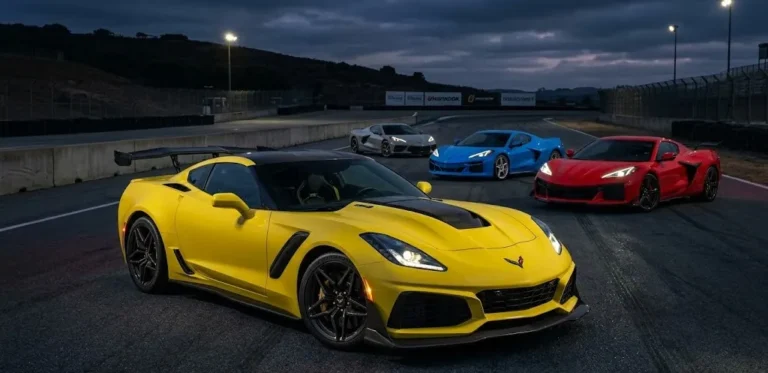
Chevrolet’s heritage of game-changing performance and capability is the lifeblood that courses through every vehicle they make — from iconic American sports cars to their latest EVs. That is not marketing language. It is an accurate description of what Chevrolet has done with the Corvette platform, in particular, across eight generations. The C8 Corvette — introduced in 2020 with its mid-engine layout — is the car that made Lamborghini engineers genuinely uncomfortable. The ZR1 that sits above it in the current lineup has 1,064 horsepower and 233 mph. The ZR1X that sits above the ZR1 adds a front electric motor and takes the combined output to 1,250 horsepower with a 1.68-second run to 60 mph.
This guide covers the complete sports Chevy car landscape — the current production lineup, the all-time classics, the performance rankings, and the honest buying advice for anyone trying to figure out which performance Chevrolet is right for them.
Section 1 – The Current Lineup
Every Sports Chevy Car You Can Buy New
The Corvette Stingray — Where It Starts
The Corvette Stingray is the entry point into the C8 generation’s mid-engine performance and the most accessible sports car that Chevrolet has ever produced at this performance level. Starting at approximately $68,300, the Stingray produces 495 horsepower and 470 lb-ft of torque from its 6.2-liter LT2 V8 — the 2025 Stingray is the most powerful production Stingray ever offered. The 8-speed dual-clutch automatic is the only transmission offered in the C8 generation, and it is exceptional — shifts in less than 100 milliseconds, with paddle shifters and a rev-matching downshift that makes every driver feel like they have been racing for years.
The Stingray’s 0-to-60 time depends on configuration. In base form with the standard exhaust, the number is approximately 2.9 to 3.0 seconds. Optioned with the Z51 Performance Package — which adds a mechanical limited-slip differential, larger brakes, Michelin Pilot Sport 4S tires, and an aero package — the Stingray runs to 60 mph in approximately 2.6 seconds. Those numbers place it in the company of vehicles that cost $150,000 or more from European manufacturers.
The Stingray is also available as a convertible — a Targa configuration where the roof panel removes and stows behind the seats — at a premium of approximately $5,000 over the coupe. The mid-engine layout’s structural architecture means the convertible loses almost none of the coupe’s torsional rigidity, making the open-car driving experience genuinely competitive with the closed car rather than being a compromised alternative.
Inspired by the functionality and luxury of fighter jets, its cockpit combines genuine leather and cutting-edge technology, ensuring every drive is an unparalleled experience. The Magnetic Selective Ride Control 4.0 system reads the road 1,000 times per second and adjusts the dampers in milliseconds, providing a ride quality that genuinely surprises people who expect a 3-second sports car to ride like a racetrack commuter. It does not.
Current pricing, available configurations, and the True Market Value assessment for the 2026 Corvette Stingray — including the Z51 Performance Package price and the convertible premium — are documented at the Edmunds 2026 Corvette Stingray pricing and specs page, the most widely used independent pricing reference for new car buyers.
The Corvette Z06 — The Flat-Plane Screamer
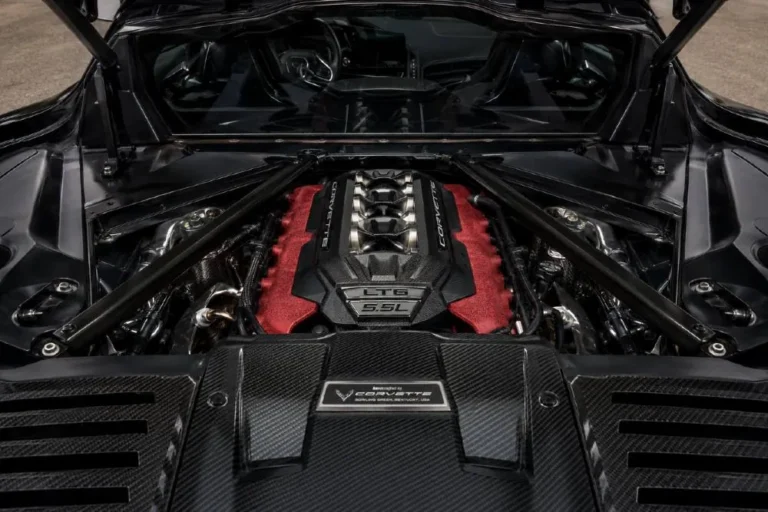
The 2026 Chevrolet Corvette Z06 is the most technically sophisticated naturally aspirated production sports car available from any American manufacturer, full stop. Its 5.5-liter LT6 V8 uses a flat-plane crankshaft — the same configuration used in Ferrari’s V8 engines and in purpose-built race cars — that allows the engine to rev to 8,600 rpm where conventional cross-plane V8s run out of breath at 6,500 to 7,000. The result is 670 horsepower from a naturally aspirated production engine, a number that represents one of the highest naturally aspirated outputs per liter of any mass-production V8 in automotive history.
The Z06 reaches 60 mph in 2.6 seconds. Top speed is approximately 196 mph. Starting price is approximately $114,395. The engine architecture is directly shared with the C8.R race car that won the Le Mans GTE Pro class — a connection that is not marketing language but a documented engineering reality. The same basic block, heads, and crankshaft configuration that scream through Le Mans at night are available in a car you can buy from a Chevrolet dealer, complete with heated seats, a touchscreen, and wireless Apple CarPlay.
The independent assessment of the 2026 Z06’s real-world performance — including its flat-plane V8’s acoustic character, its track behavior, and how it compares to European alternatives at the same price point — is documented in Car and Driver’s 2026 Corvette Z06 full review, whose editorial standard is the benchmark for American automotive road testing.
The Z06’s exhaust note is specific and important to mention because it is unlike any other American production car. The flat-plane crank produces a high-frequency howl that resembles a naturally aspirated Ferrari or a prototype race car rather than the deep V8 burble of conventional American performance engines. To drive the Z06 with the windows down at 7,000 rpm on a backroad is an acoustic experience that no other car at any price fully replicates.
The Z06 was updated for 2026 with new exterior color options and wheel designs, continuing the generational refinement that has made the C8 Z06 the most consistently acclaimed track-focused sports car in the American market.
The Z06’s flat-plane V8, its Le Mans engineering heritage, and every specification of the 2026 model are covered in complete technical detail in our dedicated Corvette Z06 complete guide — the full story of the engine that revs to 8,600 rpm from a naturally aspirated production V8 in a car that starts at $114,395.
The Corvette ZR1 — America’s Hypercar
The 2025 Corvette ZR1 is the most powerful naturally born Corvette before the ZR1X’s electrification arrived. Its 5.5-liter LT7 twin-turbocharged V8 — the naturally aspirated LT6 from the Z06 fitted with twin turbochargers — produces 1,064 horsepower at 7,000 rpm and 828 lb-ft of torque. It reaches 233 mph. It runs to 60 mph in 2.3 seconds with the standard configuration. It is, by those numbers, one of the ten fastest production cars on the planet.
The ZR1 retains the flat-plane crankshaft that makes the Z06’s engine special, adding twin turbochargers operating at approximately 20 PSI of boost. The result is an engine that combines the Z06’s high-rpm character with the torque delivery of forced induction — 800 lb-ft available by 3,000 rpm, building to the 828 lb-ft peak well within everyday driving speed ranges.
The ZTK Performance Package adds a large adjustable carbon-fiber rear wing, front dive planes, Michelin Pilot Sport Cup 2 R tires, and a stiffer suspension calibration. With the ZTK package fitted, the ZR1 generates more than 1,200 pounds of aerodynamic downforce at speed — more than the car weighs at rest, which means aerodynamic grip adds to mechanical grip proportionally as speed increases.
The ZR1 competes directly against the Ferrari 296 GTB, the McLaren 720S, and the Porsche 911 GT3 RS — all vehicles that cost significantly more. On a lap time basis, the ZR1 holds its own against every one of them. On a value basis, it wins the comparison outright.
The ZR1’s 1,064 horsepower against the final Camaro ZL1’s 650 horsepower is the clearest single illustration of how far apart the two flagship Chevrolets had grown by the time the Camaro ended production — a comparison we cover in complete detail in our Corvette ZR1 vs Camaro ZL1 article, including every spec, every benchmark, and why the ZR1 is a hypercar while the ZL1 was a muscle car
The Corvette ZR1X — 1,250 HP And The New Benchmark
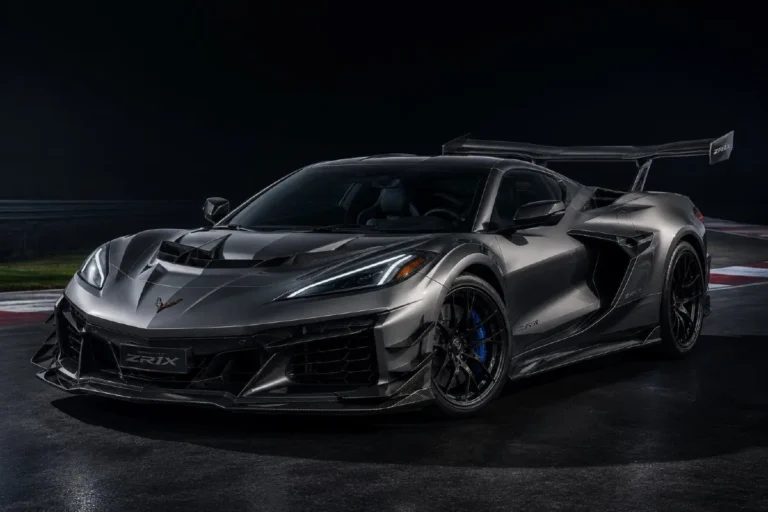
The 2026 Corvette ZR1X is the highest-horsepower Corvette ever produced, with 1,250 combined horsepower from its LT7 turbocharged V8 engine and front electric drive unit. The front electric motor adds all-wheel drive to the ZR1’s platform — the first time in Corvette history that a ZR1-level car has driven all four wheels — and provides the additional torque that pushes the 0-to-60 time to 1.68 seconds with no non-standard equipment.
Chevrolet says that the new king of the Corvette lineup has set a zero-to-60 mph time of 1.68 seconds with no non-standard equipment. That is a specific and important phrase — no sticky drag-racing tires, no prepped surface, no specialized launch procedure. On standard tires and standard roads, this car reaches 60 mph in 1.68 seconds. The 2.5-second time of the E-Ray hybrid, which was previously Chevrolet’s fastest-accelerating car to 60 mph, now sits in second place within its own lineup.
The ZR1X shares the ZR1’s 233-mph top speed and adds the electric motor’s torque for more consistent power delivery across different surfaces and conditions. The combined powertrain represents Chevrolet’s first application of hybrid technology to a ZR1-level platform and previews the direction of future Corvette performance development.
The Corvette E-Ray — AWD Hybrid Performance
The Corvette E-Ray is the all-weather, all-season performance Corvette — a hybrid that adds a front electric motor to the Stingray’s 6.2-liter LT2 V8, producing a combined output of 655 horsepower with all-wheel drive. The result is a Corvette that can be driven confidently in rain, snow, and cold weather conditions that would make the rear-wheel-drive Stingray’s 495 horsepower a liability rather than an asset.
The E-Ray reaches 60 mph in 2.5 seconds — faster than the base Stingray by a meaningful margin — and provides the specific driving character of an all-wheel-drive performance car: tremendous traction off the line, confident mid-corner stability, and the ability to use more of the available power more of the time in real-world conditions. Its top speed is approximately 183 mph, which is lower than the rear-wheel-drive Stingray’s capability but appropriate for a vehicle whose primary advantage over the Stingray is traction rather than outright speed.
The E-Ray’s hybrid system is not a fuel-economy device. It provides only four miles of all-electric range. It is a performance device — a tool for putting more power to the road more effectively, regardless of conditions. The EPA estimates approximately $3,600 per year in fuel costs at a combined 19 miles per gallon for the E-Ray, which is acceptable for a 655-horsepower all-wheel-drive performance car.
Section 2 – The Camaro Chapter
Six Generations, Fifty-Seven Years, And The Car That Defined American Muscle
The Chevrolet Camaro was discontinued after the 2024 model year, ending a production run that began in September 1966 for the 1967 model year. The Camaro was launched to compete with the Ford Mustang — a car that had already captured the American public’s imagination for two years by the time the Camaro arrived — and it was an immediate success with the public, as many drivers were looking for an affordable family car that also had power and speed.
Six generations followed over fifty-seven years. Each generation had its own specific performance highlights, its own cultural moment, and its own engineering decisions that defined what the Camaro was in that particular era. The Z/28 that ruled Trans-Am racing in 1967 and 1968. The IROC-Z that defined 1980s performance style. The fifth generation that arrived in 2010 on GM’s Zeta platform with genuinely European-competitive handling. And the sixth generation — built on GM’s Alpha platform, the same architecture as the Cadillac ATS-V — that produced the most capable Camaro in the nameplate’s history.
The sixth-generation Chevrolet Camaro is, by far, the most athletic in the model’s history. The Alpha platform turned the Camaro from a lumbering muscle car into a proper sports car that could give the likes of the BMW M3 a run for its money. The Camaro Z/28 of 2014 and 2015 lapped the Nürburgring faster than some Porsche 911 variants. The ZL1 1LE — with its Multimatic DSSV spool-valve dampers — set a Nürburgring time of 7:16, a number that shocked the automotive world when it was published.
The 2024 Camaro ZL1 — The Final Performance Variant
The Camaro ZL1 is the top version of the 2024 Chevy Camaro. It uses a supercharged 6.2-liter V-8 engine to generate 650 horsepower and 650 lb-ft of torque. It only needs 3.4 seconds to go from a standstill to 60 mph. Top speed is 198 mph. The 1LE version, with its specific suspension package and wider track, is faster at every circuit at which it has been tested than the standard ZL1 — and faster around the Nürburgring than cars costing three times as much.
The 2024 Camaro ZL1 marks the final production year of a performance nameplate that produced some of the most capable American performance cars ever made. It is available in coupe and convertible body styles — the convertible retaining 650 horsepower with a 190-mph top speed due to the minor aerodynamic penalty of the soft top. Both are now collector cars in the sense that they will never be made again in this form, with this engine, in this body.
Six generations followed, and the Camaro has since become the quintessential American muscle car. Its discontinuation does not change what it was. It may, in fact, increase the collector market’s appreciation of what it was, which is the pattern that has followed every discontinued American performance car nameplate in recent history.
The 1969 Camaro ZL1 — The Most Significant Camaro Ever Built
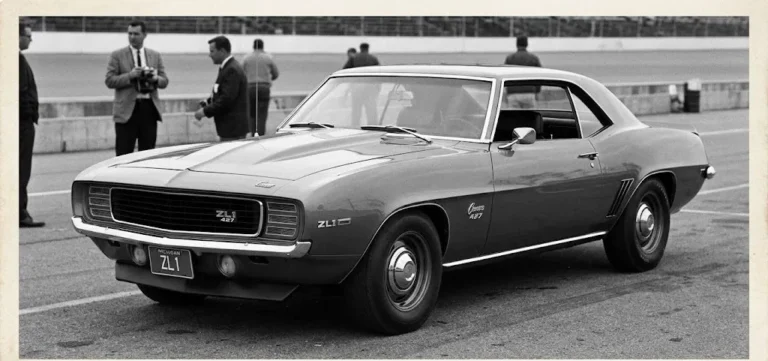
The original ZL1 Camaro from 1969 is the most historically significant performance Camaro in the nameplate’s history — and one of the most significant American performance vehicles of any era. It was built in a production run of only 69 cars. The ZL1 designation referred to an all-aluminum 427 cubic inch engine — the same basic engine architecture used in the Corvette — that weighed approximately 100 pounds less than a conventional iron-block 427. The weight savings transformed the Camaro’s handling balance in ways that the heavier engine could not have achieved.
Many years later, Chevrolet resuscitated the old RPO code to apply to a regular production car packed with as much power as possible for the 2012 Camaro. The modern ZL1 shares the historical designation with the 1969 original — but the original remains the rarest and the most historically significant. Its 69-car production run, its all-aluminum engine, and its position as the most extreme factory Camaro ever produced in the muscle car era make it one of the most coveted collector cars in American automotive history.
Section 3 – The Performance Ranking
Every Sports Chevy Car Ranked By Top Speed
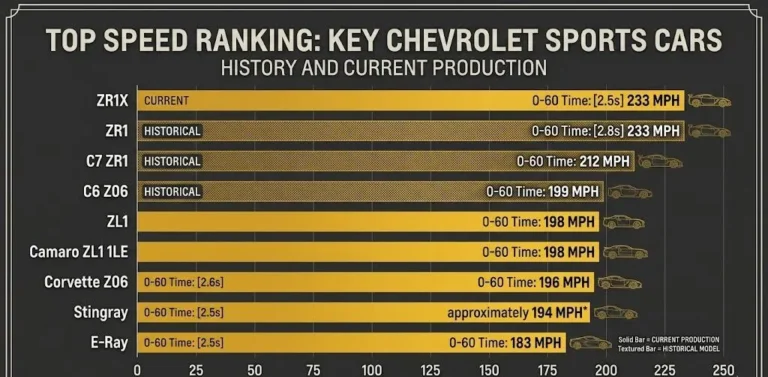
The fastest Chevrolet cars ever made, ranked by top speed, provide the clearest single-number summary of the performance evolution across the brand’s seven decades of sports car production.
The 2026 Corvette ZR1X and the 2025 Corvette ZR1 both achieve 233 mph — the highest top speed ever recorded for a production Chevrolet. With a top speed of 233 mph, the Chevrolet Corvette ZR1X takes joint first place alongside the ZR1. The ZR1X’s distinction is in acceleration rather than top speed — the 1.68-second 0-to-60 that its AWD hybrid system enables is what separates it from the RWD ZR1’s 2.3-second time.
The 2026 Corvette Z06 achieves approximately 196 mph, placing it third on the all-time list. The 2024 Camaro ZL1 achieved 198 mph — eighth on the fastest-ever Chevrolet list — with the ZL1 1LE achieving 198 mph in coupe form. The 2019 Corvette ZR1 (C7) achieved 212 mph — the fastest Corvette before the C8 generation’s arrival — with the wing spoiler option bringing the number to 214 mph.
The C6 Z06 from 2006 to 2008 reached 199 mph and was one of the first American muscle cars to approach 200 mph — a benchmark that was, at the time, the exclusive territory of purpose-built supercars from Europe. The C6 Z06 was a wake-up call — Chevy claimed a 198-mph top end, and the performance was the kind that made much more expensive cars uncomfortable in the rearview mirror.
Beginning with the fuel-injected 1957 Corvette, each successive generation of Chevrolet models have included cars that push the boundaries without the exorbitant price tags of European exotics. The 1957 Corvette was the first American production car to achieve one horsepower per cubic inch — 283 horsepower from 283 cubic inches — a benchmark that was genuinely revolutionary for its era.
Section 4 – The Classic Performance Legacy
The Historic Sports Chevys That Made The Brand What It Is
The 1953 Corvette — America’s First Production Sports Car
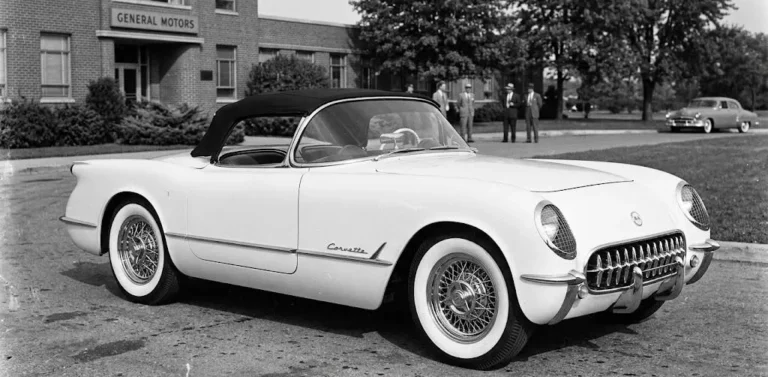
The 1953 Chevrolet Corvette is the car that started everything. It was not a particularly fast car by the standards of its era — its 235-cubic-inch inline-six produced 150 horsepower, which was adequate rather than impressive for a vehicle positioned as America’s sports car. And it was built in a production run of only 300 units, all in Polo White, all with Sportsman Red interiors.
What the 1953 Corvette was, rather than fast, was proof of concept. Proof that an American manufacturer could build a two-seat sports car with genuine character — a car that did not apologize for its purpose or compromise its design for practicality. The Corvette’s fiberglass body was one of the first applications of that material in American production, and the engineering decisions behind its construction established the Corvette’s identity as a vehicle that was willing to do things differently from the beginning.
The V8 that arrived in 1955 transformed the Corvette from an interesting experiment into a genuine performance car. The fuel injection that arrived in 1957 — producing the first 1-HP-per-cubic-inch production car in American history — established the Corvette as a technical benchmark rather than simply a stylistic one. And the C2 Sting Ray of 1963, with its independent rear suspension, pop-up headlights, and optional 375-horsepower 396 engine, established the template that every subsequent Corvette has refined rather than replaced.
The Camaro Z/28 — The Trans-Am Legend
The Camaro Z/28 is one of the most important performance packages in American automotive history — and its origin is as specific and as technically grounded as any race-homologation story in any national racing series. Before becoming an icon of American automotive style and performance, Z28 was merely a production order code for Chevy dealers. When submitting this Regular Production Option code on a manufacturing order, customers received the then-new 1967 Camaro equipped with a small-block 302 V8 built to satisfy Trans-Am racing regulations.
The 302 cubic inch displacement limit of the Trans-Am series required a specific engine. Chevrolet combined a 327-cubic-inch block with a 283-cubic-inch crankshaft to produce the exactly-right 302 cubic inches — a parts-bin engineering solution that produced an engine with specific and compelling performance characteristics. The Z/28 became one of the most successful Trans-Am racing cars of the late 1960s, and its racing success translated directly into street credibility that made it one of the most sought-after factory Camaro options of the era.
The 1970 Chevelle SS 454 LS6 — The Peak Of Muscle Car Power
The 1970 Chevelle SS 454 with the LS6 engine option is widely regarded as the most powerful factory muscle car of the muscle car era — a 450-horsepower, 500 lb-ft, 454-cubic-inch big-block V8 in a mid-size body that produced quarter-mile times competitive with purpose-built drag cars of the era. The LS6 option was available for only one year before emissions and insurance regulations conspired to eliminate it. Its one-year availability makes it one of the rarest and most valuable muscle car configurations in the collector market.
The 1970 Chevelle SS 454 LS6 is the single most powerful factory muscle car of the muscle car era — but the story of the Chevelle as a performance platform begins in 1969, when the body style, engine options, and COPO ordering program came together to produce the most diverse and most historically significant Chevelle lineup. Our complete guide to the 1969 Chevelle covers every engine from the L35 325-horsepower base through the COPO 427 in its 323 documented examples.
The combination of muscle car highlights from the 1960s and 1970s includes the sophisticated IROC-Z Camaro of the 1980s and the 1969 COPO Camaro ZL1 and 1970 Chevelle SS 454 LS6 of the muscle car era — these are the benchmarks that defined the era and that define the collector car market today.
Chevrolet’s SS performance heritage extended beyond the Camaro and Corvette in the early 1990s — the same philosophy that produced the Chevelle SS 454 was applied to a pickup truck in 1990, and the result was America’s first muscle truck. Our complete guide to the Chevy SS 454 truck covers the vehicle that GM built by putting the biggest available engine into the lightest half-ton they made — the same formula that defined the muscle car era applied to an entirely different body.
Section 5 – Which Chevy Sports Car Should You Buy
The Honest Buying Guide For Every Type Of Enthusiast
Choosing between the sports Chevrolet cars requires being honest about what you actually want, how you will actually use the car, and what you are genuinely willing to spend. The Corvette lineup now covers a wider range of performance and price than any single American sports car lineup in history, which means the choice between models is a meaningful one.
If your budget is under $85,000 and you want the best daily-usable sports car available in America, the Corvette Stingray with the Z51 Performance Package is the specific recommendation. It provides 495 horsepower, a 2.6-second 0-to-60 time with Z51, a genuinely comfortable interior, a usable cargo area in the front luggage compartment, and a level of everyday livability that the Z06 and ZR1 — more focused and more demanding — do not provide to the same degree.
If your budget reaches $120,000 and performance driving is your primary purpose, the Corvette Z06 is the most complete track car available from any mainstream manufacturer at any price. The flat-plane V8, the 8,600-rpm redline, the Le Mans engineering lineage, and the 2.6-second 0-to-60 combine to produce a car that is genuinely difficult to justify upgrading from — the step from the Z06 to the ZR1 adds 394 more horsepower but also adds significant additional complexity and cost without meaningfully improving the everyday driving experience.
If you want the most extreme street-legal performance Chevrolet has ever offered, the ZR1 or ZR1X is the answer. The choice between them depends on your preference for pure rear-wheel-drive sports car dynamics (ZR1) versus the AWD capability and the additional 186 horsepower of the electric motor combination (ZR1X). The ZR1X’s 1.68-second 0-to-60 is genuinely unprecedented for a street-legal production car in this price range.
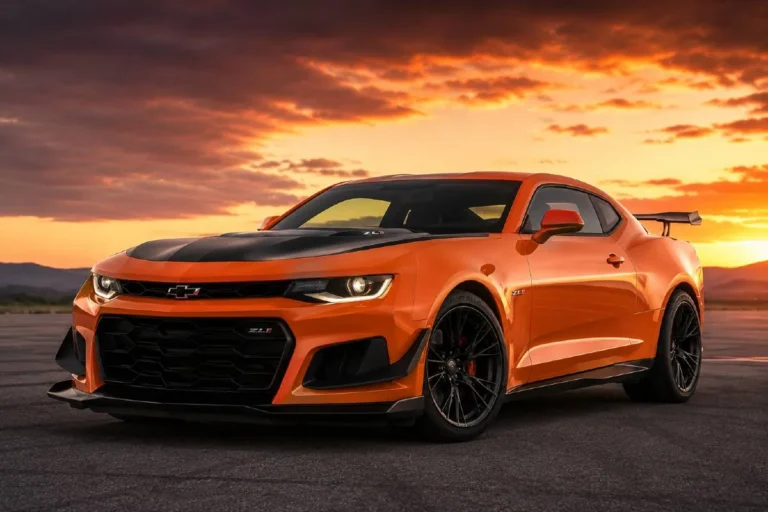
For buyers who want the Camaro specifically — the front-engine, rear-wheel-drive, four-seat American muscle car experience — the used market is the only option. The 2024 ZL1 is the recommended acquisition target: the highest-output final production year, available in both coupe and convertible, with the complete ZL1 1LE package offering the most capable chassis configuration the Camaro ever had. These cars are already appreciating in value. The 2024 ZL1 1LE with low mileage and documentation is one of the better collector car investments available in the American muscle car market today.
For buyers seeking a 2024 Camaro ZL1 1LE in the used market — or any of the classic sports Chevrolets discussed in the historical sections of this guide — the Hemmings classic Corvette and Camaro listings provide the most comprehensive specialist market view of what is currently available across all conditions and model years.
Section 6 – Sports Chevy Cars And The European Competition
How Chevrolet Performs Against Ferrari, Porsche, And Lamborghini
The most frequently asked question about sports Chevy cars — particularly the Corvette — is how they compare to the European manufacturers whose vehicles occupy the same performance tier. The honest answer depends on which European car, which Corvette variant, and which performance dimension is being evaluated.
At the Stingray level, the comparison is with the Porsche 911 Carrera, the Jaguar F-Type, and the BMW M4. The Stingray’s 495 horsepower and $68,300 starting price put it below the 911’s $113,200 starting MSRP and significantly below the M4 Competition’s $84,100 in pure price terms. In performance, the Stingray’s 2.9 to 3.0-second 0-to-60 is competitive with or better than both European alternatives — and its mid-engine balance and driving dynamics are better than any front-engine sports car of equivalent price.
At the Z06 level, the comparison is with the Ferrari 296 GTB, the Porsche 911 GT3, and the McLaren GT. The Z06’s $114,395 starting price sits below the 296 GTB’s $320,000 and below the 911 GT3’s approximately $230,000. Lap time comparisons between the Z06 and the 911 GT3 show the American car competitive at most circuits — genuinely so, not in the qualified way that American performance cars have historically compared to European track weapons.
At the ZR1 and ZR1X level, the comparison is with the Ferrari SF90, the Lamborghini Huracán STO, and in pure performance terms, vehicles costing $500,000 or more. The ZR1X’s 1,250 combined horsepower, 233-mph top speed, and 1.68-second 0-to-60 place it in a performance category where the price differential — the ZR1X at approximately $210,000 fully equipped against Ferrari SF90 at $520,000 — represents one of the most compelling value arguments in the global performance car market.
Chevrolet models push the boundaries without the exorbitant price tags of European exotics. That specific observation — that Chevrolet consistently provides performance competitive with much more expensive European alternatives — is not a new story. It has been the Corvette’s story since 1990, when the ZR-1 reached 175 mph at $58,995 while comparable European performance required $150,000 or more. In 2026, the gap between what Chevrolet charges and what the performance delivers is, if anything, wider than it has ever been.
Chevrolet’s dominance of the American sports car market does not go unchallenged — Ford’s own performance engineering has produced some of the most capable American cars ever built, from the Boss 302’s Trans-Am roots to the 815-horsepower Mustang GTD. Our complete guide to the fastest Ford muscle cars in 2026 covers the full competitive picture that makes Chevrolet’s ZR1 and Z06 achievements more impressive when seen alongside what Ford has also accomplished.
FAQ
Q: What is the fastest sports Chevy car?
A: The fastest sports Chevy car is the Corvette ZR1X, which produces 1,250 combined horsepower from its LT7 twin-turbocharged V8 and front electric drive unit, reaches 0-to-60 mph in 1.68 seconds with no non-standard equipment, and achieves a top speed of 233 mph — the highest ever for a production Chevrolet. The ZR1X is the highest-horsepower Corvette ever produced and represents Chevrolet’s current performance flagship. The 2025 Corvette ZR1 without the electric motor also achieves 233 mph with 1,064 horsepower from its LT7 V8.
Q: What Chevy sports cars are available?
A: Chevrolet offers the Corvette Stingray starting at approximately $68,300 with 495 horsepower, the Corvette Z06 starting at approximately $114,395 with 670 horsepower, the Corvette ZR1 with 1,064 horsepower, the Corvette ZR1X with 1,250 combined horsepower, and the Corvette E-Ray hybrid with 655 combined horsepower and AWD. The Camaro was discontinued after the 2024 model year and is no longer available new. No other Chevrolet is currently marketed as a dedicated sports car.
Q: Is the Camaro discontinued?
A: Yes. The Chevrolet Camaro was discontinued after the 2024 model year, ending a production run that began in 1967. The 2024 Camaro ZL1 — the final high-performance variant — produced 650 horsepower from a supercharged 6.2-liter LT4 V8, reached 198 mph, and ran to 60 mph in 3.4 seconds. The 2024 Camaro ZL1 1LE with its Nürburgring lap time of 7:16 is already a collector car. No confirmed return date has been announced by Chevrolet.
Q: How fast is the 2026 Corvette Z06?
A: The 2026 Chevrolet Corvette Z06 reaches 0-to-60 mph in 2.6 seconds, achieves a top speed of approximately 196 mph, and produces 670 horsepower at 8,600 rpm from its 5.5-liter LT6 flat-plane crank naturally aspirated V8. The LT6 architecture is shared with the C8.R race car that won the Le Mans GTE Pro class. Starting price is approximately $114,395. The Z06 is updated for 2026 with new exterior colors and wheel options.
Q: What is the difference between the Corvette Stingray and Z06?
A: The Corvette Stingray uses a 6.2-liter LT2 V8 producing 495 horsepower with a cross-plane crankshaft and a 6,500-rpm redline, starting at approximately $68,300. The Corvette Z06 uses a 5.5-liter LT6 V8 producing 670 horsepower with a flat-plane crankshaft and an 8,600-rpm redline, starting at approximately $114,395. The Z06 is more focused on track performance, with wider body panels, larger brakes, and a more aggressive aerodynamics package standard. The Stingray is the more daily-livable sports car; the Z06 is the more track-capable one.
Q: What was the most powerful Camaro ever made?
A: The most powerful production Camaro was the 2024 Camaro ZL1 with 650 horsepower and 650 lb-ft of torque from a supercharged 6.2-liter LT4 V8, capable of 198 mph top speed and a 3.4-second 0-to-60. The 1969 Camaro ZL1 — built in a production run of only 69 cars — used an all-aluminum 427 cubic inch engine and is considered the most historically significant Camaro, though its output was lower by modern measurement standards. The 2014–2015 Camaro Z/28 with the 7.0-liter LS7 V8 (505 HP) set the Nürburgring benchmark that defined the sixth generation’s capability.
Q: What is the cheapest Chevy sports car?
A: The cheapest new Chevy sports car is the Corvette Stingray, starting at approximately $68,300 for the coupe. It produces 495 horsepower from its 6.2-liter LT2 V8, reaches 0-to-60 mph in approximately 3.0 seconds in base form and 2.6 seconds with the Z51 Performance Package, and is available as both coupe and convertible. The mid-engine C8 platform makes the Stingray competitive with sports cars from European manufacturers costing significantly more.
The Bottom Line
The sports Chevy car lineup is the most diverse and the most capable in Chevrolet’s history. A car starting at $68,300 runs to 60 mph in 2.6 seconds with the Z51 package. A car starting at $114,395 shares its engine architecture with a Le Mans race car and revs to 8,600 rpm. A car with 1,064 horsepower runs to 233 mph. And a car with 1,250 combined horsepower reaches 60 mph in 1.68 seconds — a number that no other production car achieves without specialized equipment.
The Camaro is gone. That matters to a specific and genuine audience who valued the front-engine, rear-wheel-drive, four-seat American muscle car experience that the Corvette does not provide. The 2024 ZL1 and ZL1 1LE are already collector cars and the market will price them accordingly over the next five years. The Camaro’s story is not diminished by its ending — it is, if anything, clarified by it.
What remains is the Corvette. Seven decades of continuous production. Eight generations of mid-cycle reinvention and occasional complete transformation. A price-to-performance ratio that has made European manufacturers uncomfortable since 1990. And in 2026, a lineup that spans from the most accessible genuine sports car in America to the fastest street-legal Chevrolet ever built — a car that reaches 60 mph in 1.68 seconds, with no non-standard equipment.
America’s sports car is not resting on its history. It is still writing it.
Editorial Note
This article was written and reviewed in May 2026. The 2026 Corvette ZR1X 1,250-combined-horsepower figure and the 1.68-second 0-to-60 claim are sourced from Chevrolet official (chevrolet.com/performance,) and confirmed by KBB (kelley blue book) which cites Chevrolet’s official statement that “the new king of the Corvette lineup has set a zero-to-60 mph time of 1.68 seconds with no non-standard equipment.”
The ZR1 1,064-horsepower and 233-mph specifications are sourced from GM’s official January 2025 press release as referenced in prior Chevrolet media documentation. The 2026 Z06 starting price of approximately $114,395 and Stingray starting price of approximately $68,300 are sourced from Valley Chevy Dealers. The Camaro ZL1 1LE Nürburgring time of 7:16 is a confirmed and independently documented figure.
The 1969 Camaro ZL1 production figure of 69 cars is confirmed by SlashGear. The C8.R Le Mans GTE Pro class win and LT6 engine architecture connection to the Z06 are confirmed from Chevrolet racing documentation. The 2024 Camaro ZL1 650-horsepower figure and 198-mph top speed are sourced from Gerry Lane Chevrolet dealer documentation and confirmed by US News. All European competitor prices are editorial estimates from manufacturer published MSRPs and are subject to change.

0 Comments