Last Updated: October 27, 2026 | Read Time: 10 minutes
Ford produced 859 Boss 429 Mustangs for the 1969 model year, although some references cite 857; the discrepancy should be understood as a difference between source records or counting methods rather than silently treated as settled. The engine was too wide for the Mustang’s engine bay, so Ford worked with Kar Kraft to modify the front structure and complete the installation. Ford rated the engine at 375 horsepower and 450 lb-ft of torque. Claims that a completely stock engine produced approximately 500 hp are disputed and should not be treated as an established factory-output figure. A 1969 example reportedly sold for $550,000 at Barrett-Jackson Scottsdale in 2022; that historical sale is not a current valuation.
The 1969 Ford Mustang Boss 429 was built primarily to homologate Ford’s new 429 cubic-inch semi-hemispherical V8 engine for NASCAR competition. Under the applicable rules, a qualifying engine had to be installed in a minimum number of production cars made available to the public. Ford chose the Mustang as the platform, contracted Kar Kraft to make it fit, and produced 859 examples before the 1969 model year ended. The fact that these cars became some of the most distinctive and technically unusual Mustangs was a consequence of that racing objective. The purpose was racing. What the purpose produced was a legend.
In this guide: NASCAR homologation · Kar Kraft modifications · Engine specifications · Performance · Boss 302 comparison · Factory colors · 1969 vs. 1970 · Collector values · Authentication · Buying checklist
At A Glance – 1969 Ford Mustang Boss 429 Key Facts
| Item | Detail |
| Engine | 429 cubic-inch (7.0L) semi-hemispherical V8, known as the “Boss 429” |
| Factory rating | 375 hp and 450 lb-ft of torque |
| Estimated unrestricted output | Approximately 500 hp is a common expert estimate; it is not an official factory dyno figure. NHRA notes the NASCAR race engine was thought to make closer to 550 hp. |
| Transmission | 4-speed manual only |
| Drivetrain | Rear-wheel drive |
| Carburetor | 735-cfm Holley four-barrel |
| Induction | Aluminum high-riser intake manifold with ram air |
| Key engine features | Forged steel crankshaft, four-bolt main bearing caps, aluminum semi-hemispherical cylinder heads, staggered valves |
| 0–60 mph, stock, period test | 7.1 seconds |
| Quarter mile, stock, period test | 14.09 seconds |
| Top speed | Approximately 118 mph, depending on gearing, conditions, and preparation |
| Length | 187.4 inches |
| Width | 71.7 inches |
| Height | 50.6 inches |
| Wheelbase | 108 inches |
| Weight | Approximately 3,580–3,870 lb, varying by source, equipment, and measurement method |
| 1969 production | 859 units |
| 1970 production | 499 units |
| Total production | 1,358 units; some registries and auction references cite 1,359 when including a special one-off/LID car. |
| First production | Boss 429 production began in 1968 at Kar Kraft’s Brighton, Michigan facility. |
| Original price | Approximately $4,798; the Boss 429 option was listed at $1,208.35 over the base Mustang. |
| Modifier | Kar Kraft, Brighton, Michigan |
| Purpose | NASCAR homologation |
Source note: This guide draws on specialist histories, specification databases, valuation guides and auction reporting. These sources are not all primary sources. Disputed figures are attributed and qualified rather than presented as settled facts.
The Reason It Exists: NASCAR, Homologation, And The 429
The word homologation appears frequently in the story of the Boss 429, and it deserves a precise definition before anything else. In motorsport, homologation is the process by which a manufacturer proves that a race-legal component or vehicle configuration has been made available to the general public. NASCAR homologation rules required a qualifying engine to be installed in a minimum number of production cars available to the public; commonly cited accounts give a threshold of 500 cars. The applicable rule should be understood in its period-specific competition context rather than assumed to have applied identically to every class and year.
The 1969 Boss 429 Mustang is Ford’s NASCAR homologation special, a limited-production muscle car built to legalize the 429 cubic inch semi-hemispherical V8 for stock car racing.
The Boss 429’s NASCAR homologation purpose placed it in the specific tradition of American manufacturers building racing machinery with street car covers — the same tradition that Carroll Shelby had been pioneering since 1962. Our complete history of the first Shelby Cobra covers how Shelby used the AC Ace as a platform for American V8 racing ambition, establishing the formula that Ford’s own engineers were following when they contracted Kar Kraft to widen the Mustang’s engine bay for the 429.
Ford’s decision to use the Mustang as the homologation platform was a specific commercial and competitive calculation. After much consideration at Ford, the Mustang was selected as the platform to offer the highly modified motor in. The Mustang was Ford’s most visible performance car, and putting the Boss 429 engine in it served two purposes simultaneously: it satisfied the NASCAR production requirement and it gave Ford a street car with genuine racing credentials that could be sold at dealerships and driven home.
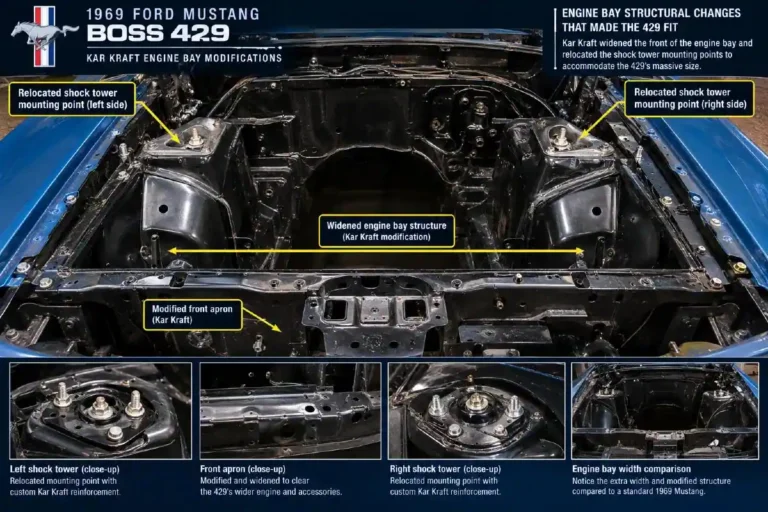
The enormous “semi-hemi” Boss 429 engine was so wide the Mustang’s engine compartment could not accommodate it. Ford contracted with Kar Kraft of Brighton, Michigan, to perform the modifications required. This is the detail that makes the Boss 429’s production story unlike virtually any other American muscle car. Ford did not simply install a different engine in an existing production car. Ford paid a separate specialty company to structurally modify each Mustang before the engine could go in — widening the engine bay, relocating components, and in some cases modifying front sheet metal to accommodate the 429’s exceptional width.
Production references commonly report 859 Boss 429 Mustangs for 1969 and 499 for 1970, while published combined totals vary between 1,358 and 1,359. The precise first-production date should be retained only when supported by a traceable production record.
The decision to build a street car specifically to legalize a racing engine — and to have that street car require so much specialist work that a third party had to be contracted for the modifications — is the founding story of one of the most valuable and most respected American muscle cars in existence. The Boss 429 was a homologation exercise. The homologation exercise became a legend.
Kar Kraft : The Company That Made It Possible
Every 1969 Ford Mustang Boss 429 that exists carries two identification numbers: the standard Ford VIN and a Kar Kraft serial number. The Kar Kraft number is not a detail. It is one of the primary authentication points that separates a genuine Boss 429 from the clones and tribute cars that have been built with the correct cosmetics but without the structural modifications that Kar Kraft performed.
Fitting a Boss 429 into a Mustang took quite a bit of modification, with significant changes to steering and suspension.
Kar Kraft’s work included modified front apron assemblies and changes to the Mustang’s front structure and related components to accommodate the engine. Specialist accounts also describe changes around the suspension and steering. Because the exact work can vary by description and production stage, an authentication inspection should compare the car with reliable Boss 429-specific reference material rather than rely on a single visual feature or a generic checklist.
Production began in 1968, with Kar Kraft front aprons being fitted to Boss 429s at the Ford Rouge plant during vehicle construction. The integration of Kar Kraft’s work into Ford’s own production process at the Rouge plant is a specific detail that communicates the depth of the manufacturing partnership — this was not an aftermarket modification performed on completed cars but a production step integrated into the manufacturing sequence.
The Kar Kraft serial number on each Boss 429 is documented in the specialty collector community, and authentication of a genuine Boss 429 begins with verifying this number alongside the Ford VIN. Buyers at any price tier above casual interest should treat the Kar Kraft number verification as non-negotiable — the absence of a verifiable Kar Kraft number on a claimed Boss 429 raises questions that no cosmetic authenticity can resolve.
The Engine: The 429 Semi-Hemi, Factory Ratings And Disputed Output
The Boss 429 engine is the reason 859 Mustangs were built with a third company’s modifications, and understanding it requires understanding both what it actually was and why Ford said it was something less.
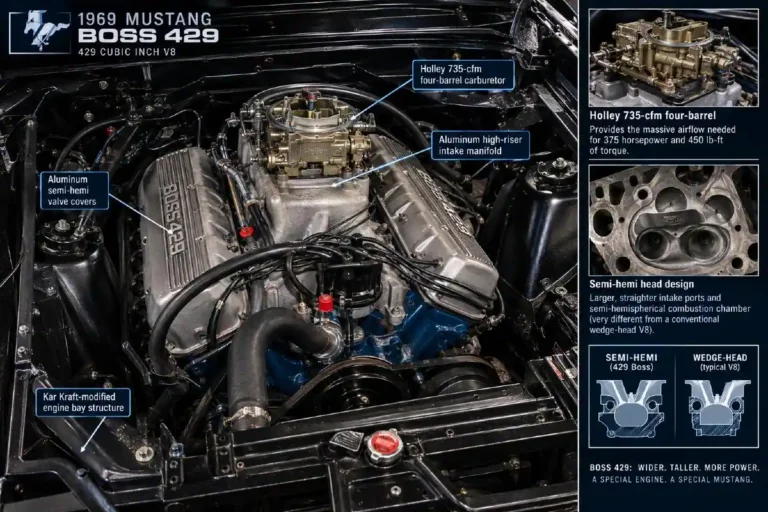
The Boss’ 429 cubic-inch V8 was nothing short of fire-breathing. This big-block featured a forged steel crankshaft, 4-bolt mains, and staggered valve aluminum heads that topped semi-hemispherical combustion chambers. This powerplant was also fitted with an aluminum high-riser intake and a 735-cfm Holley four-barrel carburetor with ram-air.
The semi-hemispherical or “crescent” combustion chamber differed from a conventional wedge-shaped chamber and was developed for the Boss 429’s racing aims. The precise combustion benefits depend on the complete engine design, including chamber shape, valve arrangement, compression, ignition and airflow; avoid reducing the advantage to spark-plug position alone.
The 4-bolt main bearing caps — versus the 2-bolt mains found in standard production engines — provided the additional crankshaft rigidity required for sustained high-RPM operation under racing conditions. The forged steel crankshaft was stronger than the cast iron cranks used in regular production engines. The aluminum cylinder heads reduced weight and improved heat dissipation. Every specification of the Boss 429 engine reflects its NASCAR design brief: this was a racing engine that Ford was also installing in street cars because the rules required it.
The Boss 429 was advertised at 375 bhp at 5,200 rpm and 450 lb-ft of torque at 3,400 rpm in commonly cited specification references. These are period gross ratings, not modern SAE net ratings.
Claims of approximately 500 hp are repeated in enthusiast coverage, but they should not be presented as a verified stock-engine result without a clearly documented test and configuration. A commonly cited 1970 Crane Cams test measured 352.0 bhp from a 1969 hydraulic-lifter engine with tubular headers substituted for the stock exhaust manifolds; this result is not directly comparable to a fully stock car or to every engine.
Modified Boss 429 engines can produce substantially different results depending on camshaft, induction, exhaust, ignition, internal condition and tuning. Claims of more than 500 hp should therefore identify the modifications and test method. Some secondary accounts criticize the factory street exhaust and emissions equipment, but those details should not be generalized to every car without model-specific documentation.
The central distinction is between the engine’s racing-oriented design, its factory street specification and the results possible after modification. The 375-bhp factory rating is documented; the claim that Ford deliberately chose it to suppress insurance costs is often repeated but requires stronger historical evidence before it can be stated as established fact. Buyers who changed induction or exhaust components could obtain different results, but those modified results should not be confused with stock output.
Insurance is frequently offered as one possible reason manufacturers advertised conservative horsepower figures during the muscle-car era. However, without direct documentary evidence from Ford or contemporary insurance records specific to this engine, it should be presented as a commonly repeated explanation rather than a proven reason for the Boss 429’s rating.
The complete 1969 Boss 429 engine specification — the forged steel crankshaft, 4-bolt main bearings, staggered valve aluminum heads topping semi-hemispherical combustion chambers, aluminum high-riser intake manifold, 735-cfm Holley four-barrel carburetor with ram-air, 375 HP official rating, and 450 lb-ft torque — is documented in mustangspecs.com’s 1969 Boss 429 ultimate guide, the primary technical reference for Boss 429 powertrain specifications.
The Mustang Body : What The 1969 The Right Platform
The 1969 Mustang used unitized (unibody) construction. Its existing front structure required substantial modification before the wide Boss 429 engine could be installed. The term “body-on-frame-adjacent” is not an accurate technical description of this construction.
The 1969 Mustang had grown significantly from the original 1964½ design — it was longer, wider, and more substantial than the car that had launched the pony car segment. This additional size gave the engine bay area that Kar Kraft needed to work with, even if the bay itself still required significant modification to accept the 429’s exceptional width.
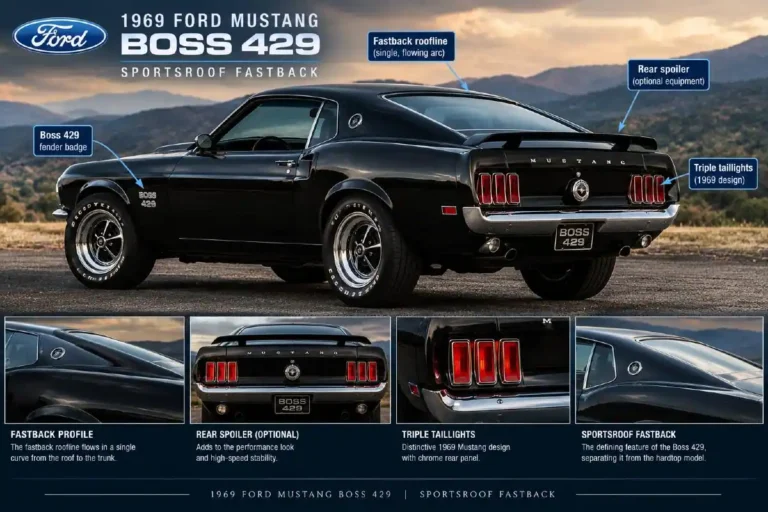
The fastback body style was the standard configuration for the Boss 429. The SportsRoof roofline — the fastback design that characterized the performance-oriented 1969 Mustang — gave the car its visual identity and established it as visually distinct from the standard hardtop and convertible Mustang configurations. The Boss 429 in fastback form looked exactly like what it was: a racing-derived vehicle in street clothing, with a visual presence that communicated purpose before the engine was started.
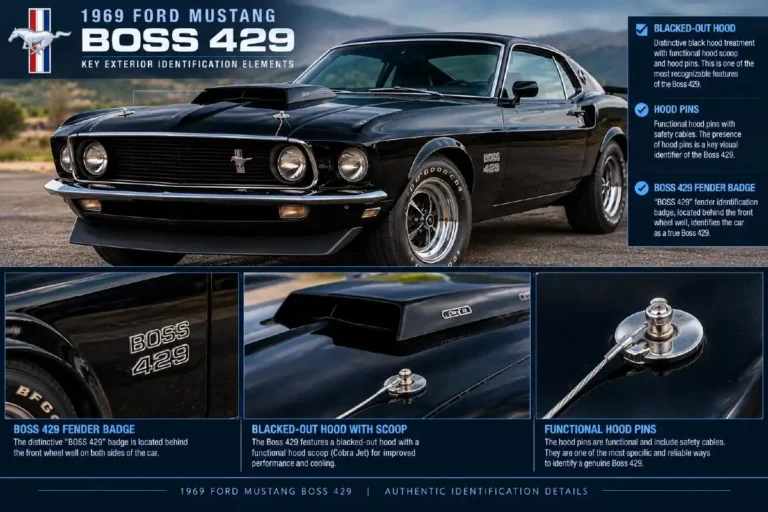
The Boss 429 had distinctive exterior details, including its large functional hood scoop, front spoiler, hood pins, striping and fender identification. Model-year details matter: descriptions of the scoop’s finish differ between 1969 and 1970, so do not describe the 1969 hood as blacked-out without a model-specific source.
Performance : What The Numbers Actually Mean
The 1969 Boss 429’s published performance figures require context because the factory-installed restrictions mean the car’s actual capability was not fully represented by its as-delivered performance.
| Measurement | Stock / period-test result | Context |
| 0–60 mph | 6.5 seconds | Period road-test result. |
| 0–100 mph | 13.6 seconds | Period road-test result. |
| Quarter mile | 14.09 seconds | Period road-test result. |
| Top speed | Approximately 118 mph | Varies by gearing, conditions, and preparation |
| Modern or modified estimates | 0–60 mph around 5.3–6.5 seconds; quarter mile around 13.3–14.0 seconds | These figures vary widely and should not be presented as factory-stock results without a documented test |
Published performance figures vary: some references report approximately 6.5 seconds from 0–60 mph and around 14 seconds for the quarter-mile, while other summaries quote quicker quarter-mile times. These figures should be treated as reported results rather than guaranteed performance. Differences in vehicle condition, gearing, tires, weather, driver technique, test method and modifications can produce substantial variation. Do not attribute a particular time to a fully stock car unless the source identifies the test conditions.
Approximately 118 mph is a commonly published top-speed figure, but it should be treated as a specification summary rather than a universal measured result. A causal claim that the factory exhaust alone set the top-speed limit requires a specific test or technical source. NASCAR engines also ran in different vehicles and racing configurations, so their performance should not be directly equated with a street Mustang.
What the factory figures communicate is the engine’s advertised output and the car’s intended character. The combination of a large-displacement V8, a four-speed manual transmission and rear-wheel drive made the Boss 429 a distinctive period performance car; claims about how it felt to drive should be attributed to named road tests or clearly presented as interpretation. The specific sensation of a 7.0-liter semi-hemi V8 at full throttle — the sound, the torque, the rate at which the speedometer climbed — was not diminished by the factory restrictions. It was merely limited, which is a different condition from being suppressed.
The Boss 429 competed not only against Mopar muscle but against the entire American performance establishment — including the Corvette, which made its own case for American performance through a completely different engineering philosophy. Our complete guide to the 1964 Corvette Stingray covers the C2 generation’s L84 fuel-injected 375 HP small-block, showing how Chevrolet was making comparable power from 4.2 fewer liters at the same time Ford was building the Boss 429’s 7.0-liter solution to the same performance question.
The Boss 429 VS The Boss 302: Two Philosophies, One Model Year
The 1969 Mustang Boss lineup offered buyers two completely different performance philosophies in the same model year, and understanding the difference between them is essential for understanding what the Boss 429 specifically was.
The Boss 429’s primary muscle car competition in 1969 came from Chrysler’s B-body program — the same 426 Street Hemi that was available in the Dodge Charger R/T was the direct rival that the Boss 429’s semi-hemispherical design was competing against both on the street and on NASCAR ovals. Our complete 1970 Dodge Charger guide covers the competing Hemi program in full, including why Chrysler’s approach to the hemispherical combustion chamber produced the specific rivalry that drove Ford to develop the Boss 429 in the first place.
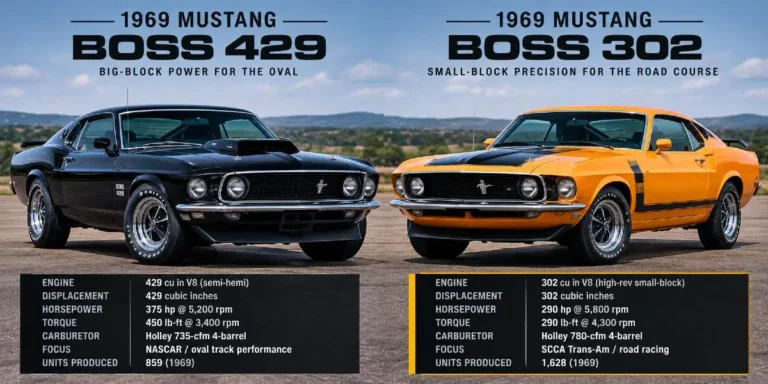
The Boss 302 was a high-revving small-block designed for road racing and Trans-Am competition. Its 302 cubic inch V8 produced 290 horsepower from a high-winding engine that made its power at the top of the RPM range. It was lightweight, nimble, and optimized for circuit racing — the kind of performance car that corner exit speed defined rather than straight-line acceleration.
Published figures commonly cite 1,934 Boss 302s and either 857 or 859 Boss 429s for 1969; the exact Boss 429 count varies by source. Historical pricing also varies by how the base car and package costs are counted. The Boss 302 V-8 cost $676.15, while a Boss 429 Cobra Jet HO would set you back a whopping $1,208.35.
The package-price difference tells part of the story: the cited Boss 429 package price of $1,208.35 was $532.20 higher than the cited $676.15 Boss 302 package price. The total cars’ original prices differed by a different amount, depending on the base-car and option figures used. The premium reflected the cost and complexity of fitting a race-derived big-block into a pony car body. But the performance character difference was more significant than the price difference. The Boss 429 was a drag strip and oval track weapon.
The Boss 302 was a road racer. Both wore Boss badges and shared the 1969 Mustang body. They were built for different competitions and produced different driving experiences. The Boss 302’s higher production volume made it less rare than the Boss 429. The Boss 429 was the more expensive purchase, but which model is more desirable depends on a collector’s priorities, the condition and originality of the individual car, and the quality of its documentation.
| Feature | Boss 302 | Boss 429 |
| Primary competition focus | Trans-Am / road racing | NASCAR / oval-track homologation |
| Engine | 302 cubic-inch small-block V8 | 429 cubic-inch semi-hemispherical big-block V8 |
| Factory rating | 290 hp | 375 hp |
| Character | High-revving, lighter, road-race oriented | Torque-heavy, large-displacement, straight-line and oval-track oriented |
| 1969 production | 1,934 units | 859 units |
| Original price | $3,450 | $4,798 |
| Collector position | Highly desirable Trans-Am homologation car | Rarer, more valuable NASCAR homologation car |
The Colors And Options: What 1969 Buyers Could Choose
Specialist summaries commonly list five exterior colors for the 1969 Boss 429: Raven Black, Wimbledon White, Royal Maroon, Candyapple Red and Black Jade. The broader 1969 Mustang color palette should not be mistaken for the Boss 429-specific palette. Exact paint names and codes should be checked against a model-specific production record or authoritative Ford documentation.
The verified color list is more useful to prospective buyers than broad comparisons of brand styling philosophy. For an original-car inspection, compare the current paint with the factory color recorded in the vehicle’s production documentation and check for evidence of repainting or color changes.
The transmission was not a choice. The 4-speed manual was the only available option for the Boss 429 — there was no automatic transmission offered. This was both an honest reflection of the car’s racing purpose and a practical necessity given the engine’s power output and the driving engagement that the Boss identity implied. A buyer who wanted an automatic Mustang with a big engine had other options in the 1969 lineup. The Boss 429 buyer understood that choosing this car meant choosing the 4-speed.
The functional hood — with its locking hood pins, a design element borrowed directly from racing practice — was standard rather than cosmetic. The pins served a genuine purpose: keeping the hood secured at high speeds and providing rapid access to the engine for service. That these pins also communicated racing credibility visually was a fortunate alignment of function and aesthetics rather than a styling decision prioritized over utility.
1969 VS 1970 : The Two-Year Production Story
However, sales started to drop off for the 1970 Boss 429 Mustangs and with higher production costs and other internal Ford problems, it was decided that 1970 would be the last year of the Boss 429. From day one, the Boss 429 was a unicorn. Ford only built 859 units in 1969, with another 499 rolling out in 1970.
The 1969 engine used hydraulic lifters; the 1970 version switched to solid lifters, among other changes. A commonly cited Crane Cams test measured 352.0 bhp for a 1969 hydraulic-lifter engine with tubular headers and 366.5 bhp for a 1970 solid-lifter engine, both at 5,500 rpm. These figures describe the tested engines and setup; they do not prove that every 1969 engine produced more than its official rating or that the two cars were tested in fully stock form.
Detail | 1969 Boss 429 | 1970 Boss 429 |
|---|---|---|
Reported production | 859 in several references; some cite 857 | 499 in commonly cited references |
Valve-lifter design | Hydraulic lifters | Solid/mechanical lifters |
Factory-advertised output | 375 bhp and 450 lb-ft gross torque commonly cited | 375 bhp and 450 lb-ft gross torque commonly cited |
Exterior details | Model-year-specific scoop finish and trim | Model-year-specific scoop finish and trim |
Authentication | Verify the individual car against its own records | Verify the individual car against its own records |
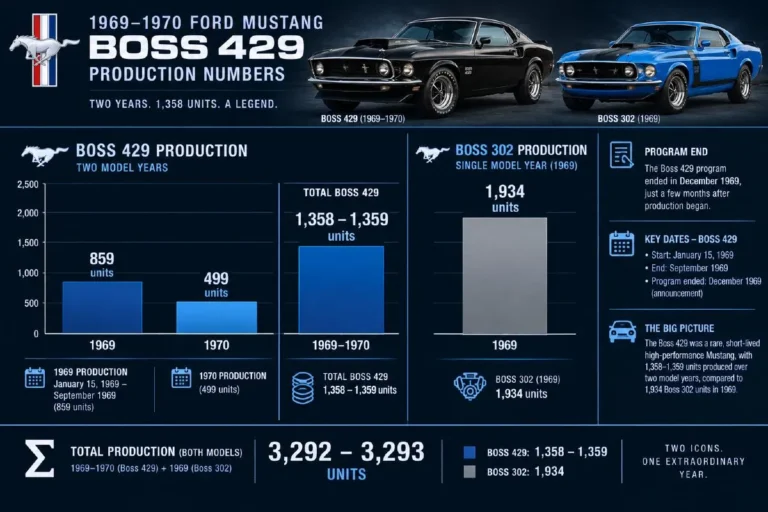
The 1969 is often especially appealing to collectors because it was the first model year, but desirability varies by buyer and by the originality, condition and documentation of each car. Combined production is commonly reported as 1,358 or 1,359; the difference should be attributed to source records rather than presented as a settled single figure.
The Collector Market : What The Boss 429 Is Worth
The 1969 Boss 429 occupies a high-value segment of the classic muscle-car market, where originality, condition and documentation can materially affect price. Not every surviving example is publicly tracked or fully authenticated, so buyers should evaluate each car individually and avoid assuming that a model’s rarity guarantees a particular value.
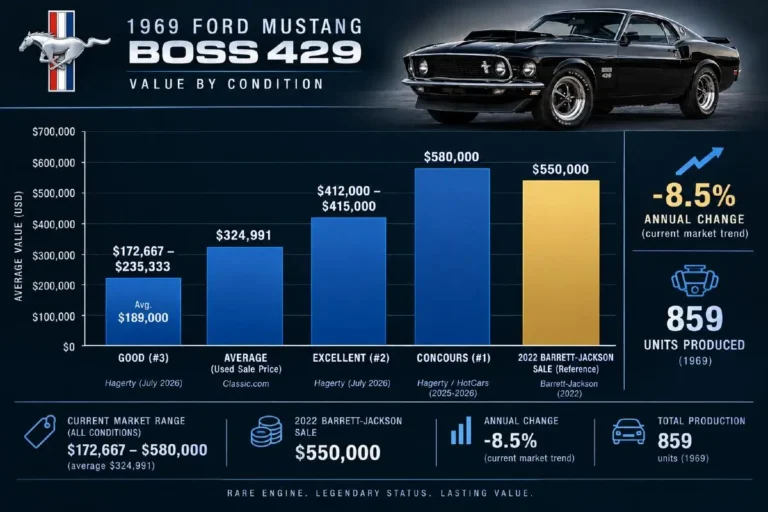
A July 2026 valuation snapshot attributed to Hagerty reported a Good (#3) condition range of roughly $173,000–$235,000, with a midpoint near $189,000. These are dated guide estimates, not transaction prices.
The 1969 Boss 429’s $580,000 Concours valuation from Hagerty’s July 2026 data places it in the same price tier explored in our complete guide to the most expensive American cars — where the Cadillac Celestiq starts at $400,000 and the Hennessey Venom F5 reaches $2.1 million. The Boss 429 is the rare case where a 1969 American production car commands pricing that overlaps with the most expensive cars.
An early-2025 third-party report cited estimates of roughly $412,000–$415,000 for Excellent (#2) examples and about $580,000 for Concours (#1) examples. Those are dated guide estimates, not guaranteed sale prices; verify the original valuation source and its methodology before republishing them as current. A Classic.com average is meaningful only when its date range, sample size and definition of “average” are stated.
The $580,000 Concours condition valuation, the approximately $412,000 to $415,000 Excellent condition value, the $324,991 average used selling price from Classic.com, and the characterization of the Boss 429 as ‘the Mustang equivalent of fine art’ are from HotCars’ 1969 Boss 429 current value report, published early 2025 and the most recent comprehensive valuation survey available for the model.”
Do not attribute HotCars valuation figures to Revology: the two pages serve different purposes. Revology is a specialist reference for production information, while the quoted condition-based estimates were attributed in the source notes to a HotCars report.
If the quoted percentage changes are confirmed on the dated valuation page, they suggest that the guide’s assessed value had declined over the stated period. They do not by themselves establish the direction of every Boss 429 transaction or predict future prices. The reported $550,000 Barrett-Jackson result is a single historical sale; compare it with other completed sales and account for condition, originality, fees and sale venue before drawing market-wide conclusions.
The original production total is finite, but rarity alone does not guarantee appreciation or liquidity. The number of surviving, documented cars is not established here, and future demand can change. Buyers should assess condition, provenance, maintenance needs, transaction costs and personal affordability rather than treating scarcity as an investment guarantee.
2022 Barrett-Jackson Auction (Scottsdale): A fully restored 1969 Mustang Boss 429 sold for $550,000.
Authentication : How To Verify A Genuine Boss 429
The value levels documented in this article create an obvious incentive for fraud — a standard 1969 Mustang with the correct cosmetics and a 429 engine installed by a subsequent owner could be misrepresented as an original Boss 429 to buyers who do not know what to check. Authentication is not optional at any price tier above casual interest. The primary authentication documents and evidence for a genuine 1969 Boss 429 are specific and non-substitutable.
A Marti Report is an important tool for checking a Ford’s original production data. It can help confirm the vehicle’s recorded configuration, engine code, color and options, depending on the report and available records. For a claimed Boss 429, check that the report corresponds to the exact VIN and that the recorded configuration is consistent with the car. A report is important evidence, but it is not a substitute for inspecting the vehicle and verifying all identification details.
The Kar Kraft identification number is another important authentication clue distinct from the Ford VIN. Record its location and format, then compare it with reliable Boss 429-specific references and available records. Do not assume that the presence of a number alone proves authenticity; its consistency with the VIN, production documentation and physical modifications matters.
The engine stamp is the third authentication element. Ford stamped a partial VIN on each engine block at the factory, and this partial VIN should correspond to the car’s VIN for a numbers-matching example. An engine transplant — even a correct Boss 429 engine from another car — will not produce a matching engine stamp.
The physical evidence of the Kar Kraft-related front-structure work should be inspected by a specialist familiar with genuine Boss 429s. Do not rely on a single feature, because repairs and restorations can alter visible details. An experienced appraiser should compare the structure, identification numbers, production documentation and engine details together.
The Marti Report — produced by Marti Auto Works using Ford’s original production data — is the essential first step in authenticating any 1969 Boss 429. A genuine Boss 429 will show the Z-Code engine designation and the Boss 429 package in its production data, and Marti Auto Works Ford build records provide this authentication for any Ford product from the 1967-2002 production database.
The Boss 429 In Popular Culture
The 1969 Boss 429 has maintained cultural presence across five decades through specific appearances that introduced it to audiences beyond the muscle car enthusiast community.
The specific rivalry between Ford’s Boss 429 semi-hemi and Chrysler’s 426 Street Hemi in 1969 is the direct historical precedent for the muscle car competition that continued through every subsequent decade — including the modern era covered in our complete Dodge Challenger guide, where the supercharged 6.2-liter HEMI in the Challenger SRT Hellcat is the direct philosophical descendant of the same engine philosophy that the Boss 429’s semi-hemi was built to challenge.
The Mustang associated with the John Wick films is often described in enthusiast coverage as a 1969 Boss 429. However, a film car’s appearance or badge alone does not establish that it was an authentic factory Boss 429. Unless production documentation confirms the exact vehicle, describe it as a Mustang portrayed or identified as a Boss 429 rather than asserting that the film used a genuine, numbers-matching example.
The Boss 429 also appears regularly in automotive film and television productions specifically because its combination of visual presence, historical significance, and inherent rarity creates exactly the kind of vehicle that communicates extraordinary character. A Boss 429 on screen is not simply a fast Mustang. It is a car with a specific story that knowledgeable viewers recognize immediately.
The model also appears in scale-model collections, die-cast reproductions and automotive simulation games, extending its recognition beyond the full-size collector market. Specific sales-performance claims for individual toy or model versions would require current retailer or manufacturer data.
Buying A 1969 Boss 429
Buying a 1969 Boss 429 requires careful preparation because the model is valuable, rare and susceptible to misrepresentation. A purchase decision should be based on documentation, physical inspection, condition and comparable completed sales—not rarity claims alone.
Do not treat any budget band as a guarantee of what is currently available. A car in a particular price range is not necessarily authentic because it comes with a report, and a report should be checked against the VIN and the vehicle itself. Compare current listings and completed sales, then have a Boss 429 specialist verify the car’s identity, configuration, condition and restoration history.
For higher-priced examples, seek consistent documentation, matching engine identification where applicable, credible restoration records, a verified production report and an independent inspection. Do not describe the model as “liquid” or promise investment performance without transaction data demonstrating typical time-to-sale and realized prices.
If a current valuation guide confirms a decline, that information can help frame negotiations, but it cannot reliably predict the next price movement. Buyers should compare recent transactions and the condition of the specific car. Purchase timing should reflect the buyer’s budget and ownership goals rather than a forecast based solely on limited supply.
Pre-purchase inspection for any Boss 429 should include a Marti Report verification, an in-person inspection by a Boss 429 specialist, a complete engine bay assessment by someone experienced with Kar Kraft modifications, and an independent appraisal by a specialist with documented Boss 429 transaction history.
Pre-Purchase Checklist
** Match the VIN on the car to the title, production report and all available paperwork.
** Verify the recorded factory configuration and paint color against a Marti Report or other credible production documentation.
** Have the engine identification and partial VIN stamps examined by a qualified specialist; determine whether the engine is original to the car.
** Inspect the Kar Kraft identification and front-structure modifications against model-specific references.
** Review restoration invoices, ownership history, accident repairs and any changes from factory specification.
** Obtain an independent inspection and appraisal, and compare the asking price with recent completed sales of similarly documented cars.
** Budget for specialist maintenance, parts availability, insurance, storage, transport and transaction costs.
No single document or identifier proves authenticity on its own. The strongest case is a consistent match between records, numbers, physical construction and the car’s history.
FAQ
How many 1969 Ford Mustang Boss 429 were made?
Several specialist references report 859 Boss 429 Mustangs for 1969 and 499 for 1970; other sources cite 857 for 1969 or a combined total of 1,358 rather than 1,359. The exact first-production date of January 15, 1969 appears in secondary sources and should be confirmed against a traceable production record.
How much horsepower does a 1969 Boss 429 have?
Ford advertised the 1969 Boss 429 at 375 bhp and 450 lb-ft of torque. Claims of approximately 500 hp are disputed and should not be treated as a verified stock-engine figure. A frequently cited period test measured 352.0 bhp from a 1969 engine fitted with tubular headers, so test configuration matters. Insurance-cost explanations are often repeated, but need direct historical evidence before being stated as fact.
What is a 1969 Boss 429 worth?
A July 2026 Hagerty estimate cited for Good-condition cars was near $189,000; older third-party reports put Excellent examples around $412,000–$415,000 and Concours examples around $580,000. These are dated estimates, not verified current market prices. Check the valuation date, condition category and underlying sales data before relying on them. A guide estimate is not the same as a completed sale.
Why was the Boss 429 built?
The Boss 429 Mustang was built to homologate Ford’s 429 engine for NASCAR competition. Commonly cited accounts describe a 500-car production requirement. Ford selected the Mustang and worked with Kar Kraft to modify the front structure and install the engine; several references report 859 Mustangs for the 1969 model year.
What is Kar Kraft and why does it matter?
Kar Kraft was a Ford-associated specialty engineering and modification operation that worked on the Mustang’s front structure and installation process to accommodate the 429 engine. The exact modifications should be verified against Boss 429-specific technical references and the individual car. Each Boss 429 received a Kar Kraft serial number in addition to its Ford VIN, and this number is one of the primary authentication points for verifying a genuine Boss 429.
The Bottom Line
The 1969 Ford Mustang Boss 429 was not built to be a collector’s item. It was built because NASCAR required Ford to build it. The buyers who paid close to $4,800 for a Boss 429 in 1969 received a street-legal Mustang with a factory-rated 375-bhp racing-oriented engine. Its as-delivered performance should be distinguished from results achieved after exhaust, induction or other modifications.
What those buyers also acquired was a limited-production Mustang whose modern authentication requires careful comparison of factory records, identification numbers, physical construction and condition. A Marti Report and specialist inspection are valuable parts of that process, but neither should be treated as a substitute for examining the complete evidence.
The Boss 429’s market value reflects a combination of rarity, engineering history, originality, condition, documentation and buyer demand. Its NASCAR purpose and unusual installation process are central to its historical significance, but no single factor guarantees a particular sale price or future appreciation.
Ford built a limited run of Boss 429 Mustangs to satisfy a NASCAR homologation objective. The production requirement was a means to a racing end. The legend was not required. It arrived anyway.
Editorial Note
This article was revised on October 23, 2026. It synthesizes specialist histories, specification databases, valuation guides and auction reports. Not all cited sources are primary sources, and some historical details remain disputed. Prices and valuation-guide estimates are time-sensitive; check the linked source and its date before relying on them. No first-hand vehicle inspection or independent dyno test is claimed in this article.
Production figures — several specialist references report 859 units for 1969 and 499 for 1970; some sources cite 857 for 1969 or a combined total of 1,358 rather than 1,359. The exact first-production date should be confirmed against a traceable record.
Engine specifications (429 cu in, 7.0L, 375 HP factory rating, 450 lb-ft, forged steel crankshaft, 4-bolt mains, aluminum semi-hemi heads, 735-cfm Holley four-barrel, aluminum high-riser intake, ram-air) — mustangspecs.com 1969 Boss 429 Ultimate Guide and automobile-catalog.com 1969 Boss 429 specs.
Engine output — the factory-advertised figure is 375 bhp and 450 lb-ft gross torque in commonly cited specifications. The often-repeated approximately 500-hp claim is not presented here as a verified stock result. The cited Crane Cams test figures describe engines tested with tubular headers and should be read with that limitation.
Factory exhaust and emissions details — secondary sources discuss restrictions, but claims about their exact effects should be checked against period technical documentation and should not be generalized across all cars or engine configurations.
Collector values — the guide distinguishes a July 2026 Hagerty estimate and early-2025 third-party condition estimates from completed auction transactions. Recheck guide figures directly before presenting them as current values. The reported $550,000 Barrett-Jackson 2022 result is a historical sale and should be confirmed against the auction house’s archived lot record.
Original pricing ($4,798 total / $1,208.35 option cost) — Hagerty valuation page citing period documentation.
Boss 302 vs Boss 429 production and pricing comparison — Hagerty valuation page.
Kar Kraft modification details — cross-check specialist histories with original production documentation where available; Wikipedia is a secondary starting point, not a primary source.
Additional Reference Links
Ultimatecarpage: 1969–1970 Ford Mustang Boss 429 specifications
Mustang Attitude: 1969 Mustang engine data
Revology: Boss 429 production data
Hagerty: 1969 Ford Mustang Boss 429 valuation tool