Last Updated: September 26, 2026 | Read Time: 8 minutes
The 2026 Ford Ranger Raptor starts at $56,070 and comes with one engine, one cab configuration, and one mission: to deliver as much of the F-150 Raptor’s specific high-speed off-road capability as a midsize pickup platform can physically support. That mission succeeds more completely than it has any right to. The 3.0-liter twin-turbo V6 EcoBoost produces 405 horsepower and 430 lb-ft of torque. The FOX 2.5-inch Live Valve shocks adjust damping automatically in real time. The Watts-link rear suspension replaces the standard Ranger’s leaf springs with a geometry that keeps the rear axle centered under the truck at speed.
The ground clearance is 11.7 inches. There are seven selectable drive modes, and the one called Baja mode changes the truck’s personality dramatically by holding gears longer, sharpening throttle response, and reducing stability system intervention. Most trucks want you to slow down when the road gets rough. The Ranger Raptor almost feels like it wants the opposite. Here is the complete guide to what it is, what it does, and whether it is right for you.
Quick Answers – 2026 Ford Ranger Raptor
— Engine: 3.0-liter twin-turbocharged V6 EcoBoost — Raptor exclusive (not available on other Ranger trims)
— Output: 405 HP / 430 lb-ft torque
— Transmission: 10-speed automatic — standard
— Drivetrain: 4WD standard — standard on all Raptors
— Configuration: SuperCrew cab only / 5-foot bed
— 0-60 MPH: Approximately 5.2 to 5.8 seconds (independent tests, conditions dependent)
— Fuel Economy: 16 city / 18 highway (EPA estimated)
Suspension:
— Front: Forged aluminum double A-arm (independent)
— Rear: Watts-link with trailing arms (replaces standard leaf springs)
— Shocks: FOX Racing 2.5-inch Live Valve — all four corners — auto-adjusting damping
— Ground Clearance: 11.7 inches
— Approach Angle: 31 degrees
— Wheels: 17-inch beadlock-capable
— Tires: 33-inch BFGoodrich KO3 all-terrain (285/70R17)
— Towing: 5,510 lbs maximum when properly equipped
— Payload: 1,373 lbs maximum
— Seven Drive Modes: Normal, Sport, Slippery, Tow/Haul, Mud/Sand, Rock Crawl, Baja
— Locking Differentials: Front and rear electronic locking differentials standard
— Skid Plates: Heavy-duty front and rear underbody protection standard
— Starting MSRP: $56,070 (2026 — $1,000 increase over 2025)
— As-Tested Range: $58,000–$62,000 with common options
— Key Exterior: Bold FORD grille lettering / widened fenders / vented hood / dual rear exhaust / steel bumpers / fog lamps / LED taillights / zone lighting
— Key Interior: 12-inch vertical SYNC 4A touchscreen / leather-trimmed front bucket seats / 10-way power driver seat / 8-way passenger seat / Raptor-specific gauges
— Exclusive Color: Shelter Green Metallic (Raptor only)
— Position in Raptor Lineup: Below Bronco Raptor and F-150 Raptor in price
— US Market Debut: 2024 model year
— Competition: Chevrolet Colorado ZR2, Toyota Tacoma TRD Pro, RAM 1500 Classic (off-road builds)
Sources: Autoblog 2026 Ranger Raptor Review (May 18, 2026), CarPro 2026 Ranger Raptor Review (June 2, 2026), Ford.com official 2026 Ranger Raptor specifications (July 2026), Pacifico Ford specifications analysis (June 28, 2026), TopSpeed Ranger Raptor suspension analysis (July 2, 2026), Wendle Ford Ranger vs F-150 comparison (June 10, 2026).
Overview
The Raptor Name Scales Down More Completely Than Anyone Expected
The Ford Raptor formula is one of the most specific and most successful product concepts in American truck history. Take a production pickup platform, re-engineer the suspension with long-travel hardware and specialized dampers, widen the body to accommodate the wider track and bigger tires, tune the powertrain for performance rather than economy or maximum towing, add a specific mode that unlocks high-speed off-road capability, and price it at a premium that the specific buyer who wants this experience will pay without much negotiation.
That formula worked with the F-150 Raptor, and now Ford has successfully scaled it down into a midsize package that feels easier to live with every day while still delivering the personality that made the Raptor name famous. The affectionate “baby Raptor” description that some journalists have applied to the Ranger Raptor is accurate in size terms — the Ranger’s platform is meaningfully more compact than the F-150’s — but it undersells what the Raptor hardware delivers in that smaller package.
The 2026 Ranger Raptor is the third model year of the truck’s American market existence. Ford introduced the new-generation Ranger for 2024 alongside the Raptor variant’s American debut, and the 2025 and 2026 model years have carried forward essentially unchanged in mechanical specification — the most significant 2026 update is a $1,000 price increase and a new Shelter Green Metallic exclusive exterior color. For the specific buyer who wants the most capable midsize performance off-road truck available from an American manufacturer at a price below $60,000, the Ranger Raptor is the specific answer in 2026.
The Ranger Raptor occupies a specific position in the American truck market that is worth mapping before diving into its individual specifications — our complete guide to the best pickup trucks 2026 covers the full-size trucks that dominate American sales including the F-150, Ram 1500, and Silverado alongside every other significant American truck, providing the landscape context that shows where the Ranger Raptor’s midsize performance focus fits relative to the full-size alternatives that most truck buyers consider.
What this guide covers: the complete mechanical story behind the Raptor’s specific off-road capability, the seven drive modes and what each one actually does, the daily driving experience that the Raptor delivers alongside its trail credentials, the towing and payload reality that buyers need to understand honestly, the comparison against the Chevrolet Colorado ZR2 and the F-150 Raptor, and the honest buying decision that helps specific buyers determine whether the Raptor is the right midsize truck or whether a standard Ranger in a different trim provides better value for their specific use case.
Section 1 – The Engine
405 HP From A Twin-Turbo V6 That No Other Ranger Gets
The 2026 Ford Ranger Raptor uses a dedicated powertrain not available on other Ranger trims. The 3.0L twin-turbo V6 EcoBoost produces 405 hp and 430 lb-ft of torque — more than 90 horsepower above the standard Ranger’s available 2.7-liter V6 and more than 135 horsepower above the standard 2.3-liter four-cylinder. This is the specific powertrain choice that makes the Ranger Raptor a fundamentally different truck from the Ranger it shares styling cues with, not simply a Ranger with different shocks.
The 3.0L EcoBoost features an aluminum engine block and heads for lightweight durability, and the twin-turbo configuration provides the specific combination of low-RPM torque and sustained high-RPM output that high-speed off-road driving requires. When the Raptor is being pushed through a desert wash at 70 mph, the driver needs power that is available immediately in any gear — the 430 lb-ft of torque arriving at low RPM from the twin-turbo setup provides exactly that kind of always-available pulling force.
Independent tests place 0-60 mph acceleration between approximately 5.2 and 5.8 seconds, depending on conditions and surface grip. This performance positions the 2026 Ranger Raptor among the quickest midsize pickups currently available — quicker than the Toyota Tacoma TRD Pro and competitive with the Chevrolet Colorado ZR2 in straight-line acceleration, while producing meaningfully more power than either.
The 10-speed automatic transmission is the same unit that has proven itself across the Ford truck lineup in various configurations. It shifts smoothly in daily driving, holds gears appropriately when the driver is working through a technical trail section, and in Baja mode specifically holds gears longer and at higher RPM to keep the engine in its power band through the specific speed range where desert running happens. The transmission’s mapping changes across the seven drive modes in a way that is genuinely perceptible rather than simply theoretical.
Fuel economy of 16 city and 18 highway is the honest trade-off for 405 horsepower in a midsize truck. The Raptor’s dual-turbo V6 does not pretend to be an economy truck. For buyers whose primary concern is fuel cost, the standard Ranger’s 2.3-liter four-cylinder provides better efficiency without the Raptor’s specific off-road hardware. For buyers who want the Raptor’s specific capability, the fuel economy is an accepted operating cost.
Section 2 – The Suspension
Why The FOX Live Valve Shocks And Watts-Link Are The Raptor’s Most Important Specifications
The most revealing way to understand the 2026 Ford Ranger Raptor is to look at what Ford replaced rather than what they added. A standard Ranger uses a leaf-spring rear suspension, a robust and cost-effective setup found on the majority of midsize and full-size pickups. Leaf springs are durable and capable of handling significant payload, but they are fundamentally limited in how much suspension travel they allow and how predictably they manage at speed over irregular surfaces.
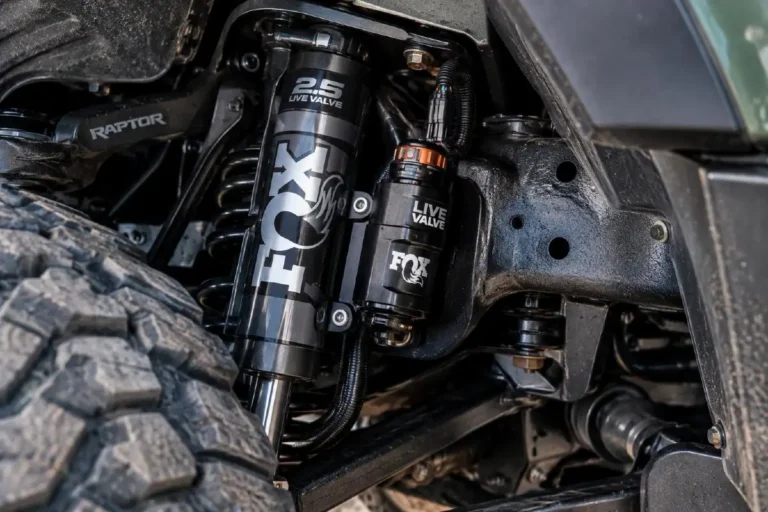
The Ranger Raptor replaces the leaf springs with a Watts-link rear suspension with trailing arms. This is a completely different engineering philosophy — the Watts linkage mechanically keeps the rear axle centered under the truck during vertical movement, reducing the lateral kick that leaf-spring rear ends produce when hitting bumps at speed. The result is a truck that tracks straight and true over rutted terrain at speeds that would have a leaf-spring truck hunting sideways and requiring constant steering correction.
Both ends are fitted with Fox Racing 2.5-inch Live Valve shocks that adjust damping automatically based on driving conditions, and the size matters. Larger-diameter shock absorbers have more oil volume, which means they resist fade better during prolonged abuse. In Normal mode they are comfortable; in Baja mode they stiffen to match high-speed demands without manual adjustment.
The practical driving experience that this hardware produces is the specific thing that separates the Raptor from every other midsize truck. What impressed me most on the Ranger Raptor was not that it could handle rough terrain — that is expected — it was how composed and confidence-inspiring it stayed doing it. Most trucks want you to slow down when the road gets rough.
The Ranger Raptor almost feels like it wants the opposite. On washboard surfaces, loose gravel, ruts, and uneven terrain, the faster I pushed it, the more planted and controlled it felt. Credit goes largely to the FOX Live Valve shocks, which are constantly adjusting in the background and do an outstanding job soaking up impacts without letting the truck get unsettled.
The forged aluminum double A-arm front suspension — independent rather than the solid front axle that some off-road trucks use — provides the specific combination of on-road steering precision and off-road travel that the Raptor’s dual-purpose mission requires. The front suspension geometry, combined with the Watts-link rear, produces a truck that is genuinely composed at highway speeds and genuinely capable at off-road speeds — a combination that neither a traditional solid-axle off-road truck nor a standard independent-suspension midsize truck fully achieves.
Ground clearance of 11.7 inches and a 31-degree approach angle are the specific geometric figures that communicate what terrain the Raptor can enter. The 31-degree approach angle means the Raptor’s steel front bumper reaches the obstacle at a steeper incline than almost any other midsize truck before the front valance contacts the terrain. The heavy-duty skid plates protect the underbody components when contact is unavoidable.
Section 3 – The Seven Drive Modes
What Each One Does And Which One You Will Actually Use
The 2026 Ranger Raptor’s seven selectable drive modes are not marketing features that change nothing measurable. Each mode adjusts throttle response, transmission mapping, steering calibration, and stability control thresholds in ways that are perceptible in driving. Understanding what each mode actually does is the most practical information for any Raptor buyer.
Normal mode is where the Ranger Raptor spends most of its life for most buyers. The FOX shocks are comfortable, the transmission shifts conventionally, and the overall driving experience is that of a refined midsize truck that happens to be slightly wider and slightly taller than a standard Ranger. On a typical daily commute or highway drive, Normal mode makes the Raptor’s specific hardware feel like a comfortable bonus rather than an intrusion.
Sport mode sharpens throttle response and adjusts the transmission for more aggressive gear holding — useful for highway passing, merging, and on-road performance driving where the 405 horsepower deserves access to the transmission’s full range without waiting for the standard shift mapping.
Slippery mode softens throttle response and adjusts stability control for low-traction surfaces — pavement in rain or light snow where gradual power delivery prevents the 430 lb-ft of torque from overwhelming traction.
Tow/Haul mode adjusts the transmission’s shift points for trailer use — earlier downshifts on descents, higher RPM holds on climbs, and the specific transmission behavior that reduces heat buildup under sustained towing conditions.
Mud/Sand mode adjusts wheel slip tolerance and transmission behavior for loose surfaces where some wheel spin is desirable for forward momentum rather than a condition to be controlled.
Rock Crawl mode reduces speeds and provides maximum mechanical traction through the locking differentials, low transfer case ratio, and specific stability control calibration for technical slow-speed terrain. The combination of front and rear electronic locking differentials with Rock Crawl mode provides genuine technical capability for rocky terrain that high-speed desert runners do not require but that trail users encounter regularly.
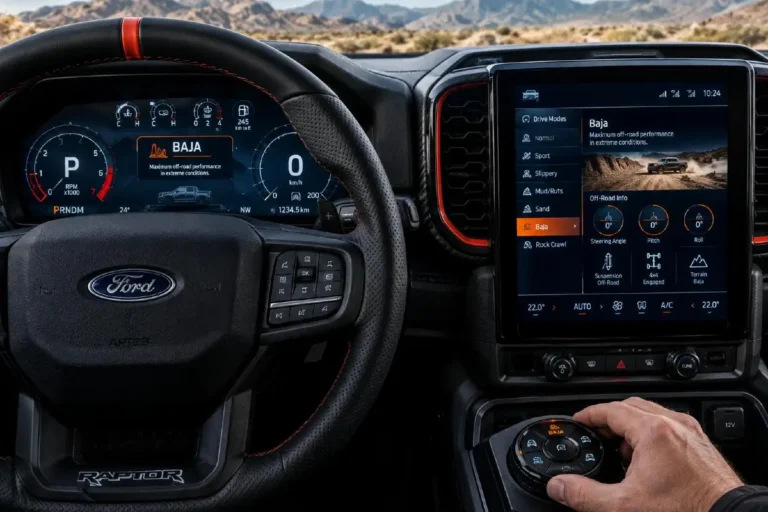
Baja mode is the fun one — it is designed for higher-speed off-road driving and changes the truck’s personality dramatically by holding gears longer, sharpening throttle response, reducing intervention from stability systems, and allowing more wheel slip than other modes. The FOX Live Valve shocks also stiffen in Baja mode to match high-speed demands without manual adjustment. This is the mode that makes the Ranger Raptor feel like something more than a well-equipped midsize truck. In Baja mode, with a dirt road ahead and nothing behind, the Ranger Raptor justifies every dollar of its premium over a standard Ranger.
Section 4 – The Exterior And Tires
Why Nobody Will Mistake This For An Ordinary Ranger
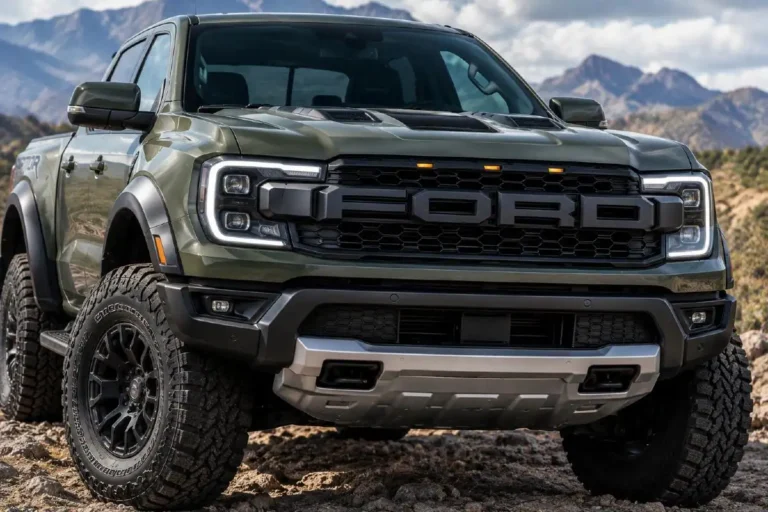
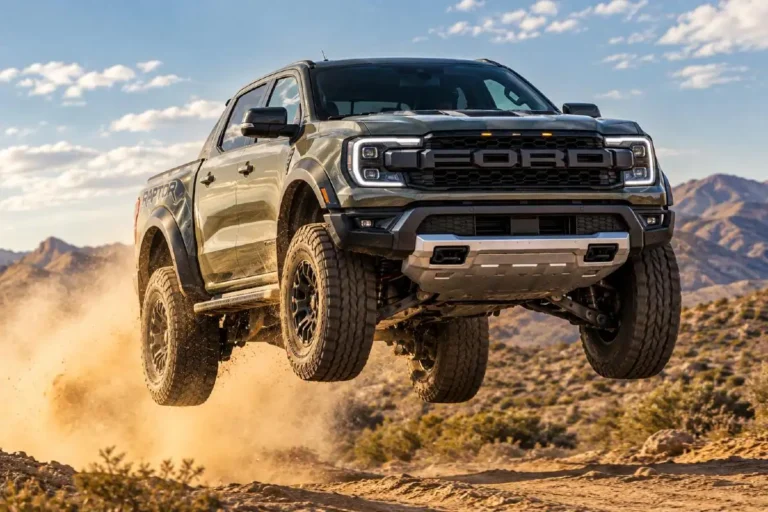
Visually, nobody will mistake this for an ordinary Ranger. The Raptor receives widened fenders, an aggressive stance, large wheel openings, unique suspension tuning, and 17-inch beadlock-capable wheels wrapped in BF Goodrich 285/70R tires. It comes with fog lamps, LED taillights, dual exhaust, heat-extracting vents on the hood, and air dams on the fenders. The Ranger Raptor is slightly longer, just a little taller, but has almost an inch-and-a-half more ground clearance than the regular Ranger.
The unique grille with bold FORD lettering replaces the traditional Ford emblem — a styling decision that communicates the truck’s specific identity immediately and that has become the Raptor family’s signature visual element across the F-150 Raptor, Bronco Raptor, and now the Ranger Raptor. The steel front and rear bumpers improve durability and also improve approach and departure angles by eliminating the plastic valance extensions that standard Ranger trims use. The heavy-duty skid plates visible beneath the front bumper communicate the underbody protection that the Raptor’s lower ground clearance excursions require.
The 33-inch BFGoodrich KO3 all-terrain tires on 17-inch beadlock-capable wheels are the tire and wheel combination most directly connected to the Raptor’s specific capability. The KO3 provides genuine all-terrain traction without the specific compromises of a mud-terrain tire on road surfaces, and the beadlock-capable wheels allow tire pressure to be reduced for rock crawling without the risk of the tire unseating from the rim under extreme articulation. The 33-inch diameter provides the specific combination of sidewall height for obstacle clearance and contact patch for off-road traction that the Raptor’s suspension geometry was designed around.
The Shelter Green Metallic color exclusive to the Raptor for 2026 is the most distinctive exterior option and the one that most clearly communicates the truck’s off-road identity — a muted, earthy green that reads as purposeful rather than sporty and that disappears appropriately into natural terrain environments.
Zone lighting — standard equipment that enhances visibility around the stationary vehicle — is a practical feature for campsite or trail-side use that demonstrates Ford’s specific attention to the off-road lifestyle context in which Raptor buyers use their trucks.
Section 5 – The Interior
Capability First, Comfort Second – But Comfort Is Not Optional
The Ranger Raptor’s interior priorities are clear from the moment you open the door: the leather-trimmed front bucket seats with substantial bolstering communicate that this cabin is designed around a driver who is being thrown sideways by terrain. The bolstering is specifically functional rather than merely aesthetic — in Baja mode at speed over rough terrain, the seats hold occupants in position without requiring the driver to brace against the door.
The driver’s seat offers 10-way power adjustment, while the passenger seat provides 8-way adjustment. The Raptor-specific gauge cluster and steering wheel distinguish the interior from standard Ranger trims visually and functionally — the gauge display includes performance-relevant data including off-road metrics, pitch and roll angles, and the seven-mode drive mode selector status.
The 12-inch vertical SYNC 4A touchscreen is the Raptor’s primary technology interface. The portrait-orientation screen provides navigation, media, phone, and vehicle settings in a format that allows the off-road metrics display to occupy a meaningful portion of the screen alongside other information. Wireless Apple CarPlay and Android Auto are standard, as is wireless phone charging and a Wi-Fi hotspot.
The rear seat in the SuperCrew configuration provides adult-appropriate rear passenger space — the Ranger Raptor is a functional five-passenger vehicle when all seats are occupied, not a nominal five-passenger truck where rear occupants are accommodated rather than comfortable. For families who want the Raptor’s capability with regular rear passenger use, the SuperCrew’s rear seat is genuinely adequate rather than merely technically present.
The cargo bed provides approximately 4 feet of width between the wheelwells — sufficient for standard sheet goods to lie flat when laid diagonally. The integrated bed step makes access straightforward for users who do not want to climb over the tailgate. The bed is protected by a standard spray-in bed liner that reflects the Raptor’s working utility orientation alongside its performance character.
Section 6 – Towing And Payload
The Honest Conversation Raptor Buyers Need To Have Before Purchase
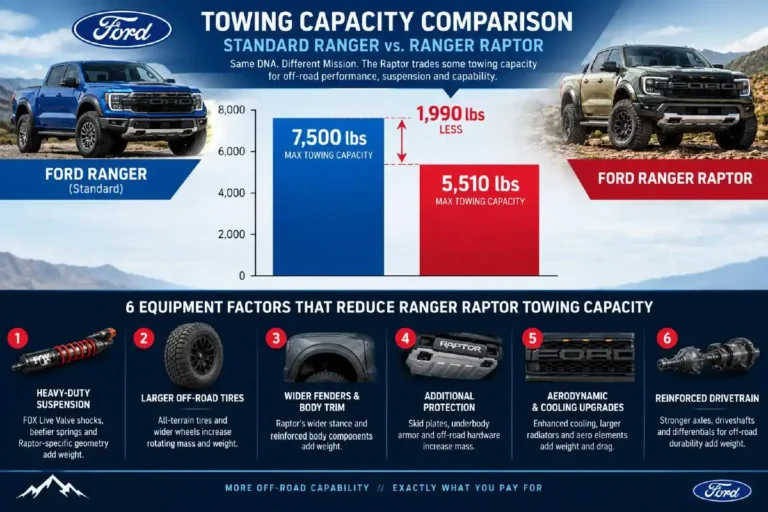
The 2026 Ford Ranger Raptor has a maximum towing capacity of 5,510 pounds when properly equipped. This number requires context for any buyer who is cross-shopping the Raptor against other Ranger trims. The standard Ranger’s maximum towing capacity is 7,500 pounds — nearly 2,000 pounds more than the Raptor. The difference is not a Ford engineering limitation or an oversight. It is the direct consequence of the design choices that make the Raptor what it is.
The Raptor’s towing rating is affected by features such as: off-road suspension tuning, FOX performance shocks, wider stance, aggressive all-terrain tires, higher-performance chassis setup, off-road-focused ride control, and added performance equipment. Every element of the Raptor’s off-road hardware that makes it exceptional in Baja mode compromises its towing rating relative to a leaf-spring, road-focused midsize truck configuration.
The 5,510-pound towing capacity is adequate for specific recreational towing applications — small boats in the 3,000 to 4,500-pound range, utility trailers, and lighter campers. For buyers whose towing need regularly approaches or exceeds 5,510 pounds, the specific recommendation is either a standard Ranger Lariat or XLT in 4WD for those who want the Ranger nameplate, or a larger Ford truck platform for those whose towing need requires the full 7,500-pound capacity.
The maximum payload of 1,373 pounds is similarly below the standard Ranger’s 1,788-pound maximum payload. For work-truck buyers who regularly carry heavy cargo in the bed, the payload reduction is a meaningful operational consideration alongside the towing limitation.
The honest advice: if you need a midsize Ford truck primarily for towing and hauling, choose a standard Ranger trim. If you need a midsize Ford truck primarily for off-road performance and can manage within the 5,510-pound towing limit for your specific recreational needs, the Raptor is the specific recommendation. The two use cases are genuine and the two vehicle choices serve them genuinely differently.
Section 7 – Ranger Raptor VS The Competition
Colorado ZR2, Tacoma TRD Pro, And The F-150 Raptor
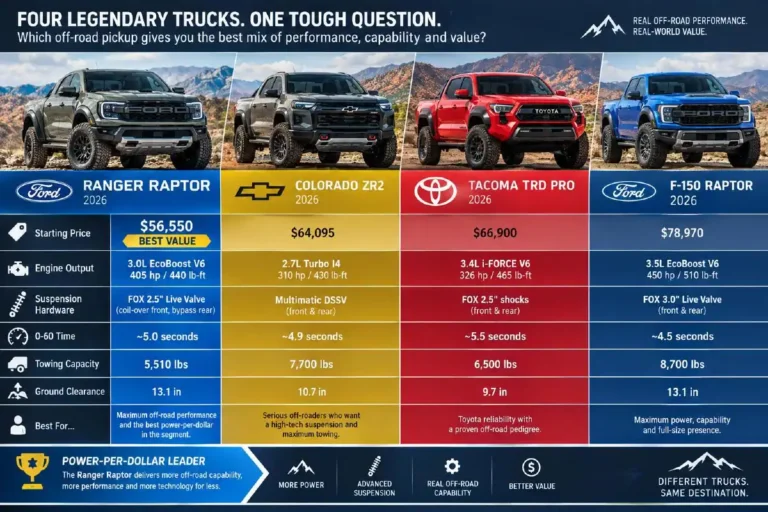
The Ranger Raptor’s three most directly comparable competitors are the Chevrolet Colorado ZR2, the Toyota Tacoma TRD Pro, and its own big brother the Ford F-150 Raptor. Understanding where the Ranger Raptor leads and where it concedes against each is the most practically useful competitive assessment for any buyer narrowing their decision.
Ranger Raptor vs Chevrolet Colorado ZR2
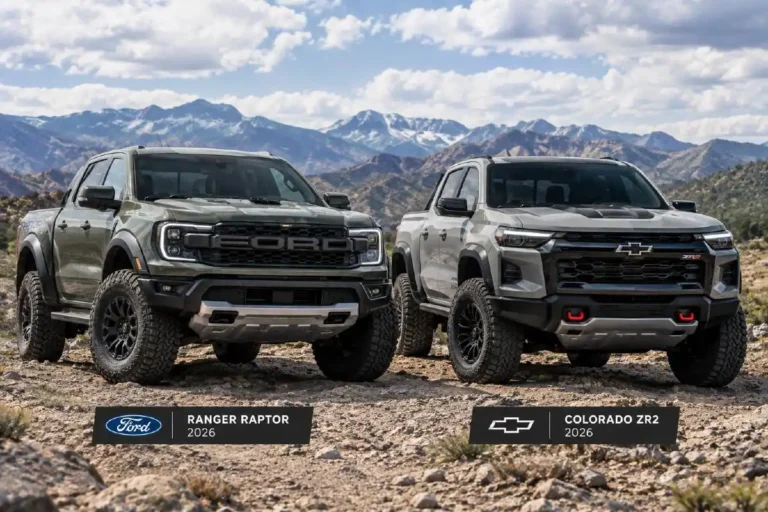
The Colorado ZR2 and Ranger Raptor represent the two most technically sophisticated factory midsize off-road trucks available from American manufacturers in 2026. The Colorado ZR2 uses Multimatic DSSV dampers — spool-valve technology used in racing applications and in the Camaro Z/28 — versus the Ranger Raptor’s FOX 2.5-inch Live Valve shocks. Both represent the highest available shock technology in their respective trucks, and both produce genuinely impressive off-road capability.
The Ranger Raptor’s 405 HP provides approximately 95 HP more than the Colorado ZR2’s 310 HP TurboMax four-cylinder. The power advantage is meaningful in high-speed desert running and on highway driving. The ZR2’s Multimatic dampers are arguably the most sophisticated passive damper available on any production midsize truck, while the Ranger Raptor’s FOX Live Valve shocks provide active adjustment. Both approaches produce excellent real-world results by slightly different engineering means.
The Colorado ZR2’s towing cap of 6,000 pounds — versus the Ranger Raptor’s 5,510 — provides slightly more towing flexibility for buyers who occasionally need to tow within midsize truck limits. The ZR2 starts at approximately $46,495 — about $9,500 less than the Ranger Raptor — making it the more accessible option for buyers whose primary criterion is off-road capability at the lowest available price.
The Chevrolet Colorado ZR2 is the Ranger Raptor’s most technically comparable American competitor — Multimatic DSSV dampers against FOX Live Valve shocks, 310 HP against 405 HP, $46,495 against $56,070. Our complete Chevy Colorado guide covers every trim from the WT through the ZR2 in full detail, providing the complete Colorado buyer context including ZR2-specific hardware specifications that give the Ranger Raptor comparison its most precise technical foundation.
Ranger Raptor vs Toyota Tacoma TRD Pro
The Toyota Tacoma TRD Pro is the most directly brand-comparison competitor to the Ranger Raptor — both are factory performance midsize trucks from their respective brands. The TRD Pro uses Fox 2.5-inch internal bypass shocks (non-live-valve), TRD-specific suspension tuning, and the available i-Force Max hybrid powertrain producing 326 horsepower.
The Ranger Raptor’s power advantage over the TRD Pro’s 326 HP i-Force Max is approximately 79 HP — a meaningful difference in high-speed off-road driving. The TRD Pro’s long-term reliability reputation and resale value advantage — the Tacoma is the definitive midsize truck reliability benchmark — are the specific reasons buyers choose the TRD Pro despite the Ranger Raptor’s performance leadership.
The Toyota Tacoma TRD Pro’s primary advantage over the Ranger Raptor is not performance — the Raptor’s 405 HP leads the TRD Pro’s 326 HP i-Force Max — it is long-term reliability reputation and resale value, both of which Toyota consistently leads Ford in the midsize truck segment. Our complete guide to the most reliable American cars 2026 documents Ford’s current 11th-place Consumer Reports ranking — its best in 15 years — alongside every other American brand’s reliability position, providing the data foundation for the reliability comparison that serious Raptor buyers should evaluate honestly.
Ranger Raptor vs Ford F-150 Raptor
The F-150 Raptor is the direct performance comparison within the Ford family, and the comparison is informative both for what the Ranger Raptor delivers and for where it concedes. The 2026 F-150 Raptor is powered by a high-output twin-turbo 3.5-liter EcoBoost V6 producing 450 hp and 510 lb-ft of torque. Both configurations use Fox Live Valve shocks, which actively adjust damping in real time as the truck reads terrain changes. The F-150 Raptor’s wheelbase and suspension travel are substantially larger than the Ranger’s, letting it carry higher speeds over rough terrain while staying planted.
The Ranger Raptor is positioned below the Bronco Raptor and F-150 Raptor in price terms. The new Ford Ranger comes as a single, well-equipped trim level starting around $57,000. This price includes most of the off-road capability and technology features you’d want, making it a relatively straightforward purchasing decision. When factoring in applicable tax and different locations for pricing, the Ranger Raptor represents better value for buyers who don’t need maximum capability.
The F-150 Raptor’s wider track, longer suspension travel, and larger platform make it better suited to the specific high-speed desert running that the Raptor formula was originally developed for. The Ranger Raptor’s more compact dimensions make it better suited to tighter trail environments, urban daily driving, and parking situations where the F-150’s substantial width is a genuine inconvenience.
Section 8 – The Buying Decision
Who Should Buy The Ranger Raptor — And Who Should Not
The Ranger Raptor is the right truck for a specific buyer whose requirements align with its specific capability package. Understanding whether that buyer is you requires honest engagement with three questions.
Before finalizing any Ranger Raptor purchase — particularly used examples from the 2024 first-American-model-year that may have carried first-year production issues — understanding the specific maintenance profile of the 3.0-liter EcoBoost V6 and the FOX Live Valve shock service requirements is essential preparation. Our complete guide to common issues that kill American cars covers the documented failure patterns for Ford EcoBoost turbocharged engines and the service requirements that any Raptor owner should build into their ownership cost planning.
Question One: How much off-road driving do you actually do? The Ranger Raptor’s premium over a standard Ranger Lariat is approximately $15,000 to $18,000 depending on configuration. That premium buys FOX Live Valve shocks, a Watts-link rear suspension, 33-inch BFGoodrich tires, 11.7 inches of ground clearance, seven drive modes including Baja, and 405 horsepower. If your actual off-road use involves occasional gravel forest roads and light dirt driving, the standard Ranger with the FX4 Off-Road package provides adequate capability at a significantly lower price. If your off-road use involves regular trail driving, desert running, or the specific Baja-mode experience at speed over rough terrain, the Raptor’s hardware is the difference between an adequate experience and an extraordinary one.
Question Two: What are your towing needs? If you regularly tow trailers in the 5,500 to 7,500-pound range, the Ranger Raptor is not the right truck. The standard Ranger’s 7,500-pound capacity serves that need better. If your towing is recreational and falls within the Raptor’s 5,510-pound limit, the towing concession is acceptable alongside everything else the Raptor provides.
Question Three: Can you live with the Raptor’s width every day? The widened fenders and wider track that the Raptor requires for its long-travel suspension make it meaningfully wider than a standard Ranger. That width creates specific challenges in narrow urban environments, tight parking garages, and drive-through lanes. The specific buyer who chooses the Raptor and then drives primarily in dense urban environments without regular trail use is not using what they paid for — and is accepting the width penalty without the off-road reward.
For buyers who want Edmunds’ independent long-term evaluation of the 2026 Ranger Raptor alongside their comparison testing data — including the specific Edmunds advice on whether the standard Ranger’s four-cylinder or the Raptor’s V6 makes more sense for their specific use case — the Edmunds 2026 Ford Ranger Raptor review and pricing page provides the most comprehensive independent buyer guidance available.
The buyer who the Raptor is specifically built for: someone who commutes in environments where midsize truck width is manageable, who takes the truck off-road regularly enough to use the Baja and Rock Crawl modes with intention, whose recreational towing stays within the 5,510-pound limit, and who finds genuine daily satisfaction in driving a truck whose specific engineering communicates constant readiness for the next trail. That buyer will find the Ranger Raptor deeply rewarding. Any other buyer should start with the standard Ranger and add off-road packages as needed.
Ford’s performance vehicle investment in 2026 extends well beyond the Raptor truck family — our complete Ford Mustang Mach-E guide covers Ford’s performance electric SUV, showing how the Mach-E GT Performance Edition’s 480 HP and 3.5-second 0-60 represents the same Ford performance engineering philosophy that produced the Ranger Raptor’s 405 HP and Baja mode, applied to an entirely different vehicle type and buyer mission.
FAQ
How much does the 2026 Ford Ranger Raptor cost?
The 2026 Ford Ranger Raptor starts at $56,070 before the destination charge — a $1,000 increase over the 2025 model. It is available as a single SuperCrew configuration with the 3.0-liter twin-turbo V6, 10-speed automatic, and standard 4WD. No additional trim levels or powertrain options are available. With popular options and color choices, the as-tested price typically reaches $58,000 to $62,000.
What engine does the 2026 Ford Ranger Raptor have?
The 2026 Ranger Raptor uses a 3.0-liter twin-turbocharged V6 EcoBoost producing 405 horsepower and 430 lb-ft of torque — the most powerful engine available in the Ranger lineup and exclusive to the Raptor trim. It is paired with a 10-speed automatic transmission and standard 4WD. The aluminum block and heads reduce weight while the twin-turbo configuration provides strong low-RPM torque for off-road power delivery.
How does Baja mode work on the Ranger Raptor?
Baja mode is designed for higher-speed off-road driving. It holds gears longer, sharpens throttle response, reduces intervention from stability systems, and allows more wheel slip than other modes. The FOX Live Valve shocks stiffen automatically in Baja mode without driver input. It is the mode that most completely delivers the Raptor experience — most trucks want you to slow down when terrain gets rough, and Baja mode calibrates the truck to feel the opposite.
Can the Ranger Raptor tow 7,500 pounds?
No. The 2026 Ranger Raptor’s maximum towing capacity is 5,510 pounds when properly equipped — significantly less than the standard Ranger’s 7,500-pound maximum. The reduction is caused by the Raptor’s off-road suspension setup, FOX performance shocks, wider stance, and off-road-focused chassis calibration. Buyers who regularly tow near 7,500 pounds should choose a standard Ranger Lariat or XLT instead.
Is the Ranger Raptor better than the Colorado ZR2?
The Ranger Raptor and Colorado ZR2 are the two most technically sophisticated factory midsize off-road trucks in 2026. The Ranger Raptor has approximately 95 HP more (405 vs 310) and FOX Live Valve active shocks. The Colorado ZR2 has Multimatic DSSV spool-valve dampers and a slightly higher towing capacity at 6,000 pounds. The ZR2 starts approximately $9,500 less. The right choice depends on whether you prioritize the Raptor’s power advantage and active shock technology or the ZR2’s Multimatic dampers and better price-to-capability ratio.
How does the 2026 Ranger Raptor compare to the F-150 Raptor?
The Ranger Raptor produces 405 HP versus the F-150 Raptor’s 450 HP. Both use FOX Live Valve shocks, but the F-150’s larger platform provides more suspension travel and better high-speed desert capability. The Ranger Raptor’s more compact size is easier to live with daily and better in tighter trail environments. The Ranger Raptor starts at $56,070 and represents better value for buyers who don’t need the F-150 Raptor’s maximum capability.
The Bottom Line
The 2026 Ford Ranger Raptor succeeds at the specific thing it was designed to do: deliver as much of the F-150 Raptor’s specific high-speed off-road capability as a midsize platform can support, in a package that is genuinely easier to live with every day. The FOX Live Valve shocks, the Watts-link rear suspension, and the 405-horsepower twin-turbo V6 are not marketing specifications. They produce a truck that behaves differently from any other midsize truck when the terrain gets challenging — specifically more planted, more composed, and more encouraging of speed rather than more nervous.
The honest limitations are real: the 5,510-pound towing cap eliminates the Raptor for buyers who regularly tow at the top of the midsize truck class, the 16/18 mpg fuel economy reflects the powertrain’s specific priorities, and the width requires genuine lifestyle compatibility in daily use. These are not flaws. They are the specific trade-offs that make the Raptor what it is.
At $56,070, the Ranger Raptor is priced below every F-150 Raptor configuration and below every Bronco Raptor. The single-configuration approach — one cab, one engine, one powertrain, everything included — makes the buying decision simple in a way that multi-trim trucks rarely achieve. You are either buying the Ranger Raptor or you are not. If you are, you are getting a midsize truck that is among the most capable factory off-road vehicles available from any manufacturer at any price within its footprint. If your specific use case aligns with what the Raptor delivers, there is no midsize truck in the American market that does what it does more completely.
Editorial Note
This article was written and reviewed in September 2026. All specifications and performance figures are sourced from the following primary sources: Autoblog 2026 Ford Ranger Raptor Review (May 18, 2026) — primary source for the 3.0L twin-turbo V6 405 HP / 430 lb-ft specification, the 10-speed automatic, the forged aluminum double A-arm front suspension, the Watts-link rear suspension, the FOX 2.5-inch Live Valve shocks, the 0-60 range of 5.2 to 5.8 seconds, and the seven drive mode framework;
CarPro 2026 Ranger Raptor Review (June 2, 2026) — primary source for the real-world driving assessment including the “most trucks want you to slow down when the road gets rough” characterization, the Baja mode personality change description, the widened fenders and stance description, the BFGoodrich 285/70R tire specification, and the “baby Raptor” characterization;
Ford.com official 2026 Ranger Raptor page (July 2026) — primary source for the 3.0L EcoBoost V6 official description, the 1,513-pound payload figure variation, and the seven drive mode names; Pacifico Ford (June 2026) — primary source for the 5,510-pound towing capacity, 1,373-pound payload, and the specific equipment factors affecting Raptor towing versus standard Ranger; TopSpeed Suspension Analysis (July 2, 2026) — primary source for the FOX Live Valve shock diameter significance, oil volume and fade resistance explanation, and the Normal vs Baja mode shock behavior;
Wendle Ford Comparison (June 10, 2026) — primary source for the 11.7-inch ground clearance, 31-degree approach angle, F-150 Raptor 450 HP / 510 lb-ft comparison, and the five-link versus Watts-link suspension comparison; Specialty Performance Parts (August 2025) — primary source for the single-trim-level characterization, the $57,000 starting simplicity, and the value position versus F-150 Raptor; Autoblog 2025 Ranger Raptor (carried forward) — primary source for the $56,070 starting MSRP confirmation and 2026 as $1,000 increase over 2025. The 2026 Raptor carries over mechanically unchanged from 2025 per Autoblog’s May 2026 review confirming no mechanical or structural changes for 2026.