Last Updated: July 22, 2026 | Read Time: 9 minutes
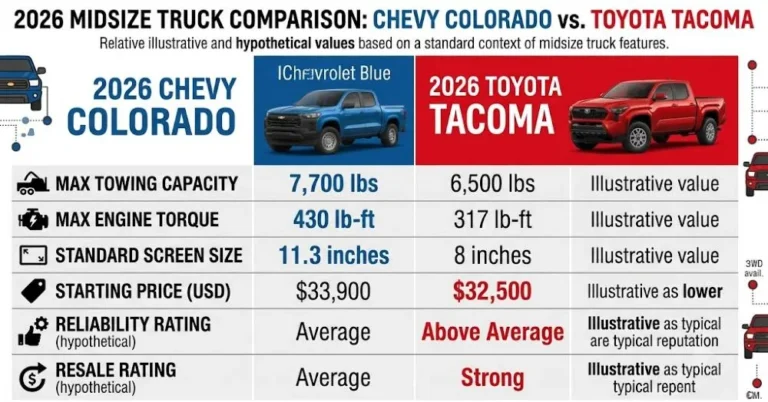
Every 2026 Chevy Colorado uses the same engine — the 2.7-liter TurboMax turbocharged four-cylinder producing 310 horsepower and 430 lb-ft of torque. That torque figure exceeds the output of the old Duramax diesel that used to be an option in this truck, and it matches the 7,700-pound maximum towing capacity that leads the midsize truck class. The 11.3-inch touchscreen is standard across all five trims.
So is Chevy Safety Assist. So is the 8-speed automatic transmission. The Colorado simplified its lineup by making the strong stuff universal, and then differentiated its five trims — WT, LT, Trail Boss, Z71, and ZR2 — by how you want to use the truck. The decision is less about what the Colorado can do and more about what you specifically need it to do on the roads and trails where you actually drive. Here is the complete guide.
Quick Facts – 2026 Chevy Colorado
— Engine: 2.7L TurboMax Turbocharged I4 — standard on all five trims
— Output: 310 HP at 5,600 RPM / 430 lb-ft torque at 3,000 RPM — class-leading torque
— Transmission: 8-speed automatic — all trims
— Body: Crew cab only / short 5-foot bed — all trims
— Seating: 5 passengers — all trims
— Drivetrain Options: RWD (WT, LT) or 4WD (all trims available)
— Maximum Towing: 7,700 lbs — WT, LT, Trail Boss, Z71 (best in midsize class)
— ZR2 Towing: 6,000 lbs (off-road setup reduces tow capacity)
— Payload: 1,445 to 1,846 lbs depending on trim and configuration
— 0-60 MPH: ZR2 approximately 6.5 seconds / Trail Boss approximately 7.0 seconds
Five Trim Levels and Starting MSRPs:
— WT (Work Truck): $34,495
— LT: $38,095
— Trail Boss: $42,495
— Z71: $46,495
— ZR2: ~$46,495–$62,000 (Bison Edition higher)
Fuel Economy:
— WT/LT: ~20 mpg combined / 18-20 city / 22-25 highway
— Trail Boss/Z71: ~19 mpg combined
— ZR2: ~17 mpg combined
— Standard Tech (all trims): 11.3-inch touchscreen, Google Built-in, wireless Apple CarPlay/Android Auto, 11-inch digital Driver Information Center, Chevy Safety Assist
— ZR2 Off-Road: Multimatic DSSV dampers, 3-inch lift, 33-inch MT tires, front/rear e-lockers, 11.2-inch ground clearance, 5 drive modes including Baja
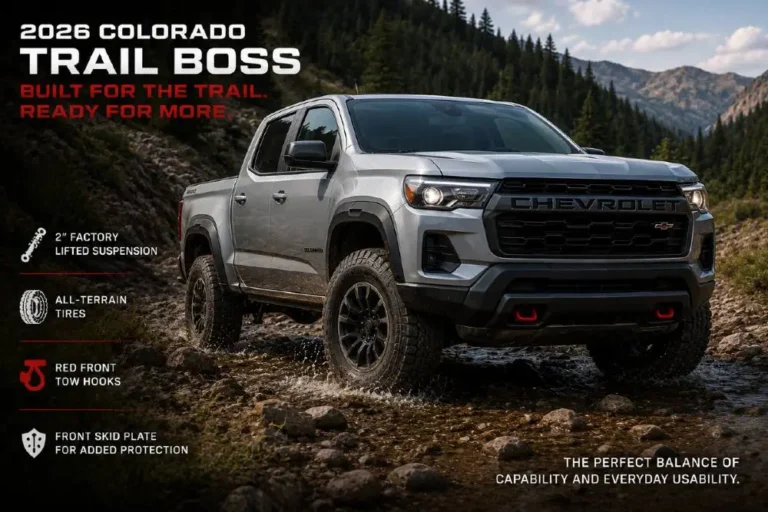
— Trail Boss Off-Road: 2-inch lift, skid plates, locking rear diff, red tow hooks, 9.5-inch ground clearance
— Warranty: 3yr/36K bumper-to-bumper / 5yr/60K drivetrain / 6yr/100K rust / 5yr/60K roadside / 1yr free maintenance
— Competition: Toyota Tacoma, Ford Ranger, GMC Canyon
— Edmunds Recommendation: LT for most everyday buyers
Sources: Edmunds, Autoblog, TrueCar, Starling Chevrolet, Delta Chevrolet.
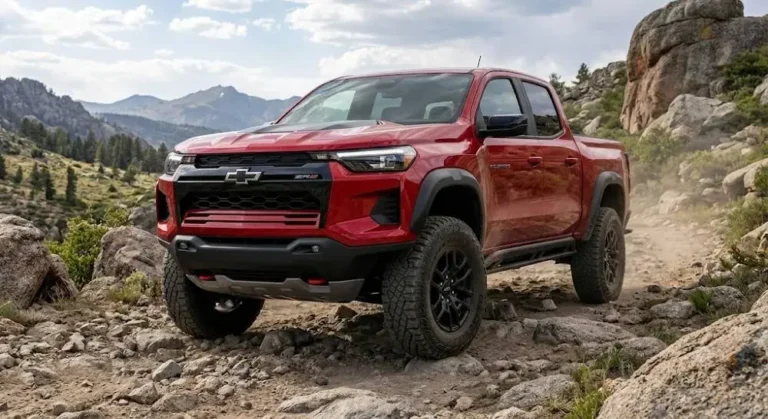
Overview – The Midsize Truck Segment’s Most Straightforward Overachiever
The midsize truck segment has quietly become one of the most competitive corners of the American automotive market. Toyota rewrote the Tacoma. Ford refreshed the Ranger aggressively. And the Chevy Colorado, now in its second model year since the generation-defining third-generation redesign, is doing something that the previous version never quite managed: earning genuine respect from automotive press and buyers who previously defaulted to the Japanese alternatives without much consideration.
The Colorado’s most important strategic decision for 2026 is the universal TurboMax engine. Every trim gets 310 horsepower and 430 lb-ft of torque — there are no engine tiers, no V6 you need to upgrade to for adequate towing, no diesel decision to navigate. The simplification means buyers spend their budget on the features they actually want rather than on the powertrain upgrade they need in order to make the truck functional. It’s not often that a truck gets compliments, but the Colorado excels in features with a powerful engine, class-leading towing, and a larger infotainment screen compared to rivals like the Tacoma and Ranger.
The Colorado’s wheelbase and overall footprint are its other significant advantages over the full-size trucks that now dominate American truck sales. A midsize footprint in a parking garage, a neighborhood, or a crowded job site is a practical advantage that no specification communicates as clearly as the first time you try to park a full-size F-150 or Silverado in an urban environment. The Colorado provides most of what a full-size truck delivers — including class-leading towing and genuine off-road capability in the ZR2 — at a lower acquisition cost, lower fuel cost, and in a package that is meaningfully easier to live with in daily driving.
This guide covers everything: the single-engine strategy and what it means for buyers, the five trims in enough detail to choose between them, the Trail Boss and ZR2 off-road hardware in enough technical depth to understand what you are actually buying, the competition comparison that explains where the Colorado leads and where it concedes, and the honest buying advice that answers the specific question most buyers arrive with — which Colorado is right for me?
The Colorado’s midsize footprint is its most practical advantage over the full-size trucks that now dominate American truck sales — our complete guide to the best pickup trucks 2026 covers the F-150, Ram 1500, Silverado, and every other full-size American truck in full detail, giving buyers who are weighing midsize against full-size the complete comparison they need before committing to either category.
Section 1 – The Engine
430 lb-ft From One Turbocharged Four-Cylinder — Why This Is Not A Compromise
The 2.7-liter TurboMax engine is the single most important decision Chevrolet made about the current-generation Colorado, and it is the decision that most clearly separates the 2026 truck from its predecessors and competitors.
Under the hood sits Chevrolet’s 2.7-liter TurboMax inline-four. Before anyone reaches for the comment section, know that this engine produces 310 horsepower at 5,600 RPM and a stout 430 lb-ft of torque at just 3,000 RPM. That torque figure is worth pausing on. It actually exceeds the output of the old 2.8-liter Duramax turbodiesel that was once available in the previous-generation Colorado, and it matches its 7,700-pound maximum towing capacity.
The 430 lb-ft at 3,000 RPM is the specific number that makes this engine work as a truck engine. Torque at low RPM is what moves heavy loads — the immediate, accessible pulling force that matters when a trailer is attached and the driver is merging onto a highway or navigating a boat ramp. A four-cylinder engine that produces 430 lb-ft at 3,000 RPM behaves more like a diesel in its low-RPM torque character than it does like the naturally aspirated V6s that mid-size trucks carried for the previous two decades.
The 2.7-liter turbocharged four-cylinder engine is responsive when you press the gas pedal, and it produces plenty of low-end torque, which is beneficial for both city driving and towing. The transmission shifts smoothly and quickly, and the brakes provide sufficient stopping power for emergency braking and are also easy to modulate for smooth stops. Those are Edmunds’ words, from their team that drove the truck around Los Angeles for extended evaluation — a summary that captures the engine’s real-world character more accurately than a specification sheet.
The trade-off that is honest to acknowledge: the TurboMax four-cylinder produces engine noise under load that a V6 smooths out through cylinder count and displacement. The engine’s character at wide-open throttle or sustained highway grade climbing is audible in a way that the old V6 alternatives were not. The engine noise under load will bother anyone who remembers what a V6 sounds like. That is a real observation and worth knowing if the daily commute involves long hill climbs on the interstate or frequent trailer towing on grades.
The practical context: for the majority of Colorado buyers whose typical use involves hauling equipment to a job site, recreational towing a few weekends per year, and daily driving without constant grade climbing, the TurboMax’s noise profile is an occasional awareness rather than a persistent annoyance. For buyers who are particularly sensitive to powertrain refinement and whose driving profile involves regular sustained heavy towing, the Toyota Tacoma’s i-Force Max hybrid or the Ford Ranger’s 2.3-liter EcoBoost offer different noise characters alongside different capability profiles.
Section 2 – The Five Trims
What Each Configuration Actually Changes In Real Ownership Terms
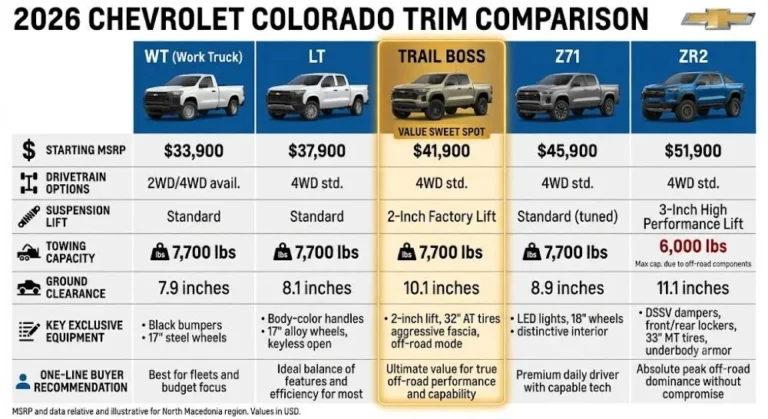
The 2026 Chevrolet Colorado trim decision is more about how you want the truck configured than what it can do — because the core capability (the TurboMax engine, 7,700-pound towing, the 11.3-inch screen, and Chevy Safety Assist) comes standard across all five trims. The trim walk determines the truck’s personality: work-first utility, value-minded comfort, everyday refinement, off-road confidence, or serious trail hardware.
WT — Work Truck ($34,495)
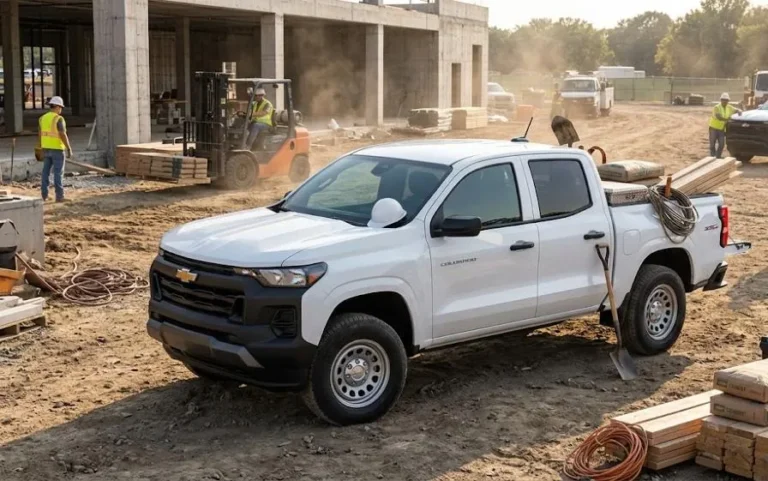
The WT is the most straightforward and most affordable Colorado. At $34,495, it is one of the most affordable midsize trucks from any manufacturer with the same powertrain as every other trim in the lineup. The WT gets the 11.3-inch touchscreen — a feature that its price competitors often provide in a much smaller format — alongside the 11-inch digital cluster, Chevy Safety Assist, air conditioning, power windows, and wireless Apple CarPlay and Android Auto.
What it skips: the WT keeps interior materials deliberately functional, with durable surfaces and straightforward controls that are appropriate for a working environment where the cabin takes more daily wear than a recreational truck. There are no premium audio options, no heated seats, and no keyless entry at this trim. The WT is the truck for buyers who need a capable midsize pickup at the lowest entry price without unnecessary amenities that add cost without adding capability.
Who should buy it: contractors, fleet operators, and buyers who want the Colorado’s towing and engine capability at the lowest available price and whose primary truck use is work rather than leisure.
LT ($38,095) — Edmunds’ Most Recommended Trim
The LT is the trim that Edmunds recommends for many midsize truck shoppers because of its reasonable starting price and available packages. At $38,095, the LT adds 17-inch aluminum wheels, a six-speaker audio system, and body-color exterior accents over the WT’s baseline.
The LT’s most important equipment additions are the ones that change the daily driving experience: the 8-way power-adjustable driver’s seat that arrives with available packages, the wireless phone charging on higher LT specifications, and the overall interior improvement that makes the LT feel more like a modern vehicle and less like a working tool. LT builds on the Colorado’s capability with more comfort, convenience, and customization flexibility.
The LT is available in both RWD and 4WD, making it the most price-accessible 4WD Colorado for buyers who want all-season traction without the off-road hardware of the Trail Boss or Z71. For buyers in climates with genuine winter weather who do not need a lifted suspension or aggressive off-road tires but do need 4WD confidence, the LT 4WD is the specific recommendation.
Who should buy it: daily drivers, commuters who occasionally tow, buyers in winter climates who want 4WD without off-road premiums, and anyone who will use the truck primarily on paved roads with occasional gravel or light off-pavement work.
Trail Boss ($42,495) — The Off-Road Sweet Spot
The Trail Boss is where the Colorado’s off-road story genuinely begins. For $42,495, it adds a 2-inch factory suspension lift that raises ground clearance to 9.5 inches, skid plates for underbody protection, all-terrain tires, an automatic locking rear differential, and red tow hooks — the specific combination of hardware that makes the difference between a truck that looks off-road ready and one that actually is.
The 2025 Colorado Trail Boss is a truck that gets the important things right. It is stable and confident on the road, capable enough off of it, powerful enough for serious towing, and priced fairly for what it delivers. That Autoblog assessment of the Trail Boss — based on extended road and trail driving — captures the trim’s specific positioning in the Colorado lineup and the midsize truck segment with unusual precision. Stable and confident on the road and capable enough off of it is exactly the promise the Trail Boss makes.
The specific assessment that the Trail Boss is stable and confident on the road, capable enough off of it, powerful enough for serious towing, and priced fairly for what it delivers — alongside the Tacoma TRD Off-Road price comparison at $46,000 — is from Autoblog’s 2025 Colorado Trail Boss honest review, published April 17, 2026 and the primary real-world driving evaluation source for the Trail Boss section in this article.
The Trail Boss maintains the full 7,700-pound towing capacity — a specific advantage over the ZR2, which trades some towing capability for its more aggressive off-road hardware. For buyers who need both genuine off-road readiness and meaningful towing capability, the Trail Boss is the specific recommendation in the Colorado lineup. The Trail Boss starts at $41,395 before destination, making it a solid value in the midsize off-road truck segment. For context, a comparably equipped Toyota Tacoma TRD Off-Road will run you around $46,000, and the Ford Ranger with the FX4 package is not far off either.
The Trail Boss is exclusive to 4WD models. Its factory-lifted stance is visible at a distance, and the all-terrain tires provide the specific confidence on unpaved surfaces, wet grass, and muddy job site access roads that all-season tires cannot match.
Who should buy it: buyers who want genuine off-road capability at a reasonable premium, who need 7,700-pound towing alongside that capability, and who are willing to accept the slight fuel economy reduction that the all-terrain tires produce versus the road-focused WT and LT.
Z71 ($46,495) — Off-Road Polish With Premium Amenities
The Z71 is the trail-capable Colorado with the most refined interior — the choice for buyers who want the off-road credentials alongside the Bose premium audio system, heated steering wheel, leather seating, and LED lighting that bring the Z71 closer to the premium end of the midsize truck market. Z71 combines off-road prowess with premium amenities like leather seating, a heated steering wheel, a Bose audio system, and 18-inch wheels.
The Z71’s suspension is off-road tuned but less aggressive than the ZR2’s Multimatic dampers — it is a more polished, more composed configuration that handles well both on pavement and on typical trail surfaces without the ZR2’s commitment to extreme terrain. For buyers who spend most of their off-road time on forest service roads, moderate trails, and gravel two-tracks rather than rock gardens and deep mud, the Z71 provides appropriate capability with significantly better cabin appointments than the Trail Boss.
The Z71 also adds LED headlamps, taillamps, and fog lamps, the Jet Black interior accented with Adrenaline Red details, ventilated front seats availability, and wireless phone charging. These are the specific upgrades that make the Z71 the right choice for buyers who prioritize both trail readiness and daily comfort in roughly equal measure.
Who should buy it: buyers who need off-road capability for weekend adventure use, want the best cabin quality in the Colorado lineup outside of the ZR2 Bison Edition, and whose trail use is moderate rather than extreme.
ZR2 — The Apex Off-Road Colorado
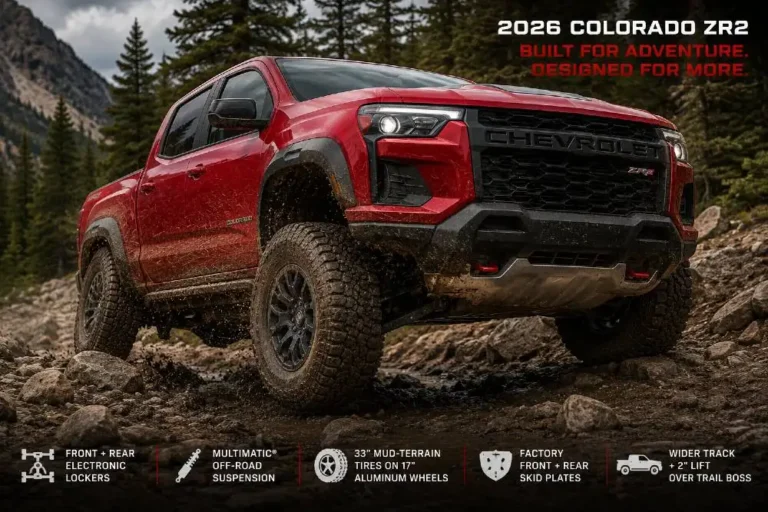
The ZR2 is the Colorado’s most serious off-road capability expression and the version that most directly challenges purpose-built alternatives like the Ford Ranger Raptor and Toyota Tacoma TRD Pro. The ZR2 tops the list with high-performance dampers, exclusive drive modes, and rugged exterior protection. At the top, the ZR2 is Chevy’s most off-road-capable Colorado, boasting a 3-inch factory-installed lift, Multimatic DSSV dampers for high-performance suspension, and 17-inch wheels with 33-inch mud-terrain tires.
The Multimatic DSSV (Dynamic Suspensions Spool Valve) dampers are the ZR2’s most technically significant equipment. Multimatic is the engineering firm whose products appear in racing applications and in the Chevrolet Camaro Z/28 — their spool-valve damper technology provides damping response that conventional shock absorbers cannot replicate, adapting to road surface inputs more rapidly and maintaining composure at off-road speeds that simpler systems cannot manage. The ZR2 Colorado features off-road suspension with Multimatic DSSV dampers, raised ride height, reinforced skid plates, and aggressive mud-terrain tires — the specific hardware that gives it confidence to rival many full-size off-road trucks.
The ZR2’s five selectable drive modes — including the exclusive Baja mode designed for sandy conditions — provide driver-selectable calibration for different terrain types. Rock crawling, mud, sand, and Baja high-speed running all receive specific throttle mapping and stability control calibration through the mode selector. The front and rear electronic locking differentials allow complete front and rear axle lockup for technical terrain where individual wheel traction is insufficient.
The ZR2’s specific limitation is its 6,000-pound maximum towing capacity — reduced from the Trail Boss’s 7,700 pounds because the ZR2’s off-road suspension configuration changes the towing dynamics. For ZR2 buyers whose primary use is trail performance, the 6,000-pound limit is adequate. For buyers who need 7,700 pounds of towing alongside off-road capability, the Trail Boss is the specific recommendation.
The ZR2 Bison Edition adds American Expedition Vehicles (AEV) off-road hardware — additional skid plates, recovery hooks, and specific AEV-tuned components that are among the most comprehensive factory off-road packages available on any midsize truck from any manufacturer.
Who should buy it: serious off-road enthusiasts who will use the ZR2’s hardware on genuine trail terrain, buyers who want the most capable factory Colorado, and those whose towing needs do not exceed 6,000 pounds.
Section 3 – Technology And Interior
An 11.3-Inch Screen Standard And The Tech That Changes Daily Driving
The 2026 Colorado’s technology standard is one of its most competitive attributes relative to the midsize truck class. The 2026 Chevrolet Colorado starts with a strong shared foundation. Every trim includes the TurboMax engine, 430 lb-ft of torque, an 8-speed automatic transmission, an 11.3-inch center touchscreen, an 11-inch digital Driver Information Center, and Chevy Safety Assist. That matters because shoppers do not have to move far up the lineup to get the Colorado’s core strength, screen technology, and safety foundation.
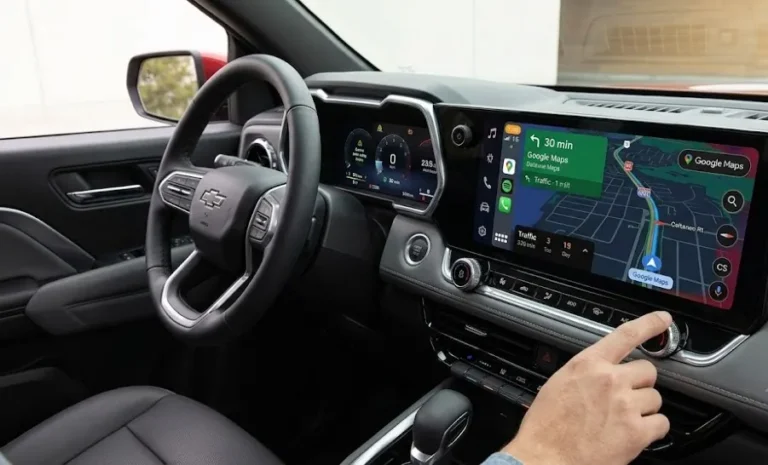
The 11.3-inch center touchscreen runs Google Built-in — the integrated Google software that provides navigation, voice commands, and Google Assistant access without requiring a connected phone. Wireless Apple CarPlay and Android Auto are also standard, and over-the-air software updates keep the system current without requiring a dealership service visit. Tech steals the show with an available 11.3-inch touchscreen running Google Built-In infotainment — think wireless Apple CarPlay, Google Maps navigation, and over-the-air updates. The screen’s portrait orientation and intuitive menu structure make it one of the most usable infotainment interfaces in the midsize truck class.
The 11-inch digital Driver Information Center displays traditional driving data alongside off-road-specific metrics on the trail-oriented trims — pitch and roll angles, throttle and brake input, and 4WD system status. In the ZR2 and Trail Boss, these off-road gauges provide genuinely useful real-time feedback during technical terrain navigation.
Chevy Safety Assist bundles automatic emergency braking, forward collision alert, front pedestrian and bicyclist braking, lane keep assist with lane departure warning, and automatic high beams. Side blind-zone alert with trailer-length coverage is now standard for 2025 and carried forward for 2026. The trailer-length blind spot monitoring is specifically useful for towing — it accounts for the trailer’s full length rather than just the truck’s body when calculating blind zone coverage.
The interior materials are honestly assessed: while lower trims feel utilitarian, upper trims offer a refined experience that justifies their cost. The hard plastics dominate the cabin of the Trail Boss that Autoblog tested — a consistent note in honest Colorado reviews across publications. Buyers who prioritize cabin material quality should budget for the Z71 or ZR2, where the interior appointments meaningfully improve over the WT through Trail Boss experience.
The crew cab’s rear seat provides adult-friendly rear legroom that is genuinely adequate for regular passenger use rather than the token rear-seat access of extended-cab alternatives. The Colorado is crew-cab-only for 2026, which means the rear seat space is a consistent presence rather than an option.
The Colorado’s over-the-air software update capability means the infotainment and vehicle systems can receive improvements without a dealership visit — a practical ownership advantage that reduces the frequency of dealer service appointments for software-related issues. Our complete guide to how to fix common car problems covers the broader maintenance and diagnostic knowledge that complements the Colorado’s modern electronics with the hands-on ownership understanding that every truck buyer benefits from.
Section 4 – Towing, Payload, And Real-World Capability
Class-Leading Numbers And What They Mean In Practice
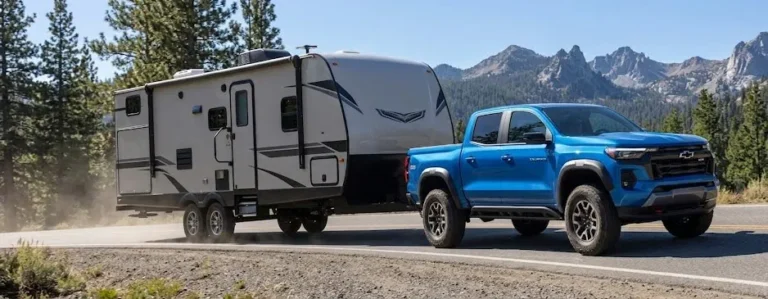
The 2026 Colorado’s towing leadership is the specification that most directly serves buyers who are choosing between the Colorado and its primary competitors. Colorado’s numbers are a selling point: properly equipped WT/LT/Z71/Trail Boss trucks tow up to 7,700 lb, while ZR2 rates 6,000 lb thanks to its off-road setup. Payload spans roughly 1,445-1,846 lb by trim and configuration.
The 7,700-pound figure leads the midsize truck class — it exceeds Toyota Tacoma’s maximum towing and matches or exceeds the Ford Ranger’s maximum in most configurations. For buyers whose specific towing need involves a boat, a camper, or equipment trailers in the 5,000 to 7,500-pound range, the Colorado’s class-leading figure provides both the capability margin and the confidence margin that practical towing requires.
The integrated trailer brake controller — standard on the Trail Boss — is one of the most practically useful towing-specific features in the segment. An integrated trailer brake controller allows the truck to coordinate braking between the tow vehicle and the trailer, reducing stopping distances and preventing trailer sway during deceleration. On the Trail Boss, it comes standard rather than as an add-on, making the trail-oriented trim genuinely tow-ready at its starting price.
The Colorado also offers an optional tow package that monitors your trailer’s mileage and can diagnose issues with it — a technology feature that reflects the truck’s modern electronics platform and that provides practical fleet and recreational towing intelligence that older trucks did not provide.
The multifunction tailgate is one of the Colorado’s most practical cargo-specific features. The tailgate incorporates a work surface, built-in measuring tape, and a storage area under the bed rail that provides weather-protected access without opening the main cargo area. These built-in tools make the Colorado genuinely more useful on a job site or in a campsite than a conventional tailgate configuration.
Section 5 – How The Colorado Compares
Toyota Tacoma, Ford Ranger, And GMC Canyon: Where Colorado Leads And Concedes
The 2026 Colorado competes primarily against the Toyota Tacoma, the Ford Ranger, and the GMC Canyon — which shares the Colorado’s platform and engine but with different styling and trim positioning.
The Colorado’s specific advantages over the Tacoma are torque and towing. The Colorado’s TurboMax engine provides a best-in-class 430 lb-ft torque and towing capacity up to 7,700 lbs, surpassing most Ranger models, which generally offer lower torque and towing limits. The 11.3-inch standard touchscreen also outperforms the Tacoma’s smaller standard display in terms of screen real estate and usability.
The safe choice in this segment is the Tacoma, but if you want something you genuinely don’t see every day, the Colorado is a very good option. That Edmunds assessment captures the competitive dynamic honestly — the Tacoma’s long-term reliability reputation and resale value are the strongest in the segment, and buyers who prioritize those factors above capability and technology specifications have defensible reasons to choose the Tacoma despite the Colorado’s leadership in towing and infotainment.
The Ford Ranger is the Colorado’s closest capability competitor in the standard midsize configuration. The Ranger’s available turbocharged inline-four produces similar output to the TurboMax, and the Ranger Raptor provides a purpose-built high-speed off-road alternative to the Colorado ZR2. The Ranger’s starting price is comparable to the Colorado’s at equivalent trim levels.
The GMC Canyon shares the Colorado’s platform, engine, and basic capability profile with different exterior styling and different trim naming — the Canyon’s AT4 and AT4X off-road trims parallel the Colorado’s Trail Boss and ZR2. Buyers who prefer GMC’s styling and brand positioning access the same fundamental truck through the Canyon.
The Toyota Tacoma’s long-term reliability reputation is the primary reason Edmunds describes it as the safe choice in the segment — a characterization grounded in Consumer Reports and J.D. Power data that our complete guide to the most reliable cars 2026 covers in full, documenting where Chevrolet’s reliability ranking sits relative to Toyota and how the Colorado’s specific platform data affects the buyer’s long-term ownership risk assessment.
Section 6 – The Buying Decision
Which Colorado Is Right For Your Specific Situation
Cross-shop it with Toyota Tacoma, Ford Ranger, and GMC Canyon, then drive the Z71 and Trail Boss back-to-back to find your sweet spot. That TrueCar guidance captures the practical buying approach for anyone seriously considering the Colorado — the back-to-back drive between two adjacent trims communicates the capability and comfort differences more clearly than any specification comparison.
The decision framework is straightforward once the primary use case is defined:
If towing is the primary decision variable: the Trail Boss or Z71 in 4WD provides 7,700-pound towing alongside off-road hardware or premium amenities at competitive prices. Avoid the ZR2 if you regularly tow near the maximum, as its 6,000-pound cap limits utility for heavier trailers.
If off-road capability is the primary variable: the Trail Boss is the most capable Colorado at its price point against its specific competitors. The ZR2 is the most capable Colorado overall, justified for buyers who will use the Multimatic dampers, locking differentials, and 33-inch mud-terrain tires on genuine trail terrain rather than just light off-pavement driving.
If daily comfort and technology are the primary variables: the Z71 provides the best interior quality in the lineup alongside genuine off-road hardware, at a price that represents the Colorado’s best overall daily driver combination. The LT is the right choice for buyers who want daily comfort without the off-road hardware premium.
The Colorado’s starting price of $34,495 for the WT through $62,000 for a fully equipped ZR2 Bison Edition spans a meaningful range that produces correspondingly different insurance costs — our guide to car insurance cost in the USA in 2026 covers how truck classification, vehicle value, and off-road equipment affect what American drivers pay annually, completing the total ownership cost picture for any Colorado trim decision.
If budget is the primary variable: the WT provides the Colorado’s full engine and technology foundation at $34,495 — the most accessible midsize truck entry point with class-leading towing. No comparable truck from Toyota or Ford provides 310 horsepower, 430 lb-ft, 7,700-pound towing, and an 11.3-inch touchscreen at a lower price.
Before finalizing any Colorado purchase — particularly in the higher-mileage used market where the previous generation’s diesel and V6 options have documented maintenance profiles — understanding the specific failure patterns that affect GM truck platforms is essential preparation. Our complete guide to common issues that kill American cars covers the documented GM engine and transmission failure patterns that are relevant to any Colorado buyer evaluating new and used examples.
FAQ
Q: What engine does the 2026 Chevy Colorado have?
A: Every 2026 Chevrolet Colorado uses the 2.7-liter TurboMax turbocharged four-cylinder engine producing 310 horsepower at 5,600 RPM and 430 lb-ft of torque at 3,000 RPM, paired with an 8-speed automatic transmission. This engine is standard across all five trims with no alternatives available. The 430 lb-ft torque figure leads the midsize truck class and exceeds what the previous generation’s Duramax diesel option produced.
Q: How much can the 2026 Chevy Colorado tow?
A: The 2026 Chevy Colorado tows up to 7,700 pounds when properly equipped on the WT, LT, Trail Boss, and Z71 trims — the class-leading figure in the midsize segment. The ZR2 is capped at 6,000 pounds due to its off-road suspension configuration. Payload capacity ranges from approximately 1,445 to 1,846 pounds depending on trim and configuration. Actual towing capacity depends on drivetrain, trailering equipment, payload, passengers, and vehicle configuration.
Q: Which 2026 Colorado trim should I buy?
A: Edmunds recommends the LT for most everyday buyers as a strong fit combining capability with comfort at a reasonable price. The Trail Boss is the specific recommendation for buyers who need genuine off-road capability alongside the full 7,700-pound towing capacity. The Z71 is the right choice for buyers who want trail readiness combined with premium amenities including leather, Bose audio, and ventilated seats. The ZR2 is for serious off-road enthusiasts who will use the Multimatic dampers and locking differentials on actual trail terrain.
Q: What is the difference between the Trail Boss and ZR2?
A: The Trail Boss adds a 2-inch lift to 9.5 inches of ground clearance, skid plates, all-terrain tires, automatic locking rear differential, and red tow hooks at $42,495, maintaining 7,700-pound towing capacity. The ZR2 adds Multimatic DSSV dampers, a 3-inch lift to 11.2 inches of ground clearance, 33-inch mud-terrain tires on beadlock-capable wheels, front and rear electronic locking differentials, five drive modes including Baja mode, and a 3.5-inch wider track, but reduces maximum towing to 6,000 pounds. The ZR2 starts around $46,495 and reaches higher with the Bison Edition package.
Q: Is the Chevy Colorado better than the Toyota Tacoma?
A: The 2026 Colorado leads the Tacoma in maximum towing capacity, engine torque output, and standard infotainment screen size. The Tacoma leads in long-term reliability reputation, resale value, and broad dealer service familiarity. The Colorado is the better choice for buyers who prioritize capability, technology, and price value. The Tacoma is the better choice for buyers who prioritize long-term reliability data and resale value projections. Edmunds notes that the Colorado is a very good option for buyers who want something they genuinely don’t see every day.
Q: What is the Colorado ZR2 0-60 time?
A: Based on real-world testing of early 2026 prototypes, the Colorado ZR2 covers 0-60 mph in approximately 6.5 seconds. The Trail Boss is slightly slower at approximately 7.0 seconds. Both times are for a midsize truck producing 310 horsepower and 430 lb-ft of torque — competitive with similar-output competitors in the segment and meaningfully quicker than the previous generation’s V6-powered alternatives.
The Bottom Line
The 2026 Chevy Colorado is the midsize truck that simplified itself into being genuinely good at everything its segment requires. One engine for five trims. Class-leading towing across four of those trims. An 11.3-inch standard touchscreen across all five. A trail-capable Trail Boss that undercuts comparable Toyota and Ford configurations. A ZR2 that challenges purpose-built off-road alternatives with Multimatic dampers and five selectable drive modes. And a warranty package — three years bumper-to-bumper, five years drivetrain, one year free maintenance — that communicates confidence in the product’s long-term ownership experience.
The honest caveats are real: the engine noise under load is audible, the lower-trim interior materials are functional rather than premium, and the ZR2’s towing compromise requires specific attention from buyers who need both maximum off-road capability and maximum towing simultaneously.
The truck that most buyers should consider is the Trail Boss for any off-road use case, the LT for any everyday use case, and the Z71 for buyers who want both without significant compromise between them. The WT for buyers who need a working truck at the lowest available price. The ZR2 for buyers who will use every piece of its specific hardware.
The Colorado has quietly become the midsize truck to beat in specific capability categories. It is not the safest choice in the segment — the Tacoma remains the default recommendation for buyers who prioritize long-term reliability data above all else. But for buyers who want class-leading towing, a large standard touchscreen, and a lineup that provides genuine off-road capability at fair prices, the Colorado is not the second choice. It is the specific right answer.
Editorial Note
This article was written and reviewed in June 2026. All specifications, pricing, and performance figures are sourced from the following primary sources: Edmunds’ 2026 Chevrolet Colorado review — primary source for the LT recommendation, the class-leading towing and torque characterization, the compliment-earning exterior assessment, and the warranty coverage details; Autoblog’s “I Drove The Chevrolet Colorado Trail Boss.
For buyers ready to configure a specific Colorado — selecting trim, drivetrain, color, and optional packages — the Chevrolet official Colorado build and price tool provides current MSRP pricing for every 2026 configuration including the Trail Boss, Z71, ZR2, and ZR2 Bison Edition with all available packages.
Here’s My Honest Review” (April 17, 2026) — primary source for the Trail Boss $41,395 starting price, the 310 HP TurboMax engine description, the 2-inch factory lift and 9.5-inch ground clearance, the engine noise under load honest characterization, the Tacoma price comparison at $46,000, and the “stable and confident” road and trail assessment; TrueCar’s 2026 Colorado overview — primary source for the 5-trim exclusive crew cab confirmation, 7,700-pound WT/LT/Trail Boss/Z71 towing and 6,000-pound ZR2 towing caps, payload range of 1,445 to 1,846 pounds, combined fuel economy figures by trim group, and the cross-shop recommendation;
Starling Chevrolet (January 17, 2026) — primary source for the TurboMax universal engine strategy, ZR2 hardware description, Trail Boss and Z71 off-road equipment, and fuel economy estimates of 18-20 city and 22-25 highway; Delta Chevrolet (May 2026) — primary source for the 2026 trim MSRP figures ($34,495 WT, $38,095 LT, $42,495 Trail Boss, $46,495 Z71 and ZR2), the 430 lb-ft torque confirmation, the 11.3-inch screen and 11-inch DIC standard equipment confirmation;
Chevrolet-Buff (November 2025) — primary source for ZR2 0-60 of 6.5 seconds, ZR2 3-inch lift and 11.2-inch ground clearance, ZR2 approach/departure angles of 38.6/25.1 degrees, ZR2 bed dimensions, and Trail Boss fuel economy of 18 mpg city/23 mpg highway. All pricing is MSRP before destination, taxes, and dealer fees. Actual pricing varies by region, dealer, and configuration.