Last Updated: June 20, 2026 | Read Time: 9 minutes
The Ford F-Series has been the best-selling vehicle in America for 44 consecutive years. The 2026 F-150 earns a 9.6 out of 10 from US News, a 4.7 out of 5 from KBB, and Consumer Reports’ Top Pick designation — the first full-size pickup to earn that recognition since 2019. The Ram 1500 is the most comfortable full-size truck on the market and its Tungsten variant reaches 60 mph in 4.7 seconds.
The Chevrolet Silverado has fantastic tech at reasonable prices. The Ford Maverick Hybrid achieves 42 miles per gallon city in a truck that starts under $25,000. American pickup trucks in 2026 are the most capable, most technologically sophisticated, and most versatile vehicles ever produced by the American automotive industry. This guide covers all of them honestly — who wins, who loses, and which one is right for your specific needs.
Quick Facts – Best Pickup Trucks
— Best Overall Full-Size: Ford F-150 — 9.6/10 US News, 4.7/5 KBB, Consumer Reports Top Pick 2026
— Most Comfortable Full-Size: Ram 1500 — air suspension, luxury interior, 4.7-sec 0-60 (Tungsten HO)
— Best Technology: Chevrolet Silverado 1500 — Edmunds: Fantastic tech
— Best Premium Workhorse: GMC Sierra 1500 — luxury-skewing, bold styling
— Best Heavy-Duty American Truck: Ford Super Duty (F-250/F-350) — highest towing and payload
— Best Compact/Fuel-Efficient: Ford Maverick Hybrid — 42 MPG city, KBB #1 fuel-efficient truck
— Best Mid-Size American: Ford Ranger — second in KBB mid-size ranking behind Tacoma
— Best Mid-Size Value: Chevrolet Colorado — KBB #3 mid-size truck
— F-150 Starting Price: $36,900 (2026)
— Ram 1500 Starting Price: Approximately $38,000
— Silverado 1500 Starting Price: Approximately $37,000
— Maverick Starting Price: Under $25,000
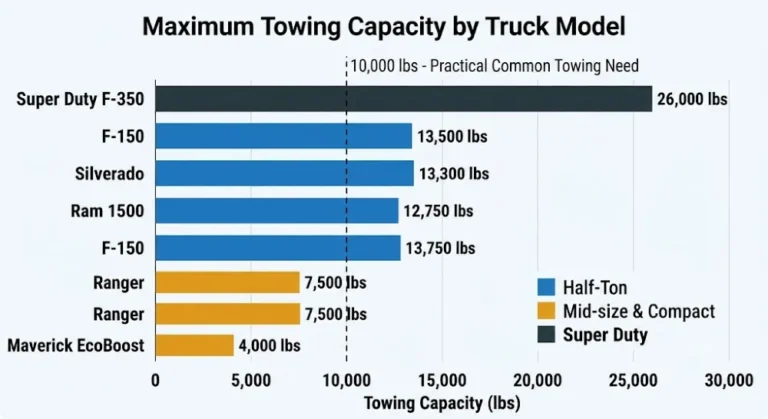
— F-150 Max Towing: 13,500 lbs (3.5L EcoBoost, Max Trailer Tow Package)
— F-150 Max Payload: 2,455 lbs
— Ram 1500 Tungsten 0-60: 4.7 seconds (High-Output Hurricane engine, Edmunds tested)
— F-150 Sales: Best-selling vehicle in America 44 consecutive years
— Reliability Rankings: J.D. Power 2026 VDS — Ram 1500 most dependable large light-duty pickup based on 2023 models
— Consumer Reports 2026 F-150: Made Top Pick list — first full-size pickup since 2019
— RepairPal: F-150, Ram 1500, Silverado, Sierra — all 3.5/5 overall reliability
— New For 2026: Ram 1500 HEMI V8 returned as option alongside Hurricane I-6
Sources: US News, KBB, Edmunds, MotorBiscuit, Consumer Reports, Lochmandy
Overview – Why American Pickup Trucks Are The Most Important Vehicles On Earth
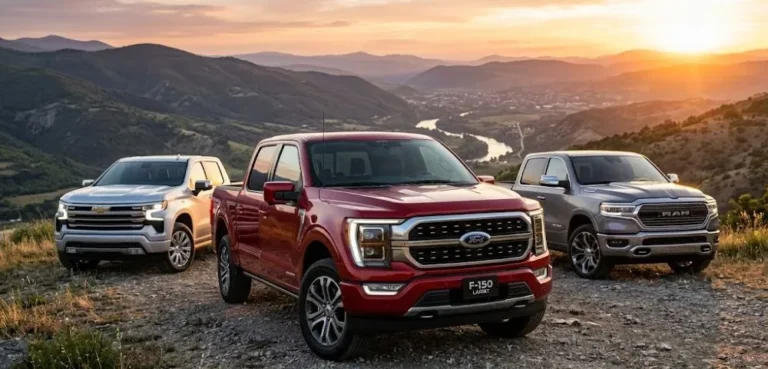
No other country’s automotive industry has produced a vehicle category that so completely defines its culture as the American pickup truck. More than 900,000 Ford F-Series trucks were sold in 2025 alone. The top five best-selling vehicles in the United States are dominated by pickup trucks, and the Ford F-Series, Chevrolet Silverado, Ram 1500, and GMC Sierra occupy four of those positions year after year with a consistency that no other category of vehicle — not sedans, not SUVs, not sports cars — can match.
The 2026 American pickup truck market is the strongest it has ever been in engineering terms. Towing capacities that exceeded anything the segment offered a decade ago are now standard on base trims. Fuel economy that would have been impossible without hybrid technology is now available in the Maverick Hybrid at 42 miles per gallon city. Luxury interiors that compete with premium European sedans are standard in the Ram 1500 Limited and Tungsten. Driver assistance technology that was unavailable at any price five years ago — Super Cruise hands-free driving, Pro Trailer Backup Assist, multi-view camera systems — is now available across the lineup.
The choice between the best American pickup trucks in 2026 is more genuinely competitive than it has ever been. The Ford F-150 earns the most awards and the highest overall scores. The Ram 1500 provides the most comfortable interior and the most sophisticated air suspension. The Chevrolet Silverado offers the best technology package and competitive pricing. The GMC Sierra provides premium positioning for buyers who want the same mechanical capability with more distinctive styling. And the compact and mid-size segment — the Ford Maverick, Ford Ranger, and Chevrolet Colorado — addresses buyers who want truck capability without full-size truck footprint or full-size truck pricing.
This guide covers every significant American pickup truck in 2026 with the data from the publications that tested and ranked them, the specific specifications that define each truck’s strengths, and the honest assessment of which truck is right for which buyer. The F-Series is the best-selling vehicle in America for good reasons. So is understanding exactly what those reasons are before you spend $36,900 to $80,000 on the vehicle you will likely own for the next decade.
Section 1 – The Ford F-150
America’s Best-Selling Vehicle For 44 Years – And The Reasons Still Hold
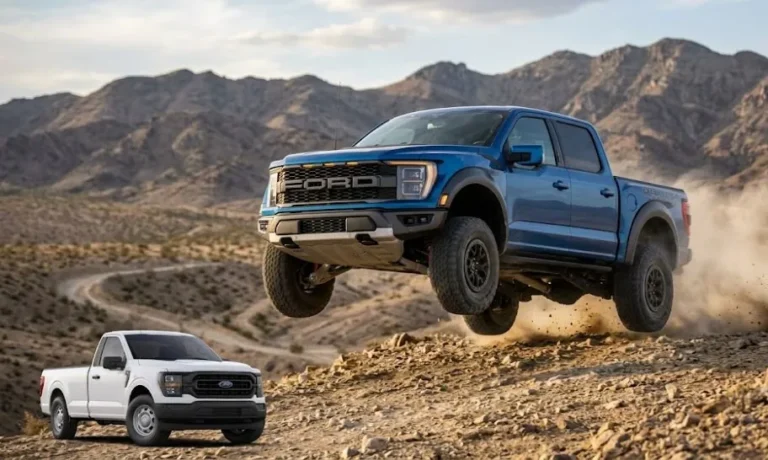
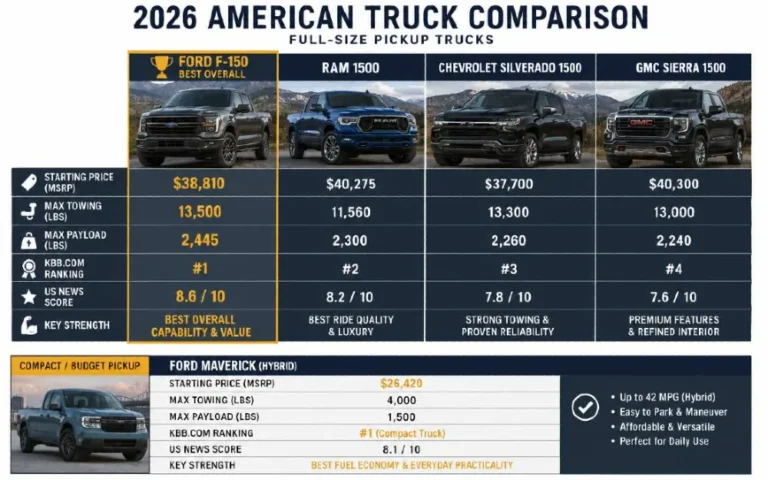
The 2026 Ford F-150 is the best American pickup truck by the most comprehensive available measures. It earns a 9.6 out of 10 from US News — the highest score in the full-size pickup class. It earns a 4.7 out of 5 expert rating from KBB as the number-one full-size truck in that publication’s annual ranking. It earned Consumer Reports’ Top Pick designation for 2026 — the first full-size pickup truck to receive that recognition since 2019. And it leads its class in towing capability and configurability, the two specifications that matter most to the largest portion of the truck-buying public.
The best full-size pickup truck is the 2026 Ford F-150, with an overall score of 9.6 out of 10. If you want to tow, haul, go off-road, or hit the road, the Ford F-150 is ready, willing, and able, boasting best-in-class capability. Those assessments, from two of the three most widely cited automotive publications in the United States, represent the consensus view of the truck’s position at the top of the segment.
The F-150’s capability credentials are the starting point for understanding its dominance. The maximum towing capacity of 13,500 pounds — achieved with the 3.5-liter EcoBoost V6 and the Max Trailer Tow Package in the appropriate configuration — leads the half-ton segment. Maximum payload of 2,455 pounds similarly leads the segment. These are not theoretical numbers from ideal test conditions — they represent the real-world capability that contractors, horse trailer operators, and recreational tow vehicle owners have relied on for decades.
The engine options are the F-150’s most impressive single specification when considered together. The lineup includes a 2.7-liter EcoBoost V6, a 3.5-liter EcoBoost V6, a 5.0-liter naturally aspirated V8, a 3.0-liter Power Stroke diesel V6, and the 3.5-liter PowerBoost hybrid that produces 430 horsepower and 570 lb-ft of torque while achieving up to 24 miles per gallon combined — a fuel economy figure that was unimaginable in a truck with 13,500 pounds of towing capability when the EcoBoost was introduced. The 5.0-liter V8 remains available for buyers who prefer a conventional naturally aspirated V8’s character and the simpler maintenance profile that comes with it.
Consumer Reports specifically cited the truck’s strong powertrains, roomy cabin, and simple controls alongside improved reliability when naming it a 2026 Top Pick. The improved reliability is the most significant change from recent years — Ford’s work on the F-150’s powertrain durability and software quality has produced a measurable improvement in owner satisfaction that the industry’s most rigorous reliability study has specifically acknowledged.
The F-150’s starting price of $36,900 puts it at the accessible end of the full-size truck segment. The fully loaded King Ranch, Platinum, and Limited trims reach into the $70,000 to $80,000 range, and the specialized Raptor off-road performance model adds further beyond that. The breadth of the F-150’s trim range — from the basic Regular Cab work truck to the luxury-focused Limited in crew cab configuration — is itself a capability argument: no other American truck is configurable across as wide a range of use cases and price points.
The Ford F-150’s Consumer Reports Top Pick designation in 2026 is the most visible expression of a broader reliability improvement across the Ford brand — one that our complete guide to the most reliable cars documents in full, with every brand ranking from Consumer Reports and J.D. Power’s 2026 studies and the specific models that score above average.
Section 2 – The Ram 1500
The Most Comfortable Truck In America – And Faster Than A Camry
The 2026 Ram 1500 is the most comfortable full-size truck on the market. That is the specific position US News assigns to it, and it is a position the Ram has defended consistently for more than a decade through a combination of suspension engineering, interior design, and powertrain refinement that no other American full-size truck has consistently replicated.
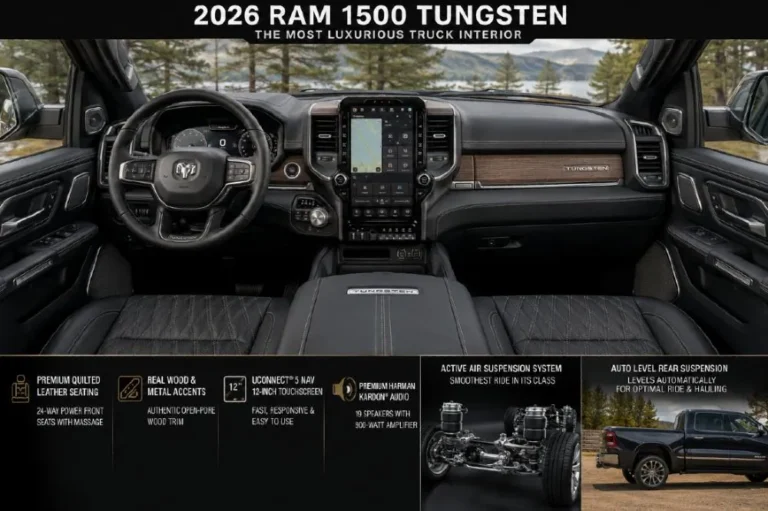
The air suspension is the Ram 1500’s most distinctive engineering advantage. Higher-end models like the Limited and Tungsten come with auto-leveling four-corner air suspension, which helps with ride quality but also makes it easier to get in and out. The coil-spring rear suspension — which the Ram uses instead of the conventional leaf-spring rear of the F-150 and Silverado — contributes to a ride quality that drivers who switch from other trucks consistently describe as transformative. The Ram drives more like a luxury SUV than a work truck in comfort mode, which is precisely the appeal for buyers whose trucks serve as primary daily transportation rather than job site workhorses.
The 2026 Ram 1500 introduces the Hemi V8’s return as an option — a development that Edmunds specifically reviewed for 2026. The Ram 1500 Hemi V8 is slower than the Hurricane turbocharged six in objective testing, but it produces the V8 character — the sound, the throttle response, the cultural connection to Chrysler’s performance history — that a meaningful segment of Ram’s buyer base specifically prefers. The Hurricane twin-turbo inline-six that replaced the HEMI as the primary powertrain for 2025 produces more peak power and better fuel economy, but it does not produce the specific V8 experience. Dodge has heard that feedback and responded.
The performance of the Ram 1500’s top configuration is worth specific documentation: a Ram 1500 Tungsten with the high-output version of the Hurricane engine reached 0-60 mph in just 4.7 seconds in Edmunds testing — a time quicker than many sports sedans. In a vehicle designed primarily to carry and tow, 4.7 seconds to 60 mph is not a marketing figure. It is a specific and documented performance capability that defines the Tungsten as the performance variant in the Ram lineup.
The Ram’s interior quality in the Tungsten and Limited trims is the best available in any American full-size truck. Genuine leather, open-pore wood trim, handcrafted stitching, and the 12-inch Uconnect touchscreen with the most intuitive interface in the segment combine to produce a cabin that competes with German luxury sedans in specific interior quality dimensions. The Ram 1500 is the truck you buy when the daily driver experience — what the cabin feels like, how the suspension absorbs road imperfections, how the interior appointments communicate quality — is the primary criterion alongside towing and hauling capability.
The Ram’s maximum towing capacity — approximately 12,750 pounds with the Hurricane HO engine in the right configuration — trails the F-150’s 13,500-pound maximum. Maximum payload similarly trails the F-150. These gaps are real and matter to buyers who are pushing the limits of half-ton truck capability. They do not matter to the majority of Ram buyers who will never approach either maximum in regular use, and who will notice the Ram’s superior ride quality and interior on every single drive they take.
The Ram 1500 Limited and Tungsten represent the peak of what an American full-size truck interior can be — the complete specifications, interior details, and buyer guidance for the top Ram configurations are covered in full in our Ram 1500 Limited complete guide, including every feature that makes the Ram the most comfortable full-size truck on the market
Section 3 – The Chevrolet Silverado 1500
Fantastic Technology At Competitive Prices — With One Honest Trade-Off
The 2026 Chevrolet Silverado 1500 ranks third in KBB’s full-size truck list and earns a 7.5 out of 10 from Edmunds — an appealing contender among full-size pickups, with reasonable prices, expansive options, and strong performance. The Silverado’s most consistent strength in independent evaluations is its technology package, which Edmunds specifically identifies as fantastic. Its most consistent weakness is comfort compared to the Ram 1500 — the existing review notes the bad as comfort, or lack thereof.
The Silverado’s last full redesign was in 2019 with a refresh following in 2022. That production maturity — the fact that this is a truck in its seventh year of production on the current platform — is both a limitation and a strength. As a limitation, it means some elements of the Silverado’s design feel less current than the most recently updated competitors. As a strength, it means the Silverado’s powertrain and platform have had more time to develop the real-world reliability profile that distinguishes a mature production vehicle from a first-year redesign.
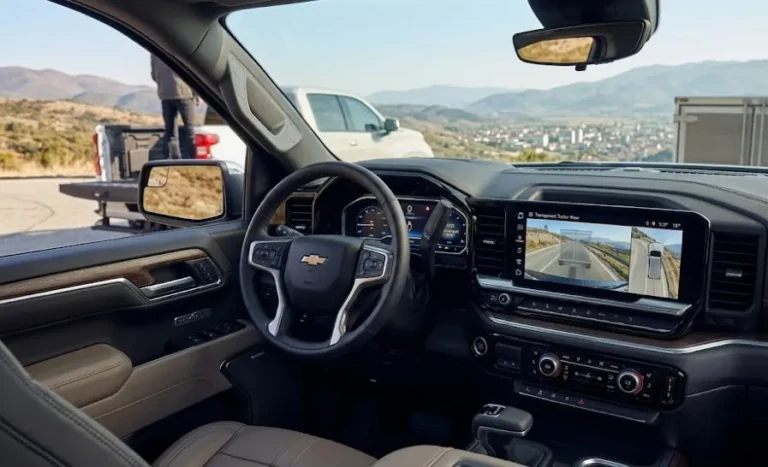
The technology package in the Silverado’s higher trims — particularly the LTZ and High Country — provides one of the most capable infotainment and driver assistance configurations available in the full-size truck segment. The GMC-developed MultiPro tailgate (also available on the Silverado) is the most functionally sophisticated tailgate in the segment, providing six different positions for loading, seating, working, and stepping. The Silverado’s camera system, with its transparent trailer view that uses camera feeds to show a virtual see-through view of the trailer, is one of the most useful technology applications in the class for tow vehicle operators.
The Silverado’s maximum towing capacity reaches 13,300 pounds in the right configuration — within competitive range of the F-150’s class-leading 13,500 pounds. The engine lineup includes a 2.7-liter turbocharged four-cylinder, a 5.3-liter naturally aspirated V8, a 6.2-liter naturally aspirated V8, and a 3.0-liter Duramax diesel. The 6.2-liter V8 is the specific recommendation for buyers who want maximum towing capability with the conventional V8 character — it provides the most torque of any naturally aspirated Silverado engine and delivers the V8 driving experience without the turbocharged character that the smaller four-cylinder offers.
For buyers prioritizing value in the full-size truck segment, the Silverado’s pricing — starting around $37,000 — combined with the breadth of available configurations and the competitive towing capability makes it the most defensible value choice in the class. The comfort trade-off relative to the Ram is real and worth acknowledging, but for buyers who spend less time in the truck seat and more time using the truck’s capability, the Silverado’s combination of towing, technology, and pricing provides strong overall value.
Section 4 – The GMC Sierra 1500
The Premium Alternative To The Silverado — Same Capability, Different Identity
The 2026 GMC Sierra 1500 is a boldly styled workhorse that skews luxurious — the specific characterization from US News captures the Sierra’s identity precisely. The Sierra shares its fundamental architecture, powertrains, and capability specifications with the Chevrolet Silverado but differentiates itself through more distinctive exterior styling, a more premium interior presentation, and the specific additions that justify its position as the premium alternative to the Silverado within General Motors’ truck lineup.
KBB ranks the GMC Sierra third in the full-size truck segment — behind the F-150 and Ram 1500. The Sierra’s positioning is specifically aimed at buyers who want the GM full-size truck engineering — the same 5.3L and 6.2L V8 options, the same maximum towing capability, the same MultiPro tailgate — with styling and interior design that more clearly communicates the premium positioning of the brand. The Sierra Denali and Sierra Denali Ultimate represent the highest expression of GM’s full-size truck luxury ambitions, with interior appointments that compete directly with the Ram 1500 Limited at the high end of the segment.
The Sierra’s AT4 and AT4X off-road variants provide genuine capability on unpaved surfaces — the AT4X specifically adds a multi-media locking front axle, electronic locker rear differential, and underbody protection that positions it as the off-road alternative to the Ford F-150 Raptor within GM’s lineup. The AT4X’s specific capability on unpaved surfaces — combined with the Sierra’s overall engineering strength — makes it the recommendation for buyers who want a full-size truck with serious off-road capability and prefer the GMC brand identity to Ford’s.
The Sierra’s reliability position — 229 problems per 100 vehicles in J.D. Power’s 2026 Vehicle Dependability Study, placing GMC at 23rd overall in Consumer Reports’ 2026 brand rankings — is the most significant concern for any Sierra buyer in 2026. The reliability gap between the Sierra and the Buick and Cadillac products built on related GM platforms reflects the Sierra’s specific generational position and the engineering decisions associated with its 2019 redesign generation. For buyers who prioritize long-term dependability above all other factors, the Silverado’s Consumer Reports position (17th vs GMC’s 23rd) makes the badge choice relevant.
Section 5 – The Ford Super Duty
The Heavy-Duty American Truck That Does What Half-Tons Cannot
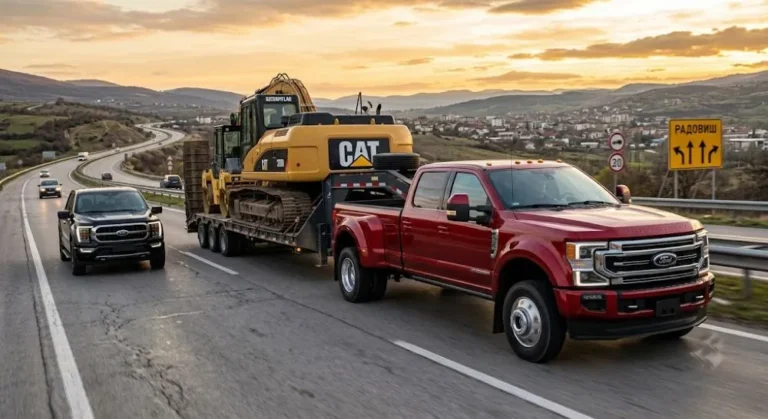
The Ford F-250 and F-350 Super Duty occupies the heavy-duty truck segment above the half-ton F-150 and provides towing and payload capabilities that the half-ton trucks cannot approach — regardless of which maximum configuration is specified. The Super Duty is the American truck for buyers who regularly tow large equipment, fifth-wheel trailers, or boat trailers that exceed 15,000 pounds — the practical ceiling of any half-ton configuration.
The Super Duty’s maximum towing capacity in fifth-wheel configuration exceeds 40,000 pounds in the F-450 dual-rear-wheel configuration — a number that renders half-ton truck towing comparisons irrelevant for the specific user who needs this capability. For buyers who tow gooseneck trailers, large horse trailers, heavy equipment haulers, or live on a farm or construction operation where moving heavy loads is a daily activity, the Super Duty is not simply the best choice — it is the only choice that provides adequate capability margins.
The 6.7-liter Power Stroke diesel V6 — available in the Super Duty and the most refined diesel engine in the American heavy-duty truck segment — produces 500 horsepower and 1,200 lb-ft of torque. That torque figure places the diesel Super Duty in territory where the half-ton trucks’ peak capability numbers are irrelevant — 1,200 lb-ft of torque from idle provides the specific towing character that makes moving heavy loads feel manageable rather than stressful. The 7.3-liter naturally aspirated gasoline V8 — a simpler and more maintenance-friendly alternative — provides 430 horsepower and 475 lb-ft of torque for buyers who prefer conventional gasoline powertrains in a heavy-duty application.
Ford’s Super Duty also led the heavy-duty truck segment in iSeeCars reliability data — Ford’s F-250, F-350, and F-450 all placed above the truck segment average for long-term dependability. This is the specific reliability finding that separates the Super Duty from the F-150 in the reliability context — the heavy-duty trucks, built for sustained heavy work, demonstrate better long-term durability than their lighter-duty counterparts in the data available.
For buyers who are debating between a loaded F-150 and an entry-level Super Duty, the decision point is simple: if the trailer or load you intend to tow regularly exceeds 12,000 pounds, start with the Super Duty. If the load is below 10,000 pounds, the F-150’s half-ton capability and better fuel economy and lower acquisition cost are the correct choice.
Section 6 – The Ford Maverick
42 Miles Per Gallon In A Pickup Truck Under $25,000
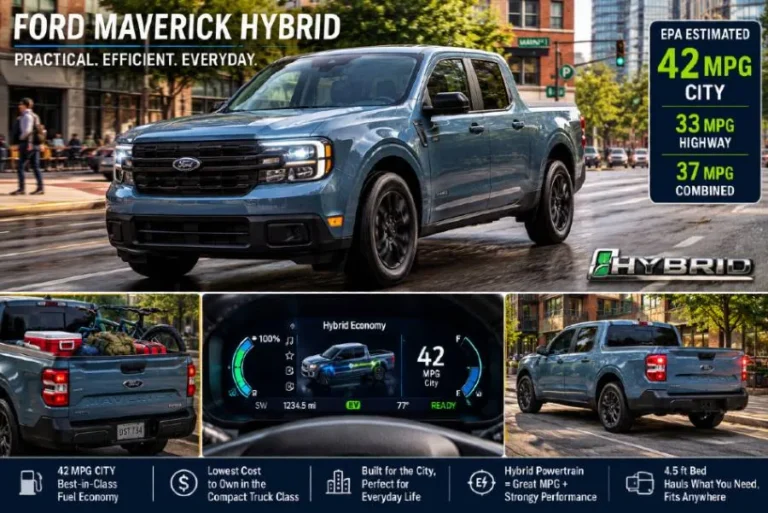
The Ford Maverick is the most remarkable value proposition in the American truck market in 2026. It achieves 42 miles per gallon city driving — the highest city fuel economy of any pickup truck sold in the United States — in a compact truck body that starts under $25,000. KBB ranks it as the number-one most fuel-efficient truck. Consumer Reports rates it above average for predicted reliability. And its hybrid powertrain uses Ford’s proven hybrid system rather than a first-generation EV platform, making it one of the most reliably performing American truck powertrains currently in production.
The Ford Maverick is a compact truck that’s capable, is available with a hybrid drivetrain, and makes city driving and parking a snap. That description from KBB captures the Maverick’s specific appeal accurately — it is not the truck for buyers who need to tow 13,000 pounds or carry 2,000 pounds in the bed. It is the truck for buyers who need a pickup bed for occasional hauling, want the parking and fuel economy benefits of a compact footprint, and want to spend significantly less than any other new truck on the market.
The Maverick’s standard hybrid powertrain is the specific element that makes it most interesting in the 2026 market. Most small trucks treat fuel economy as an afterthought — the Maverick’s standard hybrid configuration treats it as the primary engineering priority. The 2.5-liter Atkinson-cycle hybrid system with its FWD standard configuration provides the 42 MPG city figure in a package that requires no charging, no range anxiety calculation, and no change from conventional truck ownership behavior. It simply burns less fuel than any other truck on the market, city or highway.
A non-hybrid EcoBoost variant is available for buyers who want more towing capability — approximately 4,000 pounds with the right configuration — or all-wheel drive. The EcoBoost Maverick sacrifices the hybrid’s fuel economy advantage for capability gains that bring it closer to the mid-size truck segment’s capability without the mid-size truck’s size or price premium.
The Maverick’s bed is a genuine truck bed — 4.5 feet of usable cargo space with tie-down points, a lockable cargo area option, and the practical hauling capability that distinguishes a pickup from a car-based crossover with a cargo box. The FITS system — the Ford Integrated Tether System — provides a series of built-in mount points for modular accessories that address specific cargo organization needs without requiring aftermarket rack systems.
The F-150 Lightning was discontinued in December 2025 and the next-generation F-150 has been confirmed delayed until 2028 — both developments that are covered in our complete guide to future American cars 2026–2029, which documents Ford’s $30,000 electric midsize pickup promise for 2027 and the full electric truck landscape that follows the Lightning’s discontinuation.
Section 7 – The Mid-Size Segment
Ford Ranger And Chevrolet Colorado — For Buyers Who Need More Than The Maverick And Less Than The F-150
The mid-size American truck segment — occupied primarily by the Ford Ranger and Chevrolet Colorado — addresses buyers who need more capability and bed size than the compact Maverick provides but prefer a smaller footprint and lower cost than the full-size trucks. This segment has been revitalized by multiple significant updates across the competitive set and now offers genuinely compelling options for buyers whose needs sit in this specific capability range.
The Ford Ranger
The 2026 Ford Ranger ranks second in KBB’s mid-size truck rankings — behind the Toyota Tacoma, which has held the segment lead for multiple consecutive years. The Ranger uses a 2.3-liter EcoBoost turbocharged four-cylinder producing 270 horsepower and 310 lb-ft of torque — adequate for the segment’s typical towing demands, which reach approximately 7,500 pounds at maximum configuration.
The Ranger Raptor — Ford’s off-road performance variant of the mid-size truck — is the most capable mid-size off-road truck in the American market. Using a 3.0-liter EcoBoost V6 producing 392 horsepower, the Ranger Raptor provides performance and off-road capability that exceeds anything in the standard mid-size segment and approaches the full-size F-150 Raptor’s on-road performance in a smaller, more maneuverable package.
The Ranger’s on-road refinement has improved with its current generation — the ride quality and interior quality are significantly better than the outgoing model and competitive with the best mid-size trucks from any manufacturer. For buyers who want an American-branded mid-size truck, the Ranger is the specific recommendation.
The Chevrolet Colorado
The 2026 Chevrolet Colorado ranks third in KBB’s mid-size truck segment — a strong showing that reflects the Colorado’s recent redesign and the improved powertrain lineup that came with it. The Colorado uses a 2.7-liter turbocharged four-cylinder producing 310 horsepower and 390 lb-ft of torque in its highest-output configuration — more than the Ranger and competitive with anything in the segment.
The Colorado ZR2 is Chevrolet’s off-road performance mid-size truck, using Multimatic DSSV spool-valve dampers — the same technology used in the Camaro Z/28 — for genuine race-proven suspension performance on and off the road. The ZR2’s specific off-road hardware and the DSSV dampers make it the most technically sophisticated mid-size off-road truck in the American market, though the Ranger Raptor’s power advantage changes the character comparison meaningfully.
For buyers who want a mid-size American truck that has been redesigned most recently and offers the strongest power output at the starting price point, the Colorado is a compelling alternative to the Ranger.
Section 8 – How To Choose The Right American Truck
The Specific Questions That Determine The Right Answer
The American pickup truck market in 2026 offers more genuinely capable, genuinely differentiated options than at any point in the segment’s history. The choice between them is not a matter of which truck is best in isolation — it is a matter of which truck is best for a specific combination of use cases, budget, and priorities. The five questions below define that choice more clearly than any specification comparison.
The purchase price of any truck from $25,000 for the Maverick to $80,000 for a loaded F-150 Platinum is only the first ownership cost — the ongoing insurance expense for a full-size truck varies significantly by model, configuration, and driver profile. Our guide to the cheapest truck insurance in 2026 covers how to minimize the annual insurance cost alongside the purchase price decision.
The first question is towing capacity. If your maximum intended tow weight exceeds 12,000 pounds regularly, the F-150 in its maximum configuration is the half-ton choice. If it exceeds 15,000 pounds, the Super Duty is the correct starting point — not an upgrade consideration, but the base requirement. If your maximum tow weight is below 7,500 pounds, any truck in this guide provides adequate capability and the choice shifts to other criteria.
The second question is daily comfort. If the truck is your primary vehicle for 300 or more days per year and you spend significant time in the cabin across your commute and errands, the Ram 1500’s air suspension and interior quality are worth the trade-off in maximum towing capability versus the F-150. If the truck is primarily a work vehicle and you spend more time loading the bed than sitting in the cabin, the F-150’s capability leadership is more relevant than the Ram’s comfort advantage.
The third question is fuel economy. If fuel cost is a significant ongoing consideration, the Ford Maverick Hybrid at 42 MPG city is the specific answer in the compact segment. In the full-size segment, the F-150 PowerBoost Hybrid and Ram 1500’s optional EcoDiesel provide the best fuel economy at the capability levels full-size trucks offer. The standard gasoline powertrains in every full-size truck deliver fuel economy in the 17 to 24 MPG range depending on configuration and driving conditions.
The fourth question is reliability priority. If long-term reliability is the primary consideration, the J.D. Power 2026 VDS data favors the Ram 1500 based on three-year ownership of 2023 models, while Consumer Reports’ 2026 current data favors the F-150 as the first full-size truck to earn Top Pick status since 2019. The RepairPal scores for the F-150, Silverado, Ram, and Sierra are all equal at 3.5 out of 5. The specific model year matters as much as the brand — avoid first-year redesigns and first-generation new powertrains regardless of which badge they wear.
The fifth question is budget. If the budget ceiling is $25,000 for a new truck, the Ford Maverick Hybrid is the only answer. From $35,000 to $45,000, the Ranger, Colorado, and base-to-mid Silverado and F-150 configurations are all available. Above $50,000, the full-size trucks’ higher trims and the Ram 1500 Limited and Tungsten configurations represent some of the most value-dense premium vehicles available at those price points — more capability, more utility, and often more usable interior space than European luxury sedans at comparable prices.
Reliability scores from RepairPal, Consumer Reports, and J.D. Power tell you the brand average — but the specific failure patterns that affect specific powertrain configurations are what determine your actual ownership experience. Our complete guide to common issues that kill American cars covers the GM 5.3L and 6.2L AFM lifter failures, Ford EcoBoost carbon buildup, and Ram Hurricane engine teething issues that are the documented failure patterns most likely to affect truck buyers
FAQ
Q: What is the best American pickup truck in 2026?
A: The best American pickup truck in 2026 is the Ford F-150, which earns the highest overall scores from the three most widely cited automotive publications: a 9.6 out of 10 from US News (the highest full-size truck score), a 4.7 out of 5 from KBB (number-one full-size truck), and Consumer Reports’ Top Pick designation — the first full-size pickup to earn it since 2019. The F-150 starts at $36,900 and leads the half-ton truck segment in both towing capacity (13,500 pounds maximum) and payload (2,455 pounds maximum).
Q: What is the most comfortable American truck in 2026?
A: The Ram 1500 is the most comfortable full-size truck on the market in 2026, according to US News. Its four-corner air suspension — standard on higher trims including the Limited and Tungsten — provides exceptional ride quality and makes entering and exiting the truck easier. The Ram Tungsten with the high-output Hurricane engine runs 0-60 mph in 4.7 seconds in Edmunds testing. The Ram 1500’s interior quality in its top trims is the best available in any American full-size truck.
Q: What is the most fuel-efficient American truck in 2026?
A: The most fuel-efficient American truck in 2026 is the Ford Maverick Hybrid, which achieves 42 miles per gallon city — the highest city fuel economy of any pickup truck sold in America. KBB ranks the Maverick as the number-one most fuel-efficient truck. It starts under $25,000 and uses Ford’s proven hybrid system. Among full-size trucks, the F-150 PowerBoost Hybrid achieves up to 24 MPG combined while maintaining 13,500 pounds of towing capacity.
Q: Is the Ford F-150 reliable in 2026?
A: The Ford F-150’s reliability improved meaningfully for 2026. Consumer Reports named the F-150 a 2026 Top Pick — the first full-size pickup to receive that recognition since 2019 — citing improved reliability alongside strong powertrains and a roomy cabin. Ford ranks 11th overall in Consumer Reports’ 2026 brand reliability study, its best position in more than 15 years. RepairPal rates the F-150 3.5 out of 5 overall for reliability, the same score as the Ram 1500, Silverado, and Sierra.
Q: What is the difference between the Ford F-150 and Super Duty?
A: The Ford F-150 is a half-ton light-duty truck with a maximum towing capacity of 13,500 pounds. The Ford Super Duty (F-250, F-350, F-450) is a heavy-duty truck designed for sustained heavy work, with maximum towing capacities that exceed 40,000 pounds in the F-450 dual-rear-wheel fifth-wheel configuration. The Super Duty uses a heavier-duty frame, heavier-duty axles, and the 6.7-liter Power Stroke diesel or 7.3-liter gasoline V8 engines. If you regularly tow over 12,000 pounds, the Super Duty is the appropriate tool. For loads below 10,000 pounds, the F-150’s lighter weight and better fuel economy make it the more practical choice.
Q: What is the cheapest new American pickup truck in 2026?
A: The cheapest new American pickup truck in 2026 is the Ford Maverick, starting under $25,000. The Chevrolet Colorado and Ford Ranger start around $34,000 to $35,000 in the mid-size segment. For full-size trucks, the Ford F-150 starts at $36,900, the Chevrolet Silverado 1500 starts around $37,000, and the Ram 1500 starts around $38,000. The cheapest heavy-duty truck is the base Ford Super Duty F-250, starting around $42,000.
The Bottom Line
American pickup trucks in 2026 are the most capable, most technologically sophisticated, and most versatile vehicles ever produced under any American badge. The Ford F-150 at $36,900 leads the class in towing, in reliability recognition from Consumer Reports, and in overall scores from every major publication that ranks the segment. The Ram 1500 is more comfortable on every road you will ever drive and has the most luxurious interior in the segment. The Silverado has the best technology at competitive prices. The Maverick gets 42 miles per gallon from a truck that starts under $25,000.
The choice between them is not a question of which is best in the abstract. It is a question of what you are going to do with it. A contractor who tows 12,000 pounds of equipment five days a week needs a different truck than a commuter who carries mulch bags to the garden center on weekends. Both of them can find what they need in the 2026 American pickup truck market — which is the most specific and most important thing that can be said about it.
The F-Series has been the best-selling vehicle in America for 44 consecutive years for a reason. That reason is not inertia or habit. It is that for most of the buyers who buy trucks in America, the F-150 in the right configuration is the right answer. Understanding why — and understanding when the Ram’s comfort or the Maverick’s efficiency or the Super Duty’s capability is a better answer — is what this guide exists to provide.
Editorial Note
This article was written and reviewed in June 2026. All rankings, scores, and specifications are sourced from the following primary sources: US News “Best Full-Size Pickup Trucks for 2026” — primary source for the F-150 9.6/10 score, the Ram 1500 “most comfortable” designation, the GMC Sierra 1500 description, and the F-150 $36,900 base price; KBB “Best Trucks of 2026” (March 2026) — primary source for the F-150 4.7/5 rating as #1 full-size, Ram 1500 #2, Silverado #3, and the Maverick as #1 most fuel-efficient truck.
Edmunds “Best Full-Size Truck of 2025” comparison test (September 2025) — primary source for the Silverado 7.5/10 “Fantastic tech” characterization, the Ram Tungsten 0-60 4.7-second figure, and the F-150 overall comparison ranking; MotorBiscuit “Most Reliable Pickup Trucks of 2026” (April 17, 2026) — primary source for the Consumer Reports F-150 Top Pick 2026 designation (first full-size pickup since 2019), the J.D. Power 2026 VDS Ram 1500 most dependable large light-duty pickup designation, and the Silverado (12.9%) and Sierra (10.8%) iSeeCars problem frequency data.
Lochmandy Motor Sales “Best Pickup Trucks of 2026” (January 2026) — primary source for the RepairPal 3.5/5 reliability scores for F-150, Ram, Silverado, and Sierra and the description of the four models as the best-rated trucks of 2026; Consumer Reports December 2025 — supplementary source for brand reliability scores referenced in the Silverado and GMC sections. The F-150 max towing of 13,500 pounds and max payload of 2,455 pounds are confirmed by Ford’s official F-150 specifications. The Ram Tungsten 0-60 of 4.7 seconds is from Edmunds’ road test. All base prices are approximate and subject to manufacturer changes.