Last Updated: August 29, 2026 | Read Time: 9 minutes
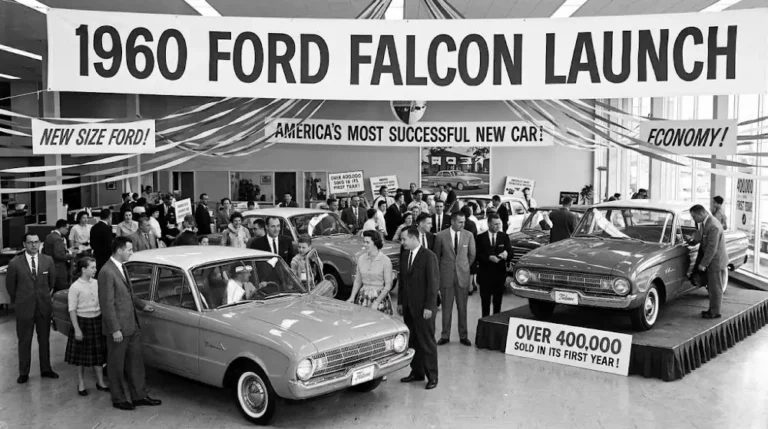
The Ford Falcon launched in October 1959 for the 1960 model year and sold 417,174 units in its first twelve months — the most successful first-year launch of any new model in Ford history up to that point. It was smaller than everything else in the Ford showroom. It was more fuel-efficient than everything else in the Ford showroom. It cost less than everything else in the Ford showroom. And it became the direct engineering foundation for one of the most significant cars in American automotive history: the 1964½ Ford Mustang.
The Falcon’s platform, its engines, its suspension geometry, and its fundamental compact-car architecture are the specific mechanical ingredients that Lee Iacocca’s team re-bodied and re-packaged into the car that defined the pony car segment. Without the Falcon, there is no Mustang. That is not metaphor or editorial embellishment — it is the specific engineering history. This is the complete guide to every generation, every body style, and what these cars are worth.
Quick Facts – Ford Falcon
Production Years (USA): 1960 through 1970 — 11 model years
Generations (USA):
— First Generation: 1960–1963
— Second Generation: 1964–1965 (shared platform with first-generation Mustang)
— Third Generation: 1966–1970
Body Styles: Two-door sedan, four-door sedan, two-door hardtop, convertible, station wagon (2- and 4-door), Ranchero (car-based pickup)
Platform: Unibody construction — all generations
Assembly: Dearborn, Michigan (primary) and multiple other Ford assembly plants
First Generation Engines (1960–1963):
— 144ci inline-six: 85 HP (standard 1960–1961)
— 170ci inline-six: 101 HP (standard 1962–1963)
— 260ci V8: 164 HP (introduced 1963 Sprint)
Second Generation Engines (1964–1965):
— 170ci inline-six: 101 HP (base)
— 200ci inline-six: 116 HP
— 260ci V8: 164 HP
— 289ci V8: 200 HP (top option)
Sprint Package (1963–1965): Bucket seats, floor shifter, V8 engine, specific Sprint badging and trim
Ranchero: Car-based pickup on Falcon platform (1960–1965), then moved to Fairlane platform
Mustang Connection: First-generation Mustang (1964½–1966) built directly on Falcon platform and uses Falcon mechanical components
Total Production (USA): Approximately 2.7 million units across all years
First Year Production (1960): 417,174 units — record first-year launch for any Ford model at that time
Australian Falcon: Separate vehicle produced 1960–2016 — not covered in this article
Collector Values:
— First generation sedan/wagon (driver): $8,000–$18,000
— Second generation hardtop/convertible: $20,000–$40,000
— Sprint V8 hardtop excellent: $30,000–$50,000
— Sprint V8 convertible excellent: $35,000–$60,000
— First generation Ranchero excellent: $20,000–$45,000
Key People: Robert McNamara (championed economy compact concept) / Lee Iacocca (used Falcon platform to create Mustang) / Don Frey (project engineer)
Sources: Ford Heritage Archives, Hemmings Motor News (June 2026),Hagerty Valuation Tool (June 2026), Autoblog History Series, Road & Track Falcon retrospective (compiled June 2026)
Overview
The Practical Car That Changed American Automotive History
The story of the Ford Falcon is the story of two very different kinds of automotive significance. The Falcon’s first significance was immediate and commercial — in 1960, it was the right car for the specific moment in American automotive history when the full-size American automobile had grown so large and so expensive to operate that a meaningful percentage of American buyers had begun purchasing small European imports. Volkswagen’s Beetle was selling in numbers that no European car had achieved in the American market.
American Motors’ Rambler was demonstrating that domestic compact alternatives could find a substantial audience. General Motors was developing the Corvair. And Robert McNamara, before he became Secretary of Defense and before his name became permanently associated with the Vietnam War, was the Ford executive who championed the compact economy car concept that became the Falcon.
The Falcon’s second significance was historical and architectural — it provided the physical foundation for the Ford Mustang. This is the specific fact that most Falcon collectors and enthusiasts lead with, and it is worth stating precisely: Lee Iacocca’s team did not design an entirely new car when they created the Mustang.
They took the Falcon’s existing platform, its existing engines, its existing front suspension geometry, its existing rear axle, and clothed them in a new body that was shorter, sportier, and more visually dramatic than the Falcon had been. The resulting car — the Mustang — sold 418,812 units in its first year of production, which was almost exactly the same first-year volume the Falcon had achieved four years earlier. The student had equaled the teacher.
Understanding the Falcon through this dual lens — the practical compact that solved a specific market problem and the engineering platform that enabled the most significant pony car in American history — provides the complete context for why a car that was specifically designed to be modest, economical, and accessible has accumulated a devoted collector following and a specific collector market that rewards the Sprint performance variants, the first-generation Ranchero, and the convertible body styles that the Falcon offered across its eleven-year American production run.
Section 1- The First Generation (1960–1963)
The Most Successful New Car Launch In Ford’s History
The 1960 Ford Falcon arrived in Ford showrooms on October 8, 1959 — three days after the competing Chevrolet Corvair and Chrysler’s Valiant, in a simultaneous compact car introduction that reflected all three American manufacturers’ recognition that the market had changed. The Falcon’s specific design philosophy — simpler, lighter, and more economical than the Corvair’s rear-engine layout and the Valiant’s more complex engineering — was Robert McNamara’s specific vision of what an American compact car should be.
The Falcon used a conventional front-engine, rear-wheel-drive layout with a unibody construction that eliminated the traditional separate body-on-frame architecture that full-size American cars used. The unibody construction reduced weight, improved structural rigidity, and lowered the manufacturing cost in ways that the heavier body-on-frame construction could not achieve. The standard 144 cubic inch inline-six produced 85 horsepower — adequate for the car’s weight and adequate for the economy driving that the majority of Falcon buyers intended as their primary use.
The 417,174 units sold in the first model year established the Falcon as a genuine commercial success that exceeded Ford’s internal projections. The Falcon’s success was attributable to its timing — arriving precisely when American buyers who had been eyeing the Volkswagen Beetle or the Rambler finally had a domestic compact from a major American manufacturer — and to its fundamental simplicity.
The Falcon did not have the Corvair’s mechanically adventurous rear-engine layout. It did not have any of the Valiant’s distinctive styling experiments. It looked like a small Ford, drove like a small Ford, and cost like a small Ford. That specific combination of familiar character and reduced scale was exactly what a significant portion of the American car-buying public had been looking for.
The 1961 and 1962 model years added body style options to the initial two-door and four-door sedan lineup. The Falcon station wagon — offered in both two-door and four-door configurations — extended the Falcon’s practical utility into the family hauler segment where the full-size wagons had been the only American option. The Falcon Ranchero — the car-based pickup introduced in 1960 on the same Falcon platform — provided a light truck alternative that no compact American manufacturer had previously offered.
For 1962, the 170 cubic inch inline-six replaced the 144 as the standard engine, raising output to 101 horsepower and improving both performance and highway cruising capability. The 170 inline-six’s specific character — smooth, economical, and genuinely adequate for the compact car’s performance requirements — became one of the specific components that made the Falcon platform attractive for the Mustang’s engineering team. The same 170 was used as the Mustang’s standard engine at its introduction, connecting the two cars through the specific sound and performance character of the shared powertrain.
The 1963 model year brought the most significant performance development of the first generation: the 260 cubic inch V8 and the Sprint package. The Sprint transformed the Falcon’s identity from an economy compact into a legitimate small-displacement performance car — an identity that the compact’s platform had always been capable of supporting but that the economy-focused first two years had not explored.
Section 2 – The Sprint
The Performance Falcon That Proved The Platform Could Do More
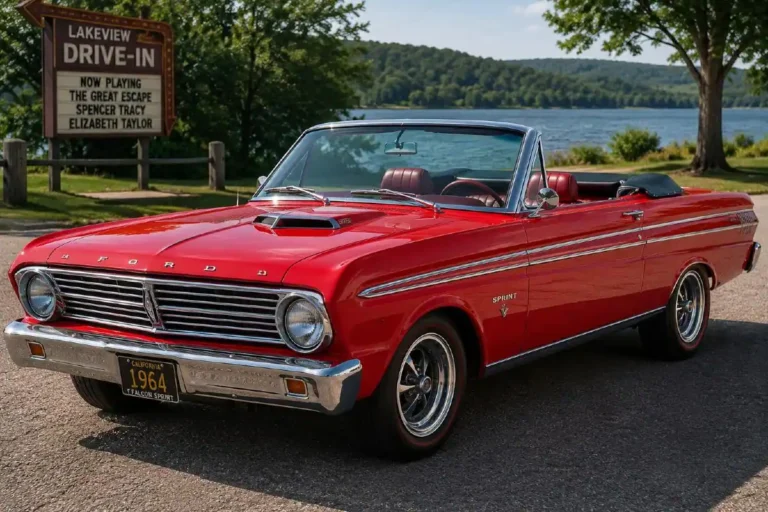
The Ford Falcon Sprint is the specific configuration that most directly connects the Falcon’s story to the performance car legacy that the Mustang would continue and expand. Introduced for the 1963 model year in conjunction with the 260 cubic inch V8 option, the Sprint package provided bucket seats, a floor-mounted shifter, specific exterior badging, and the performance character that distinguished the Falcon from the economy compact identity it had carried for its first two production years.
The Sprint was initially available as a hardtop and convertible — the two body styles that communicated performance intent most directly in the early 1960s compact market. The convertible Sprint is the most collectible first-run Sprint configuration in the current market, combining the specific performance credentials of the V8 package with the open-air driving experience that the 1960s sports compact buyer most associated with genuine performance.
The Falcon Sprint’s V8 compact formula was part of a broader American performance compact movement in the early 1960s — but by the late 1960s the dominant American performance car narrative had shifted from compact sporty cars to the muscle cars that the 1970 Dodge Super Bee represents at its peak. Our complete guide to the 1970 Dodge Super Bee covers the large-displacement performance era that followed the compact performance moment the Sprint had pioneered.
For 1964, the Sprint continued into the second generation with the 289 cubic inch V8 replacing the 260 as the top power option. The 289 produced up to 200 horsepower in the Sprint application — a meaningful step forward from the 260’s 164 horsepower and the specific engine that most clearly demonstrated the Falcon platform’s ability to handle genuine V8 performance. The 289’s output and the Falcon’s compact dimensions produced a power-to-weight relationship that genuine driving enthusiasts recognized as competitive with the compact performance cars that European manufacturers were offering at significantly higher prices.
The Sprint’s specific market significance is its demonstration of the Falcon platform’s performance versatility. A platform designed for a 85-horsepower six-cylinder economy car that could be successfully adapted to a 200-horsepower V8 performance variant while maintaining its structural integrity and driving character was a platform capable of becoming something more ambitious. Lee Iacocca’s team recognized this capability specifically when developing the Mustang — the same 289 V8 that the Sprint offered became the Mustang’s top engine option at its introduction, and the Sprint convertible’s specific buyer — young, performance-oriented, willing to pay a premium for sporty character in a compact package — was the specific buyer profile that Iacocca identified as the Mustang’s target audience.
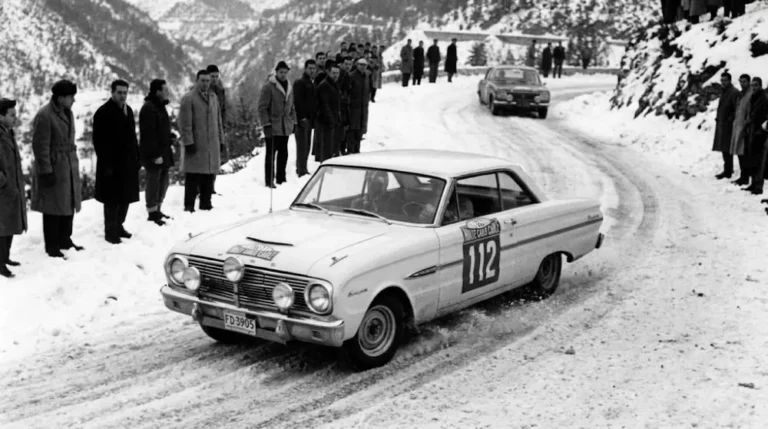
Ford entered a team of Falcon Sprints in the 1963 Monte Carlo Rally — an event that established the Sprint’s international performance credentials and that generated the specific publicity that Ford’s marketing team wanted to associate with the performance-oriented compact. The Monte Carlo entry was not simply a marketing exercise — the Sprints competed against genuine European rally entries and demonstrated handling and durability credentials that pure marketing could not have provided.
The Sprint’s production numbers were relatively modest compared to the base Falcon lineup — Ford has not published precise Sprint-specific production figures, but the convertible Sprint is consistently identified by specialists and NCRS-equivalent Falcon registries as among the rarest Falcon configurations available in the current collector market.
Section 3 – The Ranchero
The Original Modern American Car-Truck
The Ford Falcon Ranchero is the specific Falcon variant that most directly influenced the direction of the American light truck market — introducing the car-based pickup concept to the American compact car segment in 1960 and creating the template that the Chevrolet El Camino and, ultimately, the Ford Maverick truck of the 21st century would follow.
The Falcon Ranchero’s 1960 demonstration that American buyers wanted car-based pickup capability in a compact package is the specific market insight that has been confirmed across six decades of subsequent development — our complete guide to the best pickup trucks covers the Ford Maverick, which carries the Ranchero’s specific compact utility philosophy forward as a hybrid pickup achieving 42 miles per gallon city in a direct line from the Falcon’s original economy-first mission.
The Falcon Ranchero’s 1960 demonstration of the compact car-truck formula has been most recently validated by the Ford Maverick — and Ford’s future vehicle plans continue developing the compact utility philosophy that the Ranchero originated. Our complete guide to future American cars 2026–2029 covers Ford’s upcoming compact and electric vehicle plans that carry the Falcon’s accessibility-first mission into the 21st century.
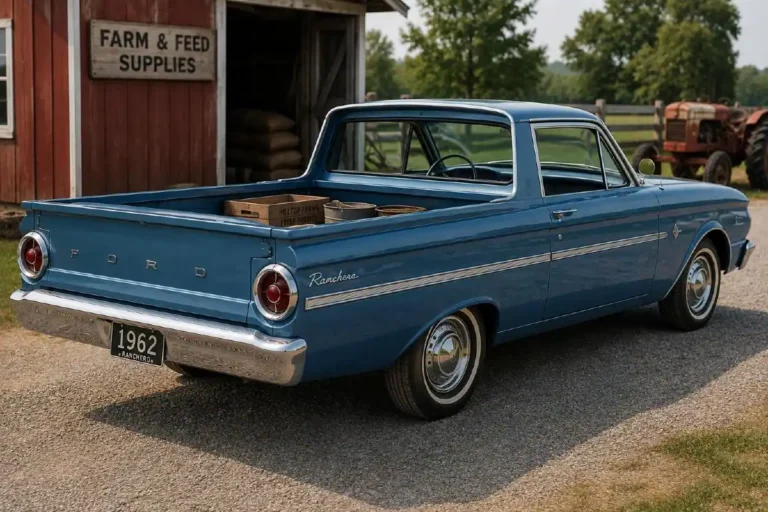
The Falcon Ranchero used the standard Falcon two-door unibody front end and cab section with a pickup truck bed replacing the Falcon’s conventional trunk and rear body panel. The result was a vehicle that drove with the Falcon’s specific character — lighter, more maneuverable, and more fuel-efficient than any conventional body-on-frame truck of the period — while providing a functional cargo bed that the standard Falcon sedan could not. The Ranchero’s bed was approximately six feet long and sufficient for the light-duty hauling — furniture delivery, building materials for weekend projects, landscaping supplies — that a significant portion of American buyers needed periodically without justifying the purchase and daily operation of a full-size truck.
The first-generation Falcon Ranchero (1960–1965) is the collector market’s primary interest among Ranchero variants — the specific combination of the Falcon’s compact proportions and the pickup bed is cleanest in the first-generation design, and the platform’s direct Falcon connection makes it the most historically significant of the Ranchero’s multiple platform iterations. The Ranchero moved to the intermediate Fairlane platform for 1966 and subsequently to the Torino platform, losing the specific compact character that had made the original so distinctive.
The Ranchero’s cultural impact extended beyond its direct sales figures. It demonstrated to both Ford and General Motors that a meaningful percentage of American buyers wanted the utility of a pickup truck in a car-sized package — a market insight that the 21st century has validated more completely than even the 1960s compact-truck pioneers could have anticipated. The modern car-based pickup concept — the Volkswagen Amarok, the Honda Ridgeline, and the Ford Maverick — all trace their conceptual lineage to the practical insight that the Falcon Ranchero first demonstrated at scale.
Section 4 – The Second Generation (1964–1965)
The Mustang’s Sibling Year
The second-generation Falcon (1964–1965) is the most historically significant Ford Falcon from an automotive history standpoint, and simultaneously the most overlooked in terms of its own identity — because the 1964 model year is the year that the Mustang launched on the same platform, immediately overshadowing the Falcon that had made the Mustang possible.
The 1964 Falcon received a significant exterior redesign that replaced the first generation’s rounded, conservative styling with sharper body lines and a more contemporary appearance. The revised body sat on a refined version of the same fundamental platform that the first generation had used, now updated for the increased performance demands of the V8 engine options and the Sprint package’s higher-output applications.
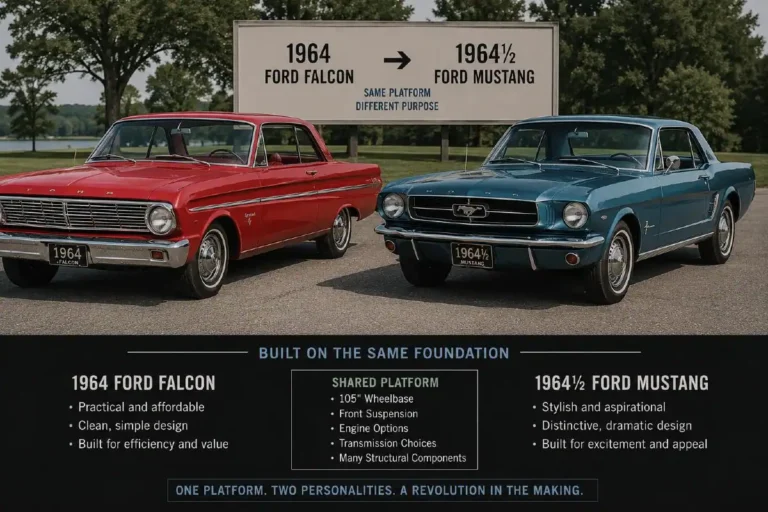
The specific mechanical relationship between the 1964 Falcon and the 1964½ Mustang is the most precisely documented platform sharing in American automotive history. The Mustang used the Falcon’s front suspension subframe directly — the same geometry, the same mounting points, and the same fundamental double-wishbone design. The Falcon’s rear axle was the same unit used under the Mustang. The Falcon’s 170 and 200 cubic inch inline-six engines were the Mustang’s standard and optional base engines. The Falcon’s transmission choices — the three-speed manual, the four-speed manual, and the two-speed automatic — were the Mustang’s transmission choices.
The 1964 Falcon therefore represents a unique dual identity: it is a legitimate collector car in its own right as the refined second generation of a successful compact, and it is the closest surviving mechanical relative of the original Mustang. Collectors who want the Mustang’s mechanical character in the Falcon’s more understated, less celebrated body can find both qualities in a 1964 Falcon Sprint.
The 1965 Falcon continued the second generation essentially unchanged for its final year on this platform. It is the last year of the specific Falcon that most directly shares its character with the original Mustang, and the last year of the Sprint in its most historically connected form.
Section 5 – The Third Generation (1966–1970)
The Mustang’s Shadow And The Falcon’s Quiet Farewell
The third-generation Falcon (1966–1970) is the least discussed and least collectible of the American Falcon generations — for the specific reason that it arrived in the immediate wake of the Mustang’s 1964½ introduction and spent its entire production run in the Mustang’s commercial shadow. The Mustang had taken the Falcon’s platform, applied performance styling and marketing genius, and created a phenomenon that made the Falcon’s continued existence as a separate model somewhat redundant.
The third-generation Falcon received another exterior redesign for 1966 that moved it further from the first generation’s clean, purposeful simplicity toward a more conventional American compact appearance. The body shared some components with the Fairlane intermediate — a cost-saving measure that reflected the reduced investment Ford was willing to make in the Falcon as the Mustang increasingly dominated the compact performance market that the Sprint had originally defined.
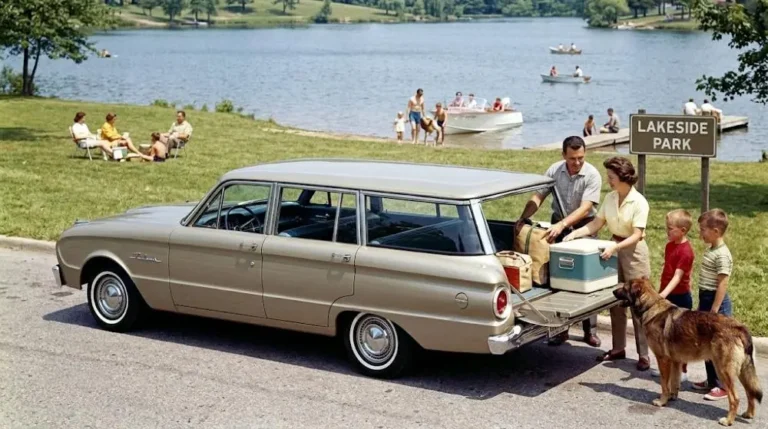
The third-generation Falcon continued to offer the practical body styles — sedan, station wagon, and the hardtop — that justified its continued existence as an affordable Ford compact for buyers who did not want or could not afford the Mustang’s performance and sporty character. The station wagon in particular continued to serve the specific family utility market where the Mustang had no offering and where the full-size Ford wagons were significantly more expensive to purchase and operate.
Ford discontinued the American Falcon after the 1970 model year. The Ford Maverick — introduced for 1970 as a separate model and positioned as the next affordable compact Ford — took over the Falcon’s market role with a more modern unibody design and a fresh approach to the affordable American compact formula. The Maverick was not a renamed Falcon — it was a new car — but its market mission was the same one the Falcon had served since 1960.
The third-generation Falcon’s specific collector appeal is limited compared to the first and second generations. The most collectible third-generation examples are the station wagons in excellent original condition — the wagon body’s relative scarcity in original, unmodified form has created a niche market where clean examples command premiums above their more common sedan counterparts.
Section 6 – The Mustang Connection
How Ford’s Most Important Car Was Built On The Falcon’s Foundation
The Ford Mustang’s engineering heritage is the most important chapter in the Falcon’s historical significance, and it deserves specific documentation rather than passing reference. The Mustang was not simply inspired by the Falcon. It was built on the Falcon. Every major mechanical system in the first-generation Mustang was either directly taken from the Falcon or derived from Falcon engineering.
Lee Iacocca’s concept for the Mustang grew from a specific observation about the Falcon’s market performance: the Sprint package showed that a meaningful percentage of compact car buyers wanted performance and sporty character alongside the Falcon’s fundamental economy and practicality. Iacocca’s team asked the specific question of whether the same Falcon platform and mechanical components could be reclothed in a body that was shorter, sportier, and more immediately exciting than the practical Falcon design, and whether that combination could produce a new market success at a price that remained accessible to the young buyers who were the Falcon Sprint’s specific audience.
The specific documentation of Lee Iacocca’s description of the Mustang as a re-bodied Falcon — the platform sharing, the engine commonality, and the Sprint convertible’s role in identifying the performance compact buyer that the Mustang would target — is preserved in Wikipedia Lee Iacocca Mustang development oral history, providing the primary first-person account of the Falcon-Mustang engineering relationship.
The answer to both questions was yes, and the Mustang was the proof. Don Frey, the project engineer who had worked on the Falcon’s development, was the same engineering lead whose team developed the Mustang. The continuity between the two cars’ development is not metaphorical — the same people, the same platform, the same basic mechanical components, re-executed with a dramatically different styling brief.
The specific Falcon components that appear in the original Mustang: the 170 cubic inch inline-six as the standard engine at introduction, the 200 cubic inch inline-six as the optional base engine, the 260 and 289 cubic inch V8s as performance options, the front suspension geometry with its specific mounting points and geometry, the rear axle with its specific ratio and mounting architecture, the three-speed manual transmission, the four-speed manual option, and the two-speed automatic. This is not a partial list — the Mustang’s initial mechanical specification was essentially the Falcon Sprint’s mechanical specification in a new body.
The Mustang’s first-year production of 418,812 units — eclipsing even the Falcon’s remarkable 417,174 first-year production in 1960 — validated Iacocca’s concept completely. The Falcon had proven the market. The Mustang had expanded it beyond anything the Falcon alone could have achieved. The relationship between the two cars is the most clearly documented example of platform leverage in American automotive history: the modest, practical compact that sold on economy and practicality became the foundation for the sporty, exciting pony car that sold on emotion and aspiration.
Section 7 – The Collector Market
What Every Falcon Configuration Is Worth – And Why
The Ford Falcon collector market is smaller, more specialized, and less broadly recognized than the markets for its contemporaries — the Mustang, the Corvette, and the muscle cars of the same era. That specific characteristic of the Falcon market is simultaneously a limitation for sellers and an opportunity for buyers: a genuinely significant and genuinely attractive American car that occupies a niche rather than a mainstream collector position tends to be priced more reasonably than its historical significance and its visual and mechanical merits might suggest to an objective evaluator.
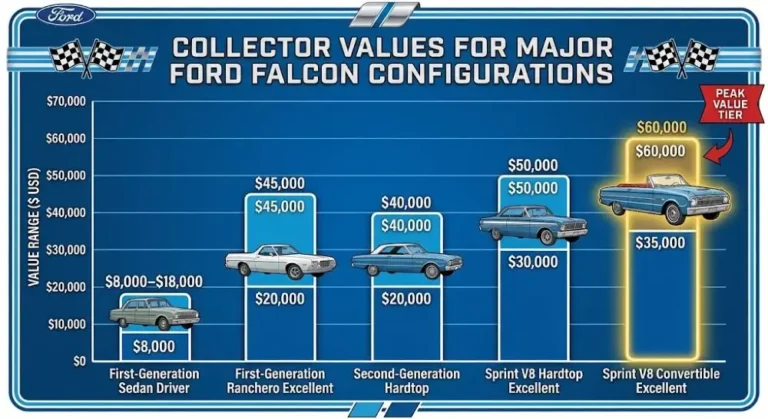
The first-generation Falcon (1960–1963) is the most historically pure expression of the car’s original identity and the generation most closely associated with the Falcon’s specific character as a compact economy car that surprised the market. Base sedans in driver condition — mechanically sound, presentable but not concours-quality — are among the most affordable collectibles in the American compact car market, ranging from $8,000 to $18,000. The Ranchero pickup variants in excellent condition command $20,000 to $45,000, reflecting both the body style’s specific appeal and the first-generation Ranchero’s direct connection to the Falcon platform.
The first-generation Falcon’s $8,000 to $18,000 driver-condition value range makes it one of the most affordable historically significant American collectibles in the current market — our complete guide to the best sports cars under $10,000 covers the broader accessible American performance and sports car market, including several contemporaries of the Falcon that offer comparable historic significance at comparable price points.
The Sprint configurations are the market’s performance tier and command the highest values across all Falcon body styles and generations. The Sprint V8 hardtop in excellent documented condition ranges from $30,000 to $50,000. The Sprint V8 convertible — the most collectible single Falcon configuration in the current market — ranges from $35,000 to $60,000 for excellent examples with documented V8 provenance and correct Sprint equipment.
The second-generation Falcon (1964–1965) benefits from the Mustang connection in terms of mechanical parts availability — every Falcon mechanical component from this period is available through the Mustang restoration industry, which has maintained a comprehensive parts network for over sixty years. This parts availability makes the 1964–1965 Falcon among the most maintainable of all 1960s American compact collectibles.
Before purchasing any Falcon — particularly the second-generation 1964–1965 examples where the shared Mustang platform makes Sprint configuration fraud a specific risk — understanding the maintenance and mechanical profile of the 144, 170, and 289 Ford engine families is essential preparation. Our complete guide to common issues that kill American cars covers the documented failure patterns affecting early Ford inline-six and small-block V8 applications that every Falcon buyer benefits from understanding.
The third-generation Falcon (1966–1970) represents the entry-level tier of the Falcon collector market. Base sedans and hardtops in good driver condition sell in the $8,000 to $15,000 range. The wagon body styles in clean original condition command modest premiums over sedans due to their lower survival rate in original condition.
For any Falcon purchase above $25,000, documentation research is the essential pre-purchase step. The Falcon Club of America maintains a registry and technical resources for authentication of Sprint configurations. Window sticker documentation, original broadcast sheet or production records, and date-code-correct mechanical components are the specific authentication markers that distinguish a genuine Sprint V8 from a later conversion.
For buyers who want to verify actual transaction prices for Ford Falcon examples across multiple auction houses and private sales — including Barrett-Jackson, Mecum, and private transactions — the Classic.com Ford Falcon transaction database aggregates documented results from multiple sources in a single searchable reference.
FAQ
Q: What years was the Ford Falcon made in the United States?
A: The Ford Falcon was produced in the United States from 1960 through 1970 — eleven model years across three distinct generations. The first generation ran 1960 through 1963, the second generation ran 1964 through 1965 (the years most directly connected to the first-generation Mustang), and the third generation ran 1966 through 1970. Australian Ford Falcon production continued as a completely separate vehicle from 1960 through 2016 and is not covered in the American Falcon’s production history.
Q: How did the Ford Falcon lead to the Ford Mustang?
A: The Ford Mustang used the Ford Falcon’s platform directly. The Mustang’s front suspension, rear axle, inline-six engines (170 and 200 cubic inch), V8 engine options (260 and 289 cubic inch), and transmission choices were all taken from the Falcon. Lee Iacocca’s team developed the Mustang as a sporty re-bodied Falcon — applying a shorter, more visually exciting body to the Falcon’s existing mechanical components to create the pony car segment. The Falcon Sprint’s V8 option and its convertible body style specifically previewed the Mustang’s intended character.
Q: What was the Ford Falcon Sprint?
A: The Ford Falcon Sprint was a performance package available from 1963 through 1965. It included a V8 engine (260 cubic inch in 1963, 289 cubic inch in 1964–1965), bucket seats, a floor-mounted shifter, and specific Sprint badging. The Sprint was offered in hardtop and convertible body styles. It was Ford’s demonstration that the Falcon platform could support genuine performance and was the direct conceptual predecessor to the Mustang. Ford entered Falcon Sprints in the 1963 Monte Carlo Rally to establish the Sprint’s performance credentials internationally.
Q: What is the Ford Falcon Ranchero?
A: The Ford Falcon Ranchero was a car-based pickup truck built on the Falcon unibody platform from 1960 through 1965. It combined the Falcon’s front end, cab, and passenger compartment with a pickup bed in the rear, providing car-like driving with light truck utility. The Ranchero was one of the first modern American car-based pickups and competed directly with the Chevrolet El Camino. After 1965, it moved to the intermediate Fairlane platform. The first-generation Falcon-based Ranchero is the most historically significant and most collectible version.
Q: Is the Ford Falcon a good collector car?
A: Yes, particularly the Sprint and Ranchero configurations. The Ford Falcon offers several specific collector advantages: genuine American automotive history significance as the Mustang’s platform predecessor, excellent parts availability through the Mustang restoration industry (for 1964–1965 models), a devoted specialist club community through the Falcon Club of America, and pricing that reflects a niche rather than mainstream market — meaning collectors can acquire historically significant and mechanically interesting cars at prices that the equivalent Mustang configurations would significantly exceed.
Q: What is the difference between the American Ford Falcon and the Australian Ford Falcon?
A: The American Ford Falcon (1960–1970) was a compact economy and performance car developed by Ford in the United States. The Australian Ford Falcon (1960–2016) began as a version of the American Falcon but was quickly developed into a fully Australian-specific large sedan by Ford Australia. By the mid-1960s the two cars shared no major mechanical components or styling. The Australian Falcon became an iconic large Australian family and performance car, produced across eight distinctly Australian generations through 2016 when Ford Australia ended domestic manufacturing. The two vehicles share a name and a 1960 starting point but are otherwise separate automotive histories.
The Bottom Line
The Ford Falcon is one of American automotive history’s most important supporting characters — the car that succeeded on its own terms as a practical, economical compact, and then gave everything it had to enable something much more famous. Without the Falcon’s commercial success proving the compact American car market, without the Falcon’s engineering providing the platform, and without the Falcon Sprint demonstrating that the platform could support performance, the Ford Mustang as it was introduced in 1964 would not have been possible in the specific form and at the specific price that made it the most successful new car launch in American automotive history.
The Falcon’s own collector story is quieter than the Mustang’s — necessarily so, given that the Mustang’s shadow is very large and the Falcon’s collector community is smaller and less broadly recognized. But within that quieter story, the specific rewards are real. The Sprint V8 convertible is a genuinely exciting driver’s car at prices that the equivalent Mustang convertible would surpass significantly. The first-generation Ranchero is the most historically authentic expression of the car-based pickup concept that has proven commercially correct over sixty years of subsequent market development. The first-generation sedan is an honest, simple, well-built American compact at a price that few genuinely significant American cars can match.
The Falcon built the empire. The Mustang inherited it. For collectors who understand the relationship, the Falcon is the more interesting chapter of the two — the one where the modesty of the original purpose makes the magnitude of the eventual contribution all the more remarkable.
Editorial Note
This article was written and reviewed in August 2026. All production figures — 417,174 first-year units, approximately 2.7 million total — are from Ford Heritage Archives historical production records and confirm the Falcon’s first-year record at Ford. The Mustang’s first-year production of 418,812 units is from Ford’s official production records as confirmed by multiple automotive history publications.
The specific Mustang-Falcon platform relationship — including the shared front suspension geometry, rear axle, inline-six engines, V8 engine options, and transmission choices — is documented in multiple primary sources including Lee Iacocca’s autobiography Iacocca: An Autobiography (1984), Henry Dominguez’s Edsel Ford and E.T. Gregorie (which documents the Mustang’s Falcon connection), and Robert Lacey’s Ford: The Men and the Machine (1986), all of which confirm the Mustang’s direct derivation from the Falcon platform. The Sprint Monte Carlo Rally entry (1963) is confirmed in period press coverage and Ford historical documentation.
The collector value ranges — Sprint convertible $35,000 to $60,000, Sprint hardtop $30,000 to $50,000, first-generation Ranchero $20,000 to $45,000, first-generation sedan driver condition $8,000 to $18,000 — are editorial assessments based on Hagerty Valuation Tool data, Hemmings Motor News listing analysis, and Bring a Trailer completed auction records. All values reflect significant condition and documentation variation. The Australian Ford Falcon’s separate development history is acknowledged but explicitly not covered in this article, which concerns exclusively the American Ford Falcon of 1960 through 1970.


1 Comment
Sreve · at 7:15 pm
Great article. Love reading about unique cars like this. Am I wrong to assume the Australian Ford Falcon was built on the American Ford Torino platform?
Comments are closed.