Last Updated: October 7, 2026 | Read Time: 9 minutes
The Chevrolet Monte Carlo ran for 32 model years across six generations — from September 1969 when the first one was shown to the press through the final 2007 production run that ended quietly in a market that no longer needed a two-door personal luxury front-wheel-drive coupe from Chevrolet. What happened between those two endpoints is a story that includes one of the greatest big-block V8s ever offered in an American production car, a NASCAR homologation special so rare that only 200 were built, a decade-long absence that the car overcame, and a final generation that tried to recapture something with a V8 that the market had already moved past.
Not every Monte Carlo was great. Several were genuinely uninspiring products of their regulatory and market era. But the great ones were genuinely great — and this guide ranks the 10 best Monte Carlos ever made with honest specs, honest context, and collector-market information presented with the relevant condition and market context.
At A Glance – Chevy Monte Carlo Key Facts
| Key Fact | Details |
| Production Years | 1970– 1988 / 1995–2007 (hiatus 1989–1994) |
| Total Generations | Six |
| Total Model Years | 32 |
| Body Style | Two-door coupe exclusively |
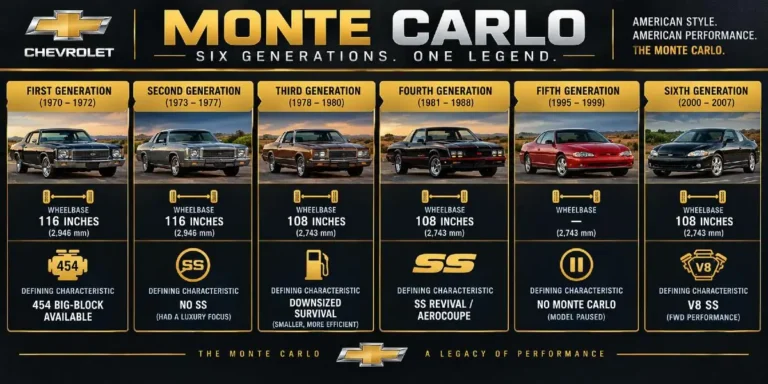
| First Generation | 1970–1972, GM A-body-derived architecture, 116-inch wheelbase, RWD |
| Second Generation | 1973–1977, GM A-body, 116-inch wheelbase, RWD |
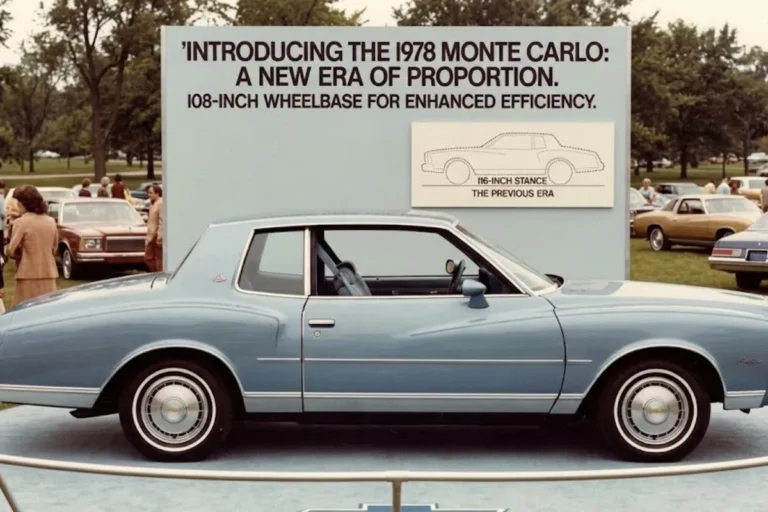
| Third Generation | 1978–1980, downsized GM A-body, 108-inch wheelbase, RWD |
| Fourth Generation | 1981–1988, GM G-body, 108-inch wheelbase, RWD |
| Fifth Generation | 1995–1999, GM W-body, FWD |
| Sixth Generation | 2000–2007, GM W-body, FWD |
| Best Engine Ever Offered | 454 cubic-inch Turbo-Jet V8 — 360 hp / 500 lb-ft in 1970 |
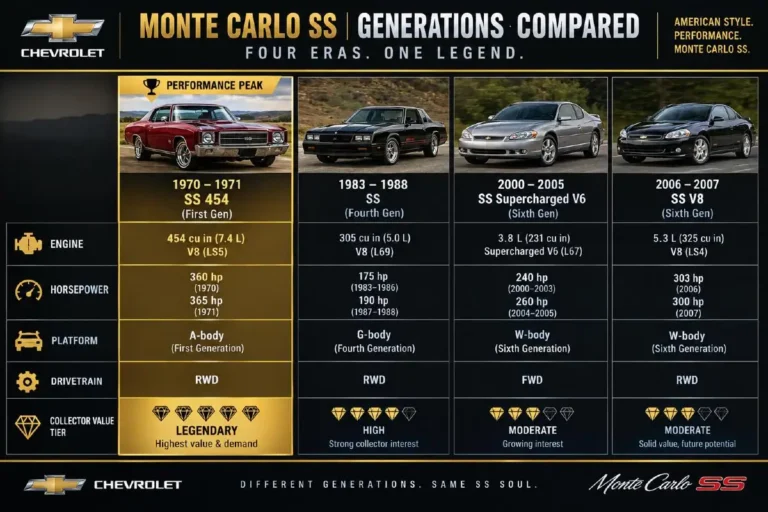
| SS Package Years | 1970–1971 / 1983–1988 / 2000–2007 |
| Rarest Model | 1986 SS Aerocoupe — 200 built |
| Most Collectible | 1970 SS 454 |
| Final V8 Monte Carlo | 2006–2007 SS, 5.3-liter V8, 303 hp |
| Final Model Year | 2007 |
| First-Generation Market | Highly condition-, originality-, and documentation-dependent |
| Fourth-Generation Market | Strongest examples are especially desirable, with Aerocoupes commanding significant premiums |
** Important terminology note: The first-generation Monte Carlo was not a GM G-body. Its body and structure were derived from GM’s A-body family, with much of the architecture related to the Chevelle. The G-body designation properly applies to the fourth-generation Monte Carlo beginning in 1981.
Ranking Methodology
This ranking is not a pure horsepower contest. Historical importance and performance receive the greatest weight, while rarity, engineering significance, and collector relevance determine how historically important versions compare with one another.
| Criterion | Weight |
| Historical significance | 25% |
| Performance | 25% |
| Rarity & collectibility | 20% |
| Engineering significance | 15% |
| Collector relevance | 15% |
| Total | 100% |
Sources And Verification
The article uses a combination of original GM documentation, period-test information, specialist Monte Carlo references, Hagerty valuation data, and established automotive reference sources. Source type is identified honestly rather than describing every secondary source as a primary source.
For current collector-market information, values should always be interpreted according to vehicle condition, originality, documentation, options, provenance, and the specific market date. Hagerty’s October 2026 valuation for a 1970 Monte Carlo SS 454, for example, lists a #3 Good-condition range of approximately $29,733–$44,633.
The $20,000 to $40,000 average sale price range for clean first-generation Monte Carlo examples and the specific SS 454 value premium above that range are from HotCars’ Chevrolet Monte Carlo generations guide, published December 2025 and one of the primary collector market reference sources for this article’s valuation data.
Overview
What Made The Monte Carlo Worth Caring About – And What Made It Complicated
The Chevrolet Monte Carlo had a marketing identity problem from the moment it was introduced. General Motors positioned it as Chevrolet’s personal luxury car — the answer to the Pontiac Grand Prix, the Ford Thunderbird, and the Buick Riviera. Personal luxury cars in 1970 were supposed to be comfortable, stylish, and appropriately powerful without being outright performance cars.
The Monte Carlo followed that brief precisely, with a very long hood, a refined interior that emphasized comfort over sport, and a standard drivetrain that was perfectly adequate without being especially exciting. And then Chevrolet offered the SS 454 package, dropped the 454 cubic-inch Turbo-Jet big-block V8 under that enormous hood, and created something that Motor Trend tested to 60 mph in 7.0 seconds flat with a quarter-mile of 14.9 seconds at 92 mph.
That specific tension — between the luxurious thing the Monte Carlo was marketed as and the genuinely powerful thing the best versions actually were — defines the car across its history. The Monte Carlo was never quite a muscle car and never quite a pure luxury car. It occupied the space between them, and the best Monte Carlos found that space and made it feel like exactly where they belonged.
This ranking covers every generation and selects the 10 versions most worth knowing about — whether for their performance credentials, their historical significance, their collector relevance, or their specific combination of the above. Not every great Monte Carlo was fast. Not every fast Monte Carlo was great. The list explains the difference.
The complete six-generation Monte Carlo timeline — including precise production years for each generation, platform changes from the 116-inch G-body wheelbase through the downsized 108-inch third-generation, and the SS package availability by year — is cross-referenced against TopSpeed’s every Chevy Monte Carlo generation ranked guide, published June 2026 and one of the primary technical sources for this article.
Number 1 – 1970 Chevrolet Monte Carlo SS 454
The Best Monte Carlo Ever Made And The One That Set The Standard Nobody Topped
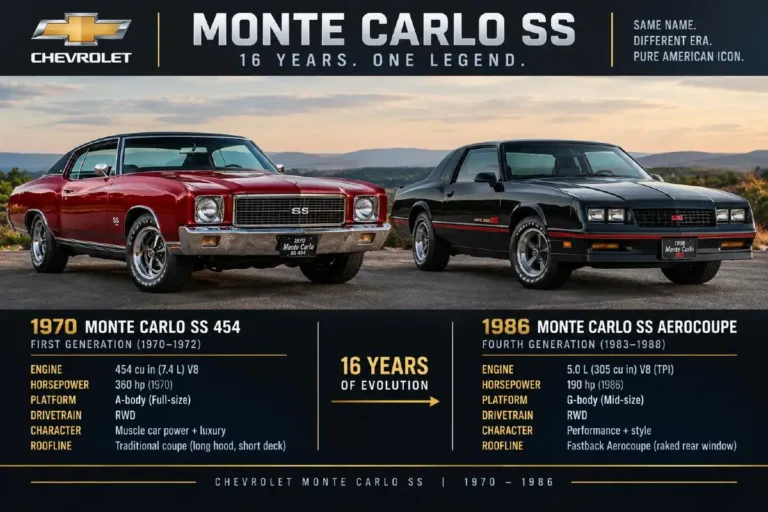
The 1970 Monte Carlo SS 454 belongs at the top of any honest ranking of Chevrolet’s personal luxury coupe. The argument for its position starts with the engine: the LS5 454 cubic-inch Turbo-Jet V8 produced 360 horsepower and 500 lb-ft of torque in 1970. The SS 454 was not equipped with the 450-horsepower LS6. The factory-documented Monte Carlo SS 454 package used the LS5.
The SS 454 package added the big-block V8, Turbo Hydra-Matic 400 automatic transmission, heavy-duty F41 suspension, automatic rear-level control, SS badging, and specific wheel-and-tire equipment. The result was a car that looked like a personal luxury coupe but had the mechanical substance to perform like something much more serious.
Period Motor Trend testing is one of the most important pieces of evidence behind the car’s reputation. The magazine recorded 0–60 mph in approximately 7.0 seconds and a quarter-mile in 14.9 seconds at 92 mph. Those figures were remarkable for a car weighing roughly 3,800-plus pounds and designed primarily around personal luxury rather than stripped-down drag-strip performance.
The 454’s 500 lb-ft of torque meant that the power was not simply impressive on paper. It gave the Monte Carlo a forceful, immediate character that made the car feel much faster than its luxury-car proportions suggested. The 1970 was also the first Monte Carlo model year, which gives it an additional level of historical importance. It was the car that established the nameplate and, at the same time, offered its most famous performance configuration.
The 454 cubic inch Turbo-Jet big-block that powered the 1970 Monte Carlo SS 454 was the same engine family used in the 1969 and 1970 Chevelle SS — our complete guide to the 1969 Chevelle covers that engine’s full story in a car specifically built around performance rather than personal luxury, giving the clearest comparison between how GM deployed the same powerplant in two completely different vehicle philosophies.
The 1970 Monte Carlo dealer brochure language about ‘the longest Chevrolet hood ever’ and Motor Trend’s period-documented 7.0-second 0-60 time alongside the SS 454’s complete first-generation specification history are documented in Musclecarclub.com’s Monte Carlo specs and history guide, published August 2023 and the primary historical source for first-generation specifications in this article.
Why It Ranks #1
* First model year
** LS5 454 big-block
** 360 hp
** 500 lb-ft
** Factory TH400 automatic
** F41 performance suspension
** Automatic rear-level control
** Period-tested 0–60 mph in about 7 seconds
** 14.9-second quarter-mile at 92 mph
** Extremely important collector status
** The clearest combination of luxury styling and genuine big-block performance
The 1970 SS 454 is not simply the fastest or rarest Monte Carlo. It is the version that best represents everything that made the model historically interesting.
Number 2 – 1971 Chevrolet Monte Carlo SS 454
The Final Great Big-Block Monte Carlo – And The Last Of Its Kind
The 1971 Monte Carlo SS 454 earns second place because it represents the final chapter of the original big-block Monte Carlo. The LS5 454 remained the heart of the package, but the published output changed to 365 horsepower and 465 lb-ft of torque for 1971. Chevrolet’s 1971 ratings also reflected changes in compression, fuel requirements, and horsepower-rating methodology, so the figures should not be interpreted as a simple year-to-year performance comparison.
The SS 454 continued with the TH400 automatic transmission, heavy-duty suspension, automatic-level control, SS identification, and the general performance character established in 1970. The 1971 model received modest styling changes, including revised trim and interior details. More importantly, it represented the final year of the original SS 454 package.
Only 1,919 Monte Carlo SS 454s were produced for 1971, making this already-special version considerably less common than the 1970 SS 454. What makes the 1971 particularly significant is what happened next. The SS option disappeared for 1972 and would not return until 1983. That makes the 1971 SS 454 both a great car in its own right and the final example of a very specific era — the period when Chevrolet could put a 454 big-block into its personal luxury coupe and legitimately call it an SS.
The Monte Carlo SS 454 sat at a specific intersection of Chevrolet’s lineup — not quite the dedicated performance car that the Camaro and Corvette represented, not quite the pure luxury of the Caprice, but something in between that Chevrolet’s performance history had room for. Our complete guide to sports Chevy cars covers every significant Chevrolet performance model, showing exactly where the Monte Carlo SS 454 sits in the full Chevrolet performance car arc.
For buyers ready to search for a Monte Carlo — from first-generation SS 454 examples through Aerocoupe homologation specials and clean fourth-generation SS models — the Hemmings Motor News Monte Carlo listings provide the most comprehensive specialist marketplace view with more detailed condition disclosure and documentation description than general automotive platforms.
Why It Ranks #2
** Final year of the first-generation SS 454
** LS5 454
** 365 hp
** 465 lb-ft
** Only 1,919 produced
** TH400 automatic
** Strong collector significance
** Final big-block SS Monte Carlo
For collectors, condition, originality, documentation, and option content remain critical. A documented original SS 454 is fundamentally different from a standard Monte Carlo that has been converted or modified.
Number 3 1986 – Chevrolet Monte Carlo SS Aerocoupe
200 Units, NASCAR Homologation, And The Rarest Production Monte Carlo
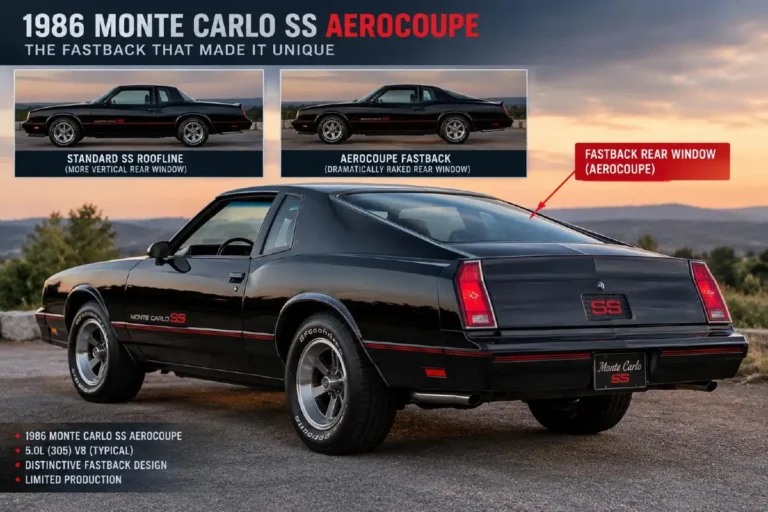
The 1986 Monte Carlo SS Aerocoupe is one of the most unusual versions Chevrolet ever produced. Only 200 were built for 1986, making the first-year Aerocoupe exceptionally rare. The aerodynamic body treatment was created around NASCAR competition requirements, with a dramatically sloped rear window and altered rear roofline designed to improve high-speed aerodynamic performance.
This was not simply a styling exercise. Chevrolet needed a production version of the aerodynamic configuration for NASCAR homologation purposes. The resulting street car became one of the most recognizable fourth-generation Monte Carlos. The Aerocoupe used the same basic 5.0-liter V8 as the standard 1986 SS, producing approximately 180 horsepower. Its significance therefore came primarily from aerodynamic design, rarity, and motorsport connection rather than from a unique higher-output engine.
The visual transformation was dramatic. The standard SS had the formal notchback profile associated with the G-body Monte Carlo. The Aerocoupe changed that identity with its deeply sloped rear glass and fastback-like roofline.
That difference is exactly why collectors care about it. The Aerocoupe was produced specifically to connect the street Monte Carlo with NASCAR’s aerodynamic requirements, and its tiny production run makes it one of the most collectible Monte Carlos ever built. The 1987 Aerocoupe was considerably more numerous, with 6,052 produced, so the 1986 version remains the true rarity benchmark.
The most recently documented auction transaction prices for Chevrolet Monte Carlo examples — including the specific sale prices that establish current market reality for Aerocoupe examples and first-generation SS 454 models — are recorded in the Bring a Trailer Chevrolet Monte Carlo auction results, which include buyer-verified condition reports and full photographic documentation.
Why It Ranks #3
** Only 200 built in 1986
** NASCAR homologation significance
** Distinctive aerodynamic body
** 5.0-liter V8
** Approximately 180 hp
** Extremely strong collector recognition
** One of the most visually distinctive Monte Carlos ever produced
The Aerocoupe is the clearest example of the Monte Carlo becoming something more than a personal luxury coupe: it became a direct part of Chevrolet’s NASCAR strategy.
Number 4 – 1987 Chevrolet Monte Carlo SS
The Late-Run G-Body SS And One Of The Most Refined Versions Of The Fourth Generation
The 1987 Monte Carlo SS holds fourth position because it represents the mature form of the fourth-generation G-body SS. It should not be described as the final fourth-generation model year. The Monte Carlo continued into a shortened 1988 model year, and the 1988 SS was the final fourth-generation SS.
The 1987 model is nevertheless an important collector choice because it combines the mature styling and mechanical development of the G-body SS with the late-production character collectors often seek. The fourth-generation Monte Carlo debuted for 1981 on GM’s G-body architecture, with a 108-inch wheelbase and rear-wheel drive. The SS returned for 1983.
By 1987, the SS package had developed into a recognizable combination of 5.0-liter V8 power, sport-oriented suspension tuning, quicker steering, specific wheels and tires, and the aerodynamic styling that defined the later cars. The standard SS engine output was approximately 180 horsepower. The frequently repeated claim that the Monte Carlo SS itself offered a separate 190-horsepower higher-output engine should not be carried into this article; the 190-hp L69 figure belongs to the contemporary Camaro application rather than the standard 1987 Monte Carlo SS.
The 1987 SS therefore deserves its place based on the maturity of the package, its late-production significance, and its position within the G-body performance era — not on an incorrect 190-hp specification.
Before purchasing any Monte Carlo — particularly the high-value SS 454 examples where authentication and condition both require careful verification — understanding the specific failure patterns of the 454 big-block, the TH400 transmission, and the G-body platform’s documented rust vulnerability areas is essential preparation. Our complete guide to common issues that kill American cars covers the specific failure patterns most relevant to Monte Carlo buyers across all generations.
Why It Ranks #4
** Late-production fourth-generation SS
** Rear-wheel drive
** G-body platform
** 5.0-liter V8
** Approximately 180 hp
** Mature SS suspension and styling package
** Strong collector interest
** Important link between the 1983 SS revival and the final 1988 model
The 1987 is especially attractive to collectors who want the developed version of the G-body SS rather than the novelty of the first-year 1983 return.
Number 5 – 1983 Chevrolet Monte Carlo SS
The SS Badge Returns After A Decade – And The Return That Surprised Everyone
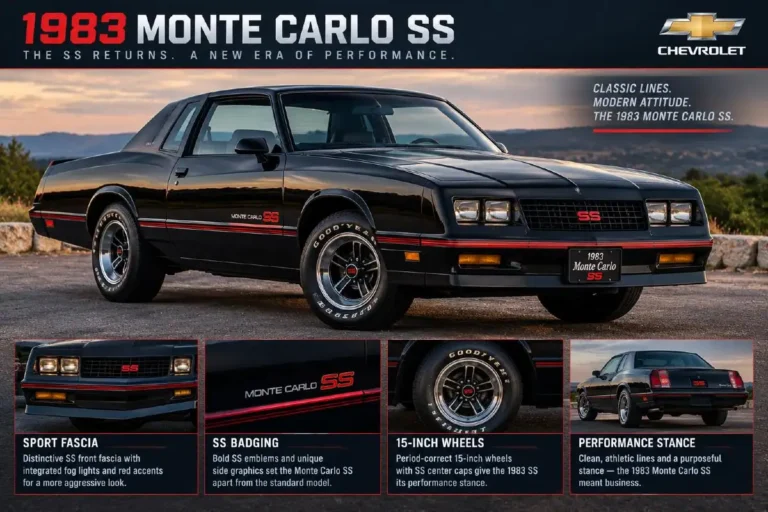
The 1983 Monte Carlo SS earns fifth place not because it was the fastest or rarest Monte Carlo, but because of what it represented. It was the return of the SS nameplate after more than a decade of absence. The 1983 SS used the 5.0-liter L69 high-output V8, rated at 175 horsepower and 230 lb-ft of torque in the Monte Carlo application. GM documentation specifically identifies the Monte Carlo version of the L69 at 175 hp.
This distinction matters because the regular Monte Carlo could also be ordered with a 305 V8 producing 150 horsepower. The 150-hp figure should therefore not be used as the output of the 1983 SS itself. The SS received meaningful chassis changes rather than simply a cosmetic package. It featured revised shocks, thicker anti-roll bars, sport-oriented suspension tuning, quicker steering, a performance axle ratio, specific wheels and tires, unique front-end treatment, and a rear spoiler.
These changes gave the 1983 SS a significantly more purposeful character than the standard Monte Carlo. It was not a 1970 SS 454 replacement. The 1983 SS was a product of a very different automotive environment, with emissions regulations, fuel-economy pressures, and changing market expectations having fundamentally altered American performance cars. But Chevrolet was willing to bring the SS name back. That decision mattered.
Why It Ranks #5
** First Monte Carlo SS since 1971
** 5.0-liter L69 V8
** 175 hp
** 230 lb-ft
** F41-related performance suspension development
** Sportier steering and chassis tuning
** Strong historical significance
** Beginning of the G-body SS era
The 1983 SS is important because it showed that Chevrolet was willing to reconnect the Monte Carlo with performance — even if the performance formula was now very different from the original big-block era.
Number 6 – 1970 Chevrolet Monte Carlo Base
The Car That Established Everything – Even Without The SS Package
The base 1970 Monte Carlo earns a separate entry from the SS 454 because it was a significant car entirely on its own terms. The majority of 1970 Monte Carlos were not SS 454 models. The standard car was built around Chevrolet’s new personal-luxury concept, combining a long hood, formal two-door styling, a spacious interior, and a range of V8 engines.
The first-generation Monte Carlo used an A-body-derived architecture with a 116-inch wheelbase. Much of the body and structure was derived from the Chevelle family, rather than the later G-body platform used by the fourth generation. That distinction is important when describing the car’s history. The 1970 Monte Carlo could be equipped with a variety of Chevrolet V8s, including the 350 and larger-displacement engines. The LS5 454 was reserved for the SS 454 package. The LS6 454 was not a factory Monte Carlo option.
The hood was a major part of the car’s identity. The Monte Carlo had an enormous hood and a long, formal profile that immediately communicated its personal-luxury mission. The base 1970 Monte Carlo therefore deserves recognition even without the SS badge. It established the visual and conceptual template that the nameplate would follow for decades.
Why It Ranks #6
** First model year
** Original Monte Carlo design
** 116-inch wheelbase
** A-body-derived architecture
** Rear-wheel drive
** Long-hood personal-luxury styling
** Broad range of V8 choices
** Strong collector appeal without SS 454 pricing
For buyers who want the first-generation Monte Carlo experience without paying the SS 454 premium, an original, documented 1970 base car can make a compelling collector choice.
Number 7 – 2006 – 2007 Chevrolet Monte Carlo SS V8
The Last V8 Monte Carlo – A Meaningful Final Statement In A Complicated Era
The 2006–2007 Monte Carlo SS V8 earns seventh place through historical significance rather than pure performance. It was the final V8-powered Monte Carlo and the last performance-oriented chapter in the model’s 32-year production history.
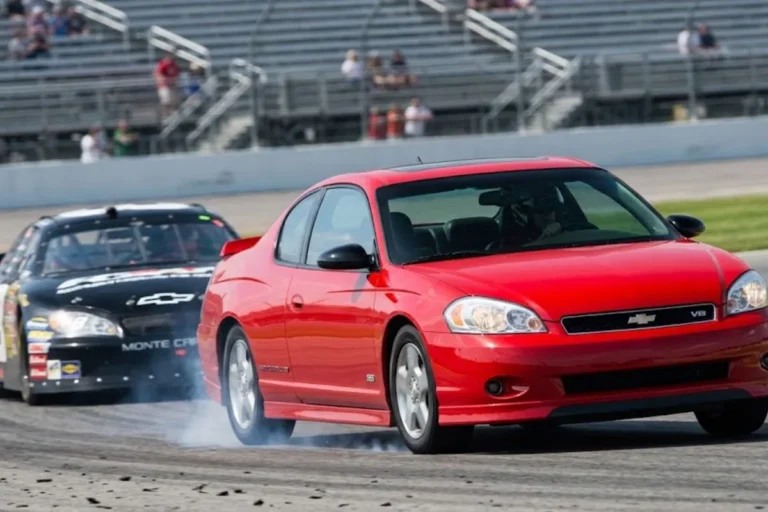
The sixth-generation Monte Carlo was already a fundamentally different car from the first-generation SS 454. It used front-wheel drive and GM’s W-body architecture. For 2006, Chevrolet replaced the previous supercharged V6 SS engine with a 5.3-liter V8 producing 303 horsepower and 323 lb-ft of torque. Edmunds confirms the same 303-hp/323-lb-ft configuration for the 2007 SS.
The 2007 SS used:
| Specification | 2007 Monte Carlo SS |
| Engine | 5.3L V8 |
| Horsepower | 303 hp @ 5,600 rpm |
| Torque | 323 lb-ft @ 4,400 rpm |
| Transmission | 4-speed automatic |
| Drivetrain | Front-wheel drive |
| Fuel Economy | 16 city / 24 highway / 19 combined mpg |
| Curb Weight | 3,549 lb |
| Wheelbase | 110.5 in |
| Final Model Year | 2007 |
The combination was unusual. A 303-horsepower V8 in a front-wheel-drive coupe gave the Monte Carlo genuine straight-line performance, but the driving character was fundamentally different from the rear-wheel-drive SS models of the past. Edmunds specifically noted torque steer and the nose-heavy feel produced by placing a V8 and front-wheel-drive drivetrain in the car.
That does not make the 2006–2007 SS a failure. It makes it a product of its time. The 2007 model year was the final one. Chevrolet then discontinued the Monte Carlo as the market for traditional two-door personal-luxury coupes continued to contract.
Why It Ranks #7
** Final V8 Monte Carlo
** Final SS generation
** 5.3-liter V8
** 303 hp
** 323 lb-ft
** Front-wheel drive
** 2007 final model year
** Historically important end of the nameplate
The 2006 and 2007 SS V8 models should be treated together in this ranking because they share the same basic 5.3-liter V8 performance formula and represent the final V8 chapter of the Monte Carlo story.
Number 8 – 1972 Chevrolet Monte Carlo
The Last First-Generation Monte Carlo – And The Last Year Of A Specific Era
The 1972 Monte Carlo occupies eighth position as the endpoint of the first generation and the final year of the original SS-era design. The first generation ran from 1970 through 1972, and 1972 was also the final year for the SS option. The 1972 Monte Carlo retained the basic architecture and proportions that made the first-generation cars so distinctive.
It received an updated grille treatment, additional rear trim, and other styling revisions. The SS package was gone after 1971, but the Monte Carlo continued with a broad engine and transmission range appropriate to its increasingly personal-luxury-oriented mission.
The four-speed manual transmission option was deleted for 1972. That change is more accurately understood as part of the model’s continuing shift toward personal-luxury positioning rather than as evidence that the entire 1972 lineup was simply “automatic-only.” Variable-ratio power steering became standard equipment.
These changes reflected the direction Chevrolet was taking the Monte Carlo. The car was becoming increasingly focused on comfort, equipment, and personal-luxury appeal rather than direct performance. That makes the 1972 particularly interesting historically. It is the final first-generation Monte Carlo, the final year of the original SS package, and the last model before the Monte Carlo entered its larger second-generation era.
Why It Ranks #8
** Final first-generation model year
** Final year of the original SS era
** 116-inch wheelbase
** Rear-wheel drive
** Original long-hood design
** Important transition toward personal luxury
** Strong collector significance
For collectors, the 1972 is an appealing way to own the first-generation design without necessarily paying the premium associated with a documented SS 454.
Number 9 – 1995 Chevrolet Monte Carlo Z34
The Revival That Proved The Name Still Had Value – With A 210-HP V6
The 1995 Monte Carlo Z34 earns ninth place because it successfully resurrected the Monte Carlo name after a six-year hiatus. The Monte Carlo disappeared after the 1988 model year and returned for 1995. That return was not a simple continuation of the earlier car.
The fifth-generation Monte Carlo moved to GM’s W-body platform and front-wheel drive, marking a fundamental architectural change from the rear-wheel-drive cars that had defined the nameplate’s first four generations. The Z34 was the performance-oriented version of the revived Monte Carlo.
It used a 3.4-liter DOHC V6 producing 210 horsepower — a meaningful output for a naturally aspirated V6 in the mid-1990s. The Z34 did not have the SS badge. That would return with the sixth generation. But the Z34 demonstrated that Chevrolet still saw value in offering a more performance-oriented Monte Carlo within the new front-wheel-drive formula.
The fifth generation also established the foundation for the sixth generation that followed for 2000. Rather than claiming that the Z34 alone guaranteed the later SS program, the more defensible conclusion is that the successful return of the Monte Carlo established a foundation for the sixth generation and allowed Chevrolet to continue developing the nameplate into the 2000s.
Why It Ranks #9
** Successful return after 1989–1994 hiatus
** First-generation Monte Carlo to use GM’s W-body platform
** Front-wheel drive
** 3.4-liter DOHC V6
** 210 hp
** Performance-oriented Z34 package
** Important bridge between classic and modern Monte Carlo generations
The 1995 Z34 is important because it proved that the Monte Carlo name could survive even after the market had moved far away from its original rear-wheel-drive formula.
Number 10 – 1978 Chevrolet Monte Carlo
The Downsized Third Generation That Kept The Model Relevant
The 1978 Monte Carlo earns tenth place not for performance but for intelligent adaptation. The third-generation Monte Carlo arrived during a period when American manufacturers were dealing with fuel-economy pressures, emissions requirements, changing consumer expectations, and GM’s broad downsizing program.
The Monte Carlo was reduced from the larger second-generation dimensions, including a shorter 108-inch wheelbase. The result was a smaller and lighter personal-luxury coupe that was better aligned with the automotive environment of the late 1970s. This should not be reduced to a simple “1977 oil crisis caused the 1978 Monte Carlo” explanation.
The downsizing was part of a much broader GM product strategy responding to fuel-economy pressures and changing market conditions. The 1978 Monte Carlo therefore deserves recognition as an adaptation story. The model had survived the transition from the early-1970s big-block era into an entirely different automotive environment.
It was no longer trying to be a muscle car. It was trying to remain a viable personal-luxury coupe. That strategy helped preserve the Monte Carlo name and set the stage for the fourth-generation G-body cars that followed in 1981.
The Monte Carlo and the Chevrolet Caprice occupied adjacent market positions in GM’s lineup throughout the 1970s and 1980s — both personal luxury vehicles on GM platforms, both available with similar V8 options, both serving buyers who wanted American comfort and style. Our complete Chevrolet Caprice guide covers the companion story, showing how GM served the full-size personal luxury market alongside the mid-size Monte Carlo.
Why It Ranks #10
** Beginning of the downsized Monte Carlo era
** 108-inch wheelbase
** Rear-wheel drive
** Adapted to changing fuel-economy pressures
** Important bridge between second- and fourth-generation cars
** Helped preserve the Monte Carlo name through a difficult market period
The 1978 Monte Carlo is therefore historically significant even though it lacks the performance credentials of the cars higher on this list.
FAQ
What is the best Chevy Monte Carlo ever made?
The best Chevy Monte Carlo ever made is the 1970 Monte Carlo SS 454.It used the LS5 454 cubic-inch big-block V8, producing 360 horsepower and 500 lb-ft of torque. Period Motor Trend testing recorded approximately 7.0 seconds from 0–60 mph and a 14.9-second quarter-mile at 92 mph. Its combination of first-year significance, big-block power, luxury-car styling, rarity, and collector demand makes it the strongest overall Monte Carlo.
What years did the Chevy Monte Carlo come in SS?
The Monte Carlo SS was offered in three major periods:
** 1970–1971: SS 454 with the LS5 454 big-block V8
** 1983–1988: G-body SS with a 5.0-liter V8
** 2000–2007: sixth-generation SS models on the W-body platform
The final 2006–2007 SS models received the 5.3-liter V8 producing 303 horsepower and 323 lb-ft of torque. The SS designation was absent from the 1972–1982 period and from the 1989–1994 Monte Carlo hiatus.
How many generations of Monte Carlo were there?
The Chevrolet Monte Carlo was produced across six generations spanning 32 model years:
1. First generation: 1970–1972
2. Second generation: 1973–1977
3. Third generation: 1978–1980
4. Fourth generation: 1981–1988
5. Fifth generation: 1995–1999
6. Sixth generation: 2000–2007
There was a six-year hiatus from 1989 through 1994. All six generations were offered exclusively as two-door coupes.
What is the Chevy Monte Carlo Aerocoupe?
The 1986 Chevrolet Monte Carlo SS Aerocoupe was a limited-production NASCAR homologation model with a dramatically sloped rear window and modified roofline designed to improve high-speed aerodynamics.
— Only 200 were produced in 1986, making that first-year Aerocoupe exceptionally rare.
— The 1987 Aerocoupe was considerably more numerous, with 6,052 produced.
— The 1986 Aerocoupe used the 5.0-liter V8 of the contemporary SS rather than receiving a unique high-output engine.
— Its collector importance comes from its extremely limited production, aerodynamic design, and direct NASCAR connection.
Is the Monte Carlo SS 454 a muscle car?
The 1970 and 1971 Monte Carlo SS 454 occupied the space between a personal-luxury car and a muscle car.
The SS 454 used the LS5 454 big-block V8, with 360 hp and 500 lb-ft in 1970 and 365 hp and 465 lb-ft in 1971.
However, Chevrolet positioned the Monte Carlo primarily as a personal-luxury coupe.
That distinction matters.
The SS 454 had genuine muscle-car performance, but the Monte Carlo’s basic identity remained one of comfort, style, and personal luxury.
It is therefore most accurately described as a personal-luxury coupe with genuine muscle-car performance credentials.
What replaced the Chevy Monte Carlo?
The Monte Carlo was discontinued after the 2007 model year and did not receive a direct successor.
Chevrolet’s lineup moved away from the traditional two-door personal-luxury coupe as consumer demand shifted toward sedans, SUVs, crossovers, and other body styles.
The Chevrolet Impala remained an important four-door Chevrolet passenger car during the period, but it was not a direct two-door replacement for the Monte Carlo.
The Monte Carlo therefore ended without a direct successor carrying the same role.
The Bottom Line
The Chevrolet Monte Carlo’s 32-year production run across six generations is the story of a car that was always trying to be two things at once: luxurious enough for personal-luxury buyers and engaging enough for performance enthusiasts, stylish enough to sell on appearance and substantive enough to justify the SS badge when it wore it.
The 1970 SS 454 succeeded at all of those simultaneously. Most subsequent Monte Carlos succeeded at some of them. A few struggled with all of them. The 10 cars on this list were chosen because each one made a genuine argument for the Monte Carlo’s relevance in its specific era.
The first-generation SS models made the strongest performance argument with the most convincing evidence — big-block 454 power, 500 lb-ft of torque in 1970, period road-test performance, and a body that represented Chevrolet’s personal-luxury philosophy at its most extravagant. The 1986 Aerocoupe made its argument differently.
It was not the most powerful Monte Carlo of its era, but it was one of the rarest and most technically specific. Its 200-unit production run and NASCAR homologation purpose turned an ordinary-looking G-body coupe into one of the most recognizable Monte Carlo collector cars ever produced. The 1983 SS revival made another kind of argument.
It brought the performance badge back after more than a decade and showed that Chevrolet was willing to reconnect the Monte Carlo with performance even after the American automotive landscape had changed dramatically. The 1995 Z34 then demonstrated that the nameplate could survive a complete architectural transformation.
And the 2006–2007 SS V8 made the final argument. It put 303 horsepower and 323 lb-ft of torque into a front-wheel-drive Monte Carlo and gave the nameplate one final V8-powered performance chapter. It was very different from the 1970 SS 454. But that difference is part of the story. The Monte Carlo did not survive for 32 model years by remaining the same car.
It survived by changing with the market. The 2007 model year was the final chapter. After that, Chevrolet no longer had a two-door personal-luxury coupe in the Monte Carlo’s role, and the nameplate disappeared from the new-car market. The best Monte Carlos understood what they were and delivered it without apology. The 1970 Monte Carlo SS 454 still does.
For buyers considering a fourth-generation Monte Carlo SS as a daily driver or occasional weekend car, understanding GM’s current reliability standing in the context of classic platform longevity is worthwhile preparation — our complete guide to the most reliable cars documents where Chevrolet and GM sit in current reliability studies, giving classic car buyers the brand context alongside the specific model’s documented ownership profile.
Editorial Note – Sources And Verification
This article was written and reviewed in October 2026. The factual framework was checked against original or manufacturer-associated documentation where available, specialist Monte Carlo references, period automotive material, established automotive publications, and current collector-market data.
Primary And Manufacturer-Associated Documentation
** General Motors Heritage Archive — GM’s official Heritage Archive contains Vehicle Information Kits and historical vehicle documentation covering Chevrolet models and model years. These materials are used where available to verify factory specifications and model information.
** 1983 Chevrolet Monte Carlo SS GM documentation — confirms the Monte Carlo SS application of the L69 engine at 175 hp and 230 lb-ft.
** GM Heritage documentation for later Monte Carlo model years — used to verify manufacturer-era specifications and model information where applicable.
Collector And Specialist Sources
** Hagerty Valuation Tools — used for current collector-market context and condition-specific valuation information. Values vary according to condition, originality, documentation, provenance, options, and market timing.
For example, Hagerty’s October 2026 valuation for a 1970 Monte Carlo SS 454 lists approximately $29,733–$44,633 for a #3 Good-condition example, demonstrating why a single generic “$20,000–$40,000 average” should not be presented as a universal current value.
** First Generation Monte Carlo Club — specialist technical and production information, including SS 454 equipment, engine identification, production numbers, and documentation of the LS5 engine.
** Monte Carlo Registry & Showcase — specialist historical and production information for first-generation SS 454 models.
Period-Test and Automotive Sources
Period Motor Trend testing is used for the documented performance figures of the 1970 SS 454.
Edmunds is used for later-model specifications, including the 2006 and 2007 SS V8. The 2007 SS is documented with a 5.3-liter V8 producing 303 hp and 323 lb-ft, a four-speed automatic transmission, front-wheel drive, and 16/24/19 mpg city/highway/combined.
Important Editorial Standards
No claim in this article should be interpreted as saying that every Monte Carlo of a particular year has the same collector value.
Collector value depends on:
** Originality
** Condition
** Documentation
** Factory options
** Matching-number status where relevant
** Restoration quality
** Provenance
** Mileage
** Rust and structural condition
** Market timing
The ranking is also editorial rather than a universal industry standard.
It evaluates each Monte Carlo according to the stated methodology:
** Historical significance — 25%
** Performance — 25%
** Rarity & collectibility — 20%
** Engineering significance — 15%
** Collector relevance — 15%