Last Updated: April 8, 2026 | Read Time: 8 minutes
670 horsepower. 8,600 rpm. A flat-plane crankshaft borrowed from Ferrari’s engineering playbook. Zero to 60 in 2.6 seconds. A starting price that makes the European supercar establishment deeply uncomfortable. The 2026 Corvette Z06 is updated, improved, and still making the same fundamental argument it has been making since its C8 debut: American engineering can build a world-class supercar — and world-class does not have to mean unattainable.
Contents
At A Glance: 2026 Corvette Z06 Key Facts
– Engine: 5.5-liter LT6 DOHC naturally aspirated V8, flat-plane crankshaft
– Horsepower: 670 hp at 8,400 rpm
– Torque: 460 lb-ft at 6,300 rpm
– Redline: 8,600 rpm — highest naturally aspirated production V8 redline ever
– Transmission: 8-speed dual-clutch automatic
– Drive: Rear-wheel drive
– 0–60 mph: 2.6 seconds (coupe) / 2.7 seconds (convertible)
– Quarter Mile: 10.5 seconds at 131 mph (Car and Driver tested)
– 0–100 mph: 5.9 seconds
– 0–150–0 mph: 22.5 seconds (Car and Driver tested)
– Top Speed: 189 mph standard / 195 mph with Z07 Performance Package
– Dry Weight: 3,500 lbs (coupe) / 3,599 lbs (convertible)
– Starting MSRP: $112,100 (1LZ) — prices confirmed for 2026 model year
– Z07 Package: Adds carbon-ceramic brakes, Michelin Cup 2 R ZP tires, high-downforce aero
– What’s New for 2026: Redesigned interior with three display screens, updated Google Built-in infotainment, electrochromic roof option, expanded color and material options
– Notable Distinction: Most powerful naturally aspirated production V8 engine in history
– Engine Status: LT6 unchanged for 2026 — performance figures carry forward
Sources: Chevrolet official product page, Car and Driver, Edmunds, MotorTrend, Cecil Clark Chevrolet
Overview – The Car That Changed What American Performance Means
There is a specific conversation that happens at every car show, track day, and enthusiast gathering where the C8 Z06 is present. Someone looks at the price — $112,100 to start — and then looks at the lap time, the horsepower figure, the 8,600-rpm redline, and the flat-plane crankshaft that produces an exhaust note unlike anything else wearing an American badge. And then they say the thing that everyone in that conversation already knows: at this price, against these competitors, this car should not be this good.
It should not be this good, and yet the test results are what they are. Car and Driver’s testing of the Z06 produced 0-to-60 in 2.6 seconds, a quarter-mile in 10.5 seconds at 131 mph, and a 0-to-150-to-0 mph time of 22.5 seconds — a number that the magazine noted is two-tenths of a second quicker than a 2022 Porsche 911 GT3 in the same 0-to-60 test. Car and Driver reported the Z06 to be two-tenths of a second quicker than a 2022 Porsche 911 GT3 in their tests.
The 911 GT3 costs approximately $170,000. The Z06 starts at $112,100.
This is the Corvette Z06’s defining characteristic, and it has been defining characteristics of the Corvette program for decades — not the fastest car in the world in any single metric, but the car that makes every other car at the same price point look like it is not trying hard enough. In the current C8 generation, that argument has never been more convincingly made.
For 2026, Chevrolet did not change the engine — the LT6 continues unchanged, because there was nothing wrong with it. What they changed was the interior, which has been meaningfully redesigned with three display screens, updated infotainment, and expanded customization options. They added the electrochromic roof as an option. And they positioned the Z06 clearly within a Corvette hierarchy that now includes the 1,064-horsepower ZR1 and the 1,250-horsepower ZR1X above it.
The Z06 remains the naturally aspirated middle of that hierarchy — the car for the driver who wants a flat-plane V8 screaming to 8,600 rpm, not turbocharged power arriving in a surge. It is a specific preference, and the Z06 serves it better than any production car has ever served it at this price.
The Z06’s 670 horsepower and 2.6-second 0-to-60 make it the fastest mid-engine American sports car you can buy at its price — but it is worth understanding how that number compares to what Ford’s performance division is doing with the Mustang GTD and the Dark Horse SC. Our guide to the fastest Ford muscle cars in 2026 covers the complete picture of what American performance engineering is achieving across both platforms.
This is the complete guide to the 2026 Corvette Z06 — the full story of what it is, what it does, and whether it is right for you.
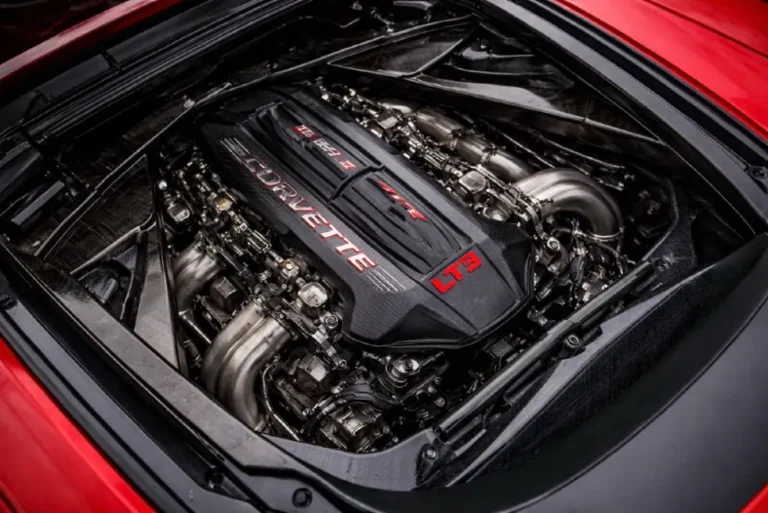
Section 1 – The Engine LT6
The Most Significant American V8 In A Generation
To understand the Corvette Z06, you have to start where the car starts — with the engine. Not because the suspension, the chassis, the aerodynamics, or the interior are unimportant — they are all genuinely excellent. But the LT6 engine is the Z06’s reason for being, the technical achievement that separates it from every other car in its category, and the specific engineering statement that makes the Z06 something more than a fast car.
The 5.5-liter LT6 DOHC V8 is a naturally aspirated engine that makes 670 horsepower and 460 lb-ft of torque. Those numbers are impressive. The rpm at which it makes them is extraordinary: peak power arrives at 8,400 rpm. The redline is 8,600 rpm. These are numbers associated with motorcycle racing engines, Formula One powertrains, and the kind of Italian naturally aspirated V8s that cost significantly more than $100,000 for the engine alone.
At the center of the LT6’s design philosophy is the flat-plane crankshaft. Traditional American V8s — the Cross-plane units that have powered Corvettes since the beginning — use a crankshaft with crank pins at 90-degree intervals. This design balances the engine well at low to medium rpm and produces the characteristic burbling sound that defines American muscle. The flat-plane crankshaft, by contrast, positions the crank pins at 180-degree intervals. This design is common in Ferrari V8s and many racing engines. It reduces the rotating mass of the crankshaft, allows the engine to rev more freely, and produces a distinctive high-pitched, even-firing exhaust note that sounds nothing like a traditional American V8.
A flat-plane crankshaft is commonly found in exotic performance cars because it reduces rotating mass and supports higher RPM. The LT6’s flat-plane design helps the Z06 deliver sharper throttle response, more immediate power delivery as revs climb, and a distinctive exhaust character that differs from traditional cross-plane American V8s.
Chevrolet claims the LT6 is the most powerful naturally aspirated production V8 engine in history — 670 horsepower from a naturally aspirated V8 represents a specific engineering achievement. The next closest competitors are Ferrari’s naturally aspirated V8s and McLaren’s high-output naturally aspirated units, all of which cost significantly more in the vehicles that carry them.
The LT6 is unchanged for the 2026 model year. Chevrolet made no mechanical changes to the engine, the transmission, or the powertrain for 2026 — and the correct interpretation of that decision is that there was nothing to fix. The 2025 LT6 was right. The 2026 LT6 is identical. The performance figures carry forward unchanged.
The 8-speed dual-clutch transmission that pairs with the LT6 uses a shorter 5.56 final drive ratio compared to the standard Corvette Stingray. This means the Z06 pulls harder in each gear, reaching the engine’s peak power band more frequently during normal spirited driving. Paddle shifters allow the driver to stay precisely in the power band. Rev matching during downshifts is automatic and seamlessly executed. The dual-clutch’s shift times in Sport and Track modes are measured in milliseconds and significantly faster than any torque-converter automatic or manual transmission can achieve.
Section 2 – Performance Numbers
Every Benchmark That Matters, Honestly Presented
The Z06’s performance numbers are not marketing claims generated by a favorable testing protocol. They are independent, verified numbers from Car and Driver testing under real-world conditions.
0-60 mph: 2.6 seconds for the coupe, 2.7 seconds for the convertible. For context, 2.6 seconds is the territory of cars that cost two to three times as much. Porsche 911 Turbo S — one of the fastest production cars in the world for this benchmark — runs 2.2 seconds. The Z06 is in the same conversation at a fraction of the Turbo S price.
Quarter-mile: 10.5 seconds at 131 mph. A quarter-mile in the 10-second range puts the Z06 in genuinely rare company on a drag strip. The trap speed of 131 mph indicates the Z06 is still accelerating hard as it crosses the line — it is not running out of steam at the end of the strip.
0-to-100 mph: 5.9 seconds. This mid-range acceleration figure is where the Z06’s power-to-weight ratio manifests most clearly in real-world driving — passing on a highway, entering a freeway on-ramp, or exploiting a gap in traffic all involve this specific range.
0-150-0 mph test: 22.5 seconds (Car and Driver tested). This combined acceleration-and-braking test measures not just how fast a car goes but how quickly it can manage the full cycle of high-speed acceleration and hard braking. 22.5 seconds is a genuinely excellent number that reflects both the engine’s output and the braking system’s capability under sustained load.
Top speed: 189 mph in standard configuration. With the Z07 Performance Package installed, the top speed increases to 195 mph — the higher-downforce aerodynamics allow the car to manage stability at higher speeds that the standard aero package cannot match.
Weight: 3,500 pounds dry for the coupe. This is heavier than a Porsche 911 GT3 (approximately 3,100 pounds) but lighter than many of the larger GT cars and grand tourers that operate at similar performance levels. The mid-engine layout places the weight centrally, which produces handling characteristics more consistent with the car’s actual weight distribution than the scale number alone suggests.
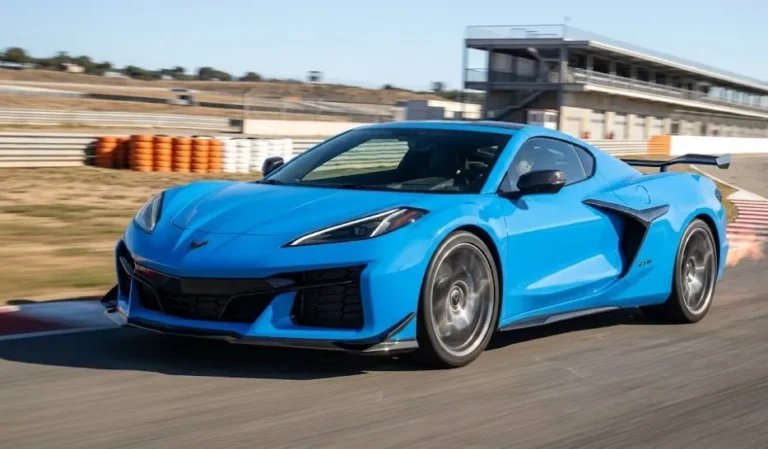
Section 3 – The 2026 Interior Update
The Biggest Change For 2026: A Cockpit That Matches The Performance
The 2026 Corvette Z06’s most significant change from the 2025 model is not mechanical — the engine, transmission, and chassis carry forward unchanged. The meaningful update is in the interior, which has been redesigned to be more driver-centric and to deliver a premium experience that better reflects the Z06’s $112,100-plus price point.
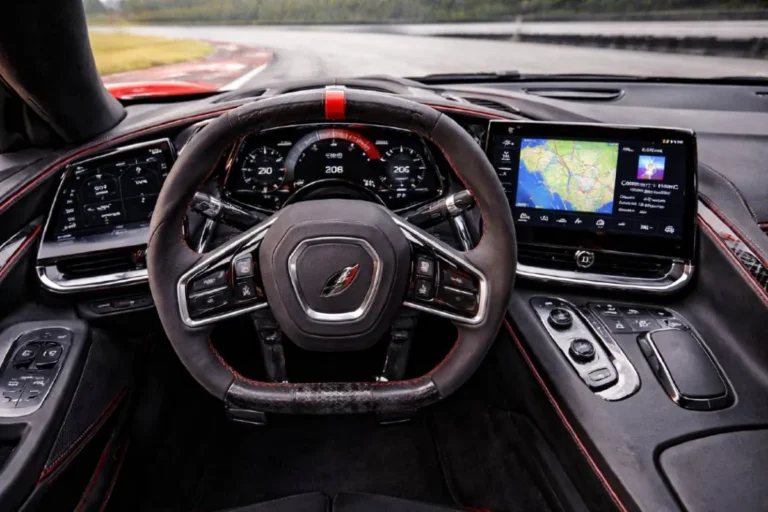
The centerpiece of the 2026 interior redesign is a new three-screen display arrangement. A larger 12.7-inch diagonal center console display replaces the previous 8-inch unit. An expanded 14-inch diagonal Driver Information Center sits behind the steering wheel where the driver can see it directly. An all-new 6.6-inch diagonal touchscreen auxiliary display provides a third point of information access without requiring the driver to look away from the primary instruments.
The new larger display screens surround the driver for a cockpit-like feel — providing easy access to the vehicle’s controls. The update also brings Google Built-in infotainment — a system that provides Google Maps, Google Assistant, and access to Google’s app ecosystem through the car’s native interface rather than through a phone mirroring system.
Beyond the screens, the 2026 interior redesign includes new upholstery options — Habanero and Adrenaline Red join the palette alongside refined combinations such as Very Dark Atmosphere with Natural Tan. Premium materials including suede, leather, and carbon fiber are used across the dashboard, center console, and seat surfaces. Small quality-of-life additions — upholstered cupholders, ambient lighting, and Corvette logos integrated throughout the cabin — complete the refinement package.
Seat options for 2026 include GT1, GT2, and Competition Sport configurations. The Competition Sport seats provide the most aggressive lateral support for track use — they hold the driver firmly in place during high-g cornering and communicate chassis dynamics more directly. The GT1 and GT2 seats are more comfortable for extended road use while still providing meaningful support over standard sports car seats.
The electrochromic roof — which transitions from clear to opaque at the touch of a button — is a new option for 2026. On the coupe, it replaces the standard manually removable roof panel as an option and adds genuine day-to-day convenience for buyers who want the open-air feel without committing to the convertible.
The Z Mode is a new driver-configurable mode accessible via a dedicated steering wheel button that allows the driver to customize throttle response, steering feel, suspension damping, and exhaust sound simultaneously with a single press. It is essentially a configurable preset that drivers can set up for their preferred driving environment — different from Tour, Sport, Track, and Weather modes, which are fixed GM calibrations.
Section 4 – Trims And Pricing
Every 2026 Z06 Configuration Explained
1LZ — Starting At $112,100
The entry-level 2026 Corvette Z06 is the 1LZ coupe. It includes the full LT6 engine, the 8-speed DCT, the Z06-exclusive wide-body exterior with its flared fenders, the standard performance suspension with Magnetic Selective Ride Control 4.0, six-piston front Brembo brakes, and the base version of the new 2026 interior with its three-screen display arrangement.
The 1LZ is the Z06 that journalists typically criticize for lacking some of the premium interior content — but it is also the Z06 that provides every single performance specification of the more expensive configurations. The engine, the transmission, the suspension, the brakes, and the body are identical to those in the top-spec 3LZ. The additional money spent on the 2LZ and 3LZ buys interior premium content, not performance.
For buyers who plan to track the car regularly and care about performance rather than heated seats and premium audio, the 1LZ represents the best value in the Z06 lineup.
2LZ — The Recommended Starting Point For Street Use
The 2LZ adds the features that most street-use buyers will find they care about on a daily basis: heated and ventilated front seats, a premium Bose audio system, the Performance Data Recorder which records video and telemetry data for track use analysis, and additional interior appointments that make the daily ownership experience more comfortable.
Most automotive journalists who spend extended time with the Z06 recommend the 2LZ as the appropriate starting point for buyers who plan to use the car both on the street and occasionally on a track. The additional cost over the 1LZ buys meaningful daily convenience without changing the car’s performance character.
3LZ — The Full-Specification Z06
The 3LZ is the fully equipped Z06 — every interior option, every technology feature, and the maximum content package. It includes the most premium audio system, all available driver assistance technology, the most complete connectivity package, and the full interior appointments list.
The 3LZ is the configuration that most closely matches the interior experience of comparable European sports cars in its price range. The Z06’s chassis, engine, and performance are world-class regardless of trim — the 3LZ simply adds an interior that matches that level of ambition.
The Z07 Performance Package
The Z07 Performance Package is the most important optional addition to any Z06 configuration and the one that produces the significant performance gains cited in some of the top-line specifications. It adds:
Carbon fiber aerodynamic components: The Z07 wing significantly increases downforce over the standard adjustable spoiler. A front carbon fiber splitter and front-corner dive planes complete the high-downforce aero package. Specific Magnetic Ride Control calibration unique to the Z07 package. Brembo carbon-ceramic brake rotors and calipers that provide significantly improved thermal management versus the standard steel rotors — critical for repeated hard stops on track. Michelin Pilot Sport Cup 2 R ZP tires — among the most capable street-legal track tires available on any production car. Enhanced cooling capability.
With the Z07 package, the top speed increases to 195 mph. The braking performance improves measurably for repeated track use. The aerodynamic package provides approximately 734 lbs of downforce at the car’s top speed — grip levels that allow cornering speeds otherwise impossible.
The Z07 package requires the Carbon Aero Package as a prerequisite. It is priced at approximately $8,995 when configured. For buyers who plan serious track use — actual laps, not just spirited road drives — the Z07 is effectively mandatory. For pure street use, the standard Z06 suspension and brakes are well-matched to what legal road use demands.
Coupe vs. Convertible
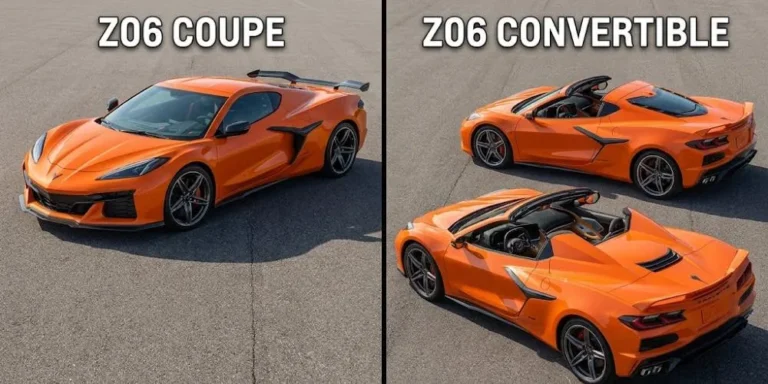
The 2026 Z06 is available as both coupe and convertible. The convertible features a power-retractable hardtop roof that can be raised or lowered at speeds up to 30 mph with a single button press. The retractable hardtop preserves the car’s aerodynamic profile better than a soft-top, and the structural reinforcements required to maintain chassis rigidity without the fixed roof add approximately 99 pounds — accounting for the Z06 convertible’s 2.7-second 0-to-60 time versus 2.6 for the coupe.
The convertible is priced modestly above the equivalent coupe configuration. For buyers who want the open-air experience without a meaningful performance penalty, the convertible represents an excellent option — the 0.1-second difference in 0-to-60 is imperceptible in normal driving.
The Z06’s $112,100 starting price is only the beginning of the ownership cost conversation — high-performance sports cars carry insurance premiums that can add $3,000 to $6,000 per year to the total cost of ownership. Our guide to car insurance cost in the USA in 2026 covers the factors that most significantly affect what a Z06 owner will pay and how to minimize that cost without compromising coverage.
Section 5 – Exterior And Aerodynamics
Wide-Body, Functional Aero, And A Look That Earns The Performance Promise
The C8 Z06’s exterior is not a styling exercise with cosmetic aero add-ons. Every dimension of the Z06 body differs from the standard Corvette Stingray, and every difference serves a specific engineering purpose.
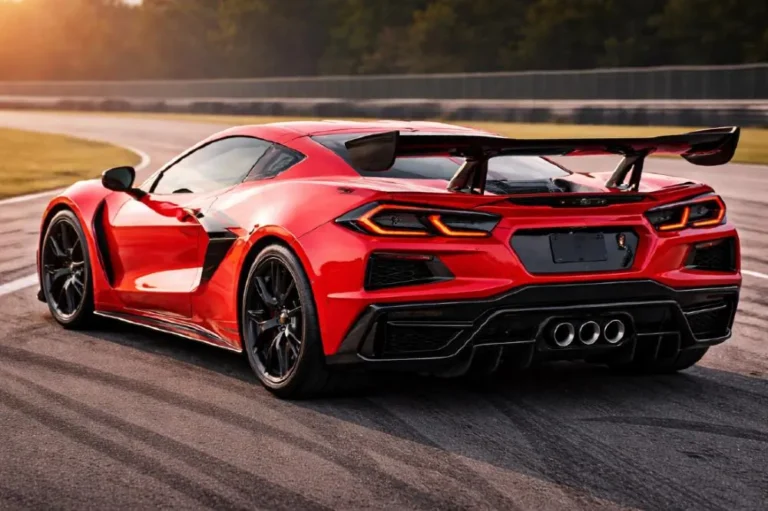
The most immediately apparent difference is the width. The Z06 is 3.6 inches wider than the Stingray, using wider rear haunches to accommodate the significantly wider rear tires — 345-section width in the back with the Z07 package. These are not car-width rear tires for aesthetic reasons. They are wide because the LT6’s 460 lb-ft of torque requires a specific amount of contact patch to be managed effectively at the limits of traction.
The Z06-exclusive front and rear fascias are designed around the cooling requirements of the LT6 engine. The brake cooling ducts are larger than the Stingray’s. The underbody strakes channel airflow away from turbulent wheel wells and toward the rear diffuser. The standard adjustable rear spoiler includes reconfigurable wickerbill elements that allow the driver to adjust the rear aerodynamic balance.
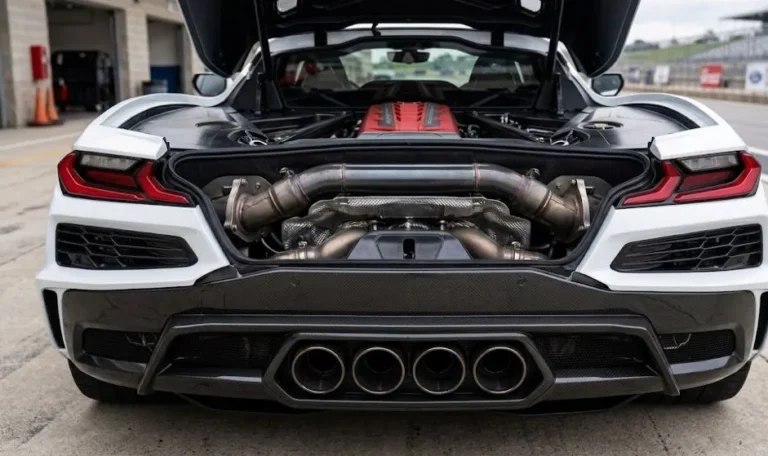
The quad-center exhaust is a Z06 signature — four outlets arranged symmetrically in the center of the rear bumper rather than the Stingray’s side-exiting arrangement. Beyond visual identity, the center-exit configuration allows a more direct exhaust routing from the centrally mounted LT6 and produces the engine’s characteristic high-pitched exhaust note without restriction.
For 2026, color options continue to expand. The Z06’s exterior palette includes bold options like Hysteria Purple Metallic and Competition Yellow Tintcoat alongside the classic Arctic White and Torch Red. The wider-body Z06 in these colors is an unmistakable car — not subtle, not anonymous, entirely intentional about declaring its purpose before the engine is even started.
The Z06’s wide body, quad exhaust, and aggressive aero make it one of the most visually commanding American cars built since the muscle car era — an era whose film culture legacy we cover in detail in our guide to Gone in 60 Seconds and the Eleanor Mustang, the movie that cemented the American performance car’s place in popular culture for a generation.
Section 6 – The Z06 In The Corvette Hierarchy
Where The Z06 Sits In 2026: Between The Stingray And The ZR1
The 2026 Corvette lineup is the most extensive in the nameplate’s history, and understanding where the Z06 fits requires understanding the cars that surround it.
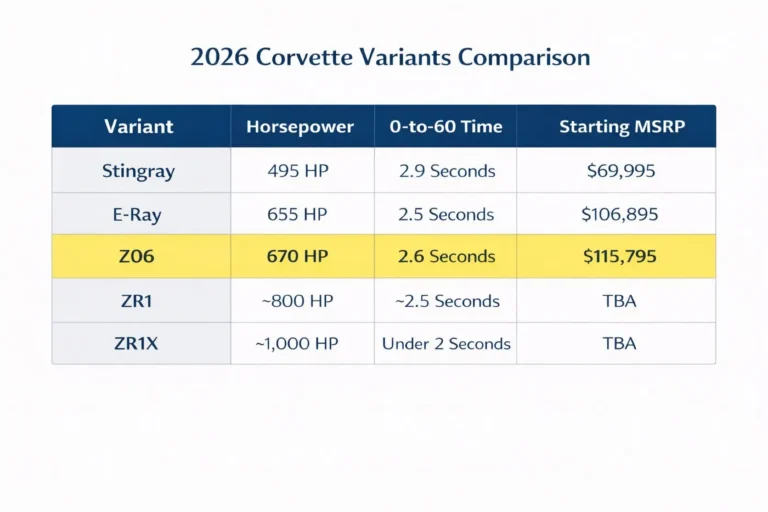
The base Corvette Stingray produces 495 horsepower from its 6.2-liter LT2 V8 and achieves 0-to-60 in 2.9 seconds. It starts at $68,300. The Stingray is the entry point — an exceptional sports car by any global standard, but a fundamentally different machine from the Z06 in character and capability.
The E-Ray hybrid adds a front electric motor to the 6.2-liter V8, producing a combined 655 horsepower and all-wheel drive. The E-Ray achieves 0-to-60 in 2.5 seconds — 0.1 faster than the Z06 — by virtue of its AWD traction advantage, particularly in less-than-perfect conditions. The E-Ray’s character is very different from the Z06: smooth, torque-rich, and sophisticated rather than high-revving and driver-demanding.
The Z06 sits in the middle of the lineup as the naturally aspirated performance flagship — the car for the driver who wants 8,600-rpm engagement rather than electric torque fill or turbocharged boost. It is a driver’s preference rather than an objective performance hierarchy, and the Z06 makes its case most convincingly on a road circuit where the character of the LT6’s power delivery, the precision of the mid-engine chassis, and the communication from the Magnetic Ride Control 4.0 suspension combine into an experience that the Stingray and E-Ray, for all their excellence, cannot replicate.
Above the Z06 is the ZR1, which takes the LT6’s flat-plane crankshaft and adds twin turbochargers — producing 1,064 horsepower at 7,000 rpm and 828 lb-ft of torque. The ZR1 starts at $174,995. Its 0-to-60 time of 2.3 seconds and quarter-mile in under 10 seconds put it in genuinely supercar territory, and its 233-mph top speed makes it the fastest production Corvette in history.
At the very top is the new ZR1X — a 1,250-horsepower hybrid combining the ZR1’s twin-turbo LT6 with the E-Ray’s front electric motor. The ZR1X achieves 0-to-60 in under 2 seconds. This is not the car for a normal driving relationship. This is the car for the driver who has run out of road on every other option and needs a vehicle calibrated for racing rather than driving.
In this hierarchy, the Z06 occupies the most specific and arguably most interesting position. It is not the most powerful, the fastest, or the most technologically complex. It is the car where the engineering ambition is most directly communicated to the driver through mechanical feel — the high-revving naturally aspirated engine, the rear-wheel-drive precision, the mid-engine balance — without the mediation of electricity or forced induction.
Historically, ZR1 models emphasize top-end acceleration and forced induction, while the Z06 emphasizes track balance and high-RPM naturally aspirated response. That distinction continues to define the Z06’s purpose in 2026.
Section 7 – Driving The Z06
What It Actually Feels Like: The Character The Specs Cannot Capture
Performance numbers describe what a car does. They do not describe what a car is. The Z06 is one of those relatively rare vehicles where the description of the driving experience requires different language than the description of the specifications. The LT6’s power delivery is fundamentally different from every turbocharged or supercharged car in the Z06’s price range. There is no surge, no lag, no moment where boost builds and the character of the acceleration changes.
The power arrives linearly as the engine revs build — a continuous escalation from idle to 8,600 rpm that rewards drivers who learn to use the full rev range rather than short-shifting for efficiency. The last 2,000 rpm of the engine’s range — from 6,500 to 8,600 — is where the LT6 lives most fully. In that range, the engine is producing its peak power, the exhaust note has climbed from a mechanical bark to something closer to a controlled scream, and the acceleration continues to build rather than plateau.
MotorTrend’s description of the Z06 captures the chassis balance that the specifications only hint at: “Yes, you feel the wheels moving about, but the Corvette itself never feels unsettled.” This is the correct description of what Magnetic Ride Control 4.0 contributes to the Z06 experience. The suspension reads the road — literally, 1,000 times per second — and adjusts damping in 10 to 15 milliseconds. The result is a car that communicates precisely what the tires are doing without transmitting the instability that communication implies in a less sophisticated setup.
Car and Driver’s description of the Z06 is equally pointed: “With its extraordinary mid-engine performance, exotic-car looks and personality, and hard-to-believe value, the Corvette Z06 is a sterling example of what GM can do when the engineers are given a long leash.”
That long leash produced the LT6 — an engine that GM engineers reportedly fought for years to bring to production against internal skepticism about whether a naturally aspirated, flat-plane V8 could deliver the power and character that the Z06 needed. The engineers won that argument. The car makes the case for them every time someone drives one back-to-back with a European sports car at twice the price and finds themselves asking the question the Z06 makes unavoidable: why does that cost so much more?
Section 8 – Z06 Versus The Competition
How The 2026 Z06 Stacks Up Against Its Real Rivals
Porsche 911 GT3 — The Z06’s Most Direct Spiritual Competitor
The Porsche 911 GT3 is the car the Z06 is most directly and most fairly compared to. Both are naturally aspirated performance cars engineered for high-revving engagement rather than turbocharged power. The GT3’s 4.0-liter flat-six revs to 9,000 rpm and produces 502 horsepower. The Z06’s 5.5-liter flat-plane V8 revs to 8,600 rpm and produces 670 horsepower.
The GT3 is lighter — approximately 3,100 pounds versus the Z06’s 3,500 pounds — and benefits from Porsche’s decades of rear-engine chassis development on the Nürburgring. The GT3 starts at approximately $170,000.
For the 0-to-60 benchmark, the Z06 is two-tenths of a second faster. On a road circuit, the comparison is more nuanced — the GT3’s lower weight and decades of specific chassis development give it advantages in specific driving situations that the Z06’s power advantage does not automatically overcome. But for most drivers in most situations, the Z06 delivers similar or superior track performance at two-thirds the GT3’s price.
Ferrari 296 GTB — Forced Induction At A Higher Price
The Ferrari 296 GTB is a plug-in hybrid that makes 819 combined horsepower. It costs approximately $325,000. It is faster than the Z06 in every measurable benchmark and provides a more sophisticated driving experience by Ferrari’s own engineering standards. It is also three times the price.
This comparison is not entirely fair, and making it honestly requires acknowledging that the 296 GTB is a different class of machine with a different ownership experience, different brand heritage, and different engineering sophistication in areas the Z06 does not attempt to replicate. But in pure performance per dollar, no car from Ferrari, Lamborghini, or McLaren matches what the Z06 delivers at its price point. This remains true in 2026.
McLaren Artura — The Closest Modern Equivalent
The McLaren Artura is a twin-turbocharged V6 hybrid producing 671 horsepower — essentially identical to the Z06’s power output. The Artura starts at approximately $230,000. It is lighter than the Z06 by approximately 400 pounds and offers the specific character of a British performance car engineering tradition.
The Artura is a genuinely excellent car. It is also $118,000 more expensive than the Z06. For that price difference, the Artura offers a different experience — not necessarily a better one in every meaningful way, but different in character, refinement, and brand prestige. For drivers who care more about the experience than the prestige, the Z06’s case against the Artura is straightforward.
The Z06’s naturally aspirated LT6 continues a tradition of American performance engineering that peaked earlier with the Dodge Viper’s naturally aspirated V10 — our Dodge Viper complete guide covers five generations of the car that defined what an American sports car could be before the mid-engine revolution changed everything.
FAQ
Q: What is the horsepower of the 2026 Corvette Z06?
A: The 2026 Corvette Z06 produces 670 horsepower at 8,400 rpm and 460 lb-ft of torque at 6,300 rpm from its 5.5-liter LT6 DOHC V8 engine. The LT6 uses a flat-plane crankshaft and revs to a redline of 8,600 rpm — the highest redline of any naturally aspirated production V8 in history. GM claims the LT6 is the most powerful naturally aspirated production V8 engine ever made. The engine is unchanged from the 2025 model year.
Q: How fast is the 2026 Corvette Z06?
A: The 2026 Corvette Z06 coupe accelerates from 0 to 60 mph in 2.6 seconds. The convertible achieves 0 to 60 in 2.7 seconds. Car and Driver’s independent testing confirmed the 2.6-second figure and a quarter-mile time of 10.5 seconds at 131 mph. The 0-to-100 mph time is 5.9 seconds. Top speed is 189 mph in standard configuration and 195 mph with the Z07 Performance Package installed.
Q: What is the price of the 2026 Corvette Z06?
A: The 2026 Corvette Z06 starts at $112,100 for the 1LZ coupe. The 2LZ and 3LZ configurations add interior content and technology features at progressively higher prices. The Z07 Performance Package adds approximately $8,995 to the base price of any Z06 configuration. The convertible body style adds to the price of the equivalent coupe trim.
Q: What is the Z07 Performance Package?
A: The Z07 Performance Package is an optional upgrade for the Corvette Z06 that adds Brembo carbon-ceramic brake rotors and calipers, Michelin Pilot Sport Cup 2 R ZP track tires, high-downforce carbon fiber aerodynamic components (front splitter, dive planes, rear wing), specific Magnetic Ride Control calibration, and enhanced cooling. With the Z07 package, the Z06’s top speed increases from 189 mph to 195 mph and the braking and cornering performance improve measurably for sustained track use.
Q: What is new in the 2026 Corvette Z06?
A: The 2026 Corvette Z06’s most significant update is a redesigned interior featuring three new display screens: a 12.7-inch center console touchscreen, a 14-inch Driver Information Center, and a 6.6-inch auxiliary display. The Google Built-in infotainment system replaces the previous unit. New interior color and material options expand customization choices. An electrochromic roof is now available as an option. The Z Mode driver-configurable driving setting is new for 2026. The engine and performance specifications are unchanged from 2025.
Q: How does the Corvette Z06 compare to the ZR1?
A: The Corvette ZR1 takes the Z06’s LT6 flat-plane V8 and adds twin turbochargers, producing 1,064 horsepower versus the Z06’s naturally aspirated 670 horsepower. The ZR1 accelerates from 0 to 60 in 2.3 seconds versus the Z06’s 2.6 seconds. The ZR1’s top speed is 233 mph versus the Z06’s 189 mph. The ZR1 starts at $174,995 versus the Z06’s $112,100. The Z06 is the naturally aspirated car — the choice for drivers who prefer the high-revving, linear character of the LT6 without forced induction. The ZR1 is for drivers who want maximum performance regardless of how that performance is produced.
Q: Is the Corvette Z06 a good daily driver?
A: The Corvette Z06 is more usable as a daily driver than most cars with comparable performance specifications. The Magnetic Ride Control 4.0 suspension in Tour mode is genuinely comfortable on most road surfaces. The interior is well-appointed, particularly in 2LZ and 3LZ configuration. The 12.6 cubic feet of front trunk space accommodates luggage for a weekend trip.
The climate control system is effective. However, the Z06’s low ride height makes speed bumps and steep driveway angles a challenge, and the Michelin Pilot Sport Cup 2 tires on the Z07 package are not appropriate for wet weather driving or cold temperatures. In standard configuration without the Z07 package, the Z06 is a reasonable daily driver for someone willing to plan around its limitations.
Conclusion
The 2026 Corvette Z06 is the same car it was in 2025 where the performance is concerned — and that is entirely the point. The LT6 engine that makes 670 horsepower at 8,600 rpm did not need to be fixed. The 2.6-second 0-to-60 time did not need to be improved. The 10.5-second quarter-mile did not need to be shortened.
What it needed was an interior that better reflected what the price tag and the performance implied — and for 2026, Chevrolet delivered that. Three screens. Google Built-in. Better materials. More color choices. A driver-configurable Z Mode. An electrochromic roof. These are not cosmetic additions to disguise a stagnant product. They are the evolution of a car that was already right in the ways that matter most.
The Z06 remains the most compelling naturally aspirated sports car value in the world. The 911 GT3 costs $170,000 and makes 502 horsepower. The Ferrari 296 GTB costs $325,000. The McLaren Artura costs $230,000. The Z06 starts at $112,100 and makes 670 horsepower from an engine that revs to 8,600 rpm and makes a sound that no other car at any price quite replicates.
That value proposition is not the whole story — the chassis, the mid-engine layout, the Magnetic Ride Control precision, the wide-body stance, and the long legacy of American performance engineering that produced it are all part of what the Z06 is. But the value proposition is the part that makes the Z06 conversation happen at every track, every show, and every enthusiast gathering where someone is standing next to one and doing the math.
The math keeps working out the same way. It probably always will.
Editorial Note
This article was written and reviewed in March 2026. All performance specifications are sourced from Chevrolet’s official 2026 Corvette Z06 product page, Car and Driver, MotorTrend, and Edmunds. The 2026 interior redesign details are sourced from Chevrolet’s official product materials and Cecil Clark Chevrolet’s 2026 Z06 update documentation. Starting MSRP of $112,100 is confirmed for the 2026 model year. ZR1 and ZR1X specifications are from Chevrolet’s official product pages and Edmunds’ 2026 coverage. All competitive pricing figures represent approximate current market prices and are subject to change. Performance figures may vary based on options, conditions, and driving setup.



0 Comments