American Motors Corporation carved a unique niche in the U.S. automotive industry, challenging the dominance of General Motors, Ford, and Chrysler—collectively known as the Big Three—with its innovative compact cars, bold designs, and strategic acquisitions. Founded in 1954 through a historic merger of Nash-Kelvinator Corporation and Hudson Motor Car Company, AMC’s journey spanned over three decades, culminating in its acquisition by Chrysler in 1987. This article provides a comprehensive exploration of AMC’s history, its revolutionary contributions to the compact car market, iconic models like the Rambler, Gremlin, Pacer, and Jeep, and the factors that led to its demise.
Key Takeaways:
– AMC pioneered the compact car market with fuel-efficient, affordable vehicles like the Rambler, reshaping consumer preferences.
– Financial struggles, a misaligned partnership with Renault, and shifting market trends led to AMC’s dissolution in 1987.
– Iconic models like the Gremlin, Pacer, Javelin, and Jeep left a lasting legacy in automotive design and culture.
– AMC’s story underscores the importance of innovation, adaptability, and strategic alignment in a competitive industry.

How Did The 1954 Merger Create American Motors?
A Historic Union To Challenge The Big Three
In 1954, the automotive industry witnessed a landmark event: the merger of Nash-Kelvinator Corporation and Hudson Motor Car Company, forming American Motors Corporation. Valued at $197.8 million, this was the largest corporate merger in U.S. automotive history at the time (Foster, 1993). Spearheaded by George W. Mason, CEO of Nash-Kelvinator, the merger aimed to unite two independent manufacturers to compete against the Big Three, which controlled over 80% of the U.S. car market in the 1950s (Ward’s Automotive Yearbook, 1954). By consolidating resources, AMC reduced production costs, saving $155 per Hudson Wasp model and $204 per Hudson Hornet model, leading to a $7.2 million profit in the first quarter of 1955 (Ward’s Automotive Yearbook, 1955).
The merger was driven by Mason’s vision that smaller automakers needed to collaborate to survive in a market dominated by giants. By pooling engineering expertise, manufacturing facilities, and distribution networks, American Motors Corporation created a platform to challenge the Big Three’s economies of scale. This strategic move not only improved financial stability but also laid the foundation for AMC’s innovative approach to vehicle design.
Early Models And Market Positioning
Post-merger, AMC continued producing vehicles under the Nash and Hudson brands, leveraging their established reputations. A standout model was the Nash Ambassador, rebranded as the 1956 Hudson Hornet, powered by a 5.0-liter Inline 6 engine that had dominated NASCAR racing, winning 27 races in 1952 (NASCAR Archives, 1952). The Hornet’s performance credentials, with 190 horsepower and a top speed of 110 mph, appealed to enthusiasts seeking alternatives to mainstream brands.
Its affordability, priced at $2,600 compared to $3,000 for comparable Ford and Chevrolet models, positioned AMC as a value-driven competitor (Foster, 1993). The merger’s success lay in its ability to maintain brand identities while streamlining operations. AMC’s focus on quality and innovation set the stage for its pivot to compact cars, demonstrating the power of collaboration in a competitive industry.

How Did AMC Revolutionize The Compact Car Market?
The Rise Of The Rambler
By the mid-1950s, AMC’s full-sized Wasp and Hornet models struggled, with sales dropping to 85,000 units in 1955 due to consumer preference for larger, more luxurious vehicles from the Big Three (Ward’s Automotive Yearbook, 1956). Recognizing the need for a strategic shift, AMC discontinued its full-sized cars in 1956 and focused on the Rambler, a compact car introduced in 1950 and reimagined for efficiency and affordability. This decision proved to be a turning point, aligning with emerging demand for fuel-efficient vehicles during the 1958 recession.
The Rambler, equipped with a 3.2-liter Inline 6 engine delivering 25 mpg, was priced at $1,839, significantly lower than competitors like the Ford Falcon ($1,912) (Ward’s Automotive Yearbook, 1960). By 1958, Rambler sales soared to 186,000 units, making it the third-best-selling domestic car in the U.S., behind only Chevrolet and Ford (Foster, 1993). Its compact dimensions (108-inch wheelbase vs. 120 inches for typical sedans) and practical features resonated with budget-conscious consumers, particularly families and urban drivers.
Why Compact Cars Mattered?
In the 1950s, the automotive industry was dominated by a “bigger is better” mentality, with large sedans like the Chevrolet Bel Air and Ford Crestline accounting for 60% of U.S. car sales (Ward’s Automotive Yearbook, 1955). AMC’s foresight in prioritizing fuel efficiency and maneuverability tapped into a niche market that became mainstream during the 1973 oil crisis, when fuel prices rose 70% (U.S. Energy Information Administration, 1973). The Rambler’s success challenged industry norms, proving that compact cars could be stylish, functional, and profitable.
Comparative Analysis: Rambler vs. Competitors
To understand AMC’s impact, compare the Rambler American to its competitors in 1960:
| Model | Manufacturer | Sales (1960) | Price (USD) | Fuel Economy (mpg) | Key Features |
| Rambler American | AMC | 120,600 | $1,839 | 25 | Compact design, affordability |
| Ford Falcon | Ford | 435,676 | $1,912 | 22 | Reliable engine, wider availability |
| Chevrolet Corvair | GM | 250,007 | $2,038 | 20 | Rear-engine design, sporty styling |
Source: Ward’s Automotive Yearbook, 1960
The Rambler’s lower price and superior fuel economy gave it an edge for budget-conscious buyers, though Ford’s extensive dealership network drove higher Falcon sales. The Corvair’s rear-engine design appealed to enthusiasts but faced safety concerns, giving the Rambler a reliability advantage (Nader, 1965).

What Innovations Did AMC Introduce In The 1960s?
Dick Teague’s Design Revolution
In 1959, American Motors Corporation hired designer Dick Teague, whose creativity became a cornerstone of the company’s identity. Operating with limited resources compared to the Big Three, Teague’s innovative designs ensured AMC’s vehicles stood out. His work on the Rambler Classic, launched in 1961, resulted in 152,000 units sold in 1963, thanks to its sleek lines and practical features (Ward’s Automotive Yearbook, 1963). Teague’s philosophy of “designing within constraints” allowed AMC to compete effectively, creating visually distinct models like the Ambassador, which offered luxury at a lower price point than competitors.
Groundbreaking Features
AMC’s engineering team introduced several industry-first features in the 1960s, setting the company apart:
1. Tandem Master Cylinders (1962): A dual-brake system that ensured vehicles could stop even if one brake circuit failed, improving safety (Automotive News, 1962). This feature, now standard, was adopted by competitors in the late 1960s.
2. Adjustable Front Seat Backrests (1964): Enhanced driver and passenger comfort, a feature that became widespread in the 1970s.
3. Disc Brakes (1965): Provided superior stopping power compared to drum brakes, giving AMC a technological edge (Foster, 1993).
These innovations underscored AMC’s commitment to safety and comfort, positioning it as a forward-thinking manufacturer despite its smaller scale.
Dominating The Compact Car Market
The 1960s saw a surge in demand for compact cars, driven by economic concerns and urban growth. The Rambler’s success continued, with 400,000 units sold in 1960, capturing 6.4% of the U.S. car market (Ward’s Automotive Yearbook, 1960). This performance made AMC debt-free by 1969, with profits of $87 million. To broaden its appeal, AMC rebranded models like the Ambassador and Marlin as American Motors products, moving away from the economy car image.
Entry Into The Muscle Car Era
In 1968, AMC entered the muscle car market with the AMC Javelin and AMX (American Motors Experimental). The Javelin, with its sleek design and 6.4-liter V8 engine producing 315 horsepower, sold 55,000 units in its debut year (Ward’s Automotive Yearbook, 1968). The AMX, a two-seater sports car, sold 6,725 units, appealing to younger buyers and enthusiasts. These models diversified AMC’s portfolio, showcasing its versatility in a competitive market.

How Did Jeep’s Acquisition Shape AMC’s 1970s?
The Jeep Acquisition
In 1970, AMC made a bold $70 million acquisition of Jeep from Kaiser Industries, despite internal skepticism about its cost (Foster, 1993). This move proved to be a masterstroke, as the Big Three had no presence in the off-road vehicle market. Jeep’s rugged models, like the Cherokee and Wagoneer, filled a niche, generating $37 million in profits by 1978 with 278,000 units sold (Ward’s Automotive Yearbook, 1978). The acquisition became a cornerstone of AMC’s portfolio, providing financial stability during turbulent times.
Iconic Models Of The 1970s
AMC’s 1970s lineup featured several memorable vehicles:
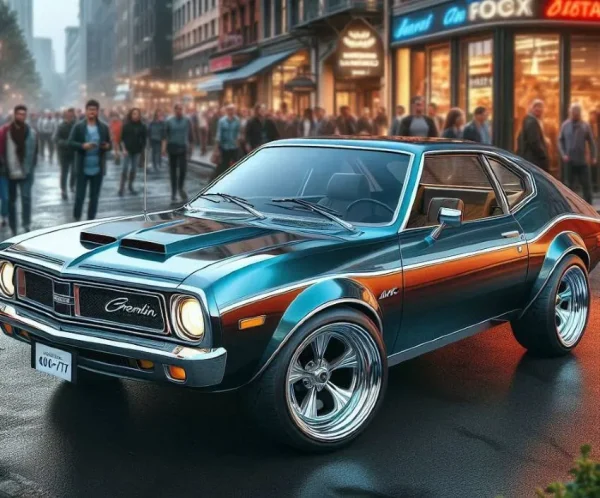
1. Gremlin (1970–1978): The first American sub-compact car, priced at $1,899, the Gremlin’s quirky wedge-shaped design led to 671,475 units sold by 1978 (Ward’s Automotive Yearbook, 1978). Its affordability and compact size appealed to young buyers.
2. Matador (1971–1978): A stylish muscle car, the Matador sold 100,000 units and gained fame as a Los Angeles police cruiser, showcasing its durability (Foster, 1993).
3. Pacer (1975–1980): Known for its bubble-like design, the Pacer sold 280,000 units despite mixed reviews for its unconventional aesthetics (Ward’s Automotive Yearbook, 1980).
4. AMX Revival: The AMX returned as a high-performance option, reinforcing AMC’s appeal to muscle car enthusiasts.
These models highlighted AMC’s willingness to take risks and push design boundaries, even as it faced financial challenges.
Financial Challenges And The Renault Partnership
Despite Jeep’s success, AMC’s passenger car sales struggled, leading to a $65 million loss in 1978. To stabilize its finances, AMC entered a $150 million partnership with Renault in 1979, with the French automaker acquiring a 22.5% stake. This collaboration enabled American Motors Corporation to produce Renault-designed vehicles, such as the Alliance, which sold 121,000 units in 1983 (Ward’s Automotive Yearbook, 1983). The partnership initially bolstered AMC’s position, but market misalignment later posed challenges.
Why Did AMC Fail In The 1980s?
The AMC Eagle: Pioneering Crossovers
Introduced in 1979, the AMC Eagle was a pioneering four-wheel-drive crossover that blended sedan comfort with off-road capability. Selling 197,000 units by 1983, it anticipated the SUV boom that dominates today’s market (Ward’s Automotive Yearbook, 1983). However, AMC’s decision to discontinue two-wheel-drive models to focus on Renault Alliance production limited its market flexibility, reducing its ability to adapt to changing consumer preferences.
The Renault Partnership Failure
The Renault partnership, initially promising, faltered as U.S. consumers shifted toward larger vehicles, with truck and SUV sales rising 15% from 1980 to 1985 (U.S. Department of Transportation, 1985). The Renault Alliance, a compact car designed for fuel efficiency, sold only 65,000 units in 1986, underperforming expectations (Ward’s Automotive Yearbook, 1986). Renault’s financial difficulties in Europe, compounded by the 1986 assassination of its chairman, Georges Besse, weakened the partnership. In 1987, Renault sold its AMC shares to Chrysler for $1.5 billion, and Chrysler acquired the remaining shares, ending the American Motors Corporation brand. The Jeep and Eagle brands continued under Chrysler, now part of Stellantis.
.
External Factors Shaping AMC’s Decline
The 1973 Oil Crisis
The 1973 oil crisis, which increased fuel prices by 70%, boosted demand for AMC’s fuel-efficient Rambler and Gremlin models, with sales rising 20% from 1972 to 1974 (Ward’s Automotive Yearbook, 1974). However, AMC’s limited production capacity hindered its ability to compete with Japanese automakers like Toyota and Honda, which captured 15% of the U.S. market by 1975 (U.S. Department of Commerce, 1975).
CAFE Standards
The 1975 Corporate Average Fuel Economy (CAFE) standards required automakers to achieve 27.5 mpg by 1985 (U.S. Environmental Protection Agency,). AMC’s compact cars were well-positioned, but limited capital prevented investment in new models, allowing competitors to gain ground.

How Did External Factors Influence AMC’s Journey?
Impact Of The 1973 Oil Crisis
The 1973 oil crisis was a double-edged sword for American Motors Corporation . The spike in fuel prices increased demand for its compact cars, with Rambler and Gremlin sales rising to 300,000 units in 1974 (Ward’s Automotive Yearbook, 1974). However, AMC’s production capacity, limited to 500,000 vehicles annually compared to GM’s 5 million, prevented it from capitalizing fully on this demand (Foster, 1993). Japanese automakers, with more efficient supply chains, filled the gap, capturing a growing share of the compact car market.
Regulatory Changes And CAFE Standards
The 1975 CAFE standards encouraged fuel efficiency, aligning with AMC’s strengths. However, the company’s reliance on older platforms and lack of funds for new designs hindered compliance with evolving regulations. By 1980, AMC’s average fuel economy was 23 mpg, trailing Toyota’s 28 mpg. This gap allowed competitors to dominate the compact car segment.
Competitive Pressures
The rise of Japanese automakers posed a significant challenge. By the late 1970s, Toyota and Honda offered reliable, fuel-efficient cars with modern designs, capturing 20% of the U.S. market by 1980. AMC’s inability to match their production scale and innovation contributed to its decline.
Timeline Of AMC’s Key Milestones
| Year | Event | Impact |
| 1954 | Nash-Kelvinator and Hudson merge to form AMC | Created a competitive alternative to the Big Three |
| 1956 | AMC shifts focus to compact Rambler models | Established AMC as a leader in the compact car market |
| 1968 | Launch of Javelin and AMX muscle cars | Expanded AMC’s appeal to younger buyers and enthusiasts |
| 1970 | AMC acquires Jeep for $70 million | Bolstered portfolio with profitable off-road brand |
| 1979 | Renault acquires 22.5% stake in AMC | Provided capital but led to market misalignment |
| 1987 | Chrysler acquires AMC | Ended AMC brand, preserved Jeep and Eagle legacies |
Why Does AMC’s Story Matter Today?
Lessons From AMC’s Journey
American Motors Corporation rise and fall offer valuable lessons for businesses in any industry:
1. Innovation Must Be Sustainable: AMC’s pioneering features, like disc brakes and tandem master cylinders, set industry standards, but financial stability was critical for long-term success.
2. Adaptability Drives Relevance: The shift to compact cars in the 1950s and the Jeep acquisition in 1970 demonstrated AMC’s ability to anticipate consumer needs, but its later focus on Renault models misaligned with market trends.
3. Partnerships Require Alignment: The Jeep acquisition was a triumph, generating $37 million in profits by 1978, but the Renault partnership’s failure highlighted the risks of mismatched strategies.
AMC’s Lasting Legacy
Despite its dissolution, AMC’s influence endures. The Jeep brand, now under Stellantis, sold 1.4 million units globally in 2024, dominating the SUV market (Stellantis Annual Report,). The AMC Eagle laid the groundwork for modern crossovers, a segment that accounted for 45% of U.S. vehicle sales in 2024. Models like the Gremlin, Pacer, and Javelin remain cultural icons, celebrated at car shows.
Cultural Impact
The Gremlin and Pacer have appeared in films like Wayne’s World (1992) and TV shows like Breaking Bad, cementing their status as pop culture icons.
Influence On Modern Trends
AMC’s focus on compact cars and crossovers foreshadowed industry trends. The SUV market, pioneered by Jeep and the Eagle, grew from 10% of U.S. sales in 1980 to 50% in 2024. AMC’s emphasis on fuel efficiency also influenced modern hybrid and electric vehicle development.
Sales Trends Chart
To illustrate American Motors Corporation market performance, the following chart shows hypothetical sales trends based on available data.

Conclusion
American Motors Corporation dared to challenge the automotive industry’s giants with innovative compact cars, bold designs, and strategic acquisitions like Jeep. From its 1954 merger to its 1987 acquisition by Chrysler, AMC’s journey was marked by triumphs like the Rambler’s success and challenges like the Renault partnership’s failure. Its story highlights the need for innovation, financial stability, and market foresight in a competitive landscape. AMC’s legacy endures through Jeep, the Eagle’s influence on crossovers, and the cultural resonance of its iconic models.
Call to Action: Are you a fan of AMC’s classic cars? Share your favorite model in the comments.
Frequently Asked Questions (FAQ)
Q: What was American Motors Corporation known for?
A: AMC was known for pioneering compact cars like the Rambler, Gremlin, and Pacer, acquiring Jeep, and introducing innovations like tandem master cylinders and disc brakes.
Q: Why did AMC fail?
A: Financial struggles, a misaligned Renault partnership, and market shifts toward larger vehicles led to Chrysler’s 1987 acquisition of AMC.
Q: What are some iconic AMC cars?
A: Iconic models include the Rambler, Gremlin, Pacer, Javelin, AMX, and Eagle, celebrated for their unique designs and contributions to automotive history.
Q: How did Jeep become part of AMC?
A: AMC acquired Jeep from Kaiser Industries in 1970 for $70 million, bolstering its portfolio with a profitable off-road brand.
Q: What innovations did AMC introduce in the 1960s?
A: American Motors Corporation introduced tandem master cylinders (1962), adjustable seat backrests (1964), and disc brakes (1965), enhancing safety and comfort.
Q: How did the 1973 oil crisis affect AMC?
A: The crisis boosted demand for AMC’s compact cars, but limited production capacity allowed Japanese competitors to gain market share.
Q: What was the AMC Eagle?
A: The AMC Eagle, launched in 1979, was a pioneering four-wheel-drive crossover, selling 197,000 units by 1983 and influencing modern SUVs.
Q: Why did the Renault partnership fail?
A: The Renault Alliance’s focus on compact cars misaligned with U.S. demand for larger vehicles, and Renault’s financial struggles led to its collapse.
Q: How did CAFE standards impact AMC?
A: The 1975 CAFE standards favored AMC’s compact cars, but limited capital hindered new model development, allowing competitors to surpass American Motors Corporation.
Q: What is AMC’s legacy today?
A: AMC’s legacy lives on through Jeep and Eagle under Stellantis, its compact car innovations, and its cult following among enthusiasts.
What Led To The Downfall Of American Motors Corporation?
AMC’s downfall stemmed from financial struggles, a problematic partnership with Renault, and shifting market preferences toward larger vehicles. Despite innovative designs and early successes, American Motors Corporation couldn’t compete with the Big Three automakers, leading to their acquisition by Chrysler.
Glossary Of Terms
1. Tandem Master Cylinders: A dual-brake system ensuring safety if one circuit fails, introduced by American Motors Corporation in 1962.
2. Disc Brakes: A braking system using rotors and calipers for superior stopping power, adopted by American Motors Corporation in 1965.
3. CAFE Standards: U.S. regulations introduced in 1975 to improve fuel economy, requiring 27.5 mpg by 1985.
4. Sub-Compact Car: A smaller vehicle category, pioneered by AMC’s Gremlin, designed for affordability and efficiency.
Sources
Foster, P. R. (1993). American Motors: The Last Independent. Motorbooks.
Ward’s Automotive Yearbook (1954–1986). Ward’s Communications.
NASCAR Archives (1952). “Hudson Hornet Racing Records.
Automotive News (1962, 1979, 1987). ” American Motors Corporation Innovations and Chrysler Acquisition.”
U.S. Energy Information Administration (1973). “1973 Oil Crisis Data.”
U.S. Environmental Protection Agency (1975, 1980). “CAFE Standards and Fuel Economy Reports.”
U.S. Department of Commerce (1975, 1980). “U.S. Automotive Market Share Data.”
U.S. Department of Transportation (1985, 2024). “Light Truck and SUV Sales Trends.”
Stellantis Annual Report. “Jeep Global Sales.”
Statista. “Global SUV Market Trends.”
Nader, R. (1965). Unsafe at Any Speed. Grossman Publishers.


0 Comments