Last Updated: March 26, 2026 | Read Time: 10 minutes
LBJ drove guests into a lake on purpose. FDR commandeered Al Capone’s bulletproof Cadillac. JFK rode in a car with no armor on the most dangerous day of his presidency. Trump just debuted a brand-new armored Escalade at Davos. Here is every presidential car ever — official, personal, and unforgettable.
US Presidents Cars By The Numbers
– First President to Ride in a Car: William McKinley (1899) — a Stanley Steam Carriage
– First President to Drive to His Inauguration: Warren G. Harding (1921)
– First Armored Presidential Car: FDR (1941) — after Pearl Harbor, using Al Capone’s seized Cadillac
– First Car Built to Secret Service Specs: 1939 Lincoln Sunshine Special — FDR
– Most Famous Presidential Car: 1961 Lincoln Continental SS-100-X — JFK assassination car
– Longest Presidential Car: 1989 Lincoln Town Car for Bush Sr at 22 feet
– Best Personal Car Collection: Lyndon B. Johnson — Lincoln Continental convertible, 1934 Ford Phaeton, Fiat 500 Jolly, Amphicar
– Current Presidential State Car: 2018 Cadillac “The Beast” — modified truck platform
– Newest Addition: “Camp Package” Cadillac Escalade — debuted Davos, January 2026
– The Beast Estimated Weight: 15,000 lbs (Obama era); current believed to be approximately 20,000 lbs
– The Beast Door Thickness: 8 inches of armor plating
– Beast Service Life: Current model due for replacement — hit 8-year service life in 2026
Sources: Wikipedia, US Secret Service, White House Historical Association, Henry Ford Museum, AAA Magazine, Gear Patrol, AutoGuide, The War Zone
The Car As A Window Into The Presidency
Every president who has ever owned or driven a car has told us something about himself through that car. Sometimes it is something small — a brand preference, a comfort level. Sometimes it is something significant — a philosophy about America, a relationship with technology, a willingness to take risks that the people around him find alarming.
The relationship between American presidents and automobiles is one of the most underappreciated threads in both automotive history and political history. It runs from a steam-powered carriage in the late 1890s to an armored Cadillac Escalade debuted on a mountain road in Switzerland in January 2026. It includes a president who drove a car retrofitted with hand controls in violation of his own Secret Service’s orders. A president who used a car from a Chicago gangster because nothing else available would stop a bullet. A president who drove guests into a lake as a practical joke. A president who lost access to his own Mustang the day he took office.
And one car — a 1961 Lincoln Continental painted Presidential Blue Metallic with no meaningful armor and a clear plastic bubble top that wasn’t even on the car on November 22, 1963 — that changed the entire history of presidential transportation, because the Secret Service learned the most expensive lesson in the history of vehicle security at 12:30 p.m. in Dallas, Texas.
This is the complete story of every significant presidential car — the official state vehicles, the personal favorites, the historically significant, and the genuinely strange.
From Steam Power To The First Real Presidential Fleet: 1899 To 1932
William McKinley — The First Presidential Car Ride (1899)
William McKinley was not a man who sought out automotive adventure. When he accepted O.F. Stanley’s invitation to ride in a steam-propelled horseless carriage in 1899, he did so with the measured diplomatic language that characterized his presidency: “I believe it will do no harm to accept your invitation. It may prove an interesting experience.”
History records that McKinley did not enjoy the ride. Open-air vehicles on unpaved roads in the 1890s were not conducive to a pleasant experience for the 25th president of the United States. But his acceptance of that invitation made him the first sitting president to ride in an automobile — a milestone that neither he nor anyone else recognized as historically significant at the time.
The first administration to genuinely embrace cars was William Howard Taft’s, beginning in 1909. Taft had the White House stables converted into a garage and purchased four vehicles for the new White House fleet: a White Steamer, a Baker Electric, and two Pierce-Arrows. The Baker Electric is particularly notable in hindsight — an all-electric vehicle in the first presidential fleet, more than a century before electrification became a defining challenge of the automotive industry.
Warren G. Harding made history in 1921 as the first president to drive to his inauguration, and more significantly, as the first qualified driver to be elected president — a distinction that reflected how completely the automobile had transformed American culture in the twenty-two years since McKinley’s reluctant steam carriage ride.
Woodrow Wilson And The Pierce-Arrow Love Affair
Woodrow Wilson had no automobile before taking office. By the time he left the White House in 1921, he had developed such a specific affection for his Pierce-Arrow limousine that his friends purchased one for him as a farewell gift — and he drove it for the rest of his life.
Wilson was such a fan of the three Pierce-Arrow cars purchased by his administration that he bought one of them from the government for $3,000 when he left office in 1921. The Pierce-Arrow was the correct car for a Wilsonian sensibility — stately, American, and constructed with genuine engineering pride. Wilson used it daily until his death in 1924.
Herbert Hoover had a Cadillac V-16 — a vehicle that remains one of the most impressive American cars of the pre-war era, with a sixteen-cylinder engine producing silky power in a body of genuine elegance. After leaving the White House, with no Secret Service protection in those pre-modern security days, Hoover was free to drive all over the American West to his heart’s content.
Franklin Roosevelt, The Sunshine Special, And The Gangster’s Cadillac
Franklin D. Roosevelt’s relationship with cars was complicated, personal, and historically consequential. He had contracted polio in 1921, which left him largely unable to walk without assistance. His response to this limitation included a characteristic combination of determination and rule-breaking that defined his presidency.
In 1936, Roosevelt bought a Ford V8 Phaeton coupe and had it equipped with hand controls in direct contravention of a Secret Service directive prohibiting sitting presidents from getting behind the wheel of a car. He drove it at his Hyde Park estate in New York, where he could be on private property and away from the public duties that required him to maintain the appearance of full physical capability. The car’s hand controls were his engineering solution to a mobility limitation that would have paralyzed a lesser man — literally and figuratively.
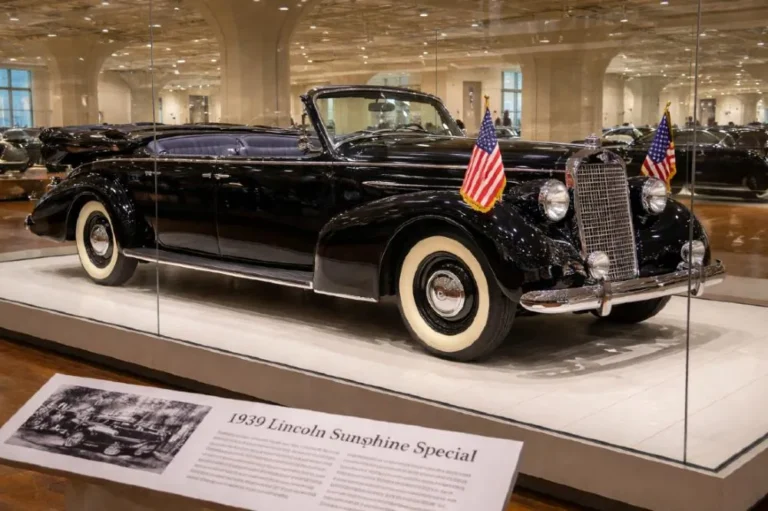
The official side of FDR’s automotive history is equally compelling. In December 1939, he received a 1939 Lincoln Motor Company V12 convertible as the first presidential car built to Secret Service specifications. He named it the Sunshine Special — because the top came down frequently and Roosevelt loved the open air. It is noteworthy for being the first presidential car to be leased instead of bought. The Sunshine Special is currently on display at the Henry Ford Museum in Dearborn, Michigan.
But between the Sunshine Special’s commission and its delivery, the United States had no armored presidential vehicle. And when the Japanese attacked Pearl Harbor on December 7, 1941, the Secret Service faced an urgent problem: they needed a bulletproof car for the president immediately, and there was nothing suitable available.
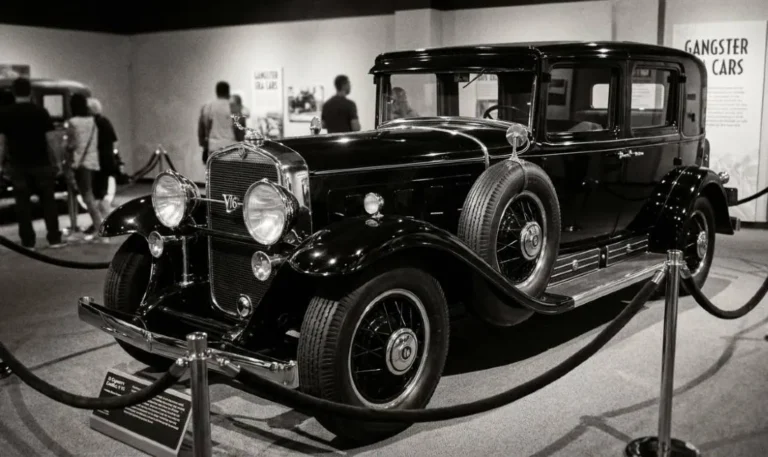
Their solution was one of the most remarkable pieces of automotive improvisation in American history. Originally belonging to infamous gangster Al Capone, the car was seized by the Treasury Department in 1932 on an income-tax evasion charge. The 1928 Cadillac V-16 that had been confiscated from Al Capone — which happened to be bulletproof, because Al Capone was the kind of man who needed a bulletproof car — was pressed into service as the presidential limousine. FDR rode in a gangster’s car for approximately one year while his proper armored Lincoln was being completed. This fact is entirely true and has never appeared in a Hollywood film, which seems like an oversight.
The Golden Era Of The Presidential Lincoln
From 1939 through 1972, with one exception under George H.W. Bush, the official presidential state car was a Lincoln. This thirty-three-year run represents the most sustained brand relationship in presidential automotive history, and the cars produced during it include both the most technologically innovative and the most historically significant vehicles ever to carry a sitting president.
Harry Truman — Lincolns And Chryslers
Harry Truman was a loyal Chrysler customer in his personal life. He owned two 1941 models — a sedan for him and a coupe for his wife — before becoming president. He bought a new 1953 Chrysler when he left office and kept buying them until he died in 1972. His license plate — since retired by the state of Missouri — read “5745,” to commemorate V.E. Day.
Officially, Truman rode in the 1950 Lincoln Cosmopolitan — the first presidential car to offer a bulletproof “bubbletop” canopy when it was retrofitted in 1954. It remained in service until 1967, outlasting the administration of three presidents.
One personal Truman car deserves specific mention: his Ford Super Deluxe Tudor Sedan was literally the first car to roll off the Ford assembly line after World War II. The car Truman owned was literally the very first car to roll off the Ford assembly line post-WWII. This signaled a new time in American industry and a symbolic rejuvenation for a war-tired nation.
Dwight Eisenhower — The Car Enthusiast President
Eisenhower came to the presidency with genuine automotive enthusiasm — he knew his way around a military Jeep from decades of command experience, but his personal taste ran to luxury. He also rode in a 1953 Cadillac El Dorado during his inauguration.
His favorite personal car was the 1956 Chrysler Imperial — a stunning convertible that was, genuinely, one of the most technologically forward automobiles available to an American buyer in the mid-1950s. It featured the first all-transistor radio in a production car. Eisenhower, who understood the significance of technology both militarily and commercially, appreciated the engineering accomplishment. He enjoyed great music on a genuinely great audio system while riding in one of the most elegant American cars of the postwar era.
JFK — The Car That Changed Everything
John F. Kennedy’s relationship with cars was genuinely enthusiastic. JFK was very proud of his 1961 Ford Thunderbird convertible. He had both the 1961 and 1963 versions. After fifty 1961 Thunderbirds appeared in his inaugural parade, the car received a significant boost in sales — a commercial impact directly traceable to Kennedy’s personal brand association with the vehicle.
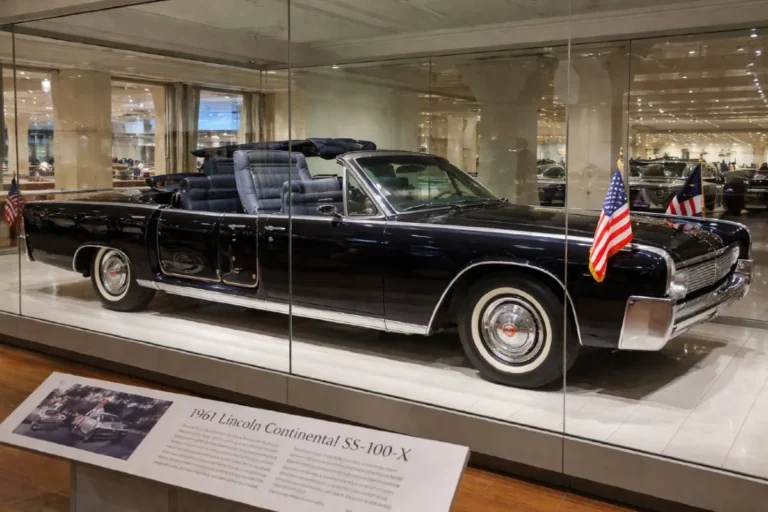
Officially, Kennedy’s car was the 1961 Lincoln Continental SS-100-X. It was customized with a phone system and a mechanism that elevated the passenger seat to allow spectators a better view of the president. But as aesthetically pleasing as the Lincoln was, it did not have any serious protective features. While the vehicle did come equipped with a clear plastic bubble-top, it was not bulletproof.
The car’s specifications were genuinely impressive for its era: stretched 3.5 feet beyond the standard Lincoln Continental, painted Presidential Blue Metallic with silver metallic flakes embedded in the paint, fitted with a heavy-duty heater and air conditioning, two radiotelephones, fire extinguisher, first-aid kit, and siren. It was leased by the federal government from Ford for $500 annually, but the modifications — performed by Hess and Eisenhardt — cost $200,000.
On November 22, 1963, in Dallas, Texas, the bubble top was not on the car. The day was clear. The crowds were large. The decision was made to drive without the cover that, while not bulletproof, would at minimum have provided a physical barrier. At 12:30 p.m., President Kennedy was shot while riding in the SS-100-X.
Following JFK’s assassination, SS-100-X was not taken out of service. It was redesigned with a fixed bulletproof roof and repainted black instead of the Kennedy car’s navy blue. It was used by President LBJ until 1967. It is currently on display at the Henry Ford Museum — the most historically significant automobile in American presidential history.
The assassination of John F. Kennedy did not end the use of the presidential limousine. It changed the limousine forever. Every car that came after it was built around a different premise: the president must be protected, not displayed.
Lyndon Johnson: The Only True Automotive Enthusiast Among US Presidents
Lyndon Baines Johnson was many things — a brilliant legislative tactician, a complicated man, a president defined by both the Great Society’s ambitions and the Vietnam War’s devastation. He was also, by any reasonable measure, the only genuine automotive enthusiast ever to occupy the White House.
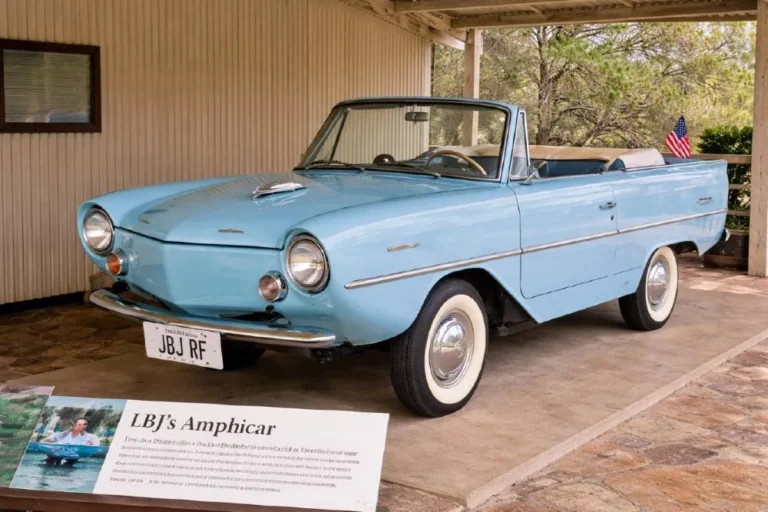
Lyndon B. Johnson may be the only U.S. President who can be considered a true automotive enthusiast. He enjoyed driving visitors around his Stonewall, Texas ranch in his prized Lincoln Continental Convertible. The ranch, now the Lyndon B. Johnson National Historical Park, displays many of his personal cars, including his famous blue Amphicar — “the only civilian amphibious passenger automobile ever to be mass produced.”
The Amphicar story is one of the great recurring anecdotes in presidential history. LBJ would enjoy playing practical jokes on his unsuspecting passengers in the Amphicar, pretending the brakes were shot and heading straight for the water. The car would then, to the visible relief of his guests and the obvious amusement of Johnson himself, simply continue into the lake and float. The Amphicar — a West German vehicle produced from 1961 to 1968 — is described by the National Park Service as the only civilian amphibious passenger automobile ever mass-produced. LBJ was one of approximately 4,000 American buyers. His specific use of it as a presidential prank delivery system is documented and entirely in character.
Beyond the Amphicar, LBJ’s personal collection at the Texas ranch included a 1934 Ford Phaeton, a Fiat 500 Jolly — a beach car with wicker seats and a fringed canopy, manufactured in tiny numbers for wealthy Italian coastal resorts — and his beloved Lincoln Continental Convertible. The Fiat 500 Jolly is perhaps the most unexpected vehicle in any presidential collection: a bright little Italian beach car owned by a Texan president who stood six feet four inches tall.
From Lincoln To Cadillac: The Transition In Official Presidential Cars
Nixon, Ford, Carter, And Reagan — The Lincoln Years
Presidents Nixon, Gerald Ford, Jimmy Carter and Ronald Reagan would all use variations of the Lincoln Continental. The 1972 Lincoln Continental used during this era is one of the more historically eventful state cars — it was involved in both the 1975 assassination attempt on Gerald Ford in Sacramento and the 1981 assassination attempt on Ronald Reagan in Washington, D.C. It is currently on display at the Henry Ford Museum. The same car, used by three different presidents, was present at two separate assassination attempts on two of them. That is a remarkable automotive biography.
The presidential state car didn’t see a model change until Reagan switched to a Cadillac Fleetwood limousine in 1983. Reagan’s transition to the 1983 Cadillac Fleetwood Brougham ended the Lincoln era of presidential transportation and began the Cadillac dominance that continues to the present day — with one brief exception.
George H.W. Bush — Back To Lincoln, One Last Time
Aside from George H.W. Bush’s Lincoln Town Car, Cadillacs have been used ever since. The 1989 Lincoln Town Car delivered to the Bush administration was a notable vehicle — at 22 feet long and more than 5 feet tall, it remains one of the longest presidential state cars ever constructed. It featured an extra section behind the B-pillar with rear-facing seats, a raised roof, and the comprehensive armoring that had become standard following the Kennedy and Reagan assassination attempts.
Bush’s personal automotive history is warm and specific. The Elder Bush’s first car when he went to Texas was, famously, a red 1947 Studebaker. The image of a young George H.W. Bush — war hero, Yale graduate, future president — driving a red Studebaker through Texas is one of the more humanizing details in presidential automotive biography.
Personal Collections And The Beast Takes Shape
Bill Clinton — A 1967 Mustang He Could No Longer Drive
When Bill Clinton became president, he lost access to his 1967 Mustang convertible. It was the underpowered six-cylinder with an automatic transmission… but it looked great. The image of a president losing his personal car the moment he takes office — traded for an armored Cadillac and a Secret Service detail — is one of the more quietly poignant moments in presidential car history. Clinton’s Mustang was not a performance car by any reasonable measure. It was his car. And the presidency took it away.
Officially, President Bill Clinton’s Fleetwood did not have running boards or a sunroof for safety reasons. It did, however, have telephones, internet access and satellite communications, all of which were considered extremely high-tech to have in a car in 1993.
George W. Bush — The First Car Built From Scratch
George W. Bush’s official car represented a genuine milestone in presidential automotive history. President George W. Bush’s Cadillac DeVille marked an important milestone in presidential car history: It was the first such vehicle not to be based on a commercial model. Instead, it was built to the specifications of the Secret Service. The car featured an infrared night vision system, 5-inch-thick armored doors, and a self-contained passenger compartment with its own secure air supply. The so-called “DeVille” was believed to be built on the chassis of a General Motors full-size SUV rather than any sedan platform — a fundamental shift in presidential vehicle architecture.
George W. Bush drives perhaps the most appropriate car for a fabulously former president residing in Texas: the Ford F-150 King Ranch. If you want to understand what the F-150 platform can become when American performance engineering gets serious about it, our guide to the F-150 Shelby Super Snake Sport shows exactly how far from the ranch truck this platform can travel.
Barack Obama — The Beast Earns Its Name
President Obama’s Cadillac lived up to its moniker of “The Beast,” weighing 15,000 pounds. The blast-resistant limo had Kevlar-reinforced tires and 8-inch-thick rear doors as heavy as the main-cabin doors of a Boeing 757. The vehicle also carried tanks of oxygen and bags of type AB negative blood (Obama’s blood type).
The 2009 Beast was described by the curator of The Henry Ford as “a tank with a Cadillac badge” — which is accurate as a design description and impressive as a compliment. It drove Obama down Pennsylvania Avenue on Inauguration Day 2009, and in 2013 it carried the distinctive Washington D.C. “TAXATION WITHOUT REPRESENTATION” license plates that Obama approved after the D.C. city council requested the motorcade use them.
Obama’s personal car history before the presidency is refreshingly ordinary. Barack Obama had a brief sliver of adulthood during which he could afford a new car, but was not yet president. His collection was very normcore-2000s: his first car was a 2000 Grand Cherokee; he later drove a 2005 Chrysler 300C as a senator, but opted for a more fuel-efficient 2008 Escape Hybrid during his presidential run.
The Lamborghini, The Rolls-Royce, And The New Beast
Donald Trump’s personal car collection before his presidency reflected the aesthetic sensibility that has characterized his public life since the 1980s — expensive, European, and attention-commanding. Longtime man-of-means Donald Trump has owned a range of exclusive cars, including a 1956 Rolls-Royce Silver Cloud, a 1997 Lamborghini Diablo and a 2003 Mercedes-Benz SLR McLaren. For a deeper look at the American side of that performance equation, our Dodge Viper complete guide covers the five-generation story of the car that defined American supercar ambition from 1992 to 2017
The 1997 Lamborghini Diablo is the car most associated with Trump’s pre-presidential automotive identity — a yellow example that appeared in promotional contexts and reflected the maximalist visual language that Trump applied to everything from buildings to golf courses. The Mercedes-Benz SLR McLaren is a more understated choice — a genuinely exceptional grand touring car produced in partnership between Mercedes-Benz and McLaren Automotive, limited in production and significant in engineering.
Trump’s relationship with Cadillac is generational. “My father was a great guy, I learned so much from him, and he loved Cadillacs. His biggest luxury in life was to get a brand new, dark-blue Cadillac every two years,” Trump was quoted as saying. “My father liked Cadillacs, so that’s good enough for me.”
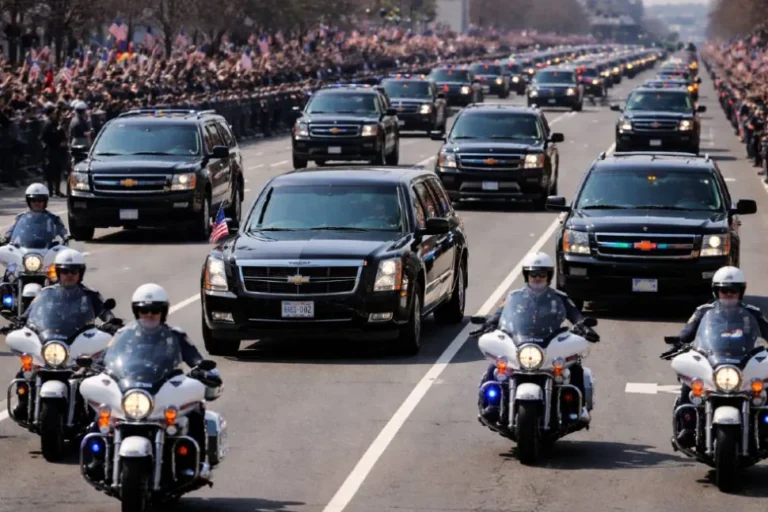
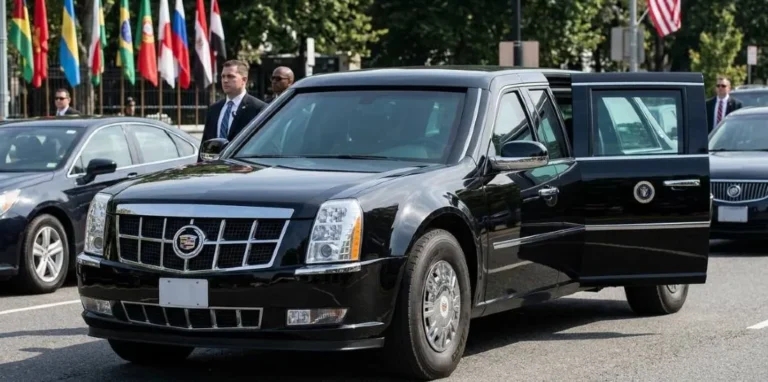
Officially, the 2018 Cadillac “Beast” that entered service during Trump’s first term is the current presidential state car. The current model debuted with a trip by President Trump to New York City on September 24, 2018. Road and Track reported that “the design appears to be a simple evolution of the old model with more current Cadillac design cues, like an Escalade sedan.”
The current Beast is among the most formidable vehicles ever built. The current Beast is said to produce its own environment inside, sealed from the world. It is also said to weigh 10 tons, have one-foot thick doors, and have extra blood on hand for the president. Other confirmed features include run-flat tires with Kevlar reinforcement, night vision optics, a tear gas cannon, onboard oxygen tanks, an armored fuel tank, and pump-action shotguns. The car cannot be bought, rented, or replicated. It exists only to keep the President of the United States alive.
The Camp Package Escalade: The Most Recent Presidential Car News
The biggest presidential automotive story of 2026 broke in January, when President Trump’s motorcade arrived at the World Economic Forum in Davos, Switzerland, and automotive observers immediately noticed something different in the convoy.
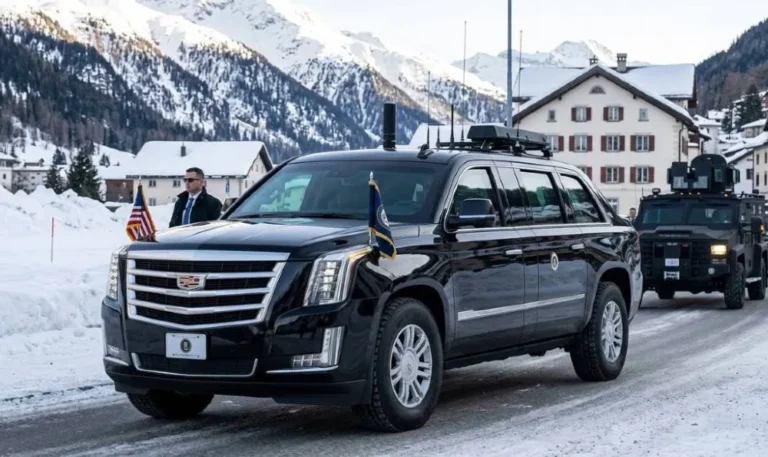
The U.S. Secret Service has introduced its one-of-a-kind Cadillac Escalade-based full-size SUVs dubbed the “Camp Package,” built to ferry the U.S. President through rough terrains like Camp David, Maryland. The new SUVs first made their debut in January at the 56th World Economic Forum Annual Meeting in Davos, Switzerland.
Secret Service Director Sean Curran told The War Zone: “Great work by our team and partners on President Trump’s trip to Davos. We were excited to build upon our long-lasting relationship with General Motors as we introduced these vehicles to our protective fleet.”
The Camp Package Escalades are not replacements for The Beast. They are purpose-built for terrain that the heavy, low-slung Beast sedan cannot traverse — the wooded hills and off-road paths around Camp David in Maryland being the primary use case, along with international venues where the Beast’s size creates tactical limitations.
The ‘Camp Package’ Cadillac Escalade is built to take on rough conditions the Beast cannot traverse. From the front, the SUVs look similar to the U.S. President’s “Beast” limousines. There are two of these presidential Cadillac SUVs, which comes as no surprise, as there are also a couple of backups for The Beast in service.
Photographs from Davos showed the Escalades fitted with thick ballistic glass, reinforced doors, and a cluster of roof-mounted antennas tied into the Secret Service’s secure communications network. The eight-lug wheels immediately communicated that this was not a consumer Escalade. The architecture underneath is the same K2 platform that underpins the Secret Service’s trusted Suburbans — but dressed in Cadillac’s signature grille and chrome accents, creating a vehicle that delivers maximum protection while looking, to the untrained eye, more consistent with the civilian luxury vehicles a head of state arrives in.
The timing of the Camp Package’s introduction is also significant. It has been noted that custom Secret Service vehicles typically have an 8-year service life, and the current Beasts will hit that service life in 2026. The Escalade’s debut may be the opening move in a broader fleet transition — a preview of what replaces the current Beast sedan when its replacement enters service.
Where You Can Actually See The Cars In Person
The most significant collection of presidential vehicles in the world is not in Washington, D.C. It is in Dearborn, Michigan, at The Henry Ford Museum of American Innovation.
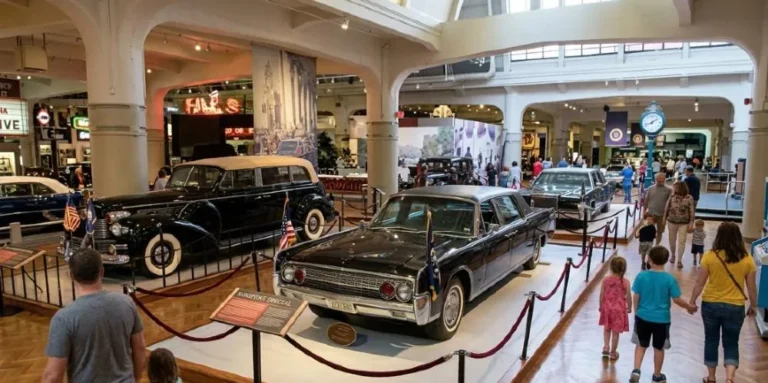
The museum holds the 1939 Lincoln Sunshine Special (FDR), the 1950 Lincoln Cosmopolitan (Truman/Eisenhower/Kennedy), the 1961 Lincoln Continental SS-100-X (JFK assassination car), and the 1972 Lincoln Continental that was present at both the Ford and Reagan assassination attempts. These four vehicles alone constitute an irreplaceable documentary record of American presidential history — and each of them tells a story that no photograph or document can communicate as directly as the physical object itself.
The JFK Lincoln Continental is the most visited exhibit in the museum. It sits behind glass, still in the black color it was repainted after Dallas, custom automotive paint specification that, even in today’s market, represents a premium build. Our guide to how much it costs to paint a car breaks down what a custom metallic finish like this would run at every level from a single panel to a full one-off build.
Still carrying the hydraulic seat mechanism and the radio equipment that were present on November 22, 1963. Visitors stand before it in silence in a way that visitors to few other museum exhibits do. The car is not famous because of what it was. It is famous because of what happened while a man was sitting in it. That weight is palpable.
The Lyndon B. Johnson National Historical Park at the LBJ Ranch in Stonewall, Texas, displays Johnson’s personal collection — including the Lincoln Continental Convertible, the 1934 Ford Phaeton, and the Amphicar. These are working ranch vehicles rather than state limousines, and they reflect the private man rather than the public office. Visiting them gives a completely different picture of a president than the formal museum display of armored state cars.
FAQ
Q: What car does the president of the United States currently drive?
A: As of 2026, the primary presidential state car is the 2018 Cadillac “The Beast” — a custom vehicle built on a modified truck platform with Cadillac sedan styling. It entered service on September 24, 2018, during Donald Trump’s first term. In January 2026, the Secret Service also introduced a new “Camp Package” Cadillac Escalade for use on rough terrain like Camp David and challenging international venues. The current Beast is approaching its 8-year typical service life and is expected to be replaced in the coming years. A fleet of armored Chevrolet Suburbans also accompanies the president during all movements.
Q: What car was JFK assassinated in?
A: President John F. Kennedy was assassinated on November 22, 1963, while riding in a 1961 Lincoln Continental presidential limousine known as the SS-100-X. The car was painted Presidential Blue Metallic, had been stretched 3.5 feet beyond standard Lincoln Continental dimensions, and was leased from Ford for $500 per year with $200,000 in modifications. Crucially, the clear plastic bubble top was not installed that day. After the assassination the car was armored, repainted black, and remained in service until 1977. It is currently on display at the Henry Ford Museum in Dearborn, Michigan.
Q: What is The Beast presidential limousine?
A: “The Beast” is the nickname for the United States presidential state car — a custom-built, heavily armored vehicle that externally resembles a Cadillac sedan but is built on a modified truck platform. The current model entered service in 2018. Confirmed features include 8-inch thick armor-plated doors, run-flat Kevlar-reinforced tires, night vision optics, a tear gas cannon, onboard oxygen tanks, an armored fuel tank, and a self-contained secure interior environment. It is believed to weigh approximately 10 tons. It was built exclusively for Secret Service specifications and has no production equivalent.
Q: Which US president owned the most interesting personal car collection?
A: By most measures, Lyndon B. Johnson owned the most genuinely interesting personal car collection of any US president. His collection at the LBJ Ranch in Stonewall, Texas, included a Lincoln Continental Convertible, a 1934 Ford Phaeton, a Fiat 500 Jolly (a rare Italian beach car with wicker seats), and his famous Amphicar — the only civilian amphibious passenger car ever mass-produced. LBJ used the Amphicar to prank guests by pretending his brakes had failed before driving into the lake. The ranch is now the Lyndon B. Johnson National Historical Park and the collection is on public display.
Q: What was the first bulletproof presidential car?
A: The first bulletproof presidential car was a 1928 Cadillac V-16 originally owned by Al Capone, seized by the Treasury Department in 1932 on income tax evasion charges. Following the attack on Pearl Harbor in December 1941, the Secret Service commandeered the gangster’s bulletproof Cadillac for FDR while a proper armored presidential Lincoln was being built. The 1939 Lincoln Sunshine Special was the first car built to Secret Service specifications from the outset, though it was not heavily armored. Full presidential armoring became standard from 1942 onward.
Q: What cars did Trump own before becoming president?
A: Before his presidency, Donald Trump’s personal car collection included a 1956 Rolls-Royce Silver Cloud, a yellow 1997 Lamborghini Diablo, and a 2003 Mercedes-Benz SLR McLaren. Trump has spoken about his family’s generational connection to Cadillac — his father Fred Trump bought a new dark-blue Cadillac every two years as his primary luxury purchase, a tradition Trump has cited as influential on his own brand associations.
Q: What is the new 2026 presidential Cadillac Escalade?
A: In January 2026, the U.S. Secret Service debuted two custom armored Cadillac Escalade-based vehicles in Donald Trump’s motorcade at the World Economic Forum in Davos, Switzerland. The Secret Service calls them the “Camp Package” — a name derived from their primary intended use at Camp David, Maryland, where the terrain is too rough for the standard Beast limousine. They are built on the K2 platform shared with Chevrolet Suburbans, feature heavy ballistic glass, reinforced doors, and roof-mounted secure communications antennas. They do not replace The Beast but supplement the fleet for challenging terrain environments.
Q: Which presidents drove their own cars while in office?
A: Sitting presidents are prohibited by the Secret Service from driving on public roads. The last president to genuinely drive on public roads while in office was George W. Bush, who occasionally drove at his Crawford, Texas ranch — a private property where Secret Service restrictions are more flexible. LBJ drove extensively at his Texas ranch. FDR drove his hand-controlled Ford V8 Phaeton at Hyde Park in violation of Secret Service directives. Warren G. Harding was the last president to drive himself on public roads as a genuinely common occurrence — a practice that became impossible after the security protocols of the post-World War II era were established.
Conclusion
The story of presidential cars is not really about the cars. It is about the presidency itself — what it demands of the person inside the car, what it takes from them, what it protects them from, and occasionally what it fails to protect them from.
The 1961 Lincoln Continental tells the story of an era that ended on a street in Dallas. The Sunshine Special tells the story of a president who refused to let his disability define his public presence. LBJ’s Amphicar tells the story of a man who loved power and used it to make people laugh. Clinton’s 1967 Mustang tells the story of what the presidency costs — including the small, personal things you never expected to give up.
And the new Camp Package Escalade, armored to specifications we are not allowed to know, debuted in January 2026 at a ski resort in Switzerland, tells the story of an America that has been protecting its presidents long enough to know that a genuinely secure car cannot look like a weapon. It has to look like a Cadillac.
Every presidential car is a response to the one that came before it. Every modification is a lesson learned. The history of presidential vehicles is, in the end, the history of America trying to keep the people it elects alive long enough to do the job.
Editorial Note
This article was written and reviewed in March 2026. All historical specifications, production dates, and documented events are sourced from Wikipedia, the US Secret Service official history, the White House Historical Association, the Henry Ford Museum, AAA Magazine, Gear Patrol, The War Zone, AutoGuide, and Autoblog. The 2026 Camp Package Cadillac Escalade information is sourced from Secret Service Director Sean Curran’s January 22, 2026 official statement and from The War Zone and Autoblog reporting dated January 22 and March 16, 2026. All presidential personal car ownership details are sourced from Gear Patrol’s documented research and official presidential library materials. Vehicle valuations where cited are in 2025–2026 equivalent dollars per cited sources.


0 Comments