Last Updated: May 11, 2026 | Read Time: 8 minutes
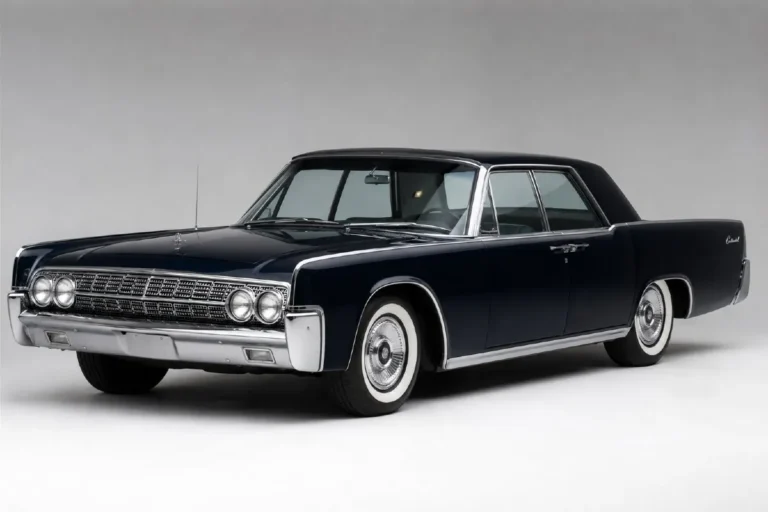
The Museum of Modern Art in New York City added the 1961 Lincoln Continental to its permanent collection. That is not a hyperbolic comparison between a car and great art — it is a documented institutional decision made by a major museum that evaluates design with the same standards it applies to sculpture. The 1964 Continental refined that original design with a longer wheelbase, more interior space, a new dashboard, and more upright glazing that made the already distinguished body even more composed.
It had center-opening suicide doors when no other American production car offered them. It had a 430-cubic-inch V8 tuned not for maximum power but for maximum silence. And it was built to a quality standard — 24-hour road testing on every car, individual assembly rather than conventional line production — that no American manufacturer has matched since.
Quick Facts – 64 Lincoln Continental Key Facts
– Production Year: 1964 model year
– Generation: Fourth generation — 1961 to 1969
– Platform: Unitized body-frame construction — new for 1961
– Body Styles: Four-door hardtop sedan, four-door convertible
– Designer: Elwood Engel — Ford Motor Company design studio
– Wheelbase: 126 inches — 3 inches longer than 1963
– Overall Length: 216.3 inches
– Engine: 7.0-liter (430 cubic inch) MEL V8 — 320 HP / 465 lb-ft
– Transmission: 3-speed Turbo-Drive automatic
– Suspension: Front independent coil-spring, rear leaf-spring with air-leveling
– Brakes: Front disc (optional), rear drum standard — discs optional for 1964
– 0–60 MPH: Approximately 9.5 to 10 seconds
– Top Speed: Approximately 115 to 120 mph
– Fuel Economy: Approximately 10 to 14 mpg combined (period testing)
– Base Price 1964 Sedan: Approximately $6,292
– Base Price 1964 Convertible: Approximately $6,938
– Sedan Production: 32,969 units
– Convertible Production: 3,328 units
– Total Production 1964: 36,297 units
– Key 1964 Changes: 3-inch wheelbase increase, new dashboard, larger doors, 4 inches more rear legroom, 15 percent more trunk space, new upright side glazing
– New 1964 Options: Heavy-duty spring/damper package, 3.11:1 final-drive ratio, front/rear lap belts, locking gas cap
– JFK Connection: The 1961 Lincoln Continental X-100 limousine carried President Kennedy on November 22, 1963 — the 1964 Continental shares that car’s design DNA
– MoMA Recognition: 1961 Continental in MoMA’s permanent collection — design judgement applies equally to 1964
– Current Value Range: $25,000–$61,000+ depending on condition and body style
– Key Auction Sales: $51,500 (Bring a Trailer) / $61,000 highest bid
Sources: Hagerty Media, Classic.com, Henry Ford Museum, Wikipedia, Autoevolution
Overview – The Car That Proved American Luxury Could Also Mean American Elegance
By 1960, the American luxury car had reached a specific crisis of identity. The vehicles produced by Cadillac and Imperial during the late 1950s were enormous, chrome-laden, fantailed machines that communicated wealth through sheer visual excess. They were unmistakably luxurious. They were also unmistakably overwrought. The tailfins that had once communicated modernity had grown so large that they had become self-parody, and the chrome that once signified quality had multiplied to the point of meaninglessness.
Into this environment, Lincoln introduced the fourth-generation Continental for 1961 — and it looked like nothing else in American production. Where its competitors reached for more chrome, the Continental used less. Where they grew wider and longer and lower with every model year, the Continental actually shrank — fifteen inches shorter than its predecessor, on a shorter wheelbase, in a body whose primary visual language was restraint rather than excess.
It was clean in a way that American luxury cars had not been clean since the late 1940s. The Museum of Modern Art added the 1961 Continental to its permanent collection. Car Life magazine gave it its Engineering Excellence Award in 1961. And the car-buying public responded: sales grew steadily throughout the generation’s production run.
The 1964 Lincoln Continental is the most refined expression of that original concept within the fourth generation’s production run. A 3-inch wheelbase increase made the car genuinely more spacious without disturbing its proportions. New doors were larger, improving entry and exit to both front and rear. Four additional inches of rear legroom addressed the only consistent complaint about the original 1961 design.
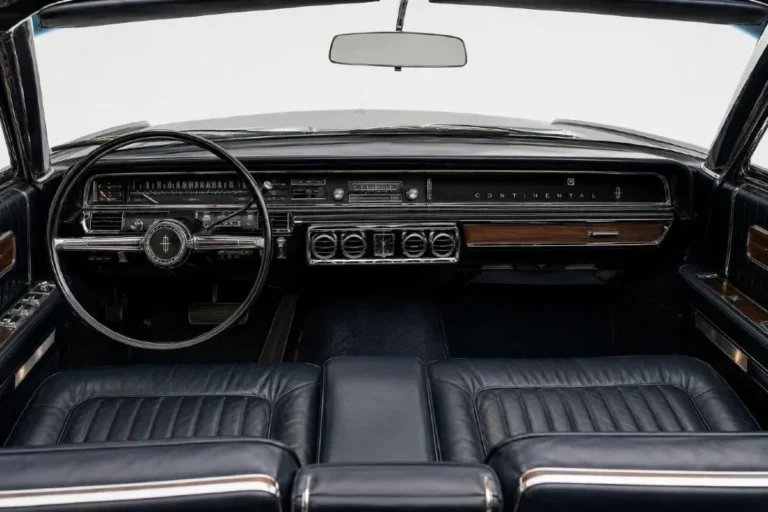
A completely new dashboard — a single elegant sweep from end to end with four climate control outlets — modernized the interior while preserving the design discipline that had defined the original. And the cargo space increased by 15 percent through a revised rear-end design that accomplished the functional improvement without compromising the visual one.
The 1964 Continental also carries a specific historical gravity that no amount of specification upgrading can fully account for. It was in production when, on November 22, 1963 in Dallas, Texas, President Kennedy was assassinated in a stretched 1961 Lincoln Continental limousine. The X-100 — the Secret Service code name for that car — now resides at the Henry Ford Museum. The 1964 Continental that emerged from that moment and continued the lineage is, in a sense, the car that existed in the shadow of the most significant event in its design family’s history.
This is the complete guide to what it was, what it is, and what it is worth today.
Section 1 – The Design Story
How Elwood Engel Created The Most Restrained American Luxury Car
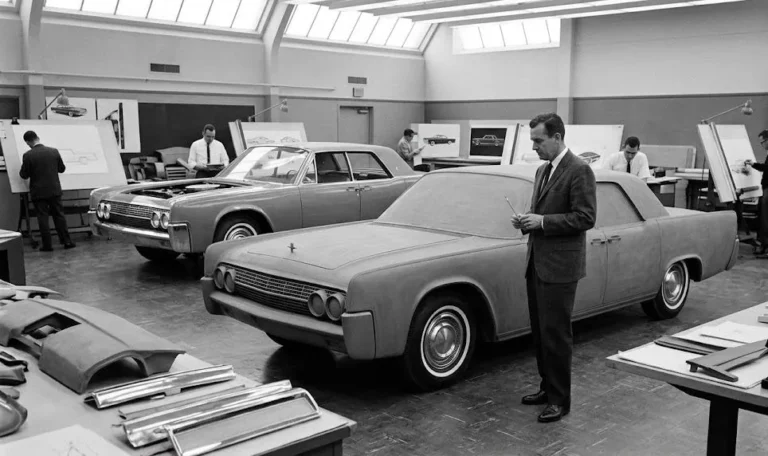
The design of the fourth-generation Lincoln Continental is attributed to Elwood Engel, who came to Ford from Chrysler in 1961 with a design philosophy that was fundamentally different from the baroque American styling of the late 1950s. The Continental that resulted from his direction was, by American standards of its time, almost radically simple.
The basic form is a long, clean slab — the long hood, short deck proportion that defines classic American luxury car design, with a greenhouse that rises from the body’s line without drama and sits above it without excess. There are no tailfins. There is minimal chrome — the window surrounds, the bumpers, the thin side moldings that mark the body’s lower section. The body sides are clean enough that the eye travels the full length of the car without interruption, which makes the car seem simultaneously longer and more composed than its actual dimensions suggest.
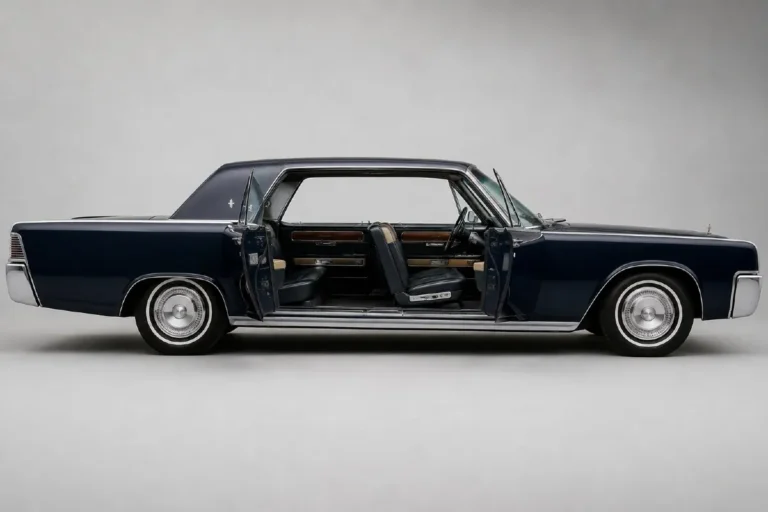
The center-opening rear doors — the feature that most people associate with the Continental and that most people call suicide doors — were both a design and an engineering decision. The front doors are hinged conventionally at the A-pillar and open forward. The rear doors are hinged at the C-pillar and open rearward — toward the back of the car — in the opposite direction from the front doors. There is no B-pillar between them. When both sets of doors are open simultaneously, the entire side of the car opens completely, creating an unobstructed entry to both front and rear passenger compartments.
The term suicide doors refers to the rear door’s opening direction — a rear-hinged door that opened accidentally while the car was in motion would be pulled further open by the airflow rather than being closed by it, creating a specific hazard for the rear passenger.
Lincoln addressed this with a safety interlock that prevented the rear doors from being opened while the car was in motion and while the front doors were closed — a mechanical solution to the physical problem that the door arrangement presented. The interlock was not perfect by modern standards, but it represented a genuine engineering response to the design’s specific safety implication.
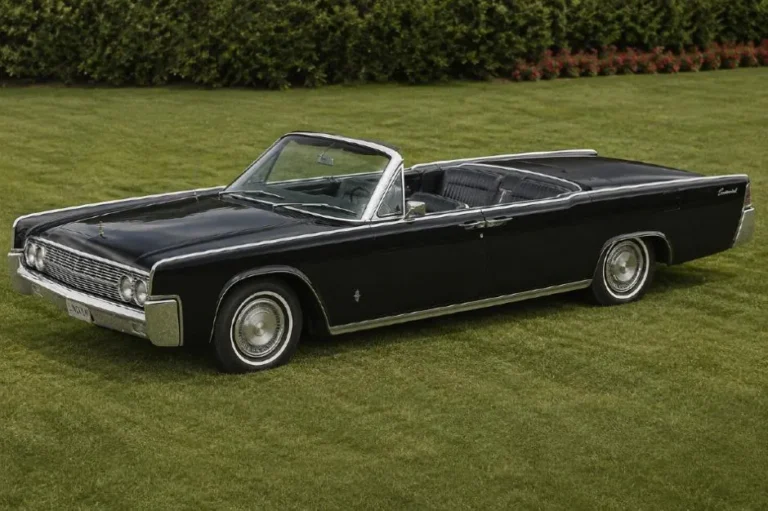
The convertible body style used a power-operated soft top that stowed completely under a metal decklid when lowered, creating a clean profile with no visible top-stowage structure above the body line. The convertible’s profile is arguably the most beautiful configuration of the Continental — without the greenhouse of the hardtop, the long, low body reads as a pure expression of the design’s fundamental form.
The 1964 model year brought specific and deliberate refinements to this established design. The 3-inch wheelbase increase was the most structurally significant change — all of the additional length went into the passenger compartment, not the body overhang. The rear doors grew larger as a result, improving entry to the rear seat for passengers who found the original 1961–1963 doors tight for comfortable access.
The new upright glazing — replacing the curved side glass of the previous years — gave the greenhouse a more formal and more composed appearance that many critics and owners preferred over the curved glass’s slightly more informal character. More light entered through the new rear window design, and the overall visual impression of the cabin was more open and more airy as a result.
The new dashboard of the 1964 Continental is worth specific attention because it represents one of the most significant interior design decisions in the generation’s history. The previous dash design — inherited directly from the 1961 original — used a twin-cowl arrangement. Ford had meanwhile given that twin-cowl arrangement to the new 1964 Mustang as part of its own interior design. The 1964 Continental received an entirely new single-sweep dash that ran from one end of the instrument panel to the other without visual interruption, housing four HVAC outlets for more even climate distribution throughout the cabin. The result was simultaneously more modern and more elegant than the dash it replaced.
Section 2 – The Engineering
How Ford Built The 1964 Continental To A Quality Standard Nobody Has Matched Since
The 1964 Lincoln Continental’s engineering story is not primarily about its engine or its transmission or its suspension, though all three deserve discussion. It is primarily about the quality control philosophy that Ford applied to its construction — a philosophy that resulted in a car whose build quality was, by the documented standards of its era, the best of any American production automobile.
Every 1964 Lincoln Continental that left the Wixom, Michigan assembly plant was subjected to a 24-hour road test before delivery. Not a sample of production. Not a final inspection check. Every single car. Each Continental was test-driven for 12 miles on a closed road course near the plant, then inspected, then test-driven for an additional 12 miles, then inspected again. Any car that failed to meet specifications at either inspection point was pulled from the delivery queue and returned for remediation before being retested.
This process added substantially to the cost of producing each Continental and contributed to the car’s price premium over Cadillac and Imperial. It also produced a documented build quality advantage that Lincoln used extensively in its marketing and that contemporary road tests consistently confirmed. Car and Driver noted in its reviews of the Continental that the car’s fit and finish, panel gap consistency, and interior quality were measurably better than any American competitor. Motor Trend reached similar conclusions. The 24-hour road test program was eventually abandoned as production volumes increased and cost pressures made the process economically unsustainable — but for the fourth-generation Continental, it remained the standard throughout the production run.
The unitized body-frame construction — introduced for the 1961 Continental as a new architecture for the Lincoln line — provided inherent structural rigidity that contributed both to build quality and to refinement. A unitized structure transmits less road noise and vibration to the passenger compartment than a body-on-frame design because there are fewer joints at which vibration can be amplified. The Continental’s unitized construction was one of the primary reasons its cabin was among the quietest in American production — a quality that the car’s marketing emphasized and that its owners consistently appreciated.
The Engine: 430 Cubic Inches Of Deliberate Restraint
The 1964 Lincoln Continental’s engine is a 7.0-liter, 430-cubic-inch MEL V8 producing 320 horsepower and 465 lb-ft of torque. The MEL designation stands for Mercury-Edsel-Lincoln — the engine family that Ford developed to serve the upper end of its product lineup from the late 1950s through the mid-1960s.
In a period when American performance engines were being rated in gross horsepower numbers that bore minimal relationship to net output in actual road use, the Continental’s 320 horsepower figure was conservative by the standards of its era. Other manufacturers were claiming 350, 400, and occasionally higher outputs from engines of similar displacement. Lincoln’s choice of a more conservative and more achievable rating was consistent with the car’s positioning — this was not a performance machine, and advertising it as one would have been both inaccurate and inappropriate. The 430 V8 was tuned for smooth, quiet, effortless power delivery rather than peak output or high-rpm excitement.
The result in everyday driving was an engine that felt larger than its 320 horsepower rating suggested. The 465 lb-ft of torque arrived at low rpm and remained present across the entire useful rev range, meaning that the Continental moved from rest to highway speed with an effortless authority that drivers of the era consistently described as the correct feeling for a full-size luxury car. The 0-to-60 time of approximately 9.5 to 10 seconds reflected the car’s weight and its tuning priorities — it was not fast by any performance standard, but it was appropriately quick for a vehicle whose purpose was serene transportation rather than sporting achievement.
The 3-speed Turbo-Drive automatic transmission paired with the 430 V8 operated with a smoothness that was remarkable for its era. The shifts were virtually imperceptible in normal driving — a quality that required careful calibration of shift points and hydraulic pressures that Ford’s engineers worked extensively to achieve. The transmission’s smooth operation was a significant contributor to the overall refinement of the driving experience and to the Continental’s reputation as the most comfortable American luxury car of its generation.
Section 3 – The JFK Connection
The connection between the Lincoln Continental and President John F. Kennedy’s assassination is the most consequential single event in the history of any American production car — and it is a connection that the 1964 Continental carries as part of its direct design lineage.
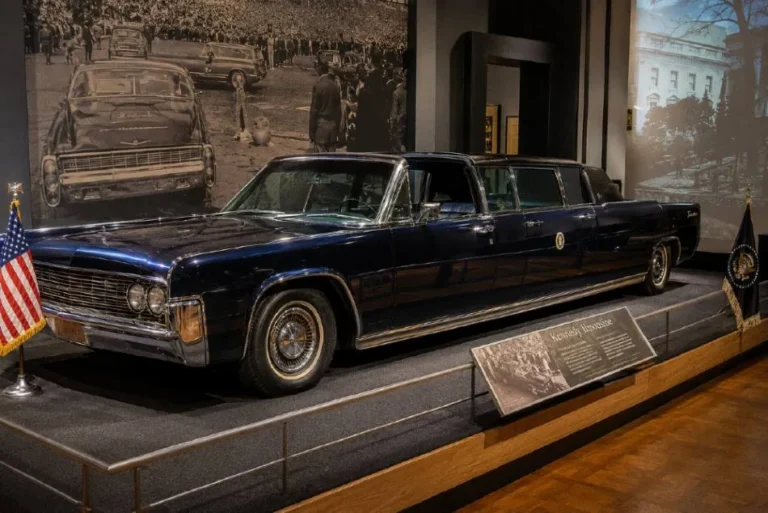
The Presidential limousine in which President Kennedy was riding on November 22, 1963, in Dallas, Texas, was a 1961 Lincoln Continental convertible. The car’s Secret Service code name was X-100. It was assembled at Lincoln’s Wixom, Michigan plant in January 1961. Hess and Eisenhardt of Cincinnati, Ohio was responsible for customizing the car, literally cutting it in half, reinforcing it, extending it 3.5 feet in length, and making numerous other modifications to function as a presidential parade limousine. The car remained the property of Ford Motor Company, which leased it to the Secret Service for the nominal price of $500 per year.
The X-100 was impounded for evidence in the weeks following the assassination. Plans were subsequently made to modify the car extensively — a committee originally comprised of thirty people, eventually reduced to six representatives from the Secret Service, the Army Materials Research Center, Hess and Eisenhardt, and Pittsburgh Plate Glass Company — and the modified car was returned to Washington for continued presidential service. Complete re-trimming of the rear compartment, new paint described in a May 1, 1964 report as regal Presidential Blue Metallic with silver metallic flakes that glitter under bright lights and sunshine, and extensive structural reinforcement were among the changes made after the assassination.
The X-100 now resides at the Henry Ford Museum in Dearborn, Michigan. No mention of the 1964 Continental is complete without the sad remembrance that it was a stretched version of this car that carried President Kennedy on the day of his assassination. That specific phrase, from Hagerty’s own valuation tool description of the car, reflects the way in which the Kennedy association has become inseparable from every evaluation of the fourth-generation Continental — including the 1964 model that was in concurrent production at the time of the assassination.
The 1964 Continental is not the JFK limousine. It is a different vehicle produced in the same year from the same design family. But its center-opening rear doors, its clean body design, and its fundamental architecture are all direct products of the same engineering and design program that produced the X-100. Owning a 1964 Continental is owning the civilian expression of the most historically significant automotive design of the 20th century.
In December 2024, Lincoln Continental limousines that JFK rode in during his presidency — not the X-100, but personal limousines used during his time in office — were offered at auction by the American Presidential Experience Collection. In March 1964, Dr. James C. Walsh, a personal acquaintance of the President, purchased one such Lincoln and confirmed that the late President Kennedy did use this car for his own personal uses in contrast to the official use of the larger White House limousine. These personal presidential Continentals were offered with an interior that remains in its original condition, including the beige leather seats, matching carpeting, and the original telephone.
The Lincoln Continental’s association with President Kennedy is the most dramatic single moment in the history of any American production car — but it is part of a longer story of American presidents and the vehicles they chose that we cover completely in our guide to cars owned by US presidents, where the Lincoln nameplate appears repeatedly as the manufacturer of choice for American executive transportation from FDR through multiple subsequent administrations.
Section 4 – The Body Styles
Sedan And Convertible — What The Difference Means
The 1964 Lincoln Continental was available in exactly two body configurations: the four-door hardtop sedan and the four-door convertible. Understanding the specific differences between them — in construction, in production volume, in driving character, and collector market value — is essential for any buyer considering a 1964 Continental purchase.
The Four-Door Hardtop Sedan
The four-door hardtop sedan produced 32,969 units in the 1964 model year — the overwhelming majority of total Continental production. The hardtop designation refers to the absence of a B-pillar between the front and rear doors, which is what makes the center-opening door arrangement possible. A conventional B-pillar would occupy exactly the space between the front door’s trailing edge and the rear door’s leading edge — the space that, in the Continental’s design, is completely open when either set of doors is open.
The hardtop sedan’s fixed roof provides inherent structural rigidity advantages over the convertible — the roof itself is a major structural element in any unibody construction, and a car with a fixed roof has more torsional rigidity than one with a removable top. The Continental’s 24-hour road test process applied equally to both body styles, but the hardtop’s superior inherent rigidity meant that it was less susceptible to the squeaks and rattles that occasionally affected the convertible in its pillar-free construction.
The hardtop sedan represents the more commonly encountered 1964 Continental in the collector market today — and as Hagerty’s buyer’s guide correctly notes, earlier four-door hardtops are more affordable than convertibles. For buyers who want to own and drive a 1964 Continental regularly, the hardtop sedan offers a more practical balance of acquisition cost, mechanical accessibility, and everyday usability.
The Four-Door Convertible
The four-door convertible produced 3,328 units in 1964 — approximately one for every ten hardtop sedans built. This production ratio creates a significant and well-established collector premium: convertible 1964 Continentals are substantially rarer than hardtops, substantially more sought-after, and substantially more valuable in any condition comparison.
The convertible’s power-operated soft top stowed completely under a metal decklid, leaving the body profile uninterrupted when the top was lowered. The clean profile this created — a long, low body with no visible top stowage — is widely considered one of the most beautiful open-car designs in American automotive history. The Lincoln Continental’s four-door convertible has appeared on virtually every published list of most beautiful American cars ever produced, and the 1964 model year’s cleaner glazing and larger doors give it a visual advantage over the 1961–1963 versions in the eyes of many who have compared them directly.
The convertible’s structural challenges — the inherent flexibility of a large open-body structure — are manageable with proper maintenance and periodic structural inspection. Bodies that have been neglected for extended periods may show cowl shake and door gap irregularity that requires professional restoration attention. Well-maintained or properly restored convertibles provide a driving experience that the hardtop cannot replicate — the combination of 430 cubic inches of smooth, quiet V8 power, the effortless roof operation, and the open-air Lincoln driving experience is as specific and as irreplaceable as any American automotive combination of its era.
Section 5 – The Interior
Where The 1964 Continental Made Its Strongest Argument For Luxury
The interior of the 1964 Lincoln Continental is its most complete expression of the design philosophy that made the fourth generation an enduring benchmark. The cabin is not merely well-equipped. It is specifically, deliberately, and measurably the best-appointed American production car interior of its year.
The new single-sweep dashboard of the 1964 model runs from one end of the instrument panel to the other in an unbroken horizontal line, housing the instruments, controls, and four climate outlets in a layout that is both functionally organized and visually composed. Unlike the twin-cowl design it replaced — which Ford had used for the 1961 through 1963 Continental before transferring it to the new 1964 Mustang — the single-sweep dash has no visual interruption from the driver’s door to the passenger door. The effect in person is of a cabin that extends broadly in both directions from the driver’s position, creating a sense of horizontal space that the Continental’s proportions fully supported.
The seats are genuine leather throughout — not leatherette, not vinyl, not a leather-and-synthetic combination in the interest of cost management. Genuine leather front and rear. The front seat configuration in 1964 continued the bench seat arrangement that gave the Continental’s interior its formal, traditional character — bucket seats were not offered in the fourth-generation Continental, a deliberate choice consistent with its positioning as a formal luxury car rather than a sporting one.
Rear seat access — specifically improved for 1964 by the combination of larger doors and 4 inches of additional legroom — makes the 1964 a meaningfully more comfortable rear-passenger experience than the 1961 through 1963 models. The rear doors, hinged at the C-pillar and opening rearward, create a wide entry that allows adult passengers of normal stature to enter the rear compartment without ducking or twisting. Once seated, the additional legroom is immediately apparent — a change that was not cosmetic but genuinely functional, and one that contemporary road tests of the 1964 model consistently identified as among its most significant improvements.
Standard equipment on the 1964 Lincoln Continental included power windows, power seats, power door locks, a power convertible top on the open-body version, automatic climate control, a full AM radio, and padded sunvisors — a list that represented the comprehensive luxury standard of the era. The air conditioning system — standard on the Lincoln Continental when it was still optional on most competitors — used a layout that Ford’s engineers had specifically calibrated for the 1964’s new four-outlet dashboard design, providing more even cooling throughout the cabin than the previous year’s system had managed.
Section 6 – The 64 Continental Against Its Competition
What Buyers Were Choosing Between In 1964
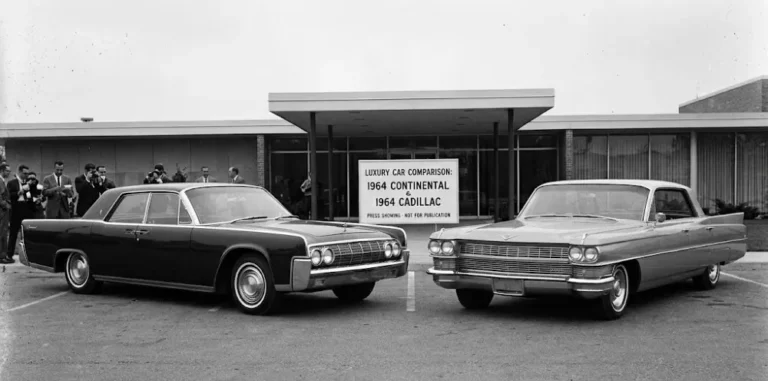
In 1964, the American luxury car market was effectively a three-way competition among Lincoln, Cadillac, and Chrysler’s Imperial — three manufacturers with fundamentally different approaches to what a luxury automobile should be and communicate.
The Cadillac De Ville
The 1964 Cadillac de Ville was the market leader in American luxury by production volume — and it was a fundamentally different vehicle from the Continental in almost every dimension of design philosophy. Where the Continental used restraint, the de Ville used abundance. Where the Continental reduced chrome, the de Ville maintained it. Where the Continental’s body was clean enough to be described by MoMA as design art, the de Ville’s body was conventionally American in its approach to luxury communication.
The de Ville offered more body style variety — two-door and four-door, hardtop and convertible — than the Continental’s two-body lineup. It offered a larger dealer network, stronger resale value support, and the specific social cachet of Cadillac’s position as America’s established luxury automobile leader. Many buyers who evaluated the Continental in 1964 chose the Cadillac because the Continental’s restrained design felt understated in a market that still associated visible abundance with luxury achievement.
The Continental’s buyers were a specific subset of the luxury car market — buyers who had the confidence to choose restraint, who valued the engineering quality that Ford’s 24-hour road test program produced, and who responded to the Continental’s design with the same appreciation that the Museum of Modern Art’s curators had demonstrated by adding the car to their collection.
The Imperial By Chrysler
The Imperial — Chrysler’s attempt to establish a separate luxury marque competitive with Cadillac and Lincoln — occupied the highest price point in American luxury production in the early 1960s but never achieved the sales volume or the critical reputation to fully justify its ambitions. Against the Continental, the Imperial offered a longer body and more elaborate styling. It could not offer the Continental’s build quality, its design purity, or the specific museum-validated endorsement that Lincoln’s marketing leaned on throughout the generation.
By 1964, the Imperial’s sales were declining — a trajectory that would continue through the generation and eventually lead Chrysler to reintegrate the Imperial nameplate back into the regular Chrysler lineup. The Continental’s sales, by contrast, were growing: the 36,297 units produced in 1964 represented a meaningful increase over previous years and reflected the market’s growing recognition that the Continental’s approach to luxury was both correct and compelling.
Ford Motor Company in 1964 was producing both the most restrained and most critically respected American luxury car — the Continental — and the most beloved American family vehicle in history — the Country Squire station wagon, which we cover in complete detail in our guide to American station wagons. The same company, the same year, two completely different approaches to what American drivers needed from their vehicles.
Section 7 – The Moma Recognition And Its Meaning
When The Museum Of Modern Art Decides A Car Is Design Art
The Museum of Modern Art in New York City added the 1961 Lincoln Continental to its permanent design collection — a decision that placed the car in the company of Eames chairs, Braun radios, and Olivetti typewriters as examples of industrial design that met the museum’s standards for functional beauty.
This recognition matters specifically for the 1964 Continental because the 1964 car is a direct refinement of the 1961 design that earned the recognition. The same fundamental body, the same design philosophy, the same center-opening door arrangement, the same horizontal design language, the same restraint in chrome application. What changed for 1964 made the car more useful — more interior space, better access, more cargo room — without changing the essential design decisions that MoMA’s curators had identified as worthy of permanent collection.
The MoMA recognition is not simply a marketing credential. It is a specific institutional judgment that the 1961 Continental — and by direct design extension, the 1964 Continental — represents the application of design principles that produce objects of lasting beauty and functional excellence simultaneously. This is a rarer achievement in automotive design than the car’s familiar appearance might suggest. Most cars are either beautiful or functional. Most luxury cars of the 1960s were neither, choosing instead to be merely expensive and elaborately trimmed.
The Continental chose a different path. The museum agreed. The market, growing steadily through the fourth generation’s production run, eventually agreed as well.
The restraint and design discipline that Elwood Engel applied to the 1964 Continental — and that the Museum of Modern Art validated with its permanent collection decision — is the same design philosophy that Lincoln has attempted to honor with every Continental that followed, including the 10th generation we cover in our complete guide to the 2019 Lincoln Continental, which arrived fifty-five years later with the same nameplate and a direct acknowledgment of the design heritage this 1964 car established.
Section 8 – The Collector Market
What A 1964 Lincoln Continental Is Worth Today And Why The Value Is Rising
The 1964 Lincoln Continental occupies a specific and increasingly appreciated position in classic car collector market — a position driven by growing recognition of the car’s design significance, the quality of its construction, and the historical gravity of the design family’s connection to the Kennedy era.
Current Market Values By Condition
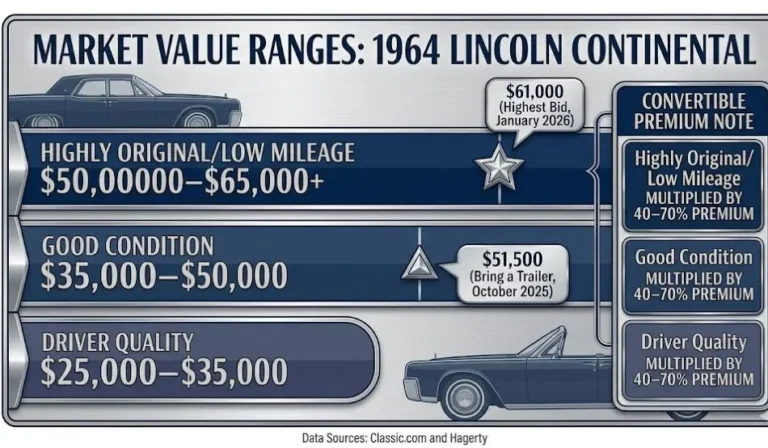
Classic.com’s documented sales provide the most accurate current market reference for the 1964 Continental. A modified 15,000-mile example with automatic transmission sold on Bring a Trailer for $51,500. A highly original 21,000-mile example with automatic transmission in Massachusetts reached a highest bid of $61,000 at auction in January without meeting the reserve. A Grand Rapids, Michigan example with 70,000 miles was last listed at $25,900 before being sold or removed.
These documented sales establish the current market range: driver-quality, higher-mileage examples in the $25,000 to $35,000 range; good-condition, well-preserved examples in the $35,000 to $50,000 range; highly original or low-mileage examples at $50,000 to $65,000 and above. As Hagerty correctly notes, convertibles command a significant premium above equivalent-condition hardtop sedans — the 3,328-unit convertible production against 32,969 sedan units creates a rarity ratio of approximately 1:10 that the market prices accordingly.
What Drives Value In The 1964 Continental Market
Originality is the primary value driver. A 1964 Continental with original drivetrain, original interior, and documented history commands a meaningful premium over an equivalent-appearing car with replacement components. The 24-hour road test certificate — issued with each car at delivery and occasionally surviving in owner documentation — is the most valuable piece of paper that can accompany a Continental sale and confirms the car’s documented production quality standard.
Condition and color combination follow closely. Period-correct colors — the Continental’s 1964 palette included Midnight Blue, Rose Mist, Corinthian White, and Black — in original or correctly restored condition are preferred by serious collectors over repainted examples in non-period colors. Interior condition is particularly significant: replacing a Continental’s leather interior correctly is an expensive process, and original, well-preserved leather adds immediate value above what a replacement interior provides.
The convertible premium is not subtle. A convertible in equivalent condition to a hardtop sedan typically sells for 40 to 70 percent more — a reflection of both the lower production number and the specific desirability of the open-body style in the collector market.
The Kennedy association is an undeniable value factor for the entire fourth-generation Continental, including the 1964. It does not make the car worth more in a direct financial sense — the 1964 Continental is not the JFK limousine and cannot claim that specific historical provenance. But it creates a cultural and historical context for the car that separates it from other 1960s American luxury cars of equal mechanical specification. Owning a 1964 Continental is owning a piece of American history in a way that owning a 1964 Cadillac de Ville of equivalent quality simply is not.
For buyers acquiring a 1964 Continental in the $25,000 to $35,000 driver-quality range who are considering a cosmetic restoration, understanding the full cost of professional bodywork and paint on a vehicle of this size is essential before committing to a project. Our guide to how much it costs to paint a car in 2026 covers the full range of professional automotive paint costs at every quality level — from basic respray to the concours-standard work that a 1964 Continental restoration of any seriousness requires.
FAQ
Q: What engine does the 1964 Lincoln Continental have?
A: The 1964 Lincoln Continental is powered by a 7.0-liter — 430 cubic inch — MEL V8 engine producing 320 horsepower and 465 lb-ft of torque. MEL stands for Mercury-Edsel-Lincoln, the Ford engine family developed for the upper end of the product lineup in the late 1950s through mid-1960s. The engine pairs with a 3-speed Turbo-Drive automatic transmission and is specifically tuned for smooth, quiet power delivery rather than performance output, consistent with the Continental’s positioning as a luxury rather than performance machine.
Q: Why does the 1964 Lincoln Continental have suicide doors?
A: The 1964 Lincoln Continental has center-opening rear doors — commonly known as suicide doors — as a deliberate design and functional decision by designer Elwood Engel and Ford’s engineering team. The front doors hinge conventionally at the A-pillar and open forward.
The rear doors hinge at the C-pillar and open rearward, with no B-pillar between them. When both sets of doors are open, the entire side of the car is unobstructed, creating an exceptionally wide and comfortable entry to both front and rear seats. Lincoln incorporated a safety interlock preventing the rear doors from opening while the car was in motion and the front doors were closed.
Q: How many 1964 Lincoln Continentals were made?
A: Total production of the 1964 Lincoln Continental was 36,297 units: 32,969 four-door hardtop sedans and 3,328 four-door convertibles. The convertible’s significantly lower production — approximately one for every ten sedans — creates the meaningful collector premium that convertible examples command in the current market. The 1964 model year represented one of the strongest production totals in the fourth generation’s 1961–1969 run, driven partly by the model’s improvements and partly by growing market recognition of the Continental’s quality advantage over competitors.
Q: What is the connection between the 1964 Lincoln Continental and JFK?
A: President Kennedy was assassinated on November 22, 1963, while riding in a 1961 Lincoln Continental convertible limousine with Secret Service code name X-100. The X-100 was assembled at Lincoln’s Wixom, Michigan plant in January 1961 and customized by Hess and Eisenhardt into a presidential parade limousine extended 3.5 feet.
The car now resides at the Henry Ford Museum in Dearborn, Michigan. The 1964 Continental was in concurrent production at the time of the assassination and shares the same design DNA, center-opening door design, and fundamental architecture as the X-100 — making it part of the same design family as the most historically significant automobile in American history.
Q: What is a 1964 Lincoln Continental worth?
A: 1964 Lincoln Continental in driver-quality, higher-mileage condition sells for approximately $25,000 to $35,000. Well-preserved examples sell for $35,000 to $50,000. Highly original or low-mileage examples reach $50,000 to $65,000 and above. A 15,000-mile modified example sold for $51,500 on Bring a Trailer.
A 21,000-mile highly original example reached a highest bid of $61,000 at a January auction without meeting the reserve. Convertibles command a 40 to 70 percent premium above equivalent-condition hardtop sedans due to their significantly lower production of 3,328 units against the sedan’s 32,969.
Q: What makes the 1964 Lincoln Continental different from the 1963 model?
A: The 1964 Lincoln Continental introduced several meaningful changes over the 1963 model. The wheelbase increased by 3 inches to 126 inches, with all additional length going into the passenger compartment rather than body overhang. The rear doors grew larger as a result, improving entry to the rear seat.
Four additional inches of rear legroom were provided. Curved side glass was replaced with more upright glazing for a more composed greenhouse appearance. A completely new single-sweep dashboard replaced the twin-cowl design. Cargo space increased by 15 percent through a revised rear-end design. New options included a heavy-duty spring/damper package, a 3.11:1 final-drive ratio, and front/rear lap belts.
The Bottom Line
The 1964 Lincoln Continental is the most beautiful American luxury car ever built. That is not a casual claim or an exercise in automotive romanticism. It is a position supported by the Museum of Modern Art’s institutional decision to add the design to its permanent collection, by Car Life’s Engineering Excellence Award, by the independent road test consensus of every major automotive publication of the era, and by a collector market in 2026 that prices the car at levels that confirm its continued relevance to buyers who could choose anything.
Its 430 cubic inches produce 320 horsepower tuned specifically for the absence of drama. Its rear doors open in the wrong direction by design and work correctly because of an interlock that Lincoln’s engineers had the foresight to include. Its interior was covered in genuine leather and tested for 24 hours before delivery at a time when no other American manufacturer offered either quality standard. And it shares a design language — the same center-opening doors, the same clean body, the same fundamental restraint — with the most historically significant automobile in American history, sitting twenty miles from where this article was written in a museum that knows exactly what it has.
The driver-quality cars sell for $25,000. The finest originals are approaching $65,000. The convertibles command a premium that the 1:10 production ratio fully justifies. And the Kennedy connection — the specific historical gravity of owning a car from the design family of the X-100 — does not show up in any valuation model, but it is present in every conversation about the car that is worth having.
Buy the best you can afford. Drive it. The Continental was built to be driven, tested for 24 hours before delivery to confirm it, and designed by a museum’s standards to be beautiful while doing so.
Editorial Note
This article was written and reviewed in May 2026. All 1964-specific specifications and production changes are sourced from Hagerty Media’s 1961–1969 Lincoln Continental buyer’s guide published May 2024 — the primary specialist editorial resource for this generation. Production figures of 32,969 sedans and 3,328 convertibles for 1964, and the descriptions of the 3-inch wheelbase increase, new dashboard, 4 inches of additional rear legroom, and 15 percent cargo increase are confirmed from that source.
Current market values — the October 2025 Bring a Trailer sale at $51,500 and the January 2026 highest bid of $61,000 — are sourced from Classic.com January 2026 market data. The Henry Ford Museum’s documentation of the X-100 presidential limousine — including its 1961 production date, Hess and Eisenhardt customization, 3.5-foot extension, Secret Service code name, and current museum residence — is sourced directly from the Henry Ford Museum’s official Kennedy Limousine Research page.
The $500 annual lease price to the Secret Service is confirmed by the same source. The December 2024 auction of personal Kennedy limousines is sourced from Supercars.net (December 2024). The MoMA permanent collection inclusion of the 1961 Continental is confirmed by Wikipedia’s Lincoln Continental article and multiple additional sources. The Car Life Engineering Excellence Award for 1961 is confirmed by Wikipedia.
The 1964 Continental base prices of approximately $6,292 (sedan) and $6,938 (convertible) are confirmed through historical documentation sources. Engine specifications of 430 cubic inches, 320 horsepower, and 465 lb-ft are confirmed through Automobile-Catalog historical documentation.



0 Comments