Last Updated: April 23, 2026 | Read Time: 10 minutes
The 1955 Chevrolet Nomad debuted at the Waldorf Astoria in New York City as a dream car and cost more than any Chevrolet except the Corvette. The Ford Country Squire ran for 41 consecutive years and appeared in more family vacation photographs than any other American car. The Oldsmobile Vista Cruiser had skylights and a raised roof section because Harley Earl wanted families to see the sky. And in 1971, GM engineers made the entire tailgate disappear into the floor while the rear glass rolled into the roof. These were not boring cars. These were the cars that carried American family life for six decades — and they are long overdue for the respect they deserve.
At A Glance – American Station Wagons Key Facts
– Peak Production Era: 1950s through early 1980s
– Driven by: American baby boom — the largest sustained increase in birth rates in US history
– First Real Woodie: 1934 Plymouth Westchester — only 35 built
– Most Produced Ford Wagon: Ford Country Squire — 1950 to 1991 — 41 years continuous production
– Most Iconic American Wagon: 1955–1957 Chevrolet Nomad — 23,167 total built
– Most Family-Friendly Wagon: Oldsmobile Vista Cruiser — 1964–1977, skylights, raised roof, V8 options
– Most Luxurious American Wagon: Buick Estate Wagon — wood-bodied 1940s versions through vinyl-trimmed 1990 finale
– Key Innovation 1: 1956 AMC Rambler — first station wagon hardtop (no B-pillar)
– Key Innovation 2: 1966 Ford/Mercury — “two-way” tailgate, folds down OR opens as door
– Key Innovation 3: 1971 GM — “clamshell” tailgate — glass into roof, gate into floor
– Station Wagons vs. SUVs: Wagons dominated from 1950s to early 1990s; SUVs took over by 2000
– Last Major American Station Wagon: Ford Taurus SHO wagon (final model year 2005)
– Current Collector Market: Rising — demand driven by Gen-X and Millennial buyers
– Most Valuable: 1955–1957 Chevrolet Nomad — particularly 1957 fuel-injected examples
Sources: Wikipedia, Hagerty Media, AutoEvolution, ChromeFinsRestoration, CollectorCarMarket, WilsonAuto
Overview – The Cars That America Forgot Were Actually Great
There is a specific kind of automotive respect that takes decades to arrive. It came late for muscle cars — which were considered crude and irresponsible before they became legendary. It came late for pickup trucks — which were work vehicles before they became status symbols. And it is arriving now, gradually and inevitably, for the American station wagon.
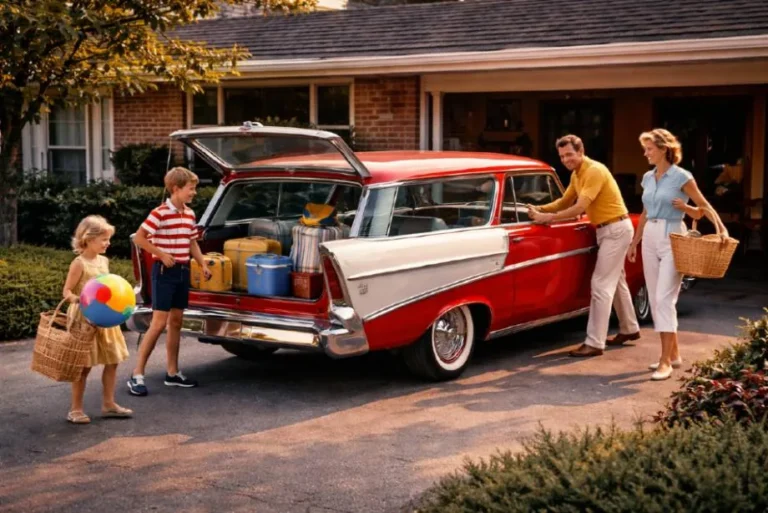
For most of the twentieth century, the station wagon occupied a unique position in American automotive culture: universally necessary, relentlessly practical, and never quite respected by the people who depended on it most. The station wagon was Mom’s car. It was what you drove when you had given up on cool. It was the vehicle that appeared in the family vacation photographs, driven by a father in short sleeves with children arguing in the rear-facing third-row seat, parked in front of a Holiday Inn somewhere in the American Southwest.
What that description misses — what the people who dismissed station wagons never quite acknowledged — is that the best American wagons were genuinely extraordinary vehicles. The 1955 Chevrolet Nomad was designed under Harley Earl, debuted as a concept at General Motors’ Motorama show at the Waldorf Astoria in New York, and combined the roofline of a Corvette show car with the utility of a family hauler in a way that no other production vehicle had attempted. It was the most expensive Chevrolet of its year except the Corvette, and it remains the only station wagon that Hagerty has described as “arguably sexier than — and almost as costly as — its convertible equivalent.”
The Ford Country Squire ran for 41 years — from 1950 to 1991 — in one of the most sustained single-nameplate production runs in American automotive history. The Oldsmobile Vista Cruiser had a raised roof section and skylights because engineers realized that families would enjoy seeing the sky while traveling, and the execution of that idea was so correct that it became one of the defining automotive objects of the 1960s and 1970s. The Buick Estate Wagon offered genuine wood body panels in the 1940s and continued the wood-trim aesthetic, in various forms of authenticity, through 1990.
And in 1971, GM engineers solved the tailgate problem so elegantly that the solution has never been equaled: the rear glass rolled up into the roof while the lower tailgate section disappeared into the floor, leaving a completely unobstructed opening into the cargo area that required no manual operation and took up no additional space in any direction. The “clamshell” tailgate is one of the great pieces of automotive packaging engineering in American history. It appeared on full-size GM wagons and was then quietly discontinued when the SUV made the station wagon irrelevant.
Station wagons experienced the highest production levels in the United States from the 1950s through the 1970s due to the American mid-20th century baby boom. By the mid-1960s, until SUVs started to take over in the early 2000s, some of the most iconic American wagons were developed. This is their complete story.
Section 1 – The Wooden Years
From Genuine Wood To Vinyl Nostalgia: 1930s To The Early 1950s
The American station wagon begins with wood — actual wood, structural wood, wood that was load-bearing rather than decorative. In the 1920s and through the 1930s, station wagon bodies were constructed by third-party companies from bare rolling chassis, using real timber framing and wooden body panels because the materials were practical, available, and appropriate for a vehicle that straddled the line between a car and a light commercial vehicle.
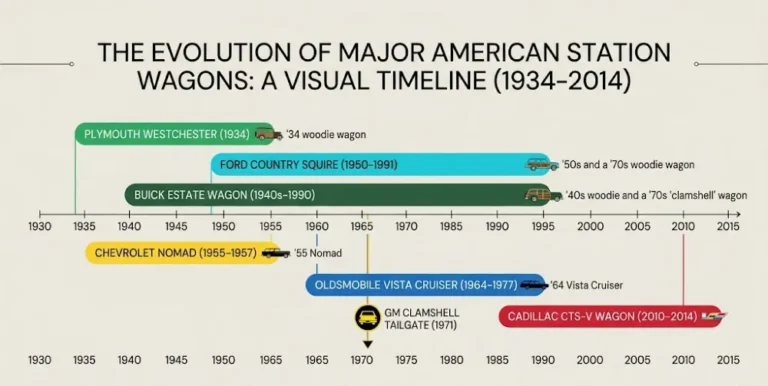
In 1934, Plymouth began offering a finished woodie wagon directly to customers rather than as a conversion. The Westchester featured luxurious leather upholstery and removable rear seats for increased practicality, pre-dating modern SUVs by decades. Only 35 examples were sold — a footnote in production history, but a significant one as the first manufacturer-completed woodie wagon offered to the American public.
Ford became the most prolific producer of woodie wagons through the late 1930s and 1940s. With over 120,000 examples built between 1932 and 1948, early Ford woodie wagons were a relatively common sight on American roads — which makes finding a well-preserved example today genuinely difficult. The cedar-and-ash construction that gave these cars their beauty was also their limitation: wood requires maintenance that most owners eventually stopped providing, and the survival rate for original-condition woodie wagons is far lower than for contemporary steel-bodied cars.
By 1951, most station wagons were being produced with all-steel bodies — a transition driven by manufacturing efficiency and material durability rather than aesthetic preference. Steel was cheaper to produce at scale, more consistent in quality, and required far less maintenance than the wood construction it replaced. The transformation happened quickly and almost completely within a few model years.
The manufacturers did not abandon the woodie aesthetic when they abandoned actual wood. As the wooden bodies were replaced by steel, manufacturers applied wooden decorative trim to the steel-bodied wagons as a visual link to the previous wooden style. By the late 1950s, the wooden trim was replaced by simulated wood in the form of stick-on vinyl coverings — a design element that was, as the Wikipedia description accurately captures it, totally honest in its artificiality, and that would become the defining visual element of the American station wagon for the next four decades.
The woodgrain aesthetic — vinyl, appliqué, stick-on strips that looked nothing like actual wood in close examination but communicated “station wagon” from twenty feet away — became one of the most recognizable design signatures in American automotive history. Models that used it most prominently included the 1957–1991 Mercury Colony Park, the 1968–1988 Chrysler Town & Country, the 1970–1990 Buick Estate, the 1971–1992 Oldsmobile Custom Cruiser, and the most famous of all, the Ford Country Squire.
Section 2 – The Chevrolet Nomad
The Most Beautiful Station Wagon America Ever Built: 1955–1957
The story of the Chevrolet Nomad begins at a hotel ballroom and ends after only three production years, and its legacy has outlasted both the circumstances of its creation and the commercial failures that defined its run.
The Nomad was primarily the concept of designer Carl Renner, working under GM design chief Harley Earl. The first Nomad concept was essentially a combination of a Corvette front end and a station wagon rear — a sports car interpretation of a family hauler that nobody had attempted to produce before. When GM showed it at the 1954 Motorama at the Waldorf Astoria in New York City alongside the Corvette, the response was immediate and enthusiastic. Following a positive response to the Motorama design, GM approved the Nomad for 1955 production.
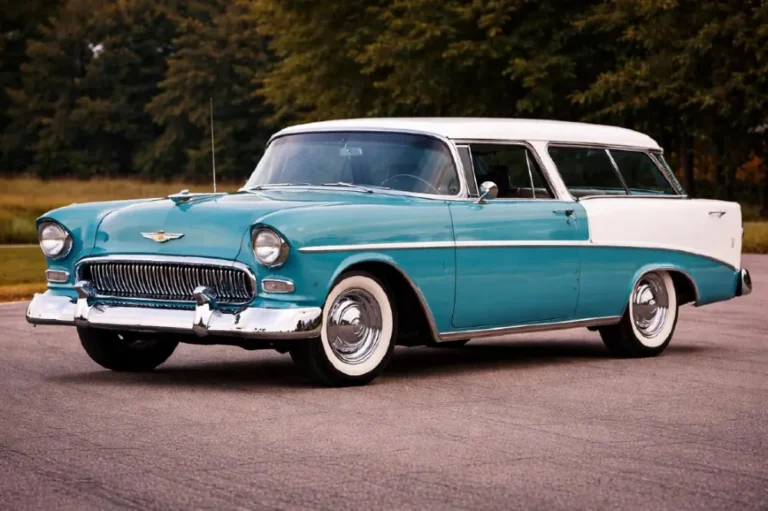
Chevrolet released the Nomad to the public in February 1955 as a mid-year model, four months after the other 1955 Chevrolets. The production Nomad shared the A-body platform and Bel Air trim and badging, but the body itself was unique to the Nomad — featuring more chrome and stainless steel than any previous Chevrolet production car. The slim A-pillars and panoramic windscreen were specific to the Nomad. The frameless door glass was shared with the Bel Air hardtop and convertible rather than the other wagons. The roof featured nine grooved strakes running transversely across the top. The rear tailgate was accented by seven chrome strips — which the Nomad community refers to as the “bananas.”
The forward-sloping B-pillars were one of the Nomad’s most distinctive design elements. Where most contemporary wagons used vertical or slightly angled B-pillars, the Nomad’s B-pillars raked forward at a dramatic angle, giving the car a specific visual identity that communicated speed and lightness in ways that no other wagon of the era could match.
Priced at $2,571 for the V8 version, the Nomad was among the most expensive 1955 Chevrolets excluding the Corvette. The base price was $210 higher than a four-door Bel Air Beauville wagon and $266 more than the convertible. The 1955 Nomad received a 265-cubic-inch V8 as standard equipment, delivering 162 horsepower — an extraordinary specification for a family hauler in 1955 when most wagons came with six-cylinder engines as standard.
Chevrolet produced 8,386 units in 1955. The following year’s production dropped to 7,886. By 1957, only 6,103 Nomads were built — the combination of a high price, a two-door body that reduced practicality compared to four-door alternatives, and increasing competition within the Chevrolet wagon lineup made it a difficult sell. The 1957 Nomad also benefited from the era’s most exciting engine option: a fuel-injected 283-cubic-inch V8 that produced one horsepower per cubic inch — the first American production car to achieve that ratio. The 1957 “fuelie” Nomad is now the most sought-after of the three Tri-Five Nomads.
The Nomad nameplate continued through 1972 in various four-door wagon applications, but the original form was discontinued after the 1957 model year. Total production for the iconic 1955–1957 Nomad was approximately 23,167 units across all three years. The Nomad is the undisputed star of the fabled Tri-Five Chevy era — the only station wagon that is arguably sexier than and almost as costly as its convertible equivalent.
Harley Earl’s Nomad concept began with a Corvette front end and a station wagon rear — a design combination that spoke to the same engineering ambition that GM has consistently applied to its performance vehicles from the Nomad’s era through the modern Corvette lineup we compare in our Corvette ZR1 vs Camaro ZL1 guide.
Section 3 – The Ford Country Squire
41 Years Of Woodgrain, V8s, And American Family Life: 1950–1991
If the Nomad is the station wagon that enthusiasts celebrate, the Country Squire is the station wagon that America lived in. No other model ran as long, appeared in as many family photographs, or defined the full-size American station wagon experience as completely as Ford’s flagship wagon.
First introduced in 1950, the Country Squire became the new name for Ford’s full-size woodie wagon and continued to be the company’s flagship wagon until the end of the 1991 model year — a production run of 41 years that spanned eight distinct body style generations and outlasted virtually every automotive trend of the postwar era.
Of the eight distinct generations, the sixth — produced from 1965 to 1968 — was arguably the most iconic. Along with the entire full-size Ford lineup, the wagon was completely redesigned for 1965. The sixth-generation Country Squire was also the first to feature standard front and rear seatbelts starting with the 1966 model year, alongside a padded dashboard and a collapsible steering column — safety features that were genuine improvements to a vehicle that had previously offered neither.
The 1966 model year brought one of the most significant tailgate innovations in station wagon history: Ford and Mercury introduced the “two-way” tailgate design that could either fold down to load cargo in the traditional manner, or operate as a hinged door for passenger access. This was a genuine engineering achievement — the first time a production station wagon offered two functionally distinct tailgate operation modes. It addressed one of the most consistent complaints about full-size station wagons: the difficulty of loading rear-facing passengers, particularly children, over a folded-down tailgate.
The Country Squire’s defining visual element was the simulated wood paneling that ran along the sides and the tailgate. This woodgrain treatment — which became increasingly elaborate and carefully designed through successive generations — communicated the Country Squire’s position as the premium wagon in Ford’s lineup and made it immediately distinguishable from the less expensive Ranch Wagon and Country Sedan alternatives.
Through the 1960s and 1970s, the Country Squire was available with the largest engines in Ford’s inventory — including 400 and 460 cubic inch V8s that were necessary to move a vehicle that by the late 1970s had grown to nearly 226 inches in length and weighed close to 4,900 pounds. The 1978 model year Country Squire was the last to use this enormous body, tipping the scales at approximately 4,881 pounds with a 400-cubic-inch V8 needed to motivate it competently.
When Ford downsized its full-size vehicles for 1979 — reducing weight and dimensions significantly in response to fuel economy regulations and the market’s shift away from large cars — the Country Squire became a more manageable vehicle that retained its premium position in the Ford lineup while becoming genuinely more practical and efficient. The downsized Country Squire of the 1980s was a significant commercial success.
The Country Squire was finally retired after the 1991 model year when Ford replaced its full-size wagon lineup. Its 41-year run represents one of the longest continuous production runs of any American passenger car nameplate.
The Country Squire occupied the same cultural center of American life that the presidential limousine occupied at its apex — one defined the peak of American governmental ceremony while the other defined the peak of American suburban normalcy. Our guide to cars owned by US presidents covers what the people who led America drove while Country Squires filled the driveways of the families they governed.
Section 4 – GM’S Golden Age Wagons
Vista Cruisers, Buick Estates, And The Clamshell Tailgate: 1960–1980
While Ford built the most recognizable American wagon in the Country Squire, General Motors built the most diverse and most technically ambitious range of station wagons in American automotive history through the 1960s and 1970s. The variety within GM’s wagon lineup — spanning Chevrolet, Buick, Oldsmobile, and Pontiac — covered every segment from entry-level family transportation to genuine luxury.
The Oldsmobile Vista Cruiser — 1964 To 1977
The Vista Cruiser is the wagon that made optional skylights and a raised roof section standard thinking for family haulers, and it remains one of the most distinctively designed American family vehicles of the postwar era. With optional rear-facing third-row seating, skylights, and a Rocket V8 engine, the Vista Cruiser was, and arguably remains, the single most likable station wagon concept ever executed in American production.
The raised roof section — which added approximately four inches of headroom in the rear passenger area while incorporating large skylights into the roof structure — addressed a legitimate limitation of conventional station wagon design. Rear passengers in full-size wagons of the early 1960s sat in a relatively low space with limited outward visibility. The Vista Cruiser’s Vista-roof transformed the rear passenger experience from something tolerable into something genuinely pleasant — children could actually see the sky, the stars, and the landscape passing overhead.
The Vista Cruiser was produced in both mid-size (on the A-body Cutlass platform) and full-size variants, providing the raised-roof feature across a range of price points. The mid-size Cutlass-based Vista Cruiser of the 1964–1977 production run is the variant that achieved pop-culture immortality through its association with the television series That ’70s Show, where a red Vista Cruiser served as the primary vehicle of the Forman family — a casting choice so correct that it significantly contributed to the modern generation’s awareness of the model.
The Buick Estate Wagon — Wood Bodies To Vinyl Luxury
The Buick Estate Wagon represents the most sustained commitment to premium wagon positioning in American automotive history. In the 1940s and early 1950s, Buick produced genuine wood-bodied wagons — vehicles where the wood was structural rather than decorative, built at a time when Buick was not merely another GM brand but a distinct marque with its own engineering identity. Finding an intact original Buick woodie from this era today is, as contemporary sources note, extraordinarily difficult precisely because wood construction was not built for the long haul.
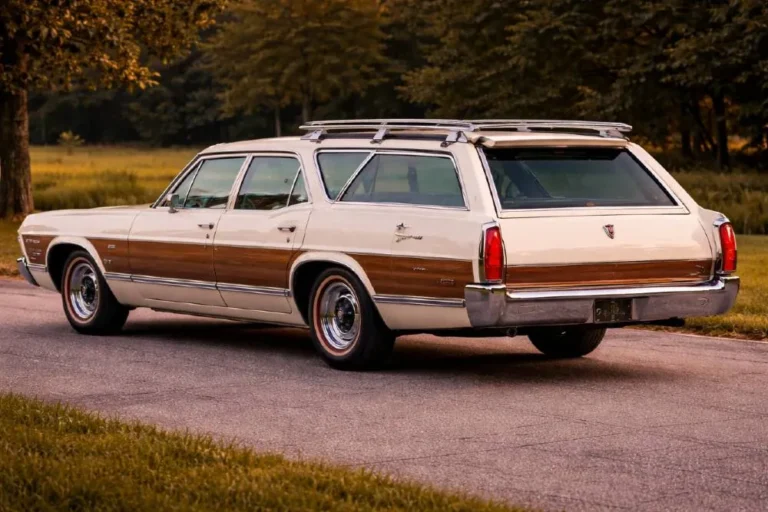
Through the 1960s and into the 1990s, the Buick Estate Wagon carried the vinyl woodgrain treatment that connected it visually to the luxury woodie tradition while providing the durability of steel construction. The Estate consistently offered the most refined interior in GM’s full-size wagon lineup, targeting buyers who wanted the functionality of a wagon alongside the luxury appointments that Buick’s positioning demanded.
The 1970–1990 Buick Estate Wagon, with simulated wood trim that differentiated it from Chevrolet and Pontiac equivalents, is the most commonly collected Buick wagon today.
The 1971 Clamshell Tailgate — GM’s Greatest Packaging Achievement
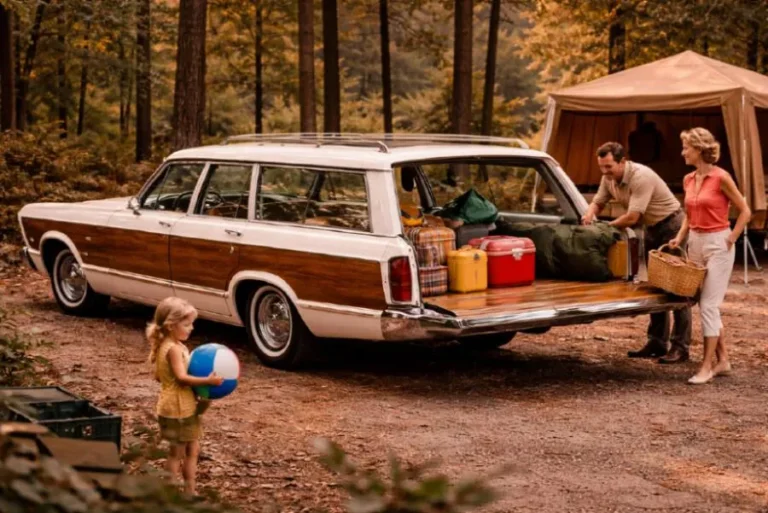
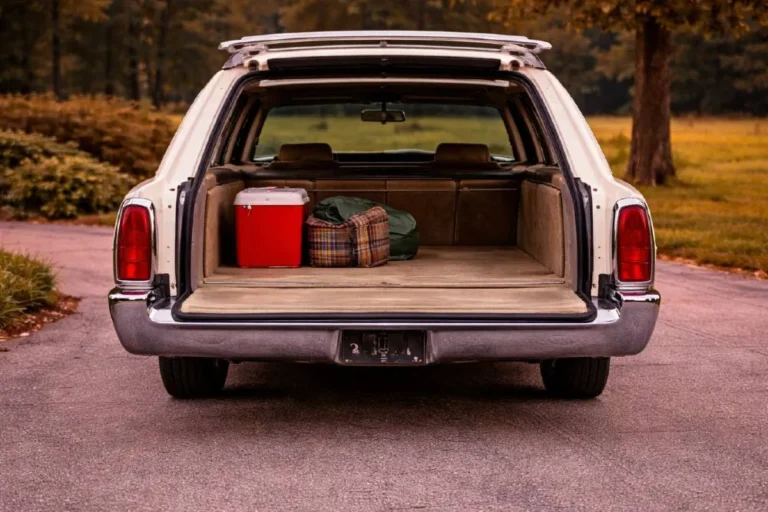
In 1971, GM introduced what remains the most elegant solution to the station wagon tailgate engineering problem ever developed. The “clamshell” tailgate design, applied to full-size GM wagons, operated as follows: the rear window glass retracted upward into the roof structure while the lower tailgate panel dropped downward into the floor — leaving a completely unobstructed opening into the cargo area with no manual operation required beyond pressing a button.
GM one-upped this in 1971 with the clamshell tailgate on its full-size wagons, in which the back glass rolled up into the roof while the lower gate portion disappeared into the rear floor. The result was an opening that was wider and taller than any conventional tailgate could provide, that required no exterior storage space for either component, and that could be operated from inside the vehicle or by key switch. It was a triumph of packaging engineering — solving a problem that Ford’s two-way tailgate had partially addressed by simply making both components disappear entirely.
The clamshell tailgate appeared on full-size Chevrolet, Buick, Oldsmobile, and Pontiac wagons through the 1970s and into the 1980s. Its complexity made it mechanically more demanding to maintain than conventional alternatives, and its eventual discontinuation when GM redesigned its full-size wagons represents one of the genuine losses in American automotive packaging history.
Section 5 – The Chrysler And AMC Chapter
Town & Country, Rambler Innovation, And The Last Great Woodies
Chrysler’s contribution to the American station wagon story is the Town & Country — the model that began with genuine wood construction in 1941 and followed families from one iconic vehicle to the next across more than five decades of continuous production.
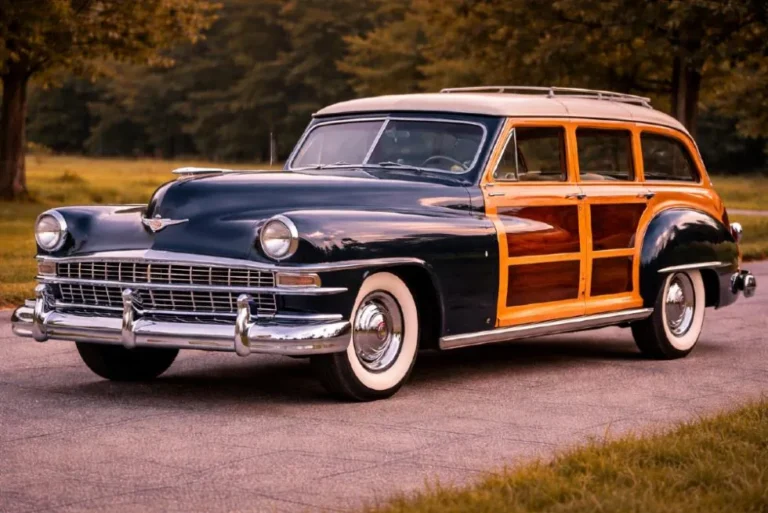
Before automakers covered their station wagons in fake wood paneling, Chrysler had the first real woodie, with actual wooden doors and side panels. The Town & Country’s wooden construction in the 1940s was genuine craftsmanship — the doors and body panels used actual mahogany and white ash framing that required skilled woodworking to produce and careful maintenance to preserve. The result was one of the most beautiful and most labor-intensive American production vehicles of the 1940s, and well-preserved examples from this era are among the most valuable American wagons in the current collector market.
Chrysler wagons also featured innovations that other manufacturers subsequently adopted. Chrysler wagons featured dual air conditioning in the late 1950s — one unit up front for the driver and front seat passenger, another unit for those in the rear. This was not a trivial feature in an era when air conditioning was itself a significant premium option. The dual-zone approach anticipated the multi-zone climate control systems that would become standard in premium vehicles decades later.
The Town & Country evolved into a large, chromed-out wagon with tailgate and rear washer — and nearly 19 feet of length — by 1968, before transitioning to fake wood paneling in the 1970s alongside a smaller K-car version in the 1980s. By 1990, however, it was a wood-paneled minivan, following families from one iconic vehicle to the next — a transition that both acknowledged and accelerated the decline of the traditional American station wagon.
American Motors Corporation — AMC, the smallest of the Detroit manufacturers — contributed an engineering innovation that deserves more historical attention than it typically receives. The 1956 AMC Rambler was the industry’s first station wagon hardtop — a four-door design without a B-pillar that offered the open, airy quality of a convertible or hardtop coupe in a family wagon body. The hardtop wagon eliminated the structural pillar between the front and rear doors, providing a panoramic side opening that full-size wagons with conventional B-pillars could not match.
AMC’s Rambler also introduced the first roll-down rear glass in a wagon tailgate in the late 1950s — a feature that became standard industry practice. The innovation replaced the split liftgate — upper window hinged up, lower panel hinged down — with a single rear glass that could be retracted into the tailgate body, providing unobstructed access to the cargo area without a protruding frame. AMC’s role as a technical innovator in the station wagon segment is consistently underappreciated given the company’s generally modest market position.
Studebaker provided one of the most memorable station wagon options of the 1960s with its Wagonaire’s sliding roof option that opened over the rear cargo space. The Wagonaire’s retractable rear roof section — which slid forward to open the cargo area to the sky — anticipated both the Vista Cruiser’s open-air rear philosophy and, in a very different way, the panoramic roof options that modern SUVs use today.
Section 6 – Performance Station Wagons
When America’s Family Haulers Got Serious
The station wagon’s reputation as an unglamorous appliance obscures a specific and remarkable chapter of American performance history: the muscle wagon era of the 1960s, when manufacturers offered big-block engines, four-speed manuals, and genuine performance hardware in station wagon body styles.
In the 1950s and 1960s, station wagon makers like Dodge, Chevrolet, and Ford had several models with high-performance engines. For instance, during the 1963 model year, Mercury produced a dozen Colony Park wagons fitted with the big-block V-8 and four-speed transmissions for the NHRA. A full-size woodgrain-trimmed station wagon built specifically for drag racing is the kind of automotive history that sounds implausible until you find the documentation.
The logic was straightforward: many of GM’s, Ford’s, and Chrysler’s full-size wagons shared platforms and drivetrains with the performance cars in those manufacturers’ lineups. The same big-block engines that powered Chevelles, Galaxies, and Polaras were available — in many cases as regular production options — in the equivalent wagon bodies. A family could order a Chevelle wagon with a 396 or 454 cubic inch big-block engine. A Ford Country Sedan buyer could specify a 428 Cobra Jet. These were not race-prepared specials — they were catalog options available through any dealer.
The same big-block engines that powered the most celebrated Chevelles were available in the equivalent wagon bodies — the 396, 402, and 454 cubic inch units that we cover completely in our 1969 Chevelle complete guide were catalog options in the Chevelle’s own station wagon variants, producing the same performance numbers in a body that could also haul a family’s camping gear.
The 1971 Pontiac Safari wagon with the 455 High Output engine represents one of the most extreme factory muscle wagon specifications of the era — 335 horsepower in a full-size station wagon body, available with a four-speed manual transmission. The combination of maximum hauling capacity and maximum available V8 power made for a vehicle that was, in period road tests, quicker than many contemporary sports cars while simultaneously being able to carry eight passengers and a load of camping equipment.
These performance wagon options largely disappeared after 1972, when emissions regulations and the broader retreat from high-compression engines transformed the performance car market. But their existence in the catalog — the fact that American manufacturers once offered 455-cubic-inch engines in wagons as routine production options — is part of what makes the American station wagon’s history more interesting than its reputation as a family appliance suggests.
Section 7 – The Decline And The SUV
Why The Wagon Died And What Replaced It
The American station wagon did not die because it became a worse product. It died because a fundamentally different product arrived and successfully argued that it did everything the wagon did, only better — while also offering the one thing the wagon had never provided: genuine off-road capability, or at least the appearance of it.
The SUV’s rise at the expense of the station wagon is one of the most extensively analyzed market transitions in American automotive history, and the analysis consistently reaches the same conclusion: the SUV did not win because it was better at the things station wagons actually did. In most objective measurements of family hauling capability — interior volume, fuel efficiency, ride quality, handling, and cargo accessibility — contemporary station wagons were competitive with or superior to the SUVs that replaced them.
The SUV won because it was different, because it communicated something about the driver that the wagon did not, and because the perception of off-road capability — even for buyers who would never leave a paved road — constituted a meaningful value in American consumer culture in a way that wagon practicality did not.
The minivan had already taken the utilitarian family hauler market from the station wagon in the mid-1980s, when the Chrysler minivan appeared in 1984 and immediately proved that most families preferred a purpose-built family vehicle to a car-based alternative. The Toyota Camry Wagon, Subaru Outback, and Ford Taurus SHO wagon carried on into the 1990s and early 2000s, but the full-size American station wagon was effectively finished as a mainstream product category by the time the Ford Crown Victoria wagon — essentially a stretched version of the full-size sedan platform — ended production.
An exception to this trend was the Subaru Legacy station wagon and its rugged derivative Subaru Outback, which continued to be produced and achieved genuine mainstream success by positioning itself as a crossover rather than a conventional wagon. The Outback accounted for 80 percent of wagon sales in the US at its peak — succeeding by not insisting on being categorized as a wagon.
The Cadillac CTS gave rise to a station wagon counterpart, the 2010 CTS Sportwagon, which defied the trend by offering almost as many trim levels as its sedan counterpart. The CTS wagon, particularly in the performance CTS-V trim, received positive reviews until it was discontinued in 2014. The CTS-V wagon with its supercharged V8 producing 556 horsepower represents the final expression of American performance station wagon thinking — and its discontinuation marked the end of a lineage that had begun with the 1963 Mercury Colony Park NHRA special.
Section 8 – The Collector Market
Why Station Wagons Are Exactly Where The Collector Market Is Heading
The American station wagon’s collector story is in its early chapters. The vehicles have existed long enough to qualify for classic car status. They are rare enough in original condition to support meaningful price appreciation. And they are beginning to attract the specific demographic — Gen-X and Millennial buyers — whose childhood memories anchor the collector market for 1960s and 1970s American vehicles.
The demand for classic station wagons from the 1950s to the 1970s is on the rise. A new generation of collectors in their 30s and 40s are no longer looking for the Model A Ford, but instead are searching for station wagons that were used as the family utility vehicle in the 60s and 70s. The station wagon was considered to be an unglamorous appliance — which means that people from the 1950s, ’60s, and ’70s did not view these cars as future collectibles. This means that finding a classic station wagon in decent condition can be a difficult task, which drives the value of unmodified originals upward.
The 1955–1957 Chevrolet Nomad leads the collector wagon market by a significant margin. Its combination of extreme visual beauty, Tri-Five Chevy association, low original production, and the specific cachet of the first American dream car that translated directly to a production station wagon makes it the most compelling individual model in the collector wagon space. 1957 fuel-injected examples — the “fuelies” — carry the highest premiums. The 1957 Nomad is the rarest production year and thus the most sought-after: basic supply-and-demand economics at work in the collector market.
The Ford Country Squire, as a staple of American suburban life from the 1950s to the 1990s, is known for its iconic woodgrain siding and expansive interior. Well-preserved models are highly sought after by collectors. Its classic Americana appeal and spacious design have made it a favorite among enthusiasts looking to relive the golden age of the station wagon.
The Oldsmobile Vista Cruiser — particularly examples with the raised-roof Vista section and V8 engines — commands premiums over equivalent-condition standard Cutlass wagons of the same era. The Vista Cruiser’s pop-culture presence through television and its specific design features give it a recognition factor that supports collector interest beyond the hardcore wagon enthusiast community.
For buyers ready to search the active market, the Hemmings classic station wagon listings provide the most comprehensive current view of what is available — from project-grade examples through fully restored Nomads and Vista Cruisers at the market’s upper tier.
Performance wagons from the 1960s — big-block equipped examples from any manufacturer, documented with original engine codes and factory configurations — represent some of the most compelling and most undervalued collector opportunities in the American muscle car space. A 396-equipped Chevelle wagon or a 428 Cobra Jet Country Sedan in documented original condition offers muscle car performance in a body style that the traditional muscle car market has not yet fully priced. These specific configurations require as much authentication diligence as any muscle car purchase — original engine codes, build sheet documentation, and factory option verification are as important here as in any classic muscle car transaction.
For buyers considering a classic station wagon restoration — particularly the wood-trimmed models whose vinyl woodgrain appliqués require specific expertise to source and apply correctly — understanding the full cost of professional bodywork is essential before committing to a purchase. Our guide to how much it costs to paint a car in 2026 covers the full range of professional automotive paint and bodywork costs at every quality level.
FAQ
Q: What were the most famous American station wagons?
A: The most celebrated American station wagons include the 1955–1957 Chevrolet Nomad — the only two-door sport wagon produced in this era and the most visually distinctive American wagon ever made; the Ford Country Squire — produced from 1950 to 1991 as Ford’s flagship wagon, known for its woodgrain trim; the Oldsmobile Vista Cruiser — 1964 to 1977, with its distinctive raised roof and skylights; the Buick Estate Wagon — which began with genuine wood body construction in the 1940s; and the Chrysler Town & Country — which ran from 1941 with actual wooden panels through its final incarnation as a minivan in the 1990s.
Q: Why did American station wagons disappear?
A: American station wagons were displaced primarily by two competing vehicle types: the minivan, which arrived in 1984 with the Chrysler Town & Country and immediately captured the family hauler market with purpose-built packaging; and the SUV, which through the 1990s offered similar carrying capacity alongside an image of ruggedness and outdoor capability that the wagon’s family-car positioning could not compete with. The SUV did not replace the wagon by being objectively better at family hauling — it replaced the wagon by being a different cultural object with a different consumer meaning.
Q: What is the rarest American station wagon?
A: Among major production models, the 1957 Chevrolet Nomad with fuel injection is among the rarest. Only 6,103 Nomads were produced in 1957, and the fuel-injected version represents a small fraction of that total. The fuel-injected 1957 Nomad was the first American production car to achieve one horsepower per cubic inch, making it significant for performance engineering reasons beyond its rarity as a wagon. Among the extreme examples, Mercury Colony Park wagons built for NHRA drag racing in 1963 — approximately a dozen were produced — are among the rarest and most unusual American station wagons ever made.
Q: What is the GM clamshell tailgate?
A: The GM clamshell tailgate was a full-size wagon feature introduced in 1971 in which the rear window glass retracted upward into the roof while the lower tailgate panel dropped downward into the floor — leaving a completely unobstructed rear opening that required no manual operation. It was the most elegant solution to the station wagon tailgate problem ever developed in American production, and it appeared on full-size Chevrolet, Buick, Oldsmobile, and Pontiac wagons through the 1970s and 1980s. Its mechanical complexity made maintenance more demanding than conventional tailgates, and it was eventually discontinued when the SUV replaced the station wagon as the primary American family vehicle.
Q: Are classic American station wagons a good investment?
A: Classic American station wagons — particularly the Chevrolet Nomad, Ford Country Squire, and Oldsmobile Vista Cruiser in original, documented condition — are among the better-appreciated collector vehicles in the current market. The demand driven by Gen-X and Millennial buyers who have personal connections to these vehicles is growing. The supply of original, unmodified examples is fixed and decreasing as attrition continues. Performance-optioned examples — big-block wagon configurations from the 1960s — represent potentially significant under-valuation relative to equivalent muscle car configurations from the same era. The collector market for classic American wagons is in an earlier stage of the appreciation curve than the muscle car market, which provides buying opportunities that the muscle car segment no longer offers at comparable price points.
Q: What was the first station wagon hardtop?
A: The 1956 AMC Rambler was the first station wagon hardtop — a four-door design without a B-pillar that offered the open, airy character of a hardtop coupe in a family wagon body. The pillarless design allowed the front and rear door windows to be fully retracted without any structural obstruction between them, creating a completely open side profile. While other manufacturers including Oldsmobile and Buick produced hardtop wagons in the same period, the AMC Rambler’s Cross Country model is documented as the industry’s first four-door station wagon hardtop.
The Bottom Line
The American station wagon carried the most important parts of American life — the family vacations, the grocery runs, the cross-country moves, the camping trips, the school runs — for six decades without receiving the respect that any of those contributions deserved. The Nomad was as beautiful as the Corvette show car it descended from. The Vista Cruiser was more imaginative than the vast majority of American vehicles produced in the same decade. The clamshell tailgate solved a packaging problem so elegantly that it has never been improved upon — only abandoned.
The SUV replaced the wagon not because it was better at what the wagon did, but because it communicated something different about the people who drove it. That is a cultural observation, not an engineering one. And culture changes — which is why the collectors who are paying serious money for original Nomads and Vista Cruisers and Country Squires are making a reasonable bet that the cultural rehabilitation of the American station wagon is not complete.
The wagons are long overdue for their moment. The evidence suggests that moment has arrived.
Editorial Note
This article was written and reviewed in April 2026. Historical production figures are sourced from Wikipedia, AutoEvolution, and ChromeFinsRestoration documented historical accounts. The 1955–1957 Chevrolet Nomad total production figure of 23,167 is sourced from Hagerty Media. The Nomad’s original price of $2,571 is confirmed by Wikipedia and Classic Insurance. GM clamshell tailgate introduction in 1971 is confirmed by CollectorCarMarket historical documentation.
Ford Country Squire production dates (1950–1991) and the two-way tailgate introduction in 1966 are confirmed by Wikipedia and AutoEvolution. Mercury Colony Park NHRA wagon documentation is sourced from CollectorCarMarket. Collector market observations are editorial assessments based on Hagerty Media reporting, Wilson Auto collector market analysis, and current market trends.


0 Comments