Last Updated: June 30, 2026 | Read Time: 9 minutes
The Chevrolet Caprice was produced for 31 years, from 1965 through 1996. It served as Chevrolet’s full-size luxury flagship. It patrolled American streets as the definitive police interceptor for more than two decades. It carried families across the country in station wagon form with a rear-facing third seat. It offered the 454 cubic inch big-block V8 producing 390 horsepower in 1970 — enough to keep pace with the muscle car era’s most dedicated performance cars in a body that could carry six passengers in air-conditioned comfort.
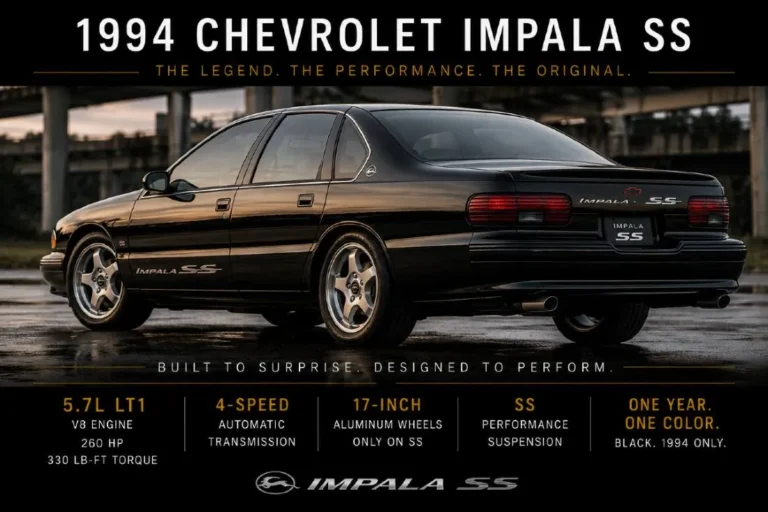
And it ended its production run with the 260-horsepower LT1 V8 in the 1994 to 1996 Impala SS — a vehicle that Car and Driver called the best American performance car value of the mid-1990s. This is the complete story of every generation, every significant engine, every cultural moment, and what these cars are worth to collectors.
Quick Facts – Chevrolet Caprice
— Production Years: 1965 (trim level) / 1966–1996 (standalone model) — 31 total production years
— Body Styles: Two-door coupe, four-door sedan, convertible (1966–1969), station wagon
— Platform: GM B-body full-size platform throughout production
— Engine Range: 307ci V8 (base) through 454ci big-block V8 (390 HP peak in 1970)
— Final Production Engine: LT1 5.7L V8 — 260 HP in 1994–1996 Caprice / Impala SS
— Peak Output: 454ci LS5/LS7 — up to 390 HP gross (1970–1971)
— Police Interceptor Use: Primary American police patrol vehicle approximately 1972–1996
— Impala SS Revival: 1994–1996 — based on Caprice platform with LT1 V8 and 17-inch wheels
— Station Wagon: Produced through 1996 — included three-row seating as standard option
— Wheelbase: 119.9 to 121.5 inches depending on generation
— Final Year: 1996 — discontinued with B-body platform retirement
— Police PPV: 2011–2017 Australian Holden-based Caprice PPV — fleet-only, not public sale
— Best Year for Collectors: 1969–1971 (peak power), 1994–1996 (Impala SS on Caprice platform)
— Collector Market Low: Driver-quality 1980s Caprice — $8,000 to $15,000
— Collector Market High: 1969–1970 Custom Coupe with 427/454 excellent condition — $50,000–$80,000+
— Station Wagon Collectibility: Growing niche market — good examples $20,000–$40,000
— Impala SS Collector Value: $25,000–$55,000 depending on condition
Sources: Hagerty Valuation Tool, Hemmings Motor News, Classic.com, Autotrader Classics
Overview – The American Car That Was Everything At Once
The Chevrolet Caprice is the most versatile single American automobile nameplate in the history of General Motors. Over 31 years of production, it served simultaneously as a luxury sedan competing with Lincoln and Chrysler for affluent family buyers, as a police interceptor that defined American law enforcement vehicle standards for a generation, as a taxicab that logged millions of miles in every American city, as a station wagon that made cross-country family road trips possible in air-conditioned comfort with a third seat facing rearward, and finally as the platform for one of the most celebrated performance car revivals of the 1990s in the form of the 1994 to 1996 Impala SS.
No other American car did all of those things. The Lincoln Continental was a luxury car and nothing else. The Dodge Polara served police fleets but never achieved the Caprice’s cultural dominance in that role. The Ford Country Squire was a station wagon but never a police car and never a performance vehicle. The Chevrolet Caprice was all of it simultaneously, across three decades, and it managed each role with sufficient competence to be the preferred choice in every one.
The Caprice’s story begins in 1965 as a trim level of the Impala — the name literally means extravagance in Spanish, communicating from the outset that this was intended to be the most fully equipped version of Chevrolet’s most popular full-size car. By 1966 it had become its own model, positioned above the Impala with more standard equipment, more distinctive styling, and more interior luxury at a price that was genuinely competitive with the Chrysler New Yorker and Lincoln Continental’s less expensive configurations.
The arc of the Caprice’s 31-year production history mirrors the arc of American automotive culture: the exuberant big-block power of the late 1960s and early 1970s, the compression-ratio-dropping emissions-equipment-adding survival mode of the mid-1970s, the gradual downsizing and federalization of the late 1970s, the remarkable longevity of the 1977 platform that lasted nearly unchanged through 1990, and the final flourish of the 1991 redesign and the LT1-powered Impala SS that ended the nameplate’s American production run with the most powerful version the Caprice platform ever offered to the public.
The Caprice’s status as the definitive American official vehicle extended beyond police departments — the B-body platform’s combination of size, rear-wheel-drive stability, and V8 reliability made it a recurring choice for government fleet applications at multiple levels. Our complete guide to cars owned by US presidents covers the official vehicle choices that parallel the Caprice’s government service legacy, showing how American full-size rear-wheel-drive sedans served official purposes across the same decades the Caprice patrolled American streets.
This guide covers all of it — every generation in enough detail to understand what distinguished it from its predecessor and successor, the police interceptor history that gave the Caprice its most enduring cultural presence, the station wagon variants that represent the most underappreciated segment of the collector market, and the honest current market values for every configuration.
Section 1 – The First Generation (1965–1970)
From Impala Trim Level To Standalone Flagship
The Chevrolet Caprice began as a special-order package on the 1965 Impala — a vinyl top, specific interior, and additional trim items that elevated the Impala’s luxury appointments toward what Chevrolet’s marketing positioned as European grand touring character. The concept was straightforward: charge a premium for additional content and distinctive styling on an existing platform. The execution was successful enough that for 1966, the Caprice became its own dedicated model with its own specific body and interior design.
The 1966 Caprice used the B-body platform shared with the full GM full-size lineup, but received a specific formal roofline for the sedan that was more squared-off and conservative than the Impala’s sportback greenhouse. This formal roofline was a deliberate luxury market signal — American luxury buyers of the mid-1960s associated formal, upright greenhouses with prestige vehicles, and the Caprice’s squared roofline placed it visually in the Lincoln Continental’s territory.
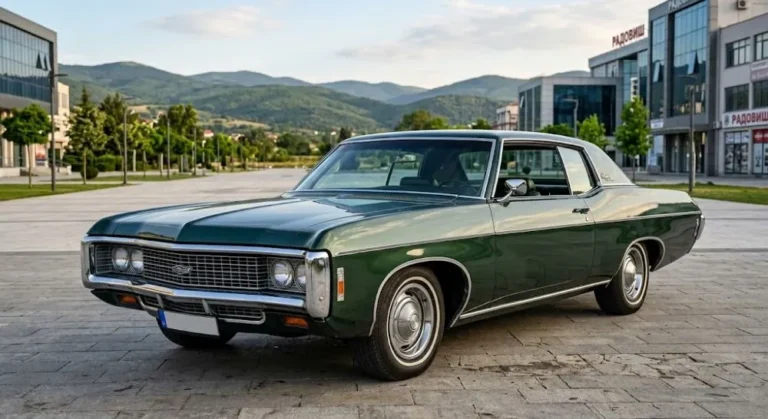
The late 1960s brought the Caprice to the peak of its original power era. The 1969 and 1970 model years are the most significant from a performance standpoint in the first generation, offering the 427 cubic inch Mark IV big-block V8 and the 454 cubic inch replacement that arrived for 1970. The 1969 Caprice Custom Coupe with the 427 is one of the most desirable configurations in the entire Caprice collector market — a full-size luxury car with available big-block power in a body that was more formally styled than the Impala SS.
The 427 cubic inch Mark IV big-block available in the 1969 Caprice Custom Coupe is the same engine family that powered the most significant GM performance cars of the era — our complete guide to the 69 Chevelle covers how this engine performed in a dedicated performance platform, providing the direct comparison that shows what the Caprice offered in a full-size luxury body alongside the Chevelle’s mid-size performance focus.
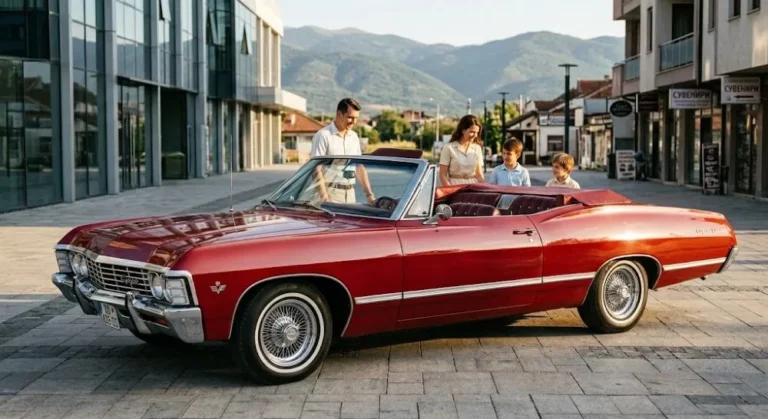
The first generation also established the Caprice’s convertible credentials, with ragtop models available from 1966 through 1969. These convertibles are among the rarest and most valuable first-generation Caprice configurations in today’s collector market — a large luxury convertible with available big-block power and full Caprice interior appointments represents a specific combination that no current production vehicle replicates.
The 1970 model year brought the peak of the Caprice’s factory horsepower with the LS5 454 producing 360 horsepower and the LS6 option that brought output to 390 horsepower gross — a figure that, in a vehicle this size, produced acceleration that surprised anyone who encountered one on a street or highway. The 454-powered 1970 Caprice is a legitimate full-size muscle car in all but name, and the collector market has gradually come to recognize this distinction.
Section 2 – The Second And Third Generations (1971–1976)
The Compression Drop And The Beginning Of The Long Decline
The 1971 through 1976 Caprice period is defined by the same forces that reshaped every American performance car of the era: federal emissions regulations, insurance industry pressure on high-performance options, and the specific compression ratio reductions required by the transition to regular-grade unleaded fuel.
The 1971 Caprice retained the 454 cubic inch big-block as an available option but with compression ratios reduced to work on regular-grade fuel — a change that dropped output from the 1970 LS5’s 360 gross horsepower to a net rating that was significantly lower on a measurement basis that was also more realistic. The 1971 454 in the Caprice is still a genuinely powerful engine in real-world terms, but it marks the beginning of the power retreat that would continue through the mid-1970s.
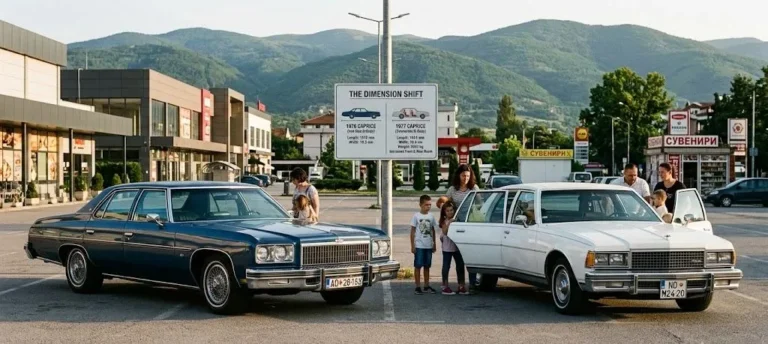
The 1973 redesign brought the Caprice its largest body in the model’s history, with a full-size American presence that aligned with the cultural moment when larger meant more prestigious. The 1973 to 1976 Caprices are the largest American Caprices ever built, with wheelbases and overall dimensions that make their mid-1970s contemporaries look modest by comparison.
The 1973 federal bumper standards added substantial weight and changed the front and rear appearance of every American car, and the Caprice was no exception. The heavy impact bumpers of the 1973 to 1976 Caprices are one of the clearest visual markers of their specific era, and the styling consequence of those regulations — along with the general design direction of the mid-1970s — places these years among the less collectible of the Caprice generations despite their historical significance.
The oil embargo of 1973 and its consequences changed the Caprice’s market fundamentally. A full-size V8 sedan became a different product in a market where fuel economy was suddenly the primary concern, and Chevrolet responded by reducing the available engine sizes and tuning the remaining V8s for economy rather than performance.
Section 3 – The Fourth Generation (1977–1990)
The Downsized Caprice That Survived Longer Than Anyone Expected
The 1977 Caprice is one of the most significant single model-year changes in American automotive history. General Motors downsized the entire B-body platform for 1977, producing a smaller, lighter, more fuel-efficient full-size sedan that actually performed better in almost every measurable way than the enormous 1976 models it replaced. The downsized 1977 Caprice was shorter, narrower, and hundreds of pounds lighter than the 1976 version — yet it offered comparable interior space due to more efficient packaging, better handling due to the reduced weight, better fuel economy, and essentially the same level of interior comfort.
The fourth-generation Caprice’s 13-year platform longevity reflects the same B-body engineering durability that made it the preferred fleet vehicle for police departments — durability characteristics that translate directly to collector ownership confidence. Our complete guide to the most reliable cars covers the modern reliability landscape, but the B-body Caprice’s documented durability in fleet service makes it one of the most proven platforms in American automotive history.
The 1977 downsizing is celebrated by automotive historians as a rare example of a manufacturer improving its product by making it smaller — a process that American manufacturers generally resisted. The 1977 Caprice’s success in the market proved the concept: the smaller Caprice outsold the enormous 1976 version and established the fourth-generation platform as the foundation for what became the most enduring version of the Caprice nameplate.
The fourth generation’s longevity was remarkable. The basic architecture established for 1977 carried forward with evolutionary refinements through 1990 — a 13-year production run on a single platform that would be unusual by any standard and was genuinely exceptional in the constantly-changing 1980s American automotive market. During those 13 years, the Caprice served as the primary American police patrol vehicle for virtually every major city police department and state highway patrol — a fleet dominance that built the Caprice’s most durable cultural identity.
The police interceptor configuration is the specific fourth-generation application that most Americans who were alive during this period associate with the nameplate. The Caprice PPV used heavy-duty cooling, upgraded suspension, specific transmission calibrations for constant low-speed maneuvering and occasional high-speed pursuit, and the 350 cubic inch or 305 cubic inch small-block V8 in fleet-appropriate configurations. The police Caprice is not a muscle car, but it is the vehicle that appeared in more American police television programs and films during the 1980s than any other vehicle, and that specific cultural presence is permanent.
The civilian 1977 to 1990 Caprice is the most commonly available generation in today’s collector and used car market — high production volumes and relatively recent production history mean that clean, usable examples are accessible at prices that remain affordable for buyers who want a large, comfortable, rear-wheel-drive American sedan from the last era when that was the mainstream American automobile.
Section 4 – The Fifth Generation (1991–1996)
The Final Caprice — And The Best Version Ever Made
The 1991 Caprice redesign is the most controversial and most debated styling decision in the nameplate’s history. The 1991 design replaced the squared, formal lines of the 1977 to 1990 generation with a dramatically rounded, smooth body that was praised by aerodynamicists for its coefficient of drag and criticized by virtually everyone who saw it for its resemblance to an upside-down bathtub. Contemporary automotive press consistently described the styling as polarizing at best and unfortunate at worst.
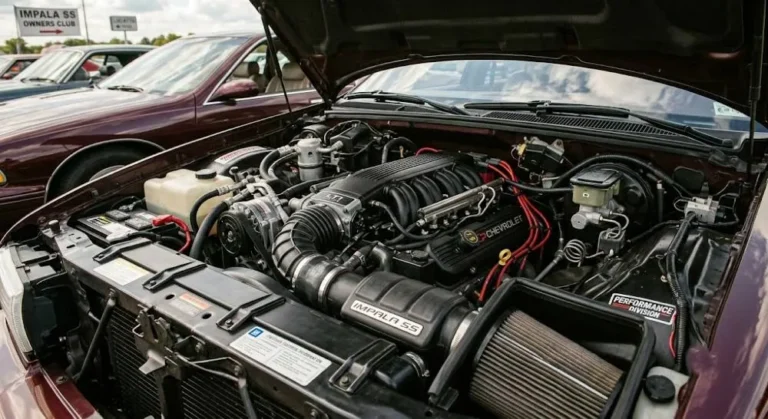
What the 1991 Caprice’s critics could not argue with was its engineering. The new body produced genuinely excellent aerodynamics. The refinements to the B-body platform improved ride quality, handling, and NVH over the already-respected 1977 to 1990 generation. The interior quality was meaningfully upgraded. And the introduction of the LT1 5.7-liter V8 for 1994 — the same engine used in the contemporary Corvette in a slightly lower state of tune — gave the final Caprice generation its best powertrain in the nameplate’s history.
The 260-horsepower LT1 in the 1994 to 1996 Caprice and its derivative models transformed a large, comfortable sedan into a genuinely quick vehicle. The LT1-powered Caprice reached 60 mph in approximately 7.0 to 7.5 seconds and ran the quarter mile in the mid-15-second range — not muscle car numbers, but competitive with many contemporary sport sedans at a fraction of their price.
The 1994 to 1996 Impala SS is the most celebrated specific application of the final Caprice generation and the vehicle that the automotive press of the era treated as the most exciting American production car surprise of the decade. Car and Driver and Motor Trend both published extensive reviews that marveled at the combination of a large, rear-wheel-drive American sedan, 260 horsepower, 17-inch wheels, a lowered and retuned suspension, and a price that remained accessible to buyers who could not afford a BMW M5 or a Cadillac Fleetwood.
The Impala SS was the car that made the case that the American full-size rear-wheel-drive sedan was not an obsolete product — it was a misunderstood one that had been waiting for the right combination of power and suspension tuning to reveal its potential. General Motors discontinued it anyway, ending the entire B-body platform’s production after 1996 in a decision that Impala SS enthusiasts have never stopped questioning.
Section 5 – The Police Interceptor Legacy
Why The Caprice Defined American Law Enforcement For A Generation
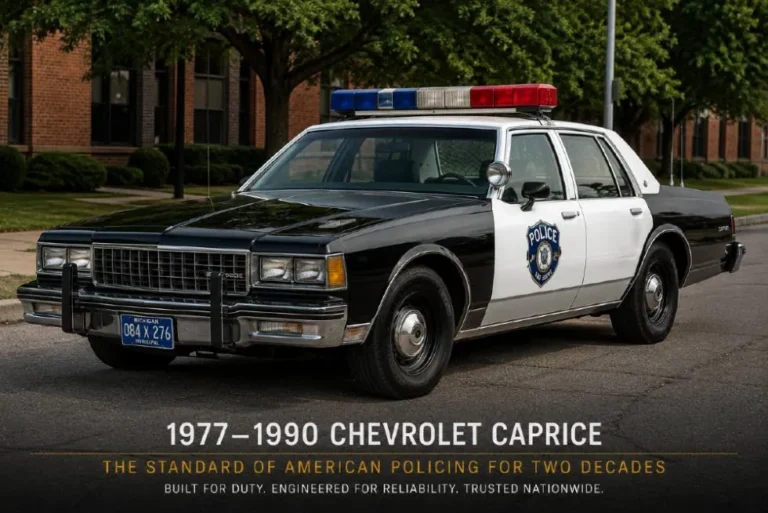
The Chevrolet Caprice’s identification as the definitive American police car is not a marketing claim — it is a documented historical reality. From approximately the early 1970s through 1996, the Caprice was the vehicle driven by the majority of American municipal police departments and state highway patrol agencies. Its rear-wheel-drive layout, available V8 power, large interior that accommodated a full complement of communications equipment alongside a uniformed officer and a prisoner, and robust B-body platform made it the engineering choice that fleet managers consistently preferred over available alternatives.
The specific police interceptor package that Chevrolet offered for fleet customers included heavy-duty cooling systems calibrated for the specific thermal demands of idling in traffic for extended periods, transmission calibrations that handled the constant low-speed work of patrol duty, upgraded brakes, and specific engine tuning for pursuit performance when required. The 350 cubic inch V8 in police configuration produced adequate performance for the patrol duties that constituted the overwhelming majority of police vehicle use.
The cultural impact of the Caprice PPV on American popular culture cannot be overstated. Every American who watched television during the 1970s, 1980s, or early 1990s developed a specific Caprice visual vocabulary — the squared-off body of the 1977 to 1990 generation in black-and-white, white, or dark blue, with the specific light bar and communications antenna configuration that identified it as law enforcement. When filmmakers needed a police car for any American setting during this period, they used a Caprice because anything else would have been historically incorrect.
The end of the Caprice’s police interceptor era created a vacuum that the Ford Crown Victoria filled almost immediately — the Crown Victoria Police Interceptor became the standard American police car from approximately 1997 through 2011, when its own production ended and the market transitioned to the Ford Police Interceptor Utility and other SUV-based patrol vehicles. The brief return of the Caprice name on a fleet-only Police Patrol Vehicle from 2011 through 2017 — based on the Australian Holden Caprice and never sold to the general public — was a specific fleet product rather than a continuation of the original American nameplate’s story.
Section 6 – The Station Wagon Legacy
The Most Underappreciated Caprice Configuration
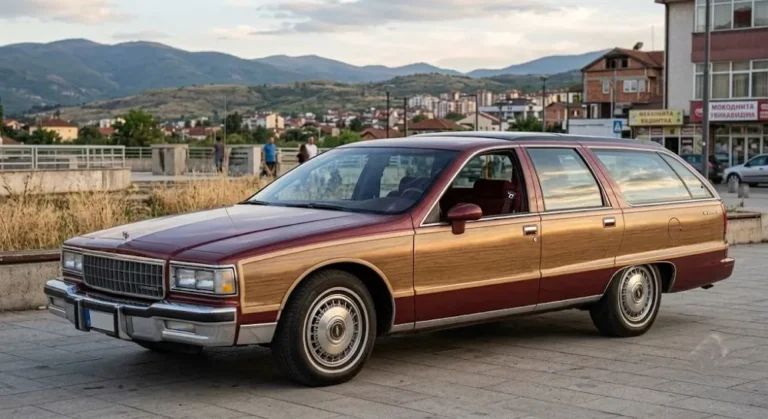
The Chevrolet Caprice station wagon is the most underappreciated configuration in the nameplate’s production history and one of the most compelling collector propositions in the current full-size American wagon market. Produced across multiple generations with available V8 power, optional rear-facing third-row seating, and the full Caprice interior appointment level, the Caprice wagon represents the definitive expression of the American family vehicle from the 1970s through the early 1990s.
The Caprice wagon outlasted every competitor in its segment. Chrysler discontinued its large station wagons before the Caprice. Ford’s Country Squire ended with the Panther platform after 1991. The Caprice wagon continued through 1996 as the only domestically-produced full-size American station wagon available to new-car buyers — a monopoly position in a segment that the minivan had largely displaced but not eliminated for buyers who specifically wanted a traditional wagon rather than a van.
The specific appeal of the Caprice wagon is the combination of full-size V8-powered capability, the distinctive full-size American wagon body style that no current production vehicle replicates, and the relative affordability compared to contemporary full-size muscle car and luxury car alternatives from the same era. A clean 1991 to 1996 Caprice wagon with the LT1 V8 is a genuinely distinctive and capable vehicle that occupies a unique position in the current collector market.
The rear-facing third seat is the feature that most immediately distinguishes the Caprice wagon experience from any other vehicle in the collector market. Children who grew up riding in the rear-facing third seat of a Caprice wagon — watching the world recede behind the vehicle through the rear window — have a specific nostalgic connection to this configuration that drives a sustained collector interest in clean examples.
Section 7 – The Collector Market
What Every Caprice Generation Is Worth And Why
The Chevrolet Caprice collector market is segmented more distinctly than almost any other full-size American car nameplate — the same model name applied to vehicles that range from affordable driver-quality examples to genuinely significant collector cars, and the price differences between generations and configurations reflect genuine differences in both rarity and enthusiast appeal.
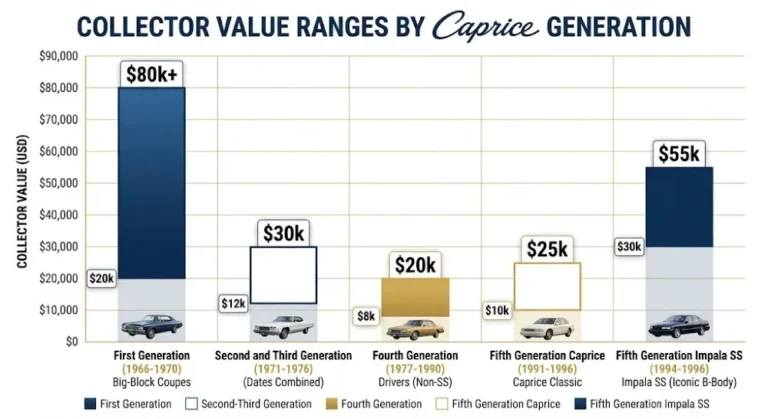
The 1966 to 1970 first-generation Caprices command the highest values in the nameplate’s collector market. The 1969 and 1970 Custom Coupes with available big-block engines — the 427 or 454 cubic inch V8 — represent the performance peak of the original Caprice generation and are correctly identified as full-size muscle cars by the collector community that has increasingly focused on these configurations. A documented 1970 Caprice with the 454 LS5 or LS6 in excellent condition is a $50,000 to $80,000 collector car in the current market.
The convertible variants of 1966 through 1969 are the rarest Caprice configurations and command premium values over equivalent coupe models. The combination of a Caprice convertible with the available big-block engine and correct interior in excellent documented condition is among the most valuable full-size Chevrolet collectibles outside the Impala SS and Corvette categories.
The most recently documented auction transaction prices for Chevrolet Caprice examples — including the specific sale prices for first-generation big-block coupes, convertibles, Impala SS models, and station wagons — are recorded in the Bring a Trailer Chevrolet Caprice auction results, which include buyer-verified condition reports and full photographic documentation for every completed transaction.
The 1977 to 1990 fourth-generation Caprices occupy the most interesting value position in the current market — they are the generation most Americans associate with the nameplate, they are available in the largest numbers, and they are the most accessible price tier for buyers who want a driving Caprice rather than a concours collectible. Driver-quality 1980s Caprices in clean condition are available for $8,000 to $15,000 — a price that makes them one of the most affordable rear-wheel-drive V8 American sedans currently available.
The fourth-generation Caprice’s driver-quality examples at $8,000 to $15,000 place it in direct value competition with the other affordable rear-wheel-drive V8 American cars available in the current used market — our guide to the best sports cars under $10,000 covers the full landscape of accessible V8 rear-wheel-drive options, giving buyers who want the Caprice’s specific character the complete comparison against contemporaneous alternatives.
The 1994 to 1996 Impala SS represents the strongest performance and collector argument in the fifth generation. Hagerty’s valuation data for the Impala SS places the average example at approximately $30,000 to $40,000 and excellent examples at $50,000 to $55,000 in 2026 — a meaningful appreciation from the bargain-level prices that Impala SSes commanded as recently as 2015. The Impala SS appreciation reflects both the growing collector recognition of the final B-body generation’s specific engineering achievement and the general appreciation of 1990s American performance cars as that era’s vehicles enter their collector years.
Before purchasing any Caprice — particularly the higher-value first-generation big-block examples or the fifth-generation LT1-powered Impala SS — understanding the specific failure patterns of the GM small-block and big-block engines, the TH400 and 700R4 automatic transmissions, and the B-body platform’s known rust vulnerability areas is essential preparation. Our complete guide to common issues that kill American cars covers the documented failure patterns that affect these specific drivetrain components.
The station wagon segment has its own enthusiast community with its own value structure. Clean 1991 to 1996 Caprice wagons — particularly LT1-equipped examples in good condition — are achieving $20,000 to $35,000 in the current market, a figure that places them in direct competition with muscle car alternatives from the same decade but represents the specific wagon premium that a genuinely rare, genuinely useful classic vehicle commands.
The most comprehensive active listings of Chevrolet Caprice examples across all generations — from affordable fourth-generation drivers to documented first-generation big-block examples and Impala SS models — are available through Hemmings Motor News Chevrolet Caprice listings, where seller-disclosed condition, documentation, and engine specification are more thoroughly described than on general automotive marketplaces.
FAQ
Q: When was the Chevrolet Caprice made?
A: The Chevrolet Caprice was produced from 1965 through 1996 in the United States — 31 total production years. It debuted as an upscale trim level of the full-size Impala in 1965 before becoming its own separate model in 1966. Production ended after 1996 when General Motors retired the B-body rear-wheel-drive platform. A separate Caprice Police Patrol Vehicle based on the Australian Holden Caprice was produced for fleet sales from 2011 through 2017 but was never sold to the general public.
Q: What is the most valuable Chevrolet Caprice?
A: The most valuable Chevrolet Caprices in 2026 are the 1969 and 1970 Custom Coupe models equipped with the 427 or 454 cubic inch big-block V8 in documented excellent condition, which can achieve $50,000 to $80,000 or more at auction depending on engine option, color, and provenance. Convertible variants from 1966 through 1969 with big-block engines command similar or higher premiums due to their rarity. The 1994 to 1996 Impala SS averages $30,000 to $40,000 with excellent examples reaching $50,000 to $55,000.
Q: What replaced the Chevrolet Caprice?
A: The Chevrolet Caprice was not directly replaced when it was discontinued after 1996. The Ford Crown Victoria Police Interceptor took over the police fleet role that the Caprice had occupied. The Chevrolet Impala name was revived for 2000 as a front-wheel-drive sedan on the W-body platform — a fundamentally different vehicle from the B-body rear-wheel-drive Caprice — and has continued in production since then. No General Motors product has replicated the Caprice’s specific combination of large rear-wheel-drive platform, V8 power, and full-size family car versatility.
Q: Is the Chevrolet Caprice a good collector car?
A: Yes, across multiple generations and configurations. The 1969 to 1970 big-block models provide genuine muscle car performance in a full-size luxury body. The 1994 to 1996 Impala SS represents the best-driving Caprice-platform vehicle ever produced. The 1977 to 1990 fourth-generation provides accessible rear-wheel-drive V8 sedan ownership at prices that most American car collectors can reach. The station wagons provide a unique and growing niche market for buyers who want the definitive American family vehicle of the late 1980s and early 1990s.
Q: What engine did the 1994 Impala SS use?
A: The 1994 to 1996 Chevrolet Impala SS used the LT1 5.7-liter V8 producing 260 horsepower — the same engine used in the contemporary Corvette in a slightly lower state of tune. The LT1-equipped Impala SS reached 60 mph in approximately 7.0 to 7.5 seconds and covered the quarter mile in the mid-15-second range. It used 17-inch wheels, a lowered and retuned suspension versus the standard Caprice, and was praised by Car and Driver and Motor Trend as the best American performance car value of the mid-1990s.
Q: Why is the Chevrolet Caprice important to American automotive history?
A: The Chevrolet Caprice is important to American automotive history for several distinct reasons. It served as the primary American police patrol vehicle for more than two decades, defining American law enforcement vehicle standards. It was the last American full-size station wagon in production, continuing through 1996 when every competitor had exited the segment. It provided one of the most significant full-size muscle car performances of 1970 with the 454 LS6 V8. And it ended with the LT1-powered Impala SS, proving that the American full-size rear-wheel-drive sedan’s potential was unrealized even as General Motors chose to discontinue it.
The Bottom Line
The Chevrolet Caprice deserves a place in any honest accounting of the most significant American cars of the second half of the 20th century — not because it was the most exciting, or the most powerful, or the most beautiful, but because it was the most versatile and the most consistently capable across the widest range of American automotive needs.
It carried families. It patrolled streets. It hauled luggage in the station wagon’s cargo area and groceries in the frunk and everything else in between. It offered the 454 LS6 when the market wanted maximum power and the LT1 when the market wanted efficiency and performance combined. It served fleet buyers for two decades and individual buyers for three, and it did all of it on one of the most durable automotive platforms General Motors ever built.
The 1996 discontinuation of the B-body platform remains, from the perspective of 2026, one of General Motors’ most regrettable decisions. The Impala SS demonstrated what was possible on that platform in 1994 — and the following three decades of front-wheel-drive sedans, crossovers, and SUVs have not produced anything that replicates what the final Caprice offered: a large, comfortable, rear-wheel-drive American sedan with genuine performance capability, genuine family utility, and a heritage connection to six generations of American automotive culture.
The Caprice is gone from American showrooms. The collector market is the only place it remains available. And at every price point from $10,000 for a driver-quality 1980s example to $80,000 for a documented 1970 big-block coupe, it represents some of the best available value in the classic American car market for buyers who understand what they are looking at.
Editorial Note
This article was written and reviewed in June 2026. The Chevrolet Caprice production history covering the six generations from 1965 through 1996 is documented through General Motors historical production records, period automotive press reviews from Car and Driver and Motor Trend, and the comprehensive collector community documentation maintained by Caprice and Impala SS enthusiast organizations.
The 1994 to 1996 Impala SS’s LT1 5.7-liter V8 260 horsepower specification and performance figures are confirmed through period Car and Driver and Motor Trend road tests. The collector market values cited — 1969 to 1970 big-block coupes at $50,000 to $80,000+; 1994 to 1996 Impala SS at $30,000 to $55,000; fourth-generation driver examples at $8,000 to $15,000; station wagons at $20,000 to $35,000 — are editorial assessments based on Hagerty Valuation Tool data, Hemmings Motor News listings, Classic.com transaction records, and Bring a Trailer completed auction results.
All values reflect significant condition, documentation, and configuration variation and should be used as reference ranges rather than fixed pricing. The police interceptor production history is based on documented fleet deployment records and period automotive press coverage of the Caprice PPV program. The 2011 to 2017 Caprice PPV’s status as a Holden-based Australian product not sold to the general American public is confirmed through GM press documentation.