Last Updated: November 3, 2026 | Read Time: 11 minutes
Buying a used Jeep is not like buying a used Honda Accord. The Accord has one engine, two trim levels, and a reliability record so predictable it is almost boring. A used Jeep requires a completely different approach — one that starts not with price but with a specific question: which Jeep, which year, which engine, and what did the previous owner do to it?
The answers matter because the spread between a great used Jeep and a problematic one can be wide. A 2019 Jeep Grand Cherokee with the V6 and documented maintenance history is a genuinely capable, reasonably reliable family SUV at around $22,400. A 2012 Grand Cherokee with the 4.7-liter V8 and deferred maintenance is a potential money pit that some Jeep enthusiasts literally call a time bomb. A 2015 Wrangler JK with the 3.6-liter Pentastar engine and original components is one of the most proven off-road vehicles available in its price range. A 2007 Wrangler JK from the first year of the generation is statistically among the most complained-about vehicles in its class.
This guide covers every significant used Jeep model and model year with the specific data that makes those distinctions. Prices are verified from CarGurus, 4x4Playground, and CarComplaints.com. Reliability information comes from RepairPal, J.D. Power, Consumer Reports, and CarComplaints.com cross-referenced across sources. Problems are specific, not generic. Recommendations have reasons attached to them.
At A Glance – Used Jeeps Models And Prices
Jeep Wrangler JL (2018-present):
** Best years: 2021-2023 | Reliability: 79-82/100 | Price range: $25,000-$37,400
** Avoid: 2020-2025 4xe unless battery recall completed
Jeep Wrangler JK (2007-2018):
** Best years: 2015-2018 | Price range: $28,000-$38,000
** Avoid: 2007-2011 (first-gen electrical, 900+ complaints on 2007)
Jeep Grand Cherokee WL (2022-present):
** Best years: 2025 (scores 75/100, highest ever tracked) | 2026 (2 recalls, no complaints yet)
** Price: $36,000 (2025, one-year-old) | $29,700 (2023, three-year-old)
Jeep Grand Cherokee WK2 (2011-2021):
** Best years: 2019-2021 | Price: $22,400 (2021)
** Avoid: 2011-2014 (TIPM problems), 2018 (scores 60/100, 804 complaints)
Jeep Cherokee KL (2014-2023):
** Best years: 2019-2023 | Price range: $9,000-$22,000
** Reliability: 79-81/100 (2019-2023 range)
Jeep Cherokee XJ (1984-2001):
** Best: All years with the 4.0L inline-six | Avoid: GM V6 models
** Price: $8,000-$18,000 for clean examples (varies widely by condition)
Jeep Gladiator (2020-present):
Best years: 2020-2022 | Price range: $35,000-$45,000 used
Key Problems by Model:
— Wrangler: Death Wobble (solid front axle wear), 4xe battery recall (320,000 vehicles)
— Grand Cherokee 2011-2017: TIPM electrical failures ($1,000-$1,500 to replace)
— Grand Cherokee 2011-2014: 4.7L V8 described as “time bomb” by fans
— Cherokee KL 2014-2018: 9-speed transmission issues in early years
Sources: CarGurus Wrangler Buying Guide (2026), CarGurus Grand Cherokee Buying Guide (2026), CarGurus Cherokee Buying Guide (2026), Road Ethos Grand Cherokee Year Analysis (October 2026), 4x4Playground Best Used Wrangler Years Guide (2026), Simi Valley CDJR Wrangler Reliability by Year (2026), Tomes Auto Group Used Jeep Guide (2026), RepairPal Wrangler reliability data, J.D. Power quality scores
What To Know Before Buying
| Jeep Model | Generations Covered | Main Buying Consideration |
| Wrangler | JK and JL, with earlier generations discussed | Modifications, suspension, steering, water leaks and recall history |
| Grand Cherokee | WK2 and WL | Engine choice, electrical equipment, transmission and maintenance |
| Cherokee | XJ and KL | Rust and age-related wear on XJ; transmission and electronics on KL |
| Gladiator | JT | Off-road use, modifications, steering-system recalls and maintenance |
| Other Jeep models | TJ, YJ, Liberty, Compass, Patriot, Commander and Wagoneer | Condition, powertrain and model-specific inspection |
Why Buying A Used Jeep Requires More Homework Than Most Used Cars
Used Jeep buyers face a specific challenge that does not apply to most mainstream vehicles: a significant portion of the used Jeep inventory has been modified, off-roaded, abused, or all three. The Wrangler, in particular, is the most commonly modified vehicle in the American market. Lift kits, aftermarket bumpers, oversized tires, rock rails, roof racks, and custom axle components are not rare additions to the Wrangler market — they are the norm.
And every modification creates a potential inspection item that a standard used car buyer’s checklist will not catch. Suspension wear is more common on modified or heavily off-roaded Wranglers. This reinforces why documented maintenance history is critical when buying used.
Beyond modification history, the used Jeep market has model-year-specific problems that are severe enough to affect ownership costs dramatically. The TIPM electrical failures on 2011-2017 Grand Cherokees, the first-year JK Wrangler problems from 2007-2011, the 4.7-liter V8’s documented reliability issues, and the active Wrangler 4xe battery recall affecting 320,000 vehicles are not minor concerns. They are ownership-defining issues that can turn a reasonable-looking used purchase into a repair bill that matches or exceeds the vehicle’s value.
The good news is that the used Jeep market also contains genuinely excellent vehicles at genuinely reasonable prices. The second-generation Wrangler TJ with the 4.0-liter inline-six is one of the most durable powertrain combinations in American automotive history. The 2015-2018 JK Wrangler with the 3.6-liter Pentastar engine represents a proven, widely-serviced combination with massive aftermarket support.
The 2019-2021 Grand Cherokee WK2 hits a specific sweet spot of refined daily driving with genuine off-road capability at prices that represent real value. The second-generation Cherokee XJ with the 4.0-liter is simply one of the greatest off-road vehicles ever made at any price. Knowing which vehicles are which requires the specific information this guide provides.
The Used Jeep Wrangler: JK vs JL And Which Years Actually Matter
The Wrangler is the reason most people get interested in Jeeps, and it is the model where the year-by-year quality variation is most dramatic. Two Wranglers from different model years can deliver completely different ownership experiences despite sharing a name and a general shape.
The JK Generation (2007-2018): The Year You Buy Within The Generation Matters More Than The Generation
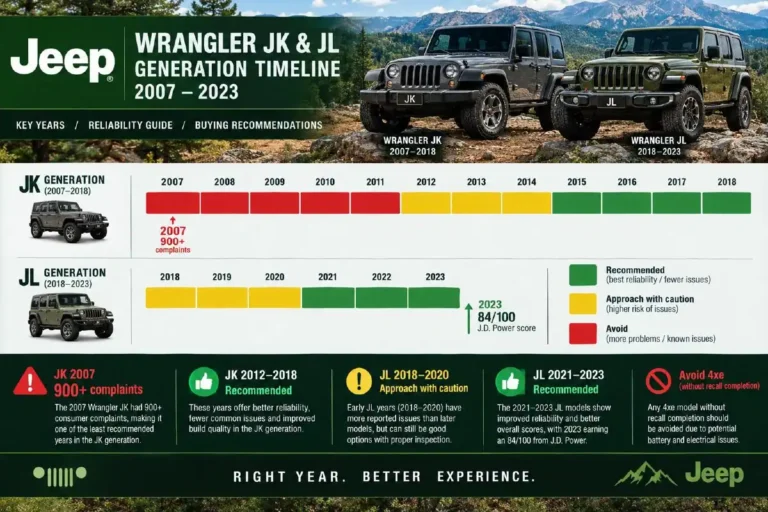
If you look at CarComplaints.com, the second generation and current generation of the Jeep Wrangler seem to have the fewest problems and complaints. Consumer Reports generally shows poor predictive reliability across the board, but the last couple of years have been trending upwards.
The 2007 model (first year of the JK generation) faced many problems. Owners often report electrical failures, leaks, and steering issues. Problems from 2007 continued into 2008, with many complaints about the TIPM (Totally Integrated Power Module). The 2013 model suffered from transmission failures and engine stalling, especially in models with the five-speed automatic. The 2010 model year also generated significant complaints. The 2007 complaint count reached 900+ with estimated repair costs of $1,200 or more.
The best used Jeep Wrangler years are 2015-2018 JK models with the 3.6L Pentastar engine, offering resolved reliability issues and strong aftermarket support around $28,000 to $38,000.
The specific reasoning behind the 2012 and later JK recommendation matters. The 3.6-liter Pentastar V6 replaced the previous 3.8-liter engine in 2012, and the Pentastar’s reliability record is significantly better than the 3.8’s. The 3.6L Pentastar V6 is usually the best Wrangler engine for reliability. It is common, widely serviced, and simpler than the 4xe plug-in hybrid system.
Many owners consider the 2012 Jeep Wrangler (after the Pentastar engine update) and the 2004 TJ with the 4.0L inline-six to be the most reliable. For most used shoppers, the best value is still a clean 2016 or 2017 Wrangler JK, or a 2020 to 2021 Wrangler JL with low mileage and no bad modifications.
The JL Generation (2018-Present): Better In Almost Every Way, Watch The 4xe
The #1 choice for 2021-2023 JL Wrangler offers the best combination of value and proven reliability. On the used market, the earliest model years of the JK generation average just shy of $25,000, while the latest model years average around $37,400.
The Wrangler (JL) 2018-2024 scores approximately 79-82 out of 100 in recent reliability ranges with strong resale demand and modern updates. The 2023 Wrangler is also worth considering because J.D. Power gives it a Quality and Reliability score of 84 out of 100, which falls into its “Great” range.
The specific JL caveat that every buyer must know: Wrangler 4xe plug-in hybrid models deserve extra attention because they are more complex. AP reported that Stellantis recalled more than 320,000 plug-in hybrid Jeep vehicles in the U.S., including 2020 to 2025 Wrangler 4xe models, due to a battery defect with fire risk. Car and Driver also reported a recall for 2023 to 2025 Wrangler 4xe models after an over-the-air software update caused communication issues that could lead to loss of drive power.
The 4xe recall is not a minor warranty paperwork matter. A battery fire risk on a plug-in hybrid is a serious safety concern, and any 4xe buyer must verify the specific vehicle’s recall completion status through NHTSA’s VIN lookup before purchase.
The Wrangler 4xe’s 320,000-vehicle battery recall raises legitimate questions about plug-in hybrid off-road vehicle reliability — questions that extend to the broader electrified truck and SUV market covered in our complete guide to electric pickup trucks, which evaluates the Rivian R1T, Silverado EV, and F-150 Lightning with the same honest reliability context that buyers need before committing to any electrified off-road platform.
Death Wobble: What It Is And What It Means For Buyers
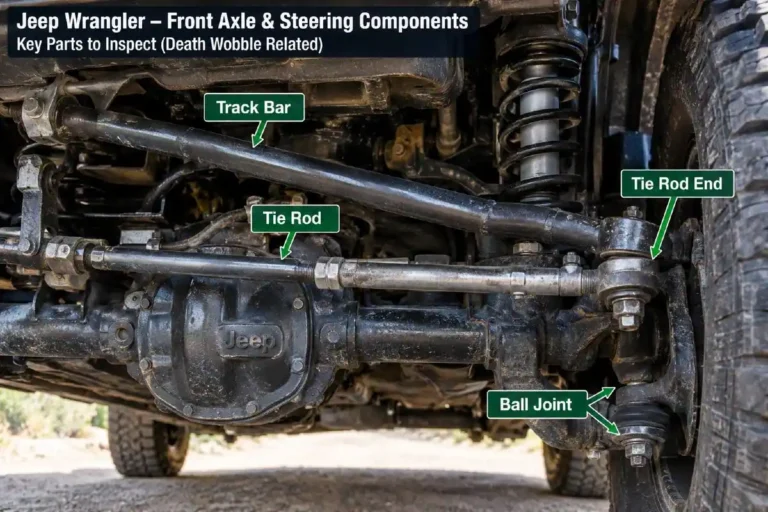
Certain Wrangler models equipped with a solid front axle have historically experienced steering vibration concerns under specific conditions. Death Wobble is a specific Wrangler phenomenon that occurs when worn front-end components — particularly track bar bushings, ball joints, steering stabilizers, and tie rod ends — allow the solid front axle to oscillate at highway speeds.
The result is a violent whole-vehicle vibration that typically starts above 45 mph after hitting a road imperfection. It is genuinely alarming to experience and requires a full front-end inspection to diagnose and eliminate. Death Wobble is not a reason to avoid the Wrangler. It is a reason to require a highway test drive at speeds above 55 mph before any used Wrangler purchase, and to include a front-end inspection in the pre-purchase examination.
The Used Jeep Grand Cherokee: The Year You Buy Matters Enormously
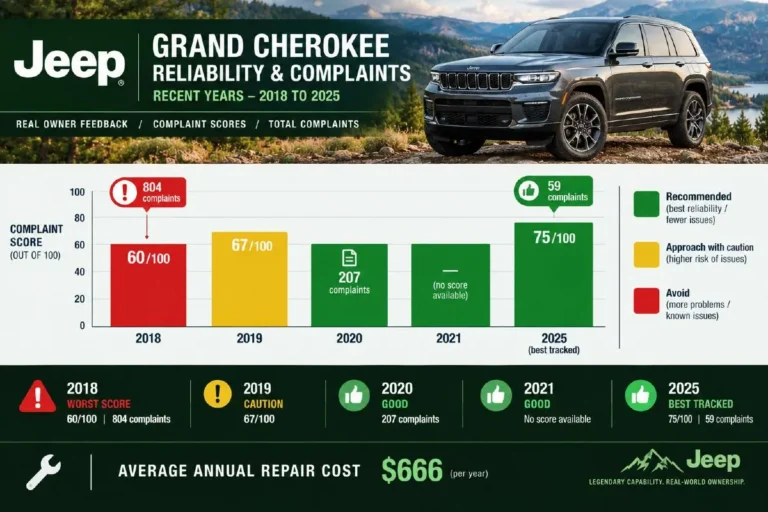
The Grand Cherokee’s reliability spread between model years is wider than almost any other American SUV. The 2025 Grand Cherokee scores 75 out of 100 — the highest of any year tracked. The 2018 scores 60 out of 100 with 804 complaints. Those two scores represent significantly different ownership experiences despite sharing a name.
Years Worth Buying
The best used buys are the 2019, which scores 67 out of 100 and is the stronger alternative to the 2018, and the 2025, which scores 75 out of 100, the highest of any Grand Cherokee year tracked. The 2020 has just 3 recalls and 207 complaints on file, the lightest record of the late fourth-generation years. If you can spend more, the newest Grand Cherokees are the most reliable.
The 2025 scores 75 out of 100, the highest of any Grand Cherokee year tracked, with 3 recalls and 59 owner complaints. The 2026 has 2 recalls and no owner complaints on file so far. A one-year-old 2025 Grand Cherokee lists for an average of around $36,000, while a three-year-old 2023 model averages around $29,700. A five-year-old 2021 Grand Cherokee averages around $22,400.
Years To Avoid
The 2018 Grand Cherokee scores 60 out of 100 with 804 complaints, and 2011 to 2014 carry older problems. These early fourth-generation years are the ones most often flagged by owners and dealers. Electrical problems are common, and the 4.7-liter V8 is prone to many expensive maladies. Some Jeep fans even refer to this engine as a time bomb.
The specific complaint scores and recall counts that justify the Grand Cherokee year recommendations — 2019 scoring 67 out of 100, 2020 with only 3 recalls and 207 complaints, 2025 scoring 75 out of 100 with 59 complaints, 2018 scoring 60 out of 100 with 804 complaints, and the 846 total electrical system complaints across recent years — are from the Road Ethos Grand Cherokee model years to avoid and buy analysis, published October 2026 and the most current comprehensive model-year reliability breakdown available.
The TIPM Problem: Specific, Expensive, And Testable
Some 2011-2017 Grand Cherokee models experienced issues tied to the TIPM (Totally Integrated Power Module), which could lead to intermittent electrical concerns.
The TIPM is not just an “electrical concern.” A failed TIPM can prevent the fuel pump from activating — meaning the vehicle simply will not start. It can cause random horn activation, window and lock malfunctions, and airbag warning lights. Replacement costs $1,000 to $1,500 at a dealer. On a 2013 Grand Cherokee purchased for $12,000, a surprise $1,500 TIPM replacement is a 12.5% unexpected cost increase.
Testing for TIPM problems before purchase involves having a dealer scan the vehicle’s codes specifically, looking for electrical history in the maintenance records, and asking directly whether the TIPM has been replaced or had warranty work. A seller who cannot answer this question should be treated as a data gap that affects the purchase price.
The Grand Cherokee’s most common problems involve its electrical system, with 846 owner complaints across its recent model years, followed by powertrain issues, with 285. Across its 2018 to 2026 model years, the Grand Cherokee averages 66 out of 100, which rates it as good overall, with an estimated annual repair cost of $666.
The Grand Cherokee’s specific value proposition as a daily driver SUV — smooth ride, genuine capability, large interior — is most useful when evaluated against mainstream alternatives that prioritize reliability over off-road performance. Our complete Chevrolet Traverse guide covers the 2026 Traverse’s 98 cubic feet of cargo space, Super Cruise hands-free driving, and the reliability track record that gives a buyer the specific comparison between a Jeep-brand purchase and a mainstream three-row GM alternative at similar prices.
The Used Jeep Cherokee: The XJ Is A Legend, The KL Is Complicated
The Jeep Cherokee name has applied to two completely different vehicles separated by more than a decade. Understanding which one you are buying — and which years to choose within each — is the specific knowledge that separates a great Cherokee purchase from a frustrating one.
The XJ Cherokee (1984-2001): The One Enthusiasts Are Still Buying
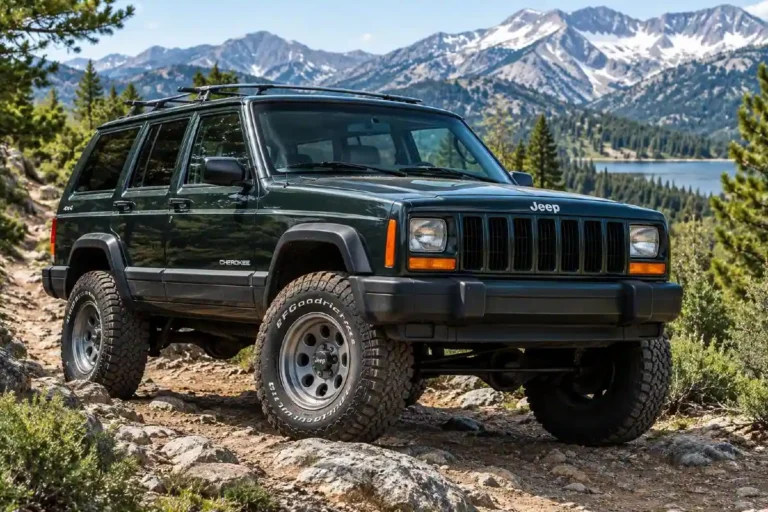
The second generation (1984-2001) is inarguably the best Cherokee for its style, bulletproof powertrains (except the GM V6), and off-road capability. The XJ Cherokee with the 4.0-liter inline-six is one of the most respected off-road vehicles ever made, and it belongs in this guide not as nostalgia but as a genuine 2026 buying recommendation.
The 4.0-liter’s specific engineering characteristics — high torque at low RPM, extremely simple mechanical design, well-understood repair requirements, and a parts ecosystem supported by decades of aftermarket development — make it genuinely competitive with modern vehicles for buyers whose priority is off-road capability and mechanical durability rather than interior refinement.
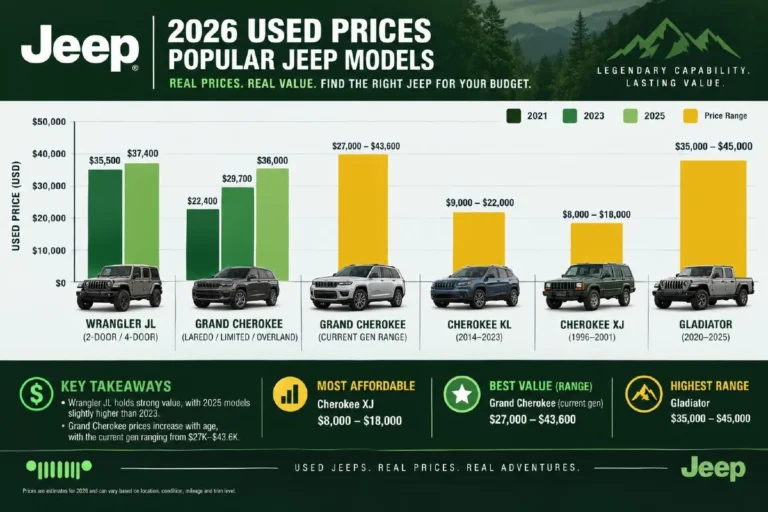
Clean XJ examples with documented history and reasonable mileage are available from $8,000 to $18,000. Higher-mileage examples with typical rust and deferred maintenance can be found for less. The specific engine caveat is important: the GM V6 option that appeared in some XJ configurations does not share the 4.0-liter’s reliability reputation and should be avoided.
The KL Cherokee (2014-2023): Improved After A Rough Start
The Jeep Cherokee can be a good deal depending on the price, condition, and which generation you go for. For the third generation, average prices at the time of writing ranged from $9,000 to $22,000 for 2014-2023 Cherokee models. Cherokee 2019-2023 offers balanced size and efficiency with reliability scores of approximately 79-81 out of 100.
The KL Cherokee’s specific reliability story centers on the 9-speed automatic transmission that launched with the 2014 model year. Early 9-speed units generated substantial complaints about hesitation, hard shifts, and software hunting between gears. Chrysler issued multiple transmission software updates through the first several years of production, and later model years from 2017 onward show significantly improved transmission behavior. Buyers targeting 2014-2016 models should specifically ask about transmission history and verify current software levels.
The Grand Cherokee’s performance range extends from the reliable V6 daily driver to the extreme — the discontinued Jeep Grand Cherokee Trackhawk with its 707-horsepower supercharged HEMI is covered in our complete guide to the fastest SUVs in the world, giving buyers a complete picture of where the Grand Cherokee fits in the American performance SUV landscape from the sensible used 2019 V6 all the way to the 180-mph Trackhawk.
The Used Jeep Gladiator: The Pickup Option
The Jeep Gladiator arrived for 2020 as the first Jeep truck in decades, and the used market for it is now established enough to offer meaningful choices. The Gladiator’s most important used-market consideration is its first model year status for the current platform. First-year vehicles across all manufacturers typically carry more undiscovered issues than subsequent years, and the 2020 Gladiator generated a recall campaign and several software-related complaints in its initial months of production.
The 2021 and 2022 model years represent more settled production with identified issues resolved, and they are the specific years most worth targeting at used prices of $35,000 to $45,000. The Gladiator uses the same 3.6-liter Pentastar V6 that has proven itself in the Wrangler over a decade of production, which is both its most reassuring powertrain characteristic and the answer to most mechanical concerns about the platform. The diesel Gladiator option carries a premium price and additional maintenance complexity that most buyers should evaluate honestly against their actual use case.
The Gladiator’s pickup truck credentials — and the honest question of whether a Jeep-based truck serves a buyer’s needs better than a conventional American pickup — is most usefully evaluated in the context of what full-size American trucks offer. Our complete guide to the best pickup trucks covers the F-150, Ram 1500, and Silverado with the specific capability comparisons that help Gladiator buyers understand exactly what they gain in off-road capability and what they trade in towing, payload, and bed dimensions.
What To Inspect On Any Used Jeep Before You Buy
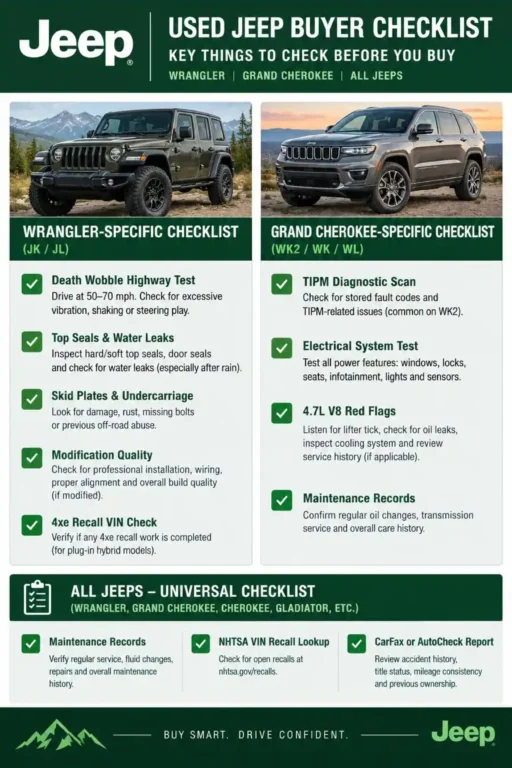
The used Jeep pre-purchase inspection is more involved than for most mainstream vehicles, and the following checklist covers the Jeep-specific items that a generic inspection will miss.
For Wranglers Specifically
Test drive above 55 mph and hit a rough road section deliberately. Death Wobble manifests at speed over road imperfections, and discovering it before purchase is essential. If the front end vibrates or shakes violently, have a complete front-end inspection performed — track bar, ball joints, tie rod ends, and steering stabilizer.
Inspect the soft-top or hard-top seals for evidence of water intrusion. Wranglers leak more than most vehicles by nature of their removable-top design, and a seller who has driven through deep water — or whose previous owner has — may have interior water damage that is not immediately apparent.
Check the skid plates and underside for off-road damage. Lifted Wranglers that have been used on rock trails will show specific impact marks on the skid plates, differential covers, and frame rails. This is not necessarily disqualifying, but it changes the inspection requirements and potentially the value proposition.
Suspension wear is more common on modified or heavily off-roaded Wranglers. Any modified Wrangler requires inspection of every aftermarket component — lift kit quality, wheel spacers if present, extended brake lines, and re-geared differentials if larger tires have been installed. A quality lift installation is not a problem. A cheap lift installed without professional alignment and re-gearing is.Verify 4xe battery recall completion status via NHTSA VIN lookup for any 2020-2025 Wrangler 4xe.
For Grand Cherokees Specifically
On 2011-2017 models, perform a full diagnostic scan specifically looking for electrical codes and TIPM-related fault history. Ask for documentation of any TIPM-related warranty or repair work.
On any model with the 4.7-liter V8, be prepared for the specific engine concerns associated with that powertrain — coolant system issues, oil sludging from infrequent oil changes, and associated costs that accumulate in high-mileage examples.
Test all electrical systems deliberately: windows, locks, sunroof, entertainment system, navigation, and the Uconnect system if equipped. Electrical issues on the Grand Cherokee tend to present as intermittent problems that are difficult to reproduce on a brief test drive.
For Cherokee XJ Models
Check the floor pans and rocker panels for rust — the XJ’s specific rust vulnerability points are the rear floor pan corners and the pinch welds along the rocker panels. In rust-belt states, an otherwise perfect-looking XJ may have significant structural rust underneath. Inspect with a flashlight and a light tap of something solid on suspected areas.
Check the cooling system — the 4.0-liter’s high cooling system pressure makes it sensitive to system condition, and an overheated 4.0-liter can develop head gasket issues that are expensive to address.
For All Used Jeeps
The Grand Cherokee typically provides the smoothest ride. Cherokee and Compass models may offer better fuel efficiency. Wrangler prioritizes capability over ride refinement. Verify the maintenance history is documented rather than claimed. Oil change intervals on turbocharged engines (including the diesel Gladiator and 4xe Wrangler) are critically important, and a seller who cannot produce maintenance records should receive a corresponding reduction in any offer.
Used Jeep Prices By Model And Year
On CarGurus, a 1-year-old 2025 Wrangler lists for around $37,400, while a 3-year-old 2023 model averages roughly $35,500. On the used market, the earliest model years of the JK generation average just shy of $25,000, while the latest JL model years average around $37,400.
Average used prices for the current-generation Grand Cherokee range from around $27,000 to $43,600, depending on model year. A one-year-old 2025 Grand Cherokee lists for an average of around $36,000, while a three-year-old 2023 model averages around $29,700. A five-year-old 2021 Grand Cherokee averages around $22,400. For the third-generation Cherokee KL, average prices ranged from $9,000 to $22,000 for 2014-2023 Cherokee models.
The XJ Cherokee market is geography-dependent. In states where rust is not a concern, clean 1998-2001 XJ examples in original condition with reasonable mileage average $10,000 to $18,000. Rust-belt examples in comparable mechanical condition are substantially less. Modified XJs in custom trail-built configurations command premiums above $20,000 for high-quality builds.
The Honest Reliability Picture
RepairPal gives the Jeep Wrangler a reliability rating of 3.5 out of 5.0, ranking it 25th out of 26 compact SUVs. That ranking deserves honest context. The Wrangler is designed and built to do things that no other vehicle in its class is designed to do — remove the roof and doors, ford deep water, crawl over boulders at near-zero speed, and survive trail abuse that would disable most conventional SUVs.
The engineering compromises that make it capable of those things — the solid front axle, the removable roof seals, the body-on-frame construction, the two-speed transfer case — are the same features that contribute to its lower reliability scores versus crossovers that do none of those things.
A Wrangler buyer who primarily uses the vehicle for suburban commuting and occasional mild off-road trips is choosing a vehicle that is significantly less reliable than alternatives that would serve that use case better. A Wrangler buyer who values genuine off-road capability, a uniquely open-air driving experience, and a vehicle culture unlike anything else in the American market is choosing the only vehicle that delivers those specific things.
The Grand Cherokee (WK2) 2018-2021 offers a refined ride with updated tech and scores approximately 80-82 out of 100. The Grand Cherokee typically provides the smoothest ride.
For buyers who want a daily driver SUV that will occasionally see a dirt road, the Grand Cherokee’s smooth ride and large interior space make it the appropriate choice from the Jeep lineup. Its reliability scores above 80 in the right years compare favorably with competitive SUVs, and its available V8 power and Quadra-Drive four-wheel drive system are genuinely capable when needed.
The Wrangler’s RepairPal ranking of 25th out of 26 compact SUVs and the Grand Cherokee’s 66 out of 100 average score make most sense when placed in the complete American reliability landscape — our complete guide to the most reliable cars covers the Consumer Reports and J.D. Power reliability rankings for every significant American model, providing the full picture of where Jeep sits relative to Ford, Chevrolet, Ram, and other American manufacturers.
FAQ
Are used Jeeps reliable?
It depends entirely on the model, year, and how the vehicle was used. JL Wranglers (2018-present) score 79-82 out of 100. Grand Cherokees from 2019-2021 score 80-82. But the 2007 Wrangler JK generated 900+ complaints with $1,200+ average repair costs, and the 2018 Grand Cherokee scores 60 out of 100 with 804 complaints. The spread between the best and worst used Jeep options is one of the widest in the American SUV market.
What is the best used Jeep to buy?
For off-road capability and value: 2015-2018 JK Wrangler with the 3.6L Pentastar ($28,000-$38,000). For the best modern Wrangler: 2021-2023 JL ($35,000-$45,000). For daily driving: 2019-2021 Grand Cherokee WK2 ($22,000-$35,000). For the best off-road value at any price: 1996-2001 Cherokee XJ with the 4.0L inline-six ($8,000-$18,000).
What is Death Wobble on a Jeep Wrangler?
Death Wobble is a violent steering vibration affecting Wranglers with solid front axles, typically triggered at highway speeds over road imperfections. It is caused by worn track bars, ball joints, steering stabilizers, or tie rod ends. It can usually be eliminated by replacing the specific worn components. Always test drive any used Wrangler above 55 mph before purchase.
What Jeep years should I avoid?
Wrangler: 2007-2011 JK (electrical, 900+ complaints), 2013 JK (transmission), 2020-2025 4xe (unless battery recall completed). Grand Cherokee: 2011-2014 (TIPM, 4.7L V8), 2018 (60/100 score, 804 complaints). Cherokee KL: 2014-2016 (9-speed transmission issues).
What is the TIPM problem on Jeep Grand Cherokee?
The Totally Integrated Power Module is an electronic control unit in 2011-2017 Grand Cherokees prone to failure. Symptoms include random horn activation, fuel pump failure causing no-start, window and lock malfunctions, and airbag warning lights. Replacement costs $1,000-$1,500. Always request a diagnostic scan specifically checking for TIPM codes before purchasing any 2011-2017 Grand Cherokee.
The Bottom Line
Buying a used Jeep rewards research and punishes assumptions. The Wrangler that looks great in the listing photos and was lifted by someone who knew what they were doing and maintained meticulously is a different purchase from the Wrangler that looks great in the listing photos and was modified by someone who bought the cheapest lift kit available and hasn’t changed the oil in 8,000 miles. The Grand Cherokee from 2019 with the V6 and documented service history is a different purchase from the Grand Cherokee from 2012 with the 4.7-liter V8 and three owners.
The specific years recommended in this guide — 2015-2018 JK Wrangler, 2021-2023 JL Wrangler, 2019-2021 Grand Cherokee, 2019-2023 Cherokee KL, and 1996-2001 Cherokee XJ — have earned those recommendations through documented reliability data, complaint records, and the accumulated experience of the specific community of people who buy, drive, modify, and repair Jeeps for a living and a passion.
Use this guide as the starting point. Use the Marti Report equivalent for Jeeps — a CarFax or AutoCheck report — to verify ownership history. Use a mechanic who knows Jeeps for the pre-purchase inspection. Use the Death Wobble highway test on every used Wrangler. Use NHTSA’s VIN lookup for the 4xe recall on every plug-in Wrangler.
The right used Jeep, purchased with the right information, delivers something that a comfortable crossover at the same price cannot: genuine capability, a unique driving experience, and membership in a vehicle community that takes the “trail and road” designation in Road and Track (R/T) seriously. The wrong used Jeep, purchased without the right information, delivers a different education — and a significantly larger repair bill.
Editorial Note
This article was written and reviewed November 3, 2026. All pricing and reliability data sourced from current primary references.
Pricing data — CarGurus Wrangler Buying Guide (2026): $37,400 for 2025 Wrangler, $35,500 for 2023, JK models near $25,000 to $38,000. CarGurus Grand Cherokee Buying Guide (2026): $36,000 for 2025, $29,700 for 2023, $22,400 for 2021, $27,000-$43,600 current generation range. CarGurus Cherokee Buying Guide (2026): $9,000-$22,000 for 2014-2023 KL models.
Reliability data — Road Ethos Grand Cherokee Year Analysis (October 2026): 2019 scores 67/100, 2020 has 3 recalls and 207 complaints, 2025 scores 75/100 with 3 recalls and 59 complaints, 2026 has 2 recalls and no complaints, 2018 scores 60/100 with 804 complaints, average annual repair cost $666, 846 electrical complaints across recent years.
Wrangler reliability — Simi Valley CDJR Wrangler Reliability by Year (2026): RepairPal 3.5/5.0, 25th of 26 compact SUVs. 3.6L Pentastar best engine recommendation. 2023 J.D. Power score 84/100. 4xe recall — AP reporting cited by SVCDJR: 320,000 plug-in hybrid vehicles recalled for battery fire risk, 2020-2025 models. JL 79-82/100 reliability range.
Best years data — 4x4Playground Best Used Wrangler Years Guide (2026): 2015-2018 JK best value at $28,000-$38,000. JeepInside Best and Worst Wrangler Years (2026): 2007 as worst year, 2015 as top pick with 100,000+ mile reports. Tomes Auto Group Used Jeep Guide (2026): reliability ranges by model confirmed.
Cherokee XJ characterization — CarGurus Cherokee Buying Guide (2026): “inarguably the best Cherokee” with “bulletproof powertrains (except the GM V6).” TIPM problem characterization — Tomes Auto Group: “intermittent electrical concerns” and dealer-cited $1,000-$1,500 replacement cost. Grand Cherokee 4.7L “time bomb” characterization — CarGurus Grand Cherokee Buying Guide direct quote.
Sources And Further Reading
NHTSA — Urgent Park-Outside Warning for Certain Jeep Wrangler and Gladiator Vehicles, June 2026
NHTSA — Vehicle Recalls Lookup