Last Updated: March 15 2026 | Read Time: 12 minutes
Four powertrains. Seven trim levels. A 5-star NHTSA safety rating. And 18 NHTSA recalls that every prospective buyer absolutely needs to understand before handing over a dollar. Here is every spec, every trim, every honest issue — and exactly what to check before you buy.
Ford Escape 2021 Key Facts
– Vehicle Type: Compact Crossover SUV
– Generation: Fourth generation (CD539 platform)
– Seating: Five passengers
– Engine Options: Four — 1.5L EcoBoost 3-cylinder, 2.0L EcoBoost 4-cylinder, 2.5L Hybrid, 2.5L PHEV
– Transmission: 8-speed automatic (gas) / eCVT (hybrid/PHEV)
– Drive Options: FWD standard; AWD available on gas models
– Fuel Economy: Up to 44 MPGe (PHEV city); 37 MPG combined (hybrid); 30 MPG combined (1.5L FWD)
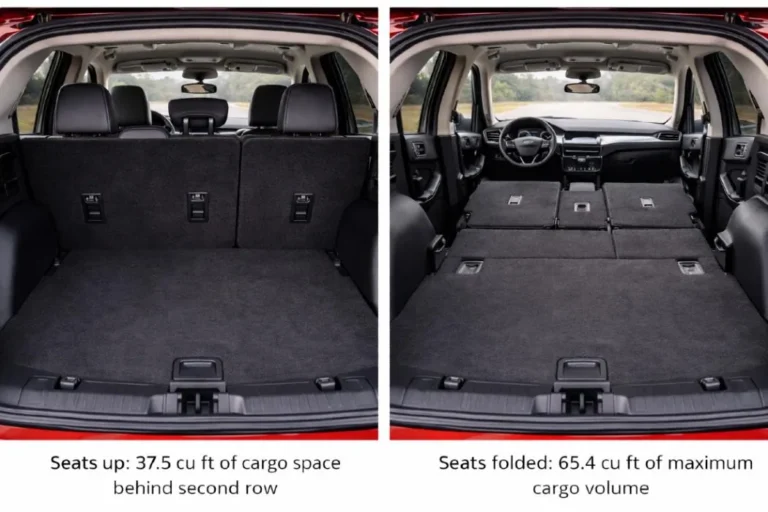
– Cargo Space: 37.5 cubic feet behind rear seats; 65.4 cubic feet maximum
– Towing Capacity: Up to 3,500 lbs (2.0L AWD models)
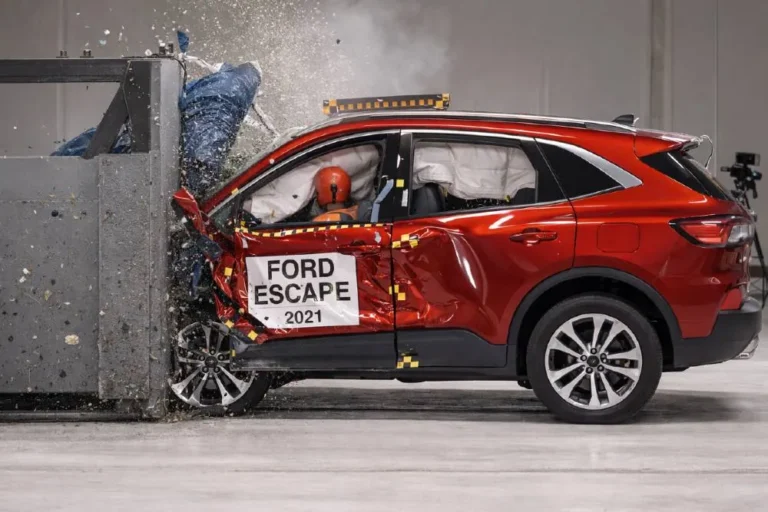
– NHTSA Overall Safety Rating: 5 Stars
– Original MSRP Range: $26,080 (S) to $40,130+ (Titanium PHEV)
– Current Used Value (2026): $17,000 – $30,000 depending on trim, mileage, and recall status
– NHTSA Recalls: 18 total as of March 2026
– Notable Recalls: 1.5L engine fire risk, PHEV battery failure, structural door defects
Sources: Ford Motor Company, NHTSA.gov, Consumer Reports, Cars.com, Kelley Blue Book, Edmunds
The Ford Escape 2021 : A Genuinely Good Compact SUV With Some Things You Need To Know First
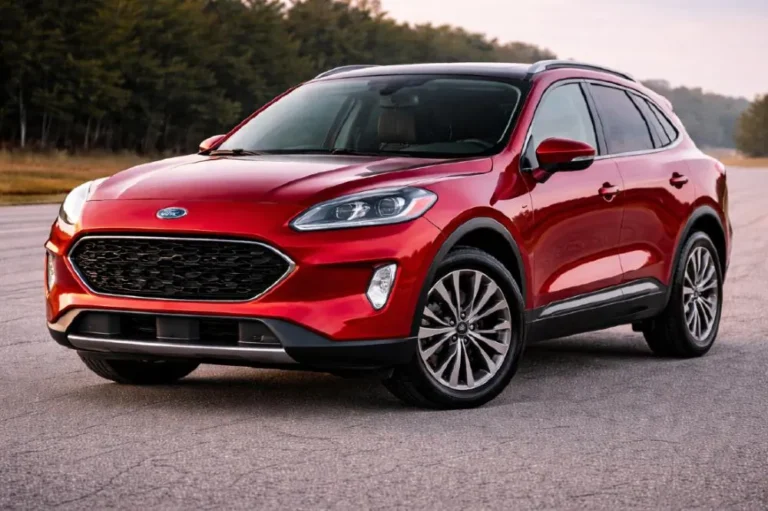
The Ford Escape 2021 is, at its core, a well-designed compact SUV that competes in one of the most competitive segments in the American automotive market. It offers more powertrain variety than almost any of its direct competitors — four engine options including a plug-in hybrid — a comfortable, well-appointed cabin, solid driving dynamics, and a genuine 5-star NHTSA overall safety rating. When it works, it works well.
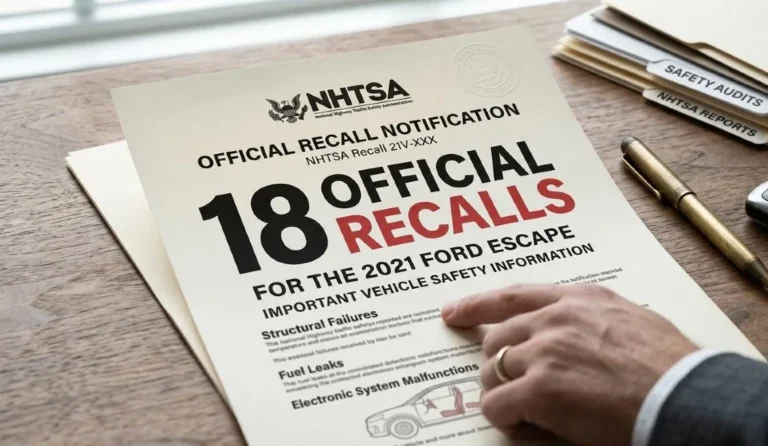
But there is a serious asterisk on that picture, and any honest review of the 2021 Escape written in 2026 has to lead with it rather than bury it. The 2021 Escape has accumulated 18 NHTSA recalls — a number that Consumer Reports, KBB, and Edmunds all flag as significant for a four-year-old vehicle.
Those recalls include fire-risk warnings related to the 1.5-liter engine’s fuel injector, high-voltage battery failure warnings affecting the plug-in hybrid, and structural defects in the door welds that have generated more than 100 owner complaints. These are not recalls about a misaligned badge or a seat belt buckle that sometimes doesn’t click cleanly. They are safety-critical issues that Ford and the NHTSA have formally identified and that require dealer attention.
The good news — and it genuinely is good news — is that most of these recalls are remediable at no cost to the owner at an authorized Ford dealer. Recall repairs are free. The risk is buying a 2021 Escape used without verifying that all applicable recalls have been completed on that specific vehicle. That verification step, which takes about two minutes using the NHTSA VIN lookup tool, is the single most important thing you can do before purchasing any 2021 Escape.
With that context clearly established, here is the complete picture of what the 2021 Ford Escape is, what it offers, what it costs on the used market in 2026, and how to buy one intelligently.
Four Powertrains Explained: Which One Should You Actually Choose?
The 2021 Escape’s powertrain lineup is genuinely unusual for a mainstream compact SUV — four distinct engines across the range, from a turbocharged three-cylinder to a plug-in hybrid system that enables real all-electric daily driving. Each has a distinct ownership profile and a distinct set of considerations for a used buyer in 2026.
The 1.5-Liter EcoBoost Three-Cylinder
– Output: 181 horsepower / 190 lb-ft torque
– Transmission: 8-speed automatic
– Drive Options: FWD standard; AWD available
– Fuel Economy: 27 MPG city / 33 MPG highway / 30 MPG combined (FWD)
– Found in: S, SE, ST-Line, SE Sport, ST-Line Select trims
Ford’s turbocharged 1.5-liter three-cylinder is the engine in the majority of 2021 Escapes sold. Under normal conditions it is a reasonably smooth, adequately powerful engine that delivers 181 horsepower and commendably good fuel economy for a non-hybrid compact SUV. The 8-speed automatic that pairs with it is well-calibrated and shifts smoothly in everyday driving.
However, this engine is the subject of a significant active recall. NHTSA recall 22V859000 — and a related active recall issued in late 2025 — identified that the 1.5-liter EcoBoost’s fuel injectors can crack and leak fuel inside the engine compartment. A fuel leak near hot engine or exhaust components creates a genuine fire risk. Ford issued interim letters to owners in late 2025 and the final remedy was anticipated to become available in early 2026. If you are considering a 2021 Escape with this engine, verifying the recall status of the specific VIN is not optional — it is the first thing you do.
On the positive side, the 1.5-liter in the FWD configuration is the most fuel-efficient non-hybrid in the lineup and the most affordable used option in 2026. Owners who have maintained these engines properly and had all recall work completed generally report acceptable reliability. The problems are concentrated in vehicles where the recall repairs were delayed or not completed.
The 2.0-Liter EcoBoost Four-Cylinder
– Output: 250 horsepower / 280 lb-ft torque
– Transmission: 8-speed automatic
– Drive Options: AWD standard
– Fuel Economy: 23 MPG city / 31 MPG highway / 26 MPG combined
– Towing Capacity: 3,500 lbs
– Found in: SE Sport and ST-Line Elite trims primarily; available as option on higher trims
The 2.0-liter EcoBoost four-cylinder is the performance option in the 2021 Escape lineup — 250 horsepower puts it at the top of the class for non-hybrid compact SUVs, and the 280 lb-ft of torque is immediately noticeable in everyday driving. The 2.0-liter also enables the highest towing capacity in the Escape range at 3,500 pounds, making it the right choice if occasional trailer or small boat towing is part of the use case.
AWD is standard on 2.0-liter models, which adds approximately $1,500 to the original MSRP but provides genuine all-weather traction capability. From a reliability standpoint, the 2.0-liter has a better record in the 2021 Escape than the 1.5-liter — fewer specific recall actions directly targeting this engine in comparison. The trade-off is fuel economy: 26 MPG combined is the bottom of the Escape range, which in a compact SUV feels like a meaningful gap from the hybrid options.
For used buyers in 2026, 2.0-liter models command a premium over 1.5-liter equivalents. That premium is often justified — particularly for buyers who want AWD as standard and genuinely use the towing capacity.
The 2.5-Liter Hybrid
– Output: 200 horsepower (combined system)
– Transmission: eCVT (continuously variable, electric motor integrated)
– Drive Options: FWD standard; AWD available
– Fuel Economy: 44 MPG city / 37 MPG highway / 41 MPG combined (FWD)
– Found in: SE, SEL, Titanium trim levels with hybrid designation
The 2021 Escape Hybrid is powered by a 2.5-liter naturally aspirated four-cylinder working in conjunction with an electric motor — the same fundamental hybrid architecture used in several Ford and Lincoln hybrid products. The eCVT transmission is smooth and well-matched to the hybrid system’s power delivery.
Fuel economy of 41 MPG combined in the FWD configuration is genuinely impressive for a compact SUV of this size — competitive with segment leaders including the Toyota RAV4 Hybrid. Over 15,000 annual miles, the fuel savings versus the 1.5-liter turbo are real and meaningful.
The hybrid system’s track record in the 2021 Escape is reasonable, with far fewer reports of catastrophic failure compared to the PHEV variant below. However, as with all hybrid vehicles, buyers should verify the high-voltage battery health via a Ford dealer diagnostic before purchase. Battery replacement on hybrid systems is the single most expensive repair possible on these vehicles, and knowing the battery’s health status before buying protects you from an unpleasant surprise.
The hybrid also has its own recall to be aware of: NHTSA campaign 23V380 involves the 2.5-liter hybrid and plug-in hybrid engines — specifically related to potential engine oil and fuel vapor release in the event of engine failure that could cause a fire. A software update addresses this on most affected vehicles. Verify completion before buying.
The 2.5-Liter Plug-In Hybrid (PHEV)
– Output: 221 horsepower (combined system)
– Transmission: eCVT
– Drive Options: FWD only
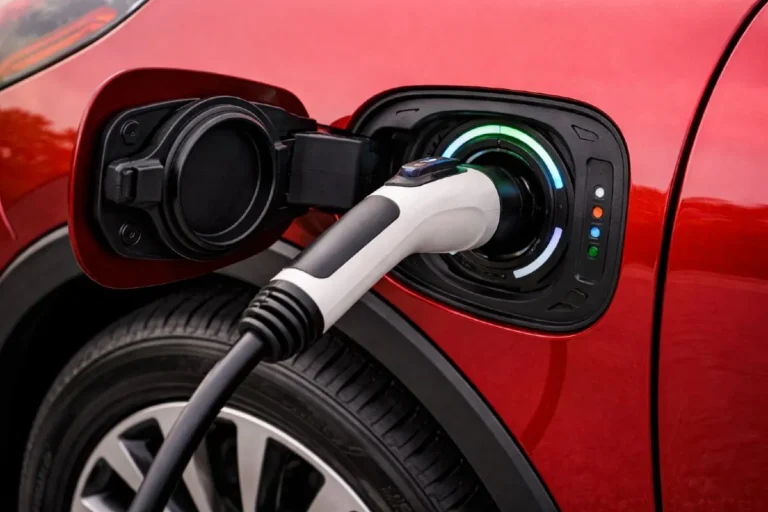
– All-Electric Range: 37 miles (EPA estimated)
– Fuel Economy: 105 MPGe city / 84 MPGe highway (electric); 40 MPG combined (gas only)
– Found in: SE PHEV, SEL PHEV, Titanium PHEV trim levels
– Original MSRP: Starting approximately $36,235 (SE PHEV)
The 2021 Escape PHEV is the most technologically sophisticated and the most problematic variant in the lineup. With 37 miles of EPA-estimated all-electric range, it can cover the average American’s daily commute entirely on electricity — genuinely meaningful for fuel cost reduction and emissions reduction when used as intended and charged regularly.
However, the PHEV is also the variant with the most serious and ongoing recall concerns. Three separate recalls address high-voltage battery failures in 2021 Escape PHEV models. The most recent, issued in late 2025, addresses a manufacturing defect in one or more high-voltage battery cells that can result in an internal short circuit and battery failure — creating risk of both sudden loss of drive power and fire. Ford’s interim guidance instructed PHEV owners to use only Auto EV mode and limit maximum charge until the remedy is completed.
This is not a reason to avoid the PHEV entirely — but it is a reason to verify, with absolute certainty, that all three battery-related recalls have been fully remedied on any specific vehicle before purchase. A PHEV with all recalls completed and a healthy battery is a genuinely capable and economical vehicle. A PHEV with outstanding recalls is a liability.
Every 2021 Ford Escape Trim Level Explained
S — The Base
MSRP: $26,080
Engine: 1.5L EcoBoost
Drive: FWD standard
Key Features: 8-inch SYNC 3 touchscreen, Apple CarPlay, Android Auto, pre-collision assist with auto emergency braking, lane-keeping system, rearview camera, cloth seating, 17-inch alloy wheels
The S is the entry-level 2021 Escape and represents decent value at its original price. The standard inclusion of Ford’s Co-Pilot360 driver assistance suite — automatic emergency braking, lane-keeping, blind-spot monitoring with cross-traffic alert — is a genuine differentiator at the base trim level. The 8-inch SYNC 3 system is genuinely easy to use and responsive compared to the segment competition at the time.
The S does not offer AWD, the 2.0-liter engine, or the hybrid/PHEV powertrains. If your primary need is a reliable, no-frills daily driver at the most affordable entry point, the S with the 1.5-liter — with all recalls completed and verified — is a defensible choice.
SE — The Sweet Spot
– MSRP: $28,655 (gas) / $33,370 (hybrid) / $36,235 (PHEV)
– Engine Options: 1.5L EcoBoost, Hybrid, or PHEV
– Drive: FWD standard; AWD available on gas version
– Additional Over S: Heated front seats, auto-dimming mirror, LED headlights, FordPass Connect Wi-Fi hotspot, power driver’s seat
The SE is where the majority of 2021 Escapes were sold, and for good reason. It adds heated seats, LED headlights, and power driver’s seat over the base S — meaningful comfort additions that most buyers notice daily. The SE is also available with all three powertrain alternatives — the 1.5L gas, the hybrid, and the PHEV — making it the most versatile trim level for buyers prioritizing efficiency.
The SE Hybrid represents one of the best value propositions in the used 2021 Escape lineup for buyers in 2026. It combines the SE’s content level with the hybrid’s 41 MPG combined, meaningful fuel savings, and a powertrain that has proven more reliable in service than the PHEV. Used SE Hybrid examples with manageable mileage are increasingly hard to find, which supports their pricing in the current market.
SEL — The Mid-Grade
– MSRP: $32,745 (gas) / $36,340 (hybrid) / $38,250 (PHEV)
– Engine Options: 1.5L EcoBoost, Hybrid, or PHEV
– Drive: FWD standard; AWD available on gas version
– Additional Over SE: Heated steering wheel, dual-zone automatic climate control, power passenger seat, 8-inch navigation-ready display with SiriusXM, proximity key with push-button start, adaptive cruise control with stop-and-go
The SEL is where the 2021 Escape starts to feel genuinely premium. Dual-zone climate is a quality-of-life upgrade that buyers with passengers notice immediately. Adaptive cruise control with stop-and-go capability is one of the most practically useful driver assistance features available — in highway driving it reduces fatigue meaningfully. Proximity key with push-button start is standard at this level.
For used buyers in 2026, the SEL hits a price point that may feel higher than expected given the used market has softened since 2022 peak pricing, but the feature content justifies the delta over SE on vehicles with comparable mileage.
ST-Line And ST-Line Select — The Sport Appearance Package
– MSRP: $30,560 (ST-Line) / $33,415 (ST-Line Select)
– Engine: 1.5L EcoBoost standard; ST-Line Select adds 2.0L as option
– Drive: FWD or AWD
– Additional Over SE/SEL: Sport-tuned suspension, unique front and rear fascias, 19-inch black alloy wheels, flat-bottom steering wheel, unique interior trim with sport-cloth seating
The ST-Line package gives the 2021 Escape a genuinely sportier visual identity — more aggressive front fascia, black wheel treatment, and sport-tuned suspension that noticeably sharpens the handling compared to standard SE and SEL models. The flat-bottom steering wheel and unique interior trim complete the sport positioning.
Important caveat: the ST-Line’s sport-tuned suspension is firmer than the standard suspension, which some buyers find uncomfortable on rougher roads. Test-drive an ST-Line specifically if ride quality is a priority — the suspension tune is a real difference, not marketing language.
Titanium — The Fully Loaded
– MSRP: $35,170 (gas) / $38,080 (hybrid) / $40,130 (PHEV)
– Engine Options: 1.5L EcoBoost, Hybrid, or PHEV
– Drive: FWD or AWD
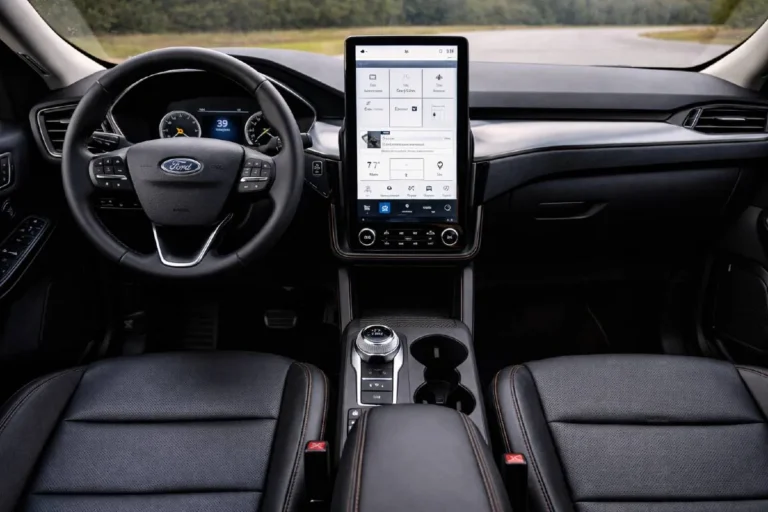
– Additional Over SEL: 12.3-inch digital instrument cluster, 13.2-inch vertical SYNC 4 touchscreen (replaces the 8-inch), wireless Apple CarPlay and Android Auto, Active Park Assist 2.0, panoramic sunroof, ventilated front seats, premium B&O audio system with 10 speakers, massage driver’s seat (on some configurations)
The Titanium is the most complete and most impressive 2021 Escape. The jump from the 8-inch SYNC 3 to the 13.2-inch SYNC 4 vertical touchscreen is dramatic — the larger screen with swipe navigation and improved voice recognition is genuinely more usable, and it makes the Titanium feel more premium than its price point suggests. Ventilated front seats, wireless CarPlay, and the panoramic roof all address real-world quality-of-life considerations.
For used buyers in 2026, Titanium models command meaningful premium over SEL and SE examples — the SYNC 4 upgrade alone is a genuine differentiator, and the overall quality of the interior in Titanium specification represents a noticeably different ownership experience from the base trims.
2021 Ford Escape Full Spec Sheet
– Body Style: 4-door compact crossover SUV
– Platform: Ford CD539 (shared with Lincoln Corsair)
– Wheelbase: 106.7 inches
– Overall Length: 180.5 inches
– Width: 74.6 inches (without mirrors)
– Height: 65.6 inches
-Curb Weight: 3,336 lbs (1.5L FWD) to 3,836 lbs (PHEV)
Engines:
— 1.5L EcoBoost 3-cylinder turbo: 181 hp / 190 lb-ft
— 2.0L EcoBoost 4-cylinder turbo: 250 hp / 280 lb-ft
— 2.5L Atkinson-cycle 4-cylinder hybrid: 200 hp combined
— 2.5L Atkinson-cycle 4-cylinder PHEV: 221 hp combined
Transmissions: 8-speed SelectShift automatic (gas) / eCVT (hybrid and PHEV)
Fuel Economy (EPA):
— 1.5L FWD: 27/33/30 MPG city/hwy/combined
— 1.5L AWD: 26/31/28 MPG
— 2.0L AWD: 23/31/26 MPG
— Hybrid FWD: 44/37/41 MPG
— Hybrid AWD: 43/37/40 MPG
— PHEV FWD: 105/84 MPGe; 40 MPG gas-only combined
Electric Range (PHEV only): 37 miles EPA estimated
Cargo Volume:
— Behind rear seats: 37.5 cubic feet
— Maximum (seats folded): 65.4 cubic feet
— With rear seat slide (standard): adjustable for cargo/passenger balance
Towing:
— 1.5L and Hybrid/PHEV: Up to 1,500 lbs
— 2.0L AWD: Up to 3,500 lbs (with trailer tow package)
Safety Ratings:
— NHTSA Overall: 5 Stars
— IIHS: Acceptable (headlights on lower trims); Good on higher trims with upgraded LED headlights
Standard Safety Features (all trims — Ford Co-Pilot360):
– Pre-Collision Assist with Automatic Emergency Braking, Lane-Keeping System, Auto High-Beam Headlamps, BLIS (Blind Spot Information System) with
Cross-Traffic Alert, Rear View Camera
Available Safety Features:
– Adaptive Cruise Control with Stop-and-Go, Evasive Steering Assist, Active Park Assist 2.0, Reverse Brake Assist
The 2021 Escape earned a 5-star overall rating — you can review the full NHTSA 2021 Ford Escape safety ratings page for the complete breakdown of frontal, side, and rollover test results.
The Honest Reliability Assessment Every 2021 Escape Buyer Needs
This section will not be softened. The 2021 Ford Escape has 18 NHTSA recalls according to Consumer Reports’ recall tracking data. That is a significant number. It represents one of the highest recall totals for a compact SUV in its model year cohort. Every prospective buyer deserves to understand specifically what those recalls cover, which ones are most serious, and what the current status is.
The Five Engine And Fuel System Recalls
Ford issued five separate recalls involving the engine and fuel systems on the 2021 Escape. The first, in August 2021, addressed a leaking fuel delivery module. A March 2022 recall covered the engine leaking oil. A July 2022 recall addressed oil or fuel vapor leaks with fire risk. A November 2022 recall specifically targeted cracked fuel injectors creating fire risk. A May 2023 recall revisited the vapor and fire risk on 2.5L hybrid and PHEV engines.
As of late 2025 and into 2026, additional active recalls continue to address the 1.5L fuel injector fire risk and the PHEV battery failure risk. Ford’s own recall numbers 25SA4, 25SD6, and 25SC4 — issued between October 2025 and January 2026 — remain in active remedy phases. This means some owners are still waiting for parts and final repairs at the time of this publication.
The practical reality: any 2021 Escape with the 1.5L engine or the PHEV powertrain that has not been to a dealer for recall completion in the last six months requires an immediate dealer visit.
The Structural Door Defect
More than 100 NHTSA complaints specifically reference structural problems with the 2021 Escape’s doors — primarily related to faulty welds and door check bracket failures. Reported symptoms include doors that will not stay open, doors that slam shut unexpectedly, hinges that develop excessive play, and in some cases doors that have separated partially from the vehicle body. These are not cosmetic issues. A door that will not stay open or closes unexpectedly while loading passengers or cargo represents a real safety concern.
The door-related structural complaints have generated a recall — NHTSA 25SD6 — covering missing or inadequate liftgate hinge covers, with interim letters sent in January 2026. If you are examining a used 2021 Escape, test every door and the liftgate for proper operation: check that each door holds position when opened, closes with consistent resistance, and shows no play in the hinges. Any unusual behavior warrants a dealer inspection before purchase.
The High-Voltage Battery Recall On PHEV Models
Three separate recalls address potential high-voltage battery failure in 2021 Escape PHEV models. The most serious, involving a manufacturing defect that can cause internal short circuit and fire risk, remained in active remedy status in late 2025. Ford’s interim guidance was for PHEV owners to use only Auto EV mode and limit maximum battery charge until the remedy is completed.
Any 2021 Escape PHEV with an unresolved battery recall should not be purchased until the recall is completed. Verify using the NHTSA VIN lookup tool and confirm at a Ford dealer.
The Brake System Issues
Consumer Reports’ 2021 Escape reliability survey documents premature brake pad and rotor wear, brake pulsation, and squeaking as reported by a meaningful number of owners. A specific recall addressed reduced braking performance related to brake pedal effort requirements. If you are test-driving a 2021 Escape, apply the brakes firmly at moderate speed and feel for pulsation, vibration, or unusually high pedal effort. All are potential indicators of brake system wear or issues that require attention.
What This Means For Buyers In 2026
The recall picture is not a reason to automatically avoid the 2021 Escape. It is a reason to be a fully informed buyer. A 2021 Escape with all recalls properly completed, documented service history, and current inspections is a fundamentally sound vehicle with genuine strengths. A 2021 Escape purchased without recall verification is an avoidable risk that could result in real safety exposure and unexpected out-of-pocket costs.
The two-step recall check process: first, enter the VIN at nhtsa.gov/vehicle to see all open and closed recalls. Second, take the vehicle to a Ford dealer and ask the service department to pull the vehicle’s recall completion history by VIN. Both steps take under 30 minutes and provide complete recall status clarity.
What Is Actually Like To Own
The Driving Experience And Day-To-Day Life With The 2021 Escape
Away from the recall discussion — which is important but does not define the entire ownership experience — the 2021 Escape has genuine qualities that made it a competitive compact SUV in its segment at launch and that continue to make well-maintained examples appealing in 2026.
Driving Character
The 2021 Escape is a significantly more car-like driving experience than the previous generation. The CD539 platform — shared with the Lincoln Corsair — provides a composed, well-damped ride that absorbs road imperfections without the floaty disconnected feel of some compact crossover competitors. Steering is well-weighted and predictable. Body roll in corners is modest. The overall driving dynamic is closer to a well-sorted family sedan than to a traditional truck-based SUV.
The 2.0-liter EcoBoost version is genuinely quick — 250 horsepower and 280 lb-ft of torque produce meaningful performance that makes highway merging and passing confident and unhurried. The 1.5-liter is adequate rather than exciting, but its fuel economy return makes the compromise acceptable for most daily-driving use cases.
The hybrid’s eCVT takes some adjustment if you are accustomed to traditional automatic transmissions — the rubber-band sensation of CVT acceleration is present but less pronounced than in competitors. After a day or two it becomes unremarkable background noise.
Interior Quality And Space
The 2021 Escape’s interior is one of its strongest competitive arguments. Material quality on SE and above is noticeably better than the segment average — soft-touch surfaces appear where hands rest, the dashboard design is clean and well-organized, and panel gaps are tight. The Titanium’s upgrade to the 13.2-inch SYNC 4 vertical touchscreen transforms the experience further — it is one of the best infotainment implementations in the compact SUV segment for its model year.
Rear seat space is adequate rather than generous — the 2021 Escape’s wheelbase does not provide the rear legroom of some larger competitors, and taller rear passengers will notice the compromise on longer trips. The sliding rear seat — standard on most 2021 Escape trims — allows adjustment between rear passenger legroom and cargo capacity, which is a practical and genuinely useful feature for families with varied needs.
Cargo capacity behind the rear seats is 37.5 cubic feet — a competitive figure for the class. With rear seats folded, the 65.4 cubic feet of maximum cargo volume is among the larger in the segment and handles full flat-pack furniture boxes, camping gear, and large luggage sets without complaint.
Fuel Economy In Real-World Use
The hybrid’s real-world fuel economy typically comes in close to the EPA estimate. Owners regularly report 38 to 42 MPG in mixed driving, which is an excellent return from a five-passenger compact SUV. Highway driving at sustained speeds above 75 MPH reduces the advantage, as the electric motor contributes less at highway speeds — expect 36 to 38 MPG on pure highway runs.
The PHEV’s real-world performance depends almost entirely on how it is used. For drivers with regular home or workplace charging who commute under 37 miles, the PHEV can cover nearly all daily driving on electricity — delivering effective real-world energy costs equivalent to 80 to 100 MPGe. For drivers who rarely charge and run primarily on the gasoline engine, the PHEV’s additional weight reduces efficiency below the standard hybrid. The PHEV rewards planning and charging access. Without those, it is a complicated way to get 40 MPG.
What A 2021 Ford Escape Is Worth In 2026
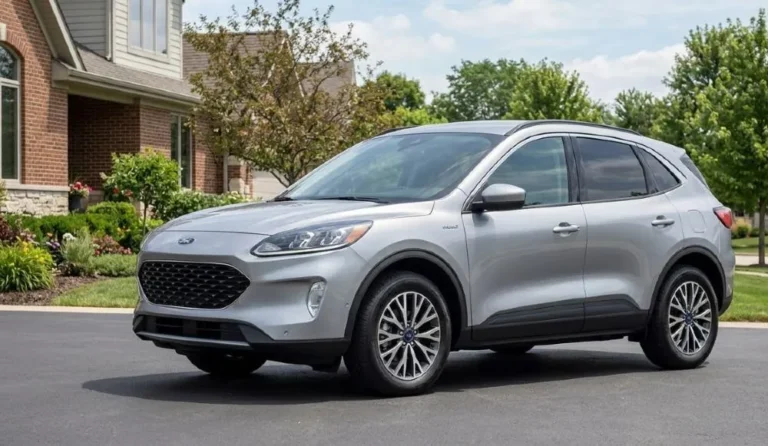
Used car values have normalized significantly from the 2021 to 2022 peak. The 2021 Escape sits in a competitive used market where its recall history applies downward pressure on pricing, particularly for PHEV and 1.5L models, while clean Hybrid examples and well-maintained 2.0L AWD trucks hold value more firmly.
Here are realistic current price ranges for Ford Escape 2021 in the U.S. used market as of early 2026, based on Edmunds and KBB data.
– S (1.5L FWD): $17,000 – $20,500
– SE (1.5L FWD): $18,500 – $22,000
– SE (1.5L AWD): $20,000 – $23,500
– SE Sport (2.0L AWD): $22,000 – $26,500
– ST-Line / ST-Line Select: $21,000 – $25,500
– SEL (1.5L): $22,000 – $25,500
– SE Hybrid (FWD): $22,500 – $27,000
– SE Hybrid (AWD): $24,000 – $28,500
– SEL Hybrid: $25,000 – $29,500
– Titanium (gas): $26,000 – $30,000
– Titanium Hybrid: $27,000 – $31,500
– SE PHEV: $23,000 – $28,500 (recall-status dependent — significant value variance)
– Titanium PHEV: $27,000 – $33,000 (recall-status dependent)
PHEV pricing note: The high-voltage battery recall situation has created meaningful price dispersion in the PHEV segment. A PHEV with all recalls completed and a battery health report from Ford showing healthy cell condition may price toward the top of its range. A PHEV with unresolved recalls or uncertain battery health should price at or below the bottom of the range, because the battery replacement cost — if needed — runs $8,000 to $15,000 depending on configuration.
How To Buy A 2021 Ford Escape In 2026 Without Regrets
These six steps, taken in order, dramatically reduce the risk of buying a 2021 Escape that causes problems. Skip any of them and you are accepting an avoidable risk.
Step 1: Run The VIN On NHTSA.gov Before You See The Car
Before you schedule a test drive or visit a dealer, enter the vehicle’s VIN at nhtsa.gov/vehicle. This shows every recall applicable to that specific vehicle and which ones have been completed versus which remain open. If multiple safety recalls show as open — particularly the 1.5L fuel injector recall or the PHEV battery recall — factor in the time required to get those remedied before the vehicle can safely be used.
Step 2: Request The Recall Completion History At A Ford Dealer
A Ford dealer’s service system can pull the complete recall completion history for any Ford VIN. This is more detailed than the NHTSA tool — it shows the specific date each recall was remedied and which dealer performed the work. Ask the seller to provide this, or take the vehicle to a Ford dealer service lane as part of your pre-purchase inspection.
Step 3: Have A Pre-Purchase Inspection Done By A Ford Specialist
A pre-purchase inspection from a technician familiar with the 2021 Escape’s known issues — particularly the brake system, the door structure, the cooling system on hybrid variants, and the engine mounts — is essential for any purchase above $20,000. This inspection typically costs $100 to $150 and is consistently the best money spent in any used vehicle purchase process.
If the pre-purchase inspection reveals paint damage, fading, or bodywork issues on the vehicle you are considering, understand what addressing those costs before they affect your total budget — our guide to how much it costs to paint a car in 2026 breaks down every price tier from a single panel to a full respray.
Step 4: Test Every Door And The Liftgate Thoroughly
Given the documented structural door complaints, test each door individually: open it fully, let go, and confirm it holds position. Open and close it several times and feel for any play in the hinges or inconsistency in resistance. Do the same for the liftgate. Any door that will not hold open, shows hinge play, or closes with unusual resistance requires investigation before purchase.
Step 5: On PHEV Models, Request A Battery Health Report
For any PHEV purchase, ask the selling dealer or take the vehicle to a Ford service department for a high-voltage battery diagnostic report. The report shows individual cell health, overall state of charge capacity, and any fault codes stored in the battery management system. A healthy battery will show balanced cell voltages and state-of-health above 80%. An unhealthy battery is an expensive problem.
Step 6: Verify The Complete Service History
Consistent oil change and maintenance records — particularly fluid services and any recall-related dealer visits — are the most reliable indicator of how well a 2021 Escape has been cared for. Missing service records on a four-year-old vehicle are a genuine yellow flag, not because gaps are always consequential but because they remove information you need to make an informed decision.
Before committing to any used vehicle purchase, it pays to understand the full cost picture — including the fact that a compact SUV with an active recall history can affect your insurance premium. Our breakdown of car insurance cost in the USA in 2026 gives you the complete framework for estimating what coverage will actually run on a vehicle in this price range.
FAQ
Q: Is the 2021 Ford Escape a good used car to buy in 2026?
A: The 2021 Ford Escape can be a good used car to buy in 2026 — with the right approach. It offers a well-designed interior, genuine fuel economy across all four powertrain options, a 5-star NHTSA crash test rating, and a driving experience that compares favorably against segment competitors. However, it has accumulated 18 NHTSA recalls as of March 2026, including fire-risk warnings on the 1.5L engine and high-voltage battery failure warnings on the PHEV. A 2021 Escape with all recalls completed and a documented service history is a sound purchase. One without recall verification is an avoidable risk.
Q: What are the most common problems with the 2021 Ford Escape?
A: The most frequently reported problems with the 2021 Ford Escape are structural door defects (faulty welds and door brackets causing doors that will not stay open), fuel system issues including cracked injectors and vapor leaks on 1.5L and 2.5L engines, high-voltage battery failure on PHEV models, brake system complaints including premature wear and pulsation, and transmission issues reported at higher mileages on 2.0L models. Most of these have formal NHTSA recalls associated with them.
Q: How many recalls does the 2021 Ford Escape have?
A: The 2021 Ford Escape has been recalled 18 times by NHTSA as of March 2026 according to Consumer Reports’ recall tracking. This includes five engine and fuel system recalls, three high-voltage battery recalls affecting PHEV models, and additional recalls covering the electrical system, structural door issues, and brake system. New recalls were issued as recently as January 2026. Check the specific VIN at nhtsa.gov to determine which recalls apply to any individual vehicle.
Q: What is the fuel economy of the 2021 Ford Escape?
A: Fuel economy varies by powertrain. The 1.5-liter EcoBoost in FWD configuration achieves 30 MPG combined. The 2.0-liter EcoBoost AWD achieves 26 MPG combined. The hybrid achieves 41 MPG combined in FWD specification. The plug-in hybrid achieves the equivalent of 105 MPGe city in electric-only mode and 40 MPG combined on gasoline. The hybrid is the most efficient non-plugin choice in the range and represents an excellent long-term fuel economy proposition for daily commuters.
Q: Which 2021 Ford Escape trim level offers the best value in 2026?
A: For most buyers in 2026, the SE Hybrid represents the best value in the 2021 Escape lineup. It combines the SE’s reasonable feature content — heated seats, LED headlights, power driver’s seat — with the hybrid’s 41 MPG combined efficiency and the more favorable reliability profile of the hybrid system compared to the PHEV. Used SE Hybrid examples in the $23,000 to $27,000 range with verified recall completion and a documented service history are consistently the best combination of price, features, and ownership confidence.
Q: What is the difference between the 2021 Ford Escape Hybrid and PHEV?
A: The 2021 Escape Hybrid uses a 2.5-liter naturally aspirated engine with an integrated electric motor, no external charging required, and achieves 41 MPG combined. It has no all-electric driving range. The PHEV adds a larger battery pack that enables 37 miles of all-electric driving on a charge and can be plugged into household current or a Level 2 charger. The PHEV is more expensive, significantly heavier, and has experienced more serious recall issues — particularly battery-related. The Hybrid is the more reliable and less complex option for buyers who do not specifically need plug-in capability.
Q: How much is a 2021 Ford Escape worth in 2026?
A: Used 2021 Ford Escape values in early 2026 range from approximately $17,000 for base S models with higher mileage to $31,500 for well-maintained Titanium Hybrid examples with comprehensive service history. PHEV values vary more widely depending on recall completion status and battery health — from $23,000 to $33,000. The 2.0L AWD SE Sport sits in the $22,000 to $26,500 range. All values assume reasonable mileage of 40,000 to 75,000 miles and are subject to regional market variation.
Q: Does the 2021 Ford Escape have Apple CarPlay?
A: Yes. Apple CarPlay is standard on every 2021 Ford Escape trim level, including the base S, through the Ford SYNC 3 system on most trims. The Titanium trim receives the upgraded SYNC 4 system with a 13.2-inch vertical touchscreen and wireless Apple CarPlay and Android Auto — meaning no cable required on Titanium. Lower trims require a USB cable connection for CarPlay functionality.
Bottom Line
The 2021 Ford Escape is a better compact SUV than its recall tally suggests — and a more complicated purchase than its attractive price suggests. Those two things are both true simultaneously, and understanding them both is how you buy one intelligently.
The 2021 Escape’s genuine strengths are real: a car-like driving experience on a well-sorted platform, four powertrain choices including a genuinely capable hybrid that achieves 41 MPG without any charging infrastructure requirement, an interior that punches above its price class at SE and above, and a standard driver assistance suite that was ahead of the segment at launch.
The recall situation is equally real, and it demands respect rather than dismissal. Eighteen recalls in four years is a significant number. The fire-risk recalls on the 1.5-liter engine and the battery failure recalls on the PHEV are not minor inconveniences — they are safety-critical issues that Ford has formally acknowledged require remediation.
The right conclusion is not “avoid the 2021 Escape” — it’s “buy the 2021 Escape correctly.” Run the VIN on NHTSA before you engage with the seller. Verify recall completion with a Ford dealer. Have a specialist inspect the doors, brakes, and powertrain. And if you are buying a PHEV, get the battery health report. Do all of that, and you are buying a capable, well-featured, efficient compact SUV at a used car price that represents genuine value in 2026.
The 2021 Escape SE with the hybrid powertrain is also worth considering for families with new drivers — though if a teenager is the primary driver, our guide to the best first cars for teenagers in 2026 covers specifically why smaller, lower-powered vehicles are a safer starting point
Skip those steps, and you are accepting risks that are easy to avoid.
Editorial Note
This article was written and reviewed in March 2026. All specifications are sourced from Ford Motor Company official documentation, the NHTSA vehicle database, Consumer Reports reliability surveys, and Edmunds and Kelley Blue Book used car pricing data. Recall information is current as of March 2026 — new recalls may be issued after this publication date.
Always verify the current recall status of any specific vehicle by entering its VIN at nhtsa.gov/vehicle before purchase. Pricing ranges are estimates based on current U.S. market data and vary by region, mileage, condition, and specific trim configuration. This article does not constitute legal or financial advice regarding any specific vehicle purchase.

0 Comments