Last Updated: August 2, 2026 | Read Time: 9 minutes
The 2026 Chevrolet Traverse starts at $40,800 and tops out at $57,295. Every version uses the same 2.5-liter turbocharged four-cylinder producing 328 horsepower and 326 lb-ft of torque. Every version gets a 17.7-inch touchscreen standard — the largest in the midsize three-row SUV class. Every version offers up to 98 cubic feet of maximum cargo space — also best-in-class.
Super Cruise hands-free driving is standard on the RS and High Country and available on the LT and Z71. The third row has a genuinely usable 32 inches of legroom. The engine sounds rough when pushed. The infotainment screen is large but its icon layout overwhelms. The high trims have hard plastics that do not match their prices. All of that is accurate, and this guide tells you all of it.
Quick Facts – 2026 Chevrolet Traverse
— Engine: 2.5-liter turbocharged I4 — standard across all four trims
— Output: 328 HP / 326 lb-ft torque
— Transmission: 8-speed automatic — all trims
— Drivetrain: FWD standard (LT, RS, High Country) / AWD optional +$2,000 / Z71 AWD standard
— Z71 AWD System: Twin-clutch with auto-locking rear differential — exclusive to Z71
— Seating: 7 standard (captain’s chairs) / 8 optional (LT bench seat only)
— Wheelbase: 121 inches
— Overall Length: 204.5 to 204.7 inches (Z71 slightly longer)
— Third-Row Legroom: 32 inches
— Cargo Behind 3rd Row: 22.9 cubic feet
— Cargo Behind 2nd Row: 56.6 cubic feet
— Max Cargo (all rows folded): 98 cubic feet — best in class
— Towing Capacity: 5,000 lbs when properly equipped — all trims
— Fuel Economy (FWD): 20 city / 27 hwy / 23 combined (EPA estimated)
— Fuel Economy (AWD): 20 city / 24 hwy / 21 combined (EPA estimated)
— Fuel Required: Regular 87 octane
Four Trim Levels and Starting MSRPs (before $1,995 destination):
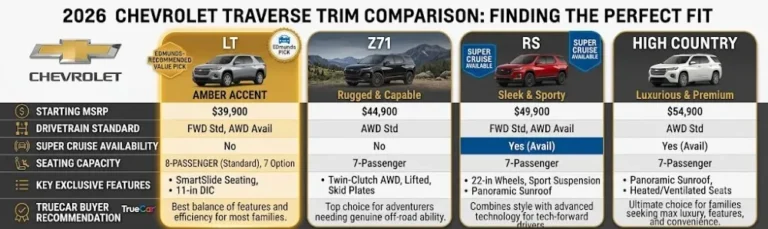
— LT: $40,800 (FWD standard, AWD +$2,000, 7- or 8-passenger)
— Z71: ~$44,800 (AWD standard, off-road tuned, 7-passenger only)
— RS: ~$48,800 (FWD standard, AWD +$2,000, Super Cruise standard, 7-passenger)
— High Country: $57,295 (FWD standard, AWD +$2,000, Super Cruise standard, Bose audio, 7-passenger)
— Standard on All Trims: 17.7-inch touchscreen, 11-inch digital cluster, wireless CarPlay/Android Auto, wireless charging, Google Built-in, Chevy Safety Assist, tri-zone climate, LED headlamps, AutoSense power liftgate
— Super Cruise: Standard on RS and High Country / Available on LT and Z71 via Enhanced Driving Package
— Safety: 2025 Traverse earned IIHS Top Safety Pick — 2026 did not qualify under updated IIHS criteria; NHTSA 5-star overall remains
— Best Trim (Edmunds): LT — best value with available packages
— Best Trim (TrueCar): LT AWD (value), Z71 (winter/trail), RS (tech/highway), High Country (long-haul comfort)
— Competition: Kia Telluride, Hyundai Palisade, Ford Explorer, Toyota Highlander, Mazda CX-90
Sources: Edmunds (June 2026), TrueCar (Feb 2026), CarsDirect (Aug 2025), US News (Mar 2026), The Car Connection (Mar 2026), Riverside Chevrolet (May 2026), Chevrolet.com (official, May 2026)
Overview
The Family SUV That Gets Space Right — And A Few Other Things Right Too
The midsize three-row SUV market is the most contested segment in the American automotive landscape. The Kia Telluride wins comparison tests. The Hyundai Palisade wins interior quality evaluations. The Ford Explorer wins for buyers who want a recognizable American name. The Toyota Highlander wins for buyers who prioritize long-term reliability. The Mazda CX-90 wins for buyers who care most about refinement and driving dynamics. Every one of those wins is legitimate.
The 2026 Chevrolet Traverse wins on space. It wins on screen size. It wins on how well those spaces are organized for the actual use cases that three-row family SUV buyers face most consistently — the Costco run, the youth soccer carpool, the weekend camping trip, the highway road trip where children in the back need their own entertainment and the adults in front want the drive to be less tiring. On those specific dimensions, the Traverse does more than any competitor at its price point.
The 2026 Traverse is in a polish year after the significant 2024 redesign and the 2025 addition of the High Country trim. Chevrolet kept the 2025 redesign rolling with light packaging tweaks for 2026. The same 2.5-liter turbo, the same four-trim ladder — LT, Z71, RS, and High Country — and the same headline technology of the 17.7-inch standard screen and available Super Cruise. What improved for 2026 is the packaging refinement that comes from a third year on a generation: the standard equipment lists are better organized, the available packages are more logically priced, and the specific features that caused the most buyer confusion in the first two years have been streamlined.
The core proposition: if you need a three-row SUV that actually seats seven adults without forcing the third-row passengers to apologize for being there, provides more cargo space than any competitor when you need it, gives you a massive standard technology screen, and starts below $41,000 for a well-equipped base trim, the Traverse is the specific answer to that specific set of requirements. Whether those are your specific requirements is what this guide helps you determine.
The Traverse’s $40,800 to $57,295 MSRP range spans a meaningful spread that produces correspondingly different insurance costs — our guide to car insurance cost in the USA in 2026 covers how three-row SUV classification, vehicle value, and safety rating affect what American families pay annually, completing the total ownership cost calculation for any Traverse trim decision.
Section 1 – The Engine And Powertrain
328 Horsepower From A Turbo-Four — More Power Than The Old V6, Different Character
The previous-generation Chevrolet Traverse used a 310-horsepower V6. The 2026 generation uses a 328-horsepower turbocharged 2.5-liter inline-four. The math is simple: the new engine makes more power with better fuel economy. The experience is more complicated.
The 2.5-liter turbocharged four-cylinder engine is energetic and delivers strong acceleration in normal driving conditions. The engine’s 326 lb-ft of torque arrives in the midrange and provides confident merging and passing capability on highway driving that most families will find adequate. The 8-speed automatic transmission manages the power delivery smoothly in the vast majority of everyday driving situations. One owner of an RS reviewed it this way: Our 2026 Traverse RS is excellent, indeed. Not perfect, however. The only complaint we have thus far is the engine is just slightly less powerful than what we’re used to in a Traverse. Maybe about 10% less power than past engines. Enough to notice. Good news is better mileage.
The fuel economy improvement is real and meaningful. The FWD Traverse achieves 20 city, 27 highway, and 23 combined — an estimate that matches or exceeds what the previous V6 achieved with less horsepower. The AWD version achieves 20 city, 24 highway, and 21 combined. For a three-row SUV carrying a family and their gear, the fuel efficiency represents tangible annual cost savings relative to the previous generation.
The specific trade-off is engine sound. While the turbo-four is energetic and delivers strong acceleration, it sounds rough and strained when pushed, detracting from the otherwise serene cabin. This is The Car Connection’s specific language from their March 2026 evaluation, and it reflects the consistent note across multiple independent reviews.
When the driver demands maximum acceleration — highway passing, steep on-ramp merging, aggressive lane changes — the engine communicates its effort audibly in a way that a V6’s additional displacement and cylinder count naturally smooths. For the large majority of Traverse buyers whose driving involves suburban commuting, school runs, and highway cruising rather than performance driving, the engine sound under push is an occasional awareness. For buyers who prioritize refinement above all other characteristics, the Kia Telluride’s V6 and the Mazda CX-90’s turbocharged inline-six offer different acoustic experiences.
The AWD system varies by trim in a way that matters for buyers who need true all-weather performance. The LT, RS, and High Country offer conventional AWD as a $2,000 option. The Z71 gets an exclusive twin-clutch AWD system with an auto-locking rear differential that independently controls torque to each rear wheel based on road conditions — a more sophisticated AWD architecture than the non-Z71 trims receive.
The Z71 AWD has selectable terrain modes for snow, sand, and off-road — calibrations that the other trims’ conventional AWD system does not provide. Buyers in climates with serious winter conditions should evaluate whether the Z71’s standard twin-clutch AWD is worth the Z71’s other trade-offs before selecting the conventional AWD upgrade on a lower trim.
Section 2 – The Four Trims
From $40,800 To $57,295 — What Each Version Actually Provides
The four trim levels of the 2026 Traverse address four distinct buyer profiles rather than simply adding content incrementally. Understanding which profile matches your specific use case is the most important single decision in any Traverse purchase.
LT ($40,800) — The Value Win
The base 2026 Chevrolet Traverse LT is the strongest value option in the lineup. It comes well-equipped with standard equipment and shares the same engine as higher trims. With a few major packages, shoppers can get the same high-tech features found on higher trims, making the LT feel just as advanced.
The LT’s standard equipment list is genuinely impressive for $40,800: the 17.7-inch touchscreen with Google Built-in, the 11-inch digital cluster, wireless Apple CarPlay and Android Auto, wireless phone charging, six USB ports, tri-zone climate control, heated front seats, LED headlamps, AutoSense Power Liftgate, and the full Chevy Safety Assist active safety suite. The trailer package is also standard on the LT, including a heavy-duty cooling system, hitch guidance with a hitch view, a factory-installed hitch with hitch cover, and a 220-amp alternator.
The LT is the only trim that offers the optional second-row bench seat — for families of eight who need maximum passenger capacity, the LT is the only choice in the Traverse lineup. The eight-passenger configuration requires the bench seat option.
Available packages on the LT make it possible to add Super Cruise through the Enhanced Driving Package (priced at $5,160 bundled with other packages) and a panoramic sunroof through available options — features that other reviews correctly note can bring an LT’s total cost close to the RS without the RS’s standard inclusion. Edmunds recommends the LT for most everyday buyers, and that recommendation is grounded in the observation that the packages most buyers actually want can be added to the LT without stepping to the RS, where the additional content does not always justify the price jump.
Z71 (~$44,800) — The All-Weather, Off-Road Choice
The Z71 is the adventure-focused Traverse — differentiated from the LT primarily by its standard twin-clutch AWD system and its off-road styling and suspension package rather than by luxury content.
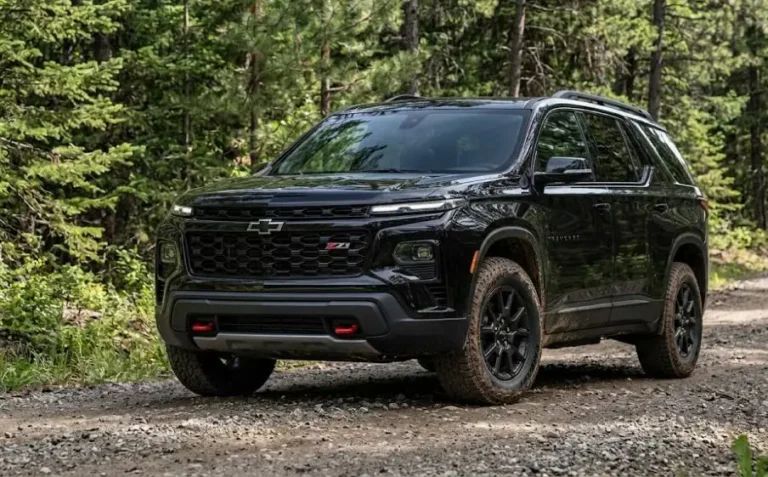
The Z71 adds a gloss black grille, black roof-mounted rails, red tow hooks, all-terrain tires, 18-inch black wheels, hill-descent control, and the exclusive twin-clutch AWD system. The off-road suspension tune gives the Z71 a slightly different ride character than the other trims — it is more composed on rougher surfaces and marginally firmer on smooth pavement. Edmunds noted that the Z71 has poor ride quality as one of its specific trade-offs versus the more comfort-focused trims.
The Z71 is the right choice for buyers in the snow belt — the Great Lakes, the Upper Midwest, Mountain West states — where standard AWD is necessary rather than optional and where the twin-clutch system’s terrain mode calibration provides genuine all-season confidence. It is also the choice for buyers who occasionally take gravel or dirt roads to trailheads and campsites without needing dedicated off-road hardware.
The Z71 does not offer the Super Cruise Enhanced Driving Package at the same price transparency as the LT — factor this in if hands-free highway driving is a priority, as the RS offers it as standard content at its price point.
RS (~$48,800) — Sport Style, Super Cruise Standard, Best Highway Trim
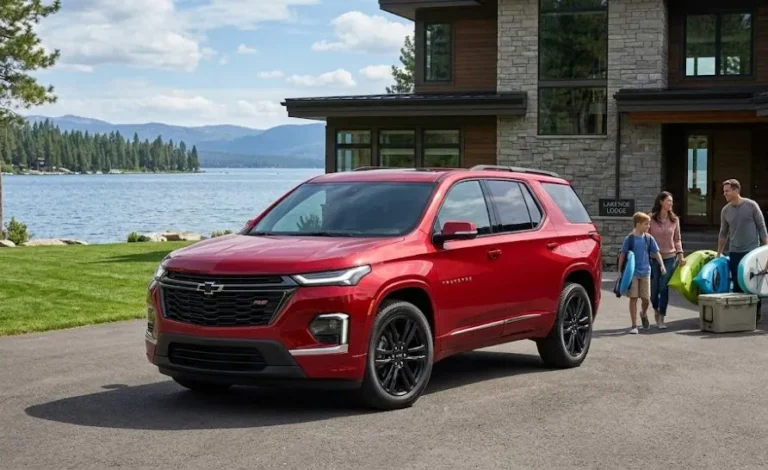
The RS is the Traverse that most appeals to buyers who prioritize driving experience and technology over off-road capability or maximum luxury. Its specific styling differentiators — 22-inch high-gloss black alloy wheels, a sporty black grille, black exterior trim, panoramic dual-glass sunroof with a power sunshade, and black leather upholstery with red accents — give it the most visually distinctive appearance in the Traverse lineup.
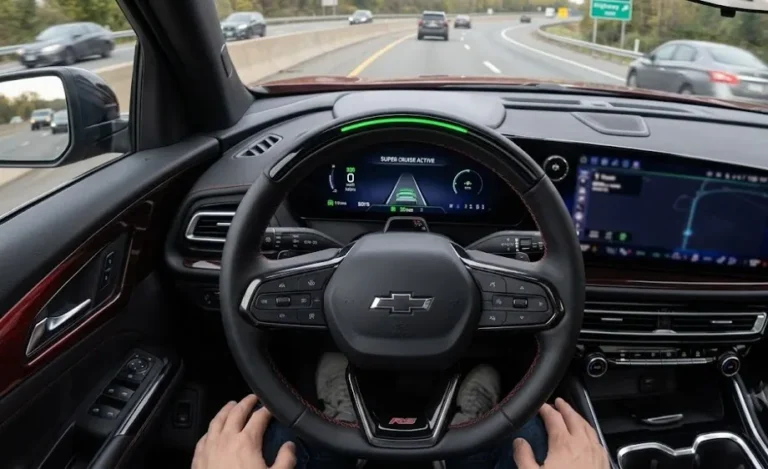
Most importantly for many buyers: Super Cruise is standard on the RS. The Enhanced Driving Package that makes Super Cruise available on the LT and Z71 is bundled into the RS’s standard content, making the RS the most straightforward way to get hands-free highway capability in the Traverse lineup without the highest-priced High Country. RS pairs bold street style with impressive versatility, and the pick for buyers who want the look and hands-free highway driving.
The RS is exclusively seven-passenger with captain’s chairs — the second-row bench option is not available. The 22-inch wheels, while visually striking, produce a slightly firmer ride than the Z71 and LT’s smaller wheel diameters.
Super Cruise on more than 585,000 miles of compatible roads is the RS’s headline capability. For families who take regular long highway drives — summer road trips, holiday travel, regular interstate commutes — Super Cruise’s hands-free capability genuinely changes the experience in a way that distinguishes the RS from the LT more meaningfully than the exterior styling differences alone.
High Country ($57,295) — The Long-Haul Comfort Flagship
The High Country is the Traverse for buyers who want the most refined daily experience and the most complete standard feature list. At $57,295 before destination and AWD, it is priced $16,495 above the LT — a premium that the Kia Telluride and Hyundai Palisade challenge directly at comparable price points with more premium interior material quality.
The High Country adds: a Bose 10-speaker audio system, driver and passenger ventilated seats, heated rear seats, walk-up/exit animation, sequential and swipe turn signals, one-touch flat-folding second row, power-folding third row, ambient lighting, and leather-appointed seats with two new interior color options. Super Cruise is standard.
Edmunds’ concern with the High Country is specific: the High Country isn’t as luxurious as rivals. At $57,295 and above, the Traverse High Country is in direct competition with the Hyundai Palisade Calligraphy and the Kia Telluride SX Prestige — both of which offer interior material quality and refinement that the High Country’s build quality does not consistently match. The rattle complaint that Edmunds documented during their High Country test — more rattles than we could count — is the specific build quality concern that buyers cross-shopping the High Country against Korean competitors need to evaluate honestly during a test drive.
High Country is the pick if you crave the calmest long-distance cruiser in the Traverse lineup. That TrueCar characterization is accurate — the Bose audio, ventilated seats, Super Cruise standard, and overall refinement intent make the High Country the best Traverse for long highway trips. The question is whether $57,295 is the right price for that experience versus what the Telluride SX Prestige provides at a comparable figure.
Section 3 – Technology
The 17.7-Inch Screen That Impresses On Size And Complicates On Interface
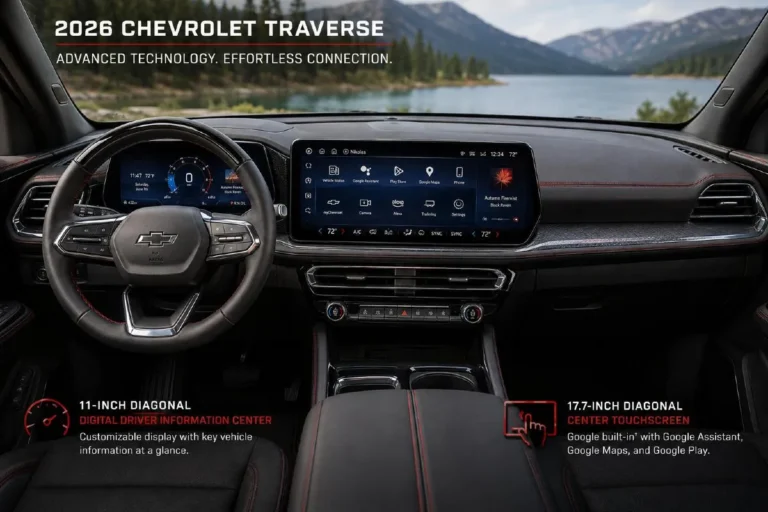
The 2026 Chevrolet Traverse’s technology foundation is one of its strongest competitive attributes and one of its most honestly mixed points. The 17.7-inch center touchscreen is the largest standard infotainment display in any midsize three-row SUV — bigger than what the Telluride, Palisade, Explorer, or Highlander offer at comparable prices. The 11-inch digital Driver Information Center provides the driver with clear, customizable instrument data in the direct sightline. Both are standard across all four trims.
The screen’s Google Built-in integration provides the most intuitive voice command experience in the segment — Google Maps, Google Play, and the Google Gemini AI assistant are available without requiring a connected phone. Wireless Apple CarPlay and Android Auto are also standard. Over-the-air software updates keep the system current without dealership visits. A Wi-Fi hotspot and wireless phone charging are standard across all trims. Six USB ports serve all three rows simultaneously.
The honest counterpoint: the infotainment system, despite its enormous display, overwhelms with tiny icons and a cluttered layout, making everyday interactions more difficult than they should be. That Car Connection assessment from March 2026 is the consistent editorial concern about the Traverse’s infotainment — the screen’s size advantage is partially offset by the icon-based interface that requires learning before it feels intuitive. First-time Traverse owners consistently report a brief familiarization period before the system’s large screen becomes an asset rather than a puzzle.
Super Cruise is the technology that generates the most significant practical impact for families who take regular highway trips. Hands-free driving on over 585,000 miles of compatible roads in the US and Canada — with a driver attention monitor that ensures the driver remains attentive without requiring constant hand contact with the wheel — changes long highway driving in a specific and meaningful way. Three years of Super Cruise service are included with new purchase. Buyers who have used competing hands-free systems consistently report that Super Cruise is among the most mature and most confident implementations available on any vehicle at any price, and having it available at the Traverse’s price point is a genuine competitive advantage.
Super Cruise in the 2026 Traverse is the same hands-free highway driving system that Cadillac builds into the Escalade-V as a standard feature — a technology that arrives in the Traverse starting at $40,800 rather than the Escalade-V’s $170,000+. Our complete Cadillac Escalade-V guide covers how Super Cruise performs in a full-size luxury SUV context and provides the most detailed available explanation of the system’s operational design.
Chevy Safety Assist is the active safety package standard on all trims. It includes automatic emergency braking with pedestrian and cyclist detection, forward collision warning, lane keep assist, lane departure warning, automatic high beams, adaptive cruise control, rear cross-traffic alert, and blind-spot monitoring. The Driver Confidence Package adds a surround-view camera system, a rear-camera mirror, and rear pedestrian alert for $1,225 on the LT and Z71.
Section 4 – Interior, Cargo, And Everyday Livability
Where The Traverse Actually Wins — 98 Cubic Feet And A Third Row That Adults Use
The 2026 Chevrolet Traverse’s most defensible competitive advantages are its interior dimensions. Cabin and cargo space are among the roomiest in the segment, with thoughtful storage and flexible seating for up to eight. That Car Connection assessment is accurate and worth unpacking specifically because these dimensions drive the day-to-day ownership experience more directly than any powertrain or technology specification.
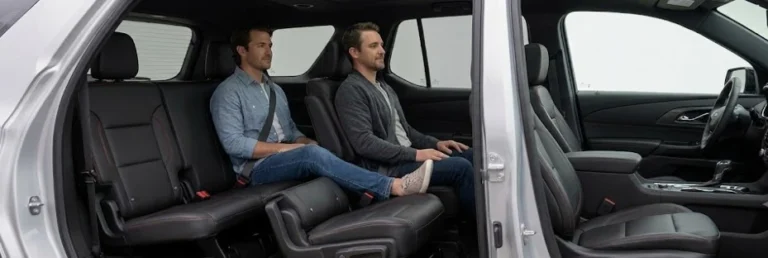
The third row is the specific measurement that matters most to families who regularly carry more than five passengers. The Traverse provides 32 inches of third-row legroom — enough for most adults to sit without their knees against the second-row seatback, and enough for teenagers to be comfortable on trips of typical length without the constant request to fold the seat and let me out. In competing SUVs where the third row is technically present but practically unusable by adults, the Traverse’s 32 inches changes the calculus of whether to seat seven or leave people behind.
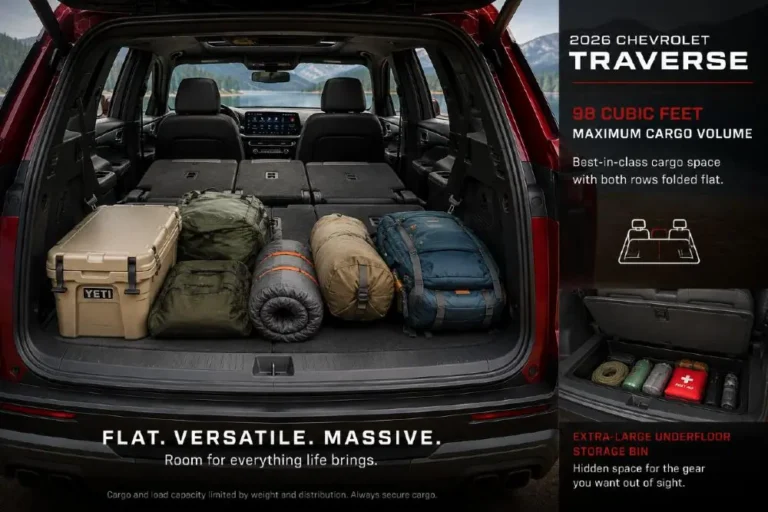
The cargo numbers are the strongest in the class. Behind the third row, 22.9 cubic feet is available — adequate for a full week of groceries or several pieces of luggage with all seven passengers present. With the third row folded, 56.6 cubic feet is available — enough for large furniture purchases, sports equipment, or the full loading of a family’s weekend camping supplies. At maximum capacity with all rows folded, the 98 cubic feet of cargo space is best-in-class, exceeding what every primary competitor offers at comparable prices.
A cargo space is a headline across the board, with a deep underfloor bin and the ability to swallow more gear behind the third row than most competitors. The underfloor bin specifically adds practically organized concealed storage that the spec-sheet cargo numbers do not reflect — it holds items that need to stay secure and dry separate from the main cargo area’s variable loading.
The first two rows are adult-friendly, and the access to the third row is simplified by wide-opening doors and power-folding seats on the RS and High Country that eliminate the physical effort of third-row access for frequent users. Materials step up convincingly on High Country and RS in the upper-trim cabin quality assessment.
The tri-zone climate control standard across all trims provides independent temperature control for front, middle, and rear passengers — a specific daily quality-of-life feature that reduces the single most common cabin argument in any family vehicle. The AutoSense Power Liftgate that detects the key fob and opens automatically serves the specific moment of hands-full cargo loading that every regular Costco or grocery run involves.
Section 5 – Towing And Outdoor Capability
5,000 Pounds — What It Actually Means For Families Who Tow
Every 2026 Traverse is set up for work with 5,000 lb of towing when equipped with the Trailering Package. The trailer package is standard on all trims, and it includes a heavy-duty cooling system, hitch guidance with a hitch view, a factory-installed hitch with hitch cover, and a 220-amp alternator.
The 5,000-pound rating is the class-competitive figure for midsize three-row SUVs. The Toyota Highlander and Kia Telluride offer similar figures. Only the Nissan Pathfinder (6,000 pounds) and the Dodge Durango (8,700 pounds) exceed this rating in the broader segment, and the Durango occupies a different market position in terms of size and price.
The Traverse’s 5,000-pound towing capability is appropriate for most recreational family towing — boats, pop-up campers, and utility trailers — but buyers whose towing needs regularly approach or exceed 5,000 pounds should understand the full-size truck alternative. Our complete guide to the best pickup trucks 2026 covers the F-150, Ram 1500, and Silverado towing capabilities that start at 8,000 pounds and reach 13,500, giving buyers who prioritize towing above three-row passenger capacity the complete comparison.
For the specific towing use cases that most three-row family SUV buyers encounter — small pontoon boats in the 2,000 to 3,000-pound range, pop-up campers or lightweight travel trailers, utility trailers for landscaping material or weekend projects — the 5,000-pound rating is fully adequate and provides the capability without the fuel economy penalty of a dedicated truck-based tow vehicle.
The trailer tech features — camera angles and guidance overlays that take the drama out of hitch days — are the specific technology additions that make the Traverse’s towing capability accessible to buyers who tow infrequently. First-time towers who are intimidated by backup alignment can use the hitch guidance overlay to place the receiver on the ball accurately without the stress of doing it by feel. Trailer tech, camera angles, and guidance overlays take the drama out of hitch days; remember tongue weight counts against payload when you’ve got all seats filled.
One important practical consideration: tongue weight from the trailer counts against the Traverse’s payload capacity when passengers are also aboard. Buyers who plan to tow a 2,500-pound trailer with five passengers and full luggage should calculate whether the combined tongue weight and passenger/cargo load falls within the Traverse’s payload specification — it almost certainly does for typical recreational towing, but it is worth verifying for heavy-trailer applications.
The Z71’s off-road tuning and twin-clutch AWD make it the most capable Traverse for buyers who need to access boat launches, campground roads, or gravel driveways with a trailer attached. The conventional AWD available on other trims is effective for typical conditions but does not provide the terrain mode calibration that makes the Z71 specifically confident on variable surfaces.
Section 6 – How The Traverse Compares
The Telluride, Palisade, Explorer, And Highlander — Honest Assessment
The 2026 Traverse competes in a class of genuinely strong alternatives, and the buyer who shops only the Traverse before purchasing is not doing the research that the segment’s quality level deserves.
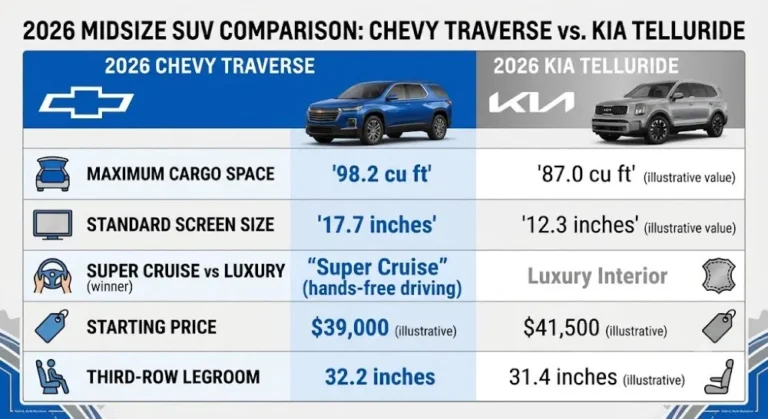
The Kia Telluride is the segment’s most consistent overall winner in automotive press comparisons. It offers superior interior material quality, more refined driving dynamics, and a better all-around package at comparable pricing — the Telluride SX Prestige and the Traverse High Country occupy similar price territory with the Telluride delivering more premium feel.
The Traverse counters with the larger cargo volume, the bigger standard touchscreen, and the available Super Cruise that the Telluride does not offer. For buyers who prioritize daily interior quality and driving refinement above cargo volume and technology features, the Telluride is the honest recommendation. For buyers who carry more stuff, need more cargo space, and want hands-free highway capability, the Traverse’s specific advantages are meaningful.
The Hyundai Palisade is the Telluride’s sibling and occupies a nearly identical competitive position — superior interior quality and refinement to the Traverse, inferior cargo volume and screen size. The Palisade Calligraphy’s interior appointments at its top price point genuinely exceed what the High Country provides.
The Ford Explorer is the most directly comparable American alternative. The Explorer had a significant refresh for 2025 with a restyled front end, upgraded interior, and better tech. Ford has an edge over the Chevy with two engine options — including a 400-horsepower V-6 option — and more premium materials at comparable trims. The Traverse counters with more second-row legroom (2.5 additional inches), about 12 more cubic feet of cargo space, and the larger standard infotainment screen. The Traverse is the better pick for a true three-row family vehicle; the Explorer is the better-handling SUV.
The Ford Explorer is the most direct American competitor to the Traverse among three-row SUVs — but Ford’s broader SUV lineup also includes smaller electric alternatives like the Mustang Mach-E for buyers whose family doesn’t require three rows. Our complete Mustang Mach-E guide covers Ford’s compact electric SUV from $37,795, providing the complete Ford SUV lineup context for buyers cross-shopping American brands.
The Toyota Highlander provides the segment’s strongest reliability reputation and resale value, comparable to the Tacoma’s position in the midsize truck segment. For buyers who prioritize long-term dependability and resale above current-year cargo volume and screen size, the Highlander remains a defensible choice despite competitive disadvantages in cargo space and standard technology.
The Toyota Highlander’s long-term reliability reputation is the primary reason it retains buyers who would otherwise choose the Traverse’s superior cargo volume and technology — our complete guide to the most reliable cars 2026 covers Chevrolet’s current reliability ranking and how it compares to Toyota in Consumer Reports and J.D. Power’s annual studies, giving buyers who prioritize dependability above all else the complete data picture before choosing between the two.
FAQ
Q: How much does the 2026 Chevrolet Traverse cost?
A: The 2026 Chevrolet Traverse starts at $40,800 for the LT before the $1,995 destination charge. The Z71 starts at approximately $44,800, the RS at approximately $48,800, and the High Country at $57,295. All-wheel drive adds $2,000 to trims where it is optional — the Z71 includes AWD as standard. Dealer pricing, package selections, and available incentives will affect the final transaction price above or below the MSRP figures.
Q: What is the best Traverse trim to buy?
A: Edmunds recommends the base LT trim for most everyday buyers as the strongest value option — it comes well-equipped with standard features including heated seats, the 17.7-inch touchscreen, trailering equipment, and advanced safety tech, with available packages that can add Super Cruise and a sunroof. TrueCar recommends the LT AWD for value-minded buyers, the Z71 for snow belt and trail use, the RS for buyers who want Super Cruise standard with sporty styling, and the High Country for the calmest long-distance cruiser experience.
Q: How many people does the 2026 Traverse seat?
A: The 2026 Traverse seats seven as standard across all trims with second-row captain’s chairs. The LT trim offers an optional second-row bench seat that increases total capacity to eight passengers. The Z71, RS, and High Country are seven-passenger only. Third-row passengers receive 32 inches of legroom — among the most generous in the midsize three-row class.
Q: Is the 2026 Traverse safe?
A: The 2025 Traverse earned an IIHS Top Safety Pick recognition. The 2026 Traverse did not qualify for the TSP or TSP+ designation under the IIHS’s updated 2026 criteria that added new emphasis on rear-seat protection and expanded crash avoidance testing, though its structural crash test ratings remain strong. The 2026 Traverse retains a 5-star overall safety rating from NHTSA. All trims include Chevy Safety Assist with automatic emergency braking, pedestrian and cyclist detection, lane keep assist, blind-spot monitoring, and rear cross-traffic alert as standard.
Q: Does the Traverse have Super Cruise?
A: Yes. Super Cruise hands-free driving is standard on the RS and High Country trims and available as part of the Enhanced Driving Package on the LT and Z71. Super Cruise enables hands-free driving on more than 585,000 miles of compatible roads in the US and Canada, with three years of service included with new purchase. It includes a driver attention monitor and automated lane change capability.
Q: What are the biggest complaints about the 2026 Traverse?
A: The most consistent criticisms of the 2026 Traverse from automotive press and owner reviews are: the engine sounds rough and strained under hard acceleration compared to V6 alternatives; the 17.7-inch touchscreen’s icon layout is cluttered and overwhelming; cabin materials at higher trims do not match the luxury feel that the price point implies, with hard plastics noted by multiple reviewers; the AWD engagement on non-Z71 trims requires a manual dashboard button rather than automatic engagement; and some owners have noted transmission issues in the 2026 RS based on early owner reviews. The cargo space, screen size, and passenger space are consistently praised despite these concerns.
The Bottom Line
The 2026 Chevrolet Traverse is the right three-row SUV for buyers who specifically need the class-leading 98 cubic feet of cargo space, the class-leading 17.7-inch standard touchscreen, a genuinely usable third row, and available Super Cruise at a starting price below $41,000. Those are specific, real advantages that influence real families’ daily lives in measurable ways — and no direct competitor currently provides all of them simultaneously at the Traverse’s pricing.
The Traverse is not the right three-row SUV for buyers who prioritize interior material quality above all else — the Telluride and Palisade deliver more premium interior feel at comparable prices. It is not the right choice for buyers who value driving refinement and V6 engine character above cargo volume — the Mazda CX-90 and Ford Explorer’s optional V6 address those priorities more directly. And it is not the right choice for buyers who demand the most proven long-term reliability data — the Toyota Highlander still holds that position in the segment.
The best Traverse configuration for most buyers is the LT AWD in climates where winter weather is real, the LT FWD in mild climates, with the Enhanced Driving Package to add Super Cruise if highway driving is a regular reality. The Z71 is the right choice for buyers who need the twin-clutch AWD and terrain modes for genuine all-weather and light off-road use. The RS is the right choice for buyers who want Super Cruise standard without the High Country’s price. The High Country is the right choice for buyers whose specific use case is long highway cruising and who value the Bose audio, ventilated seats, and power-folding rows at the price premium they represent.
The Traverse’s space advantage is real and matters. The technology is impressively specified for the price. The honest trade-offs are real and documented. Knowing both sides of that equation is exactly what a purchase decision at $40,000 to $57,000 requires.
Editorial Note
This article was written and reviewed in August 2026. All specifications, pricing, and editorial assessments are sourced from the following primary sources: Edmunds’ 2026 Chevrolet Traverse review and pricing data (June 2026) — primary source for the $40,800 LT starting price, the LT recommendation, the High Country critique regarding build quality and luxury value, the rattle complaint documentation, the Z71 poor ride quality notation, and the best value characterization of the LT with available packages;
TrueCar’s 2026 Traverse overview (February 27, 2026) — primary source for the four-trim description, the 20/26 FWD and 21 combined AWD fuel economy, the 98 cubic-foot best-in-class cargo figure, the 5,000-pound towing confirmation, the trim-by-trim buyer recommendation framework, and the twin-clutch AWD Z71 description; CarsDirect 2026 Traverse (August 2025) — primary source for the full MSRP range ($42,695 to $57,295), the Z71 equipment list including red tow hooks and hill-descent control, the RS 22-inch black wheel specification, the High Country animation and sequential turn signal features, the standard safety features list, the $1,225 Driver Confidence Package, the $5,160 Enhanced Driving Package, the 2,000-dollar AWD adder, and the six USB ports specification;
US News 2026 Traverse (March 9, 2026) — primary source for the trailer package standard-on-all-trims confirmation, the 5,000-pound towing Nissan Pathfinder and Dodge Durango comparison, the Explorer comparison noting 2.5-inch second-row legroom advantage, 12 more cubic feet of cargo, and the handling vs family vehicle assessment; The Car Connection 2026 Traverse (March 20, 2026) — primary source for the engine rough sound characterization, the infotainment overwhelming icon criticism, the hard plastics at higher trim observation, the third-row 32-inch legroom figure, and the Telluride/Palisade/CX-90 cross-shop recommendation;
Chevrolet.com official 2026 Traverse page (May 2026) — primary source for seating configurations by trim, cargo volume behind second row at 56.6 cubic feet, cargo behind third row at 22.9 cubic feet, Super Cruise 585,000-mile compatible road network, three-year Super Cruise service inclusion, 87-octane fuel requirement, and AutoSense Power Liftgate description; Riverside Chevrolet (May 2026) — supplementary source for the IIHS TSP status change explanation (2025 earned TSP, 2026 did not qualify under updated criteria) and the NHTSA 5-star overall confirmation.