Last Updated: June 29, 2026 | Read Time: 9 minutes
The Chevrolet Silverado EV achieved 493 miles of range in real-world testing — nearly 50 miles more than its EPA rating and the longest distance ever recorded by any electric vehicle in independent testing by major automotive outlets. The Rivian R1T Quad-Motor produces 1,025 horsepower and 1,198 lb-ft of torque from four individual wheel motors. The Tesla Cybertruck’s Cyberbeast configuration reaches 60 mph in 2.6 seconds. The GMC Sierra EV uses CrabWalk four-wheel steering that lets it move diagonally.
And every 2026 electric truck from Ford, GM, and Rivian now has access to Tesla’s Supercharger network — the largest DC fast charging infrastructure in North America. Electric pickup trucks in 2026 are not a technology demonstration. They are the most capable, most technologically ambitious vehicles in the American truck market.
Quick Facts — Electric Truck Pickup 2026
— Best Range: Chevrolet Silverado EV — 450 to 493 miles (real-world tested)
— Best Off-Road: Rivian R1T — Gear Tunnel, 4-motor option, purpose-built adventure
— Fastest: Tesla Cybertruck Cyberbeast — 0-60 in 2.6 seconds / Rivian R1T Quad matches it
— Best Technology and Luxury: GMC Sierra EV — 16.8-inch screen, CrabWalk, Super Cruise
— Most Practical Work Truck: Ford F-150 Lightning — frunk, Pro Power Onboard, affordable entry
— Most Powerful: GMC Hummer EV — 1,000 HP, but 9,000 lbs weight limits practicality
— Silverado EV Specs: 760 HP / 785 lb-ft / 12,500 lbs towing / 1,800 lbs payload / $74,800–$96,000
— Rivian R1T Specs: Quad: 1,025 HP / 1,198 lb-ft / 420+ miles range / ~$70,000+
— Tesla Cybertruck: Cyberbeast 2.6-sec 0-60 / 11,000 lbs towing / ~400 miles range
— GMC Sierra EV Specs: 760 HP / 785 lb-ft / 12,500 lbs towing / Super Cruise standard
— F-150 Lightning 2026: 580 HP / 775 lb-ft / 10,000 lbs towing / $54,780 starting / 320 miles range
— GMC Hummer EV: 1,000 HP / ~9,000 lbs curb weight / limited practicality
— Charging: All 2026 Ford, GM, and Rivian EV trucks have NACS — Supercharger network access
— Towing Reality: Range drops 50-60% when towing near capacity — 100-150 miles expected
— Best Charging Speed: Silverado EV — 350 kW capable
— F-150 Lightning charging: 155 kW (slowest among competitors)
— Range Champion Real-World: Silverado EV 493 miles — longest of any EV ever tested
— F-150 Lightning Status: Final generation — redesigned EREV model coming
— Ram 1500 REV: Expected 2027 — not yet available
Sources: Edmunds, CarGurus, AutoTimegist, GM Authority, FordTrend, US News
Overview – The Electric Truck Has Arrived – And It Is Better Than You Think It Is
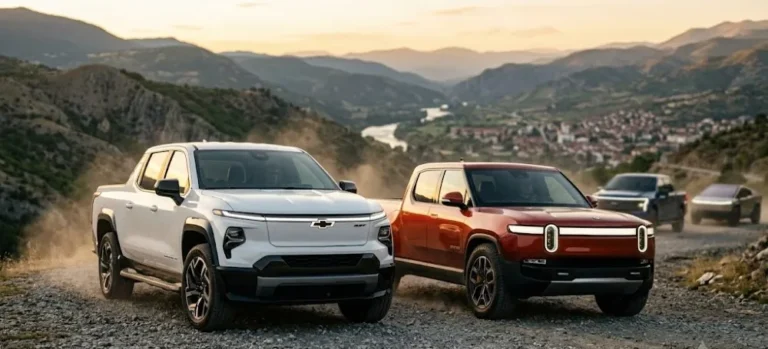
The electric pickup truck went from concept to credibility faster than almost any other automotive category in history. Four years ago, the Ford F-150 Lightning was a prototype on a stage in Michigan that nobody was entirely sure would actually work as a production truck. Today, there are six electric pickup trucks available for purchase in the United States, the best of them tow over 12,000 pounds, and the Chevrolet Silverado EV has set the record for the longest driving range of any electric vehicle ever tested in real-world conditions by major automotive publications.
The current crop of light-duty electric trucks each offers something unique that suits a variety of lifestyles. The gear pass-through and hard tonneau cover of the Rivian R1T make it ideal for outdoorsy people who live in a city. The Silverado and Sierra fill the niche left behind by the more traditionally truck-like Lightning and cater to contractors, handymen, and similar buyers. The Cybertruck and Hummer are not what anyone would call practical, but for buyers who purchase trucks for the image they project, they are precisely the right choice.
The 2026 electric truck market also has a development that changes the long-distance driving equation fundamentally: every electric truck from Ford, GM, and Rivian now comes with the North American Charging Standard connector, giving all of them direct access to Tesla’s Supercharger network. This is a game-changer for road trips — more reliable charging, more stations, and the infrastructure that has been the primary advantage of Supercharger-connected vehicles is now available to every major electric truck buyer regardless of brand.
The complete independent evaluation of every electric truck available in 2026 — including the specific characterization that the Silverado and Sierra fill the niche left behind by the Lightning, the R1T’s ideal positioning for outdoorsy city dwellers, and the Cybertruck and Hummer’s image-first appeal — is from the Edmunds best electric trucks 2026 complete evaluation, published April 14, 2026 and the primary editorial source for the segment overview in this article.
The honest questions for any buyer considering an electric truck in 2026 are not about whether the technology works — it clearly does. They are about whether the technology works for your specific use case. How much do you tow, and how far? Is your home charging infrastructure in place? What is the closest DC fast charging station to your most common routes? This guide answers those questions alongside the specifications and rankings that matter most.
Before purchasing any electric truck, verify the availability of compatible charging stations on your most common routes — the PlugShare EV charging station map provides real-time station availability, user reviews, and NACS compatibility information for every major charging network, allowing route-specific charging planning before any commitment.
Electric trucks represent the most technologically ambitious tier of the American truck market — but they exist alongside a gasoline truck segment that sold over 900,000 F-Series trucks in 2025 alone. Our complete guide to the best pickup trucks 2026 covers every gasoline and hybrid alternative alongside the electric options, giving buyers who are weighing both fuel types the complete comparison they need.
Section 1 – Chevrolet Silverado EV
The Range Champion That Puts All Comparisons In Perspective
The 2026 Chevrolet Silverado EV is the electric truck that most directly addresses the range anxiety that remains the most consistent concern among truck buyers considering the switch to electric. With a range of 493 miles in real-world testing — the longest real-world range of any electric vehicle ever tested by major automotive outlets, nearly 50 miles further than its EPA rating — the Silverado EV eliminates the range calculation as the primary variable in most buyers’ decision process.
The numbers are genuinely impressive across the full specification list. Thanks to GM’s massive 205-kWh battery pack, the base Silverado EV optioned with the Max pack has a range of 493 miles for 2026. The AWD truck has other eye-popping specs: 760 hp, 785 pound-feet of torque, a 0-60 mph time of about 4.2 seconds, and a towing capacity of 12,500 pounds. The 1,800-pound payload capacity means routine trips to the lumber yard or gravel pit are well within its working range.
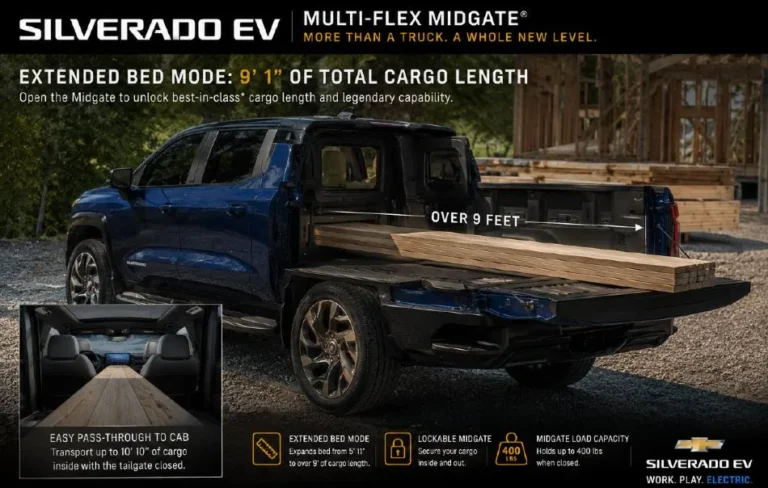
The Silverado EV’s most practically clever feature is the Multi-Flex Midgate — a pass-through section that opens the cab with a few latches to extend the bed length from about six feet to more than nine feet. This is the specific innovation that makes the Silverado EV a genuinely work-capable electric truck rather than simply an impressive specification sheet. An extended bed of more than nine feet handles lumber, sheet goods, and equipment that a six-foot bed cannot accommodate, addressing one of the traditional objections to truck-shaped electric vehicles.
The Silverado EV is available in a fleet-oriented Work Truck configuration that keeps the entry price accessible for municipal fleets and businesses — a specific market positioning that no other electric truck currently addresses. Silverado EVs are not an uncommon sight near the Edmunds offices in Southern California, which reflects the vehicle’s real-world adoption rate among buyers who are using it as a working truck rather than a technology demonstration.
The most significant limitation of the Silverado EV is its charging speed when directly compared to competitors. At 350 kW capable, it leads the segment — but only if the right charging infrastructure is available. The more significant limitation is the absence of Apple CarPlay and Android Auto. One oddity worth mentioning on all GM electric vehicles: there’s no Apple CarPlay and Android Auto offered, even as an option. For buyers who integrate their smartphones into their daily driving experience, this is a genuine functional limitation rather than a minor inconvenience.
The Silverado EV starts at approximately $74,800 for the RST configuration and reaches $96,000 for fully loaded Crew Cab variants. The Work Truck configuration is available at a lower price for fleet buyers. For the buyer who prioritizes maximum range and genuine work capability in a familiar American truck format, the Silverado EV is the clearest current choice.
Section 2 – Rivian R1T
The Original Electric Adventure Truck – And Still The Best At It
The Rivian R1T is the vehicle that established the template for what a genuinely purpose-built electric adventure truck could be. First delivered in 2021, it became the first mass-production electric pickup truck on the market, and the 2026 model has evolved significantly from its launch configuration while maintaining the specific character that made it remarkable in the first place.
The first mass-production electric pickup truck on the market, the Rivian R1T continues to improve. Refreshed for the 2025 model year with a native NACS port, the second generation R1T offers more range, more efficiency, and more power, and the 2026 model has an even more powerful Quad-Motor trim. With a motor powering each wheel, the R1T Quad rates at 1,025-horsepower and 1,198 pound-feet of torque.
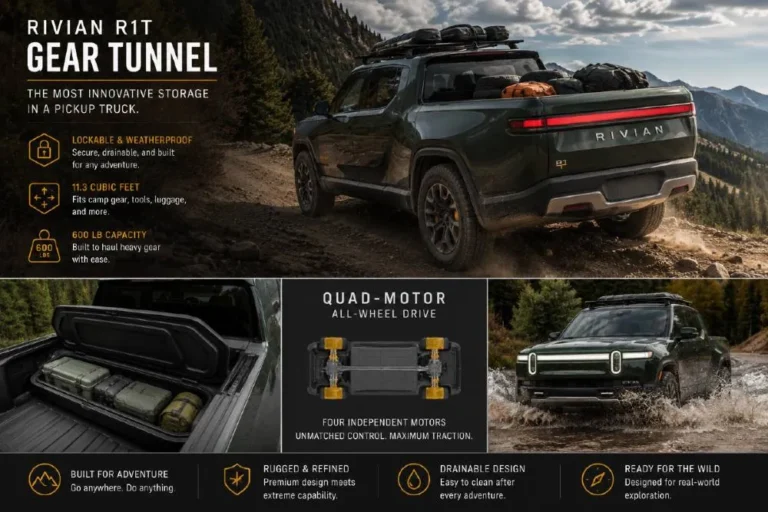
The R1T’s specific design advantages are its storage solutions — particularly the Gear Tunnel that runs between the cab and the bed, providing a lockable, weather-protected storage area for equipment that benefits from separation from the main bed cargo. This is the specific feature that makes the R1T ideal for buyers who carry specific gear regularly — the kind of organized, accessible storage that turns a general-purpose truck into a purpose-optimized tool for a specific lifestyle.
The 2026 Rivian R1T Quad-Motor’s performance credentials are extraordinary in the context of a pickup truck. Its Quad-Motor model matches the Cyberbeast’s 2.6-second sprint and offers a compelling 420-mile max range, but its lower 220 kW charge rate means longer stops on road trips. The 220 kW charging speed is the R1T’s primary competitive disadvantage — both the Silverado EV and the Cybertruck offer faster charging architecture, which matters on long-distance travel where charging time is a real variable in trip planning.
The R1T’s off-road capability is the strongest of any electric truck in the current market. Its four individual wheel motors allow torque to be distributed to each wheel independently — a capability that conventional differentials cannot replicate and that makes technical off-road situations more manageable than any mechanical limited-slip differential. The R1T’s ground clearance, approach angle, and departure angle in Adventure specification place it in competitive territory with purpose-built off-road vehicles rather than simply truck-shaped vehicles with off-road branding.
Rivian’s warranty coverage is the most generous in the electric truck segment: Rivian and Tesla both offer four years/50,000 miles overall and powertrain/battery coverage up to eight years/150,000 miles. For a vehicle that costs $70,000 or more, warranty coverage that extends to 150,000 miles on the battery system provides meaningful long-term ownership confidence.
The R1T’s primary limitation for traditional truck buyers is that its interior technology omits Apple CarPlay and Android Auto — a decision Rivian made in favor of its own infotainment system, which is generally well-regarded but represents a departure from what many truck buyers consider standard connectivity. For buyers who prioritize off-road capability, adventure-oriented storage design, and the fastest 0-60 performance available in an electric truck, the R1T Quad-Motor is the specific recommendation.
For buyers ready to configure a specific R1T — choosing between Dual, Tri, and Quad motor configurations, selecting the battery size, and verifying the NACS port inclusion — the Rivian R1T official specifications and ordering page provides the manufacturer’s primary configuration tool with current pricing for each available configuration.
Section 3 – Tesla Cybertruck
The Most Polarizing American Vehicle Since The Original Hummer
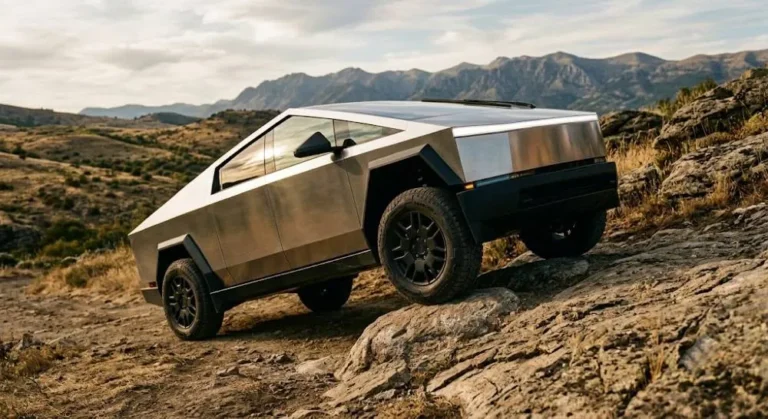
The Tesla Cybertruck is the vehicle that makes every other electric truck look conventional. Its stainless steel exoskeleton, geometric body design, and overall visual language have no precedent in production automotive history — and the performance underneath that dramatic exterior is equally impressive. Good: Blindingly quick; tows up to 11,000 pounds; comfortable and quiet cabin; Blade Runner movie prop styling.
The Tesla Cybertruck leans hard into performance and polarizing design, with its tri-motor Cyberbeast variant launching to 60 mph in a staggering 2.6 seconds. Its stainless-steel exoskeleton and up to 16 inches of ground clearance define its unique appeal, though its real-world range can fall short of estimates.
The Cybertruck’s 11,000-pound towing capacity places it below the Silverado EV and Sierra EV’s 12,500-pound figures — a real competitive gap for buyers whose towing needs approach or exceed 11,000 pounds. The maximum payload of approximately 2,500 pounds is competitive. The vehicle’s real-world range variability — where EPA-estimated figures are not always achieved in typical driving conditions — remains a consistent note in independent evaluations.
Tesla’s Supercharger network, which Cybertruck owners have accessed since the vehicle’s launch, remains the most extensive and most reliable DC fast charging network in North America. While 2026 NACS adoption by Ford and GM has reduced the network advantage, the Cybertruck’s native integration and the charging speed available at V3 Supercharger stations remain best-in-class for a Tesla product.
The Cybertruck’s practical limitations are its size — the massive dimensions make urban driving and parking genuinely challenging — and its relatively small cargo bed relative to the vehicle’s overall footprint. Its massive size makes city driving and parking stressful, and these are folks who drive for a living.
For buyers who specifically want the most distinctive vehicle on the road and are willing to accept the size limitations, the Cybertruck is the correct choice. For buyers whose primary decision criteria are towing capacity, range, and working capability, the Silverado EV or F-150 Lightning serves those priorities more directly.
Section 4 – GMC Sierra EV
The Premium Take On The Silverado EV Platform — With Technology The Silverado Does Not Have
Take what we said about the Silverado EV, give it a nicer interior, a slightly higher base price and some different styling, and you have the Sierra EV. That characterization from Edmunds captures the relationship between the two GM electric trucks accurately — the Sierra EV shares the Silverado EV’s Ultium platform and most of its mechanical specifications but adds specific technology features and a premium interior presentation that justify its higher base price.
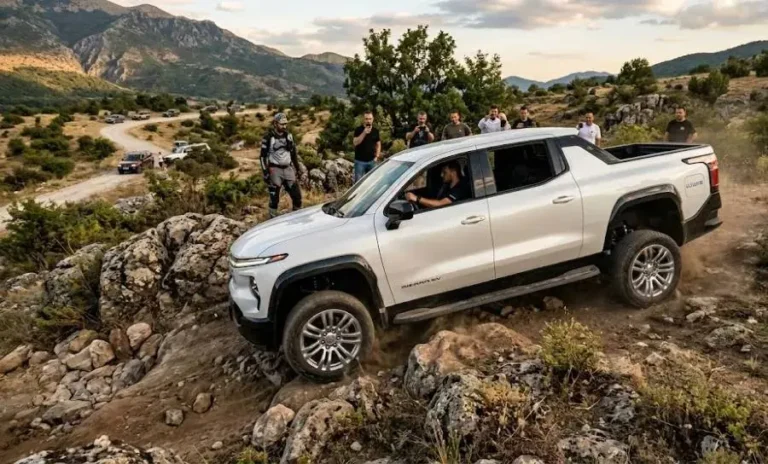
The Sierra EV’s most distinctive technology additions are CrabWalk and Super Cruise. CrabWalk is a four-wheel steering mode that allows the truck to move diagonally — a capability that is both practically useful in tight off-road situations and the kind of engineering novelty that generates genuine enthusiasm among truck enthusiasts. Super Cruise, Cadillac’s hands-free highway driving system, makes the Sierra EV the only electric truck in the current market with standard hands-free highway capability. The Sierra EV shares the Silverado’s Ultium platform but wraps it in GMC’s signature Denali luxury. It features CrabWalk (four-wheel steering), a massive 16.8-inch infotainment screen, and available Super Cruise hands-free driving.
The 16.8-inch infotainment screen is the largest display in any current electric truck, and the overall interior quality of the Sierra EV’s Denali trim is the closest to traditional luxury vehicle standards of any electric truck in the current market. This is meaningful for buyers whose trucks serve as primary daily transportation and who spend significant time in the cabin.
The GM twins make a formidable case with a strong blend of capability and technology. Both offer up to 760 horsepower, with the Sierra EV claiming a slight torque advantage at 785 pound-feet. They lead the charge in utility, boasting a maximum towing capacity of 12,500 pounds and a clever Multi-Flex Midgate that extends cargo length to over 10 feet.
The Sierra AT4 trail trim provides genuine off-road capability alongside the luxury appointments, making the Sierra EV the most versatile single-truck choice for buyers who need both luxury-level daily driving quality and occasional off-road confidence.
Section 5 – Ford F-150 Lightning
The Work Truck That Started The Electric Truck Revolution — In Its Final Form
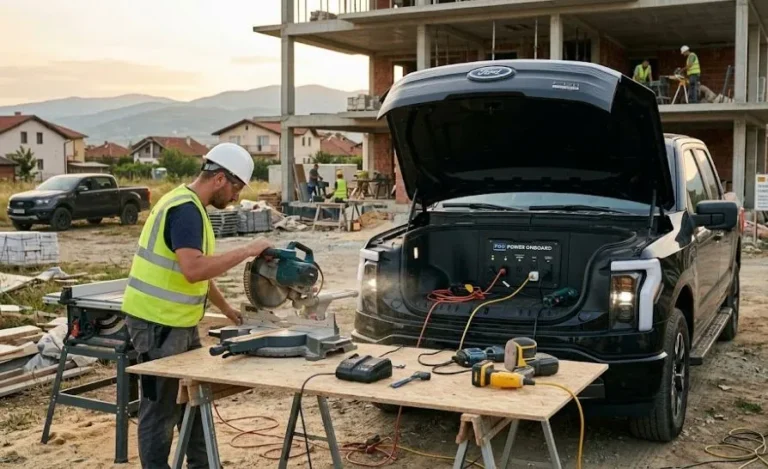
The Ford F-150 Lightning has a specific historical significance in the electric truck market: it proved, more convincingly than any other vehicle, that an electric truck could be a real truck. The base F-150 Lightning Pro is as powerful as the twin-turbo V-6 F-150 Raptor. The Lightning’s Pro Power Onboard — available up to 9.6 kW — turned it into a mobile generator capable of powering job site tools or acting as a home backup power source during outages. The massive 14.1 cubic-foot frunk replaced the engine with the most usable front storage of any production truck. These specific innovations made the Lightning genuinely useful in ways that gasoline trucks could not replicate.
The 2026 Ford Lightning is a truck that takes the proven concept of the best features of the gas-powered F-150 model and adds a pair of electric motors and an independent rear suspension. The result is a familiar-looking truck with few gimmicks that’s capable of doing actual work.
The 2026 F-150 Lightning’s specifications are competitive with the lower end of the electric truck segment: with 4.5/5 owner reliability, a massive 14.1 cu ft frunk, and Pro Power Onboard (up to 9.6 kW), it’s the most practical electric truck. 2026 is the final model year before a redesign.
Its 5.5-foot-long bed can haul up to 2,235 pounds, and thanks to its maximum of 775 lb-ft of torque, the Lightning can tow up to 10,000 pounds. The 10,000-pound towing capacity trails the Silverado EV and Sierra EV’s 12,500-pound maximum, and the maximum range of 320 miles is the shortest of the current electric truck field. However, the F-150 Lightning Pro starts at $54,780, making it the most affordable full-size electric truck in the segment — a pricing position that makes it the specific recommendation for buyers who want the most accessible entry into the electric truck market.
Real owner testimony from a contractor who owns three gas trucks: While I have been a Chevy guy all my life, currently Ford offers the best, work-ready electric truck. I love it! It feels like a regular truck that happens to be electric — and that means it’s crazy fast and offers one-pedal driving. This Lightning has a much smoother ride than my older trucks.
The F-150 Lightning’s charging speed of 155 kW is the slowest among its direct competitors — an objective limitation on long road trips where charging time adds to travel duration. This is the most significant technical gap relative to the Silverado EV’s 350 kW capability. For buyers who primarily charge at home and use the truck for daily commuting and job site work, the charging speed limitation is less relevant than for buyers who regularly take long highway trips.
The 2026 Lightning is the final model year before a complete redesign. Ford has confirmed the next generation will use EREV (Extended Range Electric Vehicle) technology — a configuration that adds a small onboard generator to extend range beyond what battery capacity alone provides, addressing the range and towing concerns that remain the most consistent objections to the current generation.
Section 6 – GMC Hummer EV
1,000 Horsepower, 9,000 Pounds, And A Statement That Needs No Clarification
The Hummer EV is massive. Seriously. In some configurations it weighs 9,000 pounds. That’s the equivalent of nearly four 2026 Mazda MX-5 Miatas. That curb weight alone is a hint at the Hummer’s whole raison d’être: being the biggest and baddest on the road.
The GMC Hummer EV’s 1,000 horsepower from its three electric motors is the highest output of any production electric truck in the American market. The WattsBomb launch system — which charges up the battery capacitors for maximum power delivery at launch — makes the Hummer EV’s 0-60 time genuinely startling for a 9,000-pound vehicle. The off-road hardware is similarly extreme: CrabWalk, Extract Mode that raises the suspension for maximum clearance, and underbody protection that allows rock-crawling situations that would damage conventional trucks.
The practical limitations of the Hummer EV are as extreme as its capabilities. Our testers found driving and parking around Los Angeles to be stressful, and these are folks who drive for a living. The Hummer EV is not a work truck, a commuter truck, or a long-range travel truck. It is a statement — the most extreme possible expression of what an American off-road vehicle can be in the electric era. For buyers who want that specific thing, nothing else delivers it. For buyers who need a truck to actually work, several other options in this guide serve those needs more practically.
Section 7 – The Honest Truths About Electric Truck Ownership
What Nobody Tells You Before You Buy – And What You Need To Know
The electric truck market’s marketing materials communicate the best-case scenario for every specification. Range figures are from EPA testing under optimal conditions. Towing figures are from maximum-configuration vehicles. Charging speeds are from the fastest available stations. Real-world ownership involves all of these figures in conditions that are not always optimal, and understanding the difference between specification and reality is the most important preparation for any electric truck purchase.
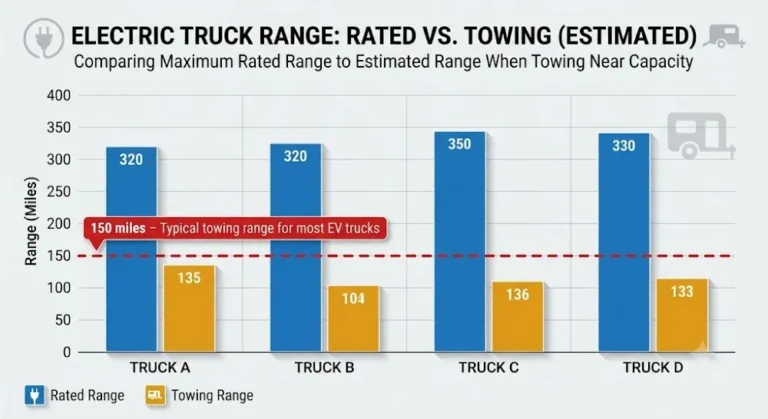
The towing reality is the most significant gap between specification and experience. All electric trucks lose 50-60% of EPA-estimated range in the real world when towing near capacity. Some estimates say towing near capacity eats into about 50% of EPA-estimated range. A Silverado EV rated at 450 miles of range becomes approximately 180 to 225 miles of range when towing 10,000 pounds.
A Lightning rated at 320 miles becomes approximately 130 to 160 miles when towing near its 10,000-pound maximum. Plan for 100-150 miles of range when towing heavy loads. This is not a failure of the technology — it is physics. Moving a heavy load requires more energy. The specific operational implication is that buyers who regularly tow at or near maximum capacity on long routes should plan charging stops more frequently than they would with a gasoline truck.
The home charging infrastructure question is the first practical question for any electric truck buyer. A Level 2 home charger — 240-volt, typically 40 to 48 amps — adds approximately 25 to 30 miles of range per hour. An overnight charge from a depleted battery to full typically takes 8 to 12 hours depending on the battery size. Most electric truck buyers charge primarily at home and rarely need public DC fast charging for typical daily and weekly driving patterns. The buyers who most need public fast charging are those who regularly take long highway trips beyond the truck’s single-charge range.
The software failures and first-generation battery technology reliability issues that affect electric trucks are part of the same documented pattern that affects all new-platform American vehicles — our complete guide to common issues that kill American cars covers the specific software failures that have affected GM EV products, the ABS module recall covering over one million Ram trucks, and the F-150 Lightning’s known reliability considerations.
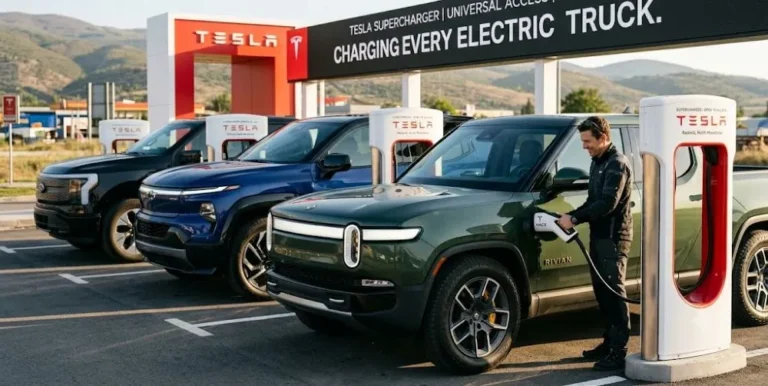
The NACS development of 2026 is the most important charging infrastructure news of the year. All 2026 electric trucks from Ford, GM, and Rivian now come with NACS ports, giving direct access to Tesla’s Supercharger network — the largest and most reliable DC fast charging network in North America. This is a game-changer for road trips — more reliable charging and more stations. For buyers who were previously deterred by limited charging infrastructure on travel routes, NACS access to the Supercharger network resolves the most significant infrastructure concern.
The federal EV tax credit of up to $7,500 is available for qualifying buyers on most electric trucks in this guide — but eligibility depends on your specific income level, filing status, and the specific vehicle’s assembly location and battery sourcing requirements. The Department of Energy federal EV tax credit eligibility checker provides the most authoritative current guidance on which vehicles qualify and under what conditions.”
The cost comparison between electric and gasoline trucks is more nuanced than fuel savings alone suggest. Electric trucks generally cost more to purchase than equivalent gasoline trucks — the Silverado EV’s $74,800 starting price is significantly above the gasoline Silverado 1500’s $37,000 starting price. The federal EV tax credit of up to $7,500 reduces this gap for qualifying buyers. Fuel savings depend entirely on local electricity and gasoline prices, annual mileage, and driving conditions. One contractor owner reports spending $9,000 on gas annually with three trucks — a figure that makes the electric premium economically rational within a few years for a working contractor operating multiple vehicles.
The purchase price premium of electric trucks over gasoline equivalents is only one component of the total ownership cost calculation — insurance for a $75,000 to $100,000 electric truck represents a meaningfully different annual expense than insurance for a $37,000 gasoline Silverado. Our guide to car insurance cost in the USA in 2026 covers how electric vehicle value, performance ratings, and brand classification affect what American drivers pay annually.”
The electric truck segment’s reliability picture is still developing — Consumer Reports’ 2026 data shows that EVs have 80 percent more issues on average than gasoline vehicles, a finding covered in full in our complete guide to the most reliable cars 2026, which documents every brand’s reliability ranking and explains why platform maturity is the single most predictive reliability factor for any electric vehicle.
Section 8 – What Comes Next
Upcoming Electric Trucks That Could Change The Market In 2027
The 2026 electric truck market, as strong as it is, is going to look different by 2028. Three confirmed incoming products will alter the competitive landscape.
The Ram 1500 REV is the most anticipated. Ram’s approach uses a range-extended electric system that addresses the towing and long-distance range concerns directly — a gasoline generator supplements the battery on long hauls, providing practical unlimited range for towing applications that pure battery electric systems cannot yet match economically. Ram’s luxury interior credentials — confirmed by its top J.D. Power Initial Quality ranking in 2024 — suggest the REV’s cabin will compete directly with the Silverado EV’s Denali-level offerings. The projected 2027 arrival makes it a consideration for any buyer who can wait.
Ford’s next-generation Lightning replacement will use EREV technology — the same basic concept as the Ram REV’s range extension approach. With a range of 539 miles, the Silverado EV has set the record for the longest range of any electric vehicle we’ve tested. This is almost 50 miles further than its EPA rating. In the most basic commercial Work Truck trim and with the biggest battery, that’s true, but it shows that the next-generation Lightning has a rough road ahead of it. The next Lightning needs to address the current generation’s 155 kW charging speed limitation and 320-mile range ceiling to remain competitive with the Silverado EV and the incoming Ram REV.
The Rivian R2 — the smaller, less expensive sibling to the R1T — is expected in the 2026 to 2027 timeframe at a price point significantly below the R1T’s current $70,000+ starting price. The R2 is specifically intended to bring Rivian’s adventure-truck philosophy to a broader audience at approximately $45,000. If Rivian delivers on that target, it would be the most accessible purpose-built adventure-oriented electric truck in the market.
The Ram 1500 REV, the next-generation Ford Lightning replacement, and the Rivian R2 are the three most significant upcoming electric trucks for 2027 and beyond — our complete guide to future cars 2026–2029 covers every confirmed and rumored upcoming American vehicle including all three electric trucks in the development pipeline, with confirmed specifications and realistic arrival timelines.
FAQ
Q: What is the best electric pickup truck in 2026?
A: The best electric pickup truck in 2026 depends on priorities. For maximum range, the Chevrolet Silverado EV achieves 450 to 493 miles — the longest real-world range of any electric vehicle tested. For off-road capability and adventure-oriented design, the Rivian R1T is the gold standard with the Gear Tunnel, four-motor option, and purpose-built outdoor credentials. For the most accessible entry price at $54,780, the Ford F-150 Lightning offers the most practical work truck design. For raw performance at 2.6-second 0-60, the Tesla Cybertruck Cyberbeast and Rivian R1T Quad match each other at the top. For luxury and technology including Super Cruise and CrabWalk, the GMC Sierra EV is unmatched.
Q: How far can an electric truck tow?
A: Electric trucks lose 50 to 60 percent of their rated range when towing near maximum capacity. In practical terms, expect approximately 100 to 150 miles of range when towing heavy loads regardless of the truck’s maximum EPA-rated range. The Chevrolet Silverado EV’s 450-mile starting range provides the most towing buffer of any electric truck in 2026. Plan charging stops more frequently than with a gasoline truck when towing, and use NACS-compatible stations for the fastest charging experience.
Q: Do 2026 electric trucks have Tesla Supercharger access?
A: Yes. All 2026 electric trucks from Ford, GM, and Rivian come equipped with NACS ports — North American Charging Standard — providing direct access to Tesla’s Supercharger network. This is the most significant charging infrastructure development of 2026 for electric truck buyers. It eliminates the need for an adapter and provides access to the most extensive and most reliable DC fast charging network in North America for all major American electric truck brands.
Q: What is the cheapest electric pickup truck in 2026?
A: The cheapest new electric pickup truck in 2026 is the Ford F-150 Lightning, starting at $54,780 for the Pro work truck configuration. The Chevrolet Silverado EV starts at approximately $74,800. The Rivian R1T starts at approximately $69,900. The Tesla Cybertruck starts at approximately $79,990. The GMC Hummer EV starts above $100,000. Federal EV tax credits of up to $7,500 are available for qualifying buyers on most models.
Q: Is the Chevrolet Silverado EV a good truck?
A: Yes. The 2026 Chevrolet Silverado EV is the range leader in the electric truck segment with 450 to 493 miles of real-world tested range — the longest of any electric vehicle independently tested. It produces 760 horsepower and 785 lb-ft of torque, tows 12,500 pounds, and carries a payload of 1,800 pounds. Its Multi-Flex Midgate extends the bed from approximately 6 feet to over 9 feet for maximum cargo versatility. Its primary limitation is the absence of Apple CarPlay and Android Auto on all GM EV products.
Q: What electric truck is coming in 2027?
A: The Ram 1500 REV is the most anticipated upcoming electric truck, projected for a 2027 launch with a range-extended electric system that adds a gasoline generator for extended range on long towing trips. Ford’s next-generation Lightning replacement with EREV technology is also in development following the 2026 model’s final production year. The Rivian R2 mid-size electric truck is expected in the 2026 to 2027 timeframe at approximately $45,000 — significantly below the R1T’s current price point.
The Bottom Line
The electric truck market in 2026 is the most competitive and most capable it has ever been. The Silverado EV has 493 miles of real-world range. The Rivian R1T Quad-Motor has 1,025 horsepower. The Cybertruck reaches 60 mph in 2.6 seconds. The Sierra EV drives sideways with CrabWalk. The Lightning has a 14.1 cubic-foot frunk and powers your house during an outage. Every one of these trucks does things that gasoline trucks cannot do.
The honest reality is that electric trucks also have genuine limitations — range drops significantly when towing, charging stops take longer than filling a gas tank, and the purchase price premium over gasoline equivalents is real. None of these limitations are fatal to the value proposition, but all of them require honest evaluation against your specific use case before purchase.
The independent expert rankings for every electric pickup truck available in 2026 — including the US News evaluation scores for the Silverado EV, Sierra EV, Rivian R1T, Cybertruck, and F-150 Lightning — are documented at the US News best electric pickup trucks rankings 2026, one of the three most widely cited electric truck evaluation resources alongside Edmunds and CarGurus.
For buyers who primarily commute, haul occasional loads, and charge at home overnight, any truck in this guide replaces a gasoline truck effectively and provides the fuel savings and driving experience benefits that have made electric vehicles compelling across every category. For buyers who regularly tow heavy loads on long routes and cannot easily plan charging stops, the Ram REV in 2027 or the EREV Lightning replacement may provide a more complete solution than the current pure-electric field.
The electric truck has arrived. It works. It is genuinely impressive. The question is not whether it is ready — it is whether it is ready for your specific version of truck ownership.
Editorial Note
This article was written and reviewed in April 2026. All specifications, range figures, pricing, and performance data are sourced from the following primary sources: Edmunds’ “What’s the Best Electric Truck of 2026” (April 14, 2026) — primary source for the Silverado EV, Sierra EV, Rivian R1T, Cybertruck, and Hummer EV descriptions, the range loss when towing figure, and the NACS adoption confirmation;
CarGurus’ “These Are the Best Electric Trucks Available Today” (March 9, 2026) — primary source for the R1T Quad-Motor 1,025 HP figure, the Silverado EV’s 493-mile real-world range, the 205-kWh battery pack, the Multi-Flex Midgate description, and the 50% range loss towing estimate; GM Authority’s “2026 Chevy Silverado EV vs EV Trucks: Spec Comparison” (December 24, 2025) — primary source for the head-to-head specifications including the Sierra EV torque advantage, the Cyberbeast 2.6-second 0-60 figure, and the R1T 220 kW charging rate;
AutoTimegist “Best Electric Trucks 2026” (February 17, 2026) — primary source for the F-150 Lightning $54,780 starting price, the 14.1 cu ft frunk figure, the 9.6 kW Pro Power Onboard figure, the 450-mile Silverado EV range figure, and the NACS game-changer characterization; FordTrend “2026 Ford Lightning” (January 16, 2026) — primary source for the 2026 Lightning expected pricing of $50,875 to $88,090, the 580 HP and 775 lb-ft figures, and the EREV next-generation confirmation; and Edmunds’ F-150 Lightning vehicle page — primary source for the contractor owner testimonial, the 10,000-pound towing figure, the 2,235-pound payload, and the warranty coverage comparison. The Ram REV 2027 projection and Rivian R2 pricing estimate are from industry reporting as of June 2026.