Last Updated: May 27, 2026 | Read Time: 10 minutes
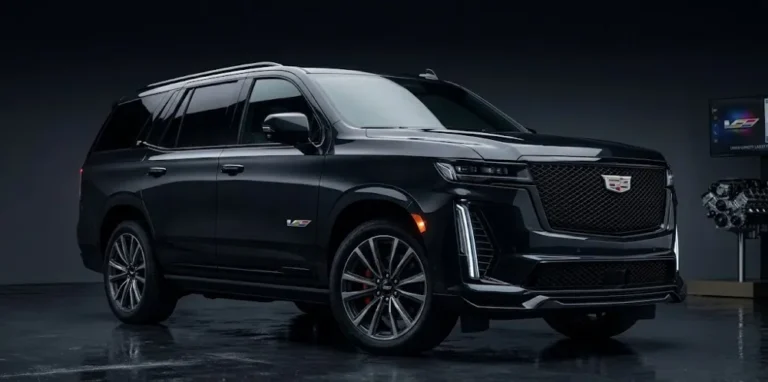
The Cadillac Escalade-V has 682 horsepower, reaches 60 mph in 4.4 seconds, and starts at $170,595. Its engine is hand-built in Bowling Green, Kentucky, and signed by the craftsman who assembled it. Its dashboard contains a 55-inch curved display. It comes with Super Cruise hands-free driving as standard, Brembo brakes, Magnetic Ride Control 4.0, an electronic limited-slip differential, carbon fiber interior trim, 24-inch wheels, and a 36-speaker AKG audio system. It also seats seven, tows 7,200 pounds, and looks like an Escalade — because that is the specific combination that no other vehicle on Earth provides.
Contents
Quick Fact – Cadillac Escalade-V 2026
– Engine: 6.2-liter supercharged V8 — hand-built in Bowling Green, Kentucky — signed by craftsman
– Output: 682 HP at peak / 653 lb-ft torque — 90% of peak torque from 2,000 RPM
– 0–60 MPH: 4.4 seconds (Cadillac estimated)
– Top Speed: 124 mph (electronically limited)
– Transmission: 10-speed automatic
– Drivetrain: AWD — standard, no rear-wheel drive option
– Towing Capacity: 7,200 lbs (V-Series standard wheelbase)
– Fuel Economy: 11 mpg city / 16 mpg highway / 13 mpg combined (EPA, 2026)
– Fuel Tank: 24.0 gallons (standard) / 28.3 gallons (ESV)
– 2026 Starting MSRP: $170,595 (standard wheelbase) before destination
– 2025 Starting MSRP: $167,400 standard / $170,400 ESV + $2,595 destination
– Body Styles: Standard wheelbase (211.9 inches) and ESV long wheelbase (226.9 inches)
– Seating: 7 passengers standard (three rows)
– Cargo Space: 25.5 to 121.0 cu ft (standard) / 41.5 to 142.8 cu ft (ESV)
– Display: 55-inch curved pillar-to-pillar Horizon Display — 35-inch driver+center zone, 20-inch passenger zone
– V-Series Exclusive Features: Carbon fiber trim, red digital accents, V-Mode with launch control, quad exhaust, active exhaust
– Suspension: Air Ride Adaptive Suspension + Magnetic Ride Control 4.0 — standard
– Brakes: Brembo front performance brakes — standard
– Drive Modes: 6 including exclusive V-Mode
– Safety Tech: Super Cruise standard, HD Surround Vision 360-degree cameras, Night Vision thermal imaging, Intersection AEB
– Audio: 36-speaker AKG Studio Reference — standard on V-Series
– Wheels: 24-inch — standard for 2025 and 2026 Escalade-V
– Rivals: Mercedes-AMG GLS 63, BMW X7 M60i, Lincoln Navigator Black Label
Sources: CarBuzz, TrueCar, Cars Frenzy, Cadillac of Calabasas, Quantrell Cadillac, Crest Cadillac TX
Overview – The Vehicle That Answers The Most American Question In The Luxury Car Market
The most American question in the luxury car market is: why does it have to be a choice? Why do you have to choose between a vehicle that is comfortable for seven passengers and capable of towing a boat, and a vehicle that does 0-to-60 in under five seconds? Why does exceptional technology have to mean sacrifice in either direction?
The Cadillac Escalade-V is General Motors’ answer to that question. It produces 682 horsepower from a hand-built supercharged V8 in an SUV that carries three rows of semi-aniline leather seating. It reaches 60 mph in 4.4 seconds in a vehicle that weighs over 6,000 pounds. It has a 55-inch curved display spanning the entire dashboard in a vehicle that can tow 7,200 pounds. Super Cruise — Cadillac’s hands-free highway driving system — is standard equipment in an SUV whose starting price is $170,595. The Escalade-V is just completely ridiculous, as CarBuzz summarized after spending time driving it through Northern Michigan. That assessment is both completely accurate and entirely the point.
The Escalade-V exists at the intersection of cultural identity and engineering ambition. The Escalade nameplate has meant something specific to American luxury culture since the original model launched in 1999 — a vehicle that communicates success in a specific and unapologetic way that European luxury SUVs simply do not replicate, regardless of their specifications. The V-Series wraps 682 supercharged horsepower in that cultural identity, adds the technology package of a flagship vehicle from any manufacturer on Earth, and prices it at a level that is genuinely competitive with the European performance SUVs it is intended to challenge.
For the 2025 model year, the entire Escalade family received a significant mid-cycle refresh with a focus on interior technology and exterior styling. The Escalade-V received refreshed front and rear fascias, new vertical headlights replacing the previous horizontal arrangement, a redesigned grille, a new center console with the shift lever moved to the steering column, and the pillar-to-pillar 55-inch curved display that transformed the interior into one of the most technologically impressive cabins available in any vehicle at any price. These updates carry through to the 2026 model with additional refinements to trim naming and new exterior color options.
This guide covers everything a buyer or researcher needs to know about the Escalade-V — the engine, the technology, the interior, the driving experience, the competition, and the specific question of whether $170,595 is a defensible purchase for what this vehicle provides.
The Escalade’s cultural identity is the specific dimension of its appeal that no specification comparison fully captures — it is the vehicle that appears in more celebrity garages and music videos than any other American luxury SUV. Our complete guide to Arnold Schwarzenegger’s car collection includes the Escalade history from one of the nameplate’s most prominent early advocates, showing how the Escalade’s cultural story connects to the people who defined American luxury vehicle culture in the 2000s.”
Section 1 – The Engine
A Hand-Built Supercharged V8 That Means What It Says
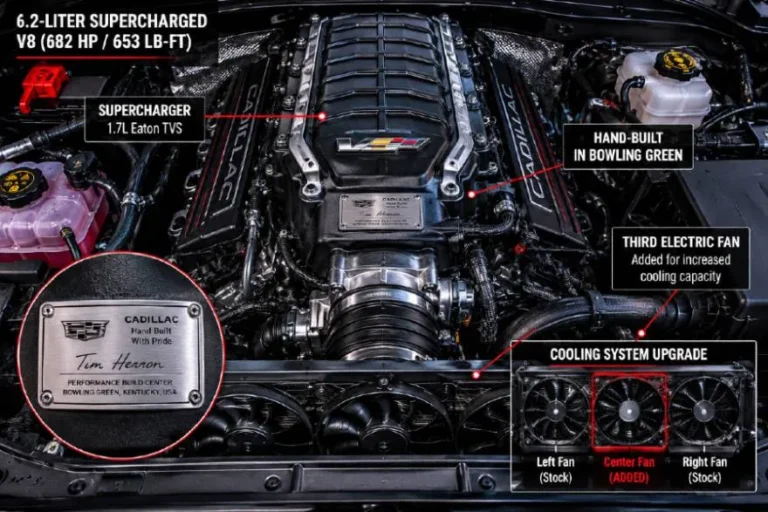
The 2026 Cadillac Escalade-V’s engine is a 6.2-liter supercharged V8 producing 682 horsepower and 653 lb-ft of torque. It is hand-built in Bowling Green, Kentucky — the same facility that builds the Corvette’s engines — and each unit is signed by the GM craftsman who assembled it. This is not a marketing detail. It is a production standard that reflects a specific and documented commitment to the quality of individual assembly over automated manufacturing.
The engine produces 90 percent of its peak 653 lb-ft torque from as low as 2,000 rpm. In practical driving terms, this means the power is present from the first application of the accelerator in virtually any situation — not at the top of the rev range, not after a turbocharger has spooled through its lag curve, but immediately, from a standing start, from a highway roll, and from a parking lot exit. The supercharger’s characteristics are specifically different from the turbocharger configurations used by the Mercedes-AMG GLS 63 and BMW X7 M60i — the boost arrives without the brief delay that turbocharged engines manage with various bypass and anti-lag technologies.
The result is a 0-to-60 time of 4.4 seconds for an SUV that carries three rows of seats, weighs significantly more than 6,000 pounds, and provides the towing capability of a working truck. That number places the Escalade-V in specific and interesting company — it is quicker to 60 than the standard BMW X7, similar in pace to the BMW X7 M60i, and offers a meaningfully different character than the Mercedes-AMG GLS 63’s twin-turbocharged inline-six at comparable or higher output levels.
All specifications cited in this article — including the 682 HP output, 653 lb-ft torque, 4.4-second 0-to-60, V-Mode drive modes, and the complete standard equipment list — are sourced from the Cadillac official Escalade-V specifications and build tool, the authoritative manufacturer primary source for the 2026 Escalade-V’s complete specification.
The engine management includes titanium intake valves for thermal durability at sustained high loads, a third electric fan specifically for engine cooling at the extreme output levels the V8 produces, and a mail slot opening below the main grille that provides additional airflow for the supercharger’s cooling requirements. An active exhaust system with quad exhaust pipes provides both functional performance benefit — reduced back pressure at high output — and the acoustic character that V-Mode enables.
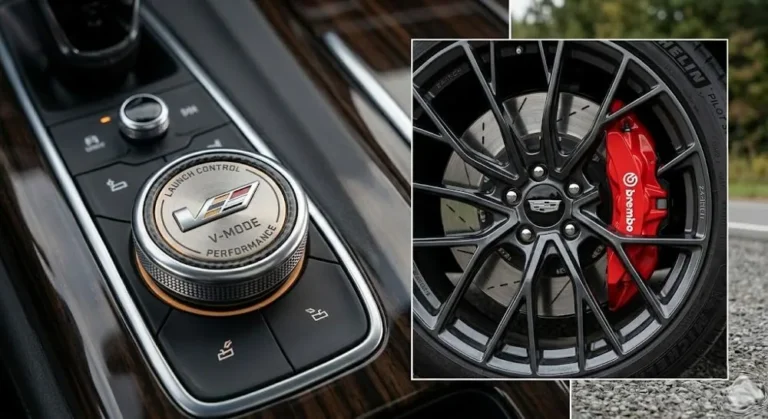
V-Mode is the Escalade-V’s exclusive performance activation. It is one of six available drive modes, and it is specifically the Escalade-V’s version of a sports car’s sport mode — but tuned for a 6,000-pound three-row SUV whose priorities are not entirely performance-focused. V-Mode activates launch control, sharpens the throttle response, adjusts the suspension damping to its most performance-oriented setting, and changes the exhaust character to its most assertive acoustic profile. The engine produces 90 percent of peak torque from 2,000 rpm — combined with a quick and precise 10-speed automatic transmission, the result is acceleration that takes your breath away, as documented in testing by the AOL Autos review team.
The 10-speed automatic transmission manages power delivery with a calibration that balances the responsiveness of manual mode paddle shifting with the smoothness that Escalade buyers expect in everyday driving. In normal mode the shifts are imperceptible. In V-Mode they are faster and more decisive. The transmission communicates with the supercharged engine’s torque curve in a way that maintains the immediate, accessible power delivery character that defines the engine’s real-world appeal.
The Escalade-V’s 6.2-liter supercharged V8 is hand-built in Bowling Green, Kentucky — the same facility that builds the Corvette’s performance engines including the flat-plane LT6 and the twin-turbo LT7. Our complete guide to sports Chevy cars covers the full story of General Motors’ performance engine program, from the 1953 Corvette’s inline-six to the 1,250-horsepower ZR1X, placing the Escalade-V’s 682-horsepower V8 in the context of GM’s complete performance engineering heritage.
Section 2 – The Performance Hardware
What Makes The V-Series Fundamentally Different From Every Other Escalade
The Cadillac Escalade-V is not simply an Escalade with a more powerful engine. It is an Escalade with a comprehensive performance hardware package that addresses every aspect of vehicle dynamics — suspension, braking, traction management, and aerodynamics — in ways that the standard Escalade’s platform does not.
The suspension is the Air Ride Adaptive Suspension combined with Magnetic Ride Control 4.0. Magnetic Ride Control uses magnetorheological fluid in the damper — a fluid whose viscosity changes almost instantaneously in response to an electrical current — to adjust suspension damping 1,000 times per second. The practical result is a suspension that can be perfectly soft for a gentle highway cruise in the same trip where it is perfectly firm for an aggressive mountain road sequence.
The transition between these states is measured in milliseconds, not seconds. Version 4.0 is specifically calibrated for the Escalade-V’s weight distribution and performance targets, producing handling responses that genuinely surprise drivers who expect a three-row SUV to behave like a three-row SUV in corners.
The Brembo front performance brakes are standard equipment on the V-Series and absent from the standard Escalade lineup. Brembo is the brake manufacturer whose products appear on Ferrari, Porsche, Lamborghini, and virtually every performance vehicle where braking performance is considered critical to the vehicle’s character. Their specification on the Escalade-V provides the stopping power appropriate to 682 horsepower in a heavy vehicle — and their calibration specifically for the V-Mode activation ensures that aggressive deceleration behavior matches the aggressive acceleration that the engine provides.
The electronic limited-slip differential manages power distribution between the rear wheels under acceleration, reducing the wheelspin that would otherwise occur when 653 lb-ft of torque is applied to the rear axle from the all-wheel-drive system. The eLSD’s contribution to the Escalade-V’s traction is most apparent in the V-Mode launch control sequence, where it coordinates with the transmission and engine management to maximize rear wheel traction at the launch threshold.
The 24-inch wheels became standard on the Escalade-V with the 2025 refresh — a specific visual differentiator from the standard Escalade and a statement about the V-Series’ design philosophy. The tires mounted on these wheels are performance-spec compounds sized for the V-Series’ performance targets rather than the fuel economy-optimized compounds used on the standard Escalade.
The V-Series top speed is electronically limited to 124 mph — a number that is practically irrelevant in any public road situation but that communicates the engineering margin available above everyday use. An Escalade-V driven at 80 mph highway speed is using approximately 50 percent of its power capability. The remaining 50 percent is available for overtaking, merging, and the specific moments where an additional 200 horsepower is genuinely useful.
Section 3 – The 55-INCH Display And Interior Technology
The Most Technologically Advanced Cabin in Any American Production SUV
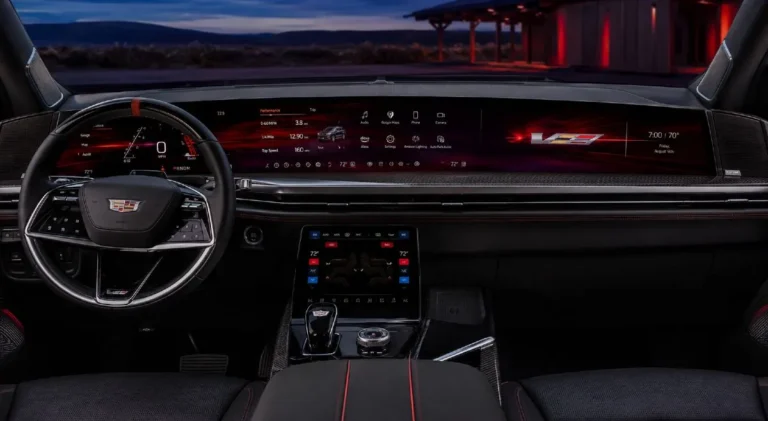
The 2025 refresh transformed the Escalade’s interior with a technology upgrade that CarBuzz described as the Escalade’s new interior is arguably its best feature. The pillar-to-pillar 55-inch curved Horizon Display spans the full width of the dashboard, creating an unbroken screen surface that incorporates the driver instrument cluster, the center infotainment display, and the passenger-side entertainment display into one continuous visual environment.
In the Escalade-V specifically, this 55-inch display is organized as follows: the driver and center displays seamlessly merge for 35 inches of real estate, leaving another 20 inches exclusively for the passenger to use for entertainment purposes. The V-Series version adds carbon fiber surrounds around the display and throughout the interior alongside red digital accents — specific to the V trim — that communicate the performance character of the powertrain through the design language of the cabin.
The system runs on Google Built-in, which provides intuitive, responsive navigation and integration with Google services without requiring a connected phone. Wireless Apple CarPlay and Android Auto are also standard. The infotainment interface, running on Google Built-in, feels intuitive and responsive, as noted by Autoblog’s February 2026 road test of the closely related Escalade Platinum Sport. The OLED display quality — with crisp resolution and deep blacks — is explicitly noted as a major selling point in multiple independent evaluations.
The 36-speaker AKG Studio Reference audio system is standard on the Escalade-V and represents one of the most capable automotive audio installations available from any manufacturer at any price. AKG — the Austrian professional audio brand that produces monitoring headphones and studio reference speakers — calibrated the system specifically for the Escalade’s acoustic environment. The specific speaker placement, crossover calibration, and signal processing produce a sound environment that satisfies genuinely critical listeners rather than simply impressing casual observers.
The 5G mobile Wi-Fi hotspot connects every device in the vehicle simultaneously with the bandwidth appropriate to the passenger entertainment system’s streaming requirements. The rear seat entertainment system adds dual 12.6-inch color touchscreens at the headrests of the second-row seats, each with Bluetooth headphones by AKG — the same brand as the vehicle’s primary audio system. This system provides fully independent entertainment for second-row passengers with wireless connectivity to their own content sources.
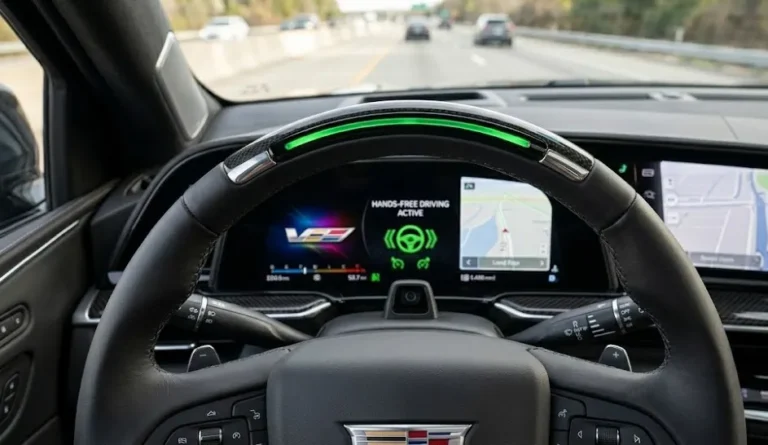
Super Cruise — Cadillac’s hands-free highway driving system — is standard on the Escalade-V. GM’s Super Cruise remains a major selling point, handling highway driving with ease and reducing fatigue on long trips. Super Cruise uses precise GPS positioning, LIDAR-mapped road data, and driver attention monitoring through the Driver Attention System to enable genuine hands-free driving on an extensive network of approved highways across North America. It is meaningfully different from lane-keeping assist systems — Super Cruise provides true hands-off capability within its operational design domain, which covers hundreds of thousands of miles of North American highway.
Additional technology standard on the Escalade-V includes: HD Surround Vision 360-degree camera system for parking and low-speed maneuvering; Night Vision thermal imaging that displays pedestrian and large animal detection at distances beyond headlight range; Intersection Automatic Emergency Braking that addresses the specific collision risk of driving through traffic intersections; and Enhanced Automatic Park Assist.
Section 4 – The Interior
Luxury That Extends Through All Three Rows
The Cadillac Escalade-V’s interior in 2025 and 2026 is genuinely different from the previous generation — not in its fundamental character as a large, comfortable, three-row American luxury SUV, but in the quality and consistency of the experience it provides across all three rows.
The front row is defined by the 55-inch display and the carbon fiber and leather environment that the V-Series specifies exclusively. The semi-aniline leather seating — a material specification that CarBuzz confirmed is described in Cadillac’s own words as three rows of semi-aniline leather seating — provides softer, more natural leather surfaces than the standard leather used in lower Escalade trims. Semi-aniline treatment involves minimal surface coating over naturally textured leather, producing a material that is softer to the touch and shows more natural leather character than heavily coated alternatives.
The front seats are heated, ventilated, and power adjustable with memory settings. The steering column now houses the gear selector — a change from the 2024 and earlier generation — freeing the center console for a redesigned layout that accommodates the carbon fiber trim and provides more accessible storage and control organization.
The 126-color ambient lighting system illuminates the cabin perimeter in customizable colors that include the V-Series-specific red accents in the instrument panel display. The tri-zone climate control manages front, rear, and independent passenger-side temperature preferences simultaneously.
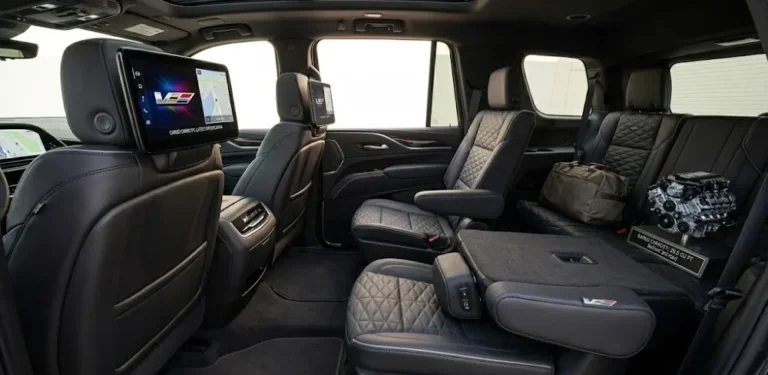
The second row provides the heated and ventilated seating that makes the Escalade-V genuinely comfortable for adult rear passengers across extended distances. The Escalade’s independent rear suspension — less common in full-size truck-based SUVs than in car-based crossovers — allows the second and third row floors to be flat rather than having the suspension tunnel intrusion that beam axle-equipped competitors produce. The result is genuinely usable second and third row seating for adults, not the compromised cabin geometry that other full-size SUVs manage.
The standard wheelbase Escalade-V provides 25.5 cubic feet of cargo space behind the third row and 121.0 cubic feet with both rows folded. The ESV adds significant cargo capacity — 41.5 cubic feet behind the third row and 142.8 cubic feet maximum — at the cost of an additional 15 inches in overall length.
Section 5 – The Escalade-V vs The Competition
How The 682 HP American Flagship Competes Against European Alternatives
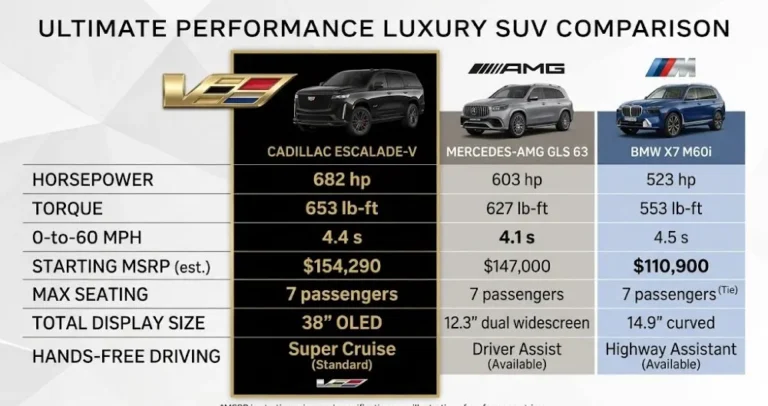
The Cadillac Escalade-V competes in a specific and increasingly contested segment — the high-performance, three-row, full-size luxury SUV. Its primary rivals are the Mercedes-AMG GLS 63 and the BMW X7 M60i, with secondary competition from the Lincoln Navigator Black Label at lower power and the Jeep Grand Wagoneer at lower both power and price.
The Mercedes-AMG GLS 63 uses a 4.0-liter twin-turbocharged V8 producing 603 horsepower in the current configuration, with AMG’s 48-volt mild-hybrid EQ Boost system adding 21 additional horsepower for brief surges during acceleration. The GLS 63 reaches 60 mph in approximately 4.3 to 4.5 seconds depending on configuration and testing conditions — a figure essentially identical to the Escalade-V’s 4.4 seconds. Mercedes-AMG prices the GLS 63 at approximately $170,000 to $175,000 in comparable specification, making it nearly price-equivalent to the Escalade-V at the point of direct comparison.
The BMW X7 M60i uses a 4.4-liter twin-turbocharged V8 producing 617 horsepower and reaches 60 mph in approximately 4.0 to 4.2 seconds — quicker than the Escalade-V by a meaningful margin in direct drag race terms. The X7 M60i starts at approximately $130,000 to $140,000 depending on configuration, making it less expensive than the Escalade-V for comparable performance output. BMW’s iDrive infotainment system, however, is a generation less visually impressive than the Escalade’s 55-inch curved display, and the X7 M60i does not offer the specific cultural identity of the Escalade nameplate.
The Lincoln Navigator Black Label — the most relevant domestic competitor — produces 440 horsepower from its twin-turbocharged 3.5-liter V6 and starts at approximately $118,000, making it significantly less expensive and significantly less powerful than the Escalade-V. The Navigator competes on interior craftsmanship and quiet refinement rather than outright performance, and its specific strengths differ from the Escalade-V’s performance and technology focus.
The honest assessment: the Escalade-V attempts to outpace the likes of the Mercedes-AMG GLS 63 and the BMW X7 M60i. On outright 0-to-60 performance, the comparison is essentially a draw with the GLS 63 and a loss to the M60i. On cultural identity, specific features — the 36-speaker AKG system, the 55-inch display, Super Cruise — and the combination of performance and three-row practicality that full-size truck-based construction provides, the Escalade-V offers a specific proposition that the Germans cannot replicate.
The most authoritative independent road test evaluation of the Escalade-V’s 4.4-second 0-to-60 claim, V-Mode performance character, and competitive positioning against the GLS 63 and X7 M60i is the Car and Driver Cadillac Escalade-V review — the publication whose editorial standard the writing style of this article emulates and the most trusted independent performance test resource in American automotive journalism.
Section 6 – The Escalade-V ESV
The Long-Wheelbase Option And When It Makes Sense
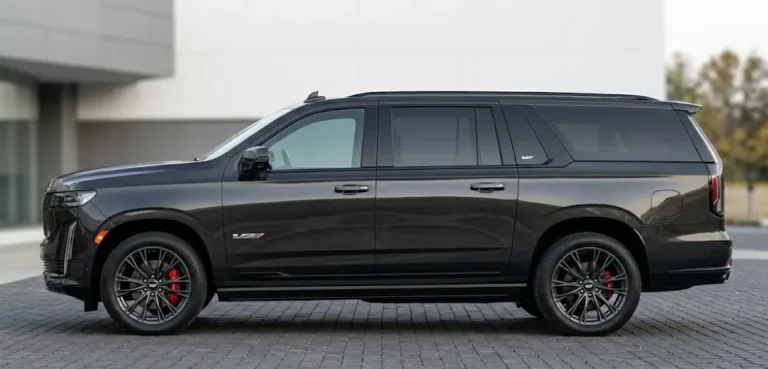
The Escalade-V is available in both standard-wheelbase and ESV long-wheelbase configurations — a distinction that is unique to the Escalade lineup among its performance SUV competitors. Neither the GLS 63 nor the X7 M60i offers a genuine long-wheelbase performance variant; the Escalade-V ESV is in a category by itself.
The ESV adds 15 inches in overall length — extending from 211.9 inches to 226.9 inches — with all additional length going into the passenger compartment and cargo area. The practical result is 41.5 cubic feet of cargo space behind the third row versus the standard’s 25.5 cubic feet — a difference large enough to genuinely change the ESV’s usefulness for families who regularly carry both passengers and luggage.
The mechanical specifications of the Escalade-V ESV are identical to the standard wheelbase: 682 horsepower, 653 lb-ft of torque, 4.4-second 0-to-60, Brembo brakes, Magnetic Ride Control 4.0, and the complete V-Series performance hardware list. The towing capacity is rated at 8,000 lbs on the ESV versus 7,200 lbs on the standard wheelbase — a modest reduction attributable to the ESV’s additional length and weight. The fuel tank is larger: 28.3 gallons versus 24.0 gallons, providing a meaningful range extension on a vehicle that achieves 13 mpg combined.
The ESV’s 2025 starting MSRP was $170,400 — $3,000 above the standard wheelbase — before destination charges. At these prices, the additional length, cargo capacity, and fuel tank are available for a cost increment that most buyers in this segment will consider reasonable.
For buyers who regularly carry seven passengers and luggage, the ESV is the correct choice. For buyers who prioritize the slightly more agile handling character that comes with the shorter wheelbase, the standard model is appropriate. Both are equally capable on the performance metrics that define the V-Series.
Section 7 – Who Should Buy The Escalade-V
The Specific Buyer The Vehicle Is Designed For
The Cadillac Escalade-V is the correct vehicle for a buyer who requires all three of the following: a three-row SUV that can carry seven passengers in genuine adult comfort; performance credentials that are not a compromise from the driving experience of a dedicated performance vehicle; and the specific cultural identity of the Escalade nameplate in its most extreme configuration. If all three of these requirements apply, the Escalade-V has no direct equivalent anywhere in the market.
The buyer who needs three rows but does not require 682 horsepower should consider the standard Escalade’s 420-horsepower lineup, which provides all of the technology, interior quality, and presence for approximately $80,000 to $110,000 less than the V-Series. The AKG audio, the 55-inch display, and Super Cruise are standard across all 2025 and 2026 Escalade trims — the V-Series’ specific additions are the supercharged engine, the Brembo brakes, the Magnetic Ride Control, and the V-Mode system.
The buyer who wants maximum straight-line performance and does not require three rows or towing capability has better-performing options at lower or comparable cost from the Corvette ZR1 and similar performance vehicles. The Escalade-V’s 4.4-second 0-to-60 is genuinely impressive for its size and configuration — it is not genuinely impressive against dedicated sports cars.
The buyer who wants the European performance SUV alternative without the European cultural association, who values the specific presence of the Escalade nameplate, and who wants a technology environment that outperforms both the GLS 63 and X7 M60i’s respective cabin technology — the 55-inch display is more impressive than anything Mercedes or BMW offers in comparable vehicles — has a specific reason to choose the Escalade-V that specifications alone do not capture.
The financial reality of Escalade-V ownership extends beyond the $170,595 sticker price — a performance SUV at this value and power level carries insurance costs that represent a meaningful annual expense. Our guide to car insurance cost in the USA in 2026 covers how vehicle value, horsepower rating, and luxury SUV classification affect what American drivers pay, completing the total cost picture for any serious Escalade-V buyer.
The vehicle is not a rational financial decision by any standard measure. At $170,595 before options and destination, it costs more than most comparably capable alternatives. The fuel economy of 13 mpg combined on premium gasoline is a meaningful ongoing expense. The vehicle’s insurance costs reflect its value and performance credentials. None of these calculations change for a buyer who has decided they want the specific combination of things this vehicle provides — because that combination is genuinely unique.
The Escalade-V’s truck-based body-on-frame construction is shared with an entirely different category of American luxury vehicle — full-size pickup trucks that compete at their own premium tier. Our complete guide to the Ram 1500 Limited covers the most luxurious half-ton pickup in America, showing how the truck platform’s luxury ambitions extend across the full range of body styles that Americans build on large-vehicle architectures.
FAQ
Q: How much horsepower does the Cadillac Escalade-V have?
A: The Cadillac Escalade-V produces 682 horsepower and 653 lb-ft of torque from its hand-built 6.2-liter supercharged V8 engine. The engine is assembled in Bowling Green, Kentucky — the same facility that builds Corvette engines — and each unit is signed by the GM craftsman who built it. The engine delivers 90 percent of its peak torque from as low as 2,000 rpm, providing immediate and accessible power throughout normal driving. The Escalade-V reaches 60 mph in 4.4 seconds according to Cadillac’s own estimate, with a top speed electronically limited to 124 mph.
Q: How much does the 2026 Cadillac Escalade-V cost?
A: The 2026 Cadillac Escalade-V has a starting MSRP of $170,595 for the standard-wheelbase version. The 2025 model started at $167,400 for the standard wheelbase and $170,400 for the ESV long-wheelbase version, both before a mandatory destination charge of $2,595. The Escalade-V is the top trim level in the Escalade lineup, which begins in the high $80,000s for the base Luxury trim. The V-Series represents approximately $80,000 to $90,000 in premium over the base Escalade for its performance hardware, exclusive interior features, and V-Mode technology.
Q: What is the difference between the Escalade V and the regular Escalade?
A: The Escalade-V differs from the standard Escalade with a hand-built 682-horsepower supercharged V8 (versus the standard Escalade’s 420-horsepower naturally aspirated V8), standard Magnetic Ride Control 4.0, Brembo front performance brakes, electronic limited-slip differential, exclusive V-Mode with launch control across six drive modes, carbon fiber interior trim, red digital display accents, active exhaust with quad exhaust pipes, 24-inch wheels, and performance-tuned Air Ride Adaptive Suspension. The standard Escalade’s 420-horsepower engine can tow up to 8,100 pounds; the V-Series is rated to 7,200 pounds due to its performance-oriented setup.
Q: What is V-Mode on the Cadillac Escalade-V?
A: V-Mode is the Escalade-V’s exclusive high-performance drive mode — one of six available drive modes. It activates launch control for maximum acceleration from a standstill, sharpens throttle response, adjusts the Magnetic Ride Control to its most performance-oriented damping setting, and changes the active exhaust character to its most assertive acoustic profile. V-Mode is activated by a dedicated button on the center console and transforms the Escalade-V’s driving character from comfortable luxury cruiser to performance-focused SUV. V-Mode is not available on any other Escalade trim.
Q: How does the Cadillac Escalade-V compare to the Mercedes-AMG GLS 63?
A: The Mercedes-AMG GLS 63 uses a 4.0-liter twin-turbocharged V8 producing 603 horsepower and reaches 60 mph in approximately 4.3 to 4.5 seconds — essentially matching the Escalade-V’s 4.4 seconds. Both vehicles are priced in the $170,000 range in comparable specification. The Escalade-V counters the GLS 63 with its 55-inch curved pillar-to-pillar display versus the Mercedes’ more conventional infotainment presentation, the 36-speaker AKG Studio Reference audio system, Super Cruise hands-free driving as standard, and the specific Escalade cultural identity. The GLS 63 is built on the GLS’s car-derived platform, while the Escalade-V uses a truck-derived body-on-frame architecture that provides genuine truck-level towing and carrying capability.
Q: What is the fuel economy of the Cadillac Escalade-V?
A: The 2026 Cadillac Escalade-V achieves EPA-estimated fuel economy of 11 mpg city, 16 mpg highway, and 13 mpg combined on premium gasoline. The standard-wheelbase fuel tank holds 24.0 gallons, providing approximately 312 miles of highway range per fill. The ESV long-wheelbase version uses a 28.3-gallon fuel tank for extended range. The Escalade-V requires premium gasoline. Drivers who use V-Mode aggressively will see city fuel economy figures below the EPA estimate.
The Bottom Line
The Cadillac Escalade-V is the correct vehicle if you need everything it provides simultaneously and cannot get those things in any other configuration. A 682-horsepower SUV that seats seven in semi-aniline leather, tows 7,200 pounds, has a 55-inch curved display across the entire dashboard, comes with Super Cruise hands-free driving as standard, sounds like a performance car through its active exhaust in V-Mode, and arrives in a body that looks exactly like what it is — the most extreme production Escalade ever built.
No European competitor offers the same combination of performance, three-row practicality, towing capability, and cultural identity. The GLS 63 and X7 M60i are faster in specific conditions and arguably more refined in specific aspects of their character — but neither is an Escalade, and for the buyer who wants an Escalade, neither is an acceptable substitute.
The price is real. The fuel economy is real. The insurance cost is real. The ongoing financial commitment to a vehicle that achieves 13 mpg combined on premium gasoline is a number that belongs in any honest assessment of what ownership actually costs.
But so is the 682-horsepower hand-built engine signed by the person who assembled it. So is the carbon fiber that replaces where lesser Escalades have conventional trim. So is the launch control that transforms a three-row family vehicle into a vehicle that covers a quarter mile in the territory where dedicated performance cars live. And so is the 55-inch display that makes every other SUV’s infotainment look like something from a different decade.
The Escalade-V is completely ridiculous. That is precisely, entirely, and unapologetically the point.
Editirial Note
This article was written and reviewed in May 2026. All specifications are sourced from the following primary sources: TrueCar’s 2026 Cadillac Escalade-V overview — primary source for the 2026 MSRP of $170,595, 682 HP, 653 lb-ft, 4.4-second 0-60, 11/16/13 MPG, 24.0-gallon tank (standard), 28.3-gallon tank (ESV), 25.5–121.0 cubic feet cargo (standard), 41.5–142.8 cubic feet (ESV).
CarBuzz’s 2025 Cadillac Escalade-V review (December 2025) — primary source for the 2025 MSRP of $167,400 standard / $170,400 ESV, the 24-inch wheel confirmation, the V-Mode six drive modes description, the 36-speaker AKG system confirmation, the Magnetic Ride Control and Brembo brakes confirmation, the semi-aniline leather description, and the pillar-to-pillar 55-inch display breakdown into 35-inch driver+center and 20-inch passenger zones; Cars Frenzy (March 2026) — supplementary source for the 8,100-pound standard Escalade towing confirmation and AWD standard confirmation.
Cadillac of Calabasas (February 2026) — supplementary source for the Super Cruise across all Escalade trims confirmation and Night Vision thermal imaging; Crest Cadillac TX — supplementary source for the Intersection AEB and HD Surround Vision confirmation; Quantrell Cadillac — source for top speed of 124 mph and V-Mode description; AOL Autos 2023 Escalade-V review — supplementary source for the 90% of peak torque from 2,000 rpm figure; Autoblog February 2026 Escalade review — supplementary source for the Google Built-in infotainment assessment; Cadillac of Calabasas April 2026 — supplementary source for 2026 specifications confirmation.
The 2025 destination charge of $2,595 is confirmed by CarBuzz. The ESV length of 226.9 inches and standard length of 211.9 inches are from the AOL Autos 2023 review and remain consistent through the current generation.

0 Comments