Last Updated: April 20, 2026 | Read Time: 10 minutes
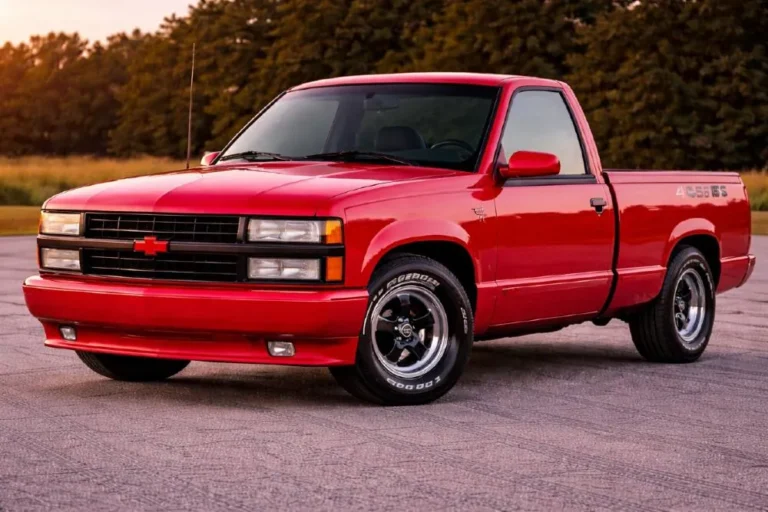
GM took the biggest engine they had and stuffed it into the lightest half-ton pickup they built. The result was a black-on-red truck that arrived before anyone knew what a muscle truck was, sold out instantly in its first year, spawned every performance pickup that came after it, and now trades hands at auction for prices that nobody predicted in 1990. Only about 17,000 were ever made. Here is the full story.
At A Glance – Chevy SS Truck 454 Key Facts
– Production Years: 1990–1993 (four model years)
– Platform: GMT400 — C1500 regular cab, short bed, 2WD only
– Engine: L19 — 7.4-liter (454 cubic inch) big-block V8, throttle-body injection
– Horsepower 1990: 230 hp at 3,600 rpm
– Horsepower 1991–1993: 255 hp at 4,000 rpm
– Torque 1990: 385 lb-ft at 2,400 rpm
– Torque 1991–1993: 405 lb-ft at 2,400 rpm
– Transmission 1990: TH400 3-speed automatic
– Transmission 1991–1993: 4L80-E 4-speed overdrive automatic
– Rear Axle Ratio 1990: 3.73:1 (GT4 code)
– Rear Axle Ratio 1991–1993: 4.10:1 (GT5 code)
– Differential: G80 Gov-Lock (locking differential)
– Suspension: Bilstein gas shocks, 32mm front stabilizer bar, sport-tuned
– Steering: 12.7:1 quick-ratio steering box
– Tires: P275/60R15 on 15×8 inch styled steel wheels
– Curb Weight: Approximately 4,662 lbs
– 0–60 mph: Mid-7-second range (1990) / high-6s (1991–1993)
– Quarter Mile: Mid-15s at approximately 87–88 mph
– Top Speed: Approximately 106–110 mph
– Original MSRP: $18,295 (1990) — approximately $36,450 in today’s dollars
– Total Production: Approximately 16,953 confirmed units
– 1990 Production: Approximately 13,748 units (about 80 percent of total)
– 1991 Production: Approximately 983 units
– 1992 Production: Approximately 1,379 units
– 1993 Production: Approximately 843 units
– Identifying Code: RPO B4U — on all genuine 454 SS trucks’ SPID label
– Colors 1990–1991: Onyx Black only, Garnet Red interior
– Colors 1992–1993: Added Summit White and Victory Red
– Collector Value Range: $22,000–$81,000+ depending on condition and mileage
Sources: MotoGallery, GMT Central, Hagerty, CarBuzz, TopSpeed, Capital One Auto Navigator
Overview – The Formula Was Simple. The Result Was Legendary
There are certain automotive ideas so obvious in hindsight that the only reasonable question is why nobody did it sooner. Putting a big-block V8 in a muscle car. Dropping a large-displacement engine into a lightweight body. Choosing the smallest, lightest platform available and then installing the most powerful engine in the inventory.
That last idea is exactly what General Motors did in 1990, and the vehicle they produced became America’s first muscle truck.
Chevy’s concept in building this truck was simple: drop the biggest engine we’ve got into the smallest truck. That specific engineering philosophy — taking a 454-cubic-inch big-block V8 from the heavy-duty truck line and installing it in the lightest, smallest half-ton pickup in the GMT400 fleet — produced a vehicle that the market was not prepared for and that the industry had not been offering. There was no muscle truck segment in 1989. GM created one, almost accidentally, and the result was a truck that sold out its first production run before buyers fully understood what they were looking at.
The first-year trucks arrived at dealerships in Onyx Black with Garnet Red interiors — a color combination that the enthusiast community immediately recognized as the correct choice for a truck that was built to intimidate. Those early examples sold for prices above their $18,295 MSRP due to “additional market adjustment” pricing at dealers who correctly identified that they had something unusual on their lots. The market had spoken before any publication had formally reviewed the truck.
By 1993, when the 454 SS was discontinued after only four model years and approximately 16,953 total units, it had established the template that the Ford F-150 Lightning, the Dodge Ram SRT-10, and every subsequent performance pickup would attempt to follow. The 1993 Ford Lightning arrived the same year the 454 SS was retired — arriving just in time to validate the market that Chevrolet’s truck had proven existed.
The 454 SS is one of the most actively appreciated muscle truck collector cars on the market. A 3,000-mile 1990 example sold for $81,400 at Mecum. Hagerty reported that excellent-condition examples increased 22 percent in a single year and 39 to 40 percent over a five-year stretch. Gen-X and Millennial buyers, according to Hagerty’s insurance data, are the primary force behind the truck’s appreciation — a demographic pattern that suggests the 454 SS’s market momentum has years of growth ahead of it rather than behind it.
GM’s decision to drop the 454 big-block into the lightest half-ton pickup was not a new philosophy — it was the same formula that had produced the most legendary muscle cars of the previous generation. Our complete guide to the 1969 Chevelle covers how GM applied this same big-engine, light-platform approach to produce America’s most beloved muscle car two decades before the 454 SS
This is the complete story of the Chevy SS truck 454.
Section 1 – The Context
Why 1990 Was The Right Moment For A Muscle Truck
Understanding why the 454 SS mattered requires understanding the landscape it arrived in. By the late 1980s, the American performance car had largely abandoned the raw, displacement-driven approach of the muscle car era. The cars that remained — the Mustang GT, the Corvette, the Camaro Z28 — were better-rounded performance cars than their 1969 predecessors, but they had traded cubic inches for sophistication and in doing so had lost some of the visceral, uncomplicated character that had defined the original muscle car experience.
The performance pickup truck, meanwhile, simply did not exist as a factory category. GM’s C/K trucks were well-regarded workhorse vehicles — cleaned up in the 1988 GMT400 redesign into genuinely handsome, capable machines — but nothing in the lineup was positioned as a performance statement. The Sport Equipment Package added cosmetic upgrades. The truck market was bifurcating between utility and comfort, not utility and performance.
Performance had, for the most part, given way to a balance of economy and useable torque. That year, however, one pickup changed all that and greatly influenced the market going forward. This was the Chevrolet 454 SS.
Taking a page from the playbook of Chrysler, who over a decade earlier had built the Dodge Lil’ Red Wagon of 1978 and 1979 — a large-displacement truck with performance pretensions that had preceded its market — Chevy took the normally unavailable-in-the-C1500-range 454 cubic inch Mark IV big-block and put it into their smallest half-ton pickup.
The key engineering decision was the platform choice. Not the full-size, heavy C3500. Not the C2500 with its larger frame and heavier components. The C1500 — the regular cab, short bed, two-wheel-drive version of the GMT400 Silverado that was the smallest and lightest half-ton in the lineup. Installing a 454 in this specific vehicle produced a power-to-weight ratio that the heavier truck configurations could not replicate, and it created a driving character that was as far from a work truck as the badge allowed while technically remaining one.
The sport truck craze that was building in the early 1990s around lowered pickups with custom wheels had created an aesthetic appetite for performance-oriented trucks. The 454 SS was the first factory answer to that appetite — a truck that came from the factory looking and driving like the best custom sport trucks of the era, with a manufacturer warranty attached.
Section 2 – The Engine
The L19 454: A Big-Block Where Nobody Expected It
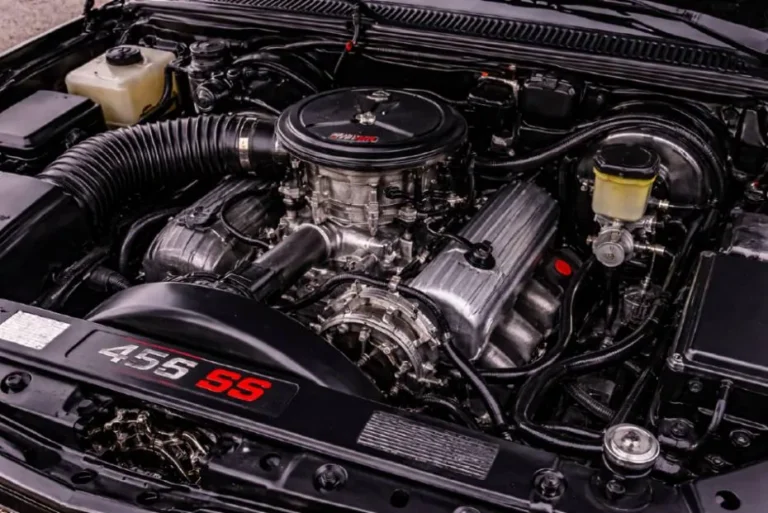
The engine in the 454 SS is the RPO L19 — a 7.4-liter, 454-cubic-inch big-block V8 with throttle-body fuel injection. It is called the “454” with the same directness that all the best American performance engines have always been called by their displacement, because that number is the explanation for everything the truck does.
The L19 is not a high-tech engine. It does not use multi-port injection or variable valve timing or any of the sophisticated technologies that were beginning to appear in performance cars by the early 1990s. It uses a single throttle-body injector — a system that amounts to an electronically controlled carburetor — feeding a single four-barrel equivalent fuel delivery to an engine with a traditional pushrod valve train, cast-iron block and heads, and the robust, understressed character of an engine that was designed for heavy-duty truck applications before it was pressed into performance service.
What the L19 does is torque. In the 1990 configuration, that means 385 lb-ft arriving at 2,400 rpm. In the 1991–1993 configuration, it means 405 lb-ft at the same rpm. These are numbers that do not appear in the context of “what rpm do I need to be at to find the power.” They appear at the moment you press the throttle in any gear, from any speed, and the truck moves with the effortless authority of a vehicle that has more torque than it needs for the situation.
Although the V-8 produced only 230 horsepower in 1990 — a figure that looks modest against modern turbocharged engines — it had plenty of torque, and that kind of force pushed the truck from 0 to 60 mph in less than 8 seconds. In 1990, in a pickup truck, it was extraordinary.
The 1991 upgrade to 255 horsepower and 405 lb-ft of torque came from revised fuel delivery and engine management calibration — the same basic engine, better tuned. The power increase translated into measurably improved acceleration: the 1991 and later trucks with the 4.10 axle and 4L80-E four-speed automatic ran into the high-6-second range to 60 mph in optimal conditions, a performance improvement that the spec sheet doesn’t fully communicate until you drive the two trucks back to back.
The TBI big-block is understressed and long-lived with routine care. Expect typical TBI-era service items — fuel pumps, pressure regulators, and idle air control valves — to require attention with age. Keep the cooling system maintained; big-blocks appreciate clean radiators and fresh hoses.
Fuel economy was, and remains, the L19’s most obvious liability. Unsurprisingly, gas mileage was abysmal: 9 to 11 mpg on average. This was known at purchase and accepted as the cost of admission for a vehicle whose fundamental appeal was torque, not efficiency. It remains the same calculation — a truck whose running costs are higher than any modern vehicle in its class, and that earns every dollar of those costs in character.
Section 3 – The Year-By-Year Story
What Changed Each Year And Why It Matters
1990: The First Year — Black, Red, And Sold Out
The 1990 model year is the defining year of the 454 SS story, for reasons that have everything to do with its production numbers. Of the approximately 16,953 total 454 SS trucks produced across four years, roughly 13,748 were built in 1990 — about 80 percent of total production. This extraordinary concentration of production in the first year reflects the market’s genuine shock at what GM had created.
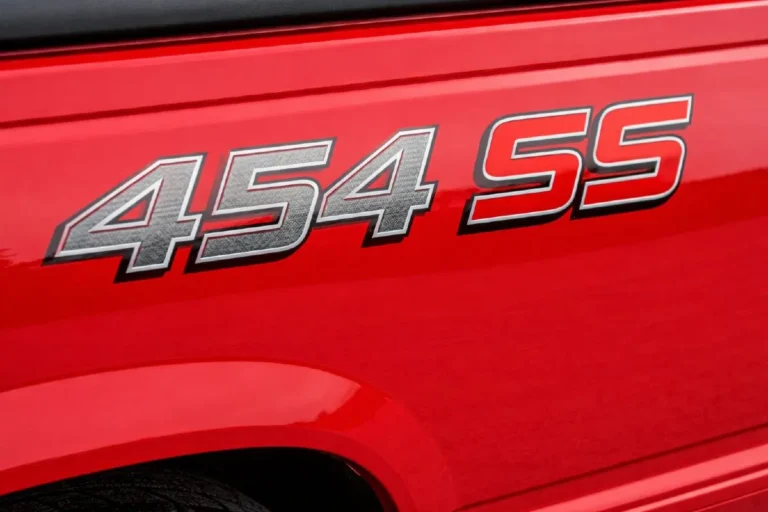
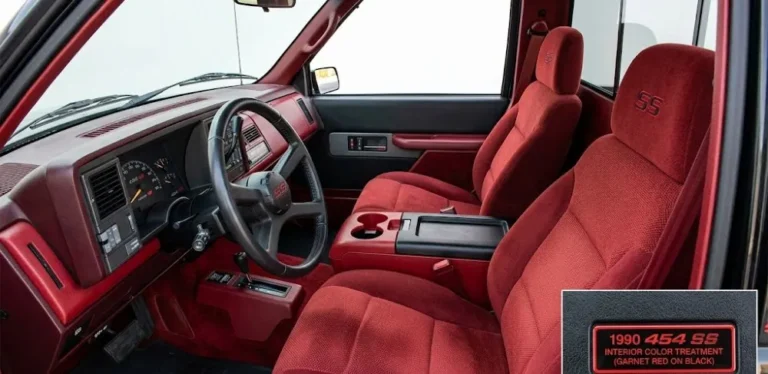
The 1990 trucks were available in exactly one color: Onyx Black. The exterior treatment included a blacked-out grille, the “454 SS” bedside decals in bold, specific graphics, and 15-inch chrome sport wheels with P275/60R15 tires. The interior was Silverado-grade Garnet Red cloth bucket seats with a center console — an appointment level that combined genuine comfort with the red-on-black visual drama that gave the first-year trucks their “Batmobile truck” reputation in the enthusiast community.
The 1990 trucks used the TH400 three-speed automatic transmission and a 3.73:1 rear axle ratio — a setup that provided strong off-the-line feel but left power on the table compared to what a closer ratio and additional overdrive gear could achieve. The G80 locking differential was standard, providing the rear-wheel traction management that a high-torque truck on street tires genuinely needed.
Available as a stand-alone model, only in a Fleetside short box, the first-year trucks sold for additional market adjustment pricing over the window sticker — dealers correctly recognized they had something unusual and priced accordingly. The trucks that arrived at dealers sold before competing examples could be compared, which is how first-year 454 SS trucks became the most commonly seen 454 SS in the collector market despite also being the most valuable.
1991: Better In Every Mechanical Dimension — Fewer Made
The 1991 model year brought the most significant mechanical improvements of the 454 SS’s production run. The L19 was recalibrated to produce 255 horsepower and 405 lb-ft of torque. The TH400 three-speed was replaced by the 4L80-E four-speed overdrive automatic — a transmission with electronic control, a taller top gear for highway cruising, and shift characteristics that worked with the engine’s power band more intelligently than the fixed-ratio TH400 had. The rear axle ratio shortened from 3.73 to 4.10 — a change that meaningfully improved acceleration at the cost of minimal top-speed performance.
The 4L80-E plus 4.10 combination noticeably improves acceleration versus the 1990 TH400/3.73 specification. This is one of those cases where the numbers tell the correct story — a shorter ratio and an additional gear together produce a truck that feels meaningfully quicker in the 0-to-60 range and that manages the engine’s torque more effectively in everyday driving.
The exterior remained Onyx Black only in 1991. The interior specification was carried over. And only 983 trucks were produced — the lowest production year of the run by a significant margin. The 1991’s combination of the best mechanical specification and the lowest production of the run makes it, by objective analysis, the most collectible configuration of the 454 SS for any buyer who prioritizes driving quality over first-year rarity.
1992: Color Arrives
The 1992 model year added Summit White and Victory Red to the exterior palette — choices that gave the 454 SS a dramatically different visual identity while preserving the blacked-out grille and trim cladding that were specific to the package. Bumpers and mirrors were painted body color rather than black in the white and red configurations, softening the sinister all-black character of the 1990–1991 trucks in favor of a more classic American performance truck aesthetic.
The interior expanded to include blue, beige, and gray color options — a meaningful improvement in daily livability for buyers who found the red interior’s drama excessive for extended ownership. The base price in 1992 was approximately $20,585 — up from the 1990’s $18,295 but still representing genuine value for the performance package delivered. Production of 1,379 units made 1992 the second-highest production year of the run.
1993: The Final Year
The 1993 model year produced approximately 843 trucks — the rarest production year of the 454 SS’s run — and retired the truck without a direct successor. The mechanical specification was carried over from 1992. The color options remained the same. No final-edition package was produced to mark the occasion.
1993 also saw the introduction of Chevy’s 350-powered Impala SS as well as the F-150 Lightning from cross-town rival Ford. The Lightning’s arrival — built explicitly to compete with the truck segment that the 454 SS had created — was itself a testament to what the 454 SS had accomplished. Ford’s engineers had spent three years building a competitor to a GM truck that GM had then decided to discontinue.
The 1993 was also the last year that the truck would roll out of its assembly plant as a current model. As a final-year, lowest-production configuration, the 1993 454 SS occupies a specific position in the collector market — the rarest of the non-1990 configurations, and a truck whose final-year status gives it a historical significance that transcends pure performance specification.
The 454 SS’s $18,295 original MSRP represented genuine value in 1990, but its 9 to 11 mpg fuel economy and the insurance cost of a high-performance truck meant that total ownership costs were meaningfully higher than the sticker suggested. Our complete breakdown of car insurance cost in the USA in 2026 gives modern buyers the broader insurance market context for any high-performance vehicle purchase.
Section 4 – The Complete Specification
Every Number That Matters For Buyers And Enthusiasts
The 454 SS was always a single-cab, short-bed truck, without four-wheel drive. This configuration was not a limitation — it was the definition. An all-wheel-drive or extended-cab 454 SS would have been a different vehicle with different purposes and a different character. The two-wheel-drive, short-bed, regular-cab specification was a deliberate engineering choice that kept weight minimized and the torque’s effect on the rear tires maximized.
The suspension package that distinguished the 454 SS from standard C1500 trucks was engineered with a single purpose — handling the 454’s torque output competently without compromising the ride quality that made the truck usable daily. Bilstein gas shock absorbers replaced the standard units. The front stabilizer bar measured 32mm — significantly stiffer than the standard bar. The overall ride height was lowered compared to standard C1500 trucks, creating the aggressive stance that the visual package required.
The 12.7:1 quick-ratio steering box gave the 454 SS a more responsive steering character than standard GMT400 trucks — not sports car territory, but a meaningful improvement in the precision of the front end’s response to driver inputs. This steering ratio, combined with the wide 275-section tires, gave the truck a planted, authoritative feel that its performance credentials deserved.
The 14-bolt, 9.5-inch semi-float rear axle was unique to the 454 SS in its 5-lug configuration — a specific detail that distinguishes authentic 454 SS axles from later-installed replacements. The G80 Gov-Lock locking differential engaged automatically under wheelspin conditions, providing the traction management the torque required while remaining transparent in normal driving.
Braking was front disc, rear drum with hydraulic assist — appropriate for the era and for a truck whose primary purpose was acceleration rather than sustained high-speed operation. The 454 SS was not marketed or sold as a towing truck or a work vehicle. Its payload capacity was tuned more for boulevard duty than heavy hauling, and period road tests noted this honestly while praising the truck’s stoplight pace and charisma.
The RPO code B4U is the single most important verification tool for any 454 SS purchase. All genuine trucks will carry this code on the SPID (Service Parts Identification) label. Verify the presence of B4U alongside the other expected codes — L19 (engine), GT4 or GT5 (axle ratio), G80 (locking differential) — before any transaction. Because the 454 SS configuration has been recreated from standard C1500 trucks using the readily available factory components and decal packages, and because the shared VIN structure of the GMT400 platform makes VIN decoding insufficient alone, the SPID label is the definitive authentication document.
Section 5 – The 454 VS. The GMC Syclone
Understanding The Muscle Truck Wars Of The Early 1990s
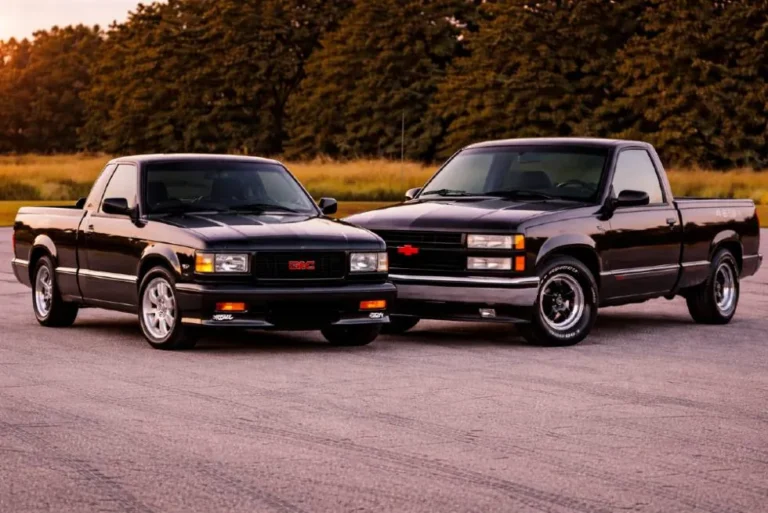
No discussion of the 454 SS is complete without acknowledging the truck that arrived one year later, was faster in a straight line, cost significantly more, and became the vehicle most often used to minimize the 454 SS’s legacy.
The GMC Syclone appeared in 1991. It used a turbocharged 4.3-liter V6 producing 280 horsepower and 350 lb-ft of torque, all-wheel drive, and a suspension tuned to an extraordinary degree for a pickup truck. The Syclone ran from 0 to 60 mph in under five seconds — quicker than a contemporary Corvette and genuinely shocking for anything wearing a pickup truck body.
The 454 SS cost $18,000 at the time, while the Syclone was $25,000. Not only that, but the Syclone has a 500-pound max payload, making it less useful as a truck in that sense. The Syclone’s combination of exotic performance and exotic price made it a different product aimed at a different buyer.
The comparison between the two trucks is instructive precisely because they represent opposite philosophies. The Syclone is technical, turbocharged, all-wheel-drive, and all about apex performance regardless of character. The 454 SS is simple, big-block, rear-wheel-drive, and all about the specific character of a large naturally aspirated V8 torqueing the rear tires onto any surface available.
A 1991 Syclone in similar condition is now valued at $33,100, while the 454 SS in comparable condition sits below that figure according to Hagerty’s data. The Syclone’s greater rarity — fewer were produced — and its more dramatic performance specification give it a higher floor in the collector market. But the 454 SS’s larger production, wider availability of parts, and the specific character of its big-block appeal have given it a broader and more demographically diverse collector base.
The Syclone has higher peak values. The 454 SS has more buyers. Both remain legitimate and beloved representations of the brief moment in the early 1990s when American pickup manufacturers decided that performance was an acceptable truck priority.
The 454 SS’s collector trajectory — low initial production, years of obscurity, then rapid value appreciation driven by demographic buyers who connected with the car in youth — mirrors exactly the path of other American performance vehicles that achieved collector status later than their engineering merited. Our Dodge Viper complete guide covers five generations of the most directly comparable American performance vehicle story — extreme capability, limited production, and a collector market that took years to catch up to the car’s significance.
Section 6 – What To Look For When Buying
The Honest Buyer’s Guide
The 454 SS market contains a significant population of tribute trucks — standard C1500 pickups that have been fitted with 454 engines, 454 SS decals, and other SS-specific components to present as genuine examples. Some of these tribute builds are disclosed honestly as such. Others are not. Distinguishing an authentic 454 SS from a well-executed tribute requires specific knowledge.
Authentication: The SPID Label And RPO Codes
The SPID label — typically located in the glovebox — is the definitive authentication tool. Run the RPO codes through a GM RPO decoder and confirm the presence of B4U (the 454 SS package code), L19 (the specific big-block engine designation), GT4 or GT5 (the axle ratio), and G80 (locking differential). The VIN’s 8th digit should be N, confirming the L19 engine code in the VIN itself.
All genuine trucks are C1500, 2WD, regular cab, short bed, with B4U on the SPID label, large “454 SS” bedside decals, monochrome trim, bucket seats with console, and the 5-lug 14-bolt rear axle.
The 5-lug, 14-bolt semi-float rear axle is a specific component that distinguishes the 454 SS from standard GMT400 trucks. Verify it is present and original. The bucket seat and center console configuration is standard to all authentic 454 SS trucks — a bench seat is a disqualifying finding on an allegedly original example.
Engine Condition And Modifications
Many trucks were modified — the 454 SS platform’s combination of a stout big-block, adequate chassis, and enthusiast appeal made it a natural target for performance upgrades. A modified truck is not necessarily a bad purchase, but it is a different purchase from a numbers-matching original, and the price should reflect that distinction accurately.
For collector-intent purchases, originality matters for collectors. Verify the engine block casting numbers and build date codes against the truck’s known production date. Replacement engines — whether factory-spec L19s or modified variants — should be disclosed and documented. An undisclosed engine replacement eliminates original collector value even when the replacement performs equivalently.
For driver-quality purchases, the aftermarket’s deep support for the 454 big-block means that a well-modified 454 SS can be an excellent purchase at an appropriate price. Headers, a better intake, a tune, and a differential upgrade are common and well-documented modifications that can improve the truck’s performance without compromising its structural integrity or reliability.
Known Problem Areas
Steering box, idler arm, and pitman arm wear are common on higher-mileage trucks — inspect for steering play and looseness before purchase. The 4L80-E’s shift quality should be clean and positive; a transmission that hunts gears or slips between shifts on a 1991–1993 example warrants specific inspection before purchase. The G80 locking differential can be fragile if shock-loaded on high-traction surfaces — verify correct operation. The cooling system on all big-block trucks deserves careful inspection; a radiator or hose that has not been serviced recently on a 35-year-old truck is a maintenance item, not a deal-breaker, but it needs to be addressed.
Early 1990s GM clearcoat and decal fade are common on high-sun trucks — exterior condition is worth careful inspection, particularly on the 1990–1991 black-only examples where the single-stage paint can show its age dramatically. Rust in common GMT400 locations — inner fenders, lower door skins, cab corners, floor pans — follows the same geographic distribution as all early-1990s GM trucks. Northern states’ examples require more careful rust inspection than southern or southwestern examples.
Section 7 – The Collector Market
What A Chevrolet 454 SS Is Worth Today And Why It Keeps Going Up
The 454 SS collector market is one of the most interesting in the classic American performance vehicle space — not because the values are the highest in any absolute sense, but because the appreciation trajectory has been consistent, demographically driven, and shows no signs of reversal.
The Value History
Average values for the 1990–93 Chevy C1500 454 SS increased significantly throughout the late 2010s and early 2020s, with excellent condition values increasing 22 percent in a single year, 31–32 percent over three years, and 39–40 percent over five years in the period measured. The appreciation was first documented by Hagerty in 2019 and has continued.
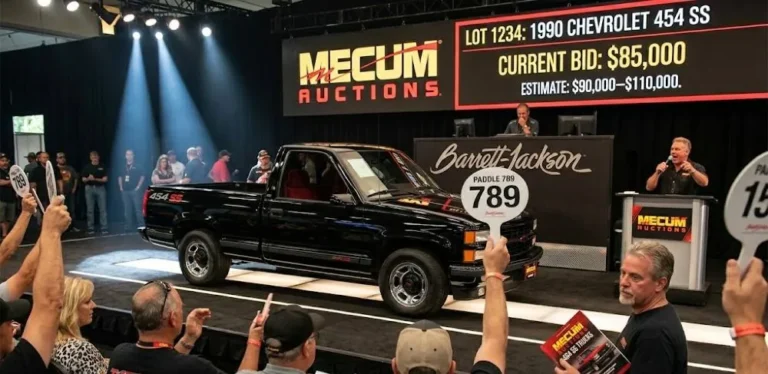
The most paid for a Chevrolet 454 SS was $40,700 for a 1990 model at Mecum’s 2019 Kissimmee Auction — a record that has since been surpassed. A 3,000-mile 1990 pickup sold for $81,400 at Mecum. A 2,000-mile 1990 pickup sold for approximately $43,000 on Bring a Trailer in December 2022. A modified 21,000-mile 1992 in red sold for $49,500 on Barrett-Jackson. A modified 19,000-mile 1993 in red sold for $58,000 on Bring a Trailer.
By comparison, a 1991 Syclone in similar condition is valued at $33,100, while a comparable 1992 Typhoon is valued at $28,400.
Current Value Ranges By Condition
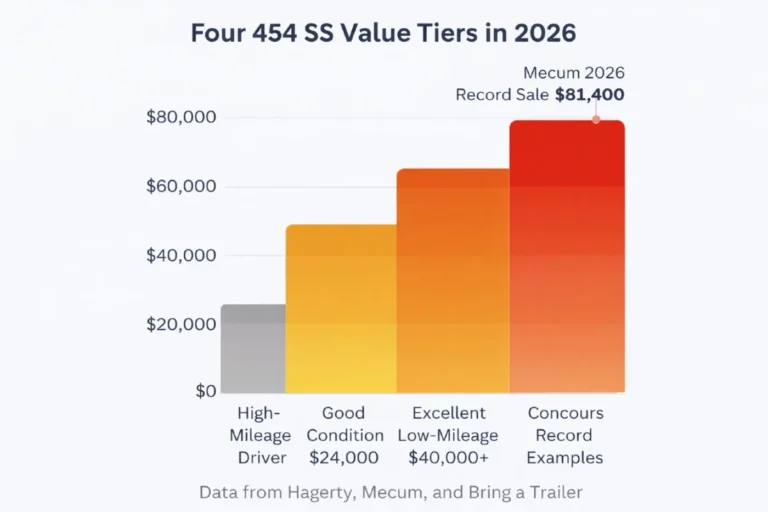
High-mileage drivers and project trucks: $18,000–$25,000. An 83,000-mile 1990 pickup sold for $22,000 at Mecum. These are running, driveable trucks that retain the specific mechanical identity of the 454 SS without commanding the premium of low-mileage collector examples.
Good-condition, mid-mileage examples: $24,000–$40,000. Hagerty estimated a 1990 example in good condition was worth about $24,000 in 2023 — that figure has continued to appreciate. This tier represents the core of the practical 454 SS market: trucks that are correct, maintained, and enjoyable to drive without demanding concours treatment.
Excellent-condition, low-mileage examples: $40,000–$60,000+. The CarBuzz market data shows multiple sales in this range for correctly specified, well-preserved examples. The Bring a Trailer 2,000-mile example at $43,000 anchors the lower end of this tier. Well-preserved examples have recorded sales from the high-teens into the mid-five-figure range at recognized auction houses, with first-year black-on-red trucks and exceptionally low-mileage examples sitting at the sharp end.
Concours and record examples: $60,000–$80,000+. The $81,400 Mecum sale for a 3,000-mile 1990 represents the current documented upper boundary of the 454 SS market. Single-digit mileage, fully documented, never-driven-hard examples in this tier are genuine collector investments that continue to appreciate with time.
Who Is Buying And Why It Matters
Gen-Xers make up 39.5 percent of insurance quotes for this model, and Millennials make up 24.6 percent. Both figures are well above the market average, which is 32.3 percent for Gen-Xers and 21 percent for Millennials, according to Hagerty’s data.
This demographic profile is the key indicator of the 454 SS’s long-term value trajectory. The buyers driving appreciation are not primarily senior collectors in their 60s and 70s who are near the end of their collector car acquisition phase. They are buyers in their 30s, 40s, and early 50s who have personal or cultural connections to early-1990s American trucks and who have reached the financial position to act on those connections. The supply of original 454 SS trucks is fixed. The demand from this demographic is growing. The outcome of that equation continues to be what the auction results reflect.
Like a lot of ’90s cars and trucks, the 454 SS is fairly popular among younger buyers, which is a good sign for collectability in the long-term, according to Hagerty valuation editor Andrew Newton.
Acquiring a 454 SS at current market prices is only the first ownership cost — insuring a collector truck with documented value between $24,000 and $81,000 requires specific agreed-value classic truck coverage that operates very differently from standard auto insurance. Our guide to cheapest truck insurance in 2026 covers how insurance companies price trucks at this level and how to find the most competitive coverage.
FAQ
Q: What years did Chevy make the 454 SS truck?
A: Chevrolet produced the 454 SS truck for four model years: 1990, 1991, 1992, and 1993. The truck was based on the GMT400-generation C1500 regular-cab, short-bed, two-wheel-drive platform. Total production across all four years was approximately 16,953 trucks, with 1990 accounting for roughly 80 percent of the total at approximately 13,748 units.
Q: How much horsepower did the Chevy 454 SS truck have?
A: The 1990 Chevrolet 454 SS truck produced 230 horsepower and 385 lb-ft of torque from its L19 7.4-liter throttle-body-injected big-block V8. For 1991 through 1993, the engine was recalibrated to produce 255 horsepower and 405 lb-ft of torque. The torque output — particularly the 405 lb-ft at 2,400 rpm in the later models — is the more meaningful performance figure for understanding what makes the truck feel the way it does.
Q: How fast was the Chevy 454 SS truck?
A: The 1990 Chevrolet 454 SS ran from 0 to 60 mph in the mid-7-second range, with quarter-mile times in the mid-15-second range at approximately 87 to 88 mph. The 1991–1993 trucks, with the upgraded engine, 4L80-E four-speed automatic, and 4.10 rear axle ratio, improved to the high-6-second range to 60 mph. Top speed was approximately 106 to 110 mph. In the context of 1990 pickup trucks, these were extraordinary numbers for a production vehicle.
Q: What makes a 454 SS truck authentic?
A: All genuine 454 SS trucks will have the RPO code B4U on their SPID label, the L19 engine designation (confirmed by the 8th VIN digit being N), GT4 or GT5 axle ratio code, and typically the G80 locking differential code. All authentic examples are regular cab, short bed, two-wheel-drive C1500s with bucket seats, a center console, and the specific 5-lug 14-bolt rear axle. The large “454 SS” bedside decals are standard, but because they can be added to tribute trucks, decal presence alone does not confirm authenticity. The SPID label is the definitive verification document.
Q: What is a 1990 Chevy 454 SS worth in 2026?
A: A 1990 Chevrolet 454 SS in good condition is currently valued between $24,000 and $40,000 based on Hagerty data and documented recent auction sales. Excellent-condition, low-mileage examples command $40,000 to $60,000. The highest documented sale as of 2026 was $81,400 for a 3,000-mile example at Mecum. High-mileage driver-quality trucks sell in the $18,000 to $25,000 range. All values are for correct, original-specification examples; modified or tribute trucks command different and generally lower prices.
Q: How many 1990 Chevy 454 SS trucks were made?
A: Approximately 13,748 of the 454 SS trucks were built in the first model year of 1990, representing approximately 80 percent of the total production run of roughly 16,953 trucks across all four years. The remaining production was spread across 1991 (approximately 983), 1992 (approximately 1,379), and 1993 (approximately 843). The 1990 trucks are the most commonly encountered in the collector market but also among the most valuable due to their first-year status and original Onyx Black configuration.
Q: What is the difference between the 1990 and 1991 454 SS?
A: The 1991 454 SS brought three significant mechanical improvements over 1990: the engine was upgraded from 230 hp/385 lb-ft to 255 hp/405 lb-ft; the transmission changed from the TH400 three-speed automatic to the 4L80-E four-speed overdrive automatic; and the rear axle ratio shortened from 3.73:1 to 4.10:1. These changes together produce a measurably quicker truck in real-world driving. The 1990 remains more valuable in the collector market due to its first-year status and significantly higher production volume, but the 1991 is the better-performing truck by specification.
The Bottom Line
GM put a 454 big-block in the lightest half-ton they made. The formula was that simple. The result was America’s first muscle truck — a vehicle that created a market segment before the market knew it wanted one, that sold out its first production year before its competitors could respond, and that commands auction prices that would have seemed fictional to the buyer who paid $18,295 for one in 1990.
Only about 17,000 were made. Of those, many have been modified, some have been lost, and the number of unmodified, numbers-correct, documented originals gets smaller every year. The youngest 454 SS truck is now more than 30 years old. The market that is bidding $81,400 for a 3,000-mile example consists primarily of Gen-X and Millennial buyers who are only getting older and only getting more financially capable of expressing what they remember from 1990.
The 454 SS was not the fastest truck of its era. The GMC Syclone arrived the following year and embarrassed it in a straight line. The 454 SS was not technologically complex — a throttle-body-injected 454 is the most straightforward engine architecture available in a modern production vehicle. It was not refined. The fuel economy was single-digit at hard use.
What it was, and what it remains, is the original. The truck that proved the concept. The vehicle that Ford spent three years building an answer to, that Dodge eventually built an answer to, and that every manufacturer has been building answers to for more than three decades without ever quite replicating the specific, simple, honest character of a big-block V8 in the smallest truck available.
Some vehicles are historically significant because they were technically brilliant. The 454 SS is historically significant because the idea was right. The execution was direct. And nobody had done it first.
Editorial Note
This article was written and reviewed in April 2026. All engine specifications are sourced from MotoGallery’s 1990–1993 Chevrolet 454 SS buyer’s guide and GMT Central’s GMT400 deep dive documentation. Production figures — approximately 16,953 total with 13,748 in 1990 — represent the most consistent figures across published sources; exact annual tallies vary slightly across publications. All auction sale prices are cited from their stated sources: the $81,400 Mecum 2026 sale and the $43,000 Bring a Trailer 2022 sale are documented transactions. Hagerty valuation appreciation percentages are from Hagerty’s published media reporting. RPO code authentication guidance is sourced from GMT Central and MotoGallery buyer’s guide research. The original MSRP of $18,295 is confirmed by Hagerty media and Capital One Auto Navigator historical documentation.


1 Comment
Ed Peters · at 9:51 pm
Great write up on the 454. Great truck but…I a Ford fanatic and own a 1st Gen Lightning. Do you have a write up on those, or is there one in the future?