Last Updated: May 4, 2026 | Read Time: 10 minutes
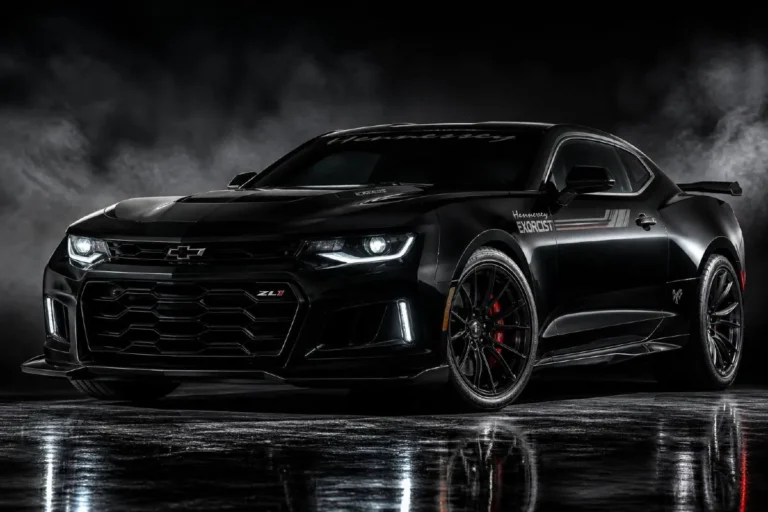
The Hennessey Exorcist is a Chevrolet Camaro ZL1 upgraded by Hennessey Performance Engineering to produce 1,000 horsepower and 966 lb-ft of torque, achieving 0-to-60 mph in 2.1 seconds, a quarter mile in 9.57 seconds at 147 mph, and a top speed of 217 mph. It was purpose-built to outrun the Dodge Challenger SRT Demon. It succeeded. Total production across all editions was 100 cars. The Final Edition of 57 cars, priced at $54,950 over the donor ZL1, concluded the production run in 2023 as a direct response to the Dodge Demon 170. Here is every detail.
The Instant Answer – Camaro Key Facts
– Builder: Hennessey Performance Engineering — Sealy, Texas
– Founded: 1991 — “making fast cars faster”
– Donor Vehicle: Chevrolet Camaro ZL1 (6th generation, Alpha platform, 2017–2024)
– Base Engine (stock ZL1): 6.2-liter supercharged LT4 V8 — 650 hp / 650 lb-ft
– Exorcist Engine Output: 1,000 hp at 6,500 rpm / 966 lb-ft at 4,500 rpm
– Power Increase: 54 percent horsepower gain / 49 percent torque gain over stock
– 0–60 mph: 2.1 seconds (official, dyno-proven)
– Quarter Mile: 9.57 seconds at 147 mph
– Top Speed: 217 mph
– Available Transmissions: 6-speed manual or 10-speed automatic
– Body Styles: Coupe or convertible
– Original Edition (2017): Limited run — launched as Dodge Demon response
– 30th Anniversary Edition (2021): 30 individually numbered cars — $135,000 complete
– Final Edition (2023): 57 cars — commemorating 57 years of Camaro production
– Final Edition Upgrade Price: $54,950 (customer supplies donor ZL1)
– Final Edition Complete Price: Approximately $130,000–$140,000 including donor car
– Warranty: 3-year / 36,000-mile limited warranty (Final Edition)
– Warranty Prior Editions: 2-year / 24,000-mile
– Production Total (all editions combined): 100 cars
– Why “Exorcist”: Created to exorcise the Dodge Demon — its name is the literal counterpart to its rival
– Hennessey’s description: “The epitome of the American Muscle car” — John Hennessey, CEO
Sources: Hennessey Performance Engineering official releases, Motor Authority, Hagerty Media, Autoevolution, HotCars, ConceptCarz
Overview – What The Camaro Exorcist Is And Why It Exists
The Hennessey Exorcist Camaro ZL1 is the most extreme street-legal Camaro ever produced. It is a factory Chevrolet Camaro ZL1 comprehensively re-engineered by Hennessey Performance Engineering of Sealy, Texas, to produce exactly 1,000 horsepower from the stock LT4 6.2-liter supercharged V8. Every Exorcist is dyno-proven, track-tested, street-legal, and warrantied before delivery. Total production across all three editions was 100 cars. The last one was built in 2023.
The Exorcist exists because of a specific event: Dodge announced the Challenger SRT Demon in 2017 — an 840-horsepower drag-racing machine that was, at the time, the most powerful production muscle car ever built. John Hennessey, founder and CEO of Hennessey Performance Engineering, responded by building a Camaro that would outrun it on every metric that mattered. He called it the Exorcist because his car was going to exorcise the Demon.
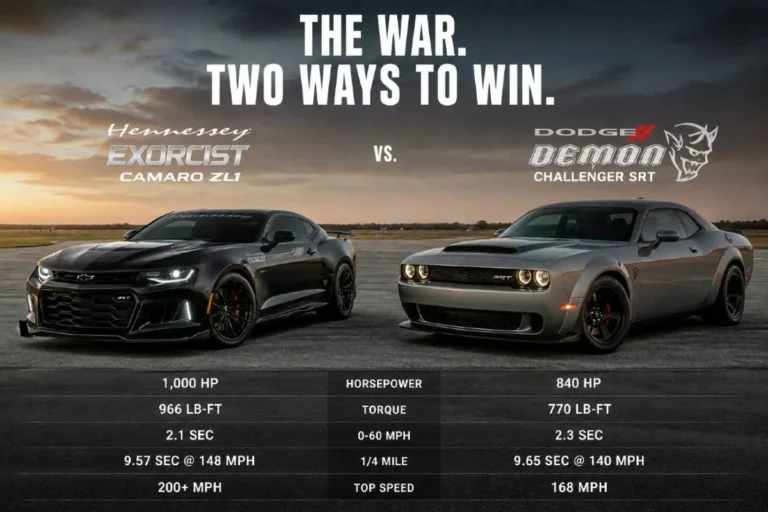
The Exorcist’s 1,000 horsepower against the Demon’s 840 told part of the story. The full story was in the timings: the Exorcist’s 2.1-second 0-to-60, 9.57-second quarter mile, and 217-mph top speed against the Demon’s 3.4-second 0-to-60, 9.65-second quarter mile, and 168-mph top speed. The Exorcist was faster at every distance.
The American brand says that the Exorcist package-equipped Camaro ZL1 can embarrass almost any production car off the line, and we’d agree — a 217-mph top speed and 2.1-second official 0-60 mph time is Dodge Demon fast, thanks to 1,000 hp and 966 lb-ft.
When the Challenger SRT Demon 170 arrived years later with E85-fueled 1,025 horsepower and a 1.66-second 0-to-60 time — genuinely faster — Hennessey responded with the Final Edition Exorcist in 2023, timed to coincide with the end of Camaro ZL1 production. The muscle car war between Texas and Detroit ran from 2017 to 2023. The Exorcist fired the first shot, held the lead for most of the engagement, and exited production with the satisfaction of a vehicle that was already a legend.
With the Camaro discontinued after the 2024 model year and the Exorcist’s production complete, every one of the 100 Exorcist Camaros is now a closed-production collector car. The market has begun to recognize this accordingly.
The LT4 that Hennessey starts with in every Exorcist build is one of the most robust pushrod V8 foundations in American performance car history — an engine whose architecture’s potential is explored at every level from the stock ZL1’s 650 horsepower through the Exorcist’s 1,000. Our complete Corvette Z06 guide covers the naturally aspirated evolution of GM’s performance V8 program, showing how the same engineering family produces both the LT6’s 670 horsepower and the platform that the Exorcist builds from.
Section 1 – The Complete Modification List
What Hennessey’s Engineers Actually Do To Build One
The Exorcist is not a tune. It is not a software update. It is a comprehensive teardown and rebuild of the Camaro ZL1’s entire powertrain, requiring skilled technicians, purpose-designed components, and calibration work that takes weeks from donor delivery to final dyno validation.
Understanding what the Exorcist actually is — at the parts and engineering level — separates it from the surface-level upgrades that many tuners produce and explains why a $54,950 modification price is appropriate rather than aggressive.
Hennessey’s expert technicians, who have been making fast cars faster for more than 32 years, fit the Camaro’s LT4 V8 with a comprehensive upgrade package that begins with the supercharger. The key components of the Exorcist build are:
The Supercharger Upgrade: 14 PSI And The Primary Power Source
The stock Camaro ZL1’s Eaton R1740 TVS supercharger is replaced with a larger, higher-flowing unit operating at increased boost pressure — 14 psi versus the stock unit’s output. More boost means more air forced into the combustion chambers per cycle. More air means more fuel can be burned. More fuel burned correctly means more power. The supercharger upgrade is the single most significant component change in the Exorcist build and the primary driver of the power increase.
The High-Flow Air Induction System
A high-flow air induction system replaces the factory airbox and intake routing, reducing intake restriction and feeding the upgraded supercharger with the volume of air it requires to operate efficiently at elevated boost levels. Intake restriction at the inlet side of a supercharger directly limits peak output — the Exorcist’s induction system removes that limitation.
The Cylinder Head Work: Porting, Camshaft, And Breathing Freely
The cylinder heads are ported — a labor-intensive machining process that improves airflow through the intake and exhaust ports by removing casting imperfections and optimizing port shape and volume. Ported heads allow the engine to breathe more freely at high rpm, where the factory heads’ airflow characteristics become the limiting factor in power production. Custom HPE camshafts replace the factory units, providing a valve timing profile optimized for the Exorcist’s elevated supercharger output and power targets.
The Complete Valvetrain Rebuild
The intake valves, exhaust valves, valve springs, retainers, lifters, and pushrods are all replaced with upgraded components calibrated to operate reliably at the Exorcist’s power level and rev range. Stock valvetrain components are sized for the factory engine’s 650-horsepower output. At 1,000 horsepower, the forces acting on every valvetrain component are substantially higher, and using factory-specification components at this power level introduces reliability risks that Hennessey eliminates by replacing the entire assembly.
The Fuel System Upgrades: Injectors And High-Flow Pump
The auxiliary fuel system is upgraded, including the fuel injectors and fuel pump. At 1,000 horsepower, the engine’s fuel demand at wide-open throttle substantially exceeds the stock injectors’ flow capacity. Upgraded injectors with higher flow rates and a high-flow fuel pump that maintains adequate fuel pressure at maximum demand ensure the engine is always fed with the fuel it needs, even under the most extreme conditions.
Long-Tube Headers And High-Flow Exhaust
Long-tube stainless steel headers replace the factory exhaust manifolds, reducing exhaust back-pressure that limits high-rpm power production. High-flow catalytic converters maintain emissions compliance while reducing restriction beyond what the factory units allow. The exhaust note of the Exorcist — distinctive and specifically different from the stock ZL1 — is partly a consequence of the free-flowing header design.
The Oversized Heat Exchanger
An oversized heat exchanger is fitted to manage the additional heat generated by the elevated boost pressure and power output. Supercharged engines generate substantial heat in the charge air between the supercharger and the intake manifold. Charge air heat reduces density — less dense air means less oxygen per charge — and directly reduces power output. The Exorcist’s heat exchanger maintains charge air temperature to preserve consistent power delivery, lap after lap.
HPE Engine Management Software: The Calibration That Makes It All Work
Following years of R&D and refinement, the Exorcist Final Edition is calibrated with a finely tuned HPE Engine Management software upgrade. The factory ECU calibration is replaced with Hennessey’s proprietary calibration that manages fuel delivery, ignition timing, boost pressure, and all engine management functions for the modified engine’s specific requirements. Custom calibration is not a secondary step — it is the integration process that makes all the hardware upgrades work together correctly.
The result of all these modifications: 1,000 horsepower at 6,500 rpm and 966 lb-ft of torque at 4,500 rpm. That is a 54 percent increase in power and a 49 percent boost in torque over the stock ZL1’s 650 hp / 650 lb-ft. Every Exorcist is dyno-proven before delivery. The certificate showing the specific power output of the specific car accompanies it.
Section 2 – The Editions
Three Production Runs, 100 Cars Total, One Legacy
The Exorcist was not a single production run. It was three distinct editions across six years, each responding to a specific moment in the Camaro’s lifecycle or Hennessey’s own history.
The Original Exorcist (2017–2018): The Demon Slayer
The original Exorcist was announced in 2017 on the Camaro’s sixth-generation Alpha platform, created by Hennessey to slay the Dodge Demon — a reference to the rival supercharged Challenger whose 840 hp output paled in comparison to Hennessey’s 1,000 hp Exorcist.
The announcement came with a direct challenge: the Dodge Challenger SRT Demon had been marketed as the world’s fastest production muscle car. John Hennessey’s response was immediate and specific. He built a car that was faster at every benchmark — a car whose name was the literal adversarial counterpart to the car it was built to defeat.
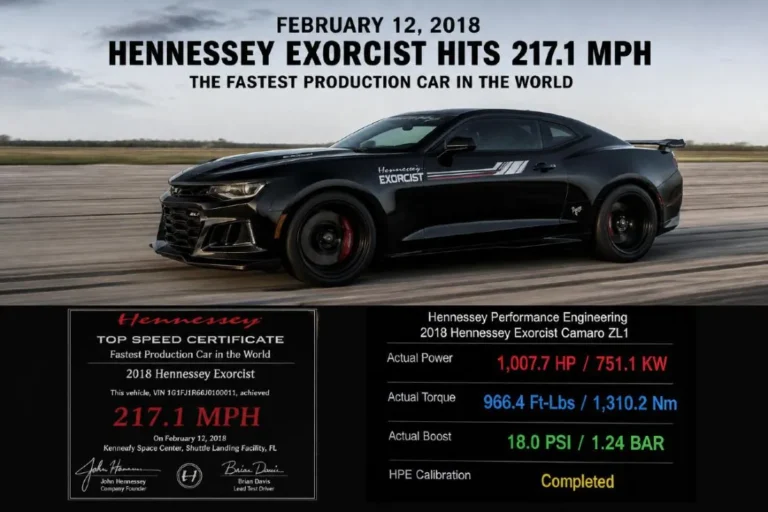
On February 12, 2018, professional driver and director of the Ford Performance Driving School, Brian Smith, piloted the Exorcist to validate its performance claims. The car’s 217-mph top speed eclipsed the Dodge Demon’s 168-mph maximum, making the Exorcist the world’s fastest muscle car at the time — surpassing even the then-current Corvette ZR1’s 213-mph top speed.
The original production run was limited. Available in coupe or convertible body style with either a 6-speed manual or 10-speed automatic transmission, the original Exorcist established the technical specification and performance benchmark that all subsequent editions would maintain.
The 30th Anniversary Edition (2021): Celebrating Three Decades
In 2021, Hennessey Performance Engineering turned 30. To mark three decades of making fast cars faster — the company was founded in 1991 — John Hennessey announced the 30th Anniversary Exorcist as the final 30 cars of a planned 100-car production run.
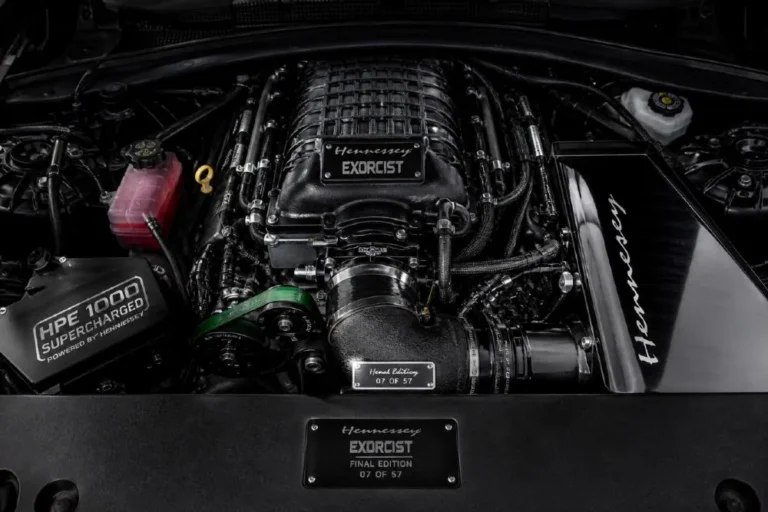
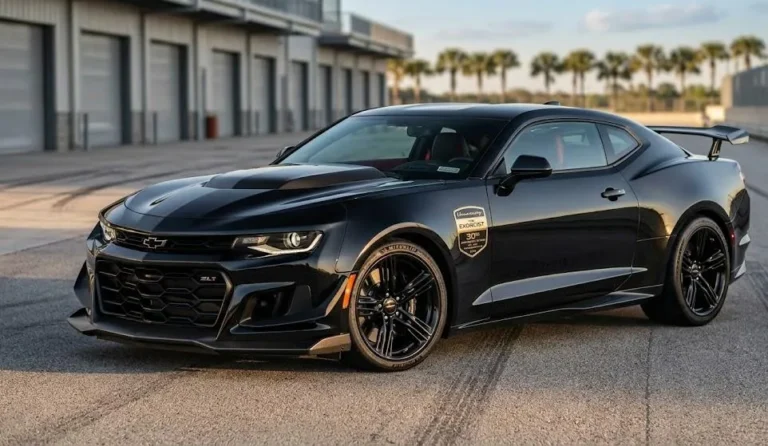
The Exorcist Anniversary Edition celebrates 30 years of Hennessey Performance Engineering, with a special limited edition run of 30 Exorcist models completing Hennessey’s 100-car build. Each Hennessey Exorcist 30th Anniversary Camaro featured an anniversary logo on the car’s front flanks, set behind each front wheel, alongside a uniquely numbered build plaque under the hood.
Performance specifications remained identical to the original: 1,000 hp, 966 lb-ft, 2.1-second 0-to-60, 9.57-second quarter mile, 217-mph top speed. The 30th Anniversary cars were priced at $135,000 complete including the donor Camaro ZL1.
John Hennessey: “The Exorcist is the epitome of the American Muscle car and has the off-the-line performance to embarrass almost any car on the planet. We’ve been making fast cars faster since 1991, so our 30th Anniversary Exorcist pools all we know into one ferocious supercar slayer.”
Available in coupe or convertible, with manual or automatic transmission, the 30th Anniversary Edition was the intended conclusion to the Exorcist story. Then the Demon 170 arrived.
The Final Edition (2023): The Last Word
When Dodge announced the Challenger SRT Demon 170 with E85-fueled 1,025 horsepower — eclipsing the Exorcist’s 1,000 hp — and when Chevrolet announced the discontinuation of the Camaro ZL1 after the 2024 model year, Hennessey responded with the Exorcist Final Edition.
Hennessey Performance, the world-renowned Texas-based hypercar manufacturer and high-performance vehicle creator, announced an end-of-production limited Final Edition series of the company’s famed Exorcist Camaro ZL1 upgrades. Production was limited to exactly 57 examples — commemorating 57 years since the iconic Camaro first entered production.
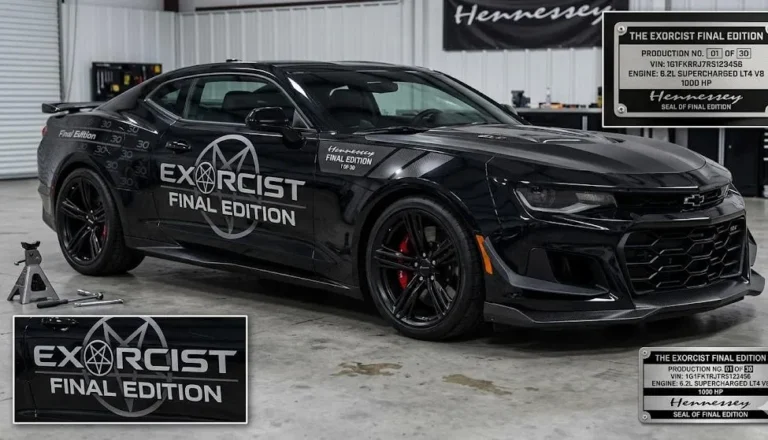
Each Final Edition engine received a unique serial-numbered engine bay plaque reading “Final Edition X of 57,” with specific Exorcist Final Edition graphics on the exterior. The upgrade was priced at $54,950, with customers supplying their own Camaro ZL1 donor vehicles.
The Final Edition’s performance specifications — 1,000 hp, 966 lb-ft, 2.1-second 0-to-60, 9.57-second quarter mile, 217-mph top speed — were identical to the original. The Final Edition was backed by Hennessey’s comprehensive 3-year / 36,000-mile limited warranty, an upgrade from the previous 2-year / 24,000-mile coverage.
John Hennessey: “Our comprehensive upgrade to the Camaro ZL1 is one of my all-time favorites. The chassis, suspension, and powerplant work seamlessly together, so all the driver experiences is raw, unbridled horsepower. There’s nothing else like our Exorcist, so we’re eager to share this special limited edition with fans of this iconic car before it’s gone forever.”
The Final Edition completed the Exorcist production run at exactly 100 cars across all three editions. Production is now permanently closed.
Section 3 – The Performance Numbers In Context
What 1,000 HP Actually Means At Every Distance
The Exorcist’s performance specifications are not marketing estimates. They are measured, independently validated figures from documented runs. Understanding them in context — against the vehicles they compete with and against the physics of what 1,000 horsepower in a sub-4,000-pound car actually produces — is the most honest way to communicate what the Exorcist delivers.
Zero To 60 MPH: 2.1 Seconds
The Exorcist reaches 60 mph in 2.1 seconds. This figure places it in the company of vehicles that cost three, five, and ten times as much. A Bugatti Chiron — at approximately $3 million — reaches 60 mph in approximately 2.3 seconds. A Lamborghini Huracán Performante — at approximately $300,000 — runs to 60 mph in approximately 2.5 seconds. The Exorcist, starting at approximately $130,000 complete, runs to 60 mph in 2.1 seconds in a Camaro body that seats four people and can drive to work on Monday.
The 2.1-second time is achieved with the launch control system active, on appropriate surfaces, with an experienced driver. In normal street driving, the Exorcist’s launch behavior requires more driver discipline than the managed launch control scenario provides. The power is real in either case — the 2.1-second figure represents the car’s capability under optimal conditions.
Quarter Mile: 9.57 Seconds At 147 MPH
The 9.57-second quarter mile at 147 mph is the Exorcist’s most significant benchmark against its rivals. Sub-10-second quarter miles from street-legal vehicles are genuinely rare — requiring the combination of sufficient power, appropriate weight management, a capable drivetrain, and tires that can manage the power delivery without excessive wheelspin consuming the available acceleration.
The Exorcist’s 147-mph trap speed indicates that the car is still deep in its powerband at the quarter-mile marker — it has not reached its performance ceiling at 1,320 feet. The combination of trap speed and elapsed time confirms that the 1,000 hp is being used effectively across the entire quarter-mile distance rather than just at launch.
Top Speed: 217 MPH
The Exorcist’s 217-mph top speed was recorded at a Texas airstrip and exceeded the then-current Corvette ZR1’s 213-mph record for the fastest American production-derived car. It also exceeded the Dodge Demon’s 168-mph top speed by 49 mph — a margin that communicates the fundamental difference between a drag-optimized car and a true top-speed machine.
217 mph requires not just engine power but aerodynamic stability, structural rigidity, and tire capability at extreme speed. The Exorcist’s top-speed record is a testament to the complete engineering package — not just the engine output, but the chassis’s ability to remain stable and controllable at nearly triple the US highway speed limit.
The Exorcist’s 217-mph top speed was recorded at a Texas airstrip on February 12, 2018 — eclipsing the then-current Corvette ZR1’s 213-mph American speed record. Our complete comparison of the Corvette ZR1 vs Camaro ZL1 covers both cars’ performance benchmarks in full detail, including how the modern ZR1’s 1,064 horsepower relates to the Exorcist’s place in the American performance hierarchy.
Against The Dodge Demon And Demon 170
The original Dodge Challenger SRT Demon produced 840 hp in regular configuration and ran the quarter mile in 9.65 seconds with a 0-to-60 time of 3.4 seconds and a top speed of 168 mph. The Exorcist’s 1,000 hp, 9.57-second quarter mile, 2.1-second 0-to-60, and 217-mph top speed were superior on every metric.
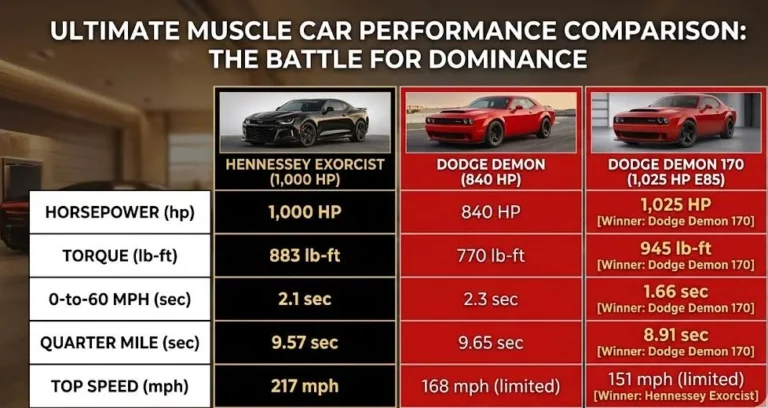
The Dodge Challenger SRT Demon 170 with E85 fuel reached 1,025 hp, ran 0-to-60 in 1.66 seconds, and completed the quarter mile in 8.91 seconds at 151 mph. This represented a genuine advancement in drag racing capability — the Demon 170 is measurably faster in straight-line drag racing scenarios. However, the Demon 170’s 168-mph top speed against the Exorcist’s 217 mph shows that the Demon 170 is a specialized drag car while the Exorcist is a complete performance machine. The Exorcist is faster at every distance beyond the quarter mile.
John Hennessey called the Exorcist “a ferocious supercar slayer” — and against its intended rival, the record confirms it.
Section 4 – The Exorcist As A Driving Experience
What It Actually Feels Like To Drive One
The Exorcist is not a car you approach casually. Every journalist who has spent time in one reaches for the same word: violent. Not in a frightening way — in the way that a car with 1,000 horsepower and a supercharger that sounds like nothing else on the road produces a visceral experience that demands full attention and complete respect.
At idle, the Exorcist sits with a menacing rumble — the supercharger whine audible even at low throttle, the exhaust note deeper and more complex than the stock ZL1’s already impressive sound. The interior is unchanged from the stock Camaro ZL1 — the Exorcist is a powertrain upgrade, not an interior renovation — which means that the contrast between the familiar, capable Camaro cabin and the extraordinary capability available from a quarter-throttle press is part of the experience.
Hennessey meticulously calibrates the engine management system to ensure that all 1,000 horses are harnessed effectively, delivering power smoothly and predictably. This calibration work is what separates a professionally built upgrade from a dangerous one. The Exorcist does not surprise the driver with unpredictable power delivery. The power is always there, always available, always predictable in its application — which is precisely what makes an honest assessment of its capability possible without the car becoming genuinely dangerous in competent hands.
The transmission choice matters significantly to the driving experience. The 6-speed manual provides the engagement and character that makes the Exorcist feel like a driver’s car — the interaction between the supercharged V8’s torque characteristics and a skilled driver’s clutch and shift technique is one of the most involving driving experiences available in any American car at any price. The 10-speed automatic provides a different experience: faster gear changes, better launch consistency, and a more manageable power delivery in tight situations. Both are correct for different drivers.
The chassis — the Camaro ZL1’s Alpha platform with its Magnetic Ride Control 4.0 dampers, Brembo brakes, and electronically controlled limited-slip differential — was not significantly altered in the Exorcist build. This was a deliberate choice. The ZL1 1LE’s 7:16 Nürburgring lap time confirmed that the chassis could handle significantly more power than the factory 650 horsepower in a track environment. At 1,000 horsepower, the chassis requires more from the driver than the factory specification does — particularly in cornering situations where the rear tires are managing both lateral forces and the Exorcist’s massive torque output simultaneously. But the chassis is not overwhelmed. It is, as John Hennessey noted, working seamlessly with the powerplant rather than against it.
Section 5 – The Exorcist vs. The Competition
How It Compared To Every Significant Rival
The Exorcist’s primary competitive context is the Dodge Challenger SRT Demon and its successor, the Demon 170. But in the broader American and global performance car landscape, the Exorcist’s 217-mph, 9.57-second capability placed it in specific and significant company.
Against The Dodge Demon 840 HP
Exorcist wins: Horsepower (1,000 vs 840), torque (966 lb-ft vs 770 lb-ft), top speed (217 vs 168 mph), quarter-mile elapsed time (9.57 vs 9.65 seconds), 0-to-60 (2.1 vs 3.4 seconds). On every performance metric, the Exorcist was definitively faster and more powerful. This was the specific purpose of the car’s creation and it was achieved completely.
Against The Dodge Demon 170 – 1,025 HP E85
The Demon 170 on E85 achieved 1,025 hp, a 1.66-second 0-to-60, and an 8.91-second quarter mile at 151 mph. On drag strip metrics — the Demon 170’s specifically optimized purpose — it is faster than the Exorcist. The Exorcist counters with 217-mph top speed versus the Demon 170’s 168 mph, confirming that the Exorcist is a broader performance car while the Demon 170 is a specialized drag racing machine. John Hennessey noted this distinction explicitly: the Exorcist is tuned for the racing circuit and day-to-day driving, not exclusively for the drag strip.
Against The Corvette ZR1 And European Hypercars
At 217 mph, the Exorcist exceeded the 2019 Corvette ZR1’s 213-mph top speed, making it briefly the fastest American production-derived car. Against European hypercars, the Exorcist’s 2.1-second 0-to-60 outpaces the Lamborghini Huracán Performante, matches the McLaren 720S, and approaches the Bugatti Chiron’s performance territory at a fraction of the cost. Hennessey has used the phrase “supercar slayer” in every edition’s marketing material — and the performance data supports the description.
Against Its Own Donor Car
The Exorcist’s 1,000 hp represents a 54 percent power increase over the Camaro ZL1’s 650 hp. The 966 lb-ft represents a 49 percent torque increase. Every performance metric improved by approximately the same margin: the quarter mile improved from 11.3 seconds (stock ZL1) to 9.57 seconds, the 0-to-60 dropped from 3.5 seconds to 2.1 seconds, and the top speed increased from 198 mph to 217 mph. The transformation is complete — not incremental.
The Exorcist occupied the apex of American muscle car performance from 2018 through 2023 — above the Ford Mustang GTD, above the Shelby GT500, and above every factory Ford performance vehicle produced in that period. Our guide to the fastest Ford muscle cars in 2026 covers the full lineage of Ford’s performance engineering from the Boss 302 through the 815-horsepower GTD — the cars the Exorcist’s 217-mph top speed was leaving behind.
Section 6 – The Hennessey Context
Who Builds The Exorcist And Why Their Credentials Matter
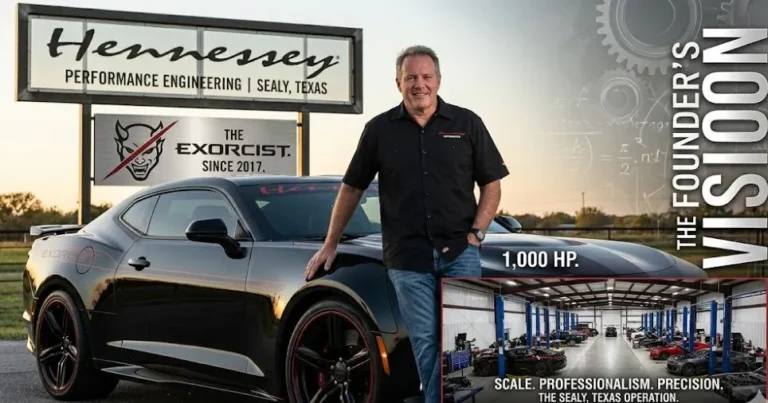
The Hennessey Exorcist is built by Hennessey Performance Engineering, based in Sealy, Texas — approximately 40 miles west of Houston. Founded by John Hennessey in 1991, the company has re-engineered more than 12,000 vehicles for performance enthusiasts from around the world to deliver unparalleled driving thrills.
Hennessey’s credential for building the Exorcist is not theoretical. The company’s portfolio spans the Venom GT — which set a world speed record of 270.49 mph in 2014 — and the Venom F5, which targets 300 mph as a purpose-built hypercar. The engineering capability required to build a 300-mph hypercar is categorically more demanding than the capability required to upgrade a Camaro ZL1 to 1,000 horsepower. The Exorcist is, in Hennessey’s broader context, a relatively accessible application of engineering expertise that extends to the absolute limits of automotive performance.
The Hennessey business comprises Hennessey Special Vehicles, Hennessey Performance (HPE), Tuner School, and the Lonestar Motorsports Park — a company structure that integrates vehicle modification, driver education, and performance testing in the same organization. Every Exorcist was dyno-proven at Hennessey’s facility before delivery. Every Exorcist was track-tested. Every Exorcist left Sealy, Texas, with its specific power output documented and warrantied.
The Exorcist’s warranty — 3 years / 36,000 miles on the Final Edition — is the most significant credential in the modified car space. A warranty on a 1,000-horsepower modification means the builder is confident enough in their engineering to underwrite its reliability in writing. This is not a common offering in the high-performance modification market, where most tuners disclaim warranty coverage on any modified vehicle.
Section 7 – The Collector Market
What An Exorcist Is Worth Today And Where The Market Is Heading
The Hennessey Exorcist Camaro ZL1 is a closed-production collector car. Every edition — the original, the 30th Anniversary, and the Final Edition — is complete. No new Exorcist Camaros will be built because the Camaro ZL1, the required donor vehicle, was discontinued after the 2024 model year. The supply of original Exorcist cars is fixed, documented, and finite.
100 cars total. Every one individually numbered. Every one with a documented build record from Hennessey Performance. In collector car terms, this is the ideal situation for value appreciation: a small, documented, authenticated population of cars with specific historical significance and a production story that cannot be repeated.
Current Market Position
The Exorcist market is moving from modified car territory into genuine collector car territory — a transition that the Camaro ZL1’s discontinuation after 2024 accelerated. A car that was once “a modified Camaro” is now “a closed-production limited edition from a documented builder in a discontinued donor vehicle.” These are not the same market category.
Final Edition cars — 57 units, individually numbered, with the serial-numbered engine plaque and Final Edition graphics — represent the cleanest collector proposition because their documentation is most complete and their production story is most specific. The $54,950 upgrade price over the donor ZL1 established a cost basis of approximately $130,000 to $140,000 for a complete Final Edition. Clean examples with documented Hennessey build records and low mileage are already trading at or above original cost.
30th Anniversary Edition cars — 30 units, celebrating Hennessey’s 30 years, complete cars at $135,000 — have the additional collector appeal of the anniversary context and the specific exterior anniversary logos that distinguish them from standard Exorcist production.
Original Exorcist cars from the 2017 and 2018 production runs — the ones that first set the 217-mph record and established the car’s legend — occupy the position of first-edition historical significance. These are the cars that started the muscle car war with the Dodge Demon, and their place in American performance car history is documented and permanent.
The Exorcist’s collector trajectory — 100 cars, production permanently closed, values at or above original cost — follows the same pattern as other American performance icons whose significance the market recognized only after production ended. Our complete Dodge Viper guide covers five generations of the most directly comparable American performance car story: extreme capability, limited production, and a collector market that consistently outperforms its initial valuation.
Authentication
Authentication of an Exorcist is straightforward compared to many collector vehicles because Hennessey’s build records are maintained and accessible. Every Exorcist has a unique build number. Every Final Edition has a serial-numbered engine bay plaque reading “Final Edition X of 57.” The HPE Engine Management software calibration and all hardware upgrades are documented. Buyers should request the original Hennessey build documentation, the dyno sheet showing the specific car’s power output, and the warranty documentation that accompanied delivery.
A claimed Exorcist without Hennessey documentation is not an Exorcist. It is a Camaro ZL1 with similar parts. The distinction is commercially significant and should be confirmed before any transaction.
FAQ
Q: What is the Hennessey Exorcist Camaro?
A: The Hennessey Exorcist Camaro ZL1 is a Chevrolet Camaro ZL1 comprehensively upgraded by Hennessey Performance Engineering of Sealy, Texas, to produce 1,000 horsepower and 966 lb-ft of torque from the stock 6.2-liter supercharged LT4 V8 engine. It achieves 0-to-60 mph in 2.1 seconds, a quarter mile in 9.57 seconds at 147 mph, and a top speed of 217 mph. It was created in 2017 to outperform the Dodge Challenger SRT Demon. Total production across all three editions — the original, the 30th Anniversary, and the Final Edition — was exactly 100 cars. Production is now permanently closed.
Q: How much horsepower does the Exorcist Camaro have?
A: The Hennessey Exorcist Camaro ZL1 produces 1,000 horsepower at 6,500 rpm and 966 lb-ft of torque at 4,500 rpm. This represents a 54 percent increase in power and a 49 percent increase in torque over the stock Chevrolet Camaro ZL1’s 650 hp and 650 lb-ft. The power is achieved through a comprehensive upgrade of the LT4 6.2-liter supercharged V8, including a larger high-flow supercharger operating at 14 psi boost pressure, ported cylinder heads, a custom HPE camshaft, upgraded valvetrain components, long-tube headers, upgraded fuel system, an oversized heat exchanger, and custom HPE engine management software calibration.
Q: How fast is the Hennessey Exorcist Camaro?
A: The Hennessey Exorcist Camaro reaches 60 mph in 2.1 seconds, completes the quarter mile in 9.57 seconds at a trap speed of 147 mph, and achieves a top speed of 217 mph. The 217-mph top speed exceeded the then-current 2019 Corvette ZR1’s 213-mph record when it was recorded, making the Exorcist the fastest American production-derived car at that time. All performance figures are official, dyno-proven, and documented by Hennessey Performance Engineering.
Q: How much does the Hennessey Exorcist Camaro cost?
A: The Hennessey Exorcist Final Edition upgrade was priced at $54,950, with the customer supplying their own Camaro ZL1 donor vehicle. The 30th Anniversary Edition was priced at $135,000 as a complete vehicle including the donor ZL1. A complete Final Edition car — upgrade plus a donor ZL1 purchased at market price — cost approximately $130,000 to $140,000 at time of production. Used collector market, clean, low-mileage, fully documented examples are trading at or above their original cost, reflecting the car’s closed-production status and the Camaro ZL1’s discontinuation.
Q: How many Hennessey Exorcist Camaros were made?
A: Exactly 100 Hennessey Exorcist Camaros were built across three editions. The original edition launched in 2017, the 30th Anniversary Edition produced 30 individually numbered cars in 2021, and the Final Edition produced 57 individually numbered cars in 2023 — the number 57 commemorating 57 years since the Camaro first entered production. Each Final Edition car bears a unique serial-numbered engine bay plaque reading “Final Edition X of 57.” Total production is permanently closed.
Q: Why is it called the Exorcist Camaro?
A: The Hennessey Exorcist Camaro is named the Exorcist because it was specifically created to defeat — to exorcise — the Dodge Challenger SRT Demon. When Dodge announced the SRT Demon in 2017 as the world’s most powerful production muscle car with 840 horsepower, John Hennessey responded by building a 1,000-horsepower Camaro whose name was the literal adversarial counterpart to its rival. The Exorcist outperformed the Demon on every benchmark: more horsepower, more torque, faster 0-to-60, faster quarter mile, and dramatically higher top speed (217 vs 168 mph).
Q: What modifications does the Hennessey Exorcist have?
A: The Exorcist Camaro’s modifications include: a larger high-flow supercharger upgrade raising boost to 14 psi, a high-flow air induction system, ported cylinder heads, a custom HPE camshaft, upgraded intake valves, exhaust valves, valve springs, retainers, lifters, and pushrods, an upgraded auxiliary fuel system with higher-flow injectors and fuel pump, long-tube stainless steel headers, high-flow catalytic converters, an oversized heat exchanger for cooling, and custom HPE engine management software calibration. All upgrades are dyno-proven and track-tested before delivery.
Q: Is the Exorcist Camaro street legal?
A: Yes. The Hennessey Exorcist Camaro ZL1 is street-legal in the United States. Hennessey specifically states that every product they produce is dyno-proven, fully track-tested, street-legal, and warrantied. The Exorcist retains the Camaro ZL1’s full factory safety and emissions equipment, passes emissions testing, and is registered and insured as a standard passenger vehicle. It is also backed by a factory-style warranty — 3 years / 36,000 miles on the Final Edition.
Q: Can you still buy a new Hennessey Exorcist Camaro?
A: No. The Hennessey Exorcist Camaro is no longer available new. Production of all three editions — totaling exactly 100 cars — is permanently complete. The Final Edition was announced in October 2023 and production concluded with the 57th unit. The Chevrolet Camaro ZL1, which served as the required donor vehicle for all Exorcist builds, was discontinued after the 2024 model year. No new Exorcist production is possible without a donor ZL1, and no new ZL1s are being produced. Any Exorcist available is a pre-owned collector car from the original 100-unit production run.
The Bottom Line
The Hennessey Exorcist Camaro ZL1 is exactly what John Hennessey said it was: the epitome of the American muscle car. It was built to do one thing — outrun the Dodge Demon — and it did it completely on its first attempt in 2017. It ran 217 mph when the Demon could do 168. It ran the quarter mile in 9.57 seconds when the Demon needed 9.65. It produced 1,000 horsepower when the Demon made 840.
The Demon 170 eventually narrowed that gap on the drag strip. The Exorcist never lost the top-speed record and never conceded the claim to being the broader performance machine. The Final Edition, built in 57 cars as the Camaro ZL1 ended production and the Demon 170 arrived, was Hennessey’s exit from a six-year muscle car war — not a retreat, but a completed campaign.
The Exorcist is finished as a production vehicle and beginning as a collector car. One hundred cars. Every one numbered. Every one documented. Every one built by the same company that builds 300-mph hypercars, warrantied the same way, and validated on the same dyno. The Camaro ZL1 is discontinued. The Exorcist will not be built again.
The market will figure out what that means on its own timeline. The physics already figured it out on February 12, 2018, at 217 miles per hour in Texas.
Summary Block
The Hennessey Exorcist is a Chevrolet Camaro ZL1 upgraded by Hennessey Performance Engineering (Sealy, Texas) to 1,000 horsepower and 966 lb-ft of torque from the 6.2-liter LT4 supercharged V8. Key modifications include a larger supercharger at 14 psi boost, ported cylinder heads, custom camshaft, upgraded valvetrain, long-tube headers, upgraded fuel system, oversized heat exchanger, and custom HPE engine management software.
Performance: 0-to-60 mph in 2.1 seconds, quarter mile in 9.57 seconds at 147 mph, top speed of 217 mph. Total production: exactly 100 cars across three editions — original (2017), 30th Anniversary (30 cars, 2021, $135,000 complete), and Final Edition (57 cars, 2023, $54,950 upgrade plus donor ZL1). The Final Edition commemorated 57 years of Camaro production.
The Exorcist was created specifically to outperform the Dodge Challenger SRT Demon. It is street-legal, dyno-proven, and warrantied (3 years / 36,000 miles, Final Edition). Production is permanently closed as the Camaro ZL1 was discontinued after 2024. All Exorcist examples are closed-production collector cars.
Editorial Note
This article was written and reviewed in May. All performance specifications — 1,000 hp, 966 lb-ft, 2.1-second 0-to-60, 9.57-second quarter mile, 147-mph trap speed, 217-mph top speed — are sourced from Hennessey Performance Engineering’s official press releases and confirmed by Motor Authority (February 2018 top speed record), Motor Authority (Final Edition announcement, October 12, 2023), Hagerty Media (Final Edition coverage, October 13, 2023), and ConceptCarz (Final Edition specifications).
The Final Edition production figure of 57 cars and upgrade price of $54,950 are confirmed by Motor Authority and Hennessey’s official release. The 30th Anniversary Edition price of $135,000 and production of 30 cars completing the 100-car run are confirmed by Motor Authority and Hennessey’s official release. John Hennessey quotes are sourced from official Hennessey press materials as published by Motor Authority and ConceptCarz.
The Dodge Demon 170 specifications (1,025 hp E85, 1.66-second 0-to-60, 8.91-second quarter mile) are sourced from Autoevolution. The Camaro ZL1 discontinuation after 2024 is confirmed by Autoevolution and multiple sources. Collector market observations are editorial assessments based on current market conditions.
Specifications
Engine Specifications
| Engine Architecture | 6.2-liter supercharged LT4 pushrod V8 |
| Supercharger Type | High-flow roots-type, Hennessey upgraded |
| Supercharger Boost | 14 PSI (upgraded) |
| Horsepower | 1,000 HP at 6,500 RPM |
| Torque | 966 lb-ft at 4,500 RPM |
| Cylinder Heads | Ported (HPE modification) |
| Camshaft | Custom HPE camshaft |
| Valvetrain | Fully rebuilt — intake/exhaust valves, springs, retainers, lifters, pushrods |
| Fuel System | Upgraded — high-flow injectors, high-flow fuel pump, aux fuel system |
| Exhaust | Long-tube stainless steel headers, high-flow catalytic converters |
| Heat Management | Oversized heat exchanger |
| Engine Management | Custom HPE ECU calibration software |
Performance Metrics
| 0–60 MPH | 2.1 seconds |
| 0–100 MPH | Sub-5 seconds (estimated from track testing) |
| Quarter Mile | 9.57 seconds |
| Quarter Mile Speed | 147 MPH trap speed |
| Top Speed | 217 MPH (recorded Feb 12, 2018) |
| Power-to-Weight | Approximately 1 HP per 3.7 lbs (est. 3,700 lb curb weight) |
| Braking | Factory Brembo six-piston front, four-piston rear |
| Chassis | ZL1 Alpha platform, Magnetic Ride Control 4.0 (unmodified) |
Production Specifications
| Donor Vehicle | Chevrolet Camaro ZL1 (6th generation) |
| Available Bodies | Coupe, Convertible |
| Available Trans | 6-speed manual (Tremec), 10-speed automatic |
| Total Production | 100 units (all editions) |
| Production Dates | 2017 (Original) / 2021 (30th Anniv.) / 2023 (Final Edition) |
| Build Location | Hennessey Performance Engineering, Sealy, Texas |
Pricing
| Original Upgrade | Approximately $50,000–$55,000 over donor ZL1 |
| 30th Anniversary | $135,000 complete (including donor ZL1) |
| Final Edition Upgrade | $54,950 over donor ZL1 |
| Final Edition Complete | Approximately $130,000–$140,000 |
Warranty
| Final Edition | 3-year / 36,000-mile limited warranty |
| Previous Editions | 2-year / 24,000-mile limited warranty |
Sources: Hennessey Performance Engineering official releases; Motor Authority (Oct 12, 2023); Hagerty Media (Oct 13, 2023); ConceptCarz (Oct 11, 2023)